
Philippa Gregory
This is a new sort of book for me; a collection, written by myself and two other historians, of three short ‘lives’ of three extraordinary women: Jacquetta Duchess of Bedford, Margaret Beaufort, and Elizabeth Woodville. This book came about because so many readers ask me for the ‘true’ stories on which I base my novels, and there is nothing readily available for these three: The Lady of the Rivers (2011), The Red Queen (2010), and The White Queen (2009). The existing biographies of Margaret Beaufort and Elizabeth Woodville were out of print when I started my research, and so I worked from rare second-hand copies. I invited the authors, David Baldwin and Michael Jones, to each write a short essay on their subject for us to jointly publish here.
There was no biography at all of Jacquetta, and I realised that if I wanted to find out about her life I would have to do my own original research from the early documents, and trace the brief references to her that occur throughout other histories. As a woman who was present at many great events, and a kinswoman of both royal houses of England, she is often mentioned in the histories of her time; but her story has never before been told. To trace her life I had to read accounts of the lives of her contemporaries and of her times, forever looking out for a reference to her, her husbands or her family. This way I have managed to trace her from her childhood in English-held France, to her family home of Luxembourg, through her first marriage into the royal House of Lancaster, into her second marriage, when she lived at the royal courts of Lancaster and York and to her country house in England. If she was present at a great event she was sometimes mentioned by name; once or twice she was one of the primary actors. Most of the time the record does not speak of her and I can only speculate as to what she was doing.
In the course of writing the biography of a woman who was present at the events but all-but missing from the record, a woman who is ‘hidden from history’, I had to think about what it means to write the different forms of history-based writing. In one week I wrote some of this non-fiction biography, some pages of the novel, and a synopsis for a drama screenplay that is based on the novels. All of these are grounded on the few known facts of Jacquetta’s life, and all of them (including the history) are works of speculation, imagination and creativity.
WHY WRITE A HISTORY OF THESE WOMEN?
Why should one bother to write the history of a woman such as Jacquetta Duchess of Bedford? Or of Elizabeth Woodville? Or of Margaret Beaufort? Does Jacquetta’s absence from the records of her own time indicate that she is no great loss to the history books of today? Of course not. Jacquetta is absent from the records of her time because the letters, chronicles and journals written then mostly told of public events, and as a woman, excluded from formal political power and military service, Jacquetta was not a primary actor. Occasionally, she was at the forefront, and then we find her recorded, for instance accused of witchcraft, or kidnapped to Calais; sometimes she was an actor representing the queen or king, sometimes she was in a conspiracy and her work is still secret. So she does have a presence in the historical records if they are carefully examined.
But the interests of medieval chroniclers were not the same as ours. Historians today are interested in women, in the dispossessed, in the marginal, in the powerless. In particular we are interested in women’s history – women as a group, and individual women. Historians would now agree that an account of a society which does not look at the lives of half of the population is only half an account. Jacquetta’s life, as a prominent medieval woman, can tell us much about the queen’s court, about elite life, about marriage, loyalty, social mobility, sex, childbirth and survival. She is interesting as a representative of her time and class as well as her gender. The medieval historians do not record such things; we have to look for them through the records, reading between the lines.
The histories of the other two women of this book are little better known; but Elizabeth Woodville’s life story has been told largely in terms of her second husband Edward IV, and the tragedy of her son Edward V. She is often slandered – as a social climber, as an abuser of power and as morally corrupt – on a biased reading of very little evidence. Margaret Beaufort, on the other hand, has been made into a stereotype of virtue. There is very little written about her, and even less that sounds realistic. We can read about her piety and self-sacrifice, almost nothing about her ambition, conspiracy and passion. Much of the work she undertook for her son was done in secret, the collaborators sworn to silence and any documents destroyed. It is almost impossible to reconstruct the history of her life’s work: it was a secret she kept to the grave.
And finally, to me these women are interesting as individuals. They are my heroines, they are my foremothers. To paraphrase Ecclesiasticus 44:1, ‘Let us now praise famous women, and our mothers that begat us . . .’ If a woman is interested in her own struggle into identity and power then she will be interested in other women. The lives of these, and other women, show me what a woman can do even without formal power, education, or rights, in a world dominated by men. They are inspirational examples of the strength of the female spirit.
WHAT IS HISTORY?
History is not a simple factual record though it depends on the facts. There are sciences underpinning the making of history; for instance, the sciences of archaeology, forensics, genetics or geography; but history itself is not a science. There may be historical explanations which can be expressed in forms other than prose: in formulae, in statistics, or in maps. But most history is written in prose; and the selection of the material, the organisation into narrative and the choice of language show that it is a created form, an art.
Selection is inevitable. No history can include all the known facts of any event, even a single small limited event. There is simply too much material for one description. This is now so thoroughly agreed that the very idea of a total history – a History of the English-Speaking Peoples sort of history – is regarded by historians as impossible. We all understand that under such inclusive titles there were massive exclusions by the historian, sometimes unstated, sometimes unconscious. These days we understand that only a partial story can ever be told, and there is no longer any expectation that a historian will tell the whole of history, or even explain the full context. Historians select what story they are going to tell, then they select what facts they are going to use to illustrate and prove this story. They make this selection on the basis of what they think is most relevant to their subject, and on what is most interesting to themselves. Just because it is factual does not mean it is innocent of artifice. It is structured: the process of selection, assembly, description, consideration and ranking of facts shows that. There is no such thing as an unbiased unprejudiced history. The very act of selection of the subject introduces a bias. The author’s preferences and opinions are the basis of the history that he or she writes, though sometimes readers – reading only one account or perhaps watching only one historian on television – think that this single view represents the totality of the subject. It does not, it cannot. It only ever represents the totality of the view of one historian. Someone else, even someone looking at exactly the same facts, might read them differently to a different conclusion, or start with a different view.
The writing of a history book is a personal process, a creative process, undertaken inside the strict innate rules of a craft form. Historians only rarely explain their process and their prejudices; these are rightly concealed under the smooth narrative of the story they have chosen to tell. They almost never discuss their writing style. Reviewers and readers tend to look at the content, but hardly ever question the narrative technique of a history. It is interesting that the convention of how histories are written is almost never challenged; though it is a powerful unstated convention, almost universally applied. Almost all histories are almost always written in the third person. Very occasionally, histories are written in third-person present tense – a device to give the illusion of intimacy. You will often see this in promotional material trying to entice readers into studying a history which the publicist secretly fears is too old and too dull: ‘Mary Queen of Scots is in flight from rebels in Scotland and puts her trust in her cousin Elizabeth.’
Most histories are written in third-person past tense with a concealed narrator – the magisterial voice, a tone most powerful in conveying information without inviting challenge: ‘For Elizabeth, Robert Dudley had one supreme advantage over all her other male admirers. He could not offer her marriage.’
As readers we are accustomed to accepting information from a concealed narrator. It is also the form used to convey instruction in everyday life: ‘During rapid heat-up, do not place any food in the cooking compartment.’ And, of course, it is the form usually used for orders: ‘Jews will not be permitted to employ female citizens of German or kindred blood as domestic servants.’
In short, the concealed narrator is the one who reassures the reader that he is an authority to be trusted, or whose commands should be obeyed. The historian, fallible, biased, prejudiced, sometimes ignorant – above all, singular with a singular point of view – writes in a form which sounds universal, authoritative, certain. And – significantly – the form conceals his or her very presence. How much less powerful is the phrase ‘I think that, for Elizabeth, Robert Dudley had one supreme advantage over all her other male admirers. He could not offer her marriage . . .’ than the authority of the sentence when the historian’s thought process is unstated, and the historian herself is invisible.
History is a personal creative craft, not a science; it is an account made by each historian, not a body of facts which exists independently of them. Indeed, there is no such thing as a ‘body’ of accepted facts – it is more like an ‘amorphous flock’ of accepted facts of which the individuals come and go. E.H. Carr, answering this very question, discusses how a fact discovered by one historian might become an accepted ‘historical’ fact, and be admitted to the general body of known historical facts, changing the narrative. He suggests a fair admission policy would be when a fact has been cited by three different historians.
Equally, I suppose, a historical fact might fall out of the historical record. Perhaps Anne Boleyn’s vestigial finger (almost certainly a fallacy invented by her detractors) may disappear in time. It was ‘common knowledge’ when I was at school; it has now disappeared from reputable scholarly histories, lingering only in popular belief. Perhaps another decade will see it disappear altogether. History is a created narrative which tells a story stepping from one agreed fact to another, with gulfs of unknown between each step, bridged only by speculation and imagination.
WHAT IS FICTION?
Fiction is not wholly the creation of an imaginary world, any more than history is the total description of a real one. Even the most unrealistic and fantasy-like fictional creations have a lineage which often stretches back to a reality. The extraordinary creations of science fiction are often rooted in science research, as the work of Isaac Asimov, Arthur C. Clarke and Robert Heinlein demonstrates. Their fiction is rooted in science fact, research or possibility and is called ‘hard science fiction’ as a result. Other novel forms are also based on reality. Some great classics have even been written to expose a reality of life and stimulate change. Charles Dickens’s Hard Times is a novel set in the northern manufacturing towns as an appeal for better treatment of the workers. Other novels, such as Charlotte Brontë’s Jane Eyre, use a real childhood experience as the starting point for the fiction. Some novels are firmly based in the real present world of the author, with fictional characters and story. Jane Austen’s Persuasion accurately describes Bath and Lyme. Some novels go even further into reality, taking their setting, characters and, even, events from everyday life; and some tell stories of the historical past.
HISTORY AND FICTION
It is odd that – even though history is not purely fact, nor fiction purely imaginary – historical fiction, which openly declares itself to be both fact and fiction, should be denied serious attention. Too many critics think of historical fiction as flawed and unreliable history, written by authors too lazy to check the facts. Others condemn it for being insufficiently imaginative, written by authors too lazy to invent. Some readers want to know the proportion of fact to fiction – as if fact and fiction were not combined in every form of writing, as if historical fiction were a recipe. Some readers want to identify the facts from the fiction; but this is to deny the very form of the novel: something that combines fact and fiction.
As a writer who prefers to read history to fiction – but loves to write history, journalism and fiction – I choose to write historical fiction for love of the form. I find it uniquely satisfying to be able to research real characters in the real past and then speculate about their emotions, motives and unconscious desires, which cannot be discovered from the records they left, but have to be imagined.
There are differences between historians and novelists, of course. But perhaps fewer differences than readers think. Historians, like novelists, have to make things up – make up their view of the character, theorise about the character, imagine the character’s inner life. As any biographer will confirm, the subject of a history is created in the mind of the author, built up from anecdotes and facts and snippets and portraits, in just the same way as a fictional character is made in the mind of a novelist. Both writers use their imagination to flesh out and animate their subject. The process of imagining someone who no longer exists is very like the process of imagining someone who has never existed.
Historians have to speculate. There are simply not enough certain facts available to write an unbroken historical account in which everything is known. Historians have to speculate about how one character arrives at a conclusion, who has advised him, how events are caused. When historians speculate, they make it clear they are doing so (at any rate the good ones do!). You will find the essays in this book are full of ‘probably’s, ‘maybe’s, and ‘likely’s. It is frustrating for the historian; but in many instances, when there is no record of what exactly a historical character was doing, the historian has to fall back on what was most likely, what people of the same sort were doing, what would be typical behaviour at this particular time.
Novelists writing historical fiction do the same (at any rate the good ones do!). A nonsensical novelist will make up whatever he likes – but I am not concerned here with what should really be called historical fantasy – when an imagined historical period offers little more than the costume and the excuse for the story, a creation more like a pantomime than a realistic drama. Here I am discussing the serious historical novel in which the author takes the history seriously, researches like a historian, but chooses to write as a novelist. The historical novelist who is serious about his craft will speculate just like the historian, falling back on the most likely of the facts available. The job of the historian is to select the facts, speculate, and then declare the speculation and acknowledge other possibilities. The job of the novelist is to take the facts, speculate, and make such a convincing story-path of the speculation that the reader does not wonder if there was any other route. The novelist cannot allow the reader to escape from the spell of the novel; the reader cannot be allowed to unpick the history from the fiction until the book is closed at the very end of the story. To write a successful novel, the historical fact, the history-based speculation and the pure fiction have to blend.
The novelist has all this to do; and more. The novelist has to write something that is pleasing on the page and the ear. The very words are chosen with care not just for what they mean; but also for what they conjure, perhaps even for how they sound, or what they look like on the page. Far more than the historian the novelist is concerned with extraneous detail: costume, saddlery, food, hobbies, weather. The novelist is also concerned with the inner life: secrets and the unconscious.
And a novel, unlike a history, has a choice of narrators. A novel can be written from many points of view. Most often a novel is written in the style called omniscient narrator or concealed narrator, in which the story is narrated by a disembodied voice, someone who sees everything and describes it with apparent neutrality, just like the usual style of a history. When the novel is narrated by the omniscient narrator, the rule generally is that the narrator has to be omniscient and stay omniscient: this narrator knows everything. The omniscient narrator cannot write as a historian who is honour-bound to acknowledge the limits of the research. Readers of history are accustomed to a break in the narrative when the historian explains that the facts are missing and that at this point we are inside the realm of informed speculation. Sometimes the historian will even step into the third-person prose to say why he or she personally cannot be certain about a fact. But this is not possible for the novelist. The reader of a novel doesn’t want to start with a world view, a god’s view, which suddenly breaks down and says ‘actually we don’t really know the facts here, but the most likely thing is . . .’ The reader wants to be captured by the narrator, and the reader wants to stay captured.
Not all novels are told by an omniscient narrator. They can come from an authorial voice, whose presence is understood by the reader and who sometimes directly addresses the reader. They can be written as if by one of the characters, looking back over their lives. As I have developed my own writing I have come to love the narrational device of writing in the first person, present tense, as one of the characters reporting on the events from her own viewpoint, as they happen. The advantage of this is to put the reader in the shoes of the protagonist, seeing the world from her viewpoint:
I touch the milestone once more, and imagine that tomorrow the messenger will come. He will hold out a paper sealed with the Howard crest deep and shiny in the red wax. ‘A message for Jane Boleyn, the Viscountess Rochford?’ he will ask, looking at my plain kirtle and the dust on the hem of my gown, my hand stained with dirt from the London milestone.
‘I will take it,’ I shall say. ‘I am her, I have been waiting forever.’ And I shall take it in my dirty hand: my inheritance.
The present tense also has the advantage of avoiding the hindsight of historians who know what is going to happen and whether or not it was a success. Some of my favourite scenes have been when the narrator expected the ‘wrong’ history: thinking that something would happen, that did not, in the end, take place. This challenge has been very stimulating for me as a novelist and sometimes even led to new conclusions for me as a historian. For example, I suggested that Mary Boleyn in The Other Boleyn Girlwas certain that her sister Anne would escape execution. The history indicates this. Anne made an agreement, mediated by the Archbishop of Canterbury, Thomas Cranmer, to accept that her marriage with Henry VIII was null and void. She was probably expecting retirement to a nunnery. Historians have not paid much attention to this agreement since they write from the point of view of knowing the end of the story: that the agreement did not save her, and Anne was executed. From the point of view of the history of what happened, the agreement is not very interesting – it made no difference to the outcome, it can be safely all-but forgotten.
But for me thinking as a historian about what might have happened, or what Anne might have hoped and planned, these days become tremendously interesting. By thinking about them as ‘live’ negotiations and putting aside the eventual outcome, I came to realise the importance of those last days in the Tower. That Anne should have struggled for her life, should have been prepared to set aside her position as queen and the inheritance of her daughter is a most important historical insight. For me as a novelist, writing ‘in role’ as the doomed woman’s sister, this is also tremendously interesting. This is a moment where I (speaking as Mary Boleyn) am absolutely convinced that my sister will survive, that my former lover Henry VIII will let her go. The tension and then pathos of the execution scene are based on the history; but draw all their energy from the fact that it is written from the point of view of Mary, who is expecting a pardon not a death. To write this scene as a novelist, I had to ‘forget’ what I knew of the history.
‘Thank God,’ I said, knowing only now how deeply I had been afraid. ‘When will she be released?’
‘Perhaps tomorrow,’ Catherine said. ‘Then she’ll have to live in France.’
‘She’ll like that,’ I said. ‘She’ll be an abbess in five days, you’ll see.’
Catherine gave me a thin smile. The skin below her eyes was almost purple with fatigue.
‘Come home now,’ I said in sudden anxiety. ‘It’s all but done.’
‘I’ll come when it’s over,’ she said. ‘When she goes to France.’
Interestingly, readers captured by the novel, and by the controlled delivery of the information, seem to accept the convention, and ‘forget’ the history they know. Many people have told me of the sense of great tension in the novel at the prospect of the execution though, of course, we all know that Anne will die.
A novel about Anne Boleyn need not end with her death – though every biography does so. Most histories aim for a complete account of their subject and so a traditional biography starts with the birth of the subject and ends with the death. History, as a study of time, tends to be written in a narrative line that follows time from the furthest past to the most recent. But a historical fiction need not do this. It can obey, instead, the requirements of the novel-form to open with a powerfully engaging scene, and this can be a foreseeing, or a flashback, or an event outside ordinary time, or outside the story altogether. Over the years this has become a signature technique for me. I try to make the opening scenes of my novels a powerful insight into the entire story, a vivid freeze-frame moment: a gestalt moment. The first scene for me does not just start the narrative – it symbolises it. My novel The Other Queen opens with Mary Queen of Scots breaking out of Bolton Castle by climbing down a rope made of sheets, a factual event and an act of typical adventure, courage and recklessness, that the more traditional and sentimental portraits of the doomed queen deny. The man who is going to fall disastrously in love with her sees her captured, circled with torches, lit like an angel, ringed with fire like a witch.
In The Red Queen the novel opens with a dream sequence, the dream which inspires Margaret Beaufort to her life’s work, and which warns her that exceptional women face exceptional dangers. The White Queen opens outside of time altogether, with the myth of Melusina, the water goddess, which is threaded through the novel as both a traditional story and one of the themes of the book: the different worlds of men and women. The Lady of the Rivers opens with the young Jacquetta meeting Joan of Arc, a girl who sees visions and speaks with angels, just as Jacquetta sees visions and hears the singing of spirits.
THE RECIPE
But how much fiction should there be in a historical novel? And how much fact? All historical novelists would give their own answer. Personally, I would say: as little fiction as possible in the chronicle of events. A chronicle is a simple narrative that says: this happens and then this happens. I believe that the chronicle should form the structure of the historical novel and it should be as solid as the historical record allows. If we know that a battle happened at Bosworth in 1485 and we know how it was fought and who won, then this must be the fact in my novel as it is in the history book. But what it was like, and how it felt to people at the time: this is where a historical novel can be a far more exciting, inspiring, poignant and beautiful form than a factual account.
But however vivid and powerful the historical novel, I believe it should be based on the recorded facts and never deviate from them when they are available. How few facts are available for some periods and lives, and how much the historian has to speculate to tell a coherent story is perhaps demonstrated in this collection of three essays: the factual basis that underpins my first three novels of ‘the cousins’ war’.
WOMEN AND HISTORY
When I consider how significant a role these women played in their times, the interest of their own lives, and the importance of their children, it amazes me that their histories have not already been thoroughly explored and recorded. Why are there not many histories of the three women of this book, when one was a queen, one was a royal duchess and the other the founder of the best-known line of monarchs in the world? Why are these three women, and so many of the other women that I write about, either absent from the historical record altogether, or hardly mentioned? Michael Hicks, the medieval historian, explains:
Historians used to suppose that there could be no history of women; especially medieval women, and certainly none that was worth the recounting. Initially, perhaps, this was because historians (especially male historians) had no wish to write about members of the other sex. They subscribed to the presumption that history was about politics, in which women have traditionally played little part. Women’s failure to participate in what really mattered in the past meant that women themselves were unhistorical and unworthy of the historian’s attention.
When women do emerge into the historical record, why are they viewed so negatively? Why was Mary Boleyn all-but invisible to history, when the story of her life and her family was so extraordinary? And why is Anne of Cleves almost forgotten, or remembered only as the fat smelly one?
I believe that women are excluded from medieval history as historical characters because of the traditional view at the time of the nature of women, which was that women were innately incapable of major public acts: ‘The Church provided two models for women: Eve the temptress and Mary, the Mother of God; thus society viewed women as either pure and virginal or filled with the carnal lust of the deceitful Eve. In either case the culture stereotyped them.’
We can see the consequences of viewing women as Eve the temptress, or Mary the Virgin, when we look at women who have entered the historical record and been firmly categorised as one or the other. Later historians revise in vain; some stereotypes are very tenacious. For instance, Katherine Howard, the young fifth wife of Henry VIII: ‘She was beheaded on 13 February 1542, only nineteen or twenty years old. The drama of her execution lends gravity to a brief life which would otherwise pass unnoticed.’
Actually, I think that Katherine Howard’s brief life is very worthy of notice, and her beheading is not the only interesting thing about her. But of all the Henry queens she is the one most likely to have been promiscuous, and this ruined her reputation in her own times, and even today inspires a sort of smug tolerance:
Then there is the question of her sensuality. The long withdrawing roar of Victorian morality inhibited generations of historians from treating this with anything other than disapproval and distaste. But we are past that now. We can confront sex as a fact, not as a sin. We can even, if pushed, see a sort of virtue in promiscuity.
Katherine benefits enormously from this shift in moral values. True, she was a good-time girl. But like many good-time girls she was also warm, loving and good natured.
It seems extraordinary to me that I should be stepping up to defend the reputation of a young woman who was executed in 1542. But new research indicates that – born between 1524 and 1527 – she was even younger at her first sexual experience than was previously thought. So, since her first so-called sexual encounter with her music teacher took place when she may have been a little girl of just eleven years old, this incident cannot be regarded as evidence of female promiscuity; more likely, it is evidence of coercion. Then, at the age of perhaps twelve, in an ill-chaperoned household she made a secret betrothal with an older, sexually experienced, man – Francis Dereham – who may have seduced her for his sexual pleasure and to promote his social advancement. At around fifteen years old she was placed in an arranged marriage to the 49-year-old Henry VIII. It is unlikely that her affections were engaged by this bad-tempered man, old enough to be her grand -father. And then she fell in love with Thomas Culpepper and perhaps became his lover. She wrote to him: ‘it makes my heart die to think what fortune I have that I cannot always be in your company.’
Surely, these are not the words of a good-time girl seeking a romp? These are the passionate words of a very young woman in love for the first time. So her well-recorded ‘promiscuity’ amounts to inappropriate behaviour by her teacher when she was eleven years old, one incident of grooming at the age of twelve, and one possible love affair. This hardly makes her a ‘good-time girl’. Executed at seventeen, she had no time to establish her own style or morality as a woman.
The reputation of Anne of Cleves, the king’s fourth wife, is also a slander, but the source of it is the king himself: ‘I liked her before not well but now I like her much worse. She is nothing fair, and have very evil smells about her. I took her to be no maid by reason of the looseness of her breasts and other tokens, which, when I felt them, strake me so to the heart that I had neither will nor courage to prove the rest. I can have none appetite for displeasant airs.’
One glance at the Holbein miniature of Anne shows a pretty young woman, not particularly dark or slack-skinned. It is unlikely that she carried ‘evil smells’ – the ladies of her bedchamber would not have allowed her to go unwashed to the king’s bed on her wedding night, and no one but the king ever mentioned this. But on that wedding night, when the king found himself impotent, he was quick to blame her.
At this time Henry VIII was grossly overweight, painfully and regularly constipated with outbreaks of wind, and with an ulcerous sore from an old wound on his leg which had to be kept open to allow the pus to drain. There was indeed a fat stinking unsexy person in the Cleves/Henry VIII bed; but it was not the 24-year-old woman who knew that her future depended on pleasing her 49-year-old husband – a sick man, old enough to be her father. Henry’s tyrannised court had no option but to take his word, against the evidence of their own eyes, and agree that the new young queen was so ugly as to prohibit sexual intercourse. Interestingly, historians have blindly followed this line, taking the word of the divorcing man against the evidence of his wife: not for the first time; nor, I expect, the last.
Very few women escape this powerful stereotyping. Great queens like Elizabeth I and Victoria receive a huge amount of positive attention, and are cast in the role of the ‘Mary the Virgin’ character. Indeed, admiration of Elizabeth is such a rule that historians are uncomfortable when they want to challenge the heroic myths; as the editor of a collection of essays on Elizabeth discovered: ‘I encountered several versions of the startled response of one scholar, “Oh!” he exclaimed. “I really wouldn’t want to say anything bad about Elizabeth.”’
The disadvantage for historians celebrating the chastity of historical women is that, just as they cannot see Anne of Cleves or Katherine Howard for the young women they were, because they are dazzled by their bad reputation, they also cannot understand the women that they overly praise. Such historians are uncomfortable about examining women’s personal lives, their lives as normal women. Queen Victoria’s clearly expressed sexual desire for her husband Albert was suppressed until recently, and her loving relationship in widowhood with her servant John Brown was only fully examined in 2003. Queen Elizabeth’s sexual life with a succession of favourites has been blandly described as ‘courtly love’ by historians, who are uncomfortable at the evidence that she satisfied her powerful sexual drive in serial exaggerated flirtations, and sexual play.
For historians who cannot bring themselves to ascribe active sexuality to respectable women, the controversy of the Katherine of Aragon divorce becomes quite incomprehensible. They want to believe that Katherine of Aragon, an outstandingly pretty princess, sixteen years old, spent five months in Wales with her young handsome husband on a prolonged honeymoon, without once having sexual intercourse though they had been publicly married and publicly put into bed together. This unlikely claim is Katherine’s own, to defend herself against an attempt by her second husband, Henry VIII, to declare his marriage to her as null – he argued that they would have been too closely related to marry, if she had consummated the marriage with his elder brother Arthur. Katherine had a series of defences: a contradiction in the Bible texts, the opinion of the majority of theologians, a dispensation from the Pope; but she fell back on the simplest argument – that she was not in too close affinity to Henry VIII because her marriage with his brother was never consummated. Despite having been married to a healthy young man for five months, she claimed she had been a virgin-widow.
Historians, overawed by Katherine’s piety, cannot bring themselves to believe that she would have had sex and then denied it. Instead, they argue that she was a virgin, inexplicably refusing sex with a handsome young husband to whom she had been betrothed from the age of four. They have to believe that she defied everyone by refusing to consummate a vitally important marriage, as arranged by her parents and blessed by the Pope, after the young couple had been publicly commended to be fruitful, and put into bed together. And also that nobody at the time – not the Spanish ambassador, nor the churchmen, nor the duennas – observed that the new Princess of Wales was refusing her husband his legal marital rights and so jeopardising the alliance between England and Spain which was the reason for the marriage.
WOMEN EXCLUDED FROM HISTORY
Whether a woman is being regarded as Eve the temptress or Mary the Virgin, this is still to view her in relation to her sexual activity with men, and this is private activity, not a public or historical act. Women were not seen as having a public nature; they were not often observed performing visible, significant and historical acts. When a woman broke this taboo and was clearly involved in public acts, the medieval historians of her time were forced to see her as a stereotype or – at the worst – hardly a woman at all. If she was neither Eve nor Mary, then she must be a man. So too the playwrights:
LADY MACBETH: The raven himself is hoarse
That croaks the fatal entrance of Duncan
Under my battlements. Come, you spirits
That tend on mortal thoughts, unsex me here,
And fill me from the crown to the toe topful
Of direst cruelty!
Traditional historians do not look for energetic, effective women; and when they cannot blind themselves to the vibrant presence of such a woman, rather than amend their views of women, they define her instead as so exceptional as to be a pseudo-man.
One of the early written histories of England, commissioned by Henry VII, father to Henry VIII, written in Latin by Polydore Vergil sometime from 1507, describes the reigns of Henry VI and Edward IV but has more to say about a woman – Margaret of Anjou – than about any other character of the times. Vergil’s difficulty in describing her is that her reality challenges this view of woman’s passive private nature. For him, as for so many historians who came after him, a woman cannot be a historical figure. If she acts powerfully, she is really a man: ‘A woman of sufficient forecast, very desirous of renown, full of policy, council, comely behaviour, and all manly qualities . . .’
This is the start of the interrogation of Margaret of Anjou’s femininity that has gone on until our own times. In a very little while this queen who fought so courageously for her son, her husband and her House would become not even a man but a beast, a ‘she-wolf’:
She-wolf of France, but worse than wolves of France . . .
Women are soft, mild, pitiful, and flexible;
Thou stern, obdurate, flinty, rough, remorseless
Many historians in the past 600 years had difficulty in describing women making history, taking events into their own hands and being agents of change, because they simply could not believe that it could be done. If it was done, then it must have been done by someone who was in some way male. Amazingly, this view of women was not left in the medieval period: ‘The coverage of Hillary Clinton’s presidential campaign, for example, has been notable for its emphasis on her appearance, with endless scathing comments on her unwomanly ambition and her coldly tenacious style.’
The UK’s first woman prime minister attracted the same unease in 1988: ‘In criticizing Mrs Thatcher as a surrogate man, feminists mean she has betrayed women – not only politically but spiritually. Antifeminists mutter the same thing. She is abhorrent, anathema, unfeminine. She is herself destroying what is most precious and treasured about womanhood in pursuit of mere manly power.’
Women were not only missing from history because of the blinkered vision of male historians, they were excluded because of the tradition of the historical record. Before history started to research the stories of social minorities, the lower classes, the excluded, the less visible, it had always focused on the documented decisions and doings of the great people – almost always men. Since women of the pre-modern world were excluded from public life, they were not likely to perform major public acts that would have entered the record books. Since women were banned from political power almost everywhere in the world until they won the right to vote, mostly in the first half of the twentieth century, they are bound to be absent from any political history. Since they were banned from combat, or segregated into women’s services in the UK until the 1990s, they are mostly absent from military history. Forced to hand over land or any wealth to a husband on marriage until 1870 in the UK, there are few women entrepreneurs or capitalists in the histories of farming or industry. Barred from gaining degrees at Oxford and Cambridge until – incredibly – the late 1920s, educated in separate colleges in the USA, potential women scientists, doctors, mathematicians, literary and social critics were not educated and so are absent from the magisterial nineteenth-century records of pioneers and experts. As late as the 1960s, professional and graduate schools in America imposed a quota that there should be no more than 10 per cent of women on their courses. Since women were not allowed to earn, study or train, how could they ever become notable? How could they ever get into the historical record for their achievements? Why would anyone ever remember them?
The 1895 editors of a history of law praise the ‘sure instinct’ of the law in excluding women: ‘On the whole we may say that, though it has no formulated theory about the position of women, a sure instinct has already guided the law to a general rule which will endure until our own time. As regards private rights women are on the same level as men, though postponed in the canons of inheritance; but public functions they have none. In the camp, at the council board, on the bench, in the jury box, there is no place for them.’
‘There is no place for them’ – how that echoes down the years! Instinctively – not thoughtfully – the law knew that women should be excluded. And so it is done, and not just in the law. In the fine arts women were present as models but not as artists: in 2007, women artists had created 2 per cent of the pictures of the National Gallery in London, but women’s faces, and their bodies – often naked – are everywhere on the walls. Women’s bodies are clearly art, of interest to the museums; but their vision is not. Again, this is because women were effectively banned from training. The Royal Academy schools in the UK only admitted women from 1861, and then they were not allowed to draw nudes. Only in the twentieth century did most schools allow women artists to study in life classes, and look at the naked body.
Female musicians were also discouraged. Although Abraham Mendelssohn trained his talented daughter Fanny, he compared her with her brother: ‘Perhaps for Felix music will become a profession, while for you it will always remain but an ornament; never can and should it become the foundation of your existence.’
Almost all great orchestras banned women performers until 1912 when four women joined the New Queen’s Hall Orchestra, London. Progress has not been swift. The Vienna Philharmonic only decided to accept women as full members in 1997, and by 2008 had recruited one: a harpist.
Women could not hope to succeed in any art when they were banned from education and training, when they could not earn or inherit money to purchase fine-art equipment or musical instruments. They lacked the networks and support of colleagues; they were especially vulnerable to physical and sexual abuse. Like all young artists they needed a patron or senior mentor and this was an especially difficult relationship for a young woman to manage.
There were many heartening exceptions to this general exclusion of women from the arts and the sciences. Gifted women taught themselves, working quite alone, unaware that they were actually part of a tradition of lone female scholars. Generous men shared their education: mentored female scholars, or educated their daughters. Women used the patriarchal Church to finance and protect their studies. Powerful women stepped into positions of leadership; clever women found ways to make and keep a fortune from their husbands. In the arts and in the sciences, in the Church and in the world, exceptional women in exceptional circumstances managed to win the expensive and exclusive training, equipment, time and opportunity to practise their art, craft or science, and thus achieve the level of skill needed to create a work so good that later critics would overcome their own prejudices and rank it alongside male achievements. Of course they were very few. Virginia Woolf suggested that no woman could effectively write unless she had an annuity and a room of her own. Hers was a bleak assessment; but she was right: it is almost impossible to complete great work isolated from one’s peers, without income, without space, without equipment and without training.
But there is another sense in which women were barred from history. They were excluded as the producers of history, as writers. They failed to become historians. When we read ‘well-behaved women don’t make history’ we must understand that not only were women barred from acting on events, denied the recognition they deserved, and explained away; they were also barred from recording events. Women are not in the record and they were not allowed to write the record. In this dual sense, history has always been made by men.
Why this should be, is quite transparent. It is no mystery. History is written or commissioned by victorious men to tell their own version of their lives. One of the spoils of victory is to be the one who tells the story. Defeated men, such as Richard III, lost both the battle and the telling of the history. The story will be that of a triumphant male, in which women (if they appear at all) are either his supporters or his victims. The victors of events prior to our own century are almost always male. As late as 1961 E.H. Carr’s definitive musing on the nature of history referred consistently and exclusively to male historians and only to male historical figures: ‘The knowledge of the historian is not his exclusive personal possession: men, probably, of many generations and of many countries have participated in accumulating it. The men whose actions the historian studies were not isolated individuals acting in a vacuum: they acted in a context . . .’
Every scholarly history that was written before 1920 was written by a man who had been taught by a man, whose thesis would be examined by a man, and whose book would be published by a male publisher, and reviewed by a male critic. This could not change until women were admitted to universities and colleges. When women could train as historians in the universities, they could for the first time research, write and publish scholarly history. The arrival of professionally trained women historians became a driving part of the new scholarship of history that looked for the first time at the minorities, at the marginalised, at the persecuted and at the working class. Women historians joined with left-wing and labour historians in opening up archives with questions about the lives of those that history had previously overlooked. When women started to write history they took an interest in women’s history and started to discover the women whose stories had been neglected, and they started to analyse the traditional history and offer an alternative to the male stereotyped views of women. They were part of a rise of historians questioning the accepted views and the canon of traditional history who critically examined issues of bias in gender, race, culture and nationality.
From the late 1950s we see the rise of women’s studies, created by the new generation of women graduates. We see the publishing of realistic and fair histories of women written by women historians who were actively seeking evidence, and – when they found it – describing it, not explaining it away. We see research into early female artists and musicians, scientists and mathematicians. Now you can search in any library, or look in any university or local-history group and find that this pioneering work has become mainstream. Women are becoming so well established in the historical record, both as historians and as subjects, that their very struggle is being forgotten.
When women are allowed to study and become historians they bring a more realistic view to the subject. Individual women, working as historians, know the range of their own experiences and capabilities and thus know what other women can do and be. Women who know themselves, know that their gender is not especially or exclusively saintly. They know it is not especially promiscuous or especially wicked. Women know that they are neither Eve nor Our Lady. Once women start to write about women a new realism creeps into the writing, and – as you see from the two co-authors of this book about women – this realism is shared by men.
THREE WOMEN OF THE COUSINS’ WAR
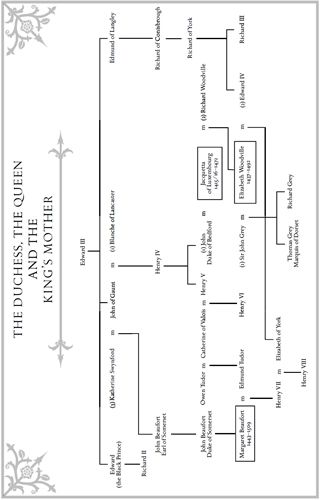
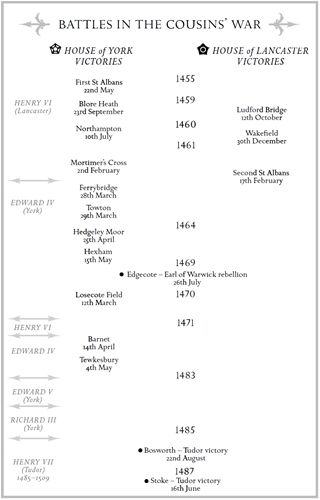
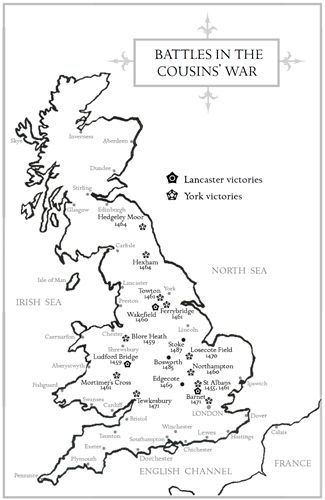
This book is part of the ongoing process of seeking and describing women in history. It examines the three women who were the heroines of the first three novels in the series I have called ‘The Cousins’ War’. This was the name given at the time to the series of battles and skirmishes which later historians would call the Wars of the Roses. But the name ‘the cousins’ war’ is the name that was used at the time and it describes the family nature of the conflict: an armed quarrel between brothers and then their sons – the cousins – over which descendant of Edward III should become King of England. It has been military history and political history which have dominated the accounts of these times, and since few women fought, and since no woman had any political rights, it is not surprising that their lives and experiences were ignored by most historians. But the three historians in this book have chosen to look at three women of the time and have uncovered extraordinary stories of networking, conspiracy, influence, power-grabbing and self-sacrificial courage which mean that we have to adjust our view of the times and include these women as effective actors on the historical stage.
The first character in the book is Jacquetta Duchess of Bedford, whose full biography has not yet been written. I started to study her for my novel The Lady of the Rivers and found an absence where a biography should be. Though she was a duchess of England, the mother of a queen, and the leading light in the court of Lancaster and then of York, nobody had thought to research Jacquetta.
There are gaps in her history that perhaps later scholars will study. We know next to nothing about her private life with her husband Sir Richard Woodville. We glimpse her in the historical record only when he serves as a military commander for the House of Lancaster, and when she serves as the primary lady-in-waiting to Margaret Anjou. We know only approximate dates of her confinements, especially those babies who may have died young: the account I give here is from my own research and from lengthy discussions with David Baldwin; it is not definitive. We are more sure about the deaths of her adult children than their birth dates because the adults later became siblings to the Queen of England and entered the historical record.
I think I can speculate with some confidence about some aspects of Jacquetta. I think she was loyal: for she served the House of Lancaster and Margaret of Anjou until the final defeat at Towton, when Margaret fled from the battle. I am sure she was passionate: for she married for love and paid a high price to do so. I know she was something of a scholar: for she kept the library inherited from her first husband; she raised a son who was a poet, a writer and an editor. Her daughter and her son sponsored the first printing press in England and edited the first ever book printed in England. I can speculate that her daughter’s court was the model for Thomas Malory’s vision of Camelot; but there is as yet no solid proof as to whether Jacquetta herself was an educated, scholarly woman, and if it was her love of learning which descended to her grandson Henry VIII and her great-granddaughter the studious Queen Elizabeth I.
We know little about Elizabeth Woodville before she made her ambitious second marriage to the young King Edward IV. Her first marriage to a relatively obscure country gentleman left few traces. She is visible on the record during her time as queen; but we know less about the months when she saved herself and her daughters from Richard III, living in sanctuary. Did she really release her second son into his care when he had kidnapped her first? Did she really believe that Richard III had murdered her sons and yet bring herself to reconcile with him, putting her daughters in his care – where their brothers had been? Why did she first conspire against him; but then order her son home from the court of Henry Tudor to reconcile with him? We know very little of what she was doing after the accession of Henry VII and the marriage of her daughter to the new king. Can it be that she really joined a plot against the incoming Tudor king, her own son-in-law? And why would she have done that?
Margaret Beaufort’s official story is powerfully bland. We have few details about her magnificent organisation of the so-called Buckingham rebellion. Perhaps we can read much into the fact that at the time the rebellion was named the Beaufort rebellion – for her, the kingpin plotter at the centre of dangerous intrigue. It was later historians who re-named the plot and so helped to obscure her shocking treason against an ordained king of England and the betrayal of his queen – her friend. We know almost nothing about her relationships with her three husbands, nor with her daughter-in-law, who was of the rival house and the daughter of her enemy. We can only reconstruct her passionate and intimate relationship with her son from small snippets of gossip, and the architecture of the royal palaces that they designed together to give themselves, in every place, a small personal shared room.
Our lack of knowledge about these women is caused by the scarcity of any records at all. The records that survive from this period are scanty. The vast majority of people were not literate, and those who did write letters, diaries or journals did not preserve their work. There are so few documents that they can be listed here: four chronicles, covering different, often short periods of time and often arguing different viewpoints; a few collections of private family letters, of which the Paston Letters are best known; the recorded impressions of a few foreign visitors; and the commissioned ‘History of England’ written by Polydore Vergil at the request of Henry VII.
As one might expect, the chronicles and the ‘History’ are all written by men, the foreign visitors are all men too, and these are all men who share the medieval view of the nature of women; some of them – as celibate churchmen – are professionally remote from women. They tell us what has happened in their world, and they tell us what they believe is the nature of that world. They do not expect to see women working effectively and powerfully, and when this is the case they often fail to report it. When they do see an ambitious and powerful woman like Margaret of Anjou they often report her negatively, or as if she were, in some way, manly. Other women, like Margaret Beaufort, appear as saints.
None of the women of this book escapes these stereotypes. Jacquetta’s story is nowhere fully told; but she is sometimes slandered as the sexually driven, secretly married wife of a socially ambitious nobody, and as the suspect witch who put her daughter to bed with a young king by enchanting him. Her daughter Elizabeth Woodville is seen as the woman who seduced a younger man and upset the order of the court. Her greed put her in conflict with the Earl of Warwick and brought war to the kingdom, and her ambition drove her to send her daughter to seduce the probable murderer of her sons, and poison his wife. Margaret Beaufort is an example of the saintly stereotype. There is no evidence of her having sex after her first brief marriage which gave her a son; historians suggest that her third marriage was a celibate union, and depend heavily on the descriptions of her in the history commissioned by her son, as a pious thoughtful woman who prayed for the victory of her son and wept in moments of joy for her realisation that all worldly success is fleeting. Her jockeying for power at her son’s court, her meticulous business sense, her brilliant political strategy, and her cool-headed cold-hearted alliances are not mentioned, let alone celebrated in traditional histories of this founding mother of the Tudor house.
There is one further gap in the record that I would like to mention here, as an invitation to further study. Traditional historians have not only missed the nature of women and the range of their experiences; they have also missed the networks of women that we can see only when we start to look. Margaret Beaufort was lady-in-waiting for years to Elizabeth Woodville, and godmother to Elizabeth’s daughter. Then she was friend and chief lady-in-waiting to Queen Anne, wife of Richard III, until she betrayed her loyalty and her friendship by conspiring with Elizabeth Woodville, who was herself Anne’s sister-in-law. Then Margaret and Elizabeth were co-grandmothers to the Tudor heirs: Arthur, who died; and Henry, who would become Henry VIII. Margaret lived long enough to be a powerful influence on the young Henry VIII and to see him married to Katherine of Aragon.
Elizabeth’s mother, Jacquetta Duchess of Bedford, was a lifelong friend of Margaret of Anjou, serving her until the marriage of Elizabeth to Edward IV meant that she became chief lady of the rival court of York. Margaret of Anjou was briefly mother-in-law to Anne Neville, who married her son Prince Edward of Lancaster until widowed at Tewkesbury, when Anne went on to marry Richard Duke of Gloucester, and become sister-in-law, and then successor and enemy to Elizabeth Woodville. There are some amazing connections here among women competing and co-operating that have been hidden from the history along with the characters and actions of these women.
As this is a book for the general reader we three authors decided against footnoting our work but we have each included an account of our sources that you will find at the foot of each section.

A book like this could not be written without the work of fellow scholars. I have to thank firstly the pioneers of women’s rights and women’s history. Without the former I would not have been allowed a place at a university; without the latter I would not have had the material which has illuminated my life. I thank my mother, from my heart, for her determination to get me an education and a trade, and for knowing that these are skills that a woman must have. My warm thanks to David Baldwin and Michael Jones for writing about these wonderful women in the first place, and for writing about them with me.