
The First Permanent Colony, 1608–09
Those who know the least shout the loudest.
—Champlain, 16071
IN THE AUTUMN OF 1607, Champlain sailed home to France in the battered barque Jonas with the sieur de Poutrincourt, Marc Lescarbot, the Port-Royal colonists, and a young Indian convert. It was a miserable crossing in a crowded ship, with short rations and a fragrant cargo of 100,000 codfish. Foul winds forced them into the port of Roscoff on the west coast of Brittany, where, by Lescarbot’s account, they “remained two and a half days to recuperate.” They went ashore to recover their land legs, and Champlain took delight in the Indian’s discovery of Europe. The lad was “astonished to see the buildings, spires, and windmills of France” and amazed by “the women whom he had never seen dressed in our manner.”2
When the wind turned fair, they went aboard and sailed east to Saint-Malo. There the passengers scattered in various directions. Poutrincourt and Lescarbot took the Indian boy to court and presented him to Henri IV as evidence that the natives were converting to Christianity. They also offered the first crops of corn, wheat, rye, barley, and oats from Port-Royal as proof of the colony’s success as an agricultural settlement. With his usual flourish, Poutrincourt gave the king five young Canada geese (outardes) that he had raised from hatchlings aboard ship. Those indestructible birds were soon swimming in the pools of Fontainebleau.
The king was gracious to the young Indian and pleased with the gifts, but he was keenly aware that the De Mons Company had failed and its colony had been abandoned. Once again, after so much effort, no French settlements survived in North America. In the gardens of Fontainebleau, the honk of Canada geese made a mocking chorus on the fate of New France.3
Champlain was not part of that scene. For the first time, he did not go directly to court. He was deeply troubled by the failure of the De Mons Company and wanted to know why it had happened. In a phrase of Winston Churchill’s, who knew a thing or two about leadership in large causes, Champlain was always “Lord Root-of-the-Matter.” Before he met the king he turned in another direction and moved straight to the heart of the problem. “I went to find the sieur de Mons,” Champlain wrote, “and found him living on a pleasant street in Paris, happily called rue Beaurepaire.” Champlain greeted his friend, and spoke of the “things I had seen since his departure.”4

After the failure of Port-Royal and the collapse of its funding, Poutrincourt returned to France, met Henri IV, and made him a present of Canada geese. In the gardens and pools of Fontainebleau, the cry of geese made a mocking chorus in what appeared to be the tragedy of New France.
He also presented “a map and drawings of the coasts and ports” in Acadia. This may have been the map now in the Library of Congress, which bears Champlain’s signature with the date 1607. It is the only manuscript map known to come directly from his hand—a miracle of survival, and a superb work of cartographic art.5 De Mons must have examined it with great interest. Historian David Buisseret suggests that its quality comes clear when we compare the “sober work of Champlain” with Captain John Smith’s map of New England (1614)—also a very good piece of work but in a different way. In Buisseret’s phrase, Champlain’s map seeks “simply to set out the main geographical features,” and also gives much attention to the Indians. His chart work is meticulous in its detail, and could only come from “a series of observations made from a small boat, working along the coast.” Smith’s map by comparison is finely engraved but frequently inaccurate in detail. It gives little attention to the Indians. The dominant features are a large portrait of Smith himself and the arms of England. Buisseret observes that Smith “seems determined to impose his presence on the land about to be seized.”6 Champlain’s work was very advanced in its cartography. He used new mathematical work of Guillaume de Nautonier on compass declination to orient his map and its elements, with somewhat mixed results but to a very high standard of accuracy and integrity. The sieur de Mons would have studied the map in two ways—for what it displayed of the American coast, and also for what it revealed of its maker. It may have made a difference in the events that followed.7
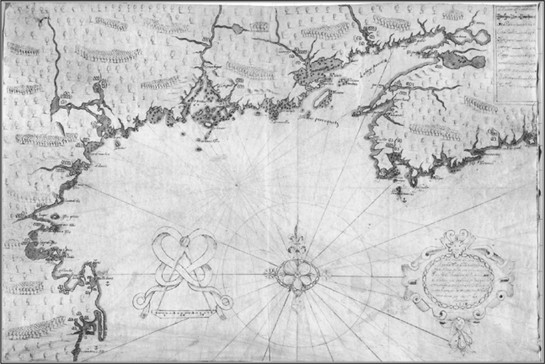
Champlain’s manuscript map of New France (1607–08) is a work of meticulous detail for coasts that he explored in Acadia and Norumbega, but less so for Cape Cod and beyond. His map is attentive to the land itself and the towns of the Indians, with no symbols of imperial dominion, and nothing of self-advertising.

By comparison, John Smith’s map of New England (1614) is roughly right in its main lines, but sketchy and careless in detail. It is inattentive to the Indians and imposes emblems of British sovereignty on the land with an English armada on the sea. The dominant element is a self-promoting portrait of John Smith.
After the two men discussed the map, de Mons told Champlain what had happened to the investment company—and it made a long litany of woe. One ironic factor in its demise was a change of fashion in Paris hats. Feathers were out; beavers were in. Demand for beaver pelts of high quality was insatiable in Europe, and it was growing at a great pace. Also in favor were lustrous furs from higher latitudes of North America: marten, lynx, white fox, and the beautiful black otter. The best source was the St. Lawrence Valley, where furs could be bought for a small fraction of their Paris price. Ironically, the increasing value of American furs made big trouble for the settlement of New France. Many merchants wanted a share of this lucrative trade and they joined forces to break the monopoly of the sieur de Mons. Champlain was told that “the Bretons, the Basques, the La Rochelle and Normandy people were renewing their complaints, and getting the ear of those who were ready to show them favor.” In Paris, the powerful Hatters’ Association joined in. Some of its members complained that a monopoly in America would drive up the price of furs. Others hoped to be monopolists themselves.8
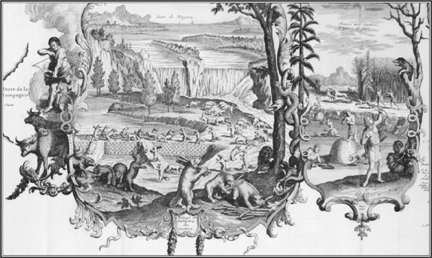
The beaver was second only to the cod in the economy of New France. Philosophes were fascinated by these appealing animals and celebrated their busy lives, collective labor, and social ethic. A happy example is this image from Henri Chatelaine’s ‘Carte très curieuse’ (1719).
These rivals had deep pockets, and money changed hands in the dark corridors of the Louvre. “At Court,” Champlain wrote, “people were not wanting who promised for a sum of money to annul the commission of the sieur de Monts.” He added that “in a short time his Majesty’s patent was revoked for a certain sum which a certain person received without his said Majesty knowing anything about it.”9
De Mons knew the identity of this “certain person.” Once again it was his old rival, the duc de Sully. In a court case, de Mons later testified that the “monopoly of ten years was revoked by the king around the fourth year [1607] because it was wanted by monsieur le duc de Sully, at the request of several hatters in the city of Paris.”10 In 1607, Sully was at the peak of his career as the king’s most powerful minister. While in office, he also built a very large private fortune. Much of it was the gift of a grateful monarch, but the Paris hatters pitched in.11 Sully appears to have been corrupt in an honorable way, a man of principle who practiced what in America would later be called “honest graft.” He accepted bribes only for actions that he believed to be good for the king and the country.12Sully had never been a friend of colonization and often argued that “lands beyond the seas can only entail considerable cost while being only of slight or extremely little use.” His repeated view was that nothing could come from American colonies above the fortieth parallel (the latitude of Philadelphia).13

The whirl of fashion in Paris hats created an insatiable demand for beaver pelts and made big trouble for de Mons and Champlain. Hatmakers, fur merchants, and their friends at court broke the trading monopolies that paid for the colonization of New France.
Sully had long wished to put an end to French settlement in North America, but knowing the king’s feeling, he bided his time. In 1607, he saw an opportunity. On the fishing coast, agents of the sieur de Mons had seized French vessels in a high-handed way. The result was a wave of anger in French seaports, and a tangle of litigation. For every ship that was seized, many others defied the monopoly with impunity. In 1607, Champlain estimated that eighty ships were trading illegally for furs in the St. Lawrence. Most were owned in France; some were Dutch ships with French pilots. The monopoly was not working, and it caused deep resentment.14
The sieur de Mons also had another problem. He was losing his investors. They had not received the dividends they had been promised after the first year, and they balked at the costs of colonization that they were expected to bear. Champlain later observed that de Mons had spent more than 100,000 livres to found the settlements at Sainte-Croix and Port-Royal, with very little to show for it. Sainte-Croix had failed as a colony, with heavy loss of life. Port-Royal had failed as an investment. Both settlements lay at a long distance from the most profitable centers of the fur trade. Even some of de Mons’ leading investors, led by a truculent merchant of Rouen named Daniel Boyer, sent their own traders to Canada in violation of the monopoly.15
With this dismal record in hand, Sully persuaded the Royal Council that the sieur de Mons had not met the terms of his commission, and argued that the monopoly should be revoked. The council showed sympathy for de Mons, and authorized him to receive 6,000 livres in cash payments “from the ships that went out to trade in furs,” as compensation for his loss. But when de Mons tried to collect the money, hostile courts in Saint-Malo and other towns told him he had the wrong names, or the defendants had disappeared, or the suits were invalid for technical reasons. It proved impossible to collect so much as a sou from these slippery contrebandiers, as they were called.16 Champlain remarked, “To find out who had been trading, and what amount should be levied on more than eighty vessels that frequented those coasts … was like trying to drink the sea!”17
All these blows did heavy damage to the company of de Mons, and were a severe setback for the grand design that he shared with Champlain. Some people would have given up, and de Mons came close to that decision in the fall of 1607. Champlain wrote that the “sieur de Mons spoke … several times about his intentions.” It must have been a painful subject, but they kept talking, and de Mons decided to try one more time. In Champlain’s words, he resolved “to continue such a noble and worthy enterprise, notwithstanding the pain and labor it had cost him.”18
De Mons also made another decision. To protect the enterprise at home, he had to stay in France. Someone else would have to take the lead in America, but whom should he choose? The senior men were not quite right for the job. Pont-Gravé was a great seaman and a good trader, but he was not in good health and his behavior was increasingly erratic. Poutrincourt had his own purpose in seeking to found a feudal utopia in Acadia, and he had failed as a leader on the coast of Norumbega. A third candidate came to mind. The sieur de Mons had watched Champlain in 1604 and 1605, when the two men had worked closely together. Champlain had done well in independent commands, better than his superiors in the same role. Others were beginning to notice his gift of leadership. One of them was Marc Lescarbot, who wrote a sonnet to Champlain about it:
And if you accomplish your beautiful enterprize,
One cannot estimate how much glory will one day
Accrue to your name,which already each person prizes.19
There was one problem. Champlain was not a nobleman, and great enterprises in France were rarely led by commoners. But the more de Mons thought about it, the more he believed that Champlain would be the best choice. In the fall of 1607 he asked his younger friend to take command in New France. Here was an important opening for Champlain and his grand design. It was a major opportunity, but full of risk. Every French colony without exception had failed in North America. Even so, Champlain believed that he could succeed. He accepted the offer of de Mons, but on one condition. The two of them had to win back the king’s support for New France. In truth it could work in no other way.20
* * *
With Champlain’s encouragement, the sieur de Mons returned to court in the winter of 1607–08, and launched a campaign for the king’s ear. He made a strong appeal for a permanent colony and for the return of a trading monopoly to support it. He and Champlain added a new argument, and recent events supported them. While the French were failing to make good their claim in North America, the English were moving rapidly. In 1607, investors in London had founded colonies at Jamestown in Virginia, and Sagadahoc in Maine, which was within the territory claimed as New France. If these initiatives succeeded, France would be in danger of forfeiting its claims in North America. Were that to happen, merchants in Rouen and Paris would have no share of the fur trade whatever. Demands of French investors for free trade, low taxes, and no spending for colonies could only end in new monopolies for England and the Netherlands, from which the French would be excluded. Champlain felt deep contempt for these shortsighted businessmen. He declared, “These envious folk were clamoring not for their own advantage, but their own ruin.”21
The king was persuaded. He was also moved by reports from Poutrincourt about the success of agriculture at Port-Royal and the progress of Christianity in New France. On January 7, 1608, Henri IV issued a new decree. On the basis of “information that has been given to us by those who have come from New France, regarding the good quality and fertility of lands in that country, and that the inhabitants thereof are disposed to receive the knowledge of God, we have resolved to continue the settlement which has already begun there.”
The king overruled Sully and the council. He supported “the offer made to us by the sieur de Mons, Gentleman-in-Ordinary of our chamber, and our Lieutenant-General in that Country, to undertake the said settlement if we grant him the means and possibility of bearing the expense.” To that end, Henri IV further decreed that “none of our subjects but [de Mons] himself shall be permitted to barter in furs and other merchandise for the period of one year only.”22 It was one of the king’s typical compromises. The sieur de Mons would receive his new monopoly but only for twelve months to help him start again. Thereafter the king favored open trade. It was a slender reed for so large a mission, but de Mons and Champlain were ready to act.
The next step was to raise the money—no small task. De Mons used a combination of coercion and persuasion. In Rouen he employed a respected merchant named Lucas Le Gendre to be his “procureur général,” with full power to prosecute French traders without a license. De Mons brought suit against some of them and won enough judgments to prove that he could enforce his powers. During the next year, any Frenchman in the fur trade would have to do business with de Mons.23
Then de Mons went to the Atlantic seaports and made agreements with individual merchants who were his friends. In the Basque country, a small group agreed to send a large ship from Saint-Jean-de-Luz with a license from de Mons. He visited Saint-Malo and signed similar agreements with five merchants. Other arrangements were made in Dieppe, Le Havre, Honfleur, Rouen, La Rochelle, and Paris. A common provision was that a quarter of the profit should go to the De Mons Company.24
Altogether more than twenty-one vessels are known to have cleared from French ports for “Canada” in the spring of 1608, not counting many others that were bound for the fisheries of “Terre Neuve.” Many of the trading voyages appear to have been under some sort of agreement with the sieur de Mons. This method of mobilizing capital was different from what had been done for the Acadian voyages in 1603–05. In place of a corporate system with three major centers, this new initiative was an improvised web of agreements with individual merchants. More than forty have been identified by name. All these arrangements required major effort on the part of the sieur de Mons.25 Unlike the Acadian venture, this new mission was built on promissory notes, and colonizing expenses were met with borrowed money. The credit of the company was not strong. Much of the borrowing was done by individuals on their own credit, with interest charges in the range of 25 to 50 percent.26
As these precarious financial agreements began to fall into place, Champlain and the sieur de Mons had a hard choice to make. Where should they plant the next settlement? After the brutal winter on Sainte-Croix Island in 1604, the sieur de Mons still “hoped to go farther south to found a healthier and more temperate colony.” Champlain wanted to go north and settle on the St. Lawrence River.27 The two friends agreed to “meet in council,” and Champlain organized his thoughts carefully, as was his habit. He gathered evidence about the St. Lawrence Valley and framed an argument on “why it was more convenient and useful to establish a settlement there.” First on his list was the problem of security from attack by European powers, in light of recent English and Dutch activity. He predicted that Acadia would be “difficult to hold because of the infinite number of its harbors which could only be guarded by large forces.” The St. Lawrence Valley, on the other hand, could be controlled at a few choke points along the river.28
Champlain also favored the St. Lawrence for another reason. It was closer to the heart of the fur trade and “commerce could be carried on by means of the great river.” He was thinking of its many Indian nations with trading networks of their own. By contrast, he wrote, Acadia “was sparsely populated by sauvages, who on account of their small numbers cannot penetrate from these regions into the interior where sedentary people live, as one could by the river St. Lawrence.” He was planning a large trade over long distances between small numbers of Frenchmen and many Indian nations, all working together without coercion in an open relationship for mutual gain. This vision of New France was very different from that of New Spain or New England.29

To all this reasoning Champlain added the argument that more souls were to be saved in the St. Lawrence Valley. He argued that the Indian nations of that region were receptive to French colonists and the land was suitable to settlement. And especially important in Champlain’s thinking was the promise of a passage to Asia, through the St. Lawrence Valley and the great lakes to the west.30
The sieur de Mons perceived the strength of Champlain’s reasoning but persisted in his own purposes. The result was another compromise. The company would send three ships in the spring of 1608: two to found a permanent settlement in the St. Lawrence Valley and a third to revive the settlement in Acadia. Champlain wrote that de Mons “resolved to do that, and to this end he spoke about it to His Majesty, who agreed.”31
As mission commander, Champlain received the title of “lieutenant for the country of New France.” His orders were to negotiate a “treaty of amity” with the Indian nations, to plant a permanent settlement, and “to lay the foundation of a permanent edifice for the glory of God and the renown of the French people.” After many failures, permanence became an important purpose.32
For the first time in his colonizing career, Champlain was in command. His mentor, Pont-Gravé, would go in a secondary role, with instructions to trade in Tadoussac harbor and return in the fall with furs and fish that might pay the costs of colonization. In 1603, Pont-Gravé had been commander and Champlain was his subordinate. Now, five years later, their roles were reversed. It is a tribute to both men that they made it work. A division of labor was agreed between them. Pont-Gravé would look after the fur trade; Champlain would plant a permanent settlement.33
In the early weeks of 1608, Champlain and the sieur de Mons recruited their colonists. The Acadian expeditions of 1604 and 1606 had drawn from the top and bottom of French society. Champlain’s colonists in 1608 came more from the middle. There were few noblemen and gentlemen-adventurers. The leaders of this expedition were experienced seamen with long service as ships’ officers: Champlain, Pont-Gravé, and Captain Guillaume Le Testu. Historian John Dickinson observes that their colony was run on the model of a ship, following the customs of the sea—a pattern different from Port-Royal.34
Most of the settlers were skilled artisans and laborers in the building trades. Contracts survive for woodcutters, sawyers, carpenters, masons, smiths, laborers, and a surgeon. Champlain also hired a gardener named Martin Béguin. These men agreed to stay two years for annual salaries that ranged from 150 livres for skilled artisans to 65 livres for laborers. About half these men were able to sign their contracts—a larger proportion of literacy than in the population of France in 1608.35
Several youngsters came along, and two of them would loom large in the history of New France: Étienne Brülé and Nicolas Marsolet. No contracts survive for them. They may have come as engagés, or indentured servants. Champlain also had personal servants on most of his voyages from 1599 to 1635. He rarely referred to them by name, merely as anonymous lackeys (laquais). Once again this French expedition had no women, a surprising omission for a settlement that was to be permanent. Also, there were no Swiss soldiers, perhaps for reasons of economy.36
And no clergy came, which was a surprise. Everyone agreed that a major purpose of the colony was to aid in the conversion of American Indians to Christianity. That idea appeared in Champlain’s arguments, in the representations of the sieur de Mons, and in the king’s commission. But how could the work of conversion be done? Which religious order would be invited to participate? Who would pay? On these issues, there was no agreement.
The leaders of the last venture remembered the unhappy experiment with religious toleration in Acadia, which had led to constant strife between a Catholic priest and the Protestant pastor. Champlain wrote sadly, “Two contrary religions are never very fruitful to God’s glory among the infidels.” Something similar had happened when toleration was tried in Maryland, Rhode Island, and Eleutheria Island during the early seventeenth century.37
Champlain and the sieur de Mons agreed that something else should be done. At the urging of Henri IV they decided to approach the Jesuits. De Mons went to see the king’s Jesuit confessor, Father Pierre Coton. Henri wanted the Jesuits to work in New France and promised 2,000 livres to support them. A devout Catholic woman of great wealth, Madame de Guercheville, also gave the Jesuits a larger sum of 3,600 livres for missions in America. The sieur de Mons tried to persuade Coton to commit that money to missions in the St. Lawrence Valley, but they could not agree on terms. Champlain was asked to join the discussion, with no better success. He and de Mons decided to go without priests or chaplains. It was an ominous start for any venture in an age of faith.38
Early in the spring of 1608, the sieur de Mons and Champlain moved to the port of Honfleur on the river Seine. They chartered at least three ships.39 Champlain’s flagship was a large vessel, probably of 150 or 200 tons to judge by her cargo. Her captain was Guillaume Le Testu of Le Havre. The name of the vessel has not been found. A few seasons earlier Le Testu had been master of the ship Fleur-de-Lys; perhaps she was Champlain’s ship. The vessel was heavily laden with settlers, materials, supplies, and all “things necessary and proper for a settlement,” in Champlain’s phrase.40
The other vessels were very small. One was the Lévrier41 of only 80 tons, with Nicolas Marion (or Marien) as master and Pont-Gravé as commander. She carried some supplies for the settlement but was meant mainly to serve as a trading vessel in Tadoussac.42A third vessel was chartered for a different mission. Her captain was Champlain’s friend the shipwright Champdoré. His orders were to sail to Port-Royal, resettle Acadia, explore the coast, and renew alliances with Indian nations.43
The small size of these vessels and the heavy borrowing at high interest were evidence of financial weakness in the De Mons Company. This mission was hanging by a thread. Money problems may also have been responsible for a late start. Champlain preferred to sail in March, but he appears to have met many delays in gathering men and material.44 Pont-Gravé sailed first on April 5, 1608. Champlain followed on April 13, very late in the season. He had lost a month of good weather, but the Atlantic passage was quick and uneventful. Champlain crossed the Grand Bank on May 15. Two weeks later he reached Isle Percée, a huge red sandstone rock 290 feet high and 1,500 feet long, with two natural stone arches. Even the aids to navigation were gigantic in this vast new world.45
Champlain continued up the St. Lawrence River and arrived at Tadoussac on June 3, 1608. There he found several ships, and they posed a major challenge to his leadership. Pont-Gravé had arrived earlier and found a Basque whaler anchored in the harbor. Her captain was buying furs from the Indians without a license. He was probably Martin Darretche, from a prominent French Basque family who worked out of Saint-Jean-de-Luz.46
Pont-Gravé told the Basques that they were in violation of a royal command. Darretche may have tangled with him before, as Basques and Malouins had long been rivals on the North American coast. Both were apt to fight first and ask questions later.47 The Basques were armed to the teeth and were determined to defend themselves, especially when challenged by a man of Saint-Malo. Pont-Gravé brought out the king’s commission, and the Basques ran out their guns. According to Champlain, Pont-Gravé attacked first and the Basques “defended themselves very well.” They brought “all of their cannon to bear” and in the first exchange of fire, Pont-Gravé fell severely wounded. Tree of his men were also hit, and one of them died. The Basque traders boarded the French ship, made Pont-Gravé their prisoner, seized “all his cannon and arms,” and promised to return them when they were ready to go home.48
Then Champlain arrived. He was very angry, both with the Basques and with Pont-Gravé. Later he wrote, “I was much annoyed at the brewing of a quarrel we could well have done without.” The Basques warned him that he could enter the harbor “only by force.” Champlain lacked the strength to impose his will by force of arms. He proposed a parley, and the Basque leaders agreed to talk.49
As they spoke, Captain Darretche began to have second thoughts about the use of force against men who carried the king’s commission. The Basques knew well that Henri IV moved swiftly to punish armed resistance against his authority, even as he offered generous rewards for loyalty. The Basques had been able to defeat the first French ship, but here was a second, and a third was close behind. Champlain continued his negotiations with patience and forbearance. “After a good deal of discussion,” he wrote, “I made peace between Pont-Gravé and [Darretche].” The Basques confessed to “a conviction of having done wrong.” They appear to have been worried mainly that “they should not be allowed to fish for whale,” which was not forbidden by de Mons’ commission. Champlain proposed a compromise. They were allowed to continue whaling, and perhaps to barter with the Indians under something like a license. Champlain also promised that he and Pont-Gravé would “undertake nothing against them while they were in New France.” In turn the Basques swore that they would “undertake nothing against Pont-Gravé nor against the king’s interest, nor that of the sieur de Mons.” All parties agreed that outstanding issues should go to courts in France, where “justice should be done.”50The warring parties laid down their arms, signed a written agreement, and began to live together in peace. Champlain was good at this work of reconciliation. He had a genuine gift for peacemaking through a combination of firmness and restraint, and he used it many times in his career.
After peace was made with the Basques, Champlain anchored his ship beside them in the small circle of Tadoussac harbor. He tells us that he “set the carpenters to work,” fitting out a petit barque of 12 or 14 tons that had been carried out from France for the purpose of exploring the St. Lawrence River. While he waited, Champlain met with the Montagnais Indians, who remembered him from his last visit in 1603. They traded American furs for French manufactures, and Champlain asked about the country north of Tadoussac. Once again, the Montagnais did not want him to go there, but allowed him to explore the lower reaches of the Saguenay River. He may have gone as far as Chicoutimi Falls, about a hundred miles upstream, and confirmed his earlier judgment that the valley was not a site for settlement. “All the land I saw there,” he wrote, “was nothing but mountains and rocky promontories, for the most part covered with spruce and birch.”51
While Champlain was searching the Saguenay to the north and Pont-Gravé was recovering from his wounds, their friend Champdoré led the third vessel on a southern voyage to the coast of Acadia. He visited Port-Royal, received a warm welcome from Membertou, chief of the Mi’kmaq, and found the settlement still intact. The Indians had guarded the buildings and tended the gardens and fields, which were flourishing. Membertou had harvested six or seven barrels of grain, and gave some of them to the French.52
The French leaders encouraged individual colonists to settle in Acadia with small proprietary grants, in an attempt to maintain their claims and keep the English at bay. Some of these settlements failed, but even the failures left behind a few Frenchmen who occupied the buildings, intermarried with Indians, and remained on the coast. In 1610, a French ship visited Sainte-Croix Island and found “a certain Frenchman … living with an Indian girl.”53
Champdoré sailed across the Bay of Fundy and cruised the coast as far south as the “land of the Almouchiquois.” There he worked to reconcile the Almouchiquois, Etchemin, and Souriquois with one another. The idea that the French sought to rule by pitting one group of Indians against another is not correct for the early seventeenth century. De Mons, Champlain, and Champdoré all believed that peace among the Indians was fundamental to their purposes.
On the coast of Maine, Champdoré also met a new generation of Indian leaders, in particular the Penobscot sagamore Asticou, “a man of weight and fine presence” who summered on Mount Desert Island. Here again, the French and the Penobscot Indians built good relations that endured in a remarkable way. Asticou’s memory is still green on Mount Desert Island, where even today Indians, islanders, cottagers, and tourists continue to meet and trade every summer on the campus of Bar Harbor’s College of the Atlantic, in the spirit of Asticou and Champdoré.54
* * *
In the last week of June, 1608, Champlain ended his work on the Saguenay and prepared to sail up the St. Lawrence Valley in search of a permanent site. His river barque was finally ready on June 30, and he set off that very day to explore the great river. He did not sail in midstream as others might have done, but preferred to study the banks and tributaries with close attention. This method called for great skill and constant vigilance. It put his vessel at risk among the submerged rocks and shifting shoals of the river. He loved to go ferreting on an unfamiliar shore—sounding, sketching, entering every major stream, going ashore, studying the soil, collecting flora and fauna. The tone of Champlain’s account reveals the pleasure that he took in this happy work.
He also took delight in naming every prominent landmark along the river, often in colorful ways. On this trip, he named one tributary the Rivière du Gouffre, Whirlpool River, for its dangerous currents. He called another prominent landmark Cap Tourmente because of his struggle against its tricky winds and currents. His names are still to be found on the land in Canada and the United States.
For many miles beyond Tadoussac the countryside did not attract him as a place of settlement. “All the coast,” he wrote, “both on the north and south sides, from Tadoussac to the Isle d’Orléans, is hilly country and very poor, with nothing but pine, spruce and birch, and very ugly rocks, amongst which, in most places, one cannot penetrate.” Today, visitors find this terrain very attractive, but Champlain had different aesthetic ideas—and another purpose.55
When he came to the Île d’Orléans, about a hundred miles upriver from Tadoussac, he examined its shoreline closely and charted its very dangerous shoal water. Then he went ashore to explore the island itself, and admired its clear fertile meadows and open woodland, with “many fine oaks and nut trees,” and “vines and other trees such as we have in France.” Here was a very promising site for a large settlement.56
At the eastern end of the island he went ashore near the great waterfall that he had earlier named after Admiral Montmorency of France, who had supported him. Champlain climbed to the top of the falls, walked inland on land that was “level and pleasant to see,” and found “a lake some ten leagues in the interior.” From that elevation, he wrote that “one can see high mountains which seem to be fifteen or twenty leagues away.”57 Champlain returned to his boat and headed upstream, noting that the land had changed its character. “Here begins the fine good country of the great river, distant 120 leagues from its mouth.”58
* * *
On July 3, Champlain and his men went another mile up the river past the Île d’Orléans, and reached the place that the Indians called Kebec, the narrowing of the waters. He had been there five years previously. This time he judged it by far the best place for permanent settlement. The strength of its position caught a soldier’s eye. The high rocky promontory commanded the full width of the river. A strong fort could control traffic through the St. Lawrence Valley.
Below the promontory was a level area, perfect for a trading settlement. It is now the lower town of Vieux-Québec. Champlain found it covered by a thick stand of nut trees, with an odor that reminded him of French walnuts. The settlers came ashore and immediately began the heavy work of clearing the land. Champlain divided his workers into several parties: one group cut down the trees; another sawed the logs into planks; a third dug cellars and ditches. A fourth had the easiest duty, sailing from Quebec to Tadoussac and back again many times with supplies.59

Champlain’s chart of Quebec (1613). At the upper center is the French town with fields to the north, meadows to the west, and fish weirs on the St. Charles River to the east. Across the St. Lawrence River is the Indian town at Lévis, and the Rivière des Etchemins, which led to Norumbega. Downstream is the Île d’Orleans.
The first priority was to build a secure storehouse, which was done promptly “by the diligence of every one.” The storehouse had two purposes: to serve the needs of trade and to hold provisions for the winter. As always, Champlain insisted on an abundance of food stocks, remembering the disasters that had destroyed many French settlements.60 Then they went to work on the building that Champlain called the habitation. It was different from the design of Acadia, where the settlement took the form of a quadrilateral fort. In Quebec, Champlain put up three interconnected buildings. One was for the artisans. Another, on the south side, looking out over the river, was the residence of Champlain. A third was for a forge and workshops. To the west was the storehouse with its deep cellar. In the courtyard he placed a dovecote with the escutcheon of the sieur de Mons and probably the king’s arms.61 Each part of the habitation was a large structure of two stories. On one of the buildings, Champlain put a great symbolic sundial as an emblem of light, time, symmetry, and order. He also raised the flag of France on a staff high above the roof. It caught the strong winds on the river, and flew bravely over the busy settlement.62
The habitation was designed to withstand a siege. The entire complex was surrounded by a palisade (unfinished until 1610), with a ditch fifteen feet wide and six feet deep that could only be crossed by a drawbridge. The ditch was enfiladed by cannon mounted on triangular bastions. Historian Marcel Trudel writes that Champlain “reproduced in miniature a European fortress.” The strength of the fortress also demonstrated his resolve to build a permanent settlement and hold it against any enemy.63
Around the settlement at Quebec, Champlain also ordered his workers to plant gardens. He had done it in every settlement: first on Sainte-Croix Island, once more at Port-Royal, and now in Quebec. “While the carpenters, sawyers and other laborers worked on our quarters,” Champlain wrote, “I put the rest to work clearing land around the settlement in order to make gardens in which to sow grain and seeds to see how everything would succeed. The soil appeared to be very good.”64
His published engravings show the plan of the gardens. Here again, as in Champlain’s other experiments, the plantings were done not in functional hills or rows but in elaborate designs that resembled the formal gardens of France. Champlain’s drawing of the settlement showed six garden plots, and there were likely more. He was still planting in the fall. “On the first of October,” he wrote, “I had some wheat sown and on the fifteenth some rye.” He noted that the killing frosts came early, with a mild “white frost” on October 3. Even so, he kept on sowing. “On the 24th [of October],” he wrote, “had some native vines planted and they prospered extremely well.”65
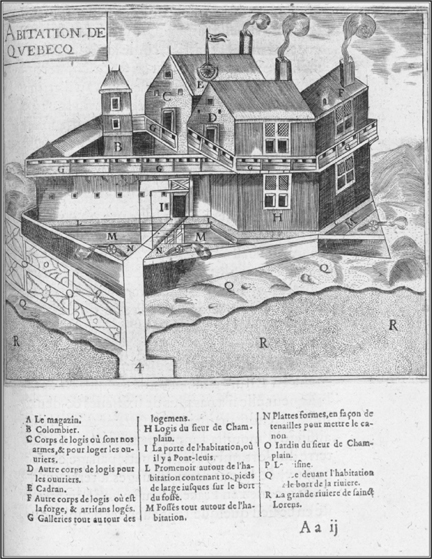
The first habitation at Quebec (1608–10), with its fortress, warehouse (A), barracks (C, D, F), and Champlain’s quarters (H). Above are a dove cote (B), sundial (E), and a flag with the lilies of Henri IV’s Bourbon dynasty. On the water’s edge is a quay (4), and Champlain’s garden (0).
Champlain was much interested in native plants and made a list of the more attractive varieties: “nut trees, cherry trees, plum trees, vines, raspberries, strawberries, gooseberries, red currants and several small fruits which are quite good.” Among the others were blueberries, which caught his eye. He wrote, “There are also several sorts of useful herbs and roots.” Champlain was quick to discover the botanical expertise of the Indians and sought to learn from them. He also introduced many seeds and plants from France. Grains were tried in great variety, especially wheat and rye. Fall and spring sowings both succeeded at Quebec.66
Champlain also introduced flowers, and was especially fond of roses. He was very much the driver of French gardening in America. The men who did the work did not share his passion. Often he complained of his gardens that “after I left the settlement to come back to France, they were all ruined for want of care, which distressed me very much.”67 Champlain’s gardens were not only useful and ornamental. They were also symbols of sovereignty and order. Champlain made an association between l’estate and l’état, the garden and the state.68
Champlain was racing the calendar and he drove his men very hard. The labor was heavy and unremitting. The food was not good, and the men began to grow restless and unhappy. In late summer and fall of 1608, four of them turned against Champlain. Their leader was Jean Duval, a skilled locksmith with a special expertise in the repair of gunlocks, and access to weapons. He had been in trouble before. On Poutrincourt’s southern cruise to Nauset in 1606, it was Duval who had refused to obey a direct order to remain aboard ship, and slept on the beach with his friends. All had been killed except Duval, the sole survivor.69
At Quebec, Duval enlisted three workers in a conspiracy. They made a plan to murder Champlain. The four men decided that it had to be done by deep stealth and extreme secrecy—a testament to Champlain’s strength and alertness. Probably he always carried arms, and knew how to use them. The conspirators agreed that he had to be killed, but they could not decide how to do it. They met together in the dark, and debated whether to poison him, blow him up with a bomb, strangle him in his bed, or sound an alarm and shoot him from ambush as he emerged from his quarters.70 Once Champlain was dead, they planned to take over the colony, and seek an alliance with the Basques, or even with Spain. The ringleaders found broad support among other workers at Quebec. Even one of Champlain’s personal servants joined the conspiracy—evidence perhaps of resentment to Champlain’s driving leadership at this stage of his career. They set a date, and all were made to swear a solemn oath of secrecy, on penalty of death by many dagger-thrusts.71
Just before the fatal day, a river barque arrived from Tadoussac and began to unload its cargo. Its commander, Captain Guillaume Le Testu, was a “very prudent man,” in Champlain’s phrase, and much respected by others. An artisan in the settlement, a locksmith named Natel, approached Captain Le Testu and warned him of the plot. The captain went at once to Champlain and found him laying out his gardens, completely absorbed in the task at hand. The two men walked alone into the woods, and Champlain learned what was afoot.
He moved very quickly. First he spoke secretly with the informer Natel, who was shaking with fear. Natel was offered full pardon if he revealed the identity of the leaders. He named four men. Champlain laid a cunning trap for them. He arranged that a young seaman should invite the ringleaders onto Le Testu’s ship, with a promise of two bottles of alcohol. The conspirators went aboard and instantly were seized by Champlain and Le Testu’s loyal crew. All were clapped in irons.
Then Champlain went ashore. It was ten o’clock at night and pitch-dark. He summoned everyone in the colony. Standing with him in the shadows were the captain and some of Le Testu’s men, all heavily armed. A faint light glinted on their weapons. Champlain told the colonists that Duval and the ringleaders had been put in irons. He gave each man a choice: pardon if he spoke the truth; death if he did not. Every man confessed and testified against the leaders. Champlain carried the four conspirators to Tadoussac and returned with Pont-Gravé (now nearly healed from his wounds) and more men who were also well armed. He convened a tribunal of four officers: Champlain himself, Pont-Gravé, Le Testu, and the surgeon Bonnerme. All were men with long experience of discipline at sea.72
They constituted a formal court, and a public trial followed, with depositions in great detail. The men of Quebec testified against the conspirators. Under the accumulating weight of evidence, Duval also made a confession and begged for mercy. For him, there would be none. The tribunal sentenced Duval to death, and Champlain ordered his immediate execution. Jean Duval was hanged, strangled, and beheaded. His severed head was mounted on a pike in Quebec as a grim warning to others.73
The three other ringleaders were also sentenced to death, but at Champlain’s recommendation the tribunal ordered that they should be taken to France in chains and their sentence should be reviewed by the king’s courts. On September 19, Pont-Gravé carried them home, and much later they were pardoned—a common pattern under Henri IV. Champlain had faced a mortal threat to the colony. He moved against it with energy and dispatch, but also with restraint. He executed one man, sent three to France, pardoned all the rest of the habitants, and regained their loyalty. Afterward Champlain wrote that all the others conducted themselves properly and did their duty. He won them to his leadership by a combination of strength, resolve, and restraint that held the colony together.74
Mutinies happened frequently in early French colonies and destroyed several of them, as in the murder of La Pierria at Charlesfort, the attack on Laudonnière at Fort Caroline in Florida, and the repeated revolts on Sable Island off the Grand Bank. Champlain, unlike earlier leaders, was able to suppress the rising before it happened, and dealt with it in a way that his men accepted as legitimate. This mortal challenge made the colony stronger—and Champlain, too.75
In the late summer, Indians visited Quebec and talked with Champlain. Most were Montagnais, and Champlain took a deep interest in them. “I studied their customs very particularly,” he wrote.76 He knew that the Montagnais were a hunting and gathering people—and thought that they were the most skillful hunters he had ever met. They were also expert traders, and constructed complex networks of exchange. He admired them as a handsome people, “well-proportioned in body, without deformity and agile.” He found the women very attractive, “well-formed, plump, of a dusky hue on account of certain pigments with which they rub themselves, which make them look olive-colored.”77
Algonquins also began to appear—many nations who lived along the upper St. Lawrence River from Quebec to the Great Lakes. Among them was the son of Iroquet, a leader of the Petite-Nation who lived far to the west, near Georgian Bay on the shore of Lake Huron. These nations, Algonquin and Montagnais, had “long been at war” with their ancient Iroquois enemies, especially the Mohawk, the easternmost of the Iroquois nations. Nobody could remember when this fighting had begun. It started long before the Europeans arrived. But with the expansion of the fur trade, these wars were growing more violent. The result was a cycle of violence and vengeance that kept all parties at war. The Algonquin and Montagnais wanted Champlain to join them in fighting the Mohawk.78
Champlain welcomed them all to Quebec, and gave them a “kind reception,” in the words of one Algonquin sagamore. They began to build alliances, French and Indians together, but with different purposes in mind. The Montagnais and Algonquins wanted Champlain to join them in defeating their mortal foes the Mohawk. The French commander agreed, and said that he “wished to help them against their enemies,” but with a different purpose in mind. His object was to bring peace to the St. Lawrence Valley. He hoped to break the cycle by striking forcefully against the Iroquois, whom he regarded as the aggressors. The plan was not to destroy their power; it was to raise the price of raiding in the St. Lawrence Valley. During the summer and fall of 1608, they made an alliance with different goals in mind. It was a fateful agreement.79
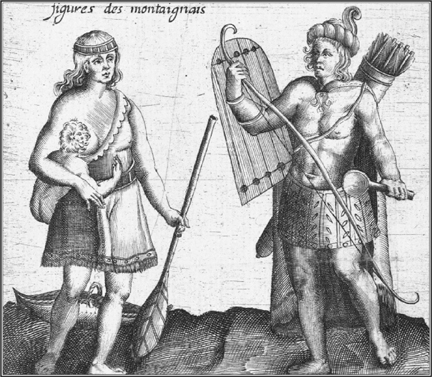
Champlain sketched this Montagnais warrior, wife, and baby. He admired this “great nation,” as expert hunters and skilled traders in highly developed networks. They thought themselves superior to farming Indians, whom they called “dogs who raise corn.”
While Champlain was meeting with the Indians, the seasons were changing rapidly. Winter came early to Quebec in 1608. On November 18, the settlement was lashed by “a great gale,” and a “heavy fall of snow.”80 It was the harbinger of a long winter that nearly destroyed the colony. The months from October to December were bad enough, with fierce winds, wet weather, and high water. Then the weather turned bitter cold and very dry—the cruelest combination. Houses were without the insulation that snow provided. Communications became difficult. Thick ice choked the rivers, and snow paths failed to form on the ground. Without deep snow, the hunting of large animals became difficult.
All of this was very hard on the French settlers and much harder on the hunting Indians. When the fall of 1608 approached, the Montagnais moved to Quebec, as they did every year. Champlain observed that they lived on the edge of subsistence and had a complex annual rhythm in their hunting and fishing. They came to the narrows of Quebec to fish for eels that began to come up the river in great numbers from about September 15, and continued to run abundantly to mid-October. “During this time,” Champlain wrote, “the natives all live upon this manna and dry some for the winter to last till the month of February.” They were a vital source of food.81
After the eel-run, the Montagnais went hunting for beaver from late October to December. Then in the coldest months they hunted large game such as moose, which were more easily caught when the snow was deep.82 Champlain greatly respected the skill of the Montagnais, and their mastery of the environment in which they lived. He was interested in their warm and handsome clothing. “In winter,” he wrote, “they are clad in good furs, such as the skins of moose, otter, beaver, bear, seal, deer, and more, which they have in great quantity.” He was fascinated by their snowshoes. “When the snow is deep,” he wrote, “they make a kind of racquet, two or three times as large as those in France, and tie them to their feet, and in this way they walk over the snow without sinking; otherwise they could not hunt or walk in many places.”83
When the Montagnais had good luck in all of their successive hunts, they could eat through a long North American winter. But the failure of even one hunt meant a time of hunger. The failure of several hunts could cause starvation. The Montagnais had no reserves of food, unlike the Huron and Iroquois, who were highly successful farmers and produced surpluses from their fields.84 Champlain urged the Montagnais to take up farming—not in the European way, but on the model of their Indian neighbors. “The soil is very good and suitable for cultivation,” he wrote, “if they were willing to take the trouble to sow Indian corn, as do all their neighbors, the Algonquin, Huron, and Iroquois,” who “are free from such cruel attacks of famine,” and “live prosperously in comparison with the Montagnais, Canadien and Souriquois.”85
In the fall of 1608, Champlain worried about the Montagnais, and watched as something terrible began to happen to them. All of their hunts ran short. The eel season was shorter than usual. The beaver hunt failed mainly because of a very wet fall. In high water the hunters could not get to the beaver lodges. The Montagnais reported to Champlain that “they did not take many beavers because the waters were too high, on account of the rivers overflowing.”

These small snowshoes were made for a Montagnais child. Champlain was fascinated by this hunting nation’s adaptation to a hard environment, but he was deeply saddened by its extreme suff ering in 1608–09, when the winter hunts failed.
The wet fall was followed by a long dry winter with very little snow. The moose hunt failed—the third hunting failure in a row for the Montagnais. Champlain observed: “All these tribes suffer so much from hunger that sometimes they are obliged to live on certain shell-fish, and to eat their dogs and skins with which they clothed themselves.”86 The crisis came in February of 1609. Montagnais families began to appear on the south side of the St. Lawrence, across from Champlain’s habitation. The river was high and the current strong, and great floes of ice were tumbling downriver. The Montagnais called to the French for assistance, and in desperation launched their canoes into the turbulent stream. Their fragile vessels were caught by the ice, and “broken into a thousand pieces.” The French watched as men, women, and children, weakened from hunger, fell into the water, clinging to ice floes. Suddenly the current drove the ice ashore and they leaped to safety. Champlain wrote that “they came to our settlement so emaciated and worn out that they look like skeletons.”87
He gave them bread and beans, and bark to build their huts. Some were so hungry that they seized the rotten carcasses of a dog and a sow that the French had set out as carrion, and ate the putrid flesh half cooked. “When they have food,” he wrote, “they lay nothing by, but eat and make good cheer continuously day and night, and after that they starve to death.” He observed the misery of the Montagnais with great sadness, and their swings from exaltation to deep depression and despair. The instability of their life and chronic insecurity took a terrible toll. Champlain wrote that they were in “great dread of their enemies,” and hardly ever slept quietly. They were “afflicted by terrible dreams that haunted them.”88
As the winter grew worse, the French also began to suffer. They had plenty of bread and beans and some supplies of salted fish and meat, but not much else. In late November, the French settlers began to fall ill with severe symptoms that Champlain described as “dysentery.” The Indians were also afflicted. Champlain wrote, “in my opinion,” it came from “having eaten badly cooked eels.” So severe was this “dysentery” that it killed many Frenchmen, including the locksmith Natel, who had saved Champlain’s life.89
In midwinter, the survivors came down with scurvy. For three months, they had some success in keeping it at bay, perhaps by hunting and fishing in late fall and early winter, which brought supplies of fresh meat that many explorers have found to possess antiscorbutic properties, and possibly by eating roots and husks that offered a source of vitamin C. But in February they began to run out of whatever had protected them. Champlain wrote that “the scurvy began very late in February, and lasted till the middle of April.” It took a terrible toll. Champlain ordered the surgeon Bonnerme to do autopsies, “to see if they were affected like those in other settlements. The same conditions were found.” Then the surgeon himself fell severely ill, and died of the same cause. Champlain wrote, “All this gave us much trouble, on account of the difficulty we had in nursing the sick.” Altogether seven Frenchmen died of scurvy, and thirteen of dysentery.90
After four months of suffering, spring at last arrived. A harbinger was the first run of fish in the St. Lawrence River. Vast numbers of shad swam upstream—more than anyone could possibly eat, and the French discovered a culinary delight in a vast abundance of shad roe, with a bit of French bacon for flavor. The last pockets of snow melted away, and the countryside turned green again. Only a small remnant of the colonists came through the winter. Champlain wrote that of twenty-eight habitants, eight remained alive, and “half of the living were very ill.” But the settlement at Quebec had survived—to face another challenge.