
The Sea as a School
Samuel Champlain, De Brouage
—title page of Champlain’s
first published book, 16031
TO TRAVEL THE OLD ROADS on the coast of France, south along the Bay of Biscay, is to find a beautiful and haunted place, full of interest for history-minded people. A few miles below the eighteenth-century navy town of Rochefort, we crossed the sparkling waters of the River Charente on a high-arched modern bridge and entered a region that was like another world. The terrain felt more like a floating island than part of the French mainland. It is very flat and not quite terra firma—a web of waterways and salt marshes, with seabirds swooping overhead and long views of sea and sky. On a sunny spring morning, the fields were green with new growth and the roadsides were brilliant with red poppies.
Near the center of this region, we followed the old D6 road as it veered past a copse of trees. Suddenly we came upon a walled town of very strange appearance. It was the object of our journey, and yet it took us by surprise. Rising before us was an old seaport that lies far from the sea. Its massive stone fortifications were once washed by the tide. Today they are a mile inland, surrounded by pastures and grazing cattle.
Four centuries ago, this little town was an important center of Atlantic trade. In the year 1581, a visitor from the rival port of La Rochelle described it as “without doubt the most beautiful harbor in France,” and one of the busiest. Today it is still a place of striking beauty, but its harbor has nearly disappeared. Broad streets that were built for commerce were empty when we walked there, and our footsteps echoed in the silence of an empty town. We climbed its stone battlements and found them carpeted with wild flowers, blooming abundantly in the bright Biscayan sun.
This is the town of Brouage, where Samuel de Champlain lived as a child. Its colorful history was the salty broth in which our hero was cooked.2
* * *
In the time of the Romans, the land around the present site of Brouage lay under water, submerged beneath the great gulf of Saintonge. The coast of France was nine miles away, on a ring of rising land to the east. As the gulf receded, it left a muddy mix of water and clay that was called broue. The lowlands that emerged from the sea were called brouage, which came to mean an area of mudflats and salt marsh.3
From an early date, villages began to rise on this new land, and one of them was also called Brouage. It was a small trading town, and its most valuable commodity was salt—a gift of the sea and the sun to the people of this region. Salt was mined from deposits in coastal marshes, and evaporated from brine in open pans. It was vital for the preservation of food, and so much in demand that it was called the “white gold” of medieval Europe. Salt also became important in another way. Monarchs were quick to discover that it could easily be taxed. The result was the hated gabelle, the infamous salt tax that became a major source of revenue for the old regime in France, and a leading cause of revolution in 1789.4
The salt of this region was known for its color, variety, quality, and price. The Île d’Oléron produced a white salt of great refinement, as “white as snow.” Périgord and Limousin yielded salt that was red or gray. Brouage had the most valuable commodity, a black salt that was favored on royal tables after François I made a gift of it to England’s Henry VIII. The black salt of Brouage looked very handsome in the beautiful gold salt vessels of the celebrated artist Benvenuto Cellini. In the rank-bound world of early modern Europe, salt became important in yet another way as an emblem of hierarchy. Those of lower rank were said to sit below the salt.5
All this was good for business in Brouage, and the salt trade expanded rapidly. As early as the fifteenth century, sailing charts began to mark the harbor of Brouage in red ink as a place of particular importance.6 Vessels large and small sailed to Brouage from many lands. In 1474, a fleet of twenty-six cogs arrived from the German city of Danzig (now the Polish Gdansk) and loaded salt for the Baltic herring industry.7 Then came the discovery of the North American fishing grounds, and salt was needed more urgently than ever. In 1525, the Norman port of Le Havre alone sent thirty-five vessels to buy salt at Brouage for the American fisheries. That trade brought great wealth to little ports along the gulf of Saintonge. Their prosperity appears in handsome old buildings that still survive.8
Ships that anchored in the harbor of Brouage made room to take on cargoes of salt by dumping piles of ballast stones at the water’s edge. In 1555 or thereabout a local entrepreneur named Jacques de Pons decided to rebuild the town on a foundation of discarded ballast stones. People called the place Jacqueville, or Jacopolis-sur-Brouage, or simply Brouage. Charles IX, king of France from 1560 to 1574, dredged a harbor deep enough for large ships. Italian military engineers, the best in the world, constructed ditches, ramparts, and watchtowers.9
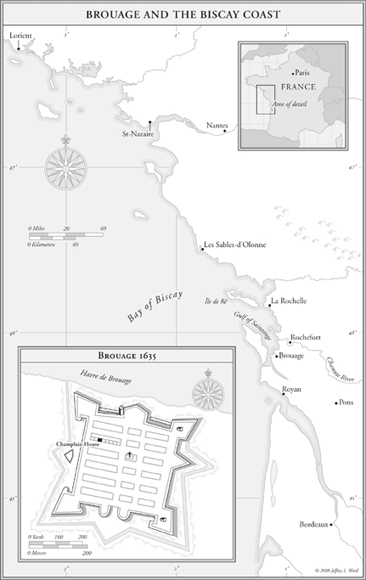
The new Brouage was designed as a handsome Renaissance ville carrée, a perfectly square town just over four hundred yards to a side. It was also built as a place forte, fortified against attack by land and sea, with round bastions at every corner, a massive stone gate, and a double wooden drawbridge. The elegant fortifications that stand today were the work of many generations. They were begun before Champlain was born, improved throughout his youth, and massively rebuilt by Cardinal Richelieu in Champlain’s old age. Its approaches were expanded by great French military architects.10
Champlain witnessed much of this construction in his youth. A detailed manuscript map survives from about 1570, very near the time of his birth. It shows that Brouage was very much a work in progress when he lived there. Crenellated stone walls had been raised around part of the town; the rest was protected by a wood palisade improvised from old masts and fir planks.11 The setting was as handsome as it is today, but life was difficult for families who lived there. One visitor wrote in 1581, “This place seems to have been hard-won from the water, which covered the entire place, and even now during the great floods in winter, the streets and the lower floors of the houses are all full of water.”12
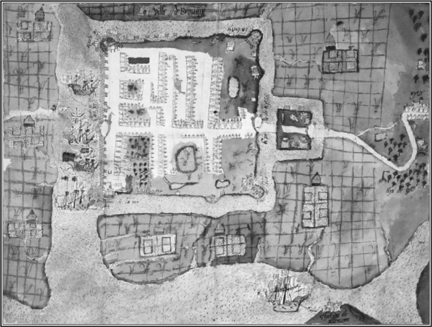
Brouage in a manuscript dated 1570, near the time of Champlain’s birth. The town was a work in progress, with half-finished walls and water-logged lots. But its marshes were crowded with saltworks, the harbor teemed with ships, and streets were lined with stone houses. His family’s home still stands on the rue Champlain.
Even so, money could be made in Brouage, and business was booming. By the time of Champlain’s birth, the town was packed with people. The land inside the walls was divided into very small building lots, some merely twenty-five feet wide by a hundred feet deep with an annual ground rent of 36 livres. On the 1570 map, every street was completely lined with stone-built private houses. Around the town, the surrounding marshes were divided into saltworks, each with its own pans and cottages for the free-spiritedsaulniers, who managed the marshland and brought the salt to town by boat. The map of 1570 shows a harbor crowded with large ships, flying the ensigns of many nations. Historian Natalie Fiquet wrote that the “town’s port was large and teeming: Scottish seacoal, Dutch tallow, cordage, herring, dry cod, iron and wood” were exchanged for barge-loads of wine, grain, and especially salt.13
Surviving records of trade describe an astonishing range of origins and destinations, even clearance papers from Brouage for Peru in the year 1570. Complex triangular and quadrilateral trades developed. One example was a voyage that began on April 26, 1602. The captain’s orders were to sail from Rouen to Brouage, take aboard a cargo of salt, proceed to the Gaspésie in America and barter the salt for cod, return to Spain and exchange the cod for a cargo of general merchandise, carry those goods to Marseilles and replace them with Mediterranean freight for Le Havre and Rouen, then back to Brouage once more.14
Brouage was a cosmopolitan town. A visitor described it as a “Babel where people speak twenty languages.” A few doors away from the home of the Champlain family is a small stone house that was built by a Dutchman. Its stone lintel still bears the inscription that he carved in his native tongue, when young Champlain was living on the same street:
1585
Wol Gode Betrout Die Heft Wolgebout
It might be translated, “He who puts his trust in God has built well,” or “Qui place sa confiance en Dieu a bien construit.” This near neighbor came from a distant land and spoke a different language, but he worshipped the same God and engaged in the same global commerce.15
The new town of Brouage was a bundle of paradoxes. It was a modern entrepôt on an ancient foundation, a small town but cosmopolitan, a fortified town but insecure. After the Protestant Reformation it was caught between warring Calvinists and Catholics. Jacques de Pons and his sons chose the Protestant side, as did most of Jacopolis. In 1559, Royal troops seized the town, and many of its inhabitants became Roman Catholic. Eleven years later it was besieged by Protestant troops from La Rochelle, and the strife continued for many years.
Rivalries of trade reinforced conflicts of religion. The people of La Rochelle thought of Brouage as their competitor and seized an opportunity to destroy a rival port. In 1586, the Rochelais sent twenty-one barges filled with sand and rock in an attempt to block the channel that led to Brouage. The port never fully recovered from this blow. Its harbor slowly filled with silt, and the expanding salt marshes that had been the source of the town’s prosperity became a factor in its decline. After Cardinal Richelieu defeated the Protestants of La Rochelle in 1628, the Catholic rulers of France made Brouage into a garrison town. They reinforced its walls, and added an arsenal and barracks to control this restless region. Its inhabitants looked with hope to the sea—and with deep suspicion toward their rulers in Paris.16
In the midst of this turmoil, Champlain lived his formative years. Like many men of action in the early modern era, the evidence of his early life is lost in obscurity. We have no record of his baptism, perhaps because a fire in the late seventeenth century burned some of the records of Brouage, or because he was baptized in the Protestant Church, or for other reasons as we shall see. We cannot be certain that he was born in Brouage, but he was raised in this town, and he presented himself to the world as “Samuel Champlain, of Brouage.”17

The stone battlements and lanterns of Brouage were begun in Champlain’s time and rebuilt by Richelieu and others. Today small canals and ponds are all that remain of its once busy harbor.
Champlain was born around the year 1570. A local antiquarian wrote in the nineteenth century that his date of birth was 1567. A modern historian has argued that he was born as late as 1580. A close look at clues that Champlain scattered through his writings (four sets of clues in particular) indicates that the earliest suggested date is improbable and the later date is impossible. The best estimate is about 1570, for reasons discussed in the first appendix to this book.18
We know next to nothing about Champlain’s mother. Her name later appeared in Samuel de Champlain’s marriage contract as Margueritte Le Roy. The local antiquarian wrote that she came from a family of fishermen, but we have no other evidence one way or the other. Margueritte Le Roy had a sister who also lived in Brouage, married a sea captain there, and had relatives in La Rochelle. For many years this was all that historians knew about Margueritte Le Roy Champlain. More recently, American genealogists have turned up information about the Le Roy family in La Rochelle and nearby towns. Some were prosperous lawyers and merchants with country estates and a coat of arms that they shared with other Le Roys in Niort and Poitiers. These Rochelais Le Roys were mostly Huguenots. Many would migrate to the Netherlands, England, and America in the French Protestant diaspora that contributed an important population to the United States. Probably Champlain’s mother had relatives in fishing ports and trading towns throughout the region.19
Champlain’s father left more traces. His name was spelled creatively in several records as Anthoyne Chapellin and in his own legible hand as Anthine Chappelain. Other legal documents called him Anthoine de Complain or Antoine de Champlain.20 If we study these scattered sources in a systematic way and order them in time, an interesting pattern begins to emerge. They describe the arc of a career that reveals many things about this family. According to the memory of a local scholar, Antoine de Champlain, like Marguerite Le Roy, was descended from families of fishing folk. He earned his living from the sea, and scattered pieces of archival evidence show him working his way up. A document in 1573 identified him as a pilotte de navires, a pilot of large ships. Pilottehad a particular meaning in the sixteenth century. A maritime historian writes that in this period “all pilots came from the ranks of the able-bodied sailors” and had an elementary education. They learned to manage a ship by long experience before the mast, and they had schooling enough to read and write, and to master the “art of navigation” both at sea and in coastal waters. A pilot was perceived to be an artisan, and he lived “from day to day” on his wages. It was written in the mid-sixteenth century that “most of the pilots are married and they have a house and a wife and children and family, and it takes everything they earn to provide for them.”21
This appears to have been Antoine Champlain’s condition when Samuel Champlain was an infant. In the years that followed, Antoine moved upward from pilot to the rank of master. This advance increased his salary and improved the status of his family. More than that, he became “the administrator of all the economic resources on board the ship, and that gave him extra income…. Whoever acceded to the charge of master crossed the frontier that separated salaried workers from those who handled and administered capital.”22
Then Antoine Champlain moved up again, from master to the rank of captain. A later record identifies him as capitaine de navires, a commander of large ships who stood high above the condition of a pilot or master. This title was also a quasi-military rank. A man who held it was expected to lead in time of war or mortal danger. A captain of a large ship was regarded as a man of honor and was treated as a gentleman, even if he came from humble origins.23 Antoine also went up another step, and received a commission from Henri IV as a naval captain. His son later described him as captain in the King’s Marine, and called him Antoine de Complain, with the particule de noblesse, a mark of distinction though not usually of nobility.
At the same time Antoine was also getting ahead in yet another way. He became a shipowner, buying small shares in several vessels, as even large investors did, to spread the risk in a dangerous business. This put him on yet another level and took his family to a different place. Owners were the men who hired the crew and employed the officers of their ships. They acquired the cargo and took the lion’s share of the profit. Owners were called “ship lords” by seamen and officers. When an owner went to sea, he had the best accommodations on board. The officers deferred to him. Even the captain who had command authority, the master who sailed the ship, and the pilot who was skilled in seamanship and navigation, gave way before a “ship lord.”24
These few legal documents tell us that Antoine de Champlain succeeded in rising from humble beginnings to high rank in maritime France. He also did well in another way, increasing his income from investments in ships and voyages. Samuel de Champlain always wrote of him with pride and respect. In Brouage, Antoine de Champlain became a man of property. The Champlain family moved to one of the larger houses in the town. They also acquired a second house, and then a third. They were not of the nobility, and their houses were nothing like the home of Christophe Depoy, sieur d’Aguerres and governor of Brouage, whose estate occupied a corner of the town, with its own gardens, fountains, and a fine view of the harbor.25 The Champlain’s were not of Depoy’s rank but they were prosperous and flourishing. Others in the family were getting ahead in the same way. An uncle from Marseille also rose through the maritime ranks to become a man of property. Their cousins in La Rochelle were doing well too. All his life, even in very hard times, Samuel de Champlain had an optimistic way of thinking about the world, an attitude that comes easily to people whose families have been moving up, especially in their childhood.
Always at the center of Champlain’s life was his Christian faith. It appeared in his youthful writings as early as 1599, grew stronger through time, and became the passion of his old age. In difficult moments, it was the source of his inner strength. The roots of Champlain’s religion are lost in obscurity. His Catholic biographer N.-E. Dionne writes, “We know practically nothing of Champlain’s years in one of the most troubled periods in the history of France, that of the wars of religion.” We do not know with certainty if his family was Protestant or Catholic. The sources are not conclusive, but they offer many clues.
The first clue appears in his name, and the names of his parents. Samuel de Champlain was named for a hero of the Old Testament. The biblical Samuel was the first of the great Hebrew prophets, an upright judge of Israel known for his stern integrity. Samuel believed deeply in one God and the rule of law. He fought the Philistines, denounced false priests, and ordered the people of Israel to “put away strange Gods.” He also refused to take bribes, and did not hesitate to stand against men in power when they went against the law.26
Samuel’s combination of virtues appealed to Protestants in the sixteenth-century Reformation. Among English Puritans, one study finds that Samuel was the third most popular name for boys, exceeded only by John and Joseph. It was less common in high Anglican households, and rare among Roman Catholics. Champlain’s forename strongly suggests that he was baptized as a Protestant.27
Other clues appear in the names of his parents. Antoine and Margueritte Champlain were named after Catholic saints. The ascetic St. Anthony and the martyred St. Margaret were favorite namesakes among Roman Catholics, but rare among Protestants. Taken together, the evidence of names tells us that Champlain’s grandparents were probably Roman Catholic and baptized their children in a Catholic church. His parents likely became Protestants before 1570 and baptized their son in a Calvinist meetinghouse, perhaps the Huguenot “temple” that was known to have existed in Brouage at the time of his birth.28
More clues emerge from the history of the region where Champlain was raised. In the sixteenth century it was one of the most Protestant areas in France. Most towns granted to Protestants under the Edict of Nantes in 1589 were in the center-west of France, from La Rochelle south to the Gironde estuary.29 The greatest concentration was in the area around Brouage. After the revocation of the Edict of Nantes in 1685, the coastal region near Brouage was said to be almost depopulated by the emigration of Huguenots for Britain and America. In Brouage today, an old forge still has graffiti that were carved into its walls by Protestants who were confined there later, when they tried to leave France in search of soul-freedom.30
Other clues to Champlain’s faith come from the religion of his extended family. His uncle was born in Marseille, and is believed to have been a Protestant who converted to Catholicism. His cousin Marie Camaret in La Rochelle was Protestant. Champlain himself would later marry into a Protestant family that converted to Catholicism. All this evidence points to the same conclusion: Champlain was probably baptized and raised as a Protestant and later converted to Catholicism.31
At an early age Champlain probably went to an infant school, perhaps several of them, a common practice in the early modern era. These schools were run by housewives in their kitchens, especially in Protestant communities where rates of literacy were higher than among Roman Catholics. The purpose was to teach the fundamentals of faith, the habits of discipline, and the rudiments of reading and writing. The housewives catechized the children, kept order with their pudding sticks, and drilled them on the fundamentals of reading and ciphering. There Champlain would have learned his letters, possibly as early as the age of two or three, as was common in households of Protestants who were Children of the Book.
At a later age, Champlain may also have gone to an academy that existed in Brouage. On May 5, 1599, the Swiss traveler Thomas Platter visited the town and wrote a full account of this school. He tells us that it was a place for the “training and teaching” of “young men of the nobility and other well-born seigneurs.” The school had a rector who received his salary from Henri IV himself, and was equipped with “twenty magnificent horses, all very handsome.” The students attended for two years, and were taught the “exercises and games of cavaliers,” in particular equitation, mounting, jumping, and trick riding. They also learned to draw, to dance, and play the mandolin. Mainly they received instruction in the arts of war and the use of weapons, which Champlain mastered at an early age. He was an excellent shot with firearms, an expert with the sword, and he could ride. In the afternoons the students learned how to measure distances and lay out the foundations for a fortress. After graduation they went into the army, or into the service of a grand seigneur.
A leading French scholar, Jean Glénisson, thinks it “very possible that he attended this institution.” Other scholars disagree. Whether Champlain was a student there or not, he clearly learned what the Brouage academy had to teach.32 He learned to draw a picture, ride a horse, wield a sword, and fire an arquebus. We have no evidence of a mandolin. In legal documents dated March 18, 1615, and again in 1625 and 1626, Champlain was called an é cuyer, a term of rank which literally meant “a person used to horses,” a member of the equestrian class. Later it came to mean a young nobleman before the adoubement in which he was dubbed a knight, or more generally an upstanding young gentleman who was not a nobleman. Somehow, Champlain acquired the manners and skills of an écuyer, perhaps in the academy at Brouage.33
Young Champlain also learned other lessons from another man who had much to teach him in Brouage. The sieur Charles Leber du Carlo was a friend of the Champlain family and later lived in one of their houses. He was a highly skilled builder of fortifications, an “engineer and geographer to the king,” and an expert cartographer. He may have taught young Champlain the art of map-making.34
In another way, however, Champlain’s schooling was very limited. He never received a classical education. Like his contemporary William Shakespeare, he had little Latin and less Greek, and he was not trained in the grammar and rhetoric of classical learning. His writings make a striking contrast with the latinate prose of classically trained writers. But he had a facility with modern languages. Champlain spoke a fluent and muscular French, as strong and colorful as Elizabethan English. Like many men who went to sea in the sixteenth century, he picked up other modern languages. In maturity, he was able to speak English well enough to converse with British seamen on technical subjects. On some of his maps, Champlain mixed French and English inscriptions, and moved easily between them.35
Champlain also learned enough Spanish to communicate in that language on his West Indian voyages. His Spanish orthography suggests that he knew it mainly as a spoken language, but he could carry on a conversation with Hispanic speakers in America. He likely had a smattering of other languages, enough to get on with the Dutch, Portuguese, and Basques whom he met in his travels. Long voyages under sail with crews that spoke many tongues made a ship into a language school. Probably that was the way Champlain learned his modern languages.
Champlain’s most important school was the sea itself, and his father was his master-teacher. Dionne writes gracefully of Samuel that “his youth appears to have glided quietly away, spent for the most part with his family, and in assisting his father, who was a mariner, in his wanderings upon the sea.”36
Young Champlain went to sea many times in his childhood and youth. Later in his life he informed the Queen Regent Marie de Medici that he had studied “the art of navigation” from childhood. He remembered, “It is this art which won my love at a very early age, and inspired me to venture nearly all my life on the turbulent waves of the ocean.”37 Just how early Champlain went to sea might be inferred from another brief passage that he wrote near the end of his life. In 1632, he said he had “spent thirty-eight years of my life in making many sea voyages.” If we read that passage literally and construct a chronology of his travels after 1594, he must have made “sea voyages” in at least fourteen of his first twenty-four years.38
At an early age, Champlain learned the art of pilotage in the modern sense: the skill of sailing in coastal waters. The maritime setting of Brouage was challenging that way. The town was set on a narrow arm of the sea and surrounded on all sides by many shoals and hazards. The tight little harbor of Brouage was often crowded with ocean-going ships and small craft of every size, all bent on their own business in a thriving commercial center. To steer a vessel under sail through the harbor on a busy day was always a challenge.
One can imagine Champlain as a small boy, standing beside his father on the deck of a ship that was underway in Brouage harbor. We might see them studying the flow of tides and currents, feeling the unsteady play of onshore breezes, cocking a weather eye upward at the sky and the sails, watching the movement of shipping, dodging other craft, and carefully avoiding anchored vessels that were shifting on their moorings. All these things had to be done at the same time as they conned their ship through the narrow, twisting channel of Brouage toward the open sea. It was a rigorous school for a bright young lad, with small margin for error.
The tidal waterways from the town led outward to the Bay of Biscay. There young Samuel learned other hard lessons. The prevailing winds came from the west, which meant that he learned to sail on a lee shore. The Bay of Biscay was notorious for sudden squalls and raging storms that could be very dangerous. Sea conditions changed quickly in the bay and could catch an unwary sailor by surprise. A pilot there had to be highly skilled, constantly alert, and very flexible in his responses.
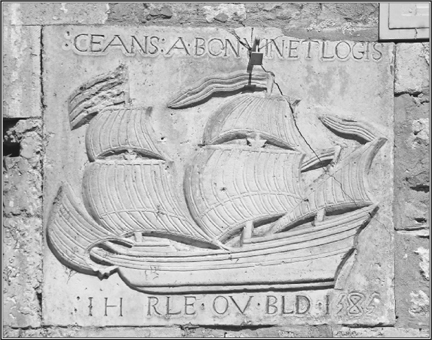
Stone sign for a seaman’s inn on the Île d’Oléron near Brouage, 1585. The top line reads, “Within: Good Wine and Lodging.” The stylized ship is a moyenne navire of the sort that young Champlain learned to sail with his father in these waters, and later used on most Atlantic crossings.
Beyond the Bay of Biscay lay the ocean. Champlain tells us that he made many ocean voyages as a child. As the ship moved out of sight of land, he had yet more skills to learn as a blue-water sailor. In his youth Champlain was probably taught to steer a course by compass and dead reckoning. His father would have instructed him in the use of an astrolabe to estimate the elevation of the sun precisely at noon, which yielded a simple measure of latitude. He would have mastered the use of a backstaffe to observe the angle of elevation for Polaris, the great North Star. It was best done at twilight, when the pole star and the horizon were both visible. It was no small feat to take a sight while standing on a moving deck of a small ship. The horizon itself seemed to rise and fall, and the stars appeared to dance in the sky as the ship rolled and pitched and yawed in a running sea. Then came the computations, with adjustments for the “limb” of the sun, and others for Polaris, which in Champlain’s era was not as near true north as today, and had to be corrected by the use of “pointer stars” nearby. Probably he learned this too as a child from his father.
There were other lessons. As Antoine Champlain rose from the rank of pilot to master, captain, and owner, he became responsible for the business side of a voyage. Young Samuel learned about the world of commerce, markets, commodities, and money. He learned to deal with men of business who spoke languages different from his own and absolutely had to be understood. He learned that some were men to be trusted and others were not, and many things hinged on a matter of judgment.
He learned that a voyage could be dangerous in ways that had nothing to do with wind and water. The coastal waters of France were infested with corsairs, pirates, and predators. Even the harbor of Brouage attracted desperate characters. The town map in 1570 showed a gibbet outside the main gate, and it was likely in frequent use. Men at sea learned how to stay out of harm’s way as best they could, but when they were in it, they had to be able to defend themselves. A seaman in the sixteenth century was also a man-at-arms. Champlain learned the use of the great guns that every navire carried for her own protection. He also had to learn how to deal with irritable passengers and unruly crews, who were often a challenge in unexpected ways. Here was yet another set of skills for Champlain to master. He would have studied these things while he watched his father deal with the routine crises that arise on a wooden ship in an open sea. Champlain had fourteen years of this instruction before he was twenty-four.
He tells us that the sea was deeply interesting to him. The drawings on his maps show us that he was fascinated by ships of all sizes—great galleons, small craft, and anything that floated on the sea. His images of ships were sketched with bold and confident strokes, and were very precise and lovingly detailed. He always had an eye for the beauty of a full-rigged ship at sea, or the sleek lines of a sharp-built patache, or the charm of a simple shallop bobbing at anchor in a quiet cove.39
Champlain was deeply drawn to the sea, even as he learned how dangerous it could be. Like any experienced seaman, he wrote of the sea with deep respect, for he knew what it could do. His treatise on navigation is full of dire warnings and rueful lessons from hard experience. More than a few passages of his journals describe his encounters with ice and fog in the North Atlantic, rocks and shoals on treacherous coasts, hurricanes in the West Indies, wild nor’easters in the Gulf of Maine, and sou’westers in the Bay of Biscay. He met huge waves on the Grand Bank, and white squalls that suddenly blew up in mid-ocean, out of a clear blue sky. He dealt with tides and currents beyond imagining, and shoal water on the fringes of four continents. In more than a few passages, he marveled that he was still alive when many a good seaman had drowned at sea.
There was always a curious mix of fatalism and instrumentalism in his attitudes. Champlain tells us in his writings that he never learned to swim, which was common among men who kept the sea during the early modern era. It belied a strangely fatalistic attitude that was very distant from our own time. All these attitudes began to form early in his young life, when Champlain went down to the sea in ships, sailing with his father from their home in Brouage, along the coast of France, and into the western ocean. It gave him an education for a life of leadership in the years to come.