
Monarch, Mentor, Patron, Friend
His Majesty, to whom I was bound as much by birth as by the pension with which he honored me.
—Champlain on his relationship with Henri IV, 16321
King [and] country … God and the world.
—Champlain on his loyalties and large purposes, 16322
IN THE RANK-BOUND WORLD of sixteenth-century France, young Samuel Champlain had a very powerful friend. From an early date, he and his family formed a personal connection with the man who would become Henri IV, king of France from 1589 to 1610. How that relationship began, we do not know. Champlain wrote late in life that he was “obligé … de naissance,” obligated or bound by birth to the king. It is a curious phrase, and its meaning has never been explained.3
Perhaps Champlain meant that his family had long been loyal supporters of Henri IV in a divided France, and they received many rewards for faithful service, which was certainly true. Champlain’s father was given a coveted commission as Captain in the Royal Navy of France. His uncle from Marseille received several commissions from the king. His Rochelais first cousin-in-law, Jacques Hersan or Hersaut, was given a special position in the Royal Household, with the wonderful title of “picqueur de chiens de la Chambre du Roy; chief whipper of dogs in the royal kennels.” It was not the most honorable of royal offices, but probably it paid well and brought other advantages. On legal documents, Jacques Hersan reproduced his royal title with great pride.4
The most generous of these royal favors came to young Samuel Champlain himself. From an early date, the king paid him an annual pension. It began by the summer of 1601, perhaps earlier, before Champlain’s first voyage to Canada in 1603, and long before any of the major achievements for which we remember him. The pension continued every year until the king’s death in 1610, and intermittently thereafter.5 Henri IV was known to be generous to his friends, but these many favors to Champlain and his family were acts of extraordinary largesse. One might ask why. What was the origin of this special relationship between a great king, a family of humble origins, and a youth of modest rank? Perhaps Champlain’s relatives or even young Champlain himself performed some special service for the king. They might have done so in some moment of danger or desperation, which happened with some frequency in Henri’s life.
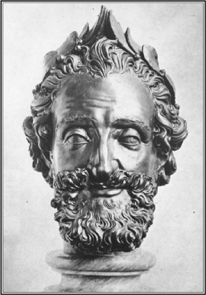
Henri IV with tousled hair, curly beard, and the libidinous look of a faun or satyr. The sculptor has caught his lively intelligence and good humor, with the brow of a thinker and the eye of a dreamer. He was the most human of great kings—and one of the most humane.
It is also possible that Champlain and the king had another connection of a different kind. For many years, rumors circulated among historians that Samuel de Champlain was the illegitimate son of a very high-born person in France. Two leading scholars put them in print. The great Canadian historian Marcel Trudel noted that some scholars have “been inclined to see in Champlain … the bastard of a great family.” A distinguished French historian, Hubert Deschamps, professor in the Institute of Political Studies at the University of Paris, asked if Champlain “was not the illegitimate son of a grande famille.”6 More than that, a report that Champlain was the son of the king himself reached the ears of Algonquin Indians in the St. Lawrence Valley. One of them was alleged to have said that he heard Champlain himself say it was so. The Indians passed on this belief in oral tradition through many generations.7
None of these rumors has any probative value. No positive evidence to confirm them has been found by any scholar. The quantum of hard data in support of this hypothesis is approximately zero. But one may ask, could it have happened? Could Champlain have been the illegitimate son of Henri IV? Could such a hypothesis explain some of many anomalies in the life of Champlain? The answer is yes. It could have happened. If so, it would resolve many puzzles in Champlain’s life and work.
At the time of Champlain’s birth, circa 1570, the future King Henri IV of France was Prince Henri de Béarn and Navarre. The prince was in his late teens. An engraving at that time shows him to have been remarkably mature for his age, and we know that he was sexually active, to say the least. He married his first wife in 1572. In the course of his life, he is known to have had at least fifty-six mistresses of record, and casual liaisons beyond counting. He is also known to have fathered at least eleven illegitimate children by five or more women.8
Altogether, Henri IV scattered his seed widely through his kingdom, before and after he came to the throne. During the years from 1568 to 1572, the young prince was often in La Rochelle, where his mother was living at the time, about 25 miles from Brouage. He traveled widely in Saintonge, and was in the right place at the right time to have fathered Samuel by a woman of that region. The infant could have been adopted by a respectable bourgeois family, a common practice for illegitimate children of high-born parents in Champlain’s time, as in our own. The rank assumed by the king’s many illegitimate children was highly variable, and tended to follow the condition of their mothers.9
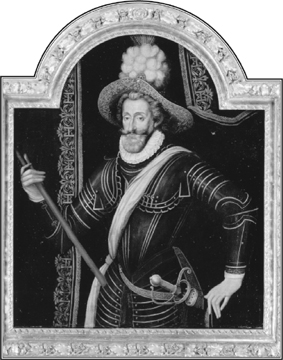
Henri IV as a triumphant warrior king in black armor and a towering white panache of curled feathers. With a sceptre in one hand and a sword in the other, he called to the French people, “Ralliez vous à mon panache blanc!”
The hypothesis that Champlain was the illegitimate son of Henri IV could explain why no records of his birth or baptism have ever been found, though many scholars have searched for them. It could account for the anomaly of Champlain’s social rank, which has long puzzled historians, and has given rise to a running controversy as to whether Champlain was a nobleman or commoner. Most scholars now agree that his family began in modest circumstances, and yet at an early age young Samuel was called the sieur de Champlain. He rarely wrote his name as “de Champlain,” usually as “Champlain.” The particule de noblesse and the honorific title of sieur were added to his name by others in official documents as early as 1595.10
The date and circumstances are important. Champlain did not assume the title of “sieur” and the particule de noblesse for himself late in life, as several historians have mistakenly asserted. They were given to him by others when he was no older than twenty-four or twenty-five. These honorifics did not mean that a person had a title of nobility. They were marks of honor, commonly given to men of high birth, important offices, great achievements, long service, or advanced age. It is interesting that the particule de noblesse came to Champlain before he had done any of the deeds for which he is remembered. An intimate connection with the king could explain why he became the sieur de Champlain at a young age, even though he was not of a noble or wealthy family and had no major achievements to his credit.11
It could also account for the royal pension that Champlain received every year from as early as 1601 until the king’s death in 1610. And it would help us to understand how and why Champlain had easy access to the person of the king. After returning from his early voyages to the West Indies, and before and after his journeys to Canada, Champlain was able to meet directly with Henri IV. It could help us understand another curious statement by Champlain—that the king made arrangements to keep him “about his person.”12
And an illegitimate birth might explain Champlain’s extreme reticence on the subject of who he was, which was all the more remarkable by contrast with his effusive accounts of what he did. It would give a literal meaning to Champlain’s puzzling phrase, “obligé de naissance,” bound from birth to Henri IV. All these anomalies in Champlain’s life would no longer be strange if he was the illegitimate son of Henri IV. Together they make a long list.
Such a connection would also help us to understand the troubles that came to Champlain after the death of Henri IV: the cold distance of Henri’s widow, Marie de Medici; the decision to end Champlain’s pension; and the hostility of her servant Cardinal Richelieu, who tried to remove Champlain from his position as lieutenant for New France. It could account for the refusal of those leaders to bestow any honors on Champlain, when others who did much less in New France were given more rewards in the form of titles of nobility, grants of land, and lucrative offices. Many historians have remarked on the refusal of Marie de Medici and Richelieu to honor Champlain, without being able to explain it.
Some of these puzzling anomalies in Champlain’s career could be explained in other ways, without assuming that he was the illegitimate son of Henri IV. His developing relationship with the king might be understood as a sequence of contingencies. This alternative hypothesis might begin with the fact that Champlain’s family appear to have been loyal supporters of Prince Henri during the most difficult and dangerous years of his life. The center-west of France was his strongest base—especially Saintonge and Aunis. Henri’s most loyal supporters were families of modest wealth and middling rank, Protestant in their religion, but not dogmatic or doctrinaire—families such as the Champlain’s in Brouage; the Le Roys, Hersans, and Camarets in La Rochelle; the Boullés in Paris—all connected to Samuel de Champlain. They and others like them helped Prince Henri and his mother in the hour of their greatest need. When the prince gained the throne, he was generous to these families, as was his nature. He gave them offices, commissions, pensions, and other marks of royal favor.
Then the young Saintongeois began to bring himself to the attention of the king. Suffice to say that Champlain was devoted to the king, loyal to his cause, and quick to seize opportunities to serve him. At the same time, the king himself appears to have taken a liking to this engaging young man and enjoyed having him about. This sequence of events, combined with the chemistry of a great king and the achievements of a personable young man, could explain the connection that developed between them.
Whatever the root of Champlain’s special relationship to the king may have been, the fact of its existence is firmly established in the record of his life. Henri’s patronage was fundamental to the prosperity of the Champlain family, and it was instrumental in the success of Samuel de Champlain. The king’s intervention directly shaped the pivotal events in Champlain’s early career, and we shall see that this happened many times.
Henri IV was not only a patron of Samuel de Champlain, but also a model and even a mentor. For this young man and many others, the king’s example of leadership was an inspiration, and Henri’s values became a creed that Champlain served all his life. To comprehend Champlain, we must understand the character of the king he served so faithfully. Without Henri IV there would have been no Champlain—as we have come to know him.
In the long history of France, Henri IV has a unique place. It has been said that he was “the only king whose memory was cherished by the people.” His subjects remembered him as Henri le Grand, Henri the Great. In physical terms he (like Champlain) was not a large man. But there was a greatness in his acts and thoughts, a largeness in his energy and resolve, and an astonishing amplitude in both his virtues and his vices.13
The qualities of this king were very different from those of other great figures in the history of France. In his personal style of life, Henri IV was far removed from the formal grandeur of Louis XIV, the imperial splendor of Napoleon, and also from the austere and distant condescension of Charles de Gaulle. The character of Henri IV appeared in the nicknames that his subjects invented for him. They celebrated him as le roi de coeur, the king of hearts. Others called him le passionné, the passionate one; or le roi libre, the free king. The literati liked to write of him as le vert-galant, the green gallant— vert with its ambiguous connotations of youth, energy, and (in French) promiscuous sexuality; galant in its mixed association with courtesy and inconstancy. These sobriquets referred to Henri’s public and private life. In his many love affairs Henri IV was indeed le roi de coeur, le roi passionné, and le roi libre all at once, in a sense that had nothing to do with political theory or public policy.14
At the same time, Henri’s nicknames also described a unique style of kingship that flowed from the heart. Other monarchs cultivated a distance between themselves and their subjects. They used remoteness as an instrument of royal power. Henri went another way. He was known to leave his palace incognito, and mix with his subjects in informal ways. As a leader he was open, informal, warm, free-spirited, brave, witty, clever, generous to friends and enemies alike. He was also thought to be mercurial, fickle, unreliable, and untrustworthy. Another nickname, borrowed from his father, was “Henri l’ondoyant,” Henri the Unsteady. His best friends acknowledged his flaws, but his warmth and magnetism drew even his enemies to his service.
Even with this cultivation of intimacy and informality, and in spite of his many vices, there was a common perception of greatness in this man. The strongest evidence appeared in his effect on the conduct of others. Even before he came to the throne, extraordinary things tended to happen when Henri was around: sometimes for better, sometimes for worse. His enemies were deeply alarmed by him and driven to extreme actions. Among his many friends, the king’s spirit and vision awakened great enterprises and inspired others to undertake them. Champlain was one of many young Frenchmen who responded to his leadership in that way. “Henri le Grand” was a man who made a difference in other men’s lives.
To comprehend Champlain’s career, one must understand the character of this great king. As Champlain called himself a man of Saintonge, so Henri was called le Béarnais, the man of Béarn. He came from the mountains of southwestern France, was born in the shadow of the Pyrénées, and brought up in a country château of great antiquity that still survives as his monument. The future king was very much a product of that special place. From infancy he was steeped in the culture of Béarn, which gave meaning to the old German saying that mountains make free. The people of that province were fiercely independent. They preserved their traditional liberties, and stubbornly retained their ancient rights until the Revolution of 1789.15
Henri also cherished the language of Béarn, and he learned to speak it as his native tongue. At the age of four he was taken to the French court and presented to Henri II, a formidable character who asked the small boy if he would like to have the king for his father. The child looked to his parents and said in the speech of Béarn, “Quel es lo seigne pay; This is my father.” The king laughed and asked the child “if he could not be a son, would he be a son-in-law?” The boy answered boldly in his Béarnais dialect,“ObéiYeah!” More impressive than what he said was the way he said it.16
The young prince’s father, Antoine de Bourbon, came from one of the great noble families of France. He was a brave soldier, but some described him with the same word that others would later use for his son: ondoyant, unsteady, unreliable. Henri’s mother, Jeanne d’Albret, was made of sterner stuff. She was handsome, headstrong, smart, tough, and extraordinarily able. As heiress to the kingdom of Navarre and the county of Béarn, she held great power in her hands, and she used it to great effect.17
Jeanne d’Albret converted to Protestantism, as did many of her subjects in southwestern France. She deliberately kept her son away from Catholic Paris and the Valois court, which she regarded with contempt. She raised him as a Protestant and brought him up to be a young man of broad cultivation and independent spirit. He was trained as a soldier and became highly skilled in the profession of arms. He was also taught by his mother to be a leader. At an early age he was given challenging assignments that required tact, judgment, and a mastery of the intricate politics in Béarn and Navarre. Those skills were soon summoned to a larger stage.18
In the year 1559, when Prince Henri of Béarn and Navarre was barely six years old, a bizarre medieval accident transformed the history of modern France. In royal celebrations for the marriage of a princess, King Henri II entered a jousting tournament. He succeeded in smashing his opponent’s lance, but a splinter from the shattered weapon pierced the king’s eye. The wound festered, and Henri II died suddenly at the peak of his considerable powers.19 That chance event came at a bad moment. Most people throughout the country shared an ideal of Christian unity: une foi, une loi, un roi—one faith, one law, one king, but the reality was very different. The kingdom was divided against itself. The population of France was growing beyond its means. In a time of rapid inflation, extremes of wealth and poverty were increasing, and social orders were moving apart.20
The political situation was highly unstable. Authority was divided among kings and nobles, regional parlements and estates, autonomous towns and cities, chartered companies and religious institutions. All were deeply jealous of their privileges and united only in their hostility to expanded royal power. Especially hostile to the monarchy were the great noble families, who were rivals for dominion. Bitter conflicts developed between the Catholic House of Guise in the east, the Protestant House of Condé to the west, and the more moderate Houses of Montmorency and Bourbon to the south. All dreamed of succeeding the House of Valois, which had ruled France for three centuries.
These dynastic rivalries were deepened by religious divisions. Most people in France were Roman Catholic in 1559, but Protestants were making converts everywhere, even within leading Catholic families. Adherents of the old church were deeply disturbed by the challenge of a new faith. On both sides, religious leaders aroused feelings of intense fear and hatred.
This was the dangerous moment when Henri II died suddenly from the splintered lance. He was succeeded by his young son Francis II, barely fifteen years old, frail of body and weak of mind. This child-king was dominated by his formidable adolescent wife, sixteen-year-old Mary Queen of Scots, and also by her French relatives in the Catholic house of Guise. They hated Protestants with a passion and chose the path of violent repression. The result was a disaster for France.
Protestant evangelists were rounded up and tried for heresy, which was a capital offense. Catholic judges inflicted barbaric tortures on Protestants who refused to recant. Victims who continued to protest their innocence had their tongues cut out before they were tortured and burned, so they could not preach to the people who gathered to watch their agony. Even these judicial atrocities were not cruel enough to satisfy sadistic crowds, who seized the suffering victims and mutilated them in unspeakable ways. In the streets of Paris, roving gangs of Catholic youths erected images of the Virgin Mary, and passersby who failed to genuflect were assaulted in rituals of bloody violence. The horror of religious persecution came both from the top down and the bottom up.21
After eighteen months of growing disorder, young Francis II died in 1560 and was succeeded by his even younger brother Charles IX, who was ten years old. Power passed to his Italian mother, Catherine de Medici, and for a time she ruled the kingdom from a small study in her beautiful château of Chenonceau. In 1562, Catherine tried to restore peace to France by proclaiming limited toleration of dissenters. It was not enough to please Protestants, and too much for Roman Catholics.
A fatal incident followed. On March 1, 1562, a quiet Sunday morning, the militant Catholic duc de Guise was on the road from his estates to court, with a large escort of men-at-arms. As he approached the town of Vassy in Champagne, he heard a bell calling Huguenots to worship in a grange. As the soldiers approached there was an exchange of epithets, then a volley of stones. The duke’s men stormed the grange, killed and wounded more than a hundred Protestant men, women, and children, and burned the building.22
The result was the first war of religion, which set the pattern for many wars to follow. The Protestant House of Condé raised a Huguenot army, and called for help from English and German Protestants. This Huguenot army began to capture strategic towns throughout the country. The violence was beyond imagining. Catholic atrocities happened in Sens and Tours where two hundred Huguenots were bludgeoned and drowned in the River Loire. Those terrible scenes were followed by a Protestant outrage called thesauterie of Montbrison, when Huguenots hurled hundreds of Catholic prisoners from a high tower into fires that were burning below.23
The Catholics brought in Swiss and Spanish troops, and won a terrible battle at Dreux, where a surgeon eyewitness estimated that 25,000 were killed on both sides in two hours of fighting. The victorious army moved on to attack the city of Rouen, and sacked it in three days of rapine that left more than a thousand dead in the first of many such scenes. As the Catholic army began yet another siege at Orléans, the Huguenots struck back by killing the duc de Guise—the beginning of many such assassinations by both sides.24
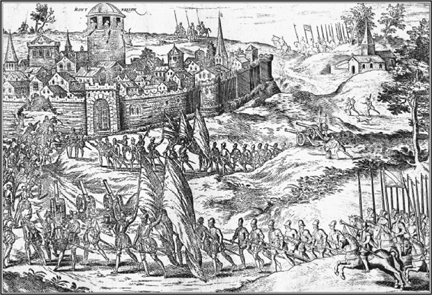
After a Catholic atrocity started the first war of religion on March 1, 1562, the town of Montbrison was the scene of a Protestant crime. Huguenots sacked it in June 1562 and hurled its Catholic defenders from a tower onto spikes and bonfires below.
This first war of religion ended in a shaky truce at Amboise in 1563, but the violence quickly resumed. A new leader of the House of Guise, the cardinal of Lorraine, gained control of King Charles IX and brought Spanish troops into France. Protestants tried to kidnap the Catholic king. This desperate effort failed and started a second civil war in 1567–68, which left a “trail of destruction” across France. The killing continued until the exhausted combatants were too weary to continue. The result was a precarious truce called the Peace of Longjumeau.25
That peace also failed, and was followed by a third and even larger religious war in 1568–70. The violence spread to the south and west of France during Champlain’s childhood. Some of it rose from angry acts of aggression by French Protestants against Catholics. Much of it came from popular violence by Catholic “confraternities” against Huguenots and anyone who tried to stay neutral. The people of Bordeaux lived in mortal fear of a sadistic gang called the Bande Cardinal, who wore the bonnet rouge and tortured, raped, and murdered Huguenots, all in the name of Christ. Some Catholic leaders tried to suppress these atrocities, but others encouraged them.26
Saintonge became a theater of war, and Champlain’s town of Brouage changed hands many times while he was a child. In 1568 Protestants controlled much of Saintonge and a Huguenot garrison occupied Brouage. The next year, Catholic forces and Italians took the town. The Protestants recovered it in 1570, but it was returned to Catholics by peace treaty and became a base for operations against the Protestant fortress of La Rochelle. Protestants later regained control of Brouage, then lost it again. Warring armies marched and countermarched through Saintonge. They foraged and plundered in a time of famine, plague, and suffering. In the midst of these horrors, Champlain was probably baptized a Protestant, in a world of intense religious hatred and incessant war.27
The worst was yet to come. In 1571, Catherine de Medici and Jeanne d’Albret arranged a dynastic marriage between their children, the attractive Catholic Princess Marguerite de Valois and the handsome Protestant Prince Henri de Béarn and Navarre. It was to be a “marriage of two religions,” in the hope of lasting peace. A sumptuous wedding was planned for Paris, and Henri rode into town with 1,500 Huguenot leaders. The Catholic nobility turned out in even greater numbers. The ceremony of betrothal took place with outward harmony on August 17, 1572, and the wedding the next day was a brilliant affair. Marguerite de Valois wrote in her splendid memoirs, “I blazed in diamonds.” Margot, as she was called, was beautiful, intelligent, and bitterly unhappy. She was reported to be in love with the Catholic duc de Guise, and it is said that she refused to say yes at the wedding until her infuriated brother King Charles IX intervened, and bent her crowned head forward by brute force in an unwilling gesture of assent.28
Four days of celebration followed, but behind the scenes the leaders of the House of Guise and the Catholic Church were outraged by the wedding and appalled by the ecumenical spirit that it symbolized. Agents of the English secret service warned Huguenot leaders to be on their guard, and the atmosphere grew heavy with foreboding. On the last day of the marriage festivities, as the great Huguenot leader Admiral Gaspard de Coligny was riding through a Paris street, a shot rang out. This leader of the Protestant cause was severely wounded. But Charles IX promised protection to the Huguenots and they remained in town.29
Rumors spread that Protestant assassins were planning to cut the king’s throat and seize the throne. A great fear swept through the city of Paris, and the frightened king was caught up in it. On the night of August 23, 1572, Catholic leaders persuaded the terrified monarch to make a preemptive strike against the Huguenots. He agreed. The gates of the city were closed. Boats in the Seine were chained to their moorings, and the Catholic militia of the city was armed. The next night Prince Henri de Béarn and the Protestant duc de Condé were summoned to the king’s chamber and arrested. Early in the morning the wounded de Coligny was murdered in his bed. That was the signal for a massacre. Huguenot nobles who had gathered for the wedding of Henri were attacked. Nearly 1,500 were killed, many with their families, in what was to be remembered as the Massacre of St. Bartholomew’s Day.30

The slaughter spread through the city. Catholics wearing white crosses and armbands turned against Protestant neighbors and murdered three thousand people in a frenzy of fear and rage. Young children were brought into it. Catholic children were given the task of castrating and disemboweling the body of Admiral de Coligny, and dragging the remains through the streets of Paris in a ritual of degradation. Similar scenes spread to the provinces of France.31
In the king’s chamber, Prince Henri de Béarn and Navarre was given a choice: immediate conversion or instant death. On September 26, 1572, he rejoined the Catholic Church. The Catholics kept him at court in luxurious captivity, closely guarded and carefully watched. The Protestant movement suffered a shattering blow but it survived, and persecution strengthened it. Huguenot armies withdrew into strongholds such as La Rochelle and held their ground. At court, Prince Henri appeared to lose himself in dissipation, but he was biding his time.
An opportunity came after 1574, when Charles IX died and Henri III de Valois came to the throne. A new attempt at coexistence followed. Protestants were granted safe havens. Prince Henri de Béarn and Navarre was allowed to leave the court, and was given the government of Guyenne in southwestern France. Once at large, he abjured Catholicism on June 13, 1576, and went to La Rochelle, where Protestant leaders received him without enthusiasm. Both sides distrusted him.32
Henri began to go a third way, looking for a middle path between the contending parties. In Guyenne he cracked down on violence by Protestants and Catholics alike, and recruited an army from men of both faiths. To a Catholic officer he wrote, “those who unswervingly follow their conscience are of my religion, as I am of all who are brave and virtuous.”33
Extremists on both sides thought this middle way was merely an expedient, and regarded Henri as ondoyant, like his unreliable father. But this was something else. Henri’s middle way was not merely a political expedient. It was an act of high principle and Christian faith. The prince said to Protestants and Catholics alike, “We believe in one God, we recognize Jesus Christ, and we draw on the same gospel.” He told zealots on both sides that wars of religion were “unworthy among Christians, and specially those who call themselves doctors of the gospel.” This idea became an article of Christian faith for him. He deeply believed that nothing could be more un-Christian than the atrocities that had been perpetrated by both sides in the name of Christ. He stood for the unity and pride of France, and for the welfare of its afflicted people.34
In Guyenne, people of all faiths began to rally to Henri’s cause. He demonstrated a gift of political judgment and a genius for war. Henri created a formidable army with sturdy French infantry and Gascon cavalry. His aide the duc de Sully provided him with the best artillery in Europe. When towns and nobles tried to fight him, he moved against them with courage, energy, and quick decision. He began to expand his control over southwestern France. In war and peace, Prince Henri was a man that other men followed.
Then came another bizarre event. The reigning king of France, Henri III of Valois, began to take notice of the growing popularity of Prince Henri of Béarn and Navarre, as did the leader of the high Catholic party, Henri of Guise. The result was yet another cycle of violence that culminated in the War of the Three Henris, and five more years of strife (1584–89). In this bloody struggle, Prince Henri of Béarn and Navarre skillfully divided Henri of Valois from Henri of Guise. In 1587 he defeated them in open battle. After bitter fighting, two of the three leaders were assassinated. Of the three Henris, only Prince Henri of Béarn and Navarre was left standing. In 1589 he became King Henri IV, the first monarch of a new Bourbon dynasty that would rule France for more than two centuries.
While Samuel Champlain passed from youth to young adulthood, Henri IV began to unite France as it had never been united before. He found himself the Protestant king of a predominantly Catholic people. To the surprise of friends and enemies alike, he decided to convert once again to Catholicism. On Sunday, July 25, 1593, he appeared at the abbey of Saint Denis. In the presence of a huge crowd, Henri knelt before the altar, and swore a vow of obedience to the Church. In the moment of the king’s conversion a great flock of doves took flight from the roof of the abbey, which was received as a sign of Providence for the king and his realm.
Many Catholics did not trust Henri IV, and with reason. This was his third conversion to Catholicism, and twice he had returned to his Protestant beliefs. The leaders of the Catholic League alleged that Henri had remarked cynically before the ceremony, “Paris is worth a mass.” No evidence exists that he actually said any such thing, which would have been impious, impolitic, and false to his own intentions. Henri IV had larger purposes in mind. He was filled with genuine horror by the wars of religion, which he believed to be deeply inhumane and anti-Christian. He was not a secular man. His object was to recover the true spirit of Christ, to rebuild a broken state, and to unite a divided people. As the leader of that noble cause, the king set a powerful example. On the inspiration of his obeisance at Saint Denis, a large number of Protestants also converted to Catholicism. Among them were many major figures who would loom large in the history of France and New France.35

On February 27, 1594, Henri IV prepared to take the Catholic city of Paris by storm, but Governor Charles de Cossé-Brissac opened its gates. The triumphant king marched to Notre Dame, took mass in the Cathedral, and the healing began in France.
In Saintonge, Samuel Champlain may also have converted to Catholicism at this time. He was certainly a Catholic by 1598, and probably by 1595. He may have become one in 1593, after Henri abjured Protestantism in his dramatic public ceremony.36Champlain also followed the example of the king in the substance of his Christian beliefs. Both men had little interest in theology. They disliked doctrinal disputes, despised religious bigotry, and hated religious persecution. They became men of deep and abiding personal faith, and cultivated a spirit of Christian piety. In 1603, it was reported of Henri IV that he “daily grows in piety, acknowledging that he owes everything to God. The Queen says that every morning he prays for half an hour, before speaking to anybody, and does the same at night.”37
Champlain changed in the same way. As he grew older, he also became more devout. The inventory of his estate included a large collection of religious books, sturdily bound in heavy vellum and designed for daily use. Prominent among them were the Fleurs des Sainetz, La Triple couronne de la bienheureuse Vierge, a Chronique et instruction du père Sainct-François, a collection of Figures des Pères Hermites, a handbook on the Pratique de la Perfection chrestienne, and other books of that genre. Some of these works celebrated the Virgin Mary and the Catholic saints. Most were guides to practical Christianity. Many offered models of piety, humility, and good works. Champlain detested religious controversy and despised bigotry. Most of all, he hated intolerance as fundamentally un-Christian, even anti-Christian. In their spiritual lives, Henri IV and Champlain matured in similar ways.38
Champlain, like Henri IV, also embraced the universal ideal of the Catholic Church, which taught that all people were the children of God, recipients of Christ’s mercy, and wards of the universal Church. That religious idea was very different from the Calvinist idea of limited atonement, which held that Christ died only for a small elite. The Catholic idea of a universal religion would be a spiritual key to the kingship of Henri IV, and to Champlain’s colonial enterprise in New France.
These men also recognized the urgent importance of religious practice and the significance of sacred ritual. They believed that the observance of religion was vital to the stability of society and the state in the sixteenth century. When Henri came to the throne he carefully performed the public rituals of Christian kingship: visiting the sick, washing the feet of paupers on Maundy Thursday, pardoning criminals on Good Friday, and touching hundreds of sufferers in the healing ceremonies on Easter Sunday.39
Henri IV and Champlain lived in an age when western civilization was deeply divided by a common ideal of One True Faith. Many people in the western world shared this obsession, but they did so in different ways. By comparison with other Christians, Henri’s and Champlain’s way of faith was something special and distinct—even unique to a small circle of leaders in France. It was very much a product of their personal experience and their country’s history. Most of all it was a reaction against the cruelty, bloodshed, and oppression of the wars of religion. That experience made Henri IV and Champlain the men they were, and New France the place that it became.
* * *
As king, Henri IV also developed a distinctive style of governance. Here again, Champlain would be deeply influenced by his example. Both men were remarkable for their energy and stamina, and they had an infinite capacity for taking pains. They knew well the importance of tact and generosity in dealing with others. Henri IV wrote, “un Roy pour estre grand ne doit ignorer rien; to be great, a king should not ignore the smallest thing.” Champlain led others by the same rule.40
By temperament, Henri of Béarn and Champlain of Saintonge were in some ways very different from one another. Henri IV lived for pleasure. He delighted in good food, great wine, and boon companions. Most of all, he loved the company of beautiful women. The pursuit of beauty became an obsession that got in the way of other things, and his closest friends complained to him about it. His faithful supporter Philippe Duplessis wrote, circa 1582, “Sire … these open and time-consuming love affairs no longer seem appropriate. It is time for you to begin loving all Christianity, and specially France herself.” Henri preferred to love all the ladies of France, seriatim.41
Samuel Champlain also enjoyed food and drink, good companions and good times, as did the king. But Champlain was more austere in his private life and he lived by a different creed. Later, those who knew him best in America remarked on his “chastity” in the face of invitations from Indian women who offered themselves to him. In that way Henri IV and Champlain could not have been more different. But in their politics and religious ideas they were very much alike.
Altogether, historians count nine civil wars of religion in France in the years from 1562 to 1598. By comparison, the United States suffered one civil war that lasted four years and its wounds still scar the great republic. The French wars of religion continued for nearly forty years. One scholar reckons the toll at “between two and four million.”42
Henri IV and Samuel Champlain lived most of their lives in a nation at war with itself. They reacted against the troubles of their age, and learned from them. Both became men of humanity in a world of cruelty and violence. Henri IV worked tirelessly to unite his kingdom, not primarily by force but by persuasion. He appealed to the altruism of his subjects and also to their material interest. He invited all the people of France to share his dream of abundance and prosperity. Every order and estate was offered inducements. Henri began by buying outright the loyalty of former opponents. Enormous sums were paid to Catholic noblemen who agreed to join the king and recognize the House of Bourbon. Some of the largest payments went to the House of Guise. The duc de Lorraine and the duc de Guise received more than a million écus. Military leaders were paid for their support. The maréchal de Brissac in Paris received 492,800 écus. Maréchal le Châtre, who held the fortresses of Orléans and Bourges, was paid 250,000, and others nearly as much. Henri IV remarked that their loyalty was pas rendu, vendu; not given, but bought. But most served the king faithfully.43
The cost of this policy was heavy. Henri was severely chastised by other European monarchs, who thought that he set a very bad example by paying his subjects for their loyalty. But Henri told his minister the duc de Sully that it would have cost him ten times as much to do it by the sword, and he was probably right.44
Henri’s policies impinged directly on the life of Champlain and the community in which he came of age. The town of Brouage came under the control of the Saint-Luc family, a dynasty of Catholic noblemen. After having opposed the Huguenots, François d’Espinay Saint-Luc rallied to Henri IV and was generously rewarded for his loyalty. His family became in effect hereditary governors of the town. In 1596, he was succeeded by Timoléon d’Espinay Saint-Luc, “un esprit plutôt libertin,” a libertine who preferred to live at Court. Peace and prosperity returned to Brouage, as to many towns in Saintonge and throughout France. The idea of national unity began to gather strength.45
Henri IV also appealed to the material interest of the middle class. He paid large sums of money to Catholic towns for their allegiance and signed treaties of reconciliation that recognized franchises, privileges, and institutions of self-government. Amnesty was granted for past acts. The Catholic Church was established as the religion of the realm, but rights of worship were granted to Protestants. Families who supported the king were rewarded.46
Peasants and even day laborers were promised prosperity and abundance. In a conversation with the duc de Savoie, Henri IV is said to have remarked “there will be no laborer in my kingdom who lacks the means to have a chicken in his pot.” Others remembered the king as promising “the poorest peasant in the land a chicken in his pot on every Sunday.” Henri IV’s phrase would reverberate through the ages. The tutors of Louis XIV quoted it to their Royal master, without much effect. In the United States, President Herbert Hoover borrowed the phrase and made a campaign promise of “a chicken in every pot” in the election of 1928.47
Henri had a dream of prosperity and abundance for all the people of France. He also became a great builder and vastly improved the city of Paris. Many of the most beloved parts of the city today were his work: the embankments and quais along the river Seine, the graceful Pont Neuf, the gardens of the Tuileries and their linkage to the Louvre, the Champs Elysees, the Place Royale, and the rue Dauphine. A distinctive architecture of brick and stone, the style Henri IV, set a tone for Paris. Henri also laid the foundations for a great royal library.48 The beautiful palace and grounds of Fontainebleau were developed by him, and the royal residences of Monceaux and Saint-Germain were in part his work.
He loved to meet and talk with friends at Fontainebleau, walking with them in the vast wooded park that surrounded the palace, deep in intimate conversation. The king formed the habit of holding his favorite companions by the hand. Other kings created distance as an instrument of power; Henri IV cultivated intimacy. Many people commented on this habit. His biographer David Buisseret believes that it was a cultural style among the méridoniaux, the people of southwestern France who had moved into the center of power with the rise of the House of Bourbon.49
Henri worked to unite the regions of France in a network of roads and canals. With his chief minister Sully (no friend of Champlain), his projects included canals between the Garonne and the Aude, which promised to link the Bay of Biscay with the waters of the Mediterranean. He maintained a strong army in France, but kept it on a short leash. His soldiers were forbidden to prey upon the civilian population. He told several captains who allowed their troops to pillage the peasantry, “Qui payera vos pensions, messieurs? Vive Dieu, s’en prendre à mon peuple, c’est s’en prendre à moi!; Who will pay your pensions, gentlemen? By God, to plunder my people is to plunder me!”50
His foreign policy won broad support in France. In the words of a leading French historian, Henri’s diplomacy created “a new equilibrium” in the affairs of Europe. He sought to end many years of confrontation between France and Spain, with treaties that were ratified by other European states. Henri IV was a man of large plans, some of them very forward-looking. He envisioned a European Union that could bring an end to violence on that war-ravaged continent. In the late twentieth century he would be rediscovered by French Europeanists as a kindred soul.51
This breadth of spirit inspired many young Frenchmen, Catholic as well as Protestant, and they rallied to the causes that Henri le Grand espoused. After a century of violence and cruelty, Henri IV offered an ideal of peace, generosity, and humanity. Champlain was one of many young men of his generation who looked to the king as their model. And for reasons that nobody has been able to explain from the historical record, young Champlain was privileged to know this great king in another way, as a mentor, sponsor, patron, and friend. Whatever its cause, its consequences were a fundamental fact of his life.