
A Design for New France, 1602
To plan such designs in table talk, to speak from the imagination of distant places … that is not the way to carry out with honor the work of discovery. One must first consider maturely the matters that present themselves in such undertakings, and talk with those … who know the dangers.
—Champlain on his grand design1
IT WAS THE WINTER OF 1602–03. Champlain was in Paris at the court of Henri IV. It was an interesting place for an ambitious young man to be. “People of all conditions went there,” writes Philippe Erlanger, “gentlemen, clergy, captains, cadets eager to make their fortunes. The court was their Eldorado. Here one gained positions, pensions, and commands. Here a royal smile sufficed to change one’s destiny. Here one found also the great model: it was necessary to walk, to dance, to talk as at the court.”2
Others went to court for another purpose, which reveals the distance between their world and ours. They wished only to serve their king. Erlanger quotes Henri’s court poet, François de Malherbe, who observed: “Good subjects are to their Prince as good servants are to their masters. They love what he loves, desire what he desires, share his sadness and his joy, and in general accommodate the movements of their spirit to those of his passion.”3
Those many motives—ambitious and altruistic, selfless and self-serving—drew young Samuel Champlain to the court of Henri IV. It was an institution of astonishing complexity. Sometimes it was called the Royal Household and always it had something of a domestic air. But it was also the seat of power in France, and the center of its civilization. In the year 1602, more than 1,500 people “of rank” belonged to the royal household, not counting 1,400 soldiers of the king’s guard, and menial servants beyond reckoning.4
All this humanity crowded into the buildings of the Louvre, a sprawling compound in Paris between the rue Saint-Honoré and the river Seine. Its architecture was another of the king’s passions, and its buildings were in a state of perpetual reconstruction. Ancient walls rang with the hammers of artisans who were endlessly at work on Henri IV’s projects. In 1594, he had ordered them to build a huge addition to the Louvre, a great gallery that ran along the river from the Pont des Arts to the Pont Royal. Altogether it cost him the immense sum of eight million livres. The king laughed about the money: “People say I am miserly, but I do three things that are unrestrained by avarice: I make war, I make love, and I build!”5

On return from Spain, Champlain reported to the king, received an annual pension, and was ordered to remain at Court. It was a school of manners for a young adventurer. Upstairs in the Louvre, the King endured boring rituals such as this banquet. Below stairs, he and Champlain worked with experts on cartography and navigation.
The Grande Galerie was fifteen years in construction. Its upper floor was a magnificent open space that extended the full length of the building. There the king liked to walk among his subjects. Below were a mezzanine with elegant shops, a ground floor with studios for artists and musicians, and a vaulted basement with quarters for the palace guard. By 1603, Henri’s Grande Galerie was only half completed. The long hall was filled with craftsmen and laborers, toiling among crowds of elegant noblemen, painted ladies, high clergy in robes of red and purple, musketeers in uniforms of blue and white, scholars in black gowns, servants in livery, opulent merchants, and impoverished petitioners of every rank. In the reign of Henri IV, the Louvre was a place of beauty and refinement. It was also ugly, smelly, noisy, and filthy. Most of all, it teemed with life and throbbed with energy.6
Officers of the royal court held many levers of power in their hands. Even in a monarchy that aspired to absolute dominion, authority was distributed more broadly than one might imagine. The most worthy proposal had to win the support of many people if it was to succeed. The opposition of one powerful person could stop it, and there were many such people here. They could make all the difference for a young man with large plans in mind.
In 1602, the court included four hundred clergy who served the king in his role as rex sacerdos, the ruler-priest who was the sacred leader of France and a living symbol of divine favor. The clergy had a public role of profound importance in early modern Europe. Nothing could be done without them. Champlain was quick to understand that these men were vital to his purposes, and he was careful to cultivate Catholics and Protestants alike.7
Equally important were the high nobility. Hundreds of noblemen lived at court and served Henri in his role as rex princeps, head of state. They conducted the elaborate rituals that were fundamental to the legitimacy of the new Bourbon dynasty. At the same time, the ceremonial life of the court converted a fractious nobility into a mannered aristocracy. It bound these restless men to the king’s will.8
Other nobles in large number assisted the king as rex gubernator, head of government. They were the royal ministers, councillors, and superintendents who attended to the administration of the kingdom. Some of the most able people were governors of provinces and commanders of fortresses, men with much experience in managing institutions. Among them were the sieur de Chaste and the sieur de Mons, who shared Champlain’s purposes.
Among the most powerful men at court were soldiers who served the king as rex dux, commander-in-chief of his armed forces. Henri IV was highly successful in binding the military leaders of France to his person—which was fundamental to the survival of his new dynasty. Young Champlain knew some of these men. He had served on the staff of at least three marshals of France and soldiered with them in Brittany. They could help with his career—and did so.
More numerous at court than the clergy and nobility were men and women of the third estate. In the field of medicine, Henri IV kept eighty royal physicians around him, an entire medical faculty. More than a few were specialists in the venereal diseases that afflicted the vert-galant and his mistresses. Others of the third estate were experts in the arts that added to the douceur de vie which Henri le grand greatly enjoyed. He mustered platoons of painters, companies of sculptors, and battalions of musicians. He gave employment to gifted chefs, both the Italians who served the Medici women at court, and French cuisiniers in the tradition of the great Taillevent, who had invented the first French haute cuisine. Royal couturiers created the constant whirl of fashion that became part of the complex rhythms of modernity.9 Royal parfumeurs improved the aroma of the court, even of the king himself, who was not noted for hygiene (veteran courtiers approached him upwind). Another corps of royal plumassiers supplied the white-feathered panaches that became emblems of the new Bourbon dynasty.10
Some of the most interesting people at court were scholars and scientists. The king recruited experts in many fields and gave them apartments in the basement of the Louvre, where they worked at projects of strategic importance. Among them were the gunsmiths who invented a new and very efficient flintlock musket in these years. It would become the standard infantry weapon in Europe for many generations.
Others were professional geographers. Henri IV was fascinated by maps, globes, and the new cartography. He sponsored a great atlas called the Théâtre Français, which carefully mapped every province in the kingdom for the first time. The king also founded a geographic and hydrographic museum that boasted six huge maps of France, the continents, and the oceans. He created a center in the Louvre below the Grande Galerie, for the development of skills that would be useful in exploration, discovery, and colonization around the world. Experts in astronomy, surveying, cartography, navigation, and geography worked there.11
One of them was Samuel de Champlain. He was not a casual visitor at court but a pensioner of the Crown with a particular job. A close acquaintance described him as géographe du roi, one of many geographers employed by Henri IV in the basement of the Louvre.12 The role of geographer was more than a job for Champlain. It was a calling that he had chosen for himself. He was fascinated by the New World, all the more so after his adventures in the Spanish empire. But what he had seen of the West Indies and Mexico made him less interested in those regions as a field for French ambition. He had witnessed at first hand the appalling inhumanity to American Indians and cruelty to African slaves in New Spain. He knew that sustained effort by France in that part of the New World would lead to incessant strife—and he had seen too much of that at home.
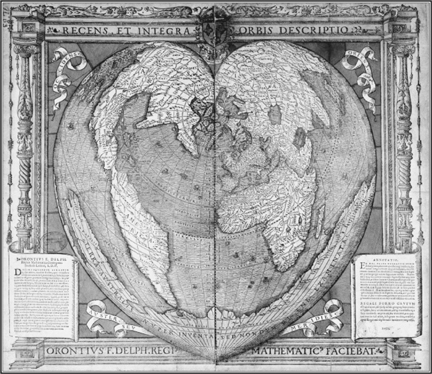
In Oronce Fine’s “Current and Complete Description of the World” (Paris, 1536), the earth became an image of the human heart and a symbol of the sacré coeur. This linkage of science to humanism and Christianity was central to Champlain’s thinking. The map shows that the least known of its inhabited continents was North America.
* * *
In Paris, Champlain’s thoughts turned to North America, and especially to the vast region above the fortieth parallel that had been labeled “Nova Francia” on maps since the voyages of Jacques Cartier. Here French activity could expand without a head-on collision with Spain and Portugal. The English and Dutch were moving into it, and each of their voyages was a warning, but France had a claim that was recognized by other nations. Champlain was keenly aware of the king’s interest in Nova Francia. He knew that Henri IV was determined to convert that geographical expression into an actual country called La Nouvelle France.
Champlain learned of many projects, past and future. With the king’s encouragement, he made it his business to learn more. From 1601 to 1603, he visited French seaports and gathered information from Norman and Breton fishermen who were active in America. He may have spent some time in Dieppe with armateurs, the ships’ chandlers who outfitted ships for voyages to the new world. These men had long memories of earlier ventures.13 He also talked with French seamen who had been sailing to North America since the early sixteenth century, perhaps earlier. Champlain believed that “it was the Bretons and Normands who in 1504 were the first among Christians to discover the grand banks of the codfish and the islands of Newfoundland.”14

Champlain’s task was to study North America. Among his best sources were French Basques who made annual whaling voyages to seasonal stations such as this one in Red Bay, Labrador, during the 16th century. Th ey traded with the natives in a pidgin speech that combined Basque and Indian languages.
Men of Brouage and La Rochelle were also very active in the American trade. Champlain’s own family had been in the business. As early as 1570, his affluent uncle Guillaume Allène had sent the ship Espérance to Newfoundland with a captain and pilot from Saintonge. Allène’s vessel was big enough to carry twelve “pieces of artillery” and was heavily manned with a crew who could defend themselves in dangerous seas. The voyage was financed by an international partnership of merchants from La Rochelle in France and Bristol in England. Allène’s voyage showed the scale and sophistication of French enterprise in North America during the sixteenth century.15
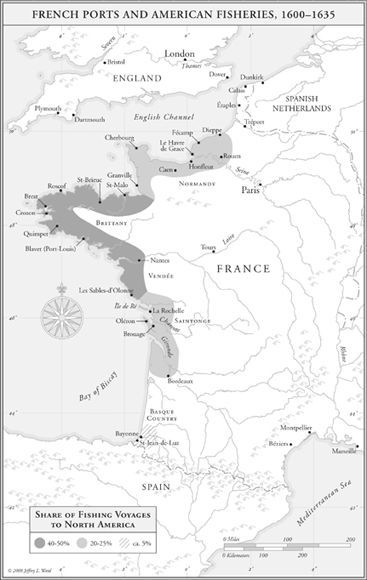
Every year, even during the worst of the religious wars, hundreds of French fishing vessels made summer voyages from Dieppe, Saint-Malo, Honfleur, Le Havre, La Rochelle, and many other ports. These fishermen worked along the coasts of America from Labrador to Nantucket. They arrived in late spring, stayed a few months, and sailed home in late summer before the autumn storms on the North Atlantic. A few wintered among the Indians, not always by choice. In 1602, a crew from Honfleur found three fishermen in the St. Lawrence Valley who had been marooned by a skipper from Saint-Malo. Others chose freely to live among the Indians, learned their ways, and formed unions with native women. These French seamen gained much knowledge of America.16
Some of Champlain’s best sources were Basque whalers and fishermen—French Basques and Spanish Basques as he called them. Their whaling stations dotted the American coast from Labrador to the Gulf of Maine for many years. They developed the technology of whale hunting and invented the light and graceful whaleboats that would be used for many centuries.17 Later, Champlain got to know a Basque named Captain Savalette, a “fine old seaman” who hailed from the French port of Saint-Jean-de-Luz. They first met in 1607, on Savalette’s forty-second voyage to North America. He had been making annual Atlantic crossings for many years—eighty-three of them since 1565, before Champlain was born. Captain Savalette and his crew of sixteen men worked near Canso in what is now Nova Scotia, operating out of a little fishing cove that Champlain later named in his honor. The work was perilous, but highly profitable. In a good year they took home 100,000 big cod, which brought as much as five crowns apiece on the Paris market.18
Through the sixteenth century, the Basques also traded with Indians, who wanted iron pots, copper pans, steel knives, metal arrowheads, and woolen textiles such as red blankets from Catalonia.19 In return, the Basques wanted furs. So strong was the European demand that the rate of exchange for a fine beaver pelt rose from one knife to eighty knives in the course of Captain Savalette’s career. Europeans also traded for products of the forest: sassafras was valued as a medicinal tea, and ginseng as a sexual restorative. By 1600, Native Americans had become aggressive entrepreneurs. Some Indians got the jump on competitors by acquiring European shallops and meeting European vessels at sea—a maritime equivalent of forestalling the market.20
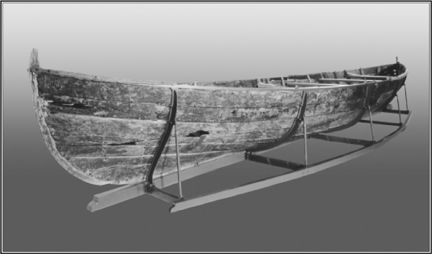
Basques invented this 16th-century whaleboat, found intact by underwater archaeology off Labrador. Champlain thought that they were the best whalers in the world and learned much from them.
A complex web of cultural relations had developed between Europeans and American Indians long before Champlain came to the new world. The northern coast acquired a unique trading language, a pidgin speech borrowed from many tongues. Much of it was Basque and Algonquian. A startling example is the word Iroquois. Linguists conclude that it was a complex coinage in the pidgin speech of the North American coast—a French understanding of an Algonquian version of two Basque words that meant “killer people.” The term was well established when Champlain became the first to publish it in 1603.21
In the midst of this flourishing Atlantic trade, many French colonies had been planted during the sixteenth century. Every one of them failed. More than a few were epic disasters. Champlain was dismayed to discover that “so many navigations and explorations had been undertaken in vain, with so much labor and expense.”22 He studied their history with close attention. Why had they gone wrong? What errors had been made? How could one learn from that experience?
His inquiry was a search for the cause of past failure, in the hope of future success. Mainly he was interested in the choices that leaders had made. Four of these failed ventures shaped his thinking in fundamental ways. Among them were efforts by Jacques Cartier in Canada (1534–43), Jean Ribault and René Goulaine de Laudonnière in Florida (1562–67), the marquis de la Roche on Sable Island (1597–1602), and Pierre de Chauvin at Tadoussac (1599–1600). Each of them taught Champlain a lesson about how not to found a colony.
Champlain was especially interested in the career of Jacques Cartier, a seaman of Saint-Malo whose voyages laid the foundation for French claims in North America. Champlain read Cartier’s journals with respect and thought that he was “very knowledgeable and experienced in seamanship, as much as anyone in his time.”23 In 1534 Cartier crossed the Atlantic in the amazing time of two weeks and six days from France to Newfoundland. He explored the coast and entered the estuary of the St. Lawrence River. On the Gaspé Peninsula he found a summer camp of two hundred Laurentian Iroquois who had come down the river to catch tinker mackerel. Cartier treated the Indians brutally, kidnapped several, and took them captive to France.24
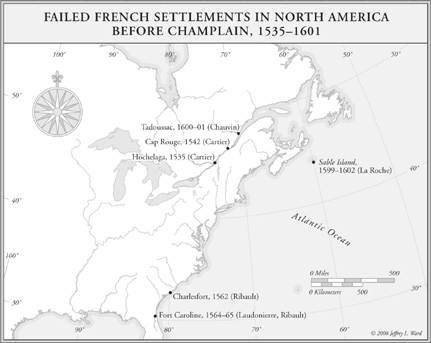
Cartier made a second voyage in 1535. He sailed up the St. Lawrence River to Tadoussac, and continued to Île d’Orléans, Cap-Rouge, and the site of present-day Quebec. He sailed on, to the head of navigation on the river, where he found the large Indian town of Hochelaga near what is now Montreal. His men built a fort there, wintered over, and suffered severely from scurvy. The Indians gave them a remedy from the leaves of a tree they called annedda, but Cartier was shaken severely by that experience and returned to France. Once again he kidnapped Indians, including Donaconna, a powerful leader of the Laurentian Iroquois, and carried him and his sons back to France against their will. They were never seen again in Canada.25
A third mission followed in 1542, led by Cartier and Jean François de la Roque, seigneur de Roberval. They came to Canada with three ships, and planted a settlement on Cap Rouge, near Quebec, where Cartier and Roberval thought they had discovered diamonds and gold. It turned out to be quartz and iron pyrites, and the disappointment gave rise to a French proverb, “false as a diamond from Canada.” The Laurentian Iroquois mistrusted the French, in large part because of Cartier’s cruel treatment of them. He and his men lied repeatedly to the Indians, kidnapped at least ten of them, and gained an evil reputation in America as “wonderful thieves” who would “steal everything they can carry off.”26
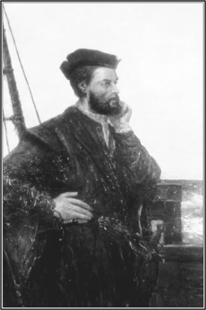
Jacques Cartier’s discoveries were the source of French claims to North America. He explored the St. Lawrence River as far as Mont Real, but cruelly abused the Indians, and his settlements failed.
In the summer of 1543, the two leaders Cartier and Roberval abandoned their own colony and returned to France, leaving thirty settlers without a leader. Champlain was taken aback by their behavior, and wrote sadly, “Little by little this enterprise dwindled to nothing for the lack of necessary attention.” Thereafter, François I died in 1547, Cartier perished of the plague in 1557, and Roberval was killed in the wars of religion. French colonizing in the St. Lawrence Valley was abandoned for many years.27
Champlain asked himself why Jacques Cartier’s voyages did not lead to a permanent French settlement. He answered that Cartier himself had caused the failure by losing faith in his own enterprise: he “was so dissatisfied with this voyage and with the great ravages of scurvy, whereof most of his men died, that, when spring came, he returned to France very sad and grieved at this loss.”28 Champlain observed that Cartier mistakenly thought that the “mal de scorbut” was a “mal de terre” in North America. He came to the false conclusion that “the air was contrary to our constitution,” and gave it up. “And so,” Champlain wrote, Cartier lost heart and “the enterprise was fruitless.” Here was the reason. “To tell the truth,” Champlain continued, “those who are in charge of explorations are often the very people who cause a laudable project to be abandoned … that is why this undertaking failed.” Cartier also alienated the Indians by treating them in a brutal and treacherous way—another fatal mistake.29
Champlain also studied the calamitous history of French colonizing ventures in Florida, where Jean Ribault had led two ships to the St. Johns River and built a settlement in 1562. Champlain’s short history of this venture became another catalogue of fatal errors. The leaders did not bring enough provisions and failed to clear lands for planting. Discipline collapsed. When an officer ordered a man hanged for “some slight offence,” others rose in rebellion. Some built a small barque and tried to sail home, but they had nothing to eat and were reduced to cannibalism. Champlain concluded that the venture had been “badly directed in every way.”30
Another effort followed in 1564, under Captain René Laudonnière and Ribault. Here again Champlain found “grave defects and shortcomings” in their leadership. They brought “provisions for only ten months” and tried to clear land for tillage, but were unable to bring in a crop in time to help. Food ran out, and the colonists lived on roots that they found in the forest. There was much “disorder and disobedience,” in Champlain’s words.31 Ribault decided to attack the Spaniards, against the advice of other leaders. Champlain observed: “It is a stubborn man’s trait to wish always to have his own way without consultation.”32 The Spanish struck back with great cruelty, crushed the settlement, and executed some of the settlers. In an escalating cycle of violence and retribution, the French settlement collapsed. Here again Champlain thought the cause of failure was erratic leadership and a failure to prepare.33
The worst of these disasters was the failed French colony at Sable Island on the outer edge of the fishing banks. After the Peace of Vervins, Henri IV sponsored colonizing ventures by an eccentric character with the exotic name of Troilus du Mesgoùez, marquis de la Roche-Helgomarche. In 1597, La Roche sent a fishing expedition to Sable Island. The voyage appears to have been a commercial success. The following year, Henri IV gave La Roche letters patent to plant a colony in North America. The king later contributed 12,000 écus to the enterprise.
The project instantly ran into difficulty. Few people volunteered for the expedition—a persistent problem in French colonization. La Roche was forced to conscript beggars and vagabonds. He persuaded Royal officials to sell him criminals who had been condemned to death and were given the choice of America or execution.
La Roche hired a captain named Thomas Chéf-d’Hostel and ordered him to land the colonists on Sable Island. A worse location could scarcely be imagined. It was a desolate crescent of sand on the outer edge of the Grand Bank, a hundred miles from the coast, swept by fierce gales and shrouded in dense Atlantic fog.34 In 1599, La Roche’s sixty colonists were put ashore with a leader named Commandant Querbonyer and a small party of soldiers to keep order. La Roche supplied materials for shelters and a storehouse, stayed for a short time, and then sailed home.35 He promised to send supply ships every year, and kept his word in 1600 and 1601. The ships returned on schedule, but the colony did not flourish, and La Roche lost support in France. In 1602 the settlers rose in mutiny, murdered the officers in their sleep, and looted the storehouse. La Roche learned what had happened from passing fishermen, and suspended the annual supply ship. The colonists lived precariously on fish, seals, and wild cattle left on the island by a Spanish ship. Sable Island lacked wood or stone, and the settlers were soon living “like foxes underground.” As supplies dwindled they made war on one another. In a few years, most were dead. A ship found eleven survivors with gaunt faces, matted hair, and sealskin suits and took them back to France.36
La Roche was thought to be “a man of the best intentions,” but among all the many colonial disasters in North America, Sable Island was one of the worst. Champlain studied its history and concluded that the enterprise had two fatal flaws, one in America and the other in Europe. He believed that the marquis de la Roche had chosen a bad site because he had “no knowledge of the land” and “did not have the place explored and examined carefully by someone with experience.” At the same time he was unable to protect his base in France. Champlain noted that “envious people” intrigued against the colony, turned the king against the enterprise, and destroyed “the good will felt by his Majesty.” It was a lesson he would not forget.37
Champlain also studied yet another recent failure. It had been led by Pierre de Chauvin, sieur de Tonnetuit, a Huguenot from Dieppe and a successful fur trader in the St. Lawrence Valley. Champlain described him as “a man very expert in navigation, and a captain who had served the king in past wars.”38 In 1599, Henri IV commissioned Chauvin to plant a colony in the St. Lawrence Valley, with a monopoly of the fur trade for ten years. The following year he assembled a fleet of four ships. Sailing with him as an observer was a nobleman from Saintonge, Pierre Dugua, sieur de Mons. The result was yet another disaster, which Champlain attributed to errors of judgment by Chauvin himself. The first mistake was in the recruitment of settlers and leaders. Chauvin insisted that “there would be none but Calvinist ministers,” but the settlers were Catholic. The result was deep division and constant strife.39
That mistake in France was compounded by others in America. The most serious error in Champlain’s opinion was in the choice of a site. The sieur de Mons wanted to move further up the St. Lawrence River, but Chauvin insisted on settling downstream at the Saguenay River, a major center for the fur trade. Champlain wrote that the location was “one of the most disagreeable and barren in the whole country.” It was also one of the coldest. “The cold is so great,” he added, that “if there is an ounce of cold forty leagues up the river, there will be a pound of it here.”40
The colonists were not given supplies to see them through the winter, which Champlain found to be a common failing in early settlements. Worst of all, the leaders departed before winter set in, and left sixteen colonists living under the same roof, “with a few commodities.” The settlers ran out of food, and suffered terribly from illness. Only five survived the winter, by abandoning the colony and living on the charity of the Indians.41
Champlain concluded that the cause of all these problems was a total failure of leadership, government, and discipline. He wrote that Chauvin’s colony was “like the Court of King Pétaud,” referring to an old French folk saying about “the court of King Pétaud, where everyone is master.” The name Pétaud derived from peto, or beggar. Champlain added, “idleness and laziness along with diseases that seized them unawares, reduced them to such desperate straits that they were forced to give themselves up to the Indians who charitably took them in.”42
This failed colony had one constructive result. Its leaders brought two young Montagnais Indians back to France. They were not kidnapped, but came willingly with the support of their chiefs to learn French and study the culture. They were treated well and survived the illnesses of the old world. Later they would return to North America with consequences of high importance for New France, as we shall see.
From this long record of failure, Champlain drew many lessons. First was the necessity of detailed planning. In the ventures that failed he found too little serious preparation, “too much table talk,” and too many fantastic schemes. “Filling the mind with illusions,” he concluded, “is not the way to carry out with honor the work of exploration.”43
A second lesson was the importance of careful exploration before settlement. He wrote, “it is of little use to run to distant lands and go to inhabit them, without first exploring them and living there at least an entire year, to learn about the quality of the land and the diversity of the seasons, in order afterward to lay the foundation of a colony.” Champlain observed, “Most colonizers and travellers do not do this, and are content to see the coasts and the elevations of the lands in passing, without staying there.” He believed that only the evidence of first-hand experience could be trusted. In particular, it is a common mistake “to believe that everything follows the rule that exists in the latitude of the places where they live, and it is in this that they find themselves greatly mistaken.”44
A third lesson was about order and authority. These many French disasters persuaded Champlain that a successful colony must have unity and strict discipline. The Florida fiascos were evidence that leaders must work together and harmonize their purposes. The disaster at Tadoussac showed clearly that they must establish a system of firm and just authority. Champlain was not a believer in what we understand as liberty or equality. He believed in order and subordination, and he drew the same conclusion from the disorders in France during the sixteenth century.
There were logistical lessons as well. To maintain order and peace in colonies, an ample supply of food was an important key. Nearly all of the failed colonies had suffered from a shortage of provisions. This problem required capital, foresight, and very careful planning.
Religious policy was another issue. Champlain concluded from the wreck of the Chauvin settlement that religion in the colony should be modeled on Henry IV’s solution for France. He believed that New France should have one official religion, and it should be Roman Catholic but it should extend toleration to other faiths. He strongly opposed persecution and sectarian strife.
And he was very mindful of the Indians. The experiences of Cartier, Roberval, Laudonnière, Ribault, and Chauvin all demonstrated that the indigenous people must be treated with humanity and respect. A major effort should be made to establish a rapport by straight words and equitable dealing.
Finally it was clear to Champlain that colonies often failed because of events at home. He noted that “envious people” in France intrigued against colonial ventures. The trouble came from rival merchants, competing seaports, jealous courtiers, and representatives of foreign powers. The most powerful opponent of settlement in New France was the king’s chief minister, the duc de Sully, who thought that colonies were a distraction from business at home, and tried to turn the king against them. De Mons and Champlain believed that Sully had been bribed by Dutch merchants, but his dislike of New France rose fundamentally from an idea of national interest. There was a debate in France during the reign of Henri IV between leaders who favored domestic reform and others who supported expansion abroad. It was similar in some ways to the debates in Victorian England between imperialists and Little Englanders, and to struggles in the United States over foreign policy in the twentieth century.

New France had enemies at Court. Most powerful was the due de Sully, the King’s chief minister, who insisted that nothing good could come from settlements above the 40th parallel (the latitude of Philadelphia). Witnesses testified that Sully took Dutch bribes to oppose French colonies.
In each of these conflicts there was also a middle way. Centrists and moderates favored a mediating position: a forward foreign policy and progressive reform at home. This was the policy of British leaders such as Pitt the Elder and Winston Churchill, and Americans including Theodore Roosevelt, Franklin Roosevelt, Harry Truman, and the “wise men” in the United States during the mid-twentieth century. It was also the choice of Henri IV in France. In 1602, he favored reform at home and expansion abroad, and believed that each of these two policies could reinforce the other.
Champlain also believed that a key to success in America was a continued effort to rally support in France, particularly at the court of Henri IV, where the good will of the king was absolutely necessary to the enterprise. He wrote that “kings are often deceived by those in whom they have confidence.” Much of his career was an ongoing effort to promote a new France in the old world.45
* * *
In 1602, an opportunity suddenly came to the friends of New France. That year, Chauvin forfeited his monopoly of fur trading in the St. Lawrence. Orders were issued from court in 1602, commanding two eminent figures to take the problem in hand. One of these men was the sieur de la Cour, president of the Parlement of Normandy. The other was the sieur de Chaste, Vice Admiral of the Navy, and an officer of high distinction. The two Royal Commissioners proposed to authorize two trading ventures: one for the merchants of Rouen in Normandy; the other for traders from Saint-Malo. In return for special trading privileges, each group was required to contribute one-third of the cost of founding a permanent colony in New France.
The king agreed, and appointed Aymar de Chaste as overall commander of the entire enterprise.46 Today he is largely forgotten—the most obscure of all the major figures in the founding of New France. He did not come to America and was in command of the colonial enterprise for a very short period, but he played a pivotal role in the history of New France and in the career of Samuel Champlain.
The sieur de Chaste was a soldier, a seaman, a chevalier, and knight-commander of the Order of Malta. He had faithfully served Catherine de Medici, led a military expedition to the Azores, and became governor of the town and fortress of Dieppe. In the wars of religion he played a major part. After the death of Henri III in 1589, de Chaste opened the gates of Dieppe to Henri IV and helped to bring moderate Catholic leaders to the support of the young king. Champlain described him as a “most honorable man, a good Catholic, a great servant of the king,” who “worthily and faithfully served his Majesty on many important occasions.” Others spoke of him in the same way.47
In 1602–03, de Chaste was near the end of his career. In the twilight of his life, he was deeply interested in founding a French colony in America, and he thought more of the future than of the past. He had a clear vision of New France as a place of harmony and prosperity, and also proposed to make it self-supporting, even a source of revenue for the Crown. Champlain wrote that “though his head was covered with as many grey hairs as years, he still wished to leave to posterity a charitable example by this project, and even to go there himself and devote the rest of his years to the service of God and his King.”
The king was happy to give him a commission as ruler of New France. De Chaste also received a charter that gave him a monopoly of trade and colonization (but not fishing) in America from the latitude of 46 degrees north (Cape Breton), to 40 degrees north (Philadelphia). De Chaste was everybody’s choice for the job and he brought many strengths to the American project. He was well connected at court and had the respect of Henri IV and his Council. He was a good Catholic, in high standing with leaders of the church.

In 1602–03, Dieppe became a center of effort for New France. Leadership passed to the very able Aymar de Chaste, governor of that walled seaport. Champlain went there to work with chandlers and merchants who had much experience of North America.
Most important were his close relations with merchants in the American trade. De Chaste put together a partnership of investors in northern France. Several noble families bought in. At the core of the group were leading merchants in the prosperous seaports of Normandy. They agreed to accept “certain conditions” that differed from other investments by these hard-headed businessmen. De Chaste persuaded them not only to fit out vessels for “the execution of a business enterprise” but also to “explore and colonize the country.”48
When Champlain learned of this new project, he was quick to approach de Chaste. The two men appear to have met before. Their paths may have crossed in the army during the war in Brittany. Probably they met in Dieppe when de Chaste was governor of that town, and Champlain was working with its ship chandlers. Champlain tells us that they met again at court in 1602, and thereafter he “went to see Commander de Chaste from time to time.”
Champlain probably gave de Chaste a manuscript of his Brief Discours on the West Indies and New Spain—in all likelihood the copy that found its way from Dieppe to the John Carter Brown Library in Providence, Rhode Island. De Chaste spoke of his project. As they talked together about America, they discovered many purposes in common. Both men shared a way of thinking about religion and politics, exploration and colonization, France and the world. In Champlain’s words, the commander “did me the favor of communicating something of his plans,” and “believing I could be of help with his design, he asked me if I would like to make the voyage, to see the country and what the entrepreneurs might accomplish there.”49
Champlain leaped at the invitation. “I told him that I was at his disposal,” he wrote. But there was a problem. As a pensioner of the king, Champlain was not at liberty to take another job without orders from His Majesty. He suggested that “if Commander de Chaste could speak with the king about it, and if it should be the king’s command,” then he would very much like to go.50 De Chaste had a word with the king, and all obstacles were removed. His Majesty not only approved, but commanded Champlain to make the voyage, and ordered that he make a “faithful report” directly to the king himself. The royal secretary, Louis Potier de Gesvres, gave Champlain a letter that was addressed to senior leaders of the expedition, ordering them in the king’s name “to receive Champlain aboard ship, and allow him to see and explore as much as possible of those places, and to assist in every possible way.”51
And so the elements came together. Aymar de Chaste, the forgotten founder, was a leader with a large spirit who won the respect and affection of all who knew him. Champlain was the junior partner, but with the ear of the king and his strong support. Henri IV was the royal patron who contributed his own broad vision, energy, and resolve. As a group, these men framed a great enterprise that combined exploration, trade, and settlement. The goal was to increase the power and prosperity of France, to spread the Christian faith, to learn more about the world, and to bring together its many people in a spirit of humanity.