


NEW YEAR 1917
Frost, the sun secreted behind the clouds. The pure snow of Tsarskoe Selo glittering as if splashed with quicksilver. The sovereign’s annual grand entrance in the Great Palace. Another New Year’s in the long line of years of his reign.
“1 January. Sunday. The day passed gray, quiet, and warm.… At about 3 Misha arrived, and he and I left for the Great Palace to a reception of the Ministers, Suite, and diplomats.”
In early 1917 no one had the slightest doubt about the coming revolution. Plots were being hatched in luxurious Petrograd apartments. And in the palaces.
The plot of the grand dukes—here, of course, the name of the army’s favorite immediately surfaced: the former commander-in-chief, Grand Duke Nicholas Nikolaevich. Sixteen grand dukes sent an emissary to Tiflis to the out-of-favor Nikolasha. Duma plotters, too, began open negotiations with Nicholas Nikolaevich. In the name of Duma member Prince Georgy Lvov, it was already being openly proposed to Nikolasha that he replace the other Nicholas on the throne. Nicholas Nikolaevich hesitated—and refused. He remained a loyal subject.
The sons of Vladimir Alexandrovich went into action and called the monarchist Purishkevich to the palace of Grand Duke Kirill Vladimirovich. “Still under the impression of my conversation with them, I left the grand duke’s palace with the firm conviction that he, Guchkov, and Rodzianko were plotting something inadmissible … with respect to the sovereign,” Purishkevich wrote in his diary. In fact, this never went beyond seditious conversations either. Many in the large Romanov family at the time could have repeated the words that burst from Grand Duke Nicholas Mikhailovich: “He [the tsar] infuriates me, yet I still love him!”
Endless meetings in Duma members’ apartments. General Krymov arrived from the front and told of the tragic situation in the army—the rumors of treason and the numerous defeats. The conclusion: a coup was inevitable.
At this time, as once before in the nineteenth century, the opposition was allying itself increasingly in secret Masonic lodges, which flourished in Russia after the 1905 revolution. By 1917 they had united society’s liberal elite, which was fed up with the Rasputin business. The paradox of the situation was that on the eve of 1905, when the police had frightened Nicholas with Masons, Masonry scarcely existed in Russia. Now, on the eve of 1917, when Masonry had become a real force, the police knew little about it. Meanwhile, the Masonic lodges included among their members tsarist ministers, generals, members of the State Council, Duma figures, prominent diplomats, industrialists: P. Balk, minister of finance; N. Pokrovsky, minister of foreign affairs; N. Polivanov, minister of war; Generals V. Gurko, A. Krymov, and N. Ruzsky; K. Dzhunkovsky, the chief of police, and so on. No, they did not want revolution—but they did want changes. Even in the lodges, then, activity was limited to seditious conversations. “Quite enough was done to get someone hanged, but not enough actually to carry out any plans,” one of the chief opposition leaders, Duma member Guchkov, would later say. Guchkov was trying to take practical steps: he was beginning to prepare a coup for March, when military units loyal to the Duma would be moved up toward Petrograd. To avoid bloodshed, he was planning to seize the tsar’s train and force the tsar to abdicate then and there. But none of the prominent military men (other than Krymov) joined in his plot. “I will never enter into a plot, I have sworn an oath.” Many could have repeated this statement by Duma Chairman Rodzianko.
At that time the head of the Petrograd secret police was submitting endless reports to Internal Affairs Minister Protopopov.
January 9: “Alarming mood among the revolutionary underground and widespread propagandization of the proletariat.”
January 28: “Events of extraordinary importance, fraught with exceptional consequences for Russian statehood, are not beyond the hills.”
February 5: “Animosity is mounting.… Spontaneous demonstrations by the popular masses will be the first and last stage on the path to senseless and merciless excesses of the most horrible thing of all—anarchical revolution.”
Protopopov blithely shelved the reports. After all, the empress had said: “There is no revolution in Russia, nor could there be. God would not allow it.”
Nicholas’s diary:
“29 January. Sunday.… In the afternoon took a walk and worked in the snow a while.… At 6 received old Klopov.”
Yes, this was the same Klopov who had come to see Nicholas at the dawn of his reign. Then Klopov had wanted to tell Nicholas the people’s truth. He came now one more time, to save his beloved tsar.
After the revolution Klopov worked quietly as a bookkeeper, and he died in 1927. Klopov left a note among his papers about his 1917 audience with Nicholas. He talked to the tsar about the court’s egoism, about the government’s criminal actions. Nicholas listened with a strange smile on his face, as if he were absent. Klopov left frightened by the incomprehensible equanimity of the tired man who had sat before him.
At this time Nicholas’s childhood friend Sandro, Grand Duke Alexander Mikhailovich, wrote Nicholas a letter. He wrote it at several sittings, decided to send it, and then changed his mind.
Nicholas’s diary:
“10 February.… Sandro arrived at 2 and had a long talk with Alix in my presence in the bedroom.”
Alix lay in bed for Sandro’s visit, as she was unwell. Sandro kissed her hand, and her lips grazed his cheeks. Sandro wanted to talk with her alone, but Nicky remained. She feared a tête-à-tête.
Later Alexander Mikhailovich told all about his conversation with Alix in his memoirs. But we are all strong in hindsight. It would be more accurate to draw on his own letter, which he wrote to Nicholas at the time and never sent:
“… We are living through a most dangerous moment in Russia’s history.… Everyone senses it: some with their mind, some their heart, some their soul….
“Certain forces inside Russia are leading you, and consequently Russia as well, to irrevocable ruin. I say ‘you and Russia’ wholly consciously, since Russia cannot exist without a tsar. One must remember, nevertheless, that the tsar alone cannot rule a state such as Russia.… The current situation, in which all responsibility lies on you and you alone, makes no sense.
“… Events have shown that your advisers are continuing to lead Russia and you to certain ruin,” Sandro repeated. “It leads one to utter despair that you do not care to heed the voices of those who know the state Russia is in and advise you to take the measures necessary to lead us out of chaos.
“… The government today is the organ preparing the revolution. The people do not want it, but the government is taking every possible measure to create as many dissatisfied people as possible and is succeeding completely at it. We are assisting at an unprecedented spectacle of revolution from above, rather than below.”
In his conversation at Alix’s bedside, Sandro begged Alix to confine herself to family matters, and Alix cut him off. He persisted. She raised her voice; so did he. During their stormy exchange Nicholas smoked silently. Sandro left, promising that one day Alix would recognize his truth. He kissed her hand in parting but received no parting kiss in response.
The entire conversation with Sandro made Alix see one thing: they wanted to remove Protopopov, whom the holy man had bequeathed to them. She was furious. What they needed was to disband the Duma, not remove devoted people from the throne.
That day Nicholas was forced to listen to a great deal more. He recorded in his diary, laconically and in order as always, the day’s chain of events.
“Took a walk with Marie, Olga’s ear hurt. Before tea received Rodzianko.”
His conversation with the Duma chairman was ominous. The usually restrained Rodzianko was unrecognizable.
Rodzianko: “A change of faces and not only faces but the whole system of government is imperative.”
Nicholas: “You keep demanding the removal of Protopopov. But he was your comrade in the Duma. Why do you all hate him so now?”
Rodzianko: “I do demand it. Before I asked, now I demand. Your Excellency, we are on the eve of great events whose outcome we cannot foresee. I have been reporting to you for an hour and a half, but everything tells me you have already selected the most dangerous path—disbanding the Duma. I am convinced that before three weeks are out a revolution will ignite that will wipe away everything, and you will not be able to rule.”
When Rodzianko had entered the study to see the tsar, he had run into Alexander Volkov and asked him to note how long he stayed in the sovereign’s study.
When the agitated Duma chairman walked out of the study, Volkov said: “You were with His Excellency for exactly twenty-six minutes.”
Rodzianko handed his briefcase to the footman who was waiting to carry it to his carriage, waved his hand hopelessly, and said, “It doesn’t matter now, it’s finished.”
But Rodzianko was wrong. This conversation did make an impression. Nicholas yielded.
On the twentieth of February the prime minister, old Golitsyn, returned home from Tsarskoe Selo unusually happy and cheerful. Nicholas himself had suddenly expressed a wish to discuss the question of an accountable ministry. He announced to Golitsyn that he was preparing to appear before the Duma and proclaim his will: to give Russia a ministry that would answer to the Russian parliament.
But on the evening of the same day Golitsyn was called to the palace again. Nicholas informed the astonished prime minister that he was leaving for Headquarters.
Between these two events, of course, there had been a conversation with Alix. That vigilant warrior would not allow him to repeat the concessions of 1905.
By that time Nicholas was very tired. Old Golitsyn sensed his desperate weariness. Subsequently he explained Nicholas’s departure for Headquarters, which stunned everyone, as the sovereign’s desire “to avoid more reports, meetings, and conversations.”
Yes, he was running away—running away from everything: her hysteria, fat Rodzianko, the Duma’s fury. From the demands of his mother, his relatives, his friends, and his country.
“Long the weary slave, I conceived a flight.”
Rodzianko described in his memoirs how one time Nicholas, having heard his report, walked over to the window.
“Why is it like this, Mikhail Vladimirovich? I was in the woods today—it’s quiet there and you forget everything—all these squabbles … the human bustle. I felt so good deep down. It’s closer to nature there … closer to God.”
Once in his diary Nicholas wrote, “Dangled my foot in a stream.” A tired, lonely man, childlike, splashing his foot in the water.
She was right: his profound loneliness.
Now he wanted to run away from everyone to his loneliness. So he ran to the woods, taking long walks down an empty road.
He explained to her that he would be away for a short time and would be back by March 1, so he was not even taking Baby with him. But she felt a horror at his trip. The empire had exactly ten days to live.
She: “Feb. 22nd 1917.… Such deep sadness and alarm at letting you leave without dear Baby—such terrible times for us now!—and even harder apart, I can’t stroke you so tired & worried. God truly has sent you a terrible & heavy cross.… Our dear Friend in another world prays for you, too now even closer to us, but I would so love to hear His consoling & heartening voice.… Lovy, be firm, because the Russians need you to be—at every turn you show love & kindness—now let them feel your fist, as they themselves ask. So many of late have told, that we need the knout. Its strange, but that is the Slav nature.… They must learn to fear you, love is not enough. Tho’ a child adores his father, he must fear his anger. I embrace you tight and hug your tired head. Oh the lonely nights to come—no Sunny or Sunshine with you. Feel my arms hold you, my lips press tenderly to yours. Eternally together, always inseparable.”
Russia was the fist and the knout. These were all very old ideas. Here is the monologue of a Russian monarchist quoted by French Ambassador Maurice Paléologue:
“The tsars founded Russia, and the harshest and cruelest were the best. Without Ivan the Terrible, without Peter the Great, without Nicholas I, there would be no Russia. The Russian people are the most submissive of all when they are sternly mastered, but they are incapable of ruling themselves. No sooner is the bridle loosened than they lapse into anarchy; they need a master, an unlimited master; they walk a straight path only when they feel an iron fist over their head.… The knout, we owe it to the Tatars, and it is the best thing they left us.”
He (telegram): “Feel again firm, but very lonely. Thank you and Baby for telegrams. Am terribly sad. Kiss you all tenderly.”
She: “Feb. 23rd.… Well now, Olga & Alexei both have measles & Olga’s face is all covered with rash. Baby suffers more in the mouth—a bad cough and sore eyes. They lie in the dark.… We are all in summer skirts & white robes, and when we receive somebody (not afraid) we put on dresses. If the others are not to avoid this, I hope they get it quickly. That way is more fun for them & does not last so long.”
Alexei had caught the measles from a little cadet who had been excused from school especially to play with the heir. Many there had already had the measles, but the empress did not know that. Now, in her white robe, the empress was rushing among her sick and soon to be sick children and Anya. The measles cut her off from the not very distant capital. She now received reports through the valet Volkov. The fall of the empire began with this illness.
He: “Headquarters. 23 February, 1917.… The day was sunny and cold and I was met by the usual public with Alexeyev [the chief of staff] at the head.… We had a good talk together for about half an hour. After that I put my room in order and got your telegram telling me of Olga and Baby having measles. I could not believe my eyes—this news was so unexpected.… In any case, it is very tiresome and disturbing for you, my darling. Perhaps you will cease to receive so many people?”
He was hoping that the measles would put a damper on her temperament and she would cease getting so fired up about affairs and putting such steady pressure on him.
“… You write I should be a firm master—that is quite true. Rest assured I have not forgotten, but it is not at all necessary to snap at people right and left each minute. Often a calm, sharp comment or reply is quite enough to show whoever it is his place.”
She: “Feb. 24th. Strikes now in Petrograd—80,000 workers have struck, lines of the hungry have formed outside the bakeries. Not enough bread in town.”
He: “Headquarters. 24 February.… I am sending you and Alexei Orders from the King and Queen of the Belgians in memory of the war.… He will be so pleased with a new little cross!”
She: “Feb. 24nd. My precious one.… There were riots yesterday, on Vasilievsky Island and Nevsky Prospect because some poor people stoned a bakery, tearing Filippov’s bakery to pieces & the Cossacks were called in. I learned all unofficially.… At 10 went to see Ania (she probably has measles too).… Am going from room to room, from sick bed to sick bed.… Went out for a minute to light candles for everyone.”
He: “Headquarters. 24 February.… And so we have now three children and Anya ill with measles!… Moreover, the rooms in Tsarskoe must be disinfected, and most likely you will not want to go to Peterhof—where can we live then? We shall think this out in peace on my return home, which I hope will be soon! My brain is resting here—no Ministers, no troublesome questions demanding thought, I consider that this is good for me, but only for my brain. My heart is suffering from the separation.”
In Petrograd, on the morning of February 25, 1917, Duma Chairman Rodzianko went to see Prime Minister Golitsyn and demand his resignation. The offended Golitsyn showed him the decree disbanding the Duma, which the tsar had signed beforehand. Golitsyn could use it at any time.
Both Golitsyn and Rodzianko realized, however, that the Duma would not obey, for the government’s power no longer existed.
On Znamenskaya Square crowds had already gathered, shouting, “Long live the republic.” Cossacks had driven out the police. The crowd was fraternizing with the troops.
She: “Feb. 25th. My precious, beloved treasure, The city’s strikes and riots are more than provoking … its a movement of hooligans, boys and girls running around shouting about no bread—just to stir up excitement—as are the workers preventing others from working. If the days were very cold, they would probably all be sitting home, but all this will pass & calm down, if only the Duma behaves.… I had a feeling when you were leaving things would go badly.… Write me a greeting for Ania—it would be nice for her.… Forgive this gloomy letter, but all round are so many tiresome requests.”
Only on the evening of the twenty-fifth did Nicholas learn about the riots that had been going on in the city for three days.
On the twenty-sixth he received a telegram from the war minister: the soldiers were refusing to fire on the rioters and were going over to the insurrectionists.
Nicholas sent a telegram to Khabalov, commander of the Petersburg Military District, ordering him to put an immediate halt to the riots.
Nicholas’s diary:
“26 February. Sunday.… Mass at 10. Report ended promptly.… Wrote Alix and walked down the Bobruisky Road to the chapel. The day was clear and frosty.… In the evening played dominoes.”
Everyone remarked on his strange indifference at that terrible time.
She: “Febr. 26th.… What joy to receive your letter, covered it with kisses and will kiss it often.… Much talk about the riots in town (I think more than 200,000 people …), but I already wrote this yesterday, forgive me, I am silly. A coupon simply must be brought in for bread (as it is now in every country; after all, it is already set up for sugar and everyone is calm and gets enough), we have idiots.… The whole trouble is this bawling public, those well-dressed people, wounded soldiers, & so on, girl students & the like, inciting the others. Lili [Lili Dehn, the wife of an aide-de-camp and naval officer, was the empress’s friend and, unlike Anya, the soul of good sense and order] talks to drivers to find out news & they have told that students have come and said if they go out in the morning they will be shot at—what rotten types! Naturally the drivers & carters are striking, but they say its not like 1905 because everyone adores you & only wants bread.… What warm weather—vexing that the children cannot even go for a ride in an open car. It seems though that all will be well. The sun is shining brightly—I feel such peace at His dear grave. He died to save us.… Baby is one great rash, covered like a leopard, Olga has large flat spots. Ania too is covered with rash. All their throats & eyes hurt—I have to go back to them in the dark. I bless & kiss you over & over.”
He: “Headquarters. 26 February.… Please do not overtire yourself, running about among the sick ones.… Yesterday I visited the ikon of the Holy Virgin and prayed fervently for you, my love, for the dear children, for our country, and also for Anya.… This morning, during the service, I felt an excruciating pain in the chest, which lasted for a quarter of an hour. I could hardly stand the service out, and my forehead was covered with drops of perspiration, I cannot understand what it could have been, because I had no palpitation of the heart; but later it disappeared, vanishing suddenly when I knelt before the image of the Holy Virgin.”
On February 26 Rodzianko sent the tsar a desperate telegram: “There is anarchy in the capital. The government is paralyzed, transportation, food, and fuel have reached a pathetic state. Military units are firing on each other. There is random shooting on the streets. You must immediately name someone who has the country’s trust to form a new government.… Any delay is akin to death. I pray God that in this hour accountability does not fall on the wearer of the crown.” The telegram arrived in the night, but Chief of Staff Alexeyev decided not to wake the tsar, not showing him the telegram until morning.
On the morning of February 27, Rodzianko addressed a second telegram to the tsar: “The situation is growing worse. You must take measures immediately, for tomorrow will be too late. The final hour has come when the fate of the Homeland and the dynasty shall be decided.”
In Petrograd the offices of the secret police were in flames, and the crowd would not let the fire be put out; regiments were on their way to the Tauride Palace, where the Provisional Committee of the Duma was in session. To furled flags and music they were swearing an oath to the new government. At that point General Khabalov decided, finally, to post notices declaring a state of siege in the city—but the authorities were unable to obtain paste or brushes.
The district court was burning, and they were already hunting down policemen.
What strange entries at this time in Nicholas’s diary. If Alix got her information “from the drivers Ania spoke with,” then he, who had all the information and read Rodzianko’s desperate telegrams—what was his excuse for his astounding inaction? Weary indifference? But then what was the meaning of “the excruciating pain in the chest”?
It does make sense, of course.
As he was leaving Tsarskoe Selo that last time on February 22, he assumed a storm was possible—a storm everyone was promising him. And he decided in advance not to fight the storm. He could not and would not make war on society anymore. He knew, though, that she would not let him concede peacefully. Just as they would not accept his concessions if she remained. Rasputin and the rumors of treason had compromised her too badly. He was left with only one choice: either her or the throne. He chose her. He chose his private life with his family, so that his unhappy, half-mad wife would not be driven even more insane, so that he could openly seek treatment for his mortally ill son. He decided to give up the throne—and this decision almost killed him. His “excruciating pain in the chest” was the result of that decision, the result of the torture he had repressed within himself.
Subsequently, discussing the activities of Nicholas’s chief of staff, Alexeyev, who oddly was in no hurry to familiarize the tsar with the panicky information from the capital, people have suspected Alexeyev of complicity in a plot. A strange figure, this chief of staff. He had come from simple people, had earned everything for himself, and under Nicholas was the actual commander-in-chief. He was Rasputin’s enemy and forbade him to come to Headquarters—but Nicholas did not give him up to Alix’s fury. They were similar in their temperaments, the chief of staff and the tsar, reserved and taciturn. And they liked each other. They understood. That was why Alexeyev was in no hurry with the alarming telegrams: he had figured Nicholas out, and he was tacitly supporting him.
Nicholas did not manage to carry his decision through to completion. He had expected that the Duma would control the situation, that the coup everyone was so certain of had been readied. He would find out, however, that the mob had gone out into the street. From the telegrams he realized with horror that in fact the Duma’s big talkers were not in control of the situation. That was when he got scared—for Alix and the children. Riots in the city could spread to his beloved Tsarskoe Selo. Nicholas was forced to act.
On Monday, February 27, he wrote in his diary: “Riots began in Petrograd several days ago. To my regret, troops have begun to take part in them. It is a hateful feeling to be so far away and receive such poor, fragmentary news! Was not long at report. In the afternoon took a walk down the road to Orsha. After dinner decided to go to Tsarskoe as soon as possible and at I moved into the train.”
He (telegram): “Am starting to-morrow at 2.30. The Cavalry Guards have received orders to leave Nov[gorod] for town immediately. God grant that the disorders among the troops will soon be stopped.”
Nicholas’s diary:
“28 February. Tuesday. Went to bed at 3.15, having spoken at length with N. I. Ivanov [General Nikolai Iudovich Ivanov], whom I am sending to Petrograd with troops to establish order. Slept until 10. Left Mogilev at 5 in the morning. The weather was frostily sunny. In the afternoon traveled through Vyazma, Rzhev, and Likhoslavl at 9”
But he never did get as far as his beloved Tsarskoe Selo.
A DREADFUL PLAY
Lermontov’s Masquerade is a play with dreadful associations. On the day war was declared in 1941, Masquerade premiered in Moscow. Masquerade also premiered then, at the end of February 1917, during the empire’s fall.
The street lamps were no longer burning. Only a searchlight on the Admiralty side beat down on Nevsky, and in this dead light, people were walking to the theater. There was shooting in the streets. A murdered student lay in the lobby. There were a great many rumors about the readied performance. All theatrical Petrograd had gathered at the Alexandrinsky Theater. Indeed, it was a fantastic spectacle. On the stage, improbable luxury no one had ever seen in a theater: huge mirrors, gilded doors. The stage presented a glittering palace hall. The apotheosis of luxury. A hymn to a palace. It was a theatrical set of the world that was drowning on that February street, moving off into nonbeing. In the Tauride Palace the Duma was in permanent session. Hoarse, ecstatic speakers….
On February 28, the last day of winter, the garrison at Tsarskoe Selo rebelled: 40,000 soldiers with antiaircraft guns.
Rodzianko, as chairman of the Duma the sole authority in the mutinous capital, made a call on the palace. Rodzianko spoke with Benckendorff, marshal of the imperial court, and asked him to tell Alix to flee the Alexander Palace as quickly as possible.
“But the sick children—” said Benckendorff.
“When a house is on fire, sick children are carried out,” Rodzianko replied (his voice said: if only you had listened to me earlier!).
“I am not going anywhere! Let them do what they wish,” the empress answered Benckendorff.
By now the station at Tsarskoe Selo had been taken by the rebels. The trains were not running. So she sent two Cossacks from the convoy to Petrograd by rail. Their fur coats hid the uniform they had recently worn so proudly.
The Cossacks returned with news: the city was firmly in the hands of the rebellion. The mobs had opened the prisons and were storming the police stations and picking up policemen. The center was overflowing with people, and there were flags everywhere. The city was awash in blood-red calico.
In the palace all day February 28 they heard disorderly firing. It was the mutinous soldiers of the Tsarskoe Selo garrison shooting ecstatically (so far still in the air). Bands were thundering the “Marseillaise.” All day—that music. Half a kilometer from the palace, the first victim: a Cossack was killed. But the 40,000 insurrectionists were not yet threatening the palace.
Along the iron fence of the palace, astride their magnificent horses, were the mounted Cossack patrols of His Imperial Highnesses Convoy.
She called in Generals Resin and von Groten, in whose hands she now placed the palace’s defense.
The many faces of Alix: the obedient granddaughter of Queen Victoria, the eternal Sweetheart, the sequestered Muscovite tsarevna, the insane fanatic of autocracy. And finally Alix, in March 1917. The heroine of an antique tragedy: overthrown but ever the warrior. The blood of Mary Stuart.
At nine o’clock the palace trumpeters sounded the alarm, and the inspection of her troops began.
They formed up before the main entry of the palace: the Life Guards Second Kuban and Third Tersk companies. Two companies of the Convoy’s Cossacks lined up.
Next to the Cossacks, having come from the barracks, was a battalion of the Marine of the Guard under the command of Grand Duke Kirill. (The Marine had thinned out, some daring sailors having already begun to disappear mysteriously in the night.)
Finally, a battalion of a mixed infantry regiment and an antiaircraft battery—two guns on motorized platforms.
Here was all her army surrounded by a sea of gray greatcoats—the garrison of Tsarskoe Selo.
Lanterns burned by the palace entrance. Several hundred defenders stood silently in the freezing night. Commands were heard: “From the Convoy—constant mounted patrols along the railway between the station and the barracks. Anti-aircraft batteries and the Marine’s machine-guns—take a position suitable for opening fire, down the streets leading to the palace.” Midnight, when she would emerge from the palace, was drawing nigh.
Across the crunching snow, in the fierce frost, a fur coat draped over her shoulders, she walked down the rank. Her proud bearing. The leading tragic actress in the drama of the revolution. Beside her was Grand Duchess Marie, her only healthy daughter. Together they passed down the rank. Alix gathered the officers in the palace’s guard room: “Gentlemen, please, there is no need to shoot. No matter what happens. I do not want blood shed because of us.”
She had realized: one shot and everything would go up in a puff of smoke. Gray coats fanned out around the palace.
The next day, when she awoke, a new blow awaited her. The palace’s pride and glory, the Marine of the Guard, under the command of Grand Duke Kirill, had left the barracks. A red ribbon on his high-collared jacket and the tsar’s monogram on his epaulets, the tsar’s cousin had taken his unit to the Tauride Palace—to swear allegiance to the Duma. Kirill had not forgotten the humiliations of 1905. Nor had he forgiven Nicholas and Alexandra the filthy muzhik who had soiled the dynasty.
That same morning, a company of the railway battalion left for Petrograd in the Marine’s wake. Two companies of Cossacks, two guns, and an infantry battalion—such was her army then.
She realized that the palace could be stormed at any moment—the mutinous garrison no longer had anyone to fear.
As before, though, they did not approach. This was an ominous calm, however. Rumors were going around the palace—the rebels’ cannons were already aimed at the cathedral and palace. They had to wait from hour to hour.
By the afternoon she had nearly forgotten the inevitable threat rushing between her sick children and sick friend.
That night she could not sleep. She went down to the palace’s half-cellar, where the Convoy’s Cossacks were resting in the warmth of the furnace, and tried to encourage them, to strengthen their spirit through prayers. Later, before dawn, she talked with Lili Dehn. And all this time she kept sending him telegrams, which returned with the mocking comment: “Place of residence unknown.” The place of residence of the Autocrat of All the Russias was unknown! She could not stand it—she sent for Paul, who had not been called to the palace since his son killed Rasputin. He came and told her that Nicky’s train had been held up, but Nicky was alive and well.
She begged Paul to do something. Catastrophe was imminent. He did not try to explain to her that the catastrophe had already occurred; he pitied her. He informed her that he, Kirill, and Misha had written a draft manifesto, which they intended to take to the Duma and in which the tsar granted a ministry accountable to the Duma. Yes, yes, she now understood: concessions were needed. (No one paid any attention to the manifesto signed by the three grand dukes. The Duma was waiting for a very different manifesto.)
On the night of March 1, Alix received yet another blow. At about one in the morning General Ivanov appeared at the palace—the same man whom Nicky had sent out with a crack detachment of highly decorated men.
In her lilac study, the old general told Alix how the railway had been seized and the echelon surrounded by rebels. And propagandized. Those men with their St. George’s Crosses refused to leave their train cars—no one would come to the aid of the palace. Againher delusions emerged: she begged the old man to try to get through to Nicky.
After the general’s departure she realized she was totally defenseless. The mutineers could come at any moment. Again she sent a Cossack lieutenant from the Convoy for Paul. The emissary walked up to the gate of the grand duke’s palace and rang for a long time. Receiving no response, he scaled the fence and was amazed to see the formal entry to the palace open. He wandered through the endless halls of the empty palace and realized the servants had fled. Finally he came to Paul’s bedroom. At the door slept Paul’s valet, all that remained of a great many servants.
He explained to Paul that the palace was expecting the mutineers at any moment. The grand duke started making phone calls, negotiating. Finally he asked the lieutenant to tell Alix that the Duma guaranteed the palace’s safety and Alix should not worry. He would sooner part with his own life than let … and so on.
On the morning of March 2 Alix wrote two long letters to Nicky. Two Cossacks from the Convoy sewed the tiny envelopes under their trouser stripes.
She: “My heart breaks from the thought of you living through all these tortures & upsets totally alone—& we know nothing of you, & you know nothing of us. I am sending Soloviev & Gramotin to you, giving each a letter, & hope at least one shall reach you. I wanted to send an aeroplan, but all have vanished. The young men will tell you all so I have nothing to tell of the state of affairs. It is all hateful, & events are progressing with colossal speed. I firmly believe, though—& no one shall shake this belief—that all will be alright.… Clearly they dont want to let you see me so above all you must not sign any paper, constitution, or other such horror—but you are alone, without your army, caught like a mouse in a trap, what can you do? This is supremely base and mean, unprecedented in history, to detain one’s sovereign.… What if you show yourself to the troops in other places and gather them around? If you must make concessions, under no circumstances are you obliged to honor them since they were obtained in ignoble fashion.… Your little family is worthy of their father. I gradually explained the situation to the Older Girls and the Cow [Anya]; before they were too ill.… It was very difficult to pretend before them. I have only told Baby half, he has 36.1 [his body temperature: 97°F] & is quite merry. Only everyone is in despair that you are not coming.… Last night was with Ivanov from 1 til 2.30.… I think he could go through Dno to see you, but could he get through? He had hoped to pull your train behind his. [Count] Fredericks’s home was burned down, and his family now in the Cavalry Guards hospital. The two movements—the Duma and the revolutionaries—are two snakes & I hope they bite each others heads off, which would save the situation. I feel that God will do something. What bright sun. If only you were here! There is only bad, even the Marine has abandoned us. They absolutely do not understand a thing, some microbe has implanted in them.… When people find out they have not let you go, the troops will be outraged & will rise up against them all….
“Well then let them bring order & show that they are good for something in the Duma. They have ignited too great a fire, tho’—how is it to be put out now?… The children are sleeping peacefully in the darkness, the elevator has not worked for 4 days, the cable broke.… Right now am going out to greet the soldiers standing in front.… I can advise you nothing, only be yourself, my precious one. Should you have to submit to circumstances, God will help you free yourself from them. Oh my holy sufferer.
“Postscript: … Wear his [Rasputin’s] cross, even if it is uncomfortable, for my peace of mind.”
The children began to recover in their darkened bedroom.
Anya awoke from her illness and high temperature. She had fallen ill in a world where she was the omnipotent friend of the most powerful woman in Russia; she woke up in a disgraced, besieged palace.
There were horrifying, maddening rumors beginning on March 2: Nicholas had abdicated!
Again she appealed to Paul.
Paul brought her the newspaper with the text of the abdication manifesto. “No, no, I do not believe it, these are all rumors, newspaper slander.” She said something else that made no sense: she did not want to read the manifesto. She fell prostrate, whispering in French: “Abdiqué! Abdiqué!” Her life was over. They had stolen her Little One’s legacy. All was lost. She remained, however, the Beautiful Lover. She did not blame him—not for a second, not in a word.
“March 3rd. My beloved, Soul of my soul—Oh, how my heart bleeds for you. I am going mad not knowing anything at all other than the vilest rumors which are enough to drive one insane. I would like to know whether the two young men I sent with my letters ever reached you today?… Oh for the love of God, at least a line. An officer’s wife will give you this letter. I know nothing about you, only heart-rending rumors. You are doubtless hearing the same.
“My heart is breaking with pain for you and your total isolation. I shall only write a little, since I do not know whether my letter will get to you, whether they will search her en route—so crazy have people become. This evening Marie & I are making a tour of the cellar to see the men—very heartening.… In town, Ducky’s husband [Grand Duke Kirill] is behaving repulsively, though acting as if he were toiling for the good of the monarch and the Homeland.… My love, my love! We had marvelous prayers & acathistus at the ikon of the Mother of God, which was brought into the green bedroom, where they were all lying—very encouraging. Everything shall—must—be alright. I shall not waver in my faith. Oh, my dear angel, I love you so much, I am with you always, night & day. I realize what your poor heart is experiencing now. God shall have mercy & send you strength & wisdom. He shall help & reward you for these mad sufferings.… We shall all fight for you, we are all in our places.… One could go mad, but we shall not for we believe in a bright future.
“… Paul was just here—and told me everything. I wholly understand your action, oh my hero. I know that you could not have signed anything that contradicted what you swore at your coronation. We know each other to perfection, we have no need of words, we shall see you again on your throne, restored by your people and troops to the glory of your realm.”
She did not force herself to read the manifesto until the following day. Then for the first time she heard his voice again. The telephone was working—he was calling from Headquarters. She spoke tender words of encouragement. Soon after the conversation a telegram was brought.
“Headquarters. 4 March, 10 o’clock in the morning. Your Highness [he called her that, as before, and would continue to call her that to the very end]. Thanks, my dear.… Despair is passing away. May God bless you all! Tender love.”
On the evening of March 4 she wrote him her last, 653rd letter:
“March 4th 1917. My dear, beloved Treasure! What a relief & joy to hear your dear voice, only it was very hard to hear, & anyway they listen to all our conversations now!—and your dear telegram today.… Baby has leaned across the bed & asks to send you a kiss. All 4 girls are lying in the green room in the darkness. Marie & I are writing, tho’ we can see almost nothing, since the curtains are lowered. Only this morning I read the manifesto.… People are beside themselves with despair, they adore my angel. Movement is beginning among the troops.… Ahead, I feel, I foresee the sun shining. I am extremely angry with Ducky’s husband….
“People are being arrested right & left now, officers naturally. God knows what is going on: the riflemen are choosing their own commanders & acting abominably to them—show no respect, smoke right in the officers’ faces. I do not want to write all that is going on—so repulsive. The sick upstairs & down do not know your decision, I am afraid to tell them, & for the time being no need.… God! Of course He will repay you a hundredfold for all your sufferings. My beloved, angel dear, I am afraid thinking what you are enduring, am going mad. I must not write of this more, I cannot! How they humiliated you, sending those two swine! I didnt know who that was until you told me. I feel the army will rise up.”
The novel in letters had come to an end. Captivity commenced.
He had spoken briefly of the abdication in that first telephone conversation. She would learn the details upon his return.
“CAUGHT LIKE A MOUSE IN A TRAP”
On the night of February 28 he was on the train to Tsarskoe Selo.
Nicholas’s diary:
“1 March, Wednesday. Last night … turned back because Lyuban and Tosno have been taken by the rebels and went to Valdai, Dno, and Pskov, where the train stopped for the night.”
When he awoke in Pskov the next morning, he learned that there was nowhere for him to go.
“Gatchina and Luga have been taken too. The shame and disgrace! We could not get to Tsarskoe, but my thoughts and feelings are there always. So distressing for poor Alix to endure all these events alone! Help us, Lord.”
Gatchina was his childhood, the garden where at the beginning of his life they built bonfires … their constant, unshakable world. And now….
“2 March. Thursday. This morning Ruzsky [commander of the northwestern and northern fronts] came and related his very long telephone conversation with Rodzianko. According to him, the situation in Petrograd is such that now the Duma ministry will be powerless to do anything since they are being opposed by the Social Democratic Party in the guise of the workers’ committee [the Petrograd Soviet of Workers’ and Soldiers’ Deputies]. My abdication is necessary.”
Everything did occur very quickly. As sometimes happens, though, once he had what he had decided on in a moment of weakness and exhaustion, he did not want it anymore. He cursed his weakness and detested his helplessness and the entire horror that would not pass: Alix, alone with their sick children, and he himself locked in a train at the Dno station! (Such was its name, Dno, or “Bottom.”) He declared to Ruzsky that he was prepared to sign the abdication, but first all the commanders at the fronts must say whether or not he should abdicate.
Nicholas’s diary:
“2 March [continuation]. Ruzsky transmitted this conversation to Headquarters and Alexeyev to all the chief commanders. By 2.30 replies had come from all of them. The essence is that, to save Russia and keep the army at the front quiet, this is a necessary step. I agreed.”
That afternoon he learned that the Duma in Petrograd had already sent for his abdication.
“HOW THEY HUMILIATED YOU, SENDING THOSE TWO SWINE”
The hour is late. Nicholas walks out on the platform to stretch his legs. It is cold—the frost is hardening. All the lights are on in the imperial train. The “gentlemen”—as he teasingly refers to his suite—are not sleeping; they are waiting.
Several tracks away, a locomotive emerges from the darkness pulling a single car.
Two men get out and walk over to his train; one is Vasily Shulgin, whom Nicholas knows: a monarchist who once pleased him with a speech in the Duma. But the other—the other is Guchkov, his lifelong enemy. His despised enemy!
It is the seventh decade of the twentieth century, Leningrad. A documentary is being readied for the fiftieth anniversary of the October Revolution. The floodlights are off on the set at Lenfilm studios. In the grimy dimness an old man sits on a chair—a bald skull, a prophet’s beard, and a young man’s flashing eyes. I have come over from the set where they are shooting my film to look at this old man, who spent time in Stalin’s camps and later, according to legend, worked as a doorman in a restaurant in Vladimir. After Khrushchev’s Thaw, the decorated Soviet director Fridrikh Ermler got the idea of shooting a documentary about this old man. Today on the set the director and the old man are discussing an episode in Abdication of the Tsar. In his book, the old man described the scene in the train car. Now he is recalling once again how they entered the car. Where each man stood. How the tsar entered. The old man bears a name once known to all of Russia: Vasily Shulgin.
It is a parlor car. Green silk on the walls. An old general with loops of gilt cord hanging from his shoulders—the minister of the imperial court, Count Fredericks.
They sit at a small table: the tsar, wearing a gray Circassian coat, across from Guchkov and Shulgin.
Guchkov launches into a long, bombastic speech. Nicholas listens in silence, his elbow propped against the wall. Shulgin is watching the tsar: there are bags under his eyes, brown, wrinkled, singed-looking skin from hard, sleepless nights.
Finally Guchkov speaks of the abdication, his voice trembling. When he finishes, Nicholas says calmly, indifferently, with his particular guardsman’s accent: “I have taken the decision, gentlemen, to renounce the throne.… Until three o’clock today I thought I could abdicate in favor of my son, but at that point I changed this decision in favor of my brother Michael. I hope, gentlemen, that you will understand a father’s feelings.”
Rising from the table, he picks up the Duma’s draft manifesto, which Guchkov had brought, and walks out.
While he is gone, Guchkov and Shulgin learn that the tsar is consulting with Dr. Feodorov—who tells him definitively that there is no hope for Alexei’s recovery.
So everything is the way Nicholas himself had wished all along. Michael will rule, and they—Alix and the family—will remain at liberty. For some reason, though, he now feels … not even sadness, but horror!
He returns to the train car and places on the table the text of abdication that he had written that afternoon, typed on telegraph blanks.
“How pitiful the sketch we brought seemed,” recalls Shulgin, “and how noble his parting words.”
THE MANIFESTO
“In these times of great struggle against an external enemy who for nearly three years has been trying to enslave our homeland, the Lord God has seen fit to send down upon Russia yet another difficult trial. Popular domestic upheavals threaten to reflect calamitously on the further conduct of a sustained war. The fate of Russia, the honor of her heroic army, the good of her people, the entire future of our dear Fatherland demand that this war be waged to a victorious conclusion no matter what.… During these decisive days in the life of Russia, we have deemed it a matter of conscience to facilitate for our people the close unity and serried ranks of all our popular forces for the speedy attainment of victory and, in agreement with the Duma, have recognized it as a good to abdicate the Throne of the Russian State and disencumber ourselves of supreme power. Not wishing to part with our beloved son, we transfer our legacy to our brother Grand Duke Michael Alexandrovich and bless him on his ascension to the Throne of the Russian State.… We command our brother to rule state affairs in full and inviolable unity with the representatives of the people.… On those principles which they shall establish.… May the Lord God help Russia.”
Although they are touched, they immediately ask him to bend the truth so that no suspicion should arise that the abdication was torn from him: they ask him to put down not the true hour when he signed it but when he himself came to this decision. And he agrees. He signs: “March 2, 15:00”—although by the clock it is already midnight.
Later there is another lie: they propose that the new prime minister, Prince Lvov, be appointed by the sovereign himself. “Ah, Lvov? Well, all right, so be it, Lvov.” He signs that as well. He is doing almost everything mechanically. All his thoughts are at Tsarskoe Selo.
Nicholas’s diary:
“2 March [continuation].… They sent the draft manifesto from Headquarters. In the evening Guchkov and Shulgin arrived from Petrograd. Spoke with them and gave them the signed and revised manifesto. At 1 in the morning left Pskov with the heavy sense of what I had been through. Am surrounded by betrayal, cowardice, and deceit.”
Having signed the manifesto, he could leave immediately for Tsarskoe Selo. To everyone’s surprise, though, he returned to Headquarters, to Mogilev.
It may have been too much for him to see her and the children right after his downfall. He may have wanted to give them time to get used to the situation. Also, he had to say goodbye to the army. There was a war in progress, and he discharged his duties as commander-in-chief to the end.
In the very depths of his soul, though, he may still have held out hope. She might suddenly turn out to be right: loyal troops could rise up and a miracle could happen. He did not want to return to Tsarskoe Selo like this, laid low.
Also, he had to say goodbye to his mother.
On March 3 he returned to Headquarters. No one knew how he should be met or indeed whether he should be met at all. Naturally, though, Alexeyev decided to greet him as usual. His generals formed up in the special pavilion for meeting the tsar’s trains. They waited in silence. Only the sarcastic Sergei Mikhailovich spoke, discussing the conduct of another grand duke, Kirill, “calling things by their proper names.”
The imperial train approached. No one got out. Finally, one of the servants emerged and called to Alexeyev, who disappeared after him into the train car. Everyone waited.
Then Nicholas appeared—with a new face: yellow skin stretched across his temples, distinct bags under his eyes. Behind him was Count Fredericks: carefully clean-shaven and erect as always. The tsar (the former tsar now) began his review by greeting each and every one of them as usual.
“3 March. Friday. Slept long and hard. Woke up long past Dvinsk. The day was sunny and freezing.… Read a lot about Julius Caesar. At 8.20 arrived in Mogilev. All the staff officers were on the platform. Received Alexeyev in my car. At 9.30 moved to the house. Alexeyev came with the latest news from Rodzianko. Misha, it turns out, has abdicated. His manifesto ends with a four-line addendum about elections for a Constituent Assembly in 6 months. God knows who gave him the idea of signing such rot! The riots have stopped in Petrograd—if only things would continue like this.”
A new world was drawing near.
The abdication in favor of Michael did not work out. Nor could it have: the new world did not want the Romanovs. The workers nearly dismembered Guchkov when he dared make the announcement about Tsar Michael Romanov.
On March 3, Guchkov and Shulgin were driven by car to obtain the new abdication from Michael. Soldiers lay on the automobile’s front fenders holding bared bayonets.
On February 27, Rodzianko had summoned Michael from Gatchina to Petrograd. At Rodzianko’s request, Michael had got on the phone directly with Headquarters and asked Nicholas to cede to the Duma—to form a government of confidence. Nicholas refused. But Michael did not make it back to Gatchina—the railway was seized by rebels. He spent the night in the Winter Palace and in the morning found himself right in the thick of things. Generals came over from the Admiralty building to the Winter Palace (among them War Minister Belaev) and proposed that Michael head a detachment to save Petrograd. Michael refused. He preferred hiding on Millionnaya Street in the apartment of Prince Putyatin.
In that apartment on Millionnaya Street, the expensive fur coats of Duma figures were tossed down in the entryway (this was still the overthrown regime—soon, very soon, both the fur coats and their owners would disappear).
Michael came in, tall, pale, his face very young. They spoke in turn.
Socialist Revolutionary and Duma member Alexander Kerensky:
“By taking the throne you will not save Russia. I know the mood of the masses. Right now everyone feels intense displeasure at the monarchy. I have no right to conceal the dangers taking power would subject you to personally. I could not vouch for your life.”
Then silence, a long silence. And Michael’s voice, his barely audible voice: “Under these circumstances, I cannot.”
Silence, and almost distinct sobbing.
Michael was crying. It was his fate to end the monarchy. Three hundred years—and it all ended with him.
And Kerensky’s happy shout: “I deeply respect your gesture! As does all Russia.”
The new world sent congratulatory telegrams to Michael Romanov, a congratulatory telegram came even from Turukhansk, where the Bolsheviks were in exile.
Nicholas was living in the governor’s house in Mogilev. Daily he walked to the quarters of the general staff, where Alexeyev reported to him and read agents’ telegrams. As if nothing had happened.
“4 March. Saturday.… Just before 12 went to the platform to meet dear mother arriving from Kiev. Brought her to my place and had lunch with her and our people. Sat and talked for a long time.… Just before 8 went to dine at Mama’s and sat with her ’til 11.”
A new world was walking around the city: clerks, drivers bedecked with red armbands and ribbons, red cockades on their caps. Endless meetings, speeches by “the freest citizens of the freest country in the world” about “the damn regime.”
Gathered in the train car of the dowager empress, however, were “his people”: Grand Duke Boris Vladimirovich (now simply Boris Romanov), Prince Alexander of Oldenburg (now simply Alec), and simply Sergei … and simply Sandro. At the time they still believed that Nikolasha would come soon and take over as commander-in-chief. Alexeyev, the generals—they all wanted him.
But the new world did not. Nikolasha had to refuse. He was already on his way to Headquarters when he was informed in the name of the Provisional Government: “Popular opinion has expressed itself decisively and insistently in opposition to members of the house of Romanov occupying any position whatsoever.… The Provisional Government is convinced that you, in the name of love for your Homeland,” etc. His reply to the telegram did not lack sarcasm: “I am happy once again to prove my love for my Homeland. Of which Russia has yet to have any doubt.”
Popular opinion. When to the question “What is your name?” one of the grand dukes answered “Romanov,” the clerk said sympathetically: “What an ugly name you have.”
The new rule was beginning—the rule of the victorious crowd, the rule of Nicholas’s former soldiers. The Soviet of Workers’ and Soldiers’ Deputies. Those once bold talkers of the Duma and the Provisional Government—how they feared that power now and tried to ingratiate themselves with it.
Once he was back at Tsarskoe Selo Nicholas would observe with a certain malicious pleasure the once terrible orators of the Duma becoming increasingly helpless to do anything about the natural disaster they had provoked.
Alexeyev was negotiating the departure of the tsar’s family. Through Murmansk, it was assumed, to England. Nicholas wanted it all arranged before his return to Alix.
But something else happened. The new world did not want his departure. On March 3, immediately after his abdication, the Petrograd Soviet of Workers’ and Soldiers’ Deputies passed a decree “On the arrest of Nicholas II and the other members of the Romanov dynasty.”
The Provisional Government was forced to yield, so much did they fear this new world, despite the fact that he had met all their conditions without a murmur and had signed the manifesto.
“The journal of the Provisional Government’s sessions of March 7.
“Considered: The incarceration of the abdicated emperor and his spouse.
“Resolved: To approve the incarceration of the abdicated Emperor Nicholas II and his wife and to remove the abdicated emperor to Tsarskoe Selo.”
Kerensky later explained the reasons for the arrest:
“The extremely agitated state of the soldiers at the rear and the workers. The Petrograd and Moscow garrisons were hostile to Nicholas.… Recall my speech of March 20 at the plenum of the Moscow Soviet—demands for execution were heard then, addressed directly to me. I said I would never take on the role of Marat, that an impartial court would examine Nicholas’s guilt before Russia.”
The Provisional Government had more or less defended him from the Soviets’ arbitrariness. But this arrest “tied the knot later broken in Ekaterinburg” (V. Nabokov, administrator of affairs for the Provisional Government).
True, Alexeyev informed him of what the government had implied: all this was temporary, for purposes of placating the crowd’s fury. A special commission of inquiry was being created—it would prove the tsar’s innocence and the nonsense of the rumors about Alix’s treason. And then—bon voyage—to England!
Nicholas’s diary:
“8 March, Wednesday. Last day in Mogilev. At 10.15 signed a parting decree to the army.”
He wanted good and reconciliation for Russia. That was why he ceded power and asked his people to serve the new government loyally: “I address you for the last time, my ardently loved troops. Do your duty—defend our valorous homeland, obey the Provisional Government, heed your leaders: may God bless you and the great martyr St. George the Conqueror lead you to holy victory.” At that moment Nicholas fell for good in monarchists’ eyes as well.
Meanwhile, no one dared publish the decree—its author was too unpopular.
Nicholas’s diary:
“8 March [continuation].… At 10.30 went to the Guards building, where said goodbye to all the officials of the staff and administration. At home said goodbye to the officers and Cossacks of the Convoy and Mixed Regiment—my heart nearly burst. At 12 went to see Mama in her train car, had lunch with her and her suite, and sat with her ’til 4.30. Said goodbye to her, Sandro, Sergei, Boris, and Alec.”
He was seeing them all for the last time.
“At 4.45 left Mogilev. A touching crowd of people saw me off. Four members of the Duma are accompanying me in my train.… It is hard, painful, and miserable.”
“Accompanying”—his delicate way of noting his arrest.
DIARY OF THE PRISONER
According to the government’s resolution:
1. The family and everyone who remained with them were to be isolated from the outside world.
2. An inside and outside guard was formed.
3. The family was permitted to move about only within the confines of the Alexander Palace.
4. Papers were confiscated from the tsar and tsaritsa, to be handed over to the conduct of the Special Commission of Inquiry.
On March 8, General Kornilov’s automobile drove up to the Alexander Palace. Lavr Kornilov, a distinguished military general—with his peaked martial mustache—left his automobile at the main gates of the palace and was met by the empress’s secretary, Count Apraxin, and taken to see Alix.
“Your Highness, it has most burdensomely fallen upon me to inform you of your arrest.”
After Kornilov’s departure Alix called in Lieutenant Zborovsky of the Convoy. Her words were worthy of the moment.
“Beginning with me, we are all going to have to submit to fate. I knew General Kornilov before. He is a knight, and I am at peace now for my children.”
(Exactly one year later, in March 1918, Kornilov would perish on the field of battle in the Civil War. His corpse would be dug out of its grave and burned by the Red victors on the outskirts of Ekaterinoslav.)
The surrender of posts at Tsarskoe Selo was set for 4:00 P.M. His Imperial Highness’s Convoy had to quit the palace. The tragic play continued: they acted out the parting scene wonderfully, the empress and the Convoy. She gave them small icons and gifts from the family. Accepting an icon, each officer dropped to one knee. Then she led Lieutenant Zborovsky into a darkened room—to say goodbye to the sick grand duchesses (Marie too had fallen ill by that time). Zborovsky bowed low to the tsar’s daughters, but he thought they seemed bewildered. No, they still did not know everything.
The empress gathered her “people” and suite in a hall. “Anyone who does not leave the palace by four o’clock this afternoon will be considered under arrest,” she told them. “The sovereign is arriving tomorrow morning.”
The hardest of all now remained: to tell them. She told her daughters herself. It was a dreadful conversation. “Mama was grieving, and I was crying, too.… But later we all tried to smile at tea,” Marie told Anya.
Gilliard took on the task of informing his pupil.
“You know, Alexei Nikolaevich, your father does not want to be emperor any longer.”
The boy looked at him with astonishment, trying to read what was happening on his face.
“He is awfully tired and he has had many difficulties of late.”
“Oh, yes! Mama told me that they stopped his train when he wanted to come here, but father will be emperor again, won’t he, later on?”
Gilliard explained that the sovereign had abdicated in favor of Michael, but Uncle Michael had refused the throne.
“In that case, who will be emperor?”
“Now—no one.”
Alexei flushed furiously and said nothing for a long time, but did not ask about himself. Then he said: “In that case, if there is not going to be a tsar anymore, who is going to rule Russia?”
This question seemed naive and childish to the good Swiss, but millions of others, too, were asking: Who will be tsar? The new tsar in a country that had always had tsars.
The revolution could not wipe out autocracy because it was in the people’s blood. And he would come again—a new tsar. A revolutionary tsar. But a tsar.
“If there is not going to be a tsar anymore, who is going to rule Russia?”
At four o’clock the revolutionary soldiers replaced the Tsar’s Convoy. But they were not protecting the family; they were guarding it. Lieutenant Zborovsky looked on with horror at this new sentry with their red ribbons. The world had fallen apart. “We had it … we had it … and now it is gone. This is something savage … incomprehensible.” So he wrote in his diary.
Alix’s first night under arrest, the last night before the arrival of the overthrown emperor.
A cruel frost, and the snow in the Tsarskoe Selo park sparkling under the moon. In the nighttime silence, Lili Dehn went downstairs with a blanket and linens to the boudoir next to the empress’s bedroom. The grand duchesses had asked her not to leave Alix alone.
Alix, with enthusiasm, made Lili’s bed on the couch: “Oh, Lili, Russian ladies don’t know how to make their own beds. When I was a girl, my grandmother showed me how it is done.”
The bed “in the style of Queen Victoria” was ready; she had played the role of concerned mistress. Alix left her bedroom door open so Lili “would not be lonely.” Both were left alone with their thoughts in the moonlit rooms. Neither slept. Lili listened to the empress’s coughing and a new sound: the steps of the sentry in the hallway—back and forth, back and forth.
On March 9, at eleven o’clock in the morning, automobiles drove out of the palace garage to the station—to the imperial pavilion. The train pulled in, and Nicholas emerged wearing a Caucasian fur cap and soldier’s greatcoat, his yellow skin taut across his temples. Behind him the members of his suite began to jump off the train and run away down the platform. Not looking back—they fled. This was not only the effect of banal fear. This was the first demonstration of the camarilla’s true attitude toward Nicholas.
The tsar got in the automobile. Next to him was Marshal of the Court Dolgorukov. In the front seat was his orderly, Pilipenko, a sergeant-major in the convoy. (Dolgorukov would be shot in 1918, Pilipenko in 1920.) The order was given: “Open the gates for the former tsar.”
The gates opened and the automobile of living corpses drove in to Tsarskoe Selo.
By this time the empress had burned her papers in her beloved lilac study. In Vyrubova’s room she destroyed all her letters to her friend. She probably burned her brother Ernie’s letters as well. And her diaries. Given her passion for the pen, one can imagine what quantity this amounted to! She did decide to preserve the memory of these days, though, so she invented a style for keeping a new diary. Only events and times. That was all, not a single opinion—a canvas for future reminiscences.
That was how she transmitted to us everything that happened from the early part of the terrible year 1917. That was how her diary of the empire’s collapse was created. English words in this diary are interspersed with Russian. She often joined individual letters—Russian and English—to make it harder to read if it were ever confiscated.
“March 1. 11:00. Benck. Tea.”
This means Count Benckendorff had been invited for tea and on that day they discussed the latest news from Petrograd.
“O. 38 and 9, T. 38, A. 36 and 7, Ania 38”—these are the temperatures of her sick children and her friend.
“Ivanov—1–2.5 night.”
This was a notation about that tragic nighttime conversation with General Ivanov, when she understood the full extent of their defenselessness.
Here is the day that interests us especially:
“March 9. O. 36.3, T. 36.2, M. 37.2, An. 36.5, A. 36.2.
“11:45—N. arrived.” Yes, this was Nicholas arriving.
When the car drove up with the sovereign, she was sitting in the playroom with Little One.
“She ran down the corridors of the palace like a fifteen-year-old girl,” Anya would write. The perpetually youthful girl was greeting her perpetual sweetheart. The two young people embraced passionately.
The valet Volkov observed this meeting: “The empress rushed to meet him, smiling. And they kissed.”
The parlormaid Anna Demidova observed her as well:
“When they were left alone together, they began to cry.”
More precisely—he cried. Her other boy.
“Lunch with N.… Alexei in the playroom.”
Afterward, when he was again calm and steady, Alix led him to the playroom to see Alexei. At lunch they talked cheerful nonsense with their son, and neither he nor she nor their son spoiled this new game. Nothing had happened, everything was as before.
Yes, everything was as before. After he saw his daughters in their darkened room, he left the palace for his cherished long walk.
Out the window, Alix saw the soldiers pushing the former tsar back toward the palace, jostling him with their rifles: “You can’t go there, colonel sir, go back, that’s an order.”
He returned to the palace in silence.
Nicholas’s diary:
“9 March, Thursday. Arrived quickly and safely at Tsarskoe Selo at 10.30. But Lord, what a change! There are guards outside and around the palace, and ensigns of some kind inside the entry. Went upstairs and there saw my sweetheart Alix and my dear children. They looked cheerful and healthy, but they were all lying in a dark room. They all feel good except Marie, who got the measles only recently. Had lunch and dinner in the playroom with Alexei. Took a walk with Valya Dolgorukov and worked with him a bit in the garden, since we are not allowed to walk any farther….
“10 March. Slept well, despite the conditions we now find ourselves in. The thought that we are together gladdens and consoles me.… Looked through papers, put them in order, and burned them….
“11 March.… In the morning received Benckendorff, learned from him that we shall be staying here quite a while. A pleasant thought. Continued burning letters and papers.”
Did he assume the possibility of his diary’s confiscation? Undoubtedly. But he did not stoop to concealment.
He “burned papers”—that was it!
Indeed, soon after, a portion of their papers would be taken away by the Provisional Government’s Special Commission.
“14 March.… Now plenty of time to read for my own pleasure. Although also enough time to sit upstairs with the children.”
A peaceful life in their beloved Tsarskoe Selo. But the life of prisoners.
“March 21.… This afternoon Kerensky, the current minister of justice, came quite unexpectedly. Walked through all the rooms, wanted to see us, spoke with me for about 5 minutes, introduced the new commandant of the palace and then left.… He ordered poor Anya put under arrest and taken to town along with Lili Dehn.”
A parting of friends. The valet Alexander Volkov brought Alix in a wheelchair. She and Anya managed an embrace and practically had to be torn apart. But Sana managed to tell her friend something sublime:
“There”—she pointed to the sky—“and in God we are always together.”
A car took Anya away to Petrograd, to prison.
She kept looking back at the palace disappearing behind the trees. Tsarskoe Selo’s park, the white statues, St. Feodor’s Cathedral—all would become a dream. The house of this family.… For twelve years it had been her home as well. She would recall the large semicircular window, the sovereign’s study. That was how she would now refer to Nicky. Sana too would disappear and remain the empress who had bestowed friendship on modest, devoted Anya. There she was, a little girl, catching a glimpse of the empress at Ilinskoe: tall, with thick golden hair to her knees. And there was the empress in the first days of their friendship—dressed in dark, fur-trimmed velvet and a long pearl necklace. An Abyssinian in a white turban was at the table. And there was the war. And the tsaritsa’s face in the kerchief of a Sister of Mercy—thin lips pressed, gray eyes sorrowful.
Meanwhile, events were unfolding.
Nicholas’s diary:
“27 March.… Kerensky came and asked me to limit my meetings [with Alix] to mealtimes and to sit separately from the children. As if he needed this to keep the famous Soviet of Workers’ and Soldiers’ Deputies quiet. Forced to obey to avoid any kind of violence.”
Their correspondence and personal papers were gathered up for the “Special Commission of Inquiry examining abuses of the ministers of the tsarist government and other high officials of the overthrown regime.”
The commission was supposed to respond to the persistent rumors current in society about the tsar’s family’s treason and dealings with Germany.
All this time the commission was slaving away. As secretary of the commission, the great poet Alexander Blok went every morning to the Fortress of Peter and Paul to record interrogations. The fortress’s cells made him think of the brilliant receptions at the Winter Palace. It was as if all of Petersburg society had moved into the fortress: prime ministers, department heads, the war minister, secret service chiefs.
At night the poet was writing his Notebook.
“Manasevich-Manuilov is loathsome, undersized, and smooth-shaven.… Prime Minister Sturmer is a large, melancholy ruin, old man’s rubber-soled boots.… The other prime minister, Goremykin, is an utter wreck, quite feeble—about to die. The director of the Police Department, Beletsky, has stubby fingers and greasy hands … an oily face, talkative.… Unusual eyes—narrow, as if tear-filled—a steady glimmer.”
Blok also gave a portrait of Anya in her cell.
“We went to see Vyrubova in her cell. She was standing by the bed with a crutch propped under her broad (misshapen) shoulder. She had done something with her chamberpot—broken it or thrown papers into it perhaps. She was still speaking helplessly, shooting pleading glances at me. She had all the givens for a Russian beauty, still, somehow distorted, irreparably and long ago, hackneyed.”
“Helpless”? “Pleading”? While “helpless Anya” had managed to set up a correspondence from the fortress with the most dangerous woman in Russia, the empress?
Blok recorded her interrogation as well.
“Chairman: ‘And did you know that Rasputin was a degenerate and nasty man?’
“Vyrubova: ‘That is what everyone said. I personally never saw anything. Perhaps he was afraid in my presence. He knew that I was close to the court. Thousands of people came with many many petitions about him, but I never saw anything.’
“ ‘And you yourself never were involved in politics?’
“ ‘Why would I be involved in politics?’
“ ‘Do you mean you never tried to place ministers?’
“ ‘No.’
“ ‘But you brought the empress together with ministers?’
“ ‘I give you my word of honor. There was never anything of the kind.’
“ ‘You can give no better than your word of honor.’”
Thus Anya mocked them.
But what did the Special Commission finally say about the tsar’s case?
Romanov (another bearer of that name), a member of the commission’s presidium, wrote: “The only thing the sovereign can be accused of was his inability to take men’s measure.… It is always easier to mislead a pure man than a bad one capable of deception. The sovereign was indisputably a pure man.”
In the interests of the family, however, the commission did not publish these thoughts—about the pure man—so as not to fan already inflamed passions and avoid a collision between the government and the Soviet. A month later Nicholas was simply allowed tobe together with his family again, and Kerensky declared: “Thank God, the sovereign is innocent.”
No one made any effort to let society hear that, though. The Romanovs were much too unpopular!
That is why the famous actress Vera Leonidovna Yureneva was so surprised when, that same year, they decided to do Konstantin Konstantinovich’s play King of the Jews at the Nezlobin Theater and she was offered the role of the Christian Anna. The play had been performed once at the Hermitage Theater. Nezlobin, an entrepreneur, had bought the whole luxurious set for peanuts. Three young men came to each performance, K. R.’s sons: Ioann, Konstantin, and Igor. The extras in the performance were people with magnificent posture, “formers”: officers who had fled Tsarskoe Selo. Now they exchanged their brilliant uniforms for the costumes of theatrical slaves of the first century of our era.
At this time something terrible happened to Alix at Tsarskoe Selo: there was a rumor that soldiers searching for jewels had found Rasputin’s grave under the chapel. The garrison ordered Rasputin’s corpse removed from Tsarskoe Selo. Poor Alix did the impossible: the head of the guard, Colonel Kobylinsky, got in touch with the Provisional Government and asked them to prohibit the grave being dug up.
She was on the brink of hysteria, and Kerensky, who sympathized with them more and more (a common feeling of revolutionary rulers toward genuine tsars) sent a tank to guard the ill-fated grave—but it arrived too late.
The coffin with Rasputin’s body was already on the truck. The lid was lying on the ground by the wheels, and the holy man’s awful made-up face and disheveled beard were looking up at the sky.
A meeting was being held beside the coffin, and a soldier was speaking. To the delight of those gathered, he showed them a small wooden icon that had been removed from the coffin. Inscribed on the back were the initials of the tsar’s entire family.
Later the truck with the coffin set out from Tsarskoe Selo. At a deserted spot on the Vyborg road where the luxurious mansion of Rasputin’s friend, the Tibetan doctor Badmaev, had once stood (an angry mob had burned the mansion down), the truck came to a halt. An enormous fire was laid, into which they threw the zinc coffin and Grishka’s gasoline-doused body. The salvaged icon was sent to the Petrograd Soviet.
The Soviet’s voice was being heard more and more.
Soon after the holy man was incinerated, Alix had a dream—much more terrible than the one with the amputated arm she had once written about to Nicky.
Grigory came to her, and his entire body was covered in terrible wounds. “They will burn you all in bonfires. All of you!” he shouted. Immediately the room was set ablaze. He beckoned to her to run and she rushed toward him, but it was too late. The whole room was lit up in flame, and the fire had already enveloped her—when she woke up, choking on her scream.
The Provisional Government was weakening. The voice of the new world was growing louder and louder, the Petrograd Soviet stronger and stronger.
In April 1917, Lenin and about three dozen Bolsheviks left Switzerland and traveled through a Germany that was at war with Russia—the émigrés were hastily returning to Petrograd.
Germany was allowing them to cross its territory in a sealed train car. Later Karl Radek, a passenger on that train, wrote that the car was not sealed at all—they were simply obliged not to leave it, and two German officers sat inside. For all this there remained the train’s puzzling delay of many hours on German territory.
From quiet Switzerland Lenin would land in turbulent Russia. At the beginning of the year he had still not believed in the possibility of any kind of revolution in Russia in his generation’s lifetime. Scarcely having set foot on Petrograd soil, however, Lenin proclaimed the path to a new, socialist revolution. Power must transfer from the hands of the Provisional Government to the Soviets. Lenin talked about a peaceful transfer of power, a peaceful revolution. But he was taken from the station to Kschessinska’s mansion—Bolshevik headquarters—by a tank of armed sailors.
In July, to demonstrate the Bolsheviks’ strength, the sailors of Kronstadt entered the city.
From her prison fortress, Anya observed this new calamity with horror: “No one slept that night, parades of sailors marched down our street toward the Tauride Palace. It felt terrible, disastrous. They marched by the thousands, dusty, tired, with horrible, brutalized faces, carrying enormous placards: ‘Down with the Provisional Government,’ ‘Down with the War.’ The sailors, including women, were riding in trucks with set bayonets. General Belaev and the imprisoned naval officers were rushing around the house of detention in horror. Our head guard announced that if the sailors approached the prison, the guard would go out to meet them and surrender their arms, since they were on the Bolsheviks’ side.
Although the government put down this July demonstration, one could already catch a glimpse of the future in this ominous element.
But no one did.
A peaceful life. He “cultivated his own garden,” as Rousseau taught. He cleaned paths, sprinkled ditches, and burned downed trees. A return to childhood. As he had once worked in the garden with his father. Only now his children were working alongside him.
“6 May. Turned 49, not far from half a century.”
But the new world’s hatred kept breaking through the palace fence more and more often.
“3 June.… Sawed up some tree trunks. That was when the incident with Alexei’s bayonet happened: he was playing with it, and the riflemen walking in the garden saw it and asked an officer to take it to guard quarters.… Fine officers who lack the nerve to refuse the lower ranks!”
In Petrograd rumors were going around that the tsar and his family had fled.
A representative of the Soviet, Socialist Revolutionary Mstislavsky, appeared at Tsarskoe Selo wearing a dirty sheepskin coat (as revolutionaries are supposed to show up at hated tsarist palaces) with a revolver poking out of his holster. He took out a warrant and demanded to be allowed to hand it personally to the emperor, for rumors about the flight of Nicholas the Bloody was called now more and more often) were alarming the worked soldiers.
The guard was indignant: “Do you think we’re guarding empty rooms?” But Mstislavsky was implacable. He needed this revolutionary theater: let the tsar stand before him, the emissary of the revolutionary workers and soldiers, as arrested revolutionaries once stood at checks in his tsarist prisons.
They yielded to the Soviet. It was decided to take Mstislavsky into the inner rooms; he would stand at the intersection of two corridors, and Nicholas would walk past.
In the inner corridors the same three-hundred-year-old life continued: Abyssinians in gold-embroidered crimson jackets and turbans, footmen in tricorner hats, lackeys in frock coats. And among them Mstislavsky, the new world, with his dirty sheepskin coat and his automatic pistol. The door bolt clicked and Nicholas appeared wearing the uniform of the Life Guard Hussar Regiment. He pulled at his mustache (as always when he was nervous), walked past, and looked indifferently at Mstislavsky. But the next moment Mstislavsky saw Nicholas’s eyes ablaze with fury. The man who had ruled Russia for twenty-two years had yet to learn humility.
FAREWELL TO TSARSKOE SELO
Newspapers, those reliable scandalmongers, were spreading rumors about their escape. In fact, all these months of their confinement so near to Petrograd, there was not one authentic plot, not a single attempt to liberate them! There were boasting, drunken conversations of young officers—but that was all.
On July 4, E. A. Naryshkina, the empress’s lady-in-waiting (Madame Zizi, as Alix called her), wrote in her diary: “Princess Paley [Grand Duke Paul’s wife] just left. She told me in confidence that a group of young officers has devised an insane plan to take them away at night by motor to one of the ports, where an English ship would be waiting. I am unspeakably worried.”
Why worried? Why was the plan insane? Because both Zizi and Paley knew that feelings about the family were such that they would never make it to any port—they would be captured and killed en route. Fortunately, these were all cock-and-bull stories. There was no English ship, nor would there be one.
During this period Alexander Blok wrote in his Notebook: “The tragedy has yet to occur, it will either not happen at all or it will be horrible, and they shall stand face to face with the enraged people.”
What were their royal relatives doing at the time?
For instance, the English Georgie, King George to the rest of the world, Nicholas’s ally in war who looked so like Nicky.
It all began quite reasonably. Immediately after the tsar’s arrest the British ambassador warned the Provisional Government that every measure must be taken to ensure the family’s safety. The Provisional Government readily entered into talks with George’s government about their departure for England. Agreement was reached in a few days. After the arrest, they informed the British ambassador on March 23. Ambassador George Buchanan wrote that “the representative of His Highness and the King will be pleased to receive,” etc.
That was in March, and it was already July—and they were still at Tsarskoe Selo. Why?
Subsequently British Prime Minister Lloyd George would blame the Provisional Government for being unable to overcome the resistance of the Petrograd Soviet. But there is another point of view: “Prime Minister Lloyd George himself advised King George to decline the Romanovs’ arrival in order to buy popularity among leftist England at the price of his own relatives’ lives.” For from the very beginning of the revolution Russian society had pronounced an implicit sentence on the tsar’s family. That is why the Special Commission, which investigated the accusations against the tsar and tsaritsa of betraying the homeland and their allies’ interests, was created. How could George provide a haven for those whom his own country was getting ready to accuse of being traitors in their common struggle? How could Kerensky release this family, which embodied “treason” and the “damned old regime”? So all these talks were just a game—a game of good intentions for the purpose of salving consciences.
“We sincerely hope that the English government does not have any intention of providing a haven for the tsar and his wife.… This would profoundly and justly hurt the feelings of the Russians, who have been forced to bring about a great revolution because of being constantly betrayed to our present enemies,” wrote the Daily Telegraph at the time.
The tsar’s family was becoming an increasingly dangerous card in the struggle between the Soviet and the Provisional Government. A decision was finally made: remove the family from Petrograd. They dreamed they would be sent to sunny Livadia, but the Provisional Government did not dare. Kerensky found an effective solution: send the tsar’s family to Siberia—to the same place where the tsar had exiled the revolutionaries. They chose Tobolsk, where their fateful favorite, the holy man, had been from. Herein lay both a hidden joke and a cunning trap. Kerensky understood that she would take this as an omen and would submit without a murmur.
The departure date and destination were kept secret; Kerensky was afraid of the Soviet and the crowd—their hatred for the family was too great.
On July 30 they sat for the last time at the formal table in the deserted palace.
Nicholas’s diary:
“30 July, Sunday. Today dear Alexei turned 13. May the Lord grant him health, patience, and strength of spirit and body in our present trying times! We went to Mass and after breakfast to prayers, where we brought the icon of the Znamenskaya Mother of God. Somehow it felt especially warm to pray to her holy face with all our people.… Everything is packed, and only paintings remain on the walls.”
Their departure was set for the following day. But the hour was kept secret. Toward evening a car arrived at the palace—Kerensky had brought Michael.
“31 July.… Our last day at Tsarskoe Selo. Marvelous weather.… After dinner waited for the departure hour to be set, which they kept postponing. Unexpectedly Kerensky arrived and declared that Misha would arrive soon. Indeed, at about 10.30 dear Misha walked in accompanied by Kerensky and the chief of guards. It was very nice to see him, but awkward to talk in front of outsiders.”
During the meeting with Misha, Kerensky was sitting in the corner, demonstratively shutting his ears to show that he was not listening to the conversation.
There was no conversation, though: “awkward to talk in front of outsiders.” They stood facing each other in silence, shifting from leg to leg, holding hands for some reason, touching each other’s buttons—as if they were trying to remember for all time, as if they felt that they were about to vanish from each other forever.
As he was leaving, Misha asked to say goodbye to the children, but Kerensky would not allow it. And he tried to make the fact known: it was popular to persecute the Romanovs.
Nicholas’s diary:
“31 July [continued].… When he left, the riflemen from the guard staff began hauling our baggage into the circular hall. Already sitting there were Benckendorff, the ladies-in-waiting, the girls, and our people. We walked back and forth, waiting for the trucks to arrive. The secret of our departure was observed to the point that both the cars and the train were ordered after the appointed departure hour. We were colossally exhausted. Alexei wanted to sleep, and he kept lying down and getting up, there were several false alarms when we got on our coats, went out onto the balcony, and again returned to the halls.”
Between the vacant walls Alix wrote to Anya. Leaving Tsarskoe, she thought about her and about the holy man. Alix knew how to be a friend.
“They aren’t telling us where we are going or for how long—we shall only find out on the train, but we think its where you just went—the Holy Man is calling us there, our Friend.… Dear one, what suffering our departure is; all is packed, empty rooms—it hurts so much: our hearth for 23 years, but you, my angel, have suffered much more.”
Nicholas’s diary:
“31 July [continued].… It got quite light, we drank tea, and finally, at 5.15, Kerensky appeared and said we could go. We got into our two cars and drove to the Alexander Station. A cavalry unit galloped behind us from the park.”
The car stopped in a field by the Alexander Station. By the tracks stood three or more companies of soldiers—the detachment being sent along to guard and protect the tsar and his family. These were all St. George’s Cross holders, brave lads all, riflemen from the First, Second, and Fourth Guards regiments. All in new tunics and new greatcoats. For their future service they had been promised pay as well as travel compensation. At the head of the entire detachment was Colonel Evgeny Kobylinsky of the Life Guard Keksgolmsky Regiment, a fighting officer who had been at the front since the war’s outset, had been wounded many times, had returned to the front, and had been taken to the hospital again by wounds. He had lain in the hospital at Tsarskoe Selo in September 1916, when the “most august Sisters of Mercy”—Alix and her daughters, the grand duchesses—made the injured colonel’s acquaintance for the first time. “We visited him in hospital & took our picture together.” Later he was a “true soldier”—so Alix wrote to her friend. Now the former wounded officer was master of their fate.
Among the guard’s riflemen was Sergeant-Major Peter Matveyev. His “Notes and Reminiscences About Nicholas Romanov” are kept in the Sverdlovsk Party Archives.
From Matveyev’s Notes:
“We saw that from the tsar’s branch line a train of international cars, with ‘Red Cross Mission’ written on them in red letters, was pulling in.… We still didn’t know where we were going or where we were taking them.”
Two trains were made up. In the breaking sun a string of people walked over to the train cars.
One train carried the guard, the other the family, the guard, their “people,” and the suite. The “people and suite” comprised forty-five people. More “people”—their servants—and many fewer of the suite had agreed to share their exile. Even then, in early March, their closest friends had made themselves scarce at the Tsarskoe Selo station—K. Naryshkin, head of the imperial chancellery; von Grabbe, commander of the imperial convoy; Nikolai Sablin, an aide-de-camp and one of the tsar’s and tsaritsa’s closest friends; the Prince of Leuchtenberg; and Colonel Mordvinov. Their loyal suite took to their heels.
“How they all betrayed him,” Nicholas Romanov said biliously and curtly.
Traveling with them were Valya (Marshal of the Court Prince Dolgorukov), the tsar’s aide-de-camp General Tatishchev, and several of the tsaritsa’s ladies-in-waiting—all that remained of their brilliant court—and their “people.”
Kerensky was nervous. He himself was directing the loading—the endless trunks, suitcase, and boxes, the furniture. Commissar Makarov entered the car; he was to accompany the family into exile for the Provisional Government (he already had experience, having brought the arrested Nicholas from Headquarters to Tsarskoe Selo in early March).
Two trains under the Red Cross flag. They would pass through large stations with curtains drawn, and at each of them Commissar Makarov would have to send a telegram to Prime Minister Kerensky. Even the riflemen of the guard did not yet know the direction of their route.
Nicholas and Alexandra were walking along the tracks to their car. The recession from Tsarskoe Selo was almost complete.
A certain Colonel Artabolevsky was present at this recession and recorded in detail how they walked to their train across the approach tracks, along the rails, how he led her, supporting her, toward the car (she had weak legs), how he helped her climb the high step, supporting her by the elbow, how she struggled up and how easily and boldly (a guardsman!) yesterday’s tsar jumped up to the step of the train car.
This was the sleeping car of the same Chinese-Eastern Railway for which countless years before, while still heir to the throne, he had helped lay a foundation stone in Vladivostok. Now he was taking this route into exile.
As dawn was breaking, they were still loading the many suitcases into the cars.
Aide-de-camp General Ilya Leonidovich Tatishchev; Marshal of the Court Vasily Alexandrovich Dolgorukov; the children’s tutor Pierre Gilliard; Alexei’s English teacher Charles Gibbes; Court Physician Evgeny Sergeyevich Botkin; the tsaritsa’s personal lady-in-waiting Anastasia Gendrikova; her reader Ekaterina Schneider; her lady-in-waiting Baroness Buxhoeveden; the two friends, the parlormaids Anna Demidova and Elizaveta Ersberg; the children’s servant Ivan Sednev; the heir’s companion, the sailor N. G. Nagorny; the cook Kharitonov; and the valet Alexander Volkov entered the car. Servers, lackeys, scribes, a hairdresser, a wardrobe attendant, a wine steward—the string of retainers took their places in the train.
Nicholas’s diary:
“The sunrise that saw us off was beautiful.… Left Tsarskoe Selo at 6.10 in the morning.”
The entire family stood at the windows of the train and looked at Tsarskoe illuminated by the rising sun.
Tsarskoe vanished—and along with it their entire past life.
From Matveyev’s Notes:
“Only when we turned away from Petrograd did we realize from the station names that we were following the direct northern route and taking the former tsar into the forests and steppes of Siberia.”

i1.1. Nicholas and the grand dukes on parade at Krasnoe Selo.

i1.2. Grand Duke Sergei Alexandrovich, uncle of Nicholas II.
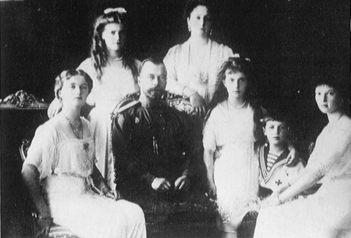
i1.3. The imperial family: Olga, Marie, Nicholas, Alexandra, Anastasia, Alexei, and Tatiana.

i1.4. Grigory Rasputin.
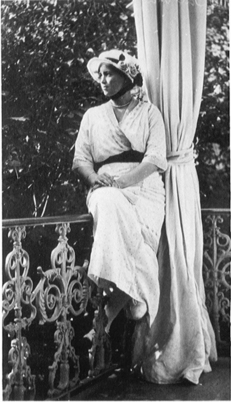
i1.5. Grand Duchess Marie, photographed by Alexandra, Tsarskoe Selo.
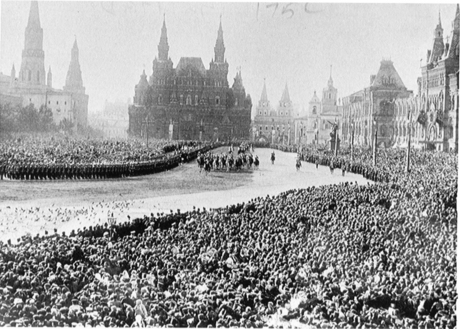
i1.6. Procession of the tsar through Red Square and ceremonial greeting during celebrations for the tricentennial of the Romanov dynasty, Moscow, May 24, 1913.

i1.7. Religious procession during the Romanov tricentennial, Kostroma, 1913.

i1.8. Nicholas emerging from a coach at the entrance to the Romanov house on Varvarka Street, Moscow, during the Romanov tricentennial, May 25, 1913. The Romanov coat of arms can be seen on the house.
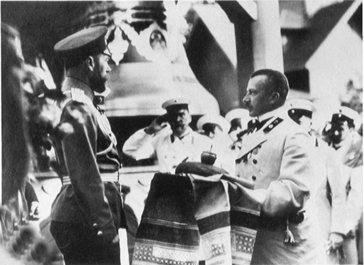
i1.9. Kostroma Mayor N. K. Shelashinov performs the ritual offering of bread and salt to the tsar, Romanov tricentennial, 1913.

i1.10. Tsar Nicholas II, 1914.

i1.11. Tsaritsa Alexandra Feodorovna, 1914.

i1.12. Alexandra with Alexei, who had injured himself jumping off a boat, Spala, Poland, 1912.

i1.13. Alexei bathing in the Dnieper near Mogilev. The bruises from hemophilia are visible on his legs.

i1.14. Alexandra, Olga, and Tatiana after completing their nursing course and receiving diplomas from the International Red Cross Society, 1914.
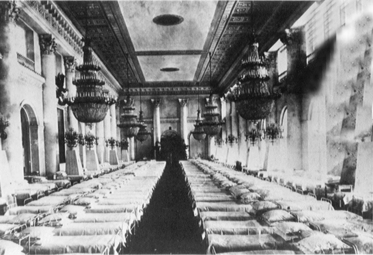
i1.15. World War I: a ward for wounded officers in the Winter Palace, Petrograd, 1916.
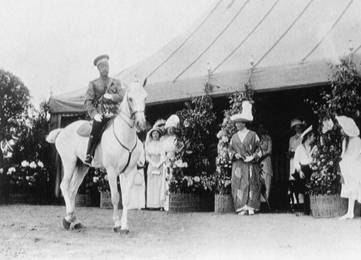
i1.16. Nicholas and his family preparing for a meeting with representatives of a town in the south of Russia during World War I.

i1.17. Nicholas before a map of military operations, the western front, World War I.
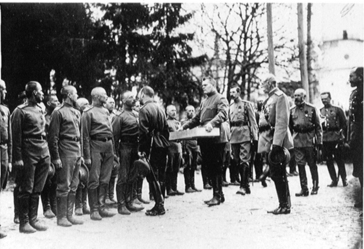
i1.18. The tsar exchanges Easter salutations with officers, imperial headquarters, Mogilev, April 11, 1916.

i1.19. Nicholas at headquarters with military representatives of the Allied powers: Colonel Marsengo (Italy), Baron B. de Ricquel (Belgium), General Sir John Hanbury-Williams (England), Nicholas, Marquess de Laguiche (France), and Colonel Londkijevic (Serbia), 1916.

i1.20. The parlor car on the imperial train in which Vasily Shulgin and Alexander Guchkov accepted Nicholas’s abdication in March 1917.

i1.21. The grand duchesses with shaved heads, under arrest of the Provisional Government, Tsarskoe Selo, 1917.
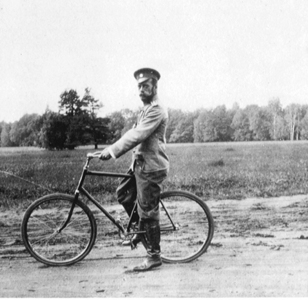
i1.22. Nicholas on a bicycle, in captivity, in Tobolsk, Siberia, 1917.