

A mountain of new readers’ letters—agonizing letters. I keep trying to put an end to the book, but they keep coming.
The niece of Elizaveta Ersberg, the tsar’s family’s parlormaid, wrote again: “A few words about my aunt’s fate after the execution of the tsar’s family. When Kolchak took Tobolsk, Elizaveta was called in for questioning to the commission of the jurist Nikolai Alexeyevich Sokolov (who turned out to have been a schoolmate of my father’s at the Third Grammar School). Elizaveta arrived in Ekaterinburg with the advance White troops. She hired a boatman and searched for the bodies in a pond and in some swamp (she had received information) but found nothing. Then through the Red Cross mission she traced—via the Far East, Japan, America, France, and Denmark—the tsar’s mother, Empress Marie Feodorovna, who gave her a subsidy, then went to Russia via Switzerland and Czechoslovakia in November 1928. She was allowed back into her homeland at my father’s personal request to Molotov. At the border Liza was given a written undertaking to appear at the Cheka in twenty-four hours. When she came, she was given a written undertaking about not disclosing the facts of the life of the tsar’s family and the circumstances connected therewith….
“Now about the story of my aunt’s friend, Anna Demidova, apparently shot in the Ipatiev house.
“No, Anna Demidova’s story did not end on the day of the execution, and here is why I draw this conclusion. My father loved to take photographs, and we had a box of negatives with views of parks in the country and on that background photographs of friends. There were many pictures of Aunt Elizaveta in the company of Demidova and other tsarist servants. Therefore I knew Anna Stefanovna’s face very well and can see her now right before my eyes. Average height, plump, with a rather common, round face, her hair sleeked back at the temples and a headdress on the top of her head….
“Even before Aunt Elizaveta’s return to Russia, I was taken to visit her sister. To amuse me, they got out an album for me with a beautiful onyx binding—Aunt Elizaveta’s album. In it were at least ten photographs of Demidova. I already recognized her. But who this was in the album—a tall, lean, pockmarked woman—they couldn’t tell me; Aunt Elizaveta could tell me. Christmas 1929, when Aunt Elizaveta was home, we went to visit our aunts. Once again I asked for the album and began leafing through it—but all the photos of Demidova, even in groups, had vanished or been smeared over. To my question about where the photograph of ‘papa’s fiancée’ was, my aunts began hushing me, and when I inquired about the tall, pockmarked woman, Elizaveta said that she was a very good person but she died. And I cried.
“My aunts died from hunger on the same day, March 12. They had been supposed to be evacuated, and their passports had been taken away at ZhAKT [Housing Office], but they didn’t go. And no one would give them bread ration cards without a passport. (Thus the tsaritsa’s parlormaid died of hunger.)
“Demidova’s story surfaced later. I was working in a plant (54 Lermontov, Leningrad). In 1968 a master compressor technician came to see us in shop number 17—Demidov. I saw him for the first time and was dumbstruck. Where had I seen that face? And suddenly I knew—Anna Demidova. I sort of joked, in conversation with him, that if he put on a bonnet he would look like a lady I knew. I asked if he wasn’t related to Anna Stepanovna Demidova. He replied, ‘Not Stepanovna, Stefanovna—she was my father’s older stepsister.’ He said she died in the Patriotic War [World War II]. As Demidov described her to me, she was average height, plump with slick-backed hair, she drank, smoked, and never went out of the house. She was either afraid of her nephew or didn’t like him. Whenever she met him in the hall, she ran away. In the night she raved and cried out. So that her brother locked her in her room. I asked Demidov to write about his aunt and he said: ‘That’s just asking for trouble.’ The woman shot by the name of Demidova was by all descriptions tall. So who was that tall woman from the album who was shot instead of Demidova?”
I set the letter aside. “Instead of Demidova?” Or maybe not instead? Maybe my guest’s version about the two being saved is true, and her father and aunts created all this obfuscation about the photographs of “the wrong Demidova” to confuse the girl and hide from her a very dangerous secret: Demidova was saved?
Soon after this letter I received a long-distance telephone call.
First I heard a cough, and then a familiar voice began to speak. My God, I’ve already finished the book, I’ve already written that line, so like a citation from a novel: “I never saw my guest again,” and here again—again this mysterious man!
The voice spoke without any introduction:
“Yesterday the remains of nine people were brought to the morgue of one of the hospitals in Sverdlovsk, now renamed Ekaterinburg again, as you well know. I hope you understand who I’m talking about?”
“No,” I said, although I did.
“Yes, these are the remains that were in the grave Yurovsky described. They opened up the grave yesterday.” And he hung up.
Just a few days after that call, reports appeared in the papers: on July 12, outside the village of Koptyaki, the grave was dug up where the remains of the tsar’s family supposedly had been buried.
Now my guest is sitting in my house once again.
He has failed significantly in these months; he is obviously ill. The conversation is constantly interrupted by his coughing, but his permanent sarcastic grin is unchanged.
“There, you see. So much has happened in the short time since we last met: Leningrad is Saint Petersburg again, Sverdlovsk is Ekaterinburg, and the Communist Party has been banned. Look at the coincidence: you finished your book about the last tsar simultaneously with the demise of communism in Russia.
“So, the grave Yurovsky described was dug up. [I realized the introduction was over and the story had begun.] By the way, the first attempt to uncover it was back in 1979.”
“I know about that.”
He continues, though, as if he had not heard me.
“Three Sverdlovsk geologists and one Moscow writer located the grave Yurovsky described. Subsequently, as we know, they talked about all the difficulties of their searches, but that was more to make the story interesting. In fact, one of them had access to the secret archives, and they knew the location of the grave Yurovsky had recorded. In 1979 they decided to dig it up. Then they removed three skulls from the grave, made casts, and put them back. One of the skulls had a gold dental bridge. They conjectured it had belonged to Nicholas. They did not talk about all this, naturally. Only ten years later did they tell the whole story in the press for the first time.
“So now, that is, twelve years later, these Sverdlovsk geologists have opened the grave a second time. The fact of the matter is that a rumor got started in Ekaterinburg that Moscow had decided to open the grave and take away the remains. And just as Ekaterinburg had not given up the Romanovs to Moscow while they were alive, now they decided not to give them up after their deaths. Generally speaking, it was all identical: secret murders and secret digging. Soldiers put a barrier up around the work site and wouldn’t let anyone in. Just as in July 1918, it had been terribly hot … but on the day of the grave’s unearthing there was a downpour.”
“You were there?”
“I didn’t have to be. I did have to know, however. They opened it up like barbarians, without a priest. It was around midnight when they came across the planking Yurovsky wrote about. Then came bones and entire skeletons, a skull with bullet holes and traces of rifle butt blows … fragments from the containers for the sulfuric acid that was supposed to disfigure the bodies beyond the point of recognition, and pieces from the rope used to raise the bodies out of the first mine shaft.… Then they hastily brought out the remains in carbine cases. A hole was left at the grave site, which quickly filled with rain. A muddy pool. Then the soldiers threw dirt and turf over it. In the local hospital, in the morgue, in the so-called soil room, where disfigured corpses go, they placed the tsar’s family. Forensic medical experts cleaned the dirt off the bones and skulls, dried them, and assigned inventory numbers. The martyrs were transformed into an archeological find.”
“You mean you think this was really the tsar’s grave?”
“I think they discovered the grave Yurovsky wrote about. Were the remains of the tsar and his family in it? Or had the remains been burned and was this only a false grave?
“If, however, it is proved that this is the tsar’s family, then the first expert opinions published recently become very interesting: of the eleven people shot, only nine skeletons were found in the grave.
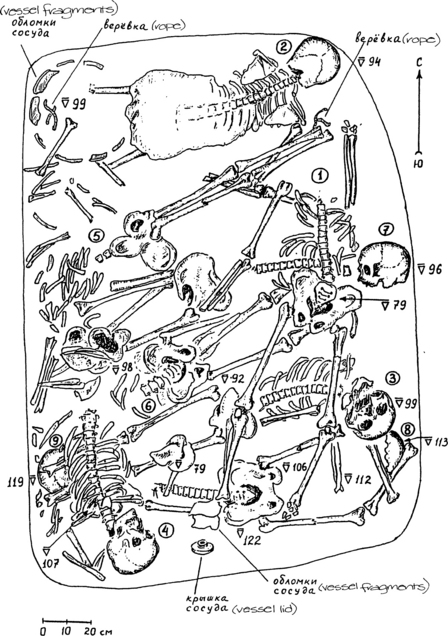
i1.42. Diagram of the grave near the village of Koptyaki presumed to contain the remains of the tsar’s murdered family. The plan shows the disposition of the corpses, fragments of the jars that contained the sulfuric acid, and segments of the rope that had been wound around the corpses. The diagram was drawn by participants in the 1991 grave opening.
“The remains of Alexei and one female skeleton are missing.”
After this visit I started receiving astonishing “presents” from him. Although the entire Ekaterinburg investigation was cloaked in strictest secrecy, he sent me a detailed sketch of the corpses’ placement in the grave. Later, photographs of their skulls turned up on my desk. This skull with the bullet hole—is this the enchanting Olga? And this one with the gap where the nose had been—is this our hero, the last Russian tsar?
My guest phoned me one last time. “The excavations are still ongoing. They’re searching for the missing pair. The experts figure he couldn’t have burned the two bodies without leaving any trace at all. That would have taken too much wood, too much gasoline, and too much time, none of which Yurovsky had. Despite all that, they have yet to find them.” He laughed. “They’re still missing.”
“But what if they are found?”
“That would mean the rescued pair did not survive for long. We can only assume they died from their wounds after all and then were left by their rescuers in the surrounding woods, only to be discovered later by my friend Peter Ermakov, who had been so unnerved by their disappearance. Then he really may have burned them, or just buried them due to lack of time.”
I heard him laugh once again. “Although knowing what this glorious Chekist was like, we have to consider another possibility: When he didn’t find them he may have burned two similar bodies, just to be safe. In those years the Cheka had a wide assortment of bodies on hand. So those experts will have to do a painstaking job.”
Enough! Enough puzzles, enough of these endless mysteries and resurrections!
But again from nonbeing—the specter of the Ipatiev house, and the grand duchesses on their knees by the wall, and the hands holding revolvers poking through the doorway, and the sovereign’s forage cap rolling away toward the wall, and he himself keeling over backward. Lord have mercy!
Will I never finish this book?
Finally! After all those years of vain attempts to storm the Central Party Archives without ever being allowed to work there! Still, with help from my readers, I did manage to find out what was in the documents I needed.
Take this intriguingly empty envelope, for instance….
In 1989, after my first article appeared in Ogonyok, I received an exceedingly curious letter from an unidentified reader:
“In the days when I was working in the Lenin archive of the Central Party Archives, I saw a strange empty envelope stamped ‘Directorate of Sovnarkom Affairs.’ On the envelope was a note: ‘Secret, to Comrade Lenin from Ekaterinburg, July 17, 12 noon.’
“It is not hard to gather from this note that the envelope once held a certain secret telegram sent from Ekaterinburg early on the morning of July 17, that is, immediately following the murder.
“Also on the envelope was the signature of Lenin himself: ‘Received. Lenin.’
“And there was a note saying a copy of this telegram had been sent to Sverdlov.
“But the telegram itself was not in the envelope: the envelope was empty.”
At the time I decided against publishing the letter without first verifying it. But I couldn’t. The Central Party Archives categorically refused to admit me.
Times have changed (for long?). I am sitting in the former Central Party Archives of the Communist Party.
Before me lies that same empty envelope from the secret telegram with Lenin’s signature of receipt.
And although the telegram has been removed as a precaution, I can guess the subject of this telegram from Ekaterinburg, which arrived the morning after the execution addressed to the individual who had given the order for that execution.
I can even imagine its content, because of that day, July 17, Ekaterinburg informed yet another initiator of the execution—Yakov Sverdlov—about the “extermination of the Romanovs.”
That telegram was preserved, though. It was found and deciphered, as we recall, by Investigator Sokolov. “Moscow, Kremlin…. Tell Sverdlov that the same fate has befallen the entire family as has its head. Officially the family will perish in the evacuation.”
There is something terrible in this remaining witness to the murder; this empty envelope with its timorously removed telegram and very clear notes.
Yet another very important set of documents turned up in Russia, volumes that had been held for nearly half a century in the secret archives! Eight volumes of documents.
Four volumes had been kept in the Party Archives with a note on the cover: “Do not release to reading room.”
The other four volumes were in the archives of the Military Prosecutor of the former USSR.
The title printed on each volume:
“Preliminary investigation carried out by Special Judicial Investigator N. A. Sokolov.”
Yes, these were the actual volumes from the famous Sokolov investigation into the murder of the Romanovs!
All the testimony in the case had been signed personally by the witnesses Sokolov had questioned. It was on the basis of this file that he wrote his book, The Murder of the Tsar’s Family, in which he frequently cited documents from this file.
How did these volumes ever wind up in the archives of the Military Prosecutor and the Communist Party?
More than likely they came out of German archives the Soviet Army captured in Berlin. How did they come to be in Germany? By way of occupied France, of course, where Sokolov lived in emigration, conducting his endless inquiry right up until his death.
An inquiry so enticing to begin but scarcely possible to conclude.
I am leafing through the testimony of the witnesses, and it is like a parade of the characters in our book: N. N. Ipatiev, Evgeny Kobylinsky, Prince Lvov, Alexander Kerensky, Alexander Guchkov, Prince Felix Yusupov, Matryona Rasputin, Gilliard and Gibbes, Tatiana Melnik-Botkina, the tsaritsa’s maid Sasha Tegleva, and so on.
And although historians have quoted much of this testimony many times, there is a kind of magic in authentic documents. Certain fine points, certain details, read completely differently in them.
There is the testimony of Prince Georgy Lvov.
How mocking history is: Prince Lvov, prime minister of the Provisional Government, which overthrew and arrested the last tsar, was himself arrested by the Bolsheviks after the October coup! Moreover, in 1918 Prince Lvov was in prison in Ekaterinburg very near the house that had been a prison for the tsar he had arrested the year previous. The former prime minister describes his encounter there with his Petersburg acquaintance Prince Dolgorukov, who was being held in the very same prison.
It turns out that, upon his arrival in Ekaterinburg, Dolgorukov was imprisoned by the Chekists, not shot. In prison the loyal Valya (Dolgorukov) was in constant distress over the tsarist money the “commissars” had confiscated from him. Actually, he did not remain distressed for very long; soon he was “sent to Moscow”—shot, in fact, in an open field by one of the characters in our book, Chekist Grigory Nikulin.
In prison, too, Prince Lvov saw the prison commissar Kabanov, brother to yet another character—former tsarist Guardsman and later Chekist Alexei Kabanov, who so distinguished himself on the Ipatiev night.
Here is the testimony of that notorious exposer of provocateurs in the revolutionary movement, V. L. Burtsev, who described one very important character in our book:
“Lenin is a ‘cynic of the spirit’ in the full sense. It is something more than ‘Jesuitry.’ He has decided once and for all that all means are good and everything is permitted.”
Here is another description of a very different character in our story: “At a depth of seven and a half sazhens [52.5 feet] a woman’s corpse was found clothed in a gray rubber cloak, a gray dress, a white cotton bodice, a black shawl on her head, and a cypress and copper cross around her neck….
“Her head and body were covered with many bruises from blows by a blunt instrument, as well as the result of injuries from her fall into the mine shaft.”
This was the beautiful Ella, Alix’s sister. This was how she looked when they excavated the mine shaft at Alapaevsk.
My guest called again.
As always, he started in without preliminaries. And, of course, about the alleged tsarist grave outside Ekaterinburg:
“I forgot to tell you one awful detail. After the grave was opened, the tsarist remains were kept for a time at the Upper Isetsk police Station, in the building where the policemen took target practice.… So that once again the Romanovs were lying against a wall strewn with bullets.… They showed me a photograph of the tsarist bones and among them was a black cat that had happened to wander onto the firing range.”
Then he added with his familiar chuckle, “Well, as for the two missing corpses, those remains have yet to be found.” He was silent for a moment and then changed topics. “I heard you’ve been out of the country for a long time. I hope you’re up to date on the experts’ latest accomplishments. They really are accomplishments. Computer comparison of skulls and photographs has already established with 90 percent accuracy that two skulls belong to the tsar and tsaritsa. Well, for 100 percent certainty, ‘fragments of the remains,’ or in plain words, pieces of bone from the skeletons, were sent to the English. They have a Center for Criminal Investigations there at the British Ministry for Internal Affairs.” A chuckle. “You’re a frequent visitor abroad now, so you’ll be interested in the results. They’re going to extract DNA from the bones. They want to compare it with the genetic code of one of the presently thriving representatives of the English royal house, who, as you know, are the Romanovs’ closest relatives. They’ve agreed to help out. Well, they didn’t help them when they were alive, so they’ll help out now that they’re dead. It looks like the question of just who is in the grave is going to be decided once and for all very soon.” Again he jumped to a different topic “By the way, you would be interested in two more finds: some of Nicholas’s hair was found in Moscow; and in Ekaterinburg, in the archives of the former KGB, they declassified a very interesting file on the tsarist diamonds. I’ve always said that the jewels were one of the reasons the tsar’s family was executed. As it turned out, though, even after the death of their unlucky owners the stones continued to kill people.”
I had known all this. I had known that the remains had been sent to the country where the family had been so happy at the end of the last century. I was well informed about the work of the Moscow team of experts and had even helped them get in touch with the grandson of Dr. Botkin, Konstantin Melnik, who was living in Paris.
And I had already seen a certain file in the former Archives of the October Revolution (which has abashedly changed its name to the Russian State Archives), a file with the terrible title “Envelope with a crown and the inscription ‘Anichkov Palace’” (archive 640, list 2, file 14). Inside the file, indeed, lay a small envelope with “Anichkov Palace” printed on it and an embossed crown. But there was one more inscription on the envelope, this handwritten, and in English: “Nicky hair when three years old.” And a signature: “Alix.” Actually, even without the signature it would have been easy to recognize the elegant handwriting of the last tsaritsa.
Evidently, immediately after the wedding, when Alix and Nicky were first living with the dowager empress at Anichkov Palace, his mother had given Alix this little envelope, and punctilious Alix had written it all down on the spot.
The envelope holds little Nicky’s golden curls, which you can see in that first photograph of him as a baby.
For this reason I was not listening very closely to that part of my guest’s conversation. But when he started talking about the diamonds …
He immediately sensed my agitation and said, derisively as always: “I’ll try to send you the documents. And I’ll call.”
He did send me the documents. But he never called.
Soon after I learned from the newspapers that a blood analysis had been done in England on Prince Philip, consort of the English queen. The DNA of the prince—the grandson of Alix’s sister—proved identical to the DNA taken from the bones of the alleged skeleton of the murdered tsaritsa. The prince’s DNA also matched the genetic code of three other skeletons—the alleged grand duchesses.
Is the story of the tsarist grave over?
I remembered this strange sentence from long ago: “Even opening the grave will not clear up the puzzle for us completely.”
Naturally, I waited impatiently for my guest’s phone call and usual commentaries.
But he never called me again. Actually, I’ve written that about him before. So I continue to await his call.
A few extracts from the file he sent me:
“Materials related to the search for the valuables of the family of the former tsar Nicholas Romanov in three volumes.
“Top secret. Report of the OGPU Economics Department for the Urals on the confiscation of the tsarist valuables …
“After an extensive search on November 20, 1933, in the town of Tobolsk, the valuables of the tsar’s family were confiscated. While the tsar’s family was staying in Tobolsk, the tsarist family’s valet Chemodurov had turned these valuables over for safekeeping to Druzhinina, mother superior of the Tobolsk Monastery of St. Ivan.”
This was the same monastery where they had so dreamed of living.
“Shortly before her death, Druzhinina gave them to her assistant, the deaconess Marfa Uzhentsova, who hid these valuables in the monastery well, the monastery cemetery, and several other places as well.”
Soon, however, after the monastery’s closing, the monks were driven out, and Marfa evidently had nowhere to hide the tsarist jewels. She tried to figure out what to do to keep them from falling into the hands of the authorities who had killed the tsar and his family.
“In 1924–25, M. Uzhentsova was planning to throw the valuables into the river. She was dissuaded from this step, however, by former Tobolsk fishing industrialist Kornilov, to whom she entrusted the valuables for temporary safekeeping.”
Yes, this was the same Kornilov in whose home the tsar’s suite had been housed during their Tobolsk confinement. Evidently, though, either Marfa consulted with someone about the tsarist jewels or she simply let it slip. The former deaconess did not realize that times had changed and that by then it was no longer prudent to seek other people’s advice.
“Arrested on October 15 of the same year, Uzhentsova admitted to keeping the tsarist valuables and indicated where they were located. No valuables were found in the indicated place.”
She was still trying to save the tsarist diamonds entrusted to her. Evidently, though, they had had her under surveillance for a long time.
“As a result of the secret service’s work, V. M. Kornilov was arrested. V. M. Kornilov, who was apprehended in Tobolsk, revealed the actual location of the valuables.
“On Kornilov’s instruction, valuables were removed in two large glass jars, which had been placed in small wooden receptacles.
“They were dug up in the cellar of Kornilov’s house.”
These fantastic jewels, which had glittered at tsarist balls, had been buried under the floor of the Kornilov house.
There is a photograph in the file of the GPU workers “with the confiscated jewels.”
——
“Appraisal of the valuables.
“In all, 154 objects were confiscated, for a total value of 3,270,693 rubles (gold rubles), 50 kopeks.
“Among the confiscated valuables were:
“1. A diamond brooch (100 carats),
“2. Three hat pins (44 and 36 carats),
“3. A diamond crescent (70 carats) [according to reports, this crescent was a gift to the tsar from the Turkish sultan],
“4. 4 diadems of the tsaritsa, and others.”
This successful operation inaugurated a real hunt for the tsarist diamonds.
First they went after the relatives of everyone connected with the Romanovs’ Tobolsk confinement.
They found and questioned the relatives of the murdered cook Kharitonov, but without success.
They located the widow of Colonel Kobylinsky, who had been shot during the civil war.
They sought her out in the small town of Orekhovo-Zuevo, where the unlucky woman had attempted to hide, living quietly with her fourteen-year-old son Innokenty, and had worked at Karbolit, a local factory.
She told them about the sovereign’s cap and the tsarist jewels, which her husband had brought home to show her and which according to rumors had later been hidden on some isolated squatter’s holding in the taiga. (Captain Aksyuta had told the truth: the tsaritsa’s jewels and the tsar’s cap had been buried in the taiga!)
Through the Kobylinsk Secret Police they picked up the trail of Pechekos’s sister and brother, whom the Kobylinskys had stayed with in 1918 in Tobolsk and who, according to Kobylinskaya, knew about the cache.
First they arrested Anelia Pechekos. Evidently they interrogated her rather zealously, and Pechekos realized she wouldn’t be able to hold out.
“On July 8, 1934, Anelia Vikentievna Pechekos died in prison after swallowing iron objects.”
Her arrested brother threw himself out a window, but survived.
Realizing that these people would rather die than reveal the secret, the secret police decided to release Pechekos from prison and put him under permanent surveillance, which went on for decades and was lifted only after Pechekos’s death.
The searches kept up. They interrogated people who had known the deceased valet Chemodurov. They determined that the old man had died in the house of the barman Grigory Solodukhin, “who according to rumors had amassed great valuables.”
But they couldn’t arrest Solodukhin. In 1920 shortsighted Chekists had shot him.
Nonetheless, they did finally pick up a fresh trail.
They determined that the tsaritsa had instructed Father Alexei (the same priest who had once prayed for “A long life!” for the tsar’s family in Tobolsk) “to carry out and conceal a case containing diamonds and gold objects of not less than one pood [36 pounds].”
And once again they met with failure: Father Alexei had managed to pass away in 1930.
They interrogated his children. But the children didn’t know anything. Father Alexei had safely hidden the tsarist case.
So perhaps even now, buried somewhere in the cellar of an old Tobolsk house, is a brown leather case bearing the tsarist coat of arms and a pood of jewels, and somewhere in the taiga of Siberia still lie the tsar’s cap and the Romanov diamonds.
I’m never going to finish this book!
The letters keep arriving, such as this one from St. Petersburg with information on that strange man Filipp Semyonov, who considered himself Alexei’s savior. Apparently, during the Khrushchev era the alleged tsarevich went straight from prison camp to Leningrad, where he married and later died in 1979. Before his death, his wife had always called him Alexei. As he was dying, he got his wife’s word that she would rebury him alongside the rest of his family. The envelope contained a photograph of him shortly before his death.
Another specter of the Ipatiev house emerging from oblivion.
At the Central Party Archive, I was finally able to read the “Secret statements of Chekist Medvedev-Kudrin on the execution of the tsar’s family,” which I had heard so much about from his son. One more witness tells the story:
“Yurovsky read the decision to execute. ‘You mean they’re not taking us anywhere?’ Botkin asked. Yurovsky wanted to say something in response, but I was already pulling the trigger. I planted the first bullet in the tsar.… Yurovsky and Ermakov shot Nicholas in the chest as well, almost point-blank.… On my fifth shot Nicholas II toppled back like a sheaf of grass.… There was a woman’s scream, and moaning.… You couldn’t see anything because of the smoke: we were shooting at falling silhouettes we could barely see….
“ ‘Stop! Cease firing,’ Yurovsky commanded.
“ ‘Thank the Lord! God has saved me!’ The surviving maid staggered as she tried to get up.… Then the maid was bayonetted. At her dying cry, Alexei, who was lightly wounded, came to and started moaning. He was lying on a chair. Yurovsky walked over and emptied the last bullets from his Mauser into him. The boy became quiet and slowly crawled to his father’s feet.… Nicholas was completely riddled with bullets.… We examined the remaining ones and finished off Tatiana and Anastasia, who were still alive, with the Colt.”
Did “lightly wounded” Alexei and Anastasia survive the execution? Only after that, Medvedev-Kudrin asserts, were they finished off—in a room where “you couldn’t see anything because of the smoke.”
Two tape recordings are also preserved in the Party Archive: those historic 1964 recordings once discussed in such detail by historian Mikhail Medvedev, Medvedev-Kudrin’s son. On the tapes are the voices of one of the main regicides, Grigory Nikulin, the assistant to the Ipatiev house commandant, and I. Rodzinsky, who participated in the secret burial of the tsar’s family, telling the story of how the tsar and his family died.
Especially interesting are the statements of the man whose name so resembles my own, I. Rodzinsky.
First he tells the tale I have already heard from Medvedev about how the Cheka organized provocations by composing “forged letters over the signature ‘An Officer’”:
“We needed proof that preparations were under way to abduct the Family, even though no such preparations were under way.… Voikov dictated the letters to me in French, and I wrote … so the handwriting was mine.”
The Chekist described the execution as well, and here the name of Alexei crops up once again:
“I must say the execution was chaotic. We nearly shot ourselves because of the bullets ricocheting.… For example, Alexei II took 11 bullets … only after that did he die.”
But Rodzinsky himself did not witness the execution. His story is based on what the other executioners told them, and they were clearly amazed at Alexei’s “strange vitality.”
He did witness the second burial of the tsar’s family, however, and even participated in it. He describes all its terrible details. The Chekist remembered everything: how they got to the mine at dawn, “how one man dropped down into the water with ropes and dragged the corpses out of the water … we pulled Nicholas out first.” He recalled: “The water was so cold that the corpses’ faces were red-cheeked, as if they were still alive.” He recalled seeing the naked body of the tsar and how amazed he was at “Nicholas’s remarkable physical development … his muscles, torso, stomach, and arms.” He remembered little details, too, such as Yurovsky being sent to town for sulfuric acid and him taking that time to go into the village to drink some milk.
He described in detail how they created this terrible secret grave:
“The truck got stuck in a quagmire, and we barely pulled it out. That was when we got the idea we eventually carried out. We decided we weren’t going to find anyplace better.… We dug out that quagmire immediately … poured sulfuric acid over the corpses … disfigured them … and dumped them into the quagmire.… The railway wasn’t far from there.” He recalled how they trucked in rotten ties to disguise the grave. But they only buried some of those shot in the grave: “The rest we burned.”
As soon as he gets to the burning, the Chekist’s memory starts to betray him: “I don’t remember how many we burned exactly … or exactly who.” This is where he starts making strange mistakes: “Nicholas we did burn, I remember.… And Botkin, too, and Alexei, I think….”
No, I never am going to finish this book!