
Peter’s confidantes, the Princess of Courland and the Countess
Vorontsova; his refusal to take baths; his accident with a whip;
Holstein oysters; his negotiations over Holstein with Denmark;
Mme. d’Arnim’s challenge to Catherine’s skill on horseback;
court masquerades; Elizabeth’s new favorite; Catherine’s English
spaniel; her simple ball dress
The first day of that year, wanting my hair done, I saw my young hairdresser, a Kalmuck whom I had raised, exceedingly flushed and with a heavy look in his eyes. I asked him what was wrong; he told me that he had a severe headache and was very hot. I dismissed him, telling him to go to bed because he truly was exhausted. He went away, and that evening I was told that he had just shown signs of smallpox. I escaped with only the fear that I had of catching smallpox, for I did not come down with it, although he had combed my hair.
The Empress spent much of carnival at Tsarskoe Selo. Petersburg was almost empty; most people who lived there stayed out of duty, not out of liking for it. When the court was in Moscow and about to return to Petersburg, all the courtiers rushed to ask for leaves for a year, six months, or at least a few weeks in order to stay in Moscow. The officials, such as senators and others, would do the same, and when they feared not obtaining a leave, then came the fake or real illnesses of husbands, wives, fathers, mothers, brothers, sisters, or children, or else trials and other indispensable affairs to settle. In a word, six months and sometimes more were necessary before the court and the city returned to what they had been before the court’s departure, and while the court was absent, grass grew in the streets of Petersburg because there were almost no carriages in the city. Under these circumstances, for the moment not a lot of company could be expected, especially for us, who were moreover kept quite isolated. Monsieur Choglokov decided during this time to entertain us, or rather, since he and his wife did not know what to do in their boredom, he invited the Grand Duke and me to come every afternoon to play cards at their residence in the apartment that he occupied at the court, which consisted of four or five rather small rooms. He invited the gentlemen and ladies of the court, and the Princess of Courland, daughter of Duke Ernst Johann Biron, the former favorite of Empress Anna. Empress Elizabeth had let this Duke come back from Siberia, where during the regency of Princess Anna he had been exiled. He had been assigned to stay in the city of Yaroslavl, on the Volga; there he had lived with his wife, his two sons, and his daughter.
This girl was neither beautiful, nor pretty, nor shapely—she was hunchbacked and rather small—but she had pretty eyes, intelligence, and a singular capacity for intrigue. Her father and her mother did not love her very much; she claimed that they constantly mistreated her. One fine day, she escaped from the paternal household and fled to the house of Madame Pushkina, the wife of the governor of Yaroslavl. This woman, delighted to make herself important at the court, brought her to Moscow and spoke to Madame Shuvalova, and they passed off the Princess of Courland’s flight from her father’s house as the result of the persecution that her parents had inflicted upon her because she had manifested a desire to embrace the Greek Orthodox religion. And indeed the first thing she did at the court really was to confess her faith. The Empress was her godmother, and afterward she was given an apartment among the maids of honor. Monsieur Choglokov took pains to cultivate her because the Princess’s older brother had provided the foundation for his fortune by taking him from the cadet corps, where he had been raised, into the horse guard, and keeping him in his service as an errand boy.73
Having made her way into our company and playing cards several hours every day with the Grand Duke, Choglokov, and me, the Princess of Courland at first conducted herself with great restraint. She was flattering, and her wit made one forget the disagreeable aspect of her figure, especially when she was seated. She spoke to each person in a manner that would please him. Everyone regarded her as an interesting orphan; she was considered a person of practically no consequence. In the eyes of the Grand Duke she had another merit, which was of no small importance. She was a kind of foreign Princess, and what is more, German; consequently they spoke only German together. This made her charming in his eyes; he began to pay her as much attention as he was capable of giving. When she dined in her residence, he sent her wine and a few of the favorite dishes from his table, and when he acquired some new grenadier’s hat or some bandolier, he sent them to her so she could see them.
The Princess of Courland, who at the time was twenty-four or twentyfive years old, was not the only acquisition that the court had made in Moscow. The Empress had engaged the two Countesses Vorontsova, nieces of the Vice Chancellor and daughters of Count Roman, his younger brother. The elder girl, Maria, may have been fourteen; she was placed among the Empress’s maids of honor. The younger, Elizabeth, was only eleven; she was given to me. She was a very ugly child with a sallow complexion and she was extremely dirty. They both started out in Petersburg by catching smallpox at the court, and the younger one became even uglier as a result because her facial features were totally deformed and her face was covered not with pockmarks but with scars.
Toward the end of carnival, the Empress returned to the city.74 The first week of Lent, we began to make our devotions. Wednesday evening I was supposed to go bathe in Madame Choglokova’s house, but the evening before, she came into my room, where the Grand Duke was too, and conveyed to him as well on the Empress’s behalf the order to go bathe. Now, not only did he have a great dislike for bathing and all the other Russian customs or national habits, he even mortally detested them. He said quite firmly that he would do no such thing. She was also very stubborn and blunt in her speech, and told him that this would be disobeying Her Imperial Majesty. He declared that he could not be ordered to do what was repugnant to his nature, that he knew that the baths, to which he had never been, did not agree with him, that he did not want to die and that he held life most dear, and that the Empress would never force him to go. Madame Choglokova shot back that the Empress would know how to punish his disobedience. At this he became incensed and said angrily to her, “I will see what she does to me. I am not a child.” Then Madame Choglokova warned him that the Empress would have him put in the fortress. At this he began to cry bitterly and they said to each other the most outrageous things that fury inspired in them, and indeed neither had any common sense. Finally she departed, saying that she was going to report this conversation word for word to the Empress. I do not know what she did, but she returned and the subject of argument changed, because she came to say that the Empress said that we did not have any children, that she was very angry, that she wanted to know which of us was at fault, and that she would send me a midwife and him a doctor. To all this she added many other outrageous remarks, of which we could make neither heads nor tails, and ended by saying that the Empress excused us from our devotions that week because the Grand Duke had said that the bath would undermine his health. During these two conversations, it should be known that I did not open my mouth, primo, because they both spoke with such vehemence that I could not get a word in; secondo, because I saw that they were both talking the most complete nonsense. I do not know how the Empress judged all this, but in the end, there was no more talk of either matter beyond what I have just reported.
Toward the middle of Lent, the Empress departed for Count Razumovsky’s house at Gostilitsa to celebrate his birthday and she sent us with her maids of honor and our usual entourage to Tsarskoe Selo. The weather was extraordinarily mild and even so warm that on March 17 there was no more snow but dust on the road. Upon arriving at Tsarskoe Selo, the Grand Duke and Choglokov began to hunt. The ladies and I went out, sometimes on foot, sometimes in carriages as often as we could. In the evenings we played different little games. Here the Grand Duke developed a decided taste for the Princess of Courland, especially when he had drunk in the evening at supper, which he did almost every day. He was never more than a step away from her and spoke only to her. Eventually this affair was in full swing in my presence and that of everyone, which began to shock my vanity and my self-esteem, seeing that this monstrous little figure was preferred over me. One evening, as I rose from the table, Madame Vladislavova said to me that everyone was shocked that this little hunchback was preferred over me. I replied to her, “What can I do?” Tears came to my eyes and I went to bed. I had only just fallen asleep when the Grand Duke came to bed as well. As he was drunk and did not know what he was doing, he tried to strike up a conversation with me about the eminent qualities of his belle. I pretended to be in a deep sleep so as to make him shut up more quickly, but after having spoken even more loudly to wake me up and seeing that I gave no sign of being awakened, he gave me two or three rather hard punches in the side, cursing the depth of my slumber, then turned, and fell asleep. I cried a great deal that night over the affair and the blows he had given me, and over my situation, which was in every way as disagreeable as it was tedious. The following day, he seemed ashamed of what he had done; he did not speak to me about it and I pretended not to have felt anything.
Two days later we returned to town. The last week of Lent we began again to make our devotions; no more mention of bathing was made to the Grand Duke. Another accident happened to him that week that made him think a bit. In his room during the day, he was almost always doing one thing or another. One afternoon he practiced cracking an immense coachman’s whip that he had had made. He snapped it right and left with large strokes and continually made his valets run from one corner to the other for fear of getting slashed. I do not know how he did it, but it happened that he gave himself a very big lash on the cheek. The scar went down the entire left side of his face and was bleeding. He was very alarmed, fearing that he would be unable to appear in public on Easter and that since he had a bloody cheek, the Empress would again forbid him from making his devotions, and that when she learned the reason, the whip exercise would bring him some unpleasant reprimand. He could think of nothing better to do in his distress than to come running to me for advice, which he never failed to do in such cases.
I saw him enter with his bloody cheek. I cried out on seeing him, “My God, what has happened to you?” He told me the story. Having considered the situation a bit, I said to him, “Well, perhaps I will get you out of this mess. First of all, go back to your room and make it so that your cheek is seen as little as possible. I will come into your apartment as soon as I have what I need, and I hope that no one will notice.” He departed and I remembered that when I had fallen a few years before in the garden at Peterhof and scratched my cheek so badly it bled, my surgeon, Guyon, had given me a salve with white lead75 with which I covered my scratch. I went on appearing in public and no one even noticed that I had scratched my cheek. I immediately sent for this salve, and when it was brought to me, I went into the Grand Duke’s apartment and I treated his cheek so well that in the mirror he himself could see nothing. Thursday we went to communion with the Empress in the big court church, and when we had taken communion we returned to our places. The sunlight shone on the Grand Duke’s cheek, and Choglokov approached us to say I know not what. Looking at the Grand Duke, he said, “Wipe your cheek because there is ointment on it.” At this I said to the Grand Duke, as if playing, “And I who am your wife forbid you to wipe it.” Then the Grand Duke said to Monsieur Choglokov, “You see how these wives treat us. We dare not even wipe ourselves when they do not want it.” Monsieur Choglokov began to laugh and said, “What a truly feminine whim.” The matter rested there, and the Grand Duke was grateful to me, both for the ointment, which did him a service by sparing him unpleasantness, and for my presence of mind, which did not leave even the least suspicion in the mind of Monsieur Choglokov.
As I had to stay up Easter night, I went to bed on Holy Saturday around five o’clock in the afternoon in order to sleep until the time when I would get dressed. I was hardly in bed when the Grand Duke came running with all his might and told me to get up and come without delay to eat the very freshest oysters that had just been brought to him from Holstein. When they arrived it was for him a grand and double feast; he loved them, and they also came from Holstein, his native land, for which he had a great predilection but which he did not govern any better for that, and in which he did and was made to do terrible things, as will be seen later. I would have offended him and exposed myself to a very violent quarrel if I had not gotten up. Therefore I arose and went to his apartment, although I was exhausted from performing my devotions for Holy Week. Once in his apartment, I found the oysters already served; I ate a dozen of them, after which he allowed me to return to my room to go back to bed, and it was for him to finish his oyster repast. I further pleased him by not eating too many because there remained more for him; he was infinitely greedy when it came to oysters. At midnight I got up and dressed myself to go to matins and to Easter mass, but I was unable to stay until the end of the service because I was seized by violent stomach cramps; I do not remember in all my life having had such pains. I returned to my room with only Princess Gagarina, all my servants being at church. She helped me undress for bed and sent for doctors. I was given medicine; I spent the first two days of the feast in bed.
It was around this time or a little before that Count de Bernis, Ambassador from the court of Vienna; Count Lynar, the Danish envoy; and General Arnim, the Saxon envoy, came to Russia; the latter brought his wife, née Hoym, with him.76 Count de Bernis was Piedmontese. At that time he was just over fifty years old, witty, amiable, merry, and educated, and of such a character that young people preferred him over and enjoyed themselves with him more than with those of their own age. He was generally loved and esteemed, and a thousand times I said and repeated that if this man or one like him had been placed in the Grand Duke’s service, it would have resulted in great good for this Prince, who like me had developed an affection and a particular and very distinguished esteem for Count de Bernis. The Grand Duke himself said that with such a man by one’s side, one would be ashamed to commit foolishness. This was an excellent thing to say, which I have never forgotten. Count de Bernis had with him Count Hamilton, a Knight of Malta, as gentleman of the embassy. One day at the court, when I asked the latter for news about the health of the ambassador, Count de Bernis, who was indisposed, I decided to tell Knight Hamilton that I had the highest opinion of Count Bathyany, whom the Queen Empress Maria Theresa had just then named the governor of her two eldest sons, the archdukes Joseph and Charles, because in this function he had been preferred over Count de Bernis. In the year 1780, when I had my first meeting with Emperor Joseph II at Magilov, His Imperial Majesty told me that he knew I had made this remark. I replied to him that apparently he had heard it from Count Hamilton, who had been placed in this Prince’s service when Hamilton had returned from Russia. He said that I had guessed rightly and that Count de Bernis, whom he had not known, had been reputed to be more apt for this position than his former governor.
Count Lynar, the envoy of the Danish King, had been sent to Russia to negotiate the exchange of Holstein, which belonged to the Grand Duke, for the County of Oldenburg. He was a man who united, so it was said, a great deal of knowledge with equal ability. His outward appearance was that of the most complete fop. He was big and well built, had reddish-blond hair and a woman’s white complexion. It was said that he took such great care of his skin that he slept only after covering his face and his hands with cream and wore gloves and a night mask. He boasted that he had eighteen children and claimed that he had always prepared his children’s wet nurses by putting them in the family way.77 Very white himself, Count Lynar wore the White Order of Denmark and had clothes in only extremely light colors, such as sky blue, apricot, lilac, flesh tones, etc., although at that time one rarely saw such light shades on men. At their home, Grand Chancellor Count Bestuzhev and his wife treated Count Lynar like the child of the house, and he was much feted there, but this did not shield his dim-wittedness from ridicule. He had yet another strike against him, which was that there were still fresh memories of his brother, who had been more than well received by Princess Anna, whose regency had been despised.78 As soon as this man arrived, he could not wait to brag about his negotiations over the exchange of Holstein for the County of Oldenburg. Grand Chancellor Count Bestuzhev had Monsieur Pechlin, the Grand Duke’s minister for his Duchy of Holstein, come to his home and told him what Count Lynar had come for.
Monsieur Pechlin made a report about this to the Grand Duke, who passionately loved his land of Holstein. Ever since he had been in Moscow, it had been represented to His Imperial Highness as insolvent. He had asked the Empress for money; she had given him a little. This money had never arrived in Holstein and instead had paid His Imperial Highness’s immense debts in Russia. Monsieur Pechlin represented the financial affairs of Holstein as desperate. This was easy for Monsieur Pechlin to do because the Grand Duke left the administration to him and gave it only little attention or none at all, to the extent that once an impatient Pechlin told him in a sober voice, “My lord, it is up to a sovereign to involve himself or not with the governing of his country. If he does not get involved, then the country governs itself, but it governs itself badly.” This Pechlin was a very short, very fat man, who wore an immense wig, but he lacked neither knowledge nor ability. This thickset, squat figure was inhabited by a sharp, nimble intelligence; he was accused only of being indelicate in his choice of means. Grand Chancellor Count Bestuzhev trusted him a great deal, and Pechlin was one of his most intimate confidants.
Monsieur Pechlin made clear to the Grand Duke that to listen was not to negotiate, that negotiation was far from agreement, and that he would always have the power to break off the discussions when he judged it appropriate. Eventually one thing led to another and the Grand Duke was persuaded to authorize Monsieur Pechlin to hear the minister of Denmark’s proposals, and in this way the negotiations were opened. Deep down these discussions pained the Grand Duke; he spoke to me about it. I had been raised with the house of Holstein’s ancient hatred of Denmark and had been told repeatedly that Count Bestuzhev had only harmful designs against the Grand Duke and me. I listened to talk of these negotiations only with a great deal of impatience and anxiety, and I tried to thwart the negotiations as much as I could by influencing the Grand Duke. At any rate, no one said a word about all this to me except for him, and he was advised to keep it very secret, especially, they added, around ladies. I think that this remark was directed at me more than anyone else, but they were deceived, because His Imperial Highness could not wait to tell me about them. The further the negotiations advanced, the more they tried to present them to the Grand Duke in a favorable and pleasant light. I often saw him enchanted with what he would acquire, and then he would have bitter changes of heart and regrets about what he was going to abandon. When he was seen to be drifting, the conferences were slowed down, and they were restarted only after some new enticement had been invented to make things appear in a favorable light.
At the beginning of spring, we were made to move into the summer garden and to live in the little house built by Peter I, where the apartments are on the same level as the garden.79 The stone quay and the Fontanka bridge did not yet exist.80 In this house, I had one of the most bitter sorrows that I had during the whole reign of Empress Elizabeth. One morning I was told that the Empress had removed my old chamber valet, Timofei Evreinov, from my service. The pretext for this dismissal was a quarrel that he had had in a wardrobe with a man who was serving us coffee, during which the Grand Duke had unexpectedly appeared and had heard some of the insults that the men had said to each other. Evreinov’s antagonist had gone to complain to Monsieur Choglokov and had told him that without consideration for the Grand Duke’s presence, Evreinov had uttered all manner of abuse to him. Monsieur Choglokov immediately made a report of this to the Empress, who ordered that both men be dismissed from the court, and Evreinov was banished to Kazan, where he was later made chief of police. The truth of the matter was that Evreinov and the other man were both very devoted to us, especially the former, and this was only a long-sought pretext to take him from me. He was in charge of all my belongings. The Empress ordered that a man named Shkurin, whom Evreinov had taken as an assistant, take his place. At the time I did not trust this man.
After staying in Peter I’s house for a while, we were moved to the wooden Summer Palace, where new apartments had been prepared for us that on one side looked out on the Fontanka, which was then nothing but a muddy swamp, and on the other onto an ugly, narrow little courtyard. On Pentecost, the Empress told me to invite the wife of the Saxon envoy, Madame d’Arnim, to accompany me on horseback to Catherinenhof. This woman had claimed that she loved horseback riding and boasted that she did it well, and the Empress wanted to see if this was so. I therefore sent an invitation to Madame d’Arnim to come with me. She was a tall woman, very well built, between twenty-five and twenty-six years old, and a bit thin, and her face was anything but pretty, as it was quite long and rather scarred by smallpox, but since she dressed well, from a distance she had a kind of glamour and appeared to have rather fair skin. Madame d’Arnim arrived at my residence around five o’clock in the afternoon dressed as a man from head to foot, with a coat of red cloth trimmed with gold braid and a green gros de tours jacket also trimmed in gold. She did not know where to put her hat and her hands, and she seemed rather gauche to us. As I knew that the Empress did not like me to go riding astride like a man, I had had an English lady’s saddle prepared for me, and I wore an English riding habit of very rich azure and silver cloth with crystal buttons, which almost perfectly resembled diamonds, and my black helmet was bordered with a row of diamonds. I went down to mount my horse. At this moment the Empress came to our apartments to watch us depart. Since I was very agile then and very accustomed to this exercise, as soon as I was near my horse I jumped on it. I let my skirt, which was open, fall to either side of the horse. I was told that the Empress, seeing me mount with such agility and deftness, exclaimed in astonishment that it was impossible to mount more skillfully. She asked what saddle I was using and, upon learning that I was on a woman’s saddle, said, “One would swear that she is on a man’s saddle.” When it was Madame d’Arnim’s turn, her skill did not overwhelm Her Imperial Majesty. This woman had had her horse brought from her house. It was an ugly black nag, very big and very heavy, which our servants claimed was one of the wheelhorses for her carriage. She needed a ladder to mount it. All this was done with all kinds of fuss, and finally with the aid of several people she was placed on her nag, which broke into a rough trot that bounced the woman a great deal since she was neither firm in her saddle nor in her stirrups, and held on to the saddle with her hand. Seeing her mounted, I set off, and those who could followed me. I caught up to the Grand Duke, who had started before me, and Madame d’Arnim and her nag stayed behind. I was told that the Empress laughed heartily and was little impressed with Madame d’Arnim’s manner of riding. I believe that at some distance from the court Madame Choglokova, who followed in a carriage, collected the lady, who had lost first her hat, then her stirrups. Finally she was brought to Catherinenhof, but the adventure was not yet over.
It had rained that day until three in the afternoon, and the stairway landing at Catherinenhof was covered in pools of water. After I had dismounted from my horse and been in the salon for some time, where there were many people, I decided to walk across the exposed landing to go to another room, where my ladies were. Madame d’Arnim wanted to follow me, and because I was walking quickly, she could follow me only by running and ended up in the puddle of water, where she slipped and fell her entire length, which made the numerous spectators on the landing laugh. She got up a bit confused, blaming her fall on new boots that she wore that day. We returned from the jaunt in a carriage, and on the way she spoke to us of the quality of her nag, while we bit our lips so as not to burst out laughing. Thus for several days she gave the court and city something to laugh about. My ladies claimed that she had fallen because she had tried to imitate me without being as agile as I was. Madame Choglokova, who was not a jovial person, laughed until she cried when the story was retold and long thereafter.
From the Summer Palace we went to Peterhof, where that year we resided at Monplaisir.81 We would regularly spend part of the afternoon at Madame Choglokova’s residence, and since people often went there, we were kept sufficiently amused. From there we went to Oranienbaum, where we would hunt every day that God granted, sometimes spending thirteen hours a day on horseback. That summer was rather rainy, however. I remember that one day when I was returning to the house completely wet, I met my tailor as I got off my horse, and he said to me, “Seeing you in this state, I am no longer surprised that I can barely keep you in riding habits and that I am continually asked for new ones.” I wore only silk camlet habits, which the rain would crack while the sun would ruin the colors, and consequently I always needed new ones. It was during this time that I invented my own saddles, on which I could sit as I wanted. They had English pommels, and one could pass one’s leg over them to sit like a man. Moreover, the pommel unscrewed, and a stirrup could be lowered and raised at will according to what I judged appropriate. If the grooms were asked how I rode, they said, On a woman’s saddle, in accordance with the Empress’s wishes. They did not lie. I slipped my leg over only when I was sure not to be seen, and since I did not boast about my invention and the grooms were happy to do me the favor, I did not have any trouble. The Grand Duke cared very little about how I rode. As for the grooms, they found less risk in me riding astride, especially as I continually ran with the hunt, than on English saddles, which they detested, always fearing some accident for which they might later be blamed. To tell the truth, I cared not at all for hunting, but I passionately loved horseback riding. The more violent this exercise, the better I liked it, so that if a horse broke loose, I chased after it and brought it back. Also during this time, I always had a book in my pocket; if I had a moment to myself, I used it to read.
I noticed that during these hunts, Monsieur Choglokov softened his demeanor greatly and above all toward me. This made me fear that he had decided to court me, which was in no way acceptable to me. He was blond and foppish, very fat, and equally thick in mind and body. He was hated like a toad by everyone and was not at all pleasant either. His wife’s jealousy, nastiness, and malevolence were also to be avoided, especially by me, who had no other support in the world but myself and whatever merit I had. I therefore ducked and dodged very skillfully, as it seemed to me, all of Monsieur Choglokov’s pursuits, without him ever being able to complain about my politeness, however. All this was perfectly clear to his wife, who was grateful to me for it and afterward formed a strong friendship with me, in part because of this, as I will recount later.
There were at our court two chamberlains Saltykov, sons of the general adjutant Vasily Fedorovich Saltykov, whose wife, Maria Alekseevna, née Princess Golitsyn, mother of these two youths, was highly considered by the Empress because of the notable services that she had rendered during her accession to the throne, having shown her a rare fidelity and devotion. The younger of these sons, Sergei, had shortly before married one of the Empress’s maids of honor, Matrena Pavlovna Balk. His older brother was named Peter. He was a fool in every sense of the word, and he had the most stupid physiognomy that I have seen in my life: big vacant eyes, a pug nose, and a mouth that hung open, with which he was a supreme tattler and as such quite welcome at the Choglokovs’ home, where he was otherwise considered a man of no importance. I suspect that it was Madame Vladislavova who, on account of her long-standing acquaintance with this imbecile’s mother, suggested to the Choglokovs the idea of marrying him to the Princess of Courland. And so it happened that he got himself ready to court her, proposed marriage, and obtained her consent, while his parents requested the Empress’s. The Grand Duke learned of all this only when the matter was already completely arranged. Upon our return to the city, he was very upset by it and treated the Princess of Courland coldly.82 I do not know what excuse she gave him, but it happened that although he greatly disapproved of her marriage, she did not fail to keep a place in his affections and for a very long time maintained some influence with him. For my part, I was delighted with this marriage and had a superb wedding gown embroidered for the bride. At that time, weddings at the court, after receiving the Empress’s consent, happened only after several years of waiting because Her Imperial Majesty fixed the date herself, very often forgetting it for quite a while, and when she was reminded, she postponed it from one day to another. So it happened in this case. In autumn we returned to the city, and I had the satisfaction of seeing the Princess of Courland and Monsieur Peter Saltykov thank Her Imperial Majesty for the consent that she had deigned to give to their union. In any event, the Saltykov family was one of the oldest and most noble of this empire. It was related to the Imperial house itself by the mother of Empress Anna, who was a Saltykov, but from another branch of the family, whereas Monsieur Biron, made Duke of Courland by the favor of Empress Anna, had only been the son of a small farmer for a gentleman of Courland.83 This farmer was named Biren, but the favor that the son enjoyed in Russia led the Biron family in France to recognize him as their own, persuaded as they were by Cardinal de Fleury, who, wanting to win over the Russian court, cultivated the views and vanity of Biren, Duke of Courland.
As soon as we returned to the city, we were told that besides the two days per week already devoted to French theater, there would be two other days of masked balls each week. The Grand Duke added another day for concerts in his apartment, and court was usually held on Sunday. We thus prepared for a quite merry and animated winter. One of the masked balls was for the court alone and those whom the Empress deigned to admit; the other was for all the titled people in the city to the rank of colonel and those who served as officers in the guards. Sometimes the entire nobility and the wealthiest merchants were also permitted to come. The court balls did not exceed 150 to 200 people and those that were called public, 800 maskers. In the year 1744, in Moscow, the Empress had enjoyed making all the men appear at the court masquerades in women’s clothing, all the women in men’s clothing, without masks on their faces. It was a day of perfect metamorphosis at court. The men wore large hoop skirts with women’s coats and were coiffed like the ladies were every day at court, and the women were in men’s outfits like those worn on court days. The men did not much like these days of metamorphosis. Most were in the worst possible humor because they felt that they were hideous in their costumes. Most of the women resembled stunted little boys, and the eldest had fat, short legs that hardly flattered them. No women looked truly and perfectly good in men’s clothing except the Empress herself; since she was very tall and had a somewhat powerful build, men’s clothes suited her marvelously. She had more beautiful legs than I have ever seen on any man and admirably proportioned feet. She danced perfectly and had a particular grace in all that she did, whether dressed as a man or a woman. One would have liked to gaze only at her, and one turned away only with regret because no other object could replace her. One day at one of these balls, I watched her dance a minuet. When she finished, she came over to me. I took the liberty of saying to her that it was very fortunate for the ladies that she was not a man and that her portrait alone, painted in this guise, could turn the head of more than one woman. She received my heartfelt effusion very well and replied to me in the same tone and in the most gracious possible way, saying that if she were a man she would give me the golden apple. I bent over to kiss her hand for such an unexpected compliment; she kissed me, and the entire company sought to discover what had passed between the Empress and me. I did not keep it a secret from Madame Choglokova, who quietly repeated it to two or three people, and within a quarter hour almost everyone knew it by word of mouth.
During the court’s most recent stay in Moscow, Prince Iusupov, senator and head of the cadet corps, had been the commander in chief of the city of St. Petersburg, where he had stayed in the court’s absence. For his amusement and that of the important persons who were there with him, he had had the cadets alternately perform the best Russian tragedies, by Sumarokov, and the best French ones, by Voltaire. These latter were as poorly spoken as performed by these youths, and the female roles were also taken by cadets, who in general deformed these plays. Upon her return from Moscow, the Empress ordered that Sumarokov’s plays be performed at the court by this troupe of young men. The Empress took pleasure in watching these performances, and soon people seemed to notice that she watched them performed with a greater interest than one might have expected. The theater, which was set up in one of the halls of the palace, was transported into her apartment. She took pleasure in dressing the actors. She had superb costumes made for them, and they were completely covered in Her Imperial Majesty’s jewels. Above all we noticed that the leading man, who was a rather handsome boy of eighteen or nineteen, was, as one might expect, the most adorned. Outside the theater, he was seen wearing very exquisite diamond buckles, rings, watches, lace, and linen. Eventually he left the cadet corps, and the Grand Master of the Hunt Count Razumovsky, former favorite of the Empress, immediately took him as his adjutant, which gave the former cadet the rank of Captain. At this the courtiers drew conclusions in their usual way and figured that since Count Razumovsky had taken cadet Beketov for his adjutant, this could have no other motive than to counterbalance the favor shown Monsieur Shuvalov, gentleman of the bedchamber, who was known to be neither on good terms nor allied with the Razumovsky family, and finally there was speculation that this young man was beginning to enjoy very great favor with the Empress. Moreover, it was also known that Count Razumovsky had placed in his new adjutant’s service another orderly of his, Ivan Perfilievich Elagin. He was married to the Empress’s former lady-in-waiting, who had taken care to furnish the young man with the aforementioned linen and lace, and as she was hardly rich, it was easy to imagine that the money for these expenses did not come from this woman’s purse.
No one was more intrigued by this young man’s growing favor than Princess Gagarina, my maid of honor, who was no longer young and sought to find herself a match to her liking.84 She had her own fortune, was not pretty, but had great intelligence and cunning. This was the second time that she had set her heart on the very person who would later enjoy the Empress’s favor: the first was Monsieur Shuvalov; the second, this same Beketov, whom I have just discussed. Many young and pretty women were linked to Princess Gagarina; moreover, she had a very large extended family. They accused Monsieur Shuvalov of being the secret reason that the Empress continually had Princess Gagarina reprimanded for her finery, and that she had forbidden her and many other young ladies from wearing now one chiffon and now another. Hating this treatment, Princess Gagarina and all the youngest, prettiest women of the court spoke badly of Monsieur Shuvalov, whom they all began to detest, though they had greatly loved him up until then. He thought to mollify them by paying them his respects and having his most faithful servants make gallant remarks on his behalf, which they regarded as a new offense. He was repulsed and badly received everywhere. All these women fled him like the plague.
While this was going on, the Grand Duke gave me a little English water spaniel that I had wanted. There was a stoker assigned to my room named Ivan Ushakov, who took care of the spaniel. The other servants decided, I know not how, to call my water spaniel Ivan Ivanovich, after this man. Left alone, this spaniel was a nice animal. He walked on his hind legs like a person most of the time and was incredibly frisky—I and my ladies did his hair and dressed him every day in a new way, and the more we dressed him up, the crazier he became. He would sit at the table with us. We would give him a napkin and he would eat very properly from his plate. Then he turned his head and asked to drink by yapping to whoever was behind him. Sometimes he climbed onto the table to take whatever he fancied, like a meat patty or a cookie or something of the sort, which made the company laugh. As he was small, he inconvenienced no one, and we left him alone because he did not abuse the liberty that he enjoyed and he kept himself perfectly clean. This spaniel amused us the whole winter, and the following summer he was taken to Oranienbaum, where Chamberlain Saltykov the younger had come with his wife, who with all the ladies of our court did nothing all day but sew and fashion the hair and the outfits for my spaniel, over which they fought. Eventually Madame Saltykova developed such an affection for the dog that it grew particularly attached to her, and when she left, the dog no longer wanted to leave her nor she the dog, and she begged me so much to let the dog go with her that I gave it to her. She took it under her arm and accompanied by the spaniel, left directly for the estate of her mother-in-law, who was then ill. Seeing her arrive with the dog and perform a thousand silly antics with him, the mother-in-law wanted to know the dog’s name, and hearing that it was Ivan Ivanovich, she could not hide her astonishment from the various people who had come to see her from the court at Peterhof. They returned to the court, and after three or four days, the city and the court were buzzing with the tale that all the young women, who were enemies of Monsieur Shuvalov, had a white spaniel named Ivan Ivanovich to deride the Empress’s favorite and that they made these spaniels perform all kinds of antics, and wear the bright colors that Shuvalov liked to dress in. The matter went so far that the Empress had the young ladies’ parents told that she found it impertinent for them to permit such things. The spaniel’s name was immediately changed, but he was fawned over as before and stayed in the Saltykov’s house, cherished until his death by his masters, despite the imperial reprimand over him. In fact this was slander, and there was only this one dog, who moreover was black, given this name, and we had not thought of Monsieur Shuvalov in naming him. As for Madame Choglokova, who did not like the Shuvalovs, she had pretended not to notice the dog’s name, though she heard it constantly and herself had given many meat patties to the dog, and had laughed at its antics and tricks.
During the last months of that winter and the frequent masquerades and balls at the court, we again saw my two former gentlemen of the bedchamber, Alexander Villebois and Count Zakhar Chernyshev, who had been made colonels in the army. As they were sincerely devoted to me, I was very content to see them again and consequently I received them. For their part, they did not miss a single occasion to give me signs of their affectionate feelings. At that time, I loved to dance. At public balls I usually changed costume three times. My jewelry was always very fine, and if the costume I wore attracted everyone’s praise, I was sure never to wear it again, because I had a rule that if it had made a big impression once, it could only make a smaller one the next time. On the other hand, at court balls that the public did not attend, I dressed as simply as I could, and so I paid my respects to the Empress, who did not much like anyone to appear overdressed. However, when the ladies were ordered to come in men’s clothes, I came in superb outfits that were meticulously embroidered or gorgeously refined, and this passed without criticism. On the contrary, this pleased the Empress, and I do not really know why. It must be admitted that at that time the cultivation of coquetry was an important part of court life, and there was competition to see whose finery would be the most elegant. I remember that one day at one of these public masquerades, after learning that everyone was having the most beautiful new outfits made, and despairing of surpassing the other women, I decided to put on a bodice of white gros de tours and a skirt of the same material over a very small hoop (at the time I had a very thin waist). I had my hair arranged as best I could in front; in back, I had my hair, which was long, very thick, and quite beautiful, curled, and I had it tied with a white ribbon in a ponytail. I had a single rose whose bud and leaves perfectly resembled the real thing placed in my hair. I attached another to my bodice. I put a ruff of very white gauze around my neck, put on cuffs and a little apron of the same gauze, and I went to the ball. As I entered, I clearly saw that all eyes were fixed on me. Without stopping, I crossed the gallery and went into the facing apartment. I met the Empress, who said to me, “Good God, what modesty. What, not even a beauty spot!” I began to laugh and replied that it was for simplicity’s sake. She pulled her box of beauty spots from her pocket and chose one of medium size, which she applied to my face. Upon leaving her, I went very quickly into the gallery, where I showed my beauty spot to my intimates. I did the same with the Empress’s favorite ladies, and as I was in high spirits, that evening I danced more than usual. In my life, I do not recall having had so much praise from everyone as on that day. They said that I was very beautiful and particularly radiant. To tell the truth, I have never believed myself to be extremely beautiful, but I knew how to please and I think that this was my forte. I returned to the house very happy with my simple invention, whereas all the other outfits were exceptionally fancy. It was with such entertainments that 1750 ended. Madame d’Arnim danced better than she rode. I remember that one day, when she and I wanted to see who would tire sooner, it turned out to be her, and seated on a chair, she confessed that she could no longer go on, whereas I was still dancing.
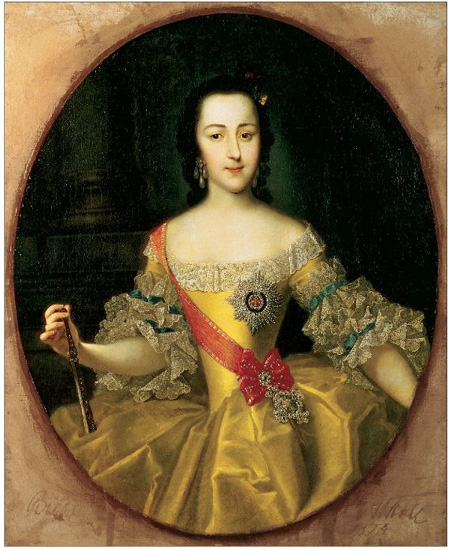
Grand Duchess Ekaterina Alekseevna (the future Catherine the Great) wearing the Order of St. Catherine (1745). GEORG CHRISTOPH GROOTH
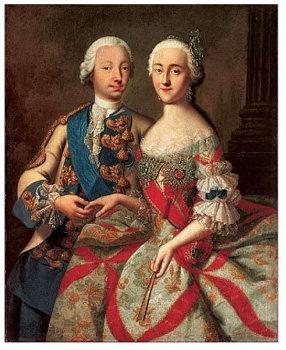
Grand Duchess Ekaterina Alekseevna and Grand Duke Peter Fedorovich (1744 – 45). GEORG CHRISTOPH GROOTH
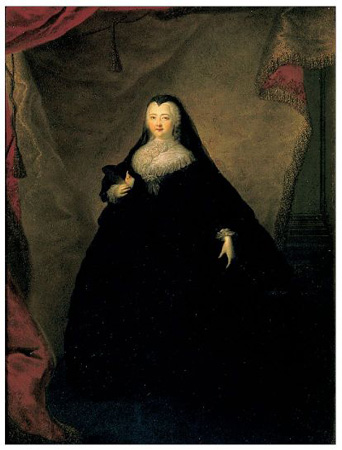
Empress Elizabeth in a black masquerade domino with a mask in her hand (1748). GEORG CHRISTOPH GROOTH
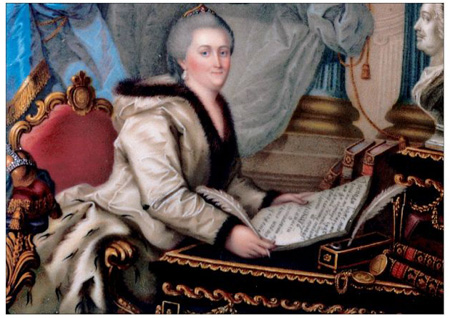
Catherine the Great holding her Instruction (1765–79). Although she first wrote it in French (1765–67), the text is in Russian; on the table are a bust of Peter the Great and books she consulted, including Montesquieu’s Spirit of the Laws (1748); an orb representing her power nestles in the arm of the chair.
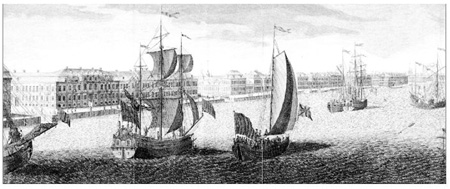
St. Petersburg and Neva River panorama (1753). MIKHAIL IVANOVICH MAKHAEV
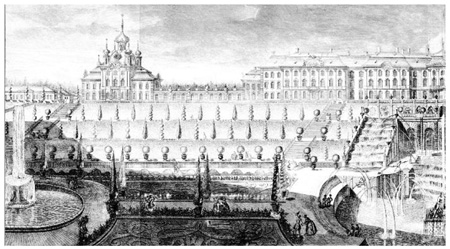
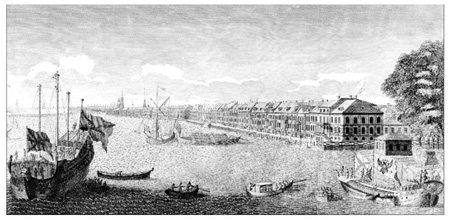
Peterhof and the Grand Cascade (1753), on the Gulf of Finland, where Peter the Great originally had his summer palace. MIKHAIL IVANOVICH MAKHAEV
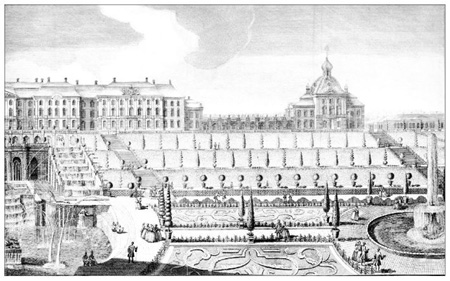
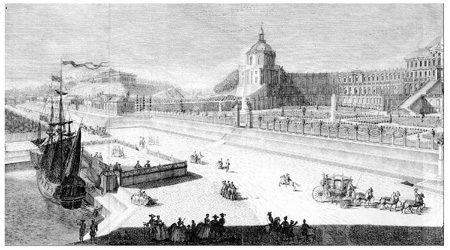
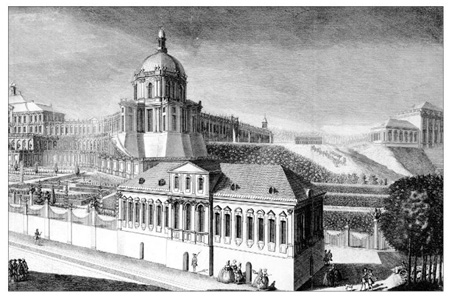
Oranienbaum (1753), home of Peter III and, later, Catherine the Great’s summer residence; today called Lomonosov. MIKHAIL IVANOVICH MAKHAEV
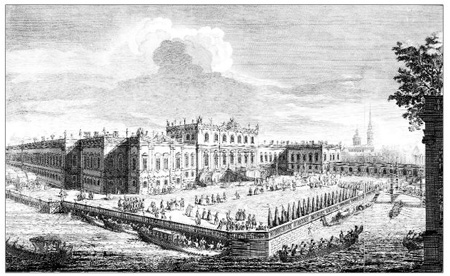
The Summer (or Catherine) Palace, Tsarskoe Selo (Czar’s Village): View of Her Imperial Highness’s summer home from the north side (1753). MIKHAIL IVANOVICH MAKHAEV