
2
His voice was as soft as a woman’s, and he rarely used it to talk of himself.
—PAT DONAN
THE CAPTURE OF THE in gold. Yet for all the public attention, hardly anyone really knew the lawman, and Garrett was not much of a talker, at least when asked to talk about himself. He seemed to have blown in off the plains and was just suddenly there, the right man at the right place. And that was pretty much how it happened.
Garrett was born in another place and time, in Chambers County, Alabama, on June 5, 1850. And although he would come to sign his name P. F. Garrett, the name given to him at birth was Patrick Floyd Jarvis Garrett, a name that had belonged to his maternal grandfather. Grandfather Jarvis died two years after the birth of his grandson, but not before willing his young namesake a rifle, a saddle, and a bridle. As young Pat would eventually learn, such basic items were crucial for a man to survive on his own. Garrett’s father, John Lumpkin Garrett, a native of Georgia, was an ambitious Southern planter. Just three years later, though, perhaps prompted by the death of wife Elizabeth Ann’s father, the Garretts pulled up stakes and moved to Claiborne Parish, Louisiana. The Garrett caravan that rattled over the rough roads to their new home included a long column of human chattel. Pat Garrett’s father was a slave owner.
In Louisiana, John Garrett purchased the cotton plantation of John Greer, consisting of eighteen hundred acres eight miles northeast of the parish seat of Homer. Pat Garrett earned his first dollar working in his father’s plantation store. And as he got bigger, so did the Garrett family; Pat would have seven brothers and sisters (Pat was the second oldest and the first son).
The Garrett plantation prospered as well. The 1860 census records the value of John Garrett’s real estate at $15,000, but his personal property was estimated at a whopping $40,000, which is not so surprising considering that it included thirty-four slaves. Pat Garrett grew up, then, in a relatively privileged world. With slaves to tend to the household and cooking, and to cultivate and harvest the vast fields of cotton, the Garretts probably never wanted for anything. The Civil War changed all that.
As a large slave owner, John Garrett was exempt from Confederate military service, but he lost his overseer to the Twenty-seventh Regiment, Louisiana Infantry. The fall of the port of New Orleans to Union forces in April 1862 brought additional hardships, forcing Louisiana cotton planters to transport their crops overland through Texas to Mexico. At the close of the war, not only did Garrett lose his slave labor force, but a portion of his cotton crop was reportedly confiscated by the occupying Federals. The debts piled up as the senior Garrett went into a spiral, his health failing and his drinking rising in proportion. He lost Elizabeth on March 23, 1867; she was only thirty-seven. He held on for almost a year longer, struggling to maintain both his livelihood and his large family. John Garrett died on February 5, 1868.
Pat, not yet eighteen, could only watch as court-appointed estate executors dealt with the financially ruined plantation; his father had left debts of more than $30,000. Pat’s brother-in-law, Larkin R. Lay, the final estate executor, sold the lands and possessions to satisfy the creditors, and the Garrett children moved into the Lay home to be raised by their sister Margaret. Furious with Larkin, Pat struck out for Texas on January 25, 1869. He had little more than a rifle, a saddle, a bridle, and a horse.
There are a number of stories about Pat Garrett’s Texas years—that he killed a black man, started and then abandoned a family, helped drive a herd of Texas cattle to Dodge City. But they remain just that, stories. Garrett first went to Dallas but soon located in Lancaster (twelve miles from Dallas), which was also the home of some old Claiborne Parish neighbors. There the strapping young fellow tried his hand at what he knew best—farming.
“I went into partnership with the owner of the land,” Garrett recalled, “my share was to be one fourth of what we made and my first work was to grub the ground and clear the land. I got mighty homesick before the crop was made, but I stayed with it.”
He stayed with it for about two years, until he met a cattleman from Uvalde County who was hiring cowboys, and Garrett’s farming days came to an end. In 1875, Garrett started north with a trail herd bound for Kansas. After about three hundred miles, the cowboys reached the Red River at Denison, where they found thousands of head of cattle, waiting to cross the famed river, then in flood stage. Here Garrett got a close-up look at the dangers of the trail, for some punchers and their horses, as well as a number of cattle, had been lost to the deep, blood-colored waters. A few days’ tough work were required to get the herds across and straightened out, after which cowboying had lost much of its romance for Garrett.
He and a buddy by the name of Luther Duke quit the herd and traded away their ponies and gear and started farming a small patch of corn and cotton. This was hardly a step up, though, and when Garrett met Willis Skelton Glenn, a twenty-six-year-old Georgia native who was about to embark in the buffalo hide business, Glenn found himself with two eager partners.
“I remember our meeting,” Glenn wrote years later. “Pat was rather young looking for all of his twenty-five or twenty-six years, and he seemed the tallest, most long-legged specimen I ever saw. There was something very attractive and impressive about his personality, even on a first meeting.” Garrett would remain associated with Glenn on the buffalo range for roughly the next three years, first as a business partner and later as Glenn’s salaried hunter. And it is because of Willis Skelton Glenn that the details of what was, for Garrett, his most mortifying deed have been preserved. In fact, Glenn made it a mission of sorts to keep Pat Garrett’s first known killing from ever being forgotten.
In the brief boom years of buffalo hunting, a good man with a rifle, and Garrett fell into this category, could down sixty or more buffalo a day, and there were hundreds of such hunters on the plains. The skinning and transporting of these hides, several hundred at a time, was hard work that required a crew of men. In camp, Garrett and the others broke the tension and monotony with an occasional practical joke, or if they were near one of the trading points, with gambling, drinking, and whoring. Still, it was not unusual for tempers to flare, even between once good friends. Sometimes, trifling disagreements escalated into deadly confrontations, just as they did with Garrett and young Joe Briscoe.
Briscoe would never have ventured onto the buffalo range had it not been for Garrett, or at least that is the story Glenn told. A native of Ireland who had lived in Louisiana before migrating to Texas, Briscoe joined the Glenn-Garrett party in the fall of 1876. After outfitting at Fort Griffin, the party headed west onto the Staked Plains. Glenn remembered that Garrett and Briscoe appeared the best of chums: “Everybody seemed to be getting on well with everybody else, and I was congratulating myself on having a harmonious outfit.” Early one morning, Glenn rode off to Rath City for a replacement firing pin for one of the buffalo guns, leaving Garrett in charge. Just before breakfast the next day, Briscoe walked to a nearby pool of water with a piece of soap and began scrubbing away at his linen handkerchief. A short time later, he walked back to camp, muttering to himself, “It was no use to wash in that damn water.”
Garrett overheard Briscoe and immediately chimed in.
“Anyone but a damn Irishman,” he said, “would have more sense than to try to wash anything in that water.”
“Yes,” Briscoe replied, “you damn Americans think you are damn smart and know a damn sight.”
Garrett was not about to take any sass from the young man and let fly with his fist, almost knocking Briscoe to the ground. Briscoe righted himself and took a swing at Garrett, missing, and then ran for the axe the cook used to split firewood. Realizing Briscoe’s intent, Garrett lunged for a .45-caliber pistol that was used around the camp to shoot skunks and other varmints. As Briscoe came at him, fire in his eyes, Garrett turned and pulled the trigger. The two were so close together that the exploding powder from the pistol scorched Briscoe’s clothing. The lead bullet punched into his left side at the waistline, then ripped across his body and exited on the opposite side just above the lower pocket of his otter skin vest. The young man collapsed at Garrett’s feet.
A stunned and trembling Garrett helped the cook carry Briscoe to one of the bedrolls. When the lad complained of being cold, they quickly scrounged more blankets for him.
Then Briscoe called out to his killer: “Pat, come here, please.”
Garrett walked over to Briscoe, wishing it was all a bad dream, trying somehow to make sense of what refused to make sense.
“I am dying, Pat. Won’t you forgive me?”
“Yes,” Garrett said, and then he returned to the campfire, tears streaming down his cheeks. Young Joe Briscoe lived only twenty minutes more.
Leaving Briscoe’s body untouched, Garrett mounted a horse and trotted after Glenn in Rath City, but Glenn had taken a different route on his return to camp, and they missed each other. Garrett finally appeared the next day, muddy and wet from having been out on the prairie all night during a horrendous storm. He remorsefully told Glenn what had happened, at the same time second-guessing his actions—maybe he was too quick to fire, maybe Briscoe did not really intend to use the axe. Glenn did not have the heart to censure his partner, saying only, “It’s a pretty hard thing, Pat, for a man to lose his life that way.” Garrett asked what he should do, and Glenn advised him to go to Fort Griffin and turn himself in. This he did, but after a few days Garrett was back in camp. The law at Fort Griffin had little inclination to deal with the guilt-ridden buffalo hunter. There was no witness to corroborate or dispute his story (and claim of self-defense), and Joe Briscoe’s body was buried miles away, marked only by an ordinary clump of mesquite. No charges were pressed and Garrett was never tried.
Winter was the main season for hunting buffalo on the Staked Plains, because the hair on the robes was longer and thicker and thus more valuable. Pat Garrett abandoned the buffalo range in the off-seasons, gambling away his earnings in places like Dodge City and St. Louis. He would, years later, recall meeting Bat Masterson in Dodge, and, also years later, Wyatt Earp would remember Garrett as among the cow town’s legendary cast of gun-toting characters.
By the spring of 1878, reports were coming in from the different trading points that the once endless herds of bison were all but “played out”—approximately two hundred thousand hides had been harvested that last season alone. There were simply no more buffalo to kill. Very few hunters came away from the business with a great deal of money, especially if they, like Garrett, had developed a fondness for gambling. And the Glenn-Garrett party had experienced the extra misfortune of having lost hundreds of hides, as well as horses and supplies, in two different Comanche raids in 1877. So, early in 1878, Garrett, Glenn, and fellow skinner Nick Ross abandoned their wagons and personal possessions near a place known as Casas Amarillas (Yellow Houses) and headed west. Garrett never explained why the three chose to go to New Mexico Territory. A writer friend of Garrett’s chalked it up to “a love of adventure.”
IT WAS A COLD February day when Pat Garrett and his two companions first showed up at Fort Sumner on the Pecos River. The military post of Fort Sumner had been established to oversee thousands of Navajos, as well as several hundred Mescalero Apaches, confined on the Bosque Redondo reservation. Once the Navajos were allowed to return to their ancestral lands three hundred miles to the west, there was no need for a reservation or a garrisoned post.
Fort Sumner was abandoned in 1869 and its buildings sold the following year. The buyer was Lucien Bonaparte Maxwell, who paid $5,000. With more than thirty Hispanic and Indian families in tow, Maxwell moved from his old home in Cimarron to Fort Sumner. They dammed the Pecos, planted crops, and tended thousands of cattle and sheep. The fort became an instant small town, its several adobe buildings converted into family residences, a dance hall, a store, even a saloon. Lucien Maxwell died in 1875, leaving his son Peter to maintain the family empire. Instead, “Pete” Maxwell, who made his home in the substantial officers’ quarters overlooking the former parade ground, oversaw its gradual decline.
Pete Maxwell and the residents of Fort Sumner were accustomed to seeing some rough characters come in off the surrounding nothingness, but the twenty-seven-year-old Garrett must have been among the scariest. When he arrived in February 1878, his hair was long and scraggly, and he had a scruffy beard. It was impossible on the frontier to get store-bought pants for a man six feet, four inches tall, so Pat had sewn nearly two feet of buffalo hide to the bottoms of his duck canvas trousers. His drooping, broad-brimmed hat was grimy from campfire smoke and being handled time and again by its owner’s greasy hands, and his belt bristled with skinning knives and cartridges for his Sharps buffalo gun. Glenn and Ross looked nearly as rough, and all three men were hungry and broke.
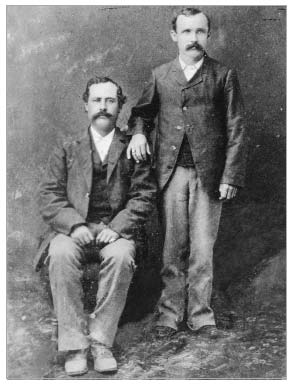
Pete Maxwell (seated) and friend Henry Leis.
Center for Southwest Research, University of New Mexico
Between them, they had a total of one dollar and fifty cents as they walked into Fort Sumner’s store. The simple establishment served meals for fifty cents each, but Pat opted to invest all of their funds in flour and bacon, grub they could stretch out into several meals. A little later, as they sat on the bank of the Pecos enjoying their breakfast feast, they saw a cloud of dust rising in the distance. This turned out to be a herd of cattle and several riders working it.
“Go on up there and get a job,” Pat prodded Ross.
The man headed over to the cow outfit but soon returned, saying the boss, Pete Maxwell, did not need any extra hands.
“Well, he’s got to have help,” Pat said as he got up off the ground.
Looking as wild as ever, Garrett went straight up to Maxwell and made his pitch. Maxwell declined again. Garrett told him with some conviction that he had come to work and work he would—Garrett, as Glenn later observed, “was always persistent in getting what he went after.”
“What can you do, Lengthy?” asked Maxwell.
“Ride anything with hair and rope better than any man you’ve got here.”
It was the right thing to say at the right time; Pat Garrett got his job.
Garrett and his fellow hide hunters moved into one of the fort buildings, quickly discovering Sumner’s primary attraction (besides the saloon): the several good-looking Hispanic girls who also lived there. Garrett and his friends were soon sharing their modest quarters with some of these young ladies. While Garrett had probably picked up some Spanish in Texas, he received a crash course here. In Spanish, his name was pronounced “Patricio,” although some preferred to call him by the nickname Juan Largo, meaning Long John.
Maxwell’s sister, Paulita, remembered that everybody at Fort Sumner liked Garrett: “He was an easy-going, agreeable man, a good storyteller, and full of dry humor. He was fond of a social glass, and was a great hand to play poker and monte.” Garrett also liked to cut a rug, and, by all accounts, he was good at it. The weekly baile (dance), held in the spacious former Quartermaster’s Depot, drew attractive young ladies from the communities of Puerto de Luna, Santa Rosa, and even Anton Chico, ninety miles distant. Yet Sumner’s female offerings and gay times were not enough to keep Glenn and Ross at the fort; they left before the summer was out. It was about this same time, for reasons long ago forgotten, that Garrett and Maxwell had a falling-out. The former hide hunter collected his wages but he did not pull up stakes, not this time.
Some accounts say Garrett opened a short-lived eating place with his saved cowboy wages. He is also said to have raised hogs and eventually partnered in a saloon and grocery business. In late 1879, Garrett and his friend Barney Mason opened a butcher shop. It might have been a success had they not been caught processing beef that did not belong to them. Garrett promised to pay the owners of the cattle, which he never did, and the shop went out of business after about a month. Whether or not all these ventures really took place, they do reflect a pattern in Garrett’s life. A proud man, Pat Garrett was determined to get ahead, to be successful, and thus retrieve a semblance of what his family had lost in Louisiana. He was willing to try just about anything that had the promise of financial rewards and, if not a certain social status, at least respect. “Pat was a working devil,” recalled his friend John Meadows. “He’d work at anything.” That anything would eventually include the job of manhunter.
LIKE GARRETT, BILLY THE KID came to New Mexico in a roundabout way, although he never called himself “Billy the Kid”—a name folks started calling him in the last six months of his life. Before that, he was Billy Bonney, Kid Antrim, or just “the Kid.” And not long before that, he was little Henry McCarty, the son of the widow Catherine McCarty. His string of aliases and nicknames does not say much about the origins and childhood of Billy the Kid, and the enigmatic outlaw had more than a little to do with keeping it that way.
At Fort Sumner in June 1880, Billy told census taker Lorenzo Labadie that his name was William Bonney, that he was twenty-five years old (which meant he was born in 1855), and that he had been born in Missouri, as had both of his parents. If the person who gave this information to Labadie was indeed Billy the Kid, then he was offering up a complete fabrication, a whole new identity to go along with his Bonney alias. Six months later, after Pat Garrett’s much-publicized capture of Billy, the Kid told more than one person that he was born in New York City. According to Garrett’s 1882 biography, the outlaw was born in that beckoning metropolis on November 23, 1859, although it is anyone’s guess how that date was obtained. Birth certificates were not required in the mid-nineteenth century, and there is no family bible entry for the babe who would one day become America’s most famous gunman. In January and April 1881, New Mexico newspapers reported that Billy’s age was twenty-one. If his birthday did occur in November, that would make 1859 his year of birth.
The few tantalizing hints of Billy’s early life must necessarily come through his mother, Catherine McCarty. She had been born in Ireland but later emigrated to the United States, perhaps while still a child but maybe as a young bride. A plucky woman, Catherine and her two boys, Henry and Joseph (born in 1863), called Indianapolis, Indiana, home for a short time in the mid-to late 1860s. She is recorded in Indianapolis city directories for 1867 and 1868 as the widow of Michael. Michael McCarty may or may not have been Billy’s father. And he may have died in New York City, or he may have perished in the Civil War as a member of an Indiana regiment. As far as we know, Billy never spoke his father’s name to any of his New Mexico acquaintances. In any case, the Catherine McCarty family was not much different from other families that found themselves without a husband and father immediately following the Civil War. And little Henry McCarty was probably not much different from other boys his age—hating school and living for play and mischief.
Sometime in 1865, Catherine met William H. Antrim, a veteran of the Fifty-fourth Indiana Volunteer Infantry who worked in Indianapolis as a driver and clerk for the Merchant’s Union Express Company. He was twenty-three years old; she was thirty-six. Yet despite their difference in age, the two developed a relationship, perhaps platonic at first, but eventually growing into something more serious. In 1870, before the census taker made his rounds, the McCarty clan and William Antrim left Indiana and headed to Kansas. The move could have been a search for a healthier place to live, because Catherine McCarty is known to have later suffered from tuberculosis. But it could have as easily been about a move westward. Much of America’s population was on the move, and there was an optimism about the West and the prospects it offered for a better life; all one needed was gumption, a piece of open land, and a little good luck. Kansas had the land.
The McCartys and Antrim settled in Wichita, a delightful culture shock for young Henry if there ever was one. Located at the junction of the Little Arkansas and Arkansas rivers, in south-central Kansas, the young town (founded in 1868 and incorporated two years later) was a true frontier crossroads. It had a strange, somewhat naked appearance—the town had been laid out on the open prairie completely absent of trees—and there was the constant and annoying sound of hammers from the construction of dozens of new houses and buildings. Lining the town’s main thoroughfare were makeshift restaurants, boardinghouses, saloons, butcher shops, bakeries, clothing stores, a barbershop, a drugstore, a livery stable, and several carpenter shops.
The ten-year-old Henry McCarty saw incredible things, sights his young friends back in Indiana would have given their souls to see. On a daily basis, the pageant of the American West passed before him—a tad begrimed, to be sure. Cowboys, freighters, buffalo hunters, home-steaders, and soldiers clomped noisily up and down the town’s board-walks. Indian men, women, and children, residents of Indian Territory (Oklahoma) to the south, shuffled in and out of stores as they stocked up on supplies. But the longhorn was king. Immense herds of Texas cattle forded the Arkansas here on their way to Abilene. During one three-day stretch that summer of 1870, 18,000 longhorns crossed the river, a fraction of the 200,000 to 300,000 that crossed that season.
From all appearances, Catherine and William intended to remain in the Kansas boomtown. They both invested in town lots, and Catherine started her own business on North Main Street. The Wichita Tribune wrote about her venture in its inaugural issue of March 15, 1871: “The City Laundry is kept by Mrs. McCarty, to whom we recommend those who wish to have their linen made clean.” If the widow McCarty was suffering from tuberculosis at that time, the tedious hand washing of linens and other laundry in a damp, steamy place certainly did not help her condition. If she was not ill when she arrived in Wichita, her workplace would have made her susceptible to the disease. She then either inhaled the deadly bacteria from a coughing customer, or it came, innocently enough, through the milk of an infected cow.
Catherine and her two boys probably started out by living in the quarters over the laundry, and at nighttime they were likely treated to some occasional gunfire from the streets below—it was a woolly cow town, after all. William Antrim and widow McCarty were not yet married, and it does not appear that they were living together, although there is not enough evidence to be certain about this. On March 4, 1871, Catherine moved her family into a small frame house that William had built for her northeast of Wichita’s business district. This was definitely an improvement, and it would suggest that everything was going according to plan for the McCartys that spring of 1871. But things happen, and plans change. By the end of the summer, Catherine had sold off all her Wichita property and, along with her two boys and Antrim, had left Wichita for good.
Perhaps Catherine’s health prompted the hasty departure for Denver. (Billy later told his friend Frank Coe that the family moved to Denver when he was about twelve years old.) Many others stricken with consumption had traveled to Denver for its “bracing atmosphere and pure water,” believing, as did their physicians, that these, along with plenty of sunshine, were the keys to their recovery. The high plains and mountains of the American West had long enjoyed a legendary reputation for healthfulness, bolstered by more than a few miracle cases. The Rocky Mountains also enjoyed a reputation for mineral riches, which could just as easily have been the overriding motivation for the McCarty-Antrim move to Colorado—William Antrim eventually became a miner obsessed with striking it rich.
Exactly how long the McCartys and Antrim remained in Denver is unknown, perhaps only a few months, because soon they were living in Santa Fe, New Mexico Territory. On March 1, 1873, William H. Antrim and Mrs. Catherine McCarty were joined in matrimony at the First Presbyterian Church of Santa Fe. Among the witnesses to the modest ceremony were Catherine’s two sons, Henry and Joseph ( Josie to family and friends). Significantly, the church marriage register described William and Catherine as “both of Santa Fe.” No sooner had Mr. and Mrs. Antrim exchanged vows, however, than they began making arrangements to move again. William, it appears, had become seduced by the fabulous reports of mineral discoveries in the southwestern part of the Territory at a place dubbed, enticingly enough, Silver City.
Antrim was not the only one. That June, the Santa Fe Sentinel’s editor commented on the starry-eyed prospectors who were passing through the capital each week and expressed his wish that they would find the mines even richer than expected, so that the whole world would know New Mexico as “the great El Dorado of the West.” No matter that the boomtown was 350 hard miles from Santa Fe, or that it was surrounded by rugged hills near the Continental Divide, or that it was located in the heart of Apache country. As the Spanish conquistadors, and countless other dream chasers who came after, could well attest, El Dorados never came easy. And so William Antrim whisked his family off to Silver City.
The Antrims’ new home was a square-hewn log cabin on Silver City’s south Main Street, near its intersection with Broadway. For whatever reason, the family no longer enjoyed the financial stability it had experienced in Wichita, and as silver ore was not piled around on the ground just waiting to be picked up, both William and Catherine had to work to put bread on the table. William found employment as a butcher and carpenter, trades that could earn as high as six to eight dollars a day. But he does not seem to have worked his jobs full-time. Naturally, he took off to prospect for his own silver mine, and, according to some accounts, to patronize the boomtown’s gambling halls. Unfortunately, William Antrim was lucky at neither mining nor gambling.
Catherine took in laundry, baked pies and other treats, and even accepted boarders into their small home. Louis Abraham, a playmate of Henry and Joseph McCarty, had fond memories of the Antrim cabin. Mrs. Antrim “always welcomed the boys with a smile and a joke,” he recalled. “The cookie jar was never empty to the boys. From school each afternoon we made straight for the Antrim home to play.” Abraham also remembered Catherine at the weekly dances, where she kicked up her heels in a most impressive Highland fling. Such displays became less frequent, however, as her disease progressed.
Henry McCarty’s friends remembered him as skinny and small, even somewhat girlish. His brother, Joseph, although younger, was actually bigger than Henry. “My sister and I went to school with Billy the Kid,” recalled the sheriff’s son, Harry Whitehill. “He wasn’t a bad fellow.” And according to Louis Abraham, Henry was “full of fun and mischief.” Not surprisingly, Henry and Joseph spent as much time, if not more, in the dance halls and saloons as they did in school and at home. In fact, Silver City’s first public school did not start until January 1874 and lasted less than three months. To keep the pupils out of trouble until school resumed, they were encouraged to put on some kind of theatrical entertainment to raise money for the new schoolhouse. The students decided that a blackface minstrel show was just the thing. Henry, who seems to have had a passion for music, surely reveled in the minstrel show’s raucous nature and crude humor.
One of Catherine’s boarders in the spring of 1874 was Marshall Ashmun Upson, known by friend and foe alike as “Ash.” Born in Wolcott, Connecticut, in 1828, Ash was a gregarious newspaperman who claimed he had once tutored the children of Mormon leader Brigham Young. He appeared to be constantly on the move, finding it difficult to remain in one place for very long. He also found it difficult to remain sober for very long, and to prove it he had several battle scars, including a “badly damaged” nose. In one of those extraordinary coincidences that history often throws at us, Ash Upson eventually became Pat Garrett’s best friend and the ghostwriter of Garrett’s 1882 biography of Billy the Kid.
Upson boarded with Catherine and the boys for no more than three months, during which time he must have witnessed Catherine’s worsening condition. In this age well before antibiotics, there was no real remedy for tuberculosis. The famed prairie or wilderness cure was largely a myth, an illusion fed by health seekers who never had TB and a few others, the lucky ones, whose disease went into remission. True consumptives were never cured, and, like Catherine Antrim, many died. Her brief obituary ran in the September 19, 1874, issue of the Silver City Mining Life.
Sometime before her death, Catherine extracted a pledge from Clara Louisa Truesdell, a Good Samaritan and friend who cared for her at the end. Catherine was justly concerned about her boys, remembered Clara’s son, Chauncey, “and she made my mother promise to look out for them if anything should happen to her.” Catherine knew she could not depend upon her husband. And sure enough, William Antrim farmed the boys out—and kept farming them out. When Henry was not in school, he made a little money working at the butcher and blacksmith shops, but he also spent more and more time at the card tables. He “was a very fine card player,” remembered schoolmate Charley Stevens, “and had picked up many card sharp tricks.”
Henry’s first bit of trouble involved an attempted theft from a combination candy and furniture store, but his next escapade got the sheriff’s attention. In April 1875, he stole several pounds of butter from a rancher by the name of Abel L. Webb. Henry sold the butter to a local merchant, and with butter bringing a dollar a pound, it was more than simple pocket change. The theft occurred shortly after Harvey H. Whitehill, a six-foot-two-inch, 240-pound former miner and Silver City town father, became the Grant County sheriff. Whitehill had no trouble connecting Henry with the stolen butter, but he let the boy go with a promise to stay out of trouble. Some twenty-seven years later, Whitehill recalled this episode and many other tidbits about young Henry McCarty for a Silver City reporter, none of it very flattering. In a colorful but highly doubtful example of nineteenth-century criminal profiling, Whitehill claimed that the young man “had one peculiar facial characteristic that to an experienced man-hunter would have marked him immediately as a bad man, and that was his dancing eyes. They never were at rest but continually shifted and roved, much like his own rebellious nature.”
Even this run-in with the law failed to make much of an impression on Henry. The same could be said for a newfound friend, named George Schaefer. A stonemason by profession, Schaefer had acquired the outlaw-appropriate nickname of “Sombrero Jack,” presumably because of his distinctive headgear. On Saturday night, September 4, 1875, Schaefer and a number of accomplices broke into the laundry operated by Chinese immigrants Charley Sun and Sam Chung (or Chong), making off with clothing, blankets, and two six-shooters. Days later, Mrs. Brown discovered some of the stolen property in Henry’s quarters, and she wasted no time getting word to the sheriff. Whitehill arrested Henry McCarty on Thursday, September 23, and took him to the adobe jailhouse (Sombrero Jack hightailed it out of town before the sheriff could learn of his involvement). “Billy was the most surprised boy in the world when he landed in the jail,” recalled Sheriff Whitehill’s daughter, Josie. “But he didn’t stay there long. He never did.”
A day or two into Henry’s confinement, he complained to Sheriff Whitehill that the jailer was picking on him and restricting him to solitary confinement, where he could get no exercise. Whitehill ordered the jailer to give Henry the freedom of the building’s corridor for a short time each morning. “And right there is where we fell down,” Whitehill admitted, “for the ‘Kid’ had a mind whose ingenuity we knew not of at that time.” The sheriff continued: “He was only a boy, you must remember, scarcely over 15 years of age.”
His jailers left him alone in the corridor, with no one watching or guarding him. After a half hour they returned and unlocked the heavy oaken doors to the jail. They looked everywhere but Henry was gone. Whitehill said, “I ran outside around the jail and a Mexican standing on a ridge at the rear, asked whom I was hunting. I replied in Spanish ‘a prisoner.’ He came out of the chimney, answered the Mexican. I ran back into the jail, looked up the big old fashioned chimney and sure enough could see where in an effort to obtain a hold his hand had clawed into the thick layer of soot which lined the sides of the flue. The chimney hole itself did not appear as large as my arm and yet the lad squeezed his frail, slender body through it and gained his liberty.”
Covered from head to toe in black soot—like a reprisal of his role as the minstrel show’s interlocutor—Henry fled Silver City and never came back. In Sheriff Whitehill’s opinion, it was then that Henry McCarty “commenced his career of lawlessness in earnest.”
THERE ARE TOO MANY stories about how Henry McCarty ended up in Arizona to be sure which is the real one. His schoolteacher, Mrs. Mary Chase, said that soon after his jailbreak, Henry appeared at the Knight ranch, fifteen miles southwest of Silver City, where she and her husband were living. She and Mrs. Knight loaned the boy a horse so that he could return to Silver City and turn himself in. If true, Mrs. Chase was not as smart as people thought, because Henry did not go back to Silver City. Chauncey Truesdell said his mother, honoring her pledge to Catherine Antrim, sheltered Henry after his escape and the next morning put him on a stagecoach bound for Arizona, along with her money and some food for the scrawny fugitive to eat along the way. Charley Stevens believed that Henry hid out at a sawmill up in the mountains near Silver City for a time before stealing a horse and leaving the region.
Now that he was out of Silver City, Henry McCarty was living by his wits and whatever survival skills he had picked up in and around town. It was beyond the city limits, however, that survival could be trickiest, especially in the American Southwest of the 1870s and 1880s. Traveling alone put one at greatest risk. If surprised by hostile Apaches or lawless Anglos or Hispanos, you were lucky if you only lost your horse and saddle. An ability to quickly “read” strangers was essential, a skill Henry likely honed while staring across a poker table. Most important of all, perhaps, was the language of the gun. As the saying goes, “God created man, and Colonel Colt made him equal.” With a gun, a cocky teenaged boy with little to lose could kill a grown man just as quick as anybody else. Most westerners knew that; some learned it the hard way.
Much has been written about the culture of violence in the American West, but it should come as no surprise that nineteenth-century America was a violent place, or that violence was, for some, a way of life. Only a few years had passed since thousands upon thousands of Americans had butchered themselves in a bloody Civil War. Particularly brutal was the guerrilla warfare on the Missouri-Kansas border, with some of the participants making their way to New Mexico after the fighting ended, as did many other Civil War veterans. America’s westward march across the continent had hardly been peaceful, nor, for that matter, had Spain’s northward march into what would become New Mexico during Spanish colonial times. Within Henry McCarty’s lifetime, the bitter struggle between American Indians and the U.S. government was still being played out. Despite the flowery language of treaty makers and signers, there was no such thing as a “permanent peace” on the frontier. Recurring outbreaks of hostilities saw Indians slaughtering setters and settlers and soldiers slaughtering Indians. The newspapers of territorial New Mexico were seldom without some report of a shooting, stabbing, murder, or Indian attack.
Henry may have been headed to the mining town of Clifton, just 103 miles west of Silver City, where his stepfather was then tirelessly pursuing his El Dorado. One story has Antrim giving the boy all the money he had on him; the other has Antrim shunning Henry: “If that’s the kind of boy you are,” his stepfather is supposed to have said, “get out.” Maybe one of these stories is near the truth, maybe neither. In any case, Henry did not remain there long. He drifted southwest, his route taking him along the Gila River and between the rugged Gila and Peloncillo mountain ranges.
Henry eventually ended up at Camp Grant, a military post near the base of Arizona’s massive, pine-topped Mount Graham. One of the more prominent and picturesque ranches in this area was Henry C. Hooker’s Sierra Bonita Rancho, located some six miles southwest of the post. Henry McCarty worked here for a time, although he was now Henry Antrim. Then someone, somewhere, got to calling him “Kid,” and the name stuck. But the Kid lost his job at Sierra Bonita because he was a “lightweight” he simply lacked the stamina and skills to measure up to the other cowhands.
Henry then worked off and on as a cook at the modest Hotel de Luna ( just inside the Camp Grant military reservation), as a teamster, and as a haymaker for an army forage contractor, jobs that neither paid well nor lasted long. Helping Henry to become a nuisance—and the Kid seldom lacked assistance in such endeavors—was a former cavalryman named John R. Mackie. A native of Scotland, Mackie was ten years older than the Kid, although similar in size. The year previous, Mackie had nearly killed a man, or at least he tried to kill him, over a card game in McDowell’s store and saloon. Despite being shot in the throat, the man lived, and Mackie got off on self-defense.
John Mackie and Kid Antrim discovered how easy it was to steal from the soldiers visiting the brothels and saloons in the civilian settlement adjacent to Camp Grant. “Billy and his chum Macky would steal the saddles and saddle blankets from the horses,” recalled the Hotel de Luna’s proprietor, Miles Wood, “and occasionally they would take the horses and hide them out until they got a chance to dispose of them.” On November 17, 1876, when Henry dashed away on the horse of First Sergeant Lewis C. Hartman, the camp’s commanding officer, Major Charles E. Compton, ordered Hartman and four other troopers to go after the thief. And even though the Kid had a five-day start, the cavalrymen caught up to him one hundred miles later, near the fledgling mining settlement of McMillen’s Camp. They ordered the Kid off the cavalry mount, grabbed the reins, and started immediately on their back trail to Camp Grant, leaving Henry to hoof it alone.
Three months later, after three more cavalry mounts were stolen, the military was determined to put the Kid behind bars. On February 16, 1877, Sergeant Hartman stood before the recently elected justice of the peace, Miles Wood, and swore out a complaint against “Henry Antrim alias Kid” for stealing his horse the previous November. Arrested in Globe City, a silver-mining town in the foothills of the Pinal Mountains, the Kid promptly escaped. The town constable apprehended the young man a second time the next day but, being a slow learner, he somehow managed to let the Kid get loose while on their way to Camp Grant. Henry and Mackie, in an attempt to get the military off their backs, returned five horses to Camp Thomas. This may have made the army quartermaster happy, but Henry was still wanted by the law. When he and Mackie showed up for breakfast at the Hotel de Luna on March 25, Miles Wood served them up his pistol.
“I shoved the platter on the table in front of them and pulled a sixgun from under it and told them to put up their hands and then to go straight out the door,” Wood remembered.
With no jail at the civilian settlement, Wood and a volunteer marched the Kid and Mackie to the post guardhouse. Just an hour or so later, Henry, ever watchful for an opportunity to get away, made a run for it. This time, however, he was chased down—and Miles Wood asked for a blacksmith. The justice of the peace stood by and watched as the smith placed shackles on Henry’s ankles and pounded the rivets flat. This would do the trick, Wood thought, confidently. But that evening, as the setting sun cast fleeting pinks and purples on the distant mountains, Henry planned yet another escape. Sometime after dark, there was a knock at the door of the commanding officer’s quarters, where the Major and Mrs. Compton were entertaining Wood and some other guests. It was the sergeant of the guard, who told his superior that Kid Antrim was gone. Captain Gilbert Smith, the Camp Grant quartermaster, was convinced that the Kid had received help from a soldier, but, as Wood later explained, Henry “was a small fellow not weighing over ninety pounds, and it was almost an impossibility to keep him imprisoned or hand-cuffed.” Curiously, Henry did not flee the area completely; perhaps because, as Camp Grant cowpuncher Gus Gildea remembered, Henry always had more friends than enemies.
On Friday night, August 17, 1877, Kid Antrim stepped into George Atkins’s saloon at the little Camp Grant settlement. The soldiers, cowboys, and girls inside looked toward the door and saw a strikingly different man than the scruffy stray they were used to. This Kid was all duded up, having received an advance on his wages from forage contractor H. F. “Sorghum” Smith. Henry came into town looking like a “country jake,” with shoes instead of boots and a pistol stuffed in the waistband of his trousers.
Thirty-two-year-old blacksmith “Windy” Cahill noticed the Kid, too. Cahill, a native of Ireland, had joined the army in 1868 in New York. He had served nearly three years in the infantry, before receiving his discharge. Cahill maintained his ties with the army, though, working as a civilian blacksmith at Camp Grant. He was a stocky, blustering man with a gruff voice, and people called him “Windy” because “he was always blowin’ about first one thing and another.” In short, Windy Cahill was a bully, and the Kid was his favorite victim. “He would throw Billy to the floor, ruffle his hair, slap his face and humiliate him before the men in the saloon,” recalled Gus Gildea.
On this particular August night, Windy and the Kid quickly got into it. One account states that Windy started razzing Henry about his new clothes and gun. Another claims that Windy refused to cough up the money the Kid won from him in a card game. Still another says that it all began as a friendly wrestling match. However it started, their words became heated, and Windy called Henry a pimp, and the Kid shouted back that the blacksmith was nothing but a son of a bitch. “[W]e then took hold of each other,” Cahill said. The blacksmith threw the Kid to the ground, pinning his arms with his knees and then slapping the Kid’s face.
“You are hurting me. Let me up!” the Kid demanded.
“I want to hurt you. That’s why I got you down,” Cahill said.
But Kid Antrim was, according to Pat Garrett, someone who “could not and would not stay whipped. When oversized and worsted in a fight, he sought such arms as he could buy, borrow, beg or steal.” Garrett may have been overstating the case, but not by much. Wiry and fast, Henry began to work his free right hand around to his pistol. Windy saw what the Kid was trying to do and made a grab for the gun but failed. The Kid turned the pistol so its muzzle was pointing at Cahill and pushed it into the blacksmith’s belly. Cahill felt the sharp poke and straightened a little, anticipating the blast from the .45, which followed with a “deafening roar.” The initial stab of pain came not from the bullet but from the exploding black powder burning Cahill’s flesh around the entry wound, but this being a shot to the gut, the worst was yet to come. The Kid squirmed free as Windy slumped to the floor, smoke slowly rising from his clothing. Henry rushed out the door and jumped on a well-known racing pony named Cashaw, the property of gambler Joseph Murphey. No one tried to stop him.
Windy Cahill suffered through the night and into the next day. On his deathbed, he gave a deposition naming “Henry Antrim, otherwise known as Kid” as his killer. Gus Gildea remembered seeing Joseph Murphey on that Saturday, and Murphey was much more upset about losing his favorite horse than he was about the dying Cahill. Several days later, the gambler’s horse appeared courtesy of the Kid. It was also several days later that the newspapers reported that a coroner’s jury had found the Kid guilty of murdering Cahill. That settled it for Kid Antrim; he would not be returning to Arizona, nor would he be riding into his old home of Silver City—murder was a hanging offense.
There was one person the Kid desperately wanted to see, and although it would take him into an area where he would be easily recognized, the Kid decided to chance it. He located his brother on the Nicolai farm, situated on the Mimbres River near Georgetown (fourteen miles northeast of Silver City). Near the end of their emotional visit, the Kid speculated that he and Joseph would probably not see each other again. As the tears welled in both young men’s eyes, the Kid kissed his brother and said good-bye. Kid Antrim next visited his former teacher, Mrs. Mary Chase, now living in Georgetown. Remembering that the teacher was a good judge of horseflesh, he showed off his handsome mount and related how he had shot and killed its former owner, an Apache Indian. The Kid liked to spin a good tale, however, and if this encounter with his teacher happened at all, it is more likely that he made up the story about killing the Apache rather than admitting he had stolen the horse from some cowboy. He then told Mrs. Chase he needed money.
“My mother gave him all the cash she had in the house, voluntarily,” the teacher’s daughter said years later, “and Billy stayed on the rest of the day, talking with mother and telling her about his experiences. Along toward evening, he took off.”
The Kid headed east across southern New Mexico, little knowing that he was riding to war.