
FIVE
“From the first troubles in Saint Domingue,” Toussaint Louverture liked to say to his guests in 1801,
I felt that I was destined for great things. When I received this divine portent, I was fifty-four years old; I did not know how to read or write; I had a few portugaises; I gave them to a junior officer of the Regiment du Cap; and, thanks to him, in a few months I knew how to sign my name and read correctly.
The revolution of Saint Domingue was going its way; I saw that the Whites could not hold out, because they were divided among themselves and crushed by superior numbers; I congratulated myself on being Black.
It was necessary to begin my career; I crossed into the Spanish region, where they had given asylum and protection to the first troops of my color. This asylum and protection ended up nowhere; I was delighted to see Jean-François turn himself into a Spaniard at the moment when the powerful French Republic proclaimed the general freedom of the Blacks. A secret voice said to me: “Since the Blacks are free, they need a chief,” and it is I who must be the chief predicted by the Abbe Raynal. I returned, transported by this sentiment, to the service of France; France and the voice of God have not deceived me.1
This self-portrait is touched up here and there, as political self-portraits tend to be. Certainly there are misrepresentations: Toussaint learned how to read and write in childhood, and at the outbreak of the revolution he was worth far more than “a few portugaises.” Finessing the point that in 1791 he was a free, prosperous owner of land and slaves, this description implicitly identifies him with the class of nouveaux libres, to whose leadership a force larger than himself had pushed him. In its picture of how Toussaint read and reacted to the situation of the early 1790s, this discourse leaves out more than a little, but is probably accurate as far as it goes.
He refers three times to prophecy and supernatural inspiration, whether “divine portent” or “secret voice.” Phrased in the elaborate French reported by General Pamphile de Lacroix, these references have a Catholic tone to them. Toussaint means to assume the mantle prepared for him by the Abbe Raynal, a Catholic priest. His devotion to the Catholic religion was always a prominent feature of his public life—in spite of the fact that the Church had been banned by the Jacobin government during the middle phase of the French Revolution and especially during the Terror. When he accepted the keys to Ciudad Santo Domingo in 1801, Toussaint ordered aTe Deum to be sung— a reassuring gesture for the Spanish citizens, who had expected to confront not only a savage African but also an envoy of the godless Jacobins. He celebrated most of the key events of his career with similar Catholic ceremonies. In Port-au-Prince he had climbed into the pulpit of the principal church to warn the colored population, ex cathedra, of the dire consequences of rebellion against his rule. Cynics denounce Tous-saint's Catholicism as tartufferie, a hypocritical mask for Machiavellian scheming—but he was probably at least as sincere as any of the Borgia popes.
With the help of the Abbe Gregoire in France, Toussaint arranged for four bishoprics to be created in Saint Domingue. Prominent in the French Revolution since 1789, Gregoire had managed to hold on to his prestige through all its various phases, including the most antireligious ones. He was a longtime abolitionist with a special interest in bringing the blacks of Saint Domingue to full status as French citizens, and reform of the Catholic Church in the colony was one means to that end. New clergy came out from France to take over the new positions, but the old colonial priests (some of whom, like Antheaume, belonged to Toussaint's inner circle) protested vigorously. Toussaint compromised, sending Guillaume Mauviel, the priest who would have become bishop of Le Cap, to a post in the former Spanish Santo Domingo. The Abbe Colin, a veteran of the old colonial clergy, was named to the Le Cap bishopric in his place. At around the same time, Toussaint declared Catholicism to be the sole religion of Saint Domingue.
Complementing his Christian fervor, Toussaint's allusions to a higher power before the 1801 assemblies can be as easily read in a Vodouisant as in a Catholic context, and in that aspect they are quintes-sentially Haitian. Toussaint meant to signal to his listeners that he was invested with a spiritual force, but not necessarily or exclusively a Christian spirit. Officially, his Catholicism was strict and exclusive, but if he gave orders against the practice of Vbdou, that only made him the first of many Haitian heads of state to forbid Vodou publicly while practicing it himself in private. He knew the conspiratorial significance of the ceremony at Bois Caiman, whether or not he had been there in person, and he knew just as well how the flexible network of Vodouisant communities could function as a cellular structure for rebellion and revolution—that was why he had complained to Laveaux about Macaya beating the drum too often.
Toussaint sometimes professed to abhor Vodou, usually when talking to white Europeans, who could be expected to disapprove of and fear such African practices (though some blancs colonists dabbled in Vodou themselves). It was a way of renouncing the Devil—and in the religious context of the time, the Devil and his minions were considered to be every bit as real and tangible as God, Christ, and the community of saints. In the eyes of the Church, the pantheon of African spirits appeared as a host of demons. The African slaves of Saint Domingue, meanwhile, combined spirits and saints in unanticipated ways, seeing Legba, the Vodou spirit of gates and crossroads, in the image of Saint Peter with his key, or the warrior spirit Ogoun in the image of the horseman Saint Jacques le Majeur. The colonial priesthood ‘was an odd bunch, known for the ‘weakness of both its morals and its doctrine (especially after the expulsion of the Jesuits from Santo Domingo). In these circumstances, Catholicism tended to accommodate African beliefs more than a little, sometimes completely unwittingly and sometimes ‘with one eye deliberately closed. To practice Catholicism and Vodou at the same time, to see them as aspects of a single structure of belief, ‘was more the rule than the exception.
Toussaint sometimes said that the nasal tone of his voice was caused by a Vodou curse that had been cast on him. That was a reason for him to dislike Vodou, but it by no means suggested that he didn't believe in it. During the civil war with Rigaud, themamboMama Boudin and two houngans were arrested in Port-au-Prince for conducting a ceremony meant to inspire a violent rebellion. Up till that time, Toussaint had done no more than discourage Vodou assemblies and ceremonies (and that inconsistently, depending on how they might suit his own needs), but now he prohibited them altogether. He did not want the revolutionary spirits called to Bois Caiman—Ogoun Ferraille and Erzulie Dantor—to be summoned to revolts against his own regime. That Vodou cults differed according to tribe was also a factor. Tous-saint's Arada group was a minority in Saint Domingue, and so too were the Arada spirits.
The apparent contradictions of Toussaint's personality—the extremes of ruthlessness or beneficence he displayed on different occasions and under different circumstances—are most easily resolved in the terms of Vodou, ‘where the individual ego can disappear altogether, ceding control of the person and his actions to an angry or a gentle spirit. Toussaint's “secret voice” had something of this quality, and probably there was more than one such voice. Despite a certain grandiosity in this discourse, he knew the spirit he incarnated was something larger than himself. He would invoke it one last time, ‘when he had personally been overthrown, as the spirit of the revolution he had carried well past the point of no return.
In the first months of 1801, Toussaint Louverture was at the apogee of his military and political success; he looked to be invincible. He had, as Pamphile de Lacroix put it, “the aura of a prince.”2 He held a kind of court in the government buildings of Cap Francais and Port-au-Prince, but though his staff, guests, and courtiers wore the most elaborately formal garb, Toussaint himself preferred “simple dress in the midst of brilliant surroundings,” either a plain field uniform of his general's rank, or the clothing of a planter at home on his property, “that is to say, ‘white trousers and a ‘white vest of very fine fabric, with a madras around his head.”3 On the other hand, he was usually attended by officers of his honor guard, a group which grew to eighteen hundred strong and was mounted on the colony's best horses. The guardsmen wore silver helmets with an engraved French motto and red crests; Toussaint's formal arrivals were preceded by trumpets. Chosen for their height and good looks among other qualities, this troop included “names distinguished during the ancien regime”4 —implying that Toussaint trusted some white citizens of his new polity enough to place them in his bodyguard.
Yet he remained extremely cautious, even or especially at this height of his powers. After all, he had narrowly escaped several assassination attempts by ambush within the last year. He continued to ride all over the colony (on a splendid white stallion named Bel Argent) ‘with the speed of a thunderbolt,” making a mystery of his movements, arriving ‘where he was least expected, and “seeing everything for himself.”5 During this period he was constantly purchasing arms from abroad and caching them all over the country. The English had left him nearly sixty thousand muskets. Sonthonax had distributed fifty thousand guns to the nouveaux libres and Toussaint imported at least thirty thousand from the United States. Many of his arms deals were kept secret from his own administrators, but he liked to conduct frequent reviews in which the guns and ammunition were produced and inspected, and he liked to brandish a musket before an audience of field hands, exclaiming, “This is your liberty!”6
Toussaint slept for no more than two hours a night, and his endurance, both in the saddle and in the office, was astounding to all who encountered it. He exhausted phalanxes of secretaries in dictating replies to as many as three hundred letters a day, ‘with every appearance of enjoyment. “He planned his future actions and reflected on them while he galloped; he reflected still more when he pretended devoutly to pray”7
Toussaint understood the dramatic effect of presenting his personal austerity in the midst of turn-of-the-century splendor; he also found his austerity practical. His self-control was absolute, and “he often pushed his sobriety to the point of abstinence.”8 His eating habits were governed in part by his not unreasonable fear of poison. He kept an “old negress” in each of the colony's important towns, whom he trusted to prepare stews for him and to serve him wine, which he would consume in private. Otherwise he could go for twenty-four hours on a glass of water and a cassava pancake, “or if there was no pancake, on one or two bananas, or two or three potatoes.”9
His standards of decorum were strict to the point of prudery. He liked his lady guests to be dressed as if for church, and on one occasion is supposed to have covered the decolletage of a young beauty with his own handkerchief, rebuking her mother by saying, “Modesty should be the endowment of your sex.”10 He also forbade the easy extramarital relations that had been so common in the colony—between white men and femmes de couleur until 1791 and between the black and colored officers and concubines of all descriptions afterward—a measure that resulted in a number of hasty marriages. It was under this pressure that Agent Roume abruptly divorced his wife, Françoise Guillemine Lambert, who was then living apart from him on the island of Trinite; married his long-term mistress, a colored woman named Mariane Elizabeth Rochard; and formally acknowledged his paternity of their ten-year-old son. Idlinger, who upon the death of Julien Raimond had been appointed general administrator of the national domains, divorced his wife to marry Marthe, a “fille de plaisir celebrated in Cap,”11 one of the colored courtesans who had been mistress to several Frenchmen before moving on to Villatte at the period of his greatest influence. When Villatte fell from power, Marthe had taken up with the pirate Moline, and cynics believed that Idlinger (renowned for his corruption) was as much interested in the pirate's gold as in the charms of his new bride.
In his own case, Toussaint made a few exceptions to this policy of strict marital fidelity. When at home, he followed his own rules. During this same period he created a new department in the colony, called the Canton Louverture, which included his and his wife's large plantations in the area of Ennery the towns of Hinche and Banica on the Central Plateau, and the port of Gona'ives on the west coast. Of course this chunk of territory also embraced all the posts in the mountains of the Cordon de l'Ouest, Toussaint's original power base, now anchored more firmly than ever by permanent access to livestock and supplies from the grasslands of the Central Plateau. At the other end of this line, Gona'ives was being rebuilt and expanded to rival the splendor of Cap Francais; Toussaint intended this town to be his capital.
His wife, Suzanne, was not an especially worldly woman, though she did know how to read and write. The high society in which Toussaint had become a central figure did not much appeal to her. She did make visits to Le Cap sometimes (where she had friends and family), but usually preferred to remain at home in Ennery, where she not only took care of the housekeeping but also managed the coffee plantation, sometimes working alongside her hired hands. A Frenchman who visited her at home described her as the fattest woman he had ever seen, yet not at all bad-looking. Her whole establishment “breathed order and decency,” while personally “she seemed to have the modesty of a girl of twenty”12
Suzanne, apparently, never traveled south of Gonai'ves. Toussaint's marital fidelity was stern in the north, but when he went south, it seemed to relax. His Port-au-Prince residence was a bachelor's paradise. An affair with Madame Desdunes, &femme de couleur of the Artibonite region, produced children whose descendants survive to this day. Another special favorite was “la Dame Fissour,” the mixed-blood wife of a wealthy blancs from Leogane, the first important town south of Port-au-Prince. Such was her intimacy with Toussaint that his bodyguards would permit her to enter his private apartments unannounced at any hour of the day or night—an extraordinary privilege for the wary general to grant to anyone.
At the same time he seems to have enjoyed romantic liaisons with some of the most prominent white women still in the colony, judging from a box of souvenirs he kept at Port-au-Prince (where Suzanne would almost certainly never have come across it). The French general Boudet and his staff found a false bottom in the box, which revealed “locks of hair of all colors, rings, golden hearts pierced with arrows, little keys, necessaires, souvenirs, and an infinity of love letters which left no doubt of the success in love obtained by the old Toussaint Louverture! Meanwhile he was Black, and had a repulsive physique … but he had made himself the dispenser of all fortunes, and at a whim his power could change any condition.”13
Women of the highest society now competed for Toussaints attention and favor, not only behind closed doors but also with extravagant public demonstrations. Catherine Viard, described as one of Toussaints “favorite adulteresses,”14 invited him to a special mass (a curious combination of his tastes for public piety and private dalliance). Soon after his return from the annexation of Spanish Santo Domingo, the most prominent women of Port-au-Prince (including the wife of General Age) turned out on horseback to greet him, shading his progress with palm fronds and presenting him an embroidered pennant.
There was a strong paternal flavor to Toussaints rule—the population was beginning to call him, affectionately, “Papa Toussaint”—and he had a weakness for damsels in distress. A woman who could gain an audience with him stood a good chance of having her problem rapidly solved, whether or not he was interested in her romantic favors. One especially credulous French husband was rumored to stand watch outside the door of Toussaints private office while his wife and the black general had long, long conferences within.
Across the board, Toussaint showed a remarkable warmth to the old grand blancs class, who had been banned as emigres by representatives of the French Revolution, but strongly encouraged to return to their properties now that no such representatives were present in Saint Domingue. As Toussaint had incorporated everything he found useful in European military strategy into his own, he now meant to incorporate everything he found valuable in European culture—then the culture of the French Enlightenment—into the new society he was building, a society which actually practiced, without regard to race, the values of liberte, egalite, fraternite. He spent the evenings following large receptions in petits cercles, which were held in an antechamber to his bedroom otherwise used as an office; these were generally attended by the “principal Whites of the country,” the priests with whom Toussaint was intimate, and distinguished foreign visitors. Toussaint knew some phrases of Church Latin, which he liked to deploy in these situations, sometimes using them to baffle poorly educated men who sought positions in his administration. He set great store by real education, both religious and secular, and education was an important topic of his petits cercles.
A prominent figure among the returning white proprietors was Bayon de Libertat, of whose reception at Toussaint's palace a curious anecdote is told: “He [Bayon] ran there, and wanted to throw himself into the arms of the one who people everywhere said was his benefactor; but this benefactor recoiled, and cried out in a solemn voice, so that all the world could hear him well: Go easy, Monsieur Manager— today there is a greater distance between me and you than there was in the old days between you and me. Return to Habitation Breda; be firm and just; make the Blacks work well, so that the success of your small interests will add to the general prosperity of the administration of the first of the Blacks, of the General in Chief of Saint Domingue.”15
Despite its distinctly apocryphal flavor, this tale is interesting, and maybe its most important detail is that Toussaint performed his reac-Uonfor all the world to hear. That is to say, he publicly distanced himself from Bayon de Libertat—and by implication from the whole white planter class—while at the same time describing plainly for all hearers just what the role of that class was meant to be in the new order of things. The favor Toussaint showed to the grand blancs planters had brought him under some suspicion among many of the nouveaux libres, but his response to Bayon makes it clear that the grands blancs and their interests are now subordinate to the interests not only of “the first of the Blacks” but also of his whole “administration”; that is, a new black ruling class representing the power of the nouveau libre majority. Returning whites were the white grains, integrated into inconsequence by a thorough shakeup with the dark corn in the jar. And if Toussaint's economic policies did allow the white planters to pursue their own “small” interests, that was only in service of the larger interest of restoring the colony's prosperity for the benefit of the black administration and a newly constituted black citizenry.
The rebuilding of the colony was proceeding apace. After ten years of'war, Saint Domingue enjoyed a season of stability at the turn of the nineteenth century, and damage from the decade of conflict began to be repaired. The Jewel of the Antilles, Cap Francais, ‘was rebuilt to an even more sumptuous level than it had known under the ancien regime, featuring elegant new residences for Toussaint and his officers, eminently including the local commander, Henry Christophe. General Dessalines had accomplished something similar in Saint Marc. Many members of Toussaint's officer corps now had the opportunity to grow wealthy by operating plantations whose grand bL·nc owners had fled. This situation produced some tension ‘with the white landowners ‘who accepted Toussaint's invitation to return; their lands were supposed to be under a leaseholding arrangement whose details had become an impractical legalistic tangle since Sonthonax and Polverel first tried to manage things. In practice, the returning white planters often found it quite difficult to reassert control of their property or to extract the compensation to ‘which they were legally entitled.
Toussaint ordered all earnings from the properties of absentee owners to be paid into public treasuries, both to finance his extremely large army and to pay a corps of civil servants ‘which was often accused of the most flagrant corruption. Income from the rental of absentee-owned plantations and town houses was surprisingly large—one observer estimated it at over four million livres in the Western Department alone. Much of this money was spent on arms, and a great deal simply leaked away. The fact that many civil service posts were unpaid encouraged embezzlement, and at the same time Toussaint was assigning more and more civil service tasks to the military, especially collection of import-export duties. White civilians in Toussaint's inner circle, like Bunel, Idlinger, and Allier (the secretary'who did most of Toussaint's correspondence ‘with the home government), were rumored to have both hands in the till. The French general d'Hebecourt, whom Toussaint trusted for negotiations ‘with the English and other surrounding powers, had to be bribed before a returning planter could regain control of his land. In the end, however, the turnover of all sequestered properties required Toussaint's own signature. When Toussaint learned that debts were being sold for collection to the military, he put a stop to it.
In the very brief period of peace Toussaints administration enjoyed in 1800 and 1801, restoration of the plantation economy was a limited success. Saint Domingue had had several cash crops under the ancien regime; in order of importance they were white sugar, brown sugar, coffee, cotton, and indigo. During the ten years of war, production of all these goods had dropped to less than half their former levels. Toussaint's administration could do little to increase production of white sugar, a labor-intensive process requiring considerable technical skill. Indigo was for all practical purposes abandoned. Disenchanted colonists were heard to complain that too many plantations were buried “in grass and vines.”16 However, exports of cotton and brown sugar increased by several percentage points between 1799 and 1801, while the export of coffee, significantly, nearly doubled during the same period.
If the damage to and deterioration of the plantations during the war years was problematic, the stability of the workforce was still more so. The majority of the newly freed slaves had been born in Africa, and once they were relieved of their grand blanc masters their natural inclination was to revert to practices of African village life, which was based on subsistence agriculture, not plantation labor. Toussaint Louverture was perturbed by this trend and by the tendency of many nouveaux libres (especially those who had come of age since 1791 and so never experienced slave labor) to adopt a wandering manner of life which Toussaint saw as an abuse of freedom and formally denounced as vagabondage.
Toussaint had objected that the labor policy Hedouville pursued was tantamount to slavery, but he himself was as determined to “make the Blacks work well” as he exhorted Bayon de Libertat to be. In October 1800, he decreed a labor policy still more stern than that proposed by Hedouville; it was based on the military model and enforced by the army. This decree was reiterated and reinforced by the constitution Toussaint created for the colony in 1801, which defined the plantation as a “family, whose father is necessarily the owner of the land or his representative.”17 Here was paternalism of the strictest sort: the “father” had unlimited authority to discipline his “family.” Cultivators were to all intents and purposes confined to their plantations and subject to severe penalties if they wandered away or slacked in their work— though now they were to be paid for their labors.
“I have never thought liberty to be license,” Toussaint pronounced in an 1801 address, “or that men become free can deliver themselves without consequence to sloth and disorder; my most formal intention is that cultivators remain attached to their respective plantations; that they enjoy a quarter of the income; that no one can be unjust to them without consequences; but at the same time I want them to work still more than in the old days; that they should be submissive, that they exactly fulfill their duties; [I am] well resolved to punish severely whomever avoids them.”18 To many so brusquely subjected to it, this regime looked all too much like slavery.
Most of the black army officers (even those who, like Jean-Jacques Dessalines, were hostile to the return of the white planters) embraced the labor policy, which was designed, among other things, to help them enrich themselves. Dessalines, given broad authority to enforce the labor rules in the west and the south, soon made himself notorious as a more rigorous taskmaster than the grands blancs ofthe bad old days. He put his opinion very simply: “Blacks don't know how to work if you don't force them.”19
The whip, as such, had been abolished, but Dessalines substituted canes. Often he administered the punishment with his own hand: a beating on the buttocks so severe that the victim could not move for several days afterward. Dessalines caned recalcitrant workers without prejudice, and sometimes unproductive overseers were also beaten. White proprietors on underproducing plantations might be flogged as well—to prove that Dessalines had no favoritism for them. When abuse of the cane became widespread, Toussaint issued orders against it. Dessalines switched to a leathery shrub common all over the Artibonite plain: “I beat with bayahondel” he cried. “Oh yes, I beat.”20 He was just as energetic in repressing rebellions against the work policy here and there in the colony, marching into areas of unrest and killing whomever he happened to meet till the trouble stopped. When he learned that the cultivators were distressed at his appointment to command the new Canton Louverture, he said tersely, “That's their business—I've got a bayonet.”21
Dessalines's enthusiasm for enforcing labor policies was an extreme case, but many members of the black officer corps probably agreed with Toussaint's larger thinking: it was necessary to restore productivity in order to stabilize trade relationships with neighbors like Jamaica and the United States and, still more important, to raise money for the purchase of arms and the maintenance of a large army for the defense of general liberty—the universal goal. But there was at least one officer who did not agree.
Toussaint had an unusually close and personal relationship with General Moyse, whom he had adopted as a nephew during slavery time. Moyse commanded at Fort Liberte and had been instrumental in Hedouville's expulsion. In Moyse's company, Toussaint was less guarded than usual; in October 1800 he declared: “Does Hedouville believe he can scare me? I have been making war for a long time, and if I have to keep on with it, I am ready. I have had business with three nations and I have beaten all three. Also I am calm in the knowledge that my soldiers will always be firm in the defense of their liberty. If France has more people, let her keep them to fight the English—she won't have too many. She has already lost twenty-two thousand men in our country, and if she sends any more they may very well meet the same fate. I don't want to go to war with France. I have saved this country for her up to now, but if she comes to attack me, I will defend myself.”22 It is an exceptionally frank and quite accurate statement of Toussaint's attitude at this time: his preference was to keep the colony under French rule, so long as general liberty for all and his personal position were not threatened—but he was prepared to fight to the bitter end if these conditions were not met.
Moyse, who hated whites even more bitterly than Dessalines, had a still more intransigent attitude. “The French are no good in this country, and there is no one but them who trouble us, but I will do so much to them that I will oblige them all to leave and abandon their properties. If it was in my power, I would soon be rid of them. That would be one less job to do; what one has begun, one must finish. Let France send her forces here, what will they do? Nothing. I wish she would send three, four, or five hundred thousand men; that would be so many more guns and ammunition for our brothers who are not armed. When we first began to fight for our liberty, we had only one gun, then two, three, and we finished by having all the guns of the French who came here.”23
In the fall of 1801, Moyse became the focal point of a gathering discontent with Toussaint's draconian labor policy and gathering suspicion of his friendliness with the white planter class. As usual, there was tremendous instinctive resistance among the African-born majority of the former slaves to cooperating with the laborious requirements of the French-model society Toussaint and the other Creole black leaders were trying to create. The natural preference of the Africans was to revert to subsistence farming, which was not very demanding in Saint Domingue (one observer calculated that in this fertile zone three months of work would produce the necessities for twelve), and to the manners and mores of African village life—a tendency which would persist in Haiti for the next two hundred years. In 1801 there was plenty of land available for such use, especially on the thinly populated Spanish side. To prevent unauthorized migration into that area, Toussaint had forbidden sales of formerly Spanish land in lots smaller than fifty carreaux (roughly two hundred acres), but this policy was difficult to enforce. The more the military had to force the former slaves to do plantation labor, the more unpopular the army became.
Toussaint had made Moyse commander of all the Northern Department—previously and potentially the most productive region of the colony—but Moyse was not willing to take the extreme and violent measures Dessalines had used to make the south and the west produce. Contrary to Toussaint's program for reestablishing the plantation economy, Moyse was inclined to allow the plantations of the north to be parceled out into small holdings. The new Canton Louverture cut a slice out of Moyse's territory in the north, and Moyse suspected that Toussaint would give this command to Dessalines, rather than to him. Moreover, Moyse felt that the constitution which Toussaint had devised for the colony contained dangerous infringements on general liberty. Julien Raimond's son-in-law Pascal, who had become one of Toussaint's aides after the collapse of the Third Commission, warned his general in chief that Moyse seemed implausibly unconscious of trouble brewing all over the north.
On the night of October 29, a revolt broke out on the Northern Plain in the style of the first rising of 1791—whites were massacred from Fort Liberte to the gates of Cap Francais. The new insurrection swept all over the Northern Department within two days, carrying the towns of Dondon, Acul, Plaisance, Port Margot, and Limbe. The war cry of the rebels was “General Moyse is with us—death to all the whites!” Joseph Flaville, the ever-insubordinate commandant of Limbe, slaughtered the last refugees on the waterfront there as they were trying to find boats to escape. Bayon de Libertat, Toussaint's former master and old friend, was counted among the dead. Moyse might have made a point of that. “Whatever my old uncle does,” he had said, “I cannot resign myself to be the executioner of my race; he is always chewing me out for the interests of the metropole; but those are the interests of the Whites, and I won't love the Whites until they give me back the eye they made me lose in battle.”24
The revolt was well and carefully timed, and caught much of the black military leadership off guard, or almost. Dessalines was celebrating his marriage to Marie Claire Heureuse, &femme de couleur he had met during the siege of Jacmel, when she persuaded him to allow her to bring medical supplies through his lines to nurse the sick and wounded in the surrounded town. The wedding festivities, which cost 100,000 livres and went on for three days, took place at Petite Riviere, in the Artibonite region. Toussaint joined the celebration, though he had to tear himself away from La Dame Fissour to do so. Moyse, who had other plans, did not attend.
Unfortunately for Moyse's intentions, Henry Christophe also skipped Dessalines's wedding, and was in position to shut down the revolt inside the gates of Cap Francais before it was well begun. He arrested a ringleader named Trois Balles and soon extracted enough other names from him to make thirty arrests. Within twenty-four hours, he was able to reassure the American merchants and agents who had fled to their ships at the first signs of trouble that Le Cap had returned to good order.
Next, Christophe subdued Limbe, Port Margot, and Acul, captur-ing Joseph Flaville in the process. General Vernet soon regained Plaisance. Dessalines, once recovered from his wedding night, was not far behind. On the plantations where white owners had been slain, he simply massacred the entire work gang.
Toussaint himself was so enraged that when he passed through the rebel zone he ordered the mutineer regiments on parade and summoned certain men to step out of the ranks and blow their own brains out. None refused to obey this order. Christophe had brought Joseph Flaville as a prisoner to Le Cap; Toussaint ordered him and several other conspirators to be blown to bits by grapeshot in the Place d'Armes, before the cathedral there. In a similar scene at Fort Liberte, the rebel Captain Hillarion was bayoneted. In the hills above Le Cap, Toussaint slaughtered a hundred-odd cultivators who had joined the rebellion, and he conducted similar exemplary executions all across the Northern Plain. For years afterward, the residents of Trou du Nord pointed out an old caimite tree around whose trunk the rebels of that region had been massacred.
In the case of Moyse himself, Toussaint—most uncharacteristically—seemed to hesitate. At Dondon, the revolt had been subdued by Moyse himself. At Marmelade, the next town west along the Cordon de l'Ouest, Toussaint received Moyse as if his nephew might possibly still be a loyal subordinate commander. “Everything leads me to believe that you are the author of this revolt,” he told Moyse. “Everywhere the rebels have been putting it out that they act in your name—your honor depends on your j ustifying yourself, and the first way to do it is to bring everything back into good order, because if you are guilty your general's rank will not save you—You are coming from Dondon—how many rebels have you punished there? None. How many have you had arrested?—No one. How can it be that you, commander of the Northern Department, come from a quarter where horrible assassinations have been committed and you have not had anyone arrested or punished! Go back to Dondon, have the guilty parties arrested, but don't have anyone shot—let them be brought to me alive and under sure guard.”25
By the look of these orders, Toussaint was trying to give Moyse an out. If he was doing it for reasons of sentiment, it was a highly unusual move—never before or after did Toussaint leave anyone standing who had threatened him. Agent Roume, whose analysis of the Moyse affair has a distinctly paranoid flavor, suggests that Toussaint might have been behind the Moyse rebellion himself, and that he meant to leave Moyse free and in feigned rebellion against him, so that when a French military expedition arrived in Saint Domingue, Moyse could lead the white soldiers into fatal ambushes. Far-fetched, yes—but as Roume justly points out, it was unlike Toussaint to let Moyse go, and unlike Moyse to put himself back in Toussaint's power without a struggle.
Returning to Dondon, Moyse obeyed Toussaint's orders, up to a point. He arrested twenty-four men, shot thirteen of them, and sent eleven back to Toussaint—but it was the dead men, presumably, who would have implicated him more certainly in the revolt. Nevertheless, Toussaint still left Moyse at large. But Dessalines appeared at Marme-lade to let Moyse know he had no business there. Now part of the Canton Louverture, the town was under Dessalines's command. Moyse passed briefly through Le Cap, without finding much of a welcome; when he returned to Dondon the inhabitants shuttered themselves in their houses.
Toussaint may have hoped that Moyse would flee the colony; if so, Moyse was too stubborn to depart. During a conference at Hericourt Plantation, Christophe and Dessalines persuaded the general in chief that Moyse must be disposed of—Dessalines insisted that Toussaint must get rid of him altogether. Toussaint ordered Moyse's arrest and had him confined in the fort of Port de Paix. By that time all of his secretaries, aides, and junior officers had been executed for their part in the revolt—so Moyse was convicted on the testimony of these dead men. Brought before a firing squad, Moyse himself gave the order to fire.
This episode caused the violent deaths of the two men to whom Toussaint had probably been closest: Moyse and Bayon de Libertat. It also left a dangerous fault line in the reconstructed social fabric of the colony. The violence of the repression silenced Moyse's sympathizers, but it did not make them disappear.
Immediately after asserting control over Spanish Santo Domingo, when “from Cap Samana to Cap Tiburon the authority of the chief of the Blacks extended its sovereign power,” Toussaint had hastened to secure his position politically by creating a constitution for the colony. In March 1801 a constitutional assembly, composed of representatives elected from the departments of the colony, convened; curiously, this body included no nouveaux libres. Moyse was elected, but refused to serve—an early harbinger of his discontent with Toussaint's consolidation of power.
Julien Raimond, experienced in diplomacy from his service on the various commissions and his long effort lobbying for rights for the gens de couleur, was a member of the assembly, along with two other colored men; the seven whites came from the grand blancs class, chief among them Bernard Borgella, the mayor of Port-au-Prince who had become part of Toussaint's inner circle. By May, the assembly had produced a succinct and lucid document of seventy-seven articles grouped in thirteen sections. The seventy-seventh article authorized Toussaint Louverture to put the constitution into practice right away, pending its approval by the French government.
Article 1, defining the territory of the colony, declares that Saint Domingue is “part of the French empire, but submitted to special laws.”26 The last phrase (aside from its echo of the home government's most recent pronouncement) had a disagreeable resonance; “special laws” in the past had permitted slavery as an exception to the Rights of Man. But Article 3 puts it very plainly: “Slaves cannot exist on this territory; servitude is abolished forever. All men are born, live and die free and French.” The article goes on to outlaw racial discrimination of any kind, in terms of employment and under the law. Article 6 declared the “Catholic, Apostolic and Roman religion” to be the only faith recognized in Saint Domingue.
There follow several sections on morals and property rights, and a firm restatement of Toussaint's labor policy. Article 17 states, somewhat euphemistically: “The introduction of cultivators, indispensable to the reestablishment and growth of agriculture, will take place in Saint Domingue; the Constitution charges the governor to take appropriate measures to encourage and favor this augmentation of arms, to stipulate and balance the different interests, to assure and guarantee the respective engagements resulting from this introduction.”27 What “the introduction of cultivators” boiled down to was the importation of slaves. By the terms of Article 3, such arrivals would have to be freed as soon as they reached the colony, but the cloudy language about “engagements” suggests that some form of indentured servitude was being contemplated. Like the early rulers of Haiti who followed him, Toussaint was willing to participate in a one-way version of the slave trade in order to increase his workforce and his army. Perhaps he justified this dubious idea on the grounds that all slaves imported to Saint Domingue would, constitutionally, be freed there. Bunel was dispatched to Jamaica to purchase ten thousand slaves from the English (at the same time that he made sure that the constitution would not disturb To ussaint's arrangements with Maitland), and Corbett, the British agent at Port-au-Prince, was also discussing the importation of slaves with Toussaint.
In Article 28: “The Constitution names as Governor the citizen Toussaint Louverture, General in Chief of the Army of Saint Domingue, and in consideration of the important service he has rendered to the colony in the most critical circumstances of the Revolution, and by the wish of the grateful inhabitants, the reins of government are confided to him for the rest of his glorious life.”28 Article 29 says that future governors would be limited to a five-year term, renewable “by reason of his good administration,” but Article 30 awards Toussaint the right to name his successor—in a secret document to be unsealed only “at the unhappy event of his death.”29 This clause looked a lot like a recipe for the foundation of a dynasty, but (since Toussaint's legitimate sons were young and inexperienced, and the older two were hostages in France) it functioned more as an apple of discord among the black officer corps. Toussaint might have chosen Moyse or Maurepas or Charles Belair or Christophe or Dessalines to succeed him; the secrecy of the succession was probably not the stabilizing element it was meant to be. In Article 31, whoever succeeded Toussaint Louverture was required to take an oath to “remain attached to the French government.”30
It is commonly held that the Constitutional Assembly was no more than a puppet body, and that the constitution of 1801 was a de facto declaration of independence. Yet it seems more likely that the composition of the assembly reflected Toussaint's desire to produce a document that ‘would be palatable not only to France but also to other powers closer by: the English colonies and the United States. Toussaint himself had no direct experience of the ‘world beyond the shores of Hispaniola, but he made sure that the Constitutional Assembly ‘was controlled by men ‘well seasoned in foreign affairs. Despite the frequent insistence on loyalty and subordination to France, the imperial tendency of the document ‘was unmistakable; the constitution gives Toussaint the dubious distinction of inventing the Haitian concept of rulership for life. And yet his counselors may have been sincere in advising him in that direction.
The notion of leadership for life was not so out of tune ‘with the times as it might seem. In France, Napoleon was on a similar course, though he had not yet declared it. It was not so long since the United States had considered crowning George Washington its king. The American Federalist Alexander Hamilton suggested to Toussaint directly that he create “a life-long executive.”31 The civilized world had been deeply dismayed by the catastrophic instability of the various governments-by-committee spawned by the French Revolution; nostalgia for monarchy and/or military dictatorship was in the ‘wind.
But proclaiming the constitution was an exceedingly dangerous move insofar as it concerned Toussaint's relations ‘with France. Colonel Vincent, described by Pamphile de Lacroix as “one of the small number of Frenchmen who, ‘while always faithful to the interests of the nation, had conserved the credibility and capacity to say everything to Toussaint Louverture,” tried mightily to dissuade him. “Toussaint Louverture admitted to him that he was not able to reduce the gigantic momentum that had taken him over. A tremendous force seemed to be dragging him, and that force was occult.’32
Vincent argued that, despite its protestations of fealty to France, the constitution drained all practical authority over Saint Domingue out of the French government. “He replied that the government would send commissioners to confer with him.” At this, Vincent burst out, “Say rather that you want them to send you charges d'affaires and ambassadors, as the Americans, the Spanish and the English ‘will not fail to do.” But what truly horrified Vincent was the discovery that Toussaint had already ordered the constitution to be printed and promulgated (according to Article JJ)and evidently meant to present it to the French government as a fait accompli. “This conduct is terrible!” Vincent snapped33 —a bold thing to say to a man who, despite their long friendship, had had him very roughly arrested on occasion and once subjected him to a mock execution.
Whatever spirit possessed Toussaint would not be gainsaid. He appointed Vincent as emissary to present his constitution to France— Vincent reluctantly accepted the mission. From the United States, where he stopped first, Vincent wrote a long letter to Toussaint, repeating several points from their earlier argument. Again he objected to “the proposed mode of government, which gives you for life an indefinite power—power which, contrary to all the principles most recognized by the French, is in some way hereditary in your hands. The choice of a government confided to the colony alone and to its Military officers, the nomination of all posts, civil and Military, given to the General-in-Chief, remain incomprehensible novelties which affect me most painfully; but when after careful study of every article of this astonishing production, I was able to convince myself that there exists for France no advantage over the other maritime nations.” Here Vincent came to the point of Toussaint's own dilemma—how to maintain his complex trade agreements with Britain and the United States without fatally offending France by making it appear that France no longer had its customary trade rights in the colony it had created. “So then, Citizen General, you may be able to conceive as a possible thing that the Colony of Saint Domingue will be nothing more today than a colonial market where all the nations, with equal advantage, would exchange the objects of their industry! So then, the Commerce of France, to which immense sums are owed, would see the guarantee of its debt carried off by the Foreigner.”
Vincent still hoped to dissuade Toussaint from what he believed to be a suicidal course, and writing from Virginia, he could probably speak more freely than when in Toussaint's presence in Le Cap. “No, Citizen General, you cannot think this way: the abyss which opens in front of you must frighten you; the good and estimable Toussaint, whom I have always cited as such, and who I want still to believe to be so, could never stray so far. He will not make himself the most guilty and ungrateful of men … How great and how worthy you still appear to me, my dear General! How much you may still be able to add to your glory! Continue to love your country and to serve it well; you have so often told me that you have no other ambition; it is effectively the only ambition you should have: your country is France, and not the isolated colony of Saint Domingue.” In their last interview, Toussaint had reassured Vincent that independence was not his goal, but now Vincent had to warn him that he was making a very different impression in the United States: “They speak of nothing here but your declared independence. They call you, loudly, King of Saint Domingue.”
Moreover, Vincent cautioned, the status Toussaint had given to British diplomats in the colony looked very bad from France, especially when Toussaint favored them over the French agent Roume (who at this time was confined in that Dondon chicken house): “Today the most terrible enemies of the Rights of Man and of France have their representatives, under the government of Toussaint, in the French colony where we have established liberty and equality for all men, principles against which they fight before your eyes, right next to you. Today the representative of France, the warmest friend of your rights, is disrespected under the government of Toussaint—what am I saying, ‘disrespected’—it's apparent to all that he is under arrest!” If Toussaint was not seeking independence, that point would be difficult to prove, for those who accused him of that ambition could “produce to their advantage the greater part of your proclamations, where France is almost always forgotten; they will produce the greater part of your deeds, which too often disregard the interests of France; finally they will produce this constitution which will have been distributed everywhere … before my arrival, and which will be the despair of all those who have loved and courageously defended the oppressed men of Saint Domingue.”34
Despite all this fervent pleading, Toussaint was set on his course. Instead of countermanding the constitution, he sent a second envoy to France to reinforce it, in case Vincent gave it an unfavorable presenta-tion. If Vincent disliked Toussaint's drift toward military dictatorship, he probably didn't like the military dictatorship forming under Napoleon in France any better. Certainly it made an unfavorable climate for his mission—yet Vincent apparently did his best to put Toussaint's constitution in a positive light. Napoleon heard him out, then exiled him, though briefly to Elba.
The constitution was a heavy weight to throw into the delicate balance of Napoleon's decision about how to handle the situation in Saint Domingue. By 1801, it was obvious to everyone that Napoleon and Toussaint had become military dictators of their respective countries, and surely they recognized each other as such. If Toussaint hoped that recognition would bring endorsement and support, he was to be disappointed.
Napoleon Bonaparte had come to power at the head of a conservative, though not explicitly royalist, backlash against the most radical extremes of the French Revolution. As a young officer, Napoleon was wont to absent himself without leave from the French army in order to participate in bootless rebellions in his native Corsica. In calmer times he might have been court-martialed and possibly shot for these derelictions, but revolutionary France, at war on practically all of its borders, was in desperate need of capable commanders, and Napoleon was certainly one of the best available. His ambition was also nakedly apparent: in 1791, War Commissioner Simon-Antoine Sucy commented, “I do not see him stopping short of either the throne or the scaffold.”35
In 1791 the French throne was in serious jeopardy, though it had not yet been abolished. Louis XVI and his family, arrested in their attempt to flee France at Varennes, were now more or less prisoners of the National Assembly, and the cause of a constitutional monarchy was weakened. Napoleon Bonaparte threw his lot in with the republican side, with such fervor that people began to call him “the little Jacobin.” The controversy over the fate of the king finally ended with his execution on January 21, 1793; the following month France, already at war with royalist regimes in Austria and Prussia, went to war with England, Holland, and Spain. In Paris, meanwhile, the National Convention (the legislative body which succeeded the National Assembly in Sep-tember 1792) was in the final throes of a struggle between the comparatively moderate Girondins and the far left Montagnards. In June 1793 the Montagnards, under the leadership of Georges-Jacques Danton and Maximilien de Robespierre, purged the Girondins from the convention. Two months later the Reign of Terror was proclaimed, and the dread Committee of Public Safety, chaired by Robespierre, began sending a stream of suspect civilians to the guillotine.
The Terror was bloody but relatively short-lived; on July 27, 1794, Robespierre himself fell victim to the death machine he had designed. The Committee of Public Safety collapsed, along with the rest of the Terror's apparatus. During this same period, Napoleon Bonaparte, just twenty-five years old in 1794, had advanced in rank from captain to brigadier general. The new constitution of September 1795 replaced the Committee of Public Safety—which had turned into the chief executive organ of government—with a five-member Executive Directory, complemented by the 750-member legislature. On October 3, General Danican attempted a military coup against this fragile new government. General Napoleon Bonaparte, who happened to be in Paris at the time, put himself at the head of troops loyal to the government and repelled the coup. From this event he emerged a hero and won command of the Army of the Interior.
From 1795 to 1799 he led large-scale campaigns outside French borders, first in Italy, then in Egypt. In October 1799 he left his army in Egypt and returned to France. Fresh from a major victory at Aboukir, he was received with huge popular enthusiasm, but his reception by the increasingly shaky Directory was comparatively cool. The French economy was exhausted by a decade of war all over Europe, and the country was being strangled by a British naval blockade. A coalition of six nations threatened the French republic from without, and within there was a plot to overthrow the Directory and restore Louis XVIII to the throne.
In 1791, war minister La Tour du Pin, alarmed by a series of mutinies in the army, had warned against the threat of “this military democracy, a type of political monster that has always devoured the empires that created it.” Eight years later, many had begun to believe that a military dictatorship offered the best chance of saving the repub-lie. Napoleon's brother Lucien was a player in the conspiracy that put one in place. On November 9, 1799, Napoleon commenced what turned out to be an essentially bloodless coup (despite a good deal of scuffling and shots fired in the air) by announcing the dissolution of the Directory. The next day, the legislature appointed him as first among a three-member consulate in charge of the provisional government. As first consul, Napoleon Bonaparte became for all practical purposes the military ruler of France.
Napoleon was a self-invented and self-made man, in much the same style as the black general across the Atlantic Ocean in Saint Domingue, whom he was now obliged to study. Perhaps he was not flattered to see a version of himself in blackface there—though the oft-told tale that Toussaint provoked him with a letter addressed “To the First of the Whites from the First of the Blacks” appears to be false; no such document has ever been found. The view that Napoleon took of Toussaint in 1801 was in fact quite similar to the view that Toussaint was apt to take of the men against whom he had to measure himself: analytic, dispassionate, and often utterly ruthless.
In deciding whether to consider Toussaint Louverture as ally or adversary, Napoleon had many reports and opinions to digest. The extremes of the case were represented on the one hand by the French general Kerverseau, one of Toussaint's most hostile critics, and on the other by Colonel Vincent, one of Toussaint's closest white friends and one of his greatest supporters in the French camp. Kerverseau had made his first tour of Saint Domingue in 1796, soon after Toussaint was named lieutenant governor of the colony by Governor General Laveaux. Suspicious of Toussaint's elevation (and perhaps jealous of his status as second in command), in 1799 Kerverseau filed a memo with the French minister of marine, denouncing “the tricky genius, the hypocritical moderation, the real and pretended fanaticism, and the delirious vanity of the general Toussaint.” Kerverseau went on to claim that Toussaint “loves mystery, requires a blind obedience, a devout submission to his will. He wants to govern the colony like a Capuchin convent … He loves to wrap himself in clouds; he only moves by night.”36
In 1801, as Napoleon contemplated how best to deal with Toussaint's ascendancy in Saint Domingue, Kerverseau filed a longer report, claiming that under the old colonial regime Toussaint had been regarded by Africans as a sort of magical being, but by most whites as an “energetic, industrious and honest person”—until the revolution “transported him into another sphere, giving wings to passions thus far enchained, and creating in him a new man.” He belittled Toussaint's military ability, claiming that he “prays on the mountain while his soldiers fight on the plain.”37 More damningly, Kerverseau accused Toussaint of disregarding or subverting the authority of representatives of the French government to whom he should have been subordinate, and of making arrangements with the Americans and the British which might have been considered treasonable from the point of view of France. He singled out the better-known compliments of Toussaint's admirers, like Laveaux's hailing him as a “black Spartacus,” for a contemptuous debunking. At the same time, Kerverseau could not always restrain himself from a grudging admiration: “in the particular relations I then had with him, I had often occasion to admire the justice of his judgment, the finesse of his repartee, and a combination of ideas truly astonishing to find in a man born and grown old in slavery, whose principal occupation for forty years had been the care of mules and horses, and the whole of whose studies had been limited to learning to read and to sign, but poorly, his name.” But a few lines later he reminds himself and his readers that “we cannot forget that he was one of the principal authors of the disasters of the colony and one of the most notable chiefs of those bands of rebel Blacks who, dagger and torch in hand, made of the most opulent country in the universe a wasteland of desolation and grief.”38
Colonel Vincent had served in Saint Domingue for ten years longer than Kerverseau, arriving as a brigadier general in 1786. Trained as an engineer, he was mainly responsible for the building of fortifications; his marriage to a Creole landowner rooted him in the colony. At an early date he became one of Toussaint's closest white confidants and advisers, and remained so to the bitter end. In 1799 he too had filed a memorandum with the French minister of marine: “The true leader of the colony, divisionary general and chief of all the armed forces, whom I should call to begin with truly illustrious, is Toussaint Louverture, by all measures a truly astonishing man, an unshakeable friend of France … the protector of Europeans and of all good men … Effectively, all must yield before the rare and healthy intelligence, the indefatigable zeal and the amazing level-headedness of this extraordinary man.'39 By 1801 his opinion of Toussaint had become somewhat more ambivalent, thanks to the arguments he and Toussaint had had over the constitution, but still he did his utmost to dissuade Napoleon from opposing Toussaint by force.
In his final exile on Saint Helena, Napoleon analyzed the matter thus:
The prosperous situation in which the Republic found itself in the present of 1801, after the Peace of Luneville, made already foreseeable the moment when England would be obliged to lay down her arms, and when we would be empowered to adopt a definitive policy on Saint Domingue. Two such presented themselves to the meditations of the First Consul: the first to clothe General Toussaint Louverture with civilian and military authority and with the title of Governor-General; to entrust command to the black generals; to consolidate and legalize the work discipline established by Toussaint, which had already been crowned by happy success; to require the black leaseholders* to pay a tax or a rent to the former French proprietors, to conserve for the metropole the exclusive right to trade with the whole colony, by having the coasts patrolled by numerous cruisers. The other policy consisted of reconquering the colony by force of arms, bringing back to France all the blacks who had occupied ranks superior to that of battalion chief, disarming the blacks while assuring them of their civil liberty, and restoring property to the [white] colonists. These projects each had advantages and inconveniences. The advantages of the first were palpable: the Republic would have an army of twenty-five to thirty thou-sand blacks, sufficient to make all America tremble; that would be a new element of power and one that would cost no sacrifice, either in men or in money. The former landowners would doubtless lose three quarters of their fortune; but French commerce would lose nothing there, since it always enjoyed the exclusive trade privilege. The second project was more advantageous to the colonial landowners, it was more in line with justice; but it required a war which would bring about the loss of many men and much money, the conflicting pretensions of the blacks, the colored men, and the white landowners would always be an object of discord and an embarrassment to the metropole; Saint Domingue would always rest on a volcano: thus the First Consul was inclined toward the first policy, because that was the one that sound politics seemed to recommend to him—the one that would give more influence to his flag in America. What might he not undertake, with an army of the twenty-five to thirty thousand blacks, in Jamaica, the Antilles, Canada, the United States even, and the Spanish colonies?40
The wistful strains of hindsight suffuse these lines. If Napoleon had foreseen just how destructive the policy of retaking Saint Domingue by force of arms would turn out to be, he almost certainly would have adopted the option of conciliating the black leadership. He was too politically astute not to have seen, even as he made the decision to commit himself to the opposite course, what an extraordinary opportunity for expansion was the path of cooperating with Toussaint Louverture and his generals. Though in 1801 Napoleon had not yet crowned himself emperor, he already had an imperial bent, and the possibility of an imposing French empire in the New World was real. The army which Toussaint had forged was certainly the most formidable fighting force in the Caribbean, if not in the whole Western Hemisphere. That army might well have spread the abolition of slavery, under the flag and the liberating rhetoric of the French Revolution, all across the Spanish and French colonies of the Greater and Lesser Antilles and even intoLouisiana, which was then still a French possession. If it had done so, we would be living in a very different world today.
So very delicately balanced, Napoleon's decision finally tipped the wrong way. Many details of Toussaints conduct in 1801 helped to turn the first consul against him, not to mention the pressure which the vociferous colonial lobby could bring to bear in Paris. Since in hindsight Napoleon saw plainly enough that the colonists were “almost all royalists and sold out to the English,” it is something of a mystery how they were able to capture his attention at the time. Though the French Revolution had put him on the road to power, it was power pure and simple that interested Napoleon most of all.
In public he maintained an antislavery position, against the colonial lobby which clamored for the restoration of slavery in the colonies. But his private opinions were probably more ambivalent. Real racial egalitarians like the Abbe Raynal, the Abbe Gregoire, Brissot, and Son-thonax were comparatively rare even in the most left-leaning phases of the French Revolution; Napoleon likely shared the well-established European view of black Africans as something just a little less than human. He was recently married to Josephine Beauharnais, a Creole from Martinique, who had lost her family properties (at least for the moment) to the slave insurrection there. A famous courtesan long before she drew Napoleon into her sphere, Josephine undoubtedly had an unusual degree of influence on the first consul, and her sentiments were naturally in favor of the other dispossessed colonists of the French Caribbean islands.
By the fall of 1801, Napoleon had already been seriously provoked by the leak of Toussaint's treaties with the British and by his taking possession of the Spanish side of the island. In treating with the British Toussaint had usurped French national authority, and in occupying the former Spanish colony he had flouted direct orders from the home government. Napoleon quietly annulled the black occupation of Spanish Santo Domingo almost as soon as he learned of it, and in March 1801, Toussaint Louverture was secretly expunged from the rolls of the French army.
But Vincent's arrival in Paris was the last straw—as Vincent himself had predicted. “He was bearer,” Napoleon recalled at Saint Helena, “of the Constitution which Toussaint had adopted on his sole authority, which he had had printed and put into execution and of which he now notified France. Not only the authority, but even the honor and dignity of the Republic were outraged: of all the ways of proclaiming his independence and raising the flag of rebellion, Toussaint L'Ouverture had chosen the most outrageous, the one which the metropole could least tolerate. From that moment on there was nothing more to deliberate; the chiefs of the blacks were ungrateful rebellious Africans, with whom it was impossible to establish a system. The honor, along with the interest of France, required that we make them go back into nothingness.”41
That, however, was easier said than done.
Toussaint's motives during this period are somewhat obscure, but it seems plain enough that he did not really want to make Saint Domingue independent, for if he had he could well have done so. President John Adams of the United States supported the idea of independence. England, whose unease at the idea of a nation of free Africans so near to Jamaica was overbalanced by the tremendous damage to France that the loss of the colony would entail, would also have supported the move; there were even rumors that England secretly offered to endorse Toussaint's crowning himself king. Toussaint had told Vincent in their last interview, “I know that the English government is the most dangerous to me and the most perfidious to France” but “I need it.”42
What Toussaint really hoped to achieve was a sort of commonwealth status for Saint Domingue: complete local autonomy combined with the protection of France in foreign affairs. By some analyses the fatal flaw of this conception was simply that it was too far ahead of its time. Toussaint's nearly successful effort to bring it about involved a judicious deployment of carrot and stick. The fat juicy carrot was the prospect he had persuasively demonstrated of restoring the vast prosperity of Saint Domingue for the benefit of France. Toussaint augmented that prospect by taking special pains to create a safe haven in his new society for the white planter class, even at the risk of alienating his black power base. The idea of equalized cooperation among the races, coupled with the prohibition of all racial discrimination in his constitution of 1801, was a good two hundred years ahead of its time.
But if Napoleon chose to decline the carrot, the stick was ready and waiting: an army over twenty thousand strong, backed by a population well armed and thoroughly determined to fight to the death for freedom.
In 1801 the dominoes began to fall in a direction unfavorable to the realization of Toussaint's hopes and dreams. In March of that year, Thomas Jefferson succeeded John Adams as U.S. president. A southern slaveholder, Jefferson was a solid supporter of the U.S. version of the ancien regime. From the very beginning, the liberation of the slaves of Saint Domingue had been a matter of tremendous anxiety for the southern states, whose political interest Jefferson was committed to defend. He must have viewed the meteoric rise of Saint Domingue's blacks to equality with some personal discomfort also. His own colored mistress, Sally Hemings, could obtain freedom only at the pleasure of her master, and under the American system both she and their children together were legally defined as Negroes, since no category for persons of mixed African and European blood officially existed.
In July 1801, President Jefferson let the French know that the United States was opposed to an independent black state in Saint Domingue and that it preferred the restoration of French authority there. Still more critically, peace negotiations that began in October led to an agreement that the British navy would not interfere with a French expedition to Saint Domingue.
Napoleon appointed Emmanuel Leclerc, his sister Pauline's husband, as captain general of the force sent to ensure respect for French authority—21,175 crack veterans from Napoleon's European campaigns. Fascinated by tales of Saint Domingue's wealth, the soldiers whiled away their passage by fashioning money belts to hide all the gold they expected to loot. Some cynics have reasoned that the first consul (who had won power through a military coup) wanted to get rid of these men, or at least prevent them from hanging idly around the capital; in the end most would die in the war against the blacks. Certainly Napoleon did want to remove his sister Pauline—a famous beauty, adventuress, and all-around troublemaker—as far from Paris as possible. Initially reluctant, Pauline was coaxed with descriptions of how charming and seductive she could make herself appear in the tropical deshabille popular in the colony; she embarked with her toddler son, Dermide, and a considerable entourage of servants and courtiers in a flagship specially refitted for her comfort. The fleet also carried Toussaint Louvertures elder sons, Placide and Isaac, with their tutor (a priest named Coisnon), and a boatload of Toussaint's mulatto adversaries who were returning from exile, including Rigaud, Petion, and Villatte.
Colonel Vincent did not accompany the expedition. His defense of Toussaint's constitution had put him under a cloud, and he may have worsened his situation by filing a memorandum which argued that to regain control of Saint Domingue would be impossible, or, if by some remote chance it did succeed, not worth the terrible cost. He had no better luck persuading Napoleon to abandon the expedition than he'd had convincing Toussaint to abandon his constitution—though his warnings proved correct in both cases. However, Napoleon did recall Vincent from exile to make use of his very privileged knowledge of the situation in Saint Domingue, where he had for sixteen years been director of fortifications. And his confidential relationship with Toussaint meant that he had all sorts of valuable information about Toussaint's measures for defense.
Once he saw the expedition was inevitable, Vincent did all he could to ensure its success; it's clear that he hoped to regain the favor of the government in the process. He produced a checklist of dozens of men he knew in civil and military posts all over the country, with notes on their rank, their race, their character, and their most likely reaction to the appearance of this large French force. He furnished Captain General Leclerc with annotated maps and copious, detailed advice for his plan of attack. He sent a bundle of letters to men of all stations that he knew in the colony, in hopes of bringing about a peaceful reception for the French.
To Christophe, whom he thought likely to prove loyal to France when the chips came down, he wrote: “We count very much on your Help, my dear General, for the success of this great enterprise,”43 and exhorted him particularly to guarantee the security of Cap Francais for the French. To Leclerc, Vincent mentioned that Christophe would probably be forced to show any letters he received to both Toussaint and Moyse. In his checklist Vincent described Moyse as “a wicked young man … and infinitely dangerous,”44 but in his letter to him he said, “Let the brave men of Saint Domingue look with pleasure on the arrival of those who have only been sent to assure the rights of all … you can do a great deal, Citizen General, with the Spirit of your brothers, and my hope has always been that your conduct will assure the motherland of your obedience.”45 As it happened, Moyse was executed soon after Vincent wrote this letter, and long before it could reach him.
There was no letter for Dessalines, but in his notes Vincent observed that while the extent of that general's power should be greatly reduced, there was no one as efficient as he in getting work out of the blacks, so he ought, one way or another, to be retained in that role. To Pascal, now at the top of Toussaint's secretarial pool, he wrote, “It's up to you, who have the confidence of the General in Chief, to unite yourself with the Citizen Allier, whom I salute, to prevent Toussaint from straying.”46 At around the same time, Allier (another of Toussaint's white secretaries) wrote to his family in France that he was throwing in his lot with Toussaint forever and so must bid them forever adieu.
Because he had so staunchly defended Toussaint's loyalty to France, Vincent had a major personal interest in Toussaint's reaction to the expedition. “Through you,” he wrote to the general in chief, “I may become the happiest or most unhappy of men.” Before he left Saint Domingue, Vincent had perceived Toussaint to be in the grip of an “occult force”; now he tried addressing himself directly to Toussaint's guardian angel. “Let not your good (but always too defiant) Spirit conceive any anxiety over these great dispositions—they spring from the vast genius of the great man [Napoleon] who is directing everything. His character is to love everything that is great; I am sure that no one esteems you so much as he; he knows that you have done great things, that you have been humane and Generous; the Restorer of a France made larger by his works will never lose sight of one who, without (so to speak) receiving any help from the metropole, has nonetheless known how to chase her most dangerous enemies out of the Colony, and to conserve it for France; he could give you no more certain proof than to send the distinguished General who will command in Saint Domingue; he seems to have sought the surest way to reconcile himself with you in sending General Leclerc to the colony, who brings with him his young Wife, sister of the First Consul.”47
These assurances were fundamentally false, though Vincent doubtless wanted to believe them. Most likely Toussaint never received this letter.
News of France's maritime peace with England unnerved Toussaint considerably, since it was certain to rattle his delicate balance among England, the United States, and France. When Bunel returned from Jamaica with news of the peace negotiations between France and England, Toussaint stopped Santo Domingo's press from publishing it, on the grounds that the news had not come through official channels. But the rumor spread all over the colony, particularly within the white planter class.
“Ill-wishers are spreading the noise that France is coming with thousands of men to annihilate the colony and liberty,” Toussaint announced, rebuking those “who lend to the French government liber-ticide intentions, who claim that it doesn't want to send me my children because it wants to hold them as hostages.” Toussaint refused to believe the rumors, or so he claimed, “but in the case that this injustice should be real, it suffices for me to tell you that there is only one thing left to do for a child whose father and mother are so unnatural as to want to destroy him, and that is to place his vengeance in the hands of God. I am a soldier, I don't fear men, I only fear God—if it is necessary to die, I will die as a soldier of honor who has nothing to reproach himself.”48 His mind was deeply divided in those days, between fading hopes for conciliation and the increasing probability of war.
Since putting down the Moyse rebellion, Toussaint had redoubled his measures to enforce internal security. He ordered investigations of all officers who had seemed sluggish in responding to the revolt. In Toussaint's view, idleness was the mother of rebellious tendencies; thus his work regulations became ever more strict. “As soon as a child is able to walk,” he proclaimed, “he should be applied to some useful work proportionate to his strength.” Dissipation, too, might foster rebelliousness, and in the same proclamation Toussaint insisted again that “marriage is the most holy of social institutions”49 and promised to purge the military and civil service of all those who lived with concubines or with more than one woman at the same time. Women were no longer to be permitted in military barracks—a most unpopular edict. In Toussaint's mind, idleness, loose morals, and insubordination were all of a piece. These were the germs of the Moyse rebellion and he was determined to stamp them out.
Despite the catastrophic failure of that rebellion, small revolts continued to crop up among the African-born segment of the nouveaux libres. Lamour Derance, a maroon leader who had never accepted the new national authority Toussaint was constructing, raided the town of Marigot on the south coast, and briefly threatened Jacmel, until Dessalines marched against him from Leogane. Lamour Derance was driven back to the mountains, but Dessalines failed to capture him or destroy his forces.
On December 8, Toussaint ordered the public execution of twenty-three blacks who had been captured in the midst of Vbdou ceremonies; these were always instrumental in stirring up revolutionary sentiment, especially among the African-born. Thehoungansand mambos who died had names like Saint Jean Pere l'Eternite and Sainte Jesus Maman Bondieu. Dessalines had pushed for the executions, as away of intimidating the cultivators of the Cul de Sac plain, and he was the one to carry them out. The victims were shot, then decapitated, to make doubly sure they were dead. One Jean Pimon died like a soldier who had nothing with which to reproach himself, remarking to Dessalines as he faced the guns: “Blan wete, Mulatre wete, si lautre wete, patat va abi.”50 This cryptic statement was understood to mean that if everyone turned on the ordinary blacks, the goose of general liberty would be cooked.
With the news of a French-English treaty on the wind, Toussaint was rushing to bring the thirteen demibrigades of his army to full strength at fifteen hundred each. With the addition of his honor guard, his force would reach twenty-five thousand; the military budget was 35 million livres. More field hands were drafted into the army, and some of the guns that had been distributed to civilians were now appropriated for use by the military. Recruits now included boys between the ages of eight and twelve. At Saint Marc, Dessalines shot two children, eight and nine years old, when they resisted this draft.
Toussaint's strategy involved the fortification of the most inaccessible points of the mountainous interior, where European troops would be most challenged, exhausted, and bewildered, and where Toussaint's fusion of conventional European tactics with African-style guerrilla warfare would work to best advantage. He closed off most of the roads and passes into the interior to all but the military, in part to block random migration of fugitive field hands into the formerly Spanish territory but still more to conceal his war preparations from all but his own soldiers. The area of the Cordon de l'Ouest, now reorganized as the Canton Louverture and embracing Toussaint's personal stronghold at Ennery was sealed in this way, along with another region further to the south, at the end of the Cahos mountain range overlooking the Artibonite River.
Unfortunately for the secrecy of Toussaint's war plan, Colonel Vincent had personally supervised most of the fortifications all over the colony, was well acquainted with the black army's various headquarters and habits of moving between them, and knew Toussaint well enough that he could predict preparations and maneuvers he had not seen with his own eyes. Much of the information he furnished Leclerc was based on direct observation, but a lot of his guesswork also proved accurate.
Vincent foresaw that the most dangerous theater of war would be a very sizable region of the interior whose limits were, to the north, the mountain towns of Valliere, Dondon, and Marmelade; to the east, Hinche on the Central Plateau; to the southeast, Mirebalais; with a line west of Mirebalais along the Artibonite River to the region of Petite Riviere at the westernmost extension of the Cahos mountain range. He knew that Toussaint had secretly built a road for supply wagons from Dondon to several of these other interior points, many of which lay along the original frontier between the French and Spanish colonies. He knew that Toussaint had long maintained a headquarters at Boche Plantation just outside Marmelade, and he expected—correctly, as it turned out—that the blacks would have cached much of their ammunition there and also along the Ravine a Couleuvre, a long, deep defile which provided a route from Hinche and the Central Plateau to the main road a few miles south of Gonai'ves.
The black army would certainly have placed cannon in the forts of this broad area, but Vincent was confident that the cannon would not be very well positioned and that the skills of the artillerymen would be poor. He recommended that the French land in force on the Spanish side of the island, secure Hinche, and use that town as a base for attacking the rest of Toussaint's positions in the interior from the rear. At the same time it would of course be necessary to take the significant ports on the coast, Le Cap, Port-au-Prince, and Gonai'ves—but Vincent believed it essential to have a substantial French force already present on the Central Plateau, threatening the whole mountainous region along the old frontier, where Toussaint's army would have planned its retreat from the coasts.
All these measures were to be undertaken if, and only if, diplomacy failed. Vincent had put as much energy into the diplomatic strategy as into the military one.
Toussaint had his own informants in France, and he knew that a fleet was being outfitted for a vast expedition. Even to the last minute he may have hoped that this operation was another decoy, for the last fleet that had set out with published orders for Saint Domingue had sailed instead, on secret orders, for Egypt. It was still just barely possible that the French would accept the nice carrot he was offering, and spare him the necessity of using his stick. Once the fleet had left port, Toussaint had no reliable news of it during the several weeks it took to cross the Atlantic.
Though he had now taken control of Spanish Santo Domingo, his troops there were thinly spread, and this eastern area of Hispaniola remained the most likely point for an invasion. Toussaint embarked on a tour of his positions there, but he had not gone very far before he was overtaken by messengers from General Christophe, warning him that French warships had been sighted. He hastened to Point Samana, the easternmost extremity of the island, expecting that the fleet would make its first landfall there.
There were sixty-seven ships in all, and when Toussaint got his first sight of them from the rocky heights of Point Samana, he quailed for an instant. “We'll all have to die,” he told his officers. “All France has come to Saint Domingue.51 He may have meant the last part literally. French Saint Domingue was approximately the size of Vermont, and Toussaint, who had spent his whole life on the island, had no way of conceiving just how big France really was. But he had known that the fleet was almost certain to come, and for months he had been making ready to meet it. Within minutes he had recovered his fortitude and was dispatching messengers to activate the defense.
During the Atlantic crossing, the squadrons of the French fleet had been scattered by storms. A couple of these were waiting off Point Samana by the time Leclerc himself arrived there. Though other ships were yet to come, the captain general knew that he must have been observed and did not want to give Toussaint too long to prepare his response. The fleet moved clockwise around the island, detaching forces to occupy various points along the way.
Vincents extremely detailed campaign plan had less influence than the grand strategy which had been designed in advance by Napoleon: General Kerverseau was to land at Ciudad Santo Domingo, General Darbois on the south coast of the Grande Anse, and General Boudet at Port-au-Prince. On February 2, Leclerc's own squadron appeared at the mouth of the Cap Francais harbor. A smaller squadron carrying General Donatien Rochambeau and the troops of his command sailed on to Fort Liberte.
Notwithstanding their reputations for military success, both Napoleon Bonaparte and Toussaint Louverture preferred to settle conflicts by diplomacy if possible; neither liked to spend men and materiel for nothing, and both preached against useless bloodshed (with some real sincerity). Leclerc's instructions were to try the diplomatic route first. He had been furnished with proclamations from Napoleon insist-ing that the French army had arrived to defend and guarantee the freedom of the blacks—not, as everyone suspected, to restore slavery.
Coisnon, with Isaac and Placide Louverture, was supposed to have been transferred to a small, fast boat that would have put him in Saint Domingue several days ahead of the main fleet. He would have delivered reassuring communications from Napoleon, including a letter from the first consul to Toussaint. Vincent wrote a letter of introduction intended to serve as a safe-conduct for Coisnon anywhere in the colony, addressed to whomever it might concern but full of beguiling references to the general in chief (for Vincent suspected that Coisnon would have trouble meeting in person with Toussaint, who might prefer to deal with him through cat's-paws like Christophe). If possible, the priest was also meant to deliver Vincent's letters to Toussaint, Christophe, Moyse, and the Frenchmen in Toussaint's inner circle. Coisnon had the most delicate task of persuading Toussaint to accept the arrival of Captain General Leclerc without a struggle. In this scenario, Leclerc's role was simply to take over Toussaint's command.
But Toussaint had had no military superior in the colony since Laveaux. Sonthonax, Hedouville, and the almost completely disem-powered Roume had played the part of the civilian intendant established in the prerevolutionary colonial structure. Toussaint had known how to outmaneuver all of them. By the end of 1801, the military had completely usurped civilian power in Saint Domingue. The shoes that Toussaint was filling had been left vacant by Galbaud and then by Laveaux. France had given him the rank of general in chief. His own constitution proclaimed him governor for life, and the citizens of Saint Domingue had begun to address him as such (reminded, sometimes, by the flats of his honor guard's swords). Still, it was not much more than a year since he had told Laveaux of his wish for a single European chief in the colony. There was just a chance that he might be persuaded to accept Leclerc as such.
Coisnon had a tricky and dangerous mission, as Vincent could testify from his own recent experience. His best protection would have been the trust and affection of his students, Isaac and Placide, and Toussaint's presumed happiness in seeing his sons again. But as it hap-pened, Coisnon and the young men were not sent in advance of the fleet after all, whether because the rough weather during the crossing prevented it, or because Leclerc was too proud to temporize with the black rebels. The priest and Toussaint's sons were still with Leclerc's squadron when it hove to at the mouth of the Cap Francais harbor, and Leclerc seemed in no hurry to send them ashore.
The buoys marking the safe channel through the reefs into the harbor had been removed. Leclerc's admiral, Villaret-Joyeuse, could not bring his warships into port without the help of local pilots. Emissaries landed in a small boat, requesting that the town's commander, General Christophe, assist their landing.
Christophe, like Toussaint, had been a free man before 1791. In his early days he had seen something of the world as the slave of an English sea captain, and he had attended the battle of Savannah with the other French colonial forces there. He had been an important commander in the civil war with Rigaud and the mulattoes, though not quite so important as Dessalines. So long as Moyse enjoyed Toussaint's favor, Christophe's command was limited to the immediate area of Le Cap, but Moyse's death had expanded his power all over the north of the colony.
Both Vincent and Roume (who had recently arrived in the United States and was filing his reports from there) believed that Christophe would be loyal to France rather than Toussaint if it came to a choice between them. According to Roume, Christophe had told him that Toussaint would have to be “not only an atrocious scoundrel, but also stupid or out of his mind if he wanted to betray France to ally himself with England and make himself independent.'52 Roume claimed that Christophe had accepted from Toussaint his promotion to brigadier general only because he thought he would be shot if he refused. To Forfait, the minister of marine, Roume offered to use his own influence to get Christophe to betray Toussaint. Vincent, meanwhile, wrote to Leclerc that “we can count on Christophe at least at the moment of the appearance of our forces; I worked toward that idea for a year before my departure.'53 Apparently Vincent believed he had a secret understanding with Christophe that he would preserve Le Cap and turn it over to the French, if it should come to that. If Coisnon's effort to persuade Toussaint failed, phase two of his mission (more hazardous still) was to turn other black leaders against Toussaint, especially Christophe and perhaps Dessalines.
Coisnon, however, remained shipboard. When other messengers from the fleet reached him, Christophe stalled, replying to Leclerc that he could not receive the French army without instruction from Governor General Toussaint Louverture—who supposedly was nowhere to be found.
Toussaint's movements during these first days of the invasion are occluded. By his own generally disingenuous account written in the Fort de Joux, Le Cap was already burning by the time he got his first glimpse of the situation from the height of Grand Boucan. However, almost a week elapsed between Leclerc's first landfall at Point Samana and his landing in force at Le Cap on February 4, and Toussaint, renowned for the speed of his movement, would hardly have taken so long to cover the distance between those two points. Leclerc's messenger noticed that during their parleys General Christophe stood near the cracked door of an inner office, and suspected that Christophe's responses were controlled by someone on the other side. Vincent had predicted that such would be the case—that Toussaint would try to manipulate Christophe without showing his hand to the French, and that under Toussaint's close surveillance, Christophe would not be able to act freely.
Leclerc sent a testy letter to Christophe (whom the civilian authorities and numerous whites in the town were imploring not to oppose the French landing), advising him that eight thousand men were landing at Port-au-Prince and four thousand at Fort Liberte,*and summoning him to surrender the harbor forts immediately. Christophe's reply was intransigent: “You will not enter the city of Le Cap before it has been reduced to ashes, and even on the ashes I will fight you still.'54
Rochambeau, an undiplomatic individual whom a later phase of the invasion would prove to be alarmingly sadistic as well as hotheaded, forced the issue on February 2 by attacking the harbor posts at Fort Liberte, not troubling himself with any peaceful preliminaries. Toussaint's concluding remark at Point Samana had been “France is deceived; she comes to defend herself and enslave the blacks.'55 In the same spirit, the defenders of Fort Liberte shouted, “Down with the whites! Down with slavery!” The battle was bloody, and cost the life of at least one noble French officer. Rochambeau butchered all the prisoners he took. Once this news reached Le Cap there was no turning back and the war was on.
On February 4, Leclerc sailed with General Hardy and a detachment of troops for a landing at Limbe, west of Morne du Cap on the Bale d'Acul, hoping that a convergence movement on Cap Francais might also preserve the rich plantations of the Northern Plain. On the road toward the town this detachment met stubborn resistance, commanded in person, according to one of Hardy's memos, by Toussaint Louverture (whose presence at this place and date suggests that he might well have been in Cap Francais earlier, directing Christophe and stalling for time). In town, as the French forced their way ashore, Christophe set an example by setting fire to his own magnificent residence with his own hands. Soon the whole town, so recently restored from the disaster of 1793, was again ablaze. A doleful procession of civilian refugees climbed to the height of Morne Lavigie to watch the conflagration. Christophe did not offer battle on the scale that he had promised, but instead (probably in obedience to Toussaint's recent order and certainly in conformity with Toussaint's overall strategy) preserved his demibrigade by retreating. On February 6, Leclerc's force, marching north from Limbe, joined one of Rochambeau's columns crossing the plain from Fort Liberte, and the next day Leclerc entered Le Cap to find that Christophe had kept the first part of his vow: the town was nothing but a smoldering ruin.
There were others besides Vincent who had tried to dissuade Napoleon from the invasion; a colonist named Page had warned him, “You will throw eight thousand men into Saint Domingue; they will take up their positions; doubtless Louverture will not have the impudence to fight them; he will retreat into the mountains and leave them to be consumed by the temperature of the towns and the want of fresh provisions.'56 And in an amiable postmortem talk with Pamphile de Lacroix, Christophe remarked that the black resistance should have “known how to fly when it was best, and cover its retreat with deserts it leaves behind it … If instead of fighting, our system of resistance had consisted in running and in alarming the Blacks, you would never have been able to touch us. Old Toussaint never stopped saying so; no one wanted to believe him. We had arms; our pride in using them ruined us.57
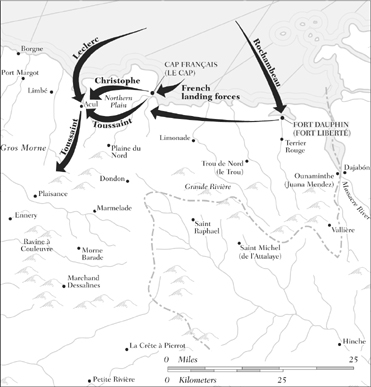
LeClerc's Attack on Cap Francais, February 4—6, 1802
“Old Toussaint s” strategy for resistance and his explicit orders in the first days of the invasion were close to what Page and Christophe described. Though his army was well-seasoned, determined, and confi-dent, he was indeed wary of risking it in the open field against veterans of the Napoleonic wars in Europe. His preference was to deny terrain to the enemy by destroying the towns on the coast and scorching the earth of the lowlands, then to fight a war of attrition from the mountains until the invasion buckled under its own weight (as Page had predicted it must). Toussaint had seen what the fever season had done to the unacclimated English invaders and had nothing against letting disease do as much of his work as possible. A February 7 letter to Dessalines put it vividly: “Do not forget that while waiting for the rainy season, which must rid us of our enemies, we have no recourse but destruction and fire. Consider that the land bathed with our sweat must not furnish our enemies the least nourishment. Jam up all the roads, throw horses and corpses into all the springs; have everything burned and annihilated, so that those who come to return us to slavery will always have before them the image of the hell that they deserve.'58
Dessalines was supposed to burn Port-au-Prince, and Toussaint had sent similar orders to his other commanders all over the colony, but the first French movements were so swift, determined, and effective that many of his messengers were intercepted. The courier to Paul Louverture in Ciudad Santo Domingo had actually been given two letters, a false one directing him to receive the French and a true one commanding him to destroy the town and retreat. The French picked off this courier, presented the false letter, and occupied Santo Domingo without firing a shot. In Santiago to the north, the priest Mauviel had been rusticating since Toussaint changed his mind about installing him as bishop of the Le Cap cathedral. He persuaded Santiago's mulatto commander, Clervaux, to yield to the French without a struggle. Thus Toussaint almost immediately lost all the key points he had been at such pains to secure in the Spanish part of the island.
In the west, there were other disasters. Dommage, a trusted commander at Jeremie, failed to receive Toussaint's dispatch. Persuaded by Napoleon's proclamation,* he turned over the town to the French and gave them a firm foothold on the Grande Anse. Laplume, who was similarly seduced and may also have been disaffected since the suppression of the Moyse rebellion, disobeyed the order to burn Les Cayes and the surrounding area, and instead offered his services to the French.
When Toussaint launched his couriers from Point Samana, Des-salines was absent from Port-au-Prince. In his place the white General Age commanded, at least in name—a local cynic reported that Age was constantly drunk and knew more about houses where he could get free libations than he did about his own officer corps. When General Boudet landed his messengers, Age secretly let them know that he had no real power in the situation; actual authority lay with his nominal subordinate, the mulatto Lamartiniere. It was Lamartiniere who arrested Boudet's messengers, who were held as hostages for the next several weeks.
Misled by pride in his arms, Lamartiniere thought he could hold the town without burning it. A couple of days' temporizing gave Boudet time to organize a successful attack on February 5, the day after the forced landing at Le Cap. Lamartiniere had threatened to massacre the white population if Boudet tried to fight his way ashore, but about half of them hid in their houses and came out later to welcome the French soldiers after Boudet had secured the town. Lamartiniere's attempt to blow up the arsenal failed. At Savane Valembrun, on the site where one of “Papa Doc” Duvalier's most notorious prisons would later stand, he executed the whites he had been able to capture, then retreated to Croix des Bouquets.
The first week of hostilities left both sides in a state of shock. The French were stunned by the destruction of Le Cap and by anarchy all over the Northern Plain, where the field hands had uncached their guns and begun to burn, pillage, and slaughter the white population. (Old friend to liberty though he was, the Abbe Delahaye was among the slain.) For his part, Toussaint must have been rattled by the speed and extent of his losses and by the betrayals of so many of his officers. In a week's time the invasion had practically reduced him to his original “arrondissement” in the Cordon de l'Ouest.
Around Port de Paix, on the Atlantic coast west of Le Cap, General Maurepas was putting up a brilliant resistance to an assault led by the French general Humbert. Port de Paix was so well defended that Vincent had warned Leclerc that it was not worth the danger and difficulty of attacking it and that the artillery defending the harbor was exceptionally well placed. Maurepas, whom Vincent characterized as “extraordinarily hard,”59 killed a third of Humbert's twelve hundred men before blowing up the forts, setting the town on fire, and retreating up the valley of Trois Rivieres with his Ninth Regiment still intact. But for the moment Toussaint was out of communication with Maurepas. When Leclerc decided to revert to diplomacy, Toussaint was willing to entertain the idea. Belatedly, Coisnon got the chance to try his hand.
Toussaint had gone to ground at Ennery, a secure pocket in the mountains just northeast of Gona'ives where he and his wife owned several plantations. Ennery was a crossroads controlling not only the ways to the Gona'ives port but also the length of the Cordon de l'Ouest via Marmelade to Dondon, the way to Borgne via the heights of Limbe and Port Margot, and the way to Port de Paix via Gros Morne. On the night of February 8, Toussaint's sons, twenty-one-year-old Placide and twenty-year-old Isaac, arrived there with their tutor, Coisnon. It had been almost six years since their parents had seen them; their reunion was a tearful one.
Some effort had been spent on cementing the young men's loyalty to France. Before the fleet sailed, they had been entertained by Napoleon Bonaparte in person: a grand dinner at the Tuileries, where Colonel Vincent, Captain General Leclerc, and other dignitaries were among the guests. After presenting Isaac and Placide with fancy dress uniforms and richly ornamented swords and pistols, Napoleon charged them with a message: “When you arrive in your country, you will make it known to your father that the French government accords him protection, glory and honor, and that it is not sending an army into the country to battle him, but only to make the French name respected against enemies of the country.”60
Placide, who had not long before been used as a decoy by Napoleon—he had embarked on an Egypt-bound ship to make observers and spies believe the fleet was sailing for Saint Domingue— seems to have taken these instructions with a grain of salt. At Ennery, it was Isaac who presented Napoleon's argument. “While he spoke, Toussaint kept the most profound silence; his features no longer had the expression of a father who listened; they expressed the withdrawal of an impassive Statesman.”61 Whereupon Coisnon presented the letter which Napoleon had written to Toussaint. This missive, both firm and friendly in tone, announced that Captain General Leclerc was to be appointed as “first magistrate” of the country—a position superior to Toussaint s. It reminded the black leader that Leclerc came with “sufficient forces to make the sovereignty of the French people respected.” It hoped that “you are going to prove to us the sincerity of the sentiments you have constantly expressed in all the letters which you have written to us.” After an equivocal discussion of the Constitution (extremely mild by comparison with Napoleon's real opinion of that document) the letter comes to the point: “What can you desire? The liberty of the blacks? You know that in all the countries we have been, we have given it to the peoples who didn't have it. Consideration, honors and fortune? After all the services you rendered, which you will still render under present circumstances, and with the special feelings we have for you, you should not be uncertain of your consideration, your fortune and the honors that await you.”62
These honeyed phrases were false to the bone. Napoleon was already resolved to reduce Toussaint and other black leaders “to nothingness.” Leclerc had secret orders to arrest and deport the black officers as soon as feasible, and the restoration of slavery in Saint Domingue was part of the hidden agenda.
Toussaint thanked Coisnon for his care of his sons, and told him briefly that he would not treat with Leclerc until the latter had stopped his offensive movements. He spent the rest of the night composing a reply to the captain general, then rode down to Gonaives to attend mass there, on the morning of February 9. On his return to Ennery he sent Coisnon and his sons back to Le Cap with his reply to Leclerc.
Soon after, his wife arrived in Ennery, with a pack train bearing the treasuries of Arcahaie, Saint Marc, Verrettes, Petite Riviere, and Gonaives. Toussaint had a plan to combine all the funds of the various towns into a single war chest if an invasion did come, but he was on the wrong side of the island at the critical moment when the fleet arrived, and the speed of their operations allowed the French to capture some of this money right away. In the many areas where the local commanders decided for whatever reason to yield to the French without a fight, the local operating funds were lost.
Toussaint's reply reproached Leclerc for opening hostilities before delivering Napoleon's letter to him; he was already thinking in terms of a subsequent legal defense. Otherwise, he temporized, asking for a truce and for time to reflect and to pray that there would be no more unnecessary “effusion of blood.”63 This letter threw Leclerc into a rage. He denounced Toussaint as a rebel in the presence of Isaac, Placide, and his aides-de-camp. When he had calmed down he drafted a reply offering a two-day armistice, stating that if Toussaint acknowledged his authority Leclerc would accept him as his second in command, but if he had not done so in two days' time he would be declared an outlaw and “devoured by the vengeance of the Republic.”64
For the third time in as many days, Isaac and Placide crossed the dizzying peaks of the mountains separating Le Cap from Gonai'ves; this time Coisnon was too exhausted to accompany them. At the Gonai'ves headquarters, Toussaint told his sons what would become the kernel of his defense from the Fort de Joux: “My children, I declare war on General Leclerc but not on France; I want him to respect the Constitution that the people of Saint Domingue have given themselves.” Somewhat more recklessly, he added, “I cannot deal with the First Consul, since he has shredded the act which guarantees our liberties”65 —a statement which shows that Toussaint had plainly detected the attitude Napoleon meant to conceal.
Then he asked his sons to choose a side, promising, “I will use neither ruse nor violence to keep you with me.”66 Isaac, the younger, was the first to reply: “You see in me a faithful servant of France, who could never resolve himself to bear arms against her.” Placide, who may or may not have been Toussaint's blood son, said, “I am with you, my father, I fear the future, I fear slavery, I am ready to fight to oppose myself to it, I know nothing more of France.”67 Placide was promptly incorporated into Toussaint's honor guard. Toussaint announced to that elite group and its officers, “He is prepared to die for our cause”—the guardsmen had already declared, “We will all die for liberty”68 Isaac did not return to Leclerc, but remained with his mother and his younger brother, Saint-Jean; he observed much of what followed as a noncombatant.
On February 17, Leclerc issued a proclamation outlawing the generals Toussaint and Christophe, but not the other black officers or soldiers of Toussaint's army, who were told that they would be incorporated into the French forces if they chose to change sides. A similar amnesty was offered to the revolting field hands; if they laid down their arms they would be treated as “stray children,”69 and sent back to their plantations. General Leclerc declared that he was entering the campaign in person and that he would not take his boots off until Toussaint had been brought to submission. If he was faithful to this vow, he must have ended—three months later—with a pair of very smelly feet.
Dessalines, whose ability to move men swiftly over difficult terrain was equal to Toussaint's, was at large with his portion of the army in the area surrounding Port-au-Prince. Though he was not able to destroy the capital he kept it in a constant state of alert, while at the same time controlling Saint Marc (where he had built a fine house), threatening Leogane, and terrorizing the plantations in the plain of Cul de Sac. On the Atlantic coast west of Cap Francais, Maurepas had regrouped in the hills above Port de Paix and reinforced himself with several thousand armed field hands. He would have retaken the town if a naval cannonade had not turned back his freshened forces.
On February 19, Leclerc launched a three-pronged attack intended either to surround Toussaint at Ennery or to force him out to the coast at Gonai'ves. With General Hardy, Leclerc began a march south from Cap Francais. Rochambeau was leading a column southwest from Fort Liberte toward Ennery and Gonai'ves via Saint Raphael and the Central Plateau. Boudet marched north from Port-au-Prince.
Leclerc's strategy did not follow Vincent's recommendations in every detail: he had allowed four hundred of Humbert's troops to be killed at Port de Paix, and the remaining eight hundred were tied up in a sideline struggle with Maurepas and the Ninth Regiment. And he had not brought his troops from the Spanish side to occupy Hinche and other key points along the old border where Toussaints line of retreat could be cut off. Rochambeau's column cut a swath across the Central Plateau, but simply passed over this territory without firmly occupying it.
At this point, however, Toussaint was not contemplating a wholesale retreat to the interior. He was determined to hold Gona'ives, the seaport he felt best able to defend, if at all possible, but at the same time he had to meet the threat from Rochambeau. In these early days of the invasion, Napoleon's crack veterans were living up to their big reputation—moving rapidly, careless of the discouraging terrain, and proving themselves very difficult to stop or slow down. Leclerc's advance put such pressure on Ennery that Toussaint was compelled to send his family to a more secure area south of Gonai'ves; nevertheless, Hardy's vanguard captured his youngest son, Saint-Jean, during the family's retreat. Isaac, Suzanne, and a handful of nieces and cousins found shelter at Lacroix Plantation.
Toussaint had arms depots and entrenchments along the Ravine a Couleuvre, which winds from the heights of Morne Barade down to Lacroix and Perisse plantations, on the dry edge of the Savane Desolee some seven miles south of Gonai'ves. Barade was a dangerous crossroads for Toussaint—his brother Pierre had been killed there during the trouble with Biassou in 1794—and he was determined to reach it before Rochambeau. The race was a close one, for Vincent had told Leclerc of the importance of this position, and Rochambeau had recruited a traitor from Toussaints army to guide him.
The relative strength of the forces that met at Ravine a Couleuvre is hard to ascertain. Rochambeau had probably landed about eighteen hundred men at Fort Liberte, but some had been diverted from his march on Gonai'ves. By some accounts Toussaint was moving with no more than four hundred men of his guard; others say he had as many as three thousand regular troops. By all accounts there was a larger number of armed cultivators already waiting to support him in the ravine.* Aside from the urgency of the purely military objective, Toussaint was also under pressure to defend his family, thinly sheltered at Lacroix Plantation just to his rear.
Heavy rain on February 20 slowed the French advance; nevertheless Rochambeau managed to occupy the heights of Morne Barade on the night of February 22, hours or minutes before Toussaint arrived there. The battle began in the darkness; by daybreak the French had forced the defenders out the bottom of the ravine onto the flat ground of Perisse Plantation. Here Toussaint was able to rally his honor guard cavalry and organize a desperate charge which scattered the French and drove Rochambeau's men back into the mouth of Ravine a Couleuvre.
That same morning, General Vernet was retreating, inch by inch, before Leclerc and Hardy's advance on Gonai'ves. Toussaint, exhausted and frustrated by the outcome at Ravine a Couleuvre, rode his horse into the town's cathedral and tore down the cross, shouting that he would no longer serve this Jesus who had betrayed him. A more warlike spirit had apparently mounted his head. Gonai'ves could not be held, but Leclerc found the town in ashes, as he had found Le Cap. Toussaint, now collapsing with fever as well as exhaustion, rode south to Pont d'Ester, where his family and army were waiting.
Ravine a Couleuvre was a loss for both sides. Toussaint had not been able to hold key terrain, but he had gotten away with his army more or less intact. According to a report Leclerc filed a couple of days later, six hundred of his men had been killed outright and thirty-five hundred wounded. The French were able to win engagements, but establishing real control over the country was a different and much more difficult matter.
For Toussaint, the worst consequence—the one he most feared—of the drawn battle at Ravine a Couleuvre and the loss of Gonai'ves was being completely cut off from Maurepas and the Ninth Regiment at Port de Paix. Now Leclerc was able to support Humbert and his detachment (which had been taking a beating from Maurepas since their landing) by sending reinforcements toward Port de Paix via Gros Morne (another route which Vincent had explained to him). At around the same time Maurepas received inaccurate but disheartening news that Toussaint had been completely demolished at Ravine a Couleuvre. Still worse, a rebel commander of the Ninth, Lubin Golart (who had sided with Rigaud during the mulatto-black civil war), attacked him from the direction of Jean Rabel. Surrounded by three hostile forces and out of communication with his commander, Maurepas surrendered to Leclerc on February 25.

La Crete a Pierrot, March 4-24,1802
Dessalines, meanwhile, had been playing cat and mouse with Boudet since the latter's landing at Port-au-Prince two weeks earlier. On February 24 he slaughtered all the whites of Saint Marc and set the town afire, beginning with his own opulent residence, as Christophe had done at Le Cap. Boudet rushed to the rescue but arrived too late, and while the French general stared aghast at the hundreds of scorched corpses in the ashes of Saint Marc, Dessalines slipped south to his rear. He would have succeeded in destroying Port-au-Prince this time if Pamphile de Lacroix, commanding during Boudet's absence, had not hastily enlisted the aid of two large maroon bands led by Lafortune and Lamour Derance, both disaffected by Toussaint's harsh labor policy and the severe repression of the Moyse rebellion. Lamour Derance, who had been skirmishing with Dessalines before the French invasion, was willing to accept the enemy of his enemy as his friend.
Dessalines doubled back across the plain of Cul de Sac, razing the plantations and rounding up white prisoners. On February 28, he met Toussaint above the town of Petite Riviere, on a hilltop called La Crete a Pierrot. A fort begun there by the British had once been under the command of Blanc Cassenave. Later on, Toussaint had completed the fortifications, with the help of a French engineer. The hilltop, tucked in a bend of the Artibonite River, controlled the passes into the Grand Cahos mountains and access to the Mirebalais area and the Central Plateau from Arcahaie and Saint Marc on the coast. The fort, which was hardly a hundred yards square and armed with only twelve cannon, was the centerpiece of the second phase of Toussaint's defense.
As Cap Francais was for the time being uninhabitable, Leclerc established a temporary headquarters in Port-au-Prince. Among the surviving white population, the first flush of enthusiasm for the French arrival was rather quick to fade. Though glad to be relieved of the more tyrannical aspects of Toussaint's rule, the proprietors of Port-au-Prince were concerned that the French army might treat them and their territory not as fellow citizens and French ground to be defended, but as a conquered land to be exploited and looted. Napoleon's armies had formed such habits all over Europe, and stories of their predatory style had already circulated in Saint Domingue.
To a considerable extent, such fears were proved true. Of the 2.5 million livres General Boudet found in the Port-au-Prince treasury, he immediately scattered a million and a half among his troops—nor did he forget himself in this redistribution. The locals accused him of a spirit of pillage. Leclerc had seen some version of Toussaint's tax rolls (the government was supposed to have taken in some 20 million livres during the past year), so he had a notion of how much money he ought to be able to find. When he learned that 1.5 million livres were still in the treasury of Les Cayes, Leclerc dispatched Admiral Latouche Treville to confiscate it. He arrested Bunel, Toussaint's diplomat and paymaster, and seized a ship bound for the United States with 3 million livres, undoubtedly intended for the purchase of more arms.
Port-au-Prince civilians found themselves under a military rule at least as harsh as Toussaint's had been. Their animals and supplies were requisitioned for the army—but never paid for. As they had feared, the inhabitants were treated as a conquered people. They had to make a full declaration of all their means or be accused of collaboration with the black enemy. Eager to restore sugar and coffee production (for the profit of the army), Leclerc ordered the landowners back to their plantations, accusing them of harboring groundless fears—while he himself went nowhere without a heavy guard. In reality, the outlying areas were far less secure than they had been under Toussaint, and the planters began to recognize that despite his shortcomings, their chances of restoring their fortunes might have been better with him than with Leclerc.
Dessalines had intended to destroy the fortifications at La Crete a Pierrot before pressing further into the interior, but after his conference with Toussaint he ordered the walls to be repaired instead, and hastily had new trenches dug outside of them. The day after Toussaint's departure, March 1, Dessalines executed all the white inhabitants of Petite Riviere and all the white prisoners he had brought there from the plain of Cul de Sac, with the exception of a doctor named Descourtilz and a handful of musicians from a band maintained for Toussaint's formal entertainments. He left these survivors in the fort under guard of Lamartiniere and a small garrison, while he himself led a force to the interior with the idea of razing and burning Mirebalais.
Toussaint, so far as the French were concerned, had disappeared. Leclerc, whose boots must have begun to chafe by then, believed that, having been forced south from Ravine a Couleuvre, Toussaint must be somewhere in the area of Petite Riviere. He changed the focus of the French maneuvers with the idea of trapping him there—a strategy Toussaint had apparently anticipated. A noose was gradually drawing tight on La Crete a Pierrot, but Toussaint himself would not be found there, and the fort on the hill was a death trap—for the French.
Now wandering in the Grand Cahos mountains, Rochambeau's column never found Toussaint, who was by then far north of where he was believed to be, and Rochambeau also failed to engage Dessalines, who eluded him in the mountains on the way to Mirebalais. Rochambeau's men did manage to intercept the pack train carrying the treasuries from the Western Department into the interior; it is likely that the legend of Toussaint's “buried treasure” really ends here. Meanwhile, some divisions of the French army had captured stupendous sums on the coast, and when news of Rochambeau's huge score spread, units that so far had found no plunder grew all the more eager for their opportunity.
On March 4, General Debelle reached Petite Riviere with a force of two thousand men. Outraged by the butchered white bodies strewn over the town, the French grenadiers were easily provoked into charging a skein of black skirmishers outside the walls of the fort on the hill above. By some accounts they were also intoxicated by the illusional prospect of loot. At the last moment the skirmishers dove into trenches just below the walls and the fort's cannon raked the French charge with grapeshot, doing incredible damage. Then a detachment of Toussaint's honor guard cavalry rode out of the woods north of the fort to sweep the field. Lamartiniere had a garrison of only three hundred, but this dismal quarter hour cost the French four hundred dead, and Debelle himself was seriously wounded, along with another French general, Devaux.
Dessalines, meanwhile, had been leading Rochambeau on a merry dance through the Grand Cahos mountains, pausing here and there to slaughter white civilians—a task he always undertook with enthusiasm, though sometimes he would spare a few whites whom he found accul-turated enough “to eat callaloo.” On March 4, a detachment from General Boudet's division found the ruins Dessalines had left at Mirebalais. On March 9, Boudet's main force reached Verrettes, just south of the Artibonite, where eight hundred white civilians lay stiffening in their coagulated blood. Furious at this spectacle, they moved west along the river and forded it during the night of March n. At first light on March 12, they found black soldiers apparently sleeping outside the wall of the fort at La Crete a Pierrot.
Rochambeau's force was approaching this formidable position as well, but no one wanted to wait for its arrival. The other French generals had all been captivated by the illusion of treasure inside the fort (in fact there was none), and none of them wanted to share it with Rochambeau's unit. General Boudet launched his charge without waiting for support, and the defeat Debelle had suffered during the previous week repeated itself in every detail: hundreds of French grenadiers were slain, and Boudet himself was put out of action by a wound in the heel. Just minutes later, another division commanded by General Dugua fell into the same trap, charging from the town of Petite Riviere. These two efforts cost the French a total of nearly eight hundred casualties, and General Dugua was struck by two balls. Captain General Leclerc, who had accompanied Dugua from Port-au-Prince, was knocked down with a badly bruised groin, and would have been slain by the sabers of the black cavalry if an officer named Dalton had not carried him away from the battle lines on his back. Greed, opined a civilian observer, had made the heroes of Marengo forget the most important military maxim: Never despise one's enemy.
For the moment, Pamphile de Lacroix was the only French general left standing on the field; he paused for a moment to “recognize just how adapted to war the Blacks of Saint Domingue had become.'70 Aside from Toussaints organized troops, all the French movements were constantly harassed by the armed field hands who sniped at their flanks from cover. “It was obvious that we no longer inspired moral terror,” Lacroix brooded, “and that is the worst misfortune that can befall an army”71
Dessalines, who never failed to inspire both moral and mortal terror, had returned to the fort on the night of March 11 to exhort the garrison: “I want no one with me but the brave; we will be attacked this morning; let those who want to be slaves of the French leave the fort, but those who are willing to die as free men stand by me.72 No one accepted the offer to escape. Standing by the door of the powder magazine with a blazing torch, Dessalines promised to blow up the fort if the French managed to enter it, but during Boudet's charge that morning he chose to climb the ramparts bare-chested and lay waste to assaulting Frenchmen with his sword. As previously, the honor guard cavalry led by Monpoint and Morisset rode out from the woods to deliver a coup de grace. A black militia commander, Gottereau, led a troop of armed cultivators onto the field from the bank of the Artibonite, took a large number of French and slew them with bayonets. That night, packs of dogs came out to eat the corpses that no one could remove from the field. Later on, Pamphile de Lacroix, lacking tools enough to have the rotting bodies buried, ordered them burnt, an attempt that succeeded poorly and created an “odor still more unbearable than the first,'73 which permeated everyone's wool clothing and suffocated the French camps.
The situation at La Crete a Pierrot devolved into a siege. Following the bloodbath of March 12, Dessalines ordered the fortification of a small rise just to the east above the main fort, then departed in search of fresh munitions from a depot at Plassac which, unfortunately for the black resistance, Boudet's division had blown up a few days before. At Morne Nolo, Dessalines lost an engagement with a French force led by General Hardy, who cut Dessalines's communications with Lamartiniere at the fort; Hardy's arrival also forced the honor guard cavalry to retreat from the area, seeking to rejoin either Dessalines or Toussaint.
On March 22, the impetuous Rochambeau appeared on the scene, hastily recalled from the ruins of Mirebalais. Andre Rigaud had been assigned to Rochambeau's staff. When he saw the situation at La Crete a Pierrot, he feigned illness and excused himself to Port-au-Prince. Rochambeau was not so prudent. Before Leclerc could countermand him, he tried to charge the small redoubt Dessalines had erected before his departure, now occupied by Lamartiniere with two hundred men and a few cannon. This futile effort cost him three hundred men. However, General Lacroix managed to establish mortar batteries from which the colored commander Petion, an experienced artilleryman, was able to drop shells into the main fort. From March 22 to March 24, the bombardment was constant.
Toussaint Louverture, meanwhile, had slipped north through whatever French lines still existed; on March 2 he flushed a light French garrison out of Ennery set fire to the town, made a feint toward Gona'ives, then began to circle through Saint Raphael, Saint Michel, Marmelade, and Dondon, raising resistance among the cultivators everywhere he could—as Christophe was doing all over the Northern Plain. Sentiment was not universally in favor of Toussaint in this region, however; the French propaganda in support of general liberty continued to erode his base, and some inhabitants sarcastically suggested, “Let him raise Moyse from the dead to fight the Whites.”74
Toussaint did not yet know that Maurepas had surrendered, and he hoped to relieve and rejoin Maurepas's Ninth Regiment—but first he had to attack and defeat General Desfourneaux at Plaisance. In the midst of this engagement, to his great dismay, he saw that the French had been reinforced by a portion of Maurepas's regiment now under command of Lubin Golart. Toussaint rode before them, shouting out, “Soldiers of the Ninth, do you dare fire on your general and your brothers?” By the account of Isaac Louverture, “These words had the effect of a thunderbolt on those soldiers; they fell to their knees, and if the European soldiers had not fired on him and pressed forward, all the Ninth Regiment would have gone over to Toussaint Louverture.”75 Unluckily for the black resistance, the French fire was well aimed on this day; a messenger bringing word from Dessalines of the state of siege at La Crete a Pierrot was hit and bled to death inToussaint's arms.
From the start, Toussaint had devised a strategy of double encirclement. Once Leclerc had been lured to besiege La Crete a Pierrot, Toussaint, reinforced by Maurepas and the Ninth Regiment, would fall on his rear, surround him, arrest him, and deport him to account for himself in France—following the same route taken by Hedouville, Sonthonax, and most other representatives of the home government who had had the bad judgment to antagonize Toussaint Louverture. But the Ninth was lost, and by the time Toussaint (severely battered in his battle with Desfourneaux) could rally men enough to try the plan, it ‘was too late.
On March 24, as he toured his posts, General Lacroix found some of his men flogging an elderly black couple ‘who supposedly had been caught leaving the fort. He rebuked the soldiers and ordered the old people released. Once they had limped to a safe distance, however, they mocked the French soldiers by dancing the chica, then fled with the speed of young antelope. Appalled at his error, Lacroix guessed that they must have been couriers from Toussaint Louverture, who was known to be advancing on Leclerc's rear. In fact, they had come from Dessalines with an order to evacuate the fort. That night, Lamartiniere took the survivors of the nine hundred men Dessalines had left him twelve days before and cut his way out through the French siege lines, leaving Lacroix with his jaw dropped: “We surrounded his post with more than twelve thousand men; he got away without losing half of his garrison, and left us nothing but his dead and his wounded.'76 The latter were all butchered on Rochambeau's order when his men entered the fort the next morning.
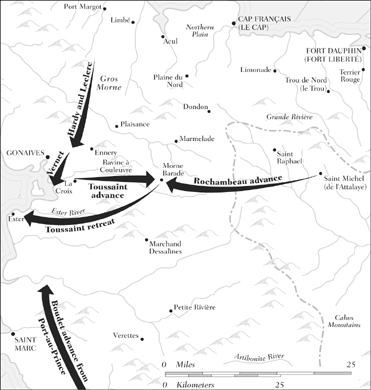
Ravine a Couleuvre, February 22-23, 1802
It was a bitter disappointment for Toussaint to have so nearly missed his quarry. After a doleful meeting with Dessalines on the heights of Morne Calvaire, he retreated to Chasseriaux Plantation, near Grands Fonds in the Petit Cahos mountains; his family had already found shelter in that area and his honor guard was waiting for him there. The French, meanwhile, limped back to Port-au-Prince in scarcely a cheerier frame of mind; they had lost two thousand men at La Crete a Pierrot. Pamphile de Lacroix ordered his men to march in squares with empty centers, so that the citizens of the capital would not realize the extent of the French losses.
Like Ravine a Couleuvre, La Crete a Pierrot is best understood as a loss for both sides. The French had technically gained ground, but they had the same difficulty holding it that Napoleon would soon encounter in campaigns against guerrilla resistance in Spain. “This is a war of Arabs,” Leclerc wrote to Napoleon. “We have hardly passed through when the blacks occupy the neighboring woods and cut our communications.”77 “Though victorious everywhere,” wrote Lieutenant Moreau de Jonnes, “we possessed nothing but our guns. The enemy did not hold anywhere, and yet remained master of the country.”78 Or in the words of a nineteenth-century French historian, Antoine Metral: “Everywhere this ground hid enemies, in a wood, behind a boulder; Liberty gave birth to them.”79
Also at Toussaint's camp at Grands Fonds were Sabes and Gimont, the two emissaries whom General Boudet had sent ashore at Port-au-Prince before forcing his landing there. Since Lamartiniere had taken them prisoner, they had been dragged all over the country, and narrowly missed being slain with the other white captives by Dessalines at Petite Riviere. NowToussaint summoned them into his presence, debated with them the legitimacy of Leclerc's actions versus his own, then sent them under safe-conduct back to General Boudet, with a note suggesting that his nephew Chancy, captured while carrying dispatches to Dommage several weeks previously, might be released in exchange.

The French Army's Siege of La Crête-à-Pierrot
By some accounts, Toussaint also sent a letter to Napoleon for Boudet to transmit. Though this document has never been definitively identified, a version which circulated at the time fits well enough with the rest of Toussaint's correspondence to be credible. “The high post I occupy is not my own choice, imperious circumstances placed me there against my will … I saw this unfortunate isle a prey to the fury of factions. My reputation and my color gave me a certain influence on the people who live here; and I was called to authority with almost a unanimous voice.”80
“Adulation has ruined Toussaint,” Colonel Vincent had written to a friend just before the expedition sailed.81 If authentic, Toussaint's words do suggest that he was at least a little intoxicated by the power which he had obtained by a considerably more circuitous route than what he describes. His next claims, though, are hard to dispute: “I stifled sedition, calmed revolt, established tranquility; I replaced anarchy with good order; finally I gave the people both peace and a constitution. Citizen Consul, are your own pretensions founded on any more legitimate titles?”82
This question, if audacious, was a fair one.
“You offer liberty to the blacks,” Toussaint goes on, “saying that wherever you have been you have given it to those who did not have it. I have only an imperfect knowledge of events which have recently taken place in Europe, but the reports that have reached me do not agree with that assertion. The liberty which one may enjoy in France, in Belgium, in Switzerland, or in the Batavian, Ligurian and Cisalpine republics would never satisfy the people of Saint Domingue. We are a long way from aspiring to an independence like that.”83
The statement is so startling as to throw the authenticity of the entire letter into doubt. Never before had Toussaint openly raised the issue of independence—but circumstances had changed drastically since the French invasion began. To say that what the French called lib-erty was not good enough for the people of Saint Domingue was a slap in Napoleon's face. Why would Toussaint risk such a provocation?
Maybe Napoleon, who would not receive the letter for two months at least (supposing he ever received it at all), was not the intended audience. Toussaint knew something about propaganda, and he had reason to hope that such a message would feed doubt among the French officers and even their troops. Most of the French soldiers had begun their careers during the revolution. They did see themselves as liberators, and some already wondered exactly why they had been sent to suppress a revolution that claimed the same ideas—liberty, fraternity, equality—as their own. During the siege of La Crete a Pierrot, the white soldiers heard the black soldiers inside the walls singing their own revolutionary anthem, “The Marseillaise.” Doubt crept in. Later in the struggle, a good number of soldiers from Polish regiments actually did change sides. If Toussaint really did write the letter, he meant for his critique of Napoleon to play on the French officers' suspicions of the first consul's imperial ambitions.
Whether this letter to Napoleon was authentic or not, Toussaint was definitely trying to establish a new diplomatic channel with Boudet—a loop that excluded Captain General Leclerc. However, Sabes and Gimont had barely departed on their mission to Boudet when word came to Toussaint's camp that General Hardy had swept across Toussaint's property at La Coupe a l'lnde, taking numerous prisoners and, most importantly, Toussaint's favorite horse, the white stallion Bel Argent. Furious, Toussaint set off in pursuit. On March 29, Hardy was caught between Toussaint's men and Christophe's at Don-don and forced to beat a hasty retreat to Cap Francais. Though Bel Argent was not recovered, this victory was a terrific boost to the morale of the black resistance.
Immediately following the evacuation of La Crete a Pierrot, Toussaint had sent word north that Leclerc's forces had been annihilated there. This message wasn't as true as he wished it were; though noticeably limping, the French army was not crippled yet. But his master strategy had been successful in luring practically all the French troops into the Artibonite Valley toward La Crete a Pierrot. Leclerc had left Le Cap defended by a mere four hundred soldiers under the mulatto General Boyer, supported by twelve hundred sailors from the fleet moored in the harbor. During the siege at La Crete a Pierrot, Toussaint had been very successful in whipping up guerrilla resistance along the Cordon de l'Ouest, led by maroon chieftains like Sylla, Romain, and Macaya (he who beat the drum too often). Troops from Toussaint's regular army were also operating all over the Northern Department, under Christophe and Colonel Jean-Baptiste Sans-Souci, who commanded at Grande Riviere and proved especially expert in combining conventional and guerrilla tactics.
During the month of March, these guerrilla leaders, working in coordination, cut French communications between the Northern Department and the rest of the country, raised rebellion at Borgne, Port Francais, and Morne Rouge, burned Limbe, and isolated Cap Francais, leaving the town open to an assault by Sans-Souci from Grande Riviere. Seriously unnerved, Admiral Villaret-Joyeuse reported to Napoleon that San-Souci's attack had carried terribly close to Le Cap; “if they had felt their own strength as well as knowing our weakness, the idea of what could have happened makes one shudder.”84 The battle in which Toussaint and Christophe routed Hardy actually went on for several days and alarmed Villaret-Joyeuse still further. Hardy had lost four or five hundred men in his flight, and the whole Northern Plain had been set afire (one more time), to the effect that “at midnight and in the middle of the harbor one could read by the light of the flames.”85
Hardy's return, which coincided with the arrival at Le Cap of fresh troops from France, moved Sans-Souci to retire. He delivered about a hundred prisoners to Toussaint, who had returned to his headquarters at Marmelade. At this point Toussaint had recovered control over all of his original power base, the Cordon de l'Ouest. Leclerc dared not cross the territory he had supposedly just conquered, but had to rush back to Cap Francais by boat. On April I, he wrote to Napoleon that he had only seven thousand fit men in the field; five thousand of his troops were in the hospital. Another five thousand were already dead, though Leclerc did not mention it.
The French forces of invasion had expected a swift and total victory. As it turned out, that's what they absolutely needed. Though they were able to win many engagements with startling speed, their successes were never complete. Unacclimated European troops could not sustain the rigors of a campaign in this country over the long haul. Well aware of this difficulty, Vincent had urged the use of as many acclimated Spanish Creole troops as possible, but no one heeded this advice.
The terrain was difficult, not to say impossible. In the effort to explain the problem to superiors in France, one young lieutenant flung a crumpled ball of paper on the table, declaring bitterly that Saint Domingue looked like that. To this day one of Haiti's most telling proverbs is Deye mbn gegne mbn (Behind the mountains are more mountains). By day the French troops labored through staggering heat on forced marches, suffocating in their sweat-drenched wool uniforms. At night it was surprisingly cold on the heights and often they'd be drenched by torrential evening rains, so pneumonia joined dysentery and the mosquito-borne fevers which afflicted them. Unreliable supply lines often left them poorly fed. And a great many more than their officers would admit had simply been killed outright in battle.
The men of Toussaint's regular army (not to mention the flocks of field hands who were turning into paramilitary groups to resist the invasion), liked bread and salt meat if they could get it, but if not they got by very well on the cassava and fruit that were everywhere available to them. They liked uniforms and boots if they could get them, but if not they fought just as well half-naked and could move barefoot over the most horrendous terrain with the speed and agility of goats. Little settlements all over the mountains provided them with food and shelter. If these men had trouble standing up to the French military on conventional open battlefields, guerrilla tactics suited them down to the ground, and they could hold out forever in these mountains.
What followed has mystified many observers. With Toussaint as strong as he was in the north, and Dessalines threatening the French all over the Western Department, the black resistance had a winning edge over the invasion. Perhaps (as Villaret-Joyeuse so frantically hoped) the leaders simply did not know it.
The prisoners whom Sans-Souci brought to Toussaint at Mar-melade made a great impression. Toussaint treated them well, and even had a beef killed in their honor; he was generally humane to prisoners under his direct control, though he ‘was often accused of tacitly suggesting massacres by his subordinates. These veterans of European ‘wars were redoubtable; Morisset, a commander of Toussaints honor guard, reported that “none of us can run through the ‘woods or climb mountains and rocks any faster than them”;86 he also claimed to have seen them pull down ‘wild horses by the ears.
The prisoners at Marmelade let Toussaint know that they had landed at Le Cap from a Dutch port just five days before they were captured, and Toussaint also learned around the same time that the Peace of Amiens had been confirmed by the signing of a treaty between England and France. The knowledge that no British blockade would dam a steady stream of such fearsome warriors flowing from France may have disheartened him. He could not have known that Leclerc was writing desperate pleas for reinforcements that were not in fact forthcoming, or that the first signs of a yellow fever epidemic had already appeared among the French at Cap Francais.
On April 26, General Henry Christophe, who was said to be “tired of living in the woods like a brigand,”87 submitted to the authority of Captain General Leclerc, on the condition that he retain his rank in the French army. He turned over some twelve hundred regular black troops, along with the towns of Acul, Boucan, Cardinaux, Saint Suzanne, Port Francais, Mornet, Grande Riviere, and Dondon— practically all the points of entry between the mountains and the Northern Plain. The loss of these posts seriously weakened the defense of Toussaints position in the Cordon de l'Ouest—the distance between Dondon and his Marmelade headquarters was alarmingly short—and brought about his own offer to surrender on May 1.
Whether Christophe's submission was an outright betrayal of Toussaint has been much debated. Vincent had predicted that Christophe would prove loyal to France if forced to a choice, but instead he had burned Le Cap and followed Toussaint in fighting the invasion. Roume believed that Christophe was ready to turn on Toussaint. Yet shortly before he did change sides, when the French camp suggested that he capture Toussaint by treachery and turn him in, Christophe rejected the proposition with huge indignation and also showed the letters to Toussaint. The theory that Christophe was acting under Toussaint's secret direction when he surrendered to Leclerc is strange but not inconceivable—it is consistent with the idea that Toussaint used Christophe as a cat's-paw when Leclerc first appeared outside the harbor of Le Cap. Certainly, he never liked to let his own hand show openly in such maneuvers.
From one point of view, it is incredible that Christophe should have accepted terms with the French without Toussaint's tacit consent and encouragement. On the other hand, other generals had done so while out of communication with their chief commander and had come to no harm. Some members of Toussaint's officer cadre may have begun to feel that they would prosper better if Toussaint were out of the picture—as Toussaint had once felt about Jean-François, Biassou, Blanc Cassenave, Dieudonne, Villatte, Rigaud, Sonthonax, and Hedouville.
Toussaint had taken care to open a separate line of communication with Boudet a month earlier, so the idea of coming to terms with the French must have been on his mind for some time. On the heels of Christophe's submission, when his own security at Marmelade was imminently threatened from Dondon, he wrote to Leclerc a generally conciliatory letter, which ended with a caution: “whatever the resources of the French army might be, he would always be strong and powerful enough to burn, ravage, and sell dearly a life which had also sometimes been useful to the mother country.”88 Pamphile de Lacroix seconded this opinion: “however feeble he might have become, he would not cease to be redoubtable, entrenched in the heart of the colony, in the middle of inaccessible mountains, whence he could come out to carry ravage and sedition all around him.”89
The French estimated that Toussaint still had some four thousand troops at his disposal, as well as the larger numbers of armed cultivators he might raise. Leclerc wrote to the minister of marine on April 21 that “it will be impossible for me to enter into campaign again before having received the twelve thousand men for which I have asked you.”90 The surrender of Christophe a few days later must have encouraged the captain general, who hoped in the same letter to exploit “dissensions” rumored among the black chiefs. However, Leclerc was already becom-ing dangerously dependent on “colonial troops”—that is to say, black rebel units that had quite recently changed sides with their officers.
During the last week of April, Toussaint (whose own communications had been much interrupted) learned of his brother Paul Louverture's submission at Ciudad Santo Domingo. The fact that so many black generals—Paul Louverture, Maurepas, Clervaux, and now Christophe—had been maintained in their French military ranks after capitulation lent credence to the Napoleonic propaganda that the French army was committed to the defense of general liberty. The fact that, even at this point, Toussaint was unwilling to pronounce the magic word that would have rallied more of the population to his cause suggested that independence from France had never been his goal. At the moment that he began to treat with Leclerc, he must have felt both isolated and surrounded—and under immediate threat of an assault on Marmelade from Dondon which, if it failed to capture him, would have put him desperately on the run.
Dessalines was difficult to persuade, and probably was never entirely persuaded. “Listen well,” he told his men. “If Dessalines surrenders to them a hundred times, he will betray them a hundred times.”91 More than likely Toussaint felt the same; characteristically he betrayed nothing of the thought.
“He never showed anything,” wrote the daughter of one of Toussaint's numerous white secretaries. “My father often told us the impression he had from these private meetings. By the doubtful light of a little lamp, the somber face was still more black. When he scrutinized you, he was like a lynx. But when he was observed, he withdrew into himself, masked his regard. Raising his eyes to heaven, he hid his pupil beneath his thick eyelid, letting nothing show but the white. So, he became hideous. My father, as young and brave as he was, could not face this demonic visage.”92
Filter out the antique racism and a rather disconcerting picture of Toussaint still remains. In hypnosis, such eye movement is a symptom of trance. In Vodou it is a sign of possession. To most people the alien is frightening; no wonder the young Frenchman read a “demonic visage” into Toussaint's entranced expression. No doubt Toussaint really was communing with his spirits when in these late-night meditations he struggled to choose the right word, or phrase, or action. In the close of his supposed letter to Napoleon, Toussaint turned again to the Christian God: “Let him decide between me and my enemies, between those who have violated his teachings and abjured his holy name, and the man who has never ceased to adore him.'93
On May 6, Toussaint Louverture rode into Cap Francais in the midst of three hundred horsemen of his honor guard. Leclerc, who was dining shipboard with the naval officers, seemed to be taken by surprise. By the time he hastened back to shore, Toussaint's guard had occupied the government palace, and by one (perhaps exaggerated) account, his men were stalking the grounds with their sabers drawn. Jacques de Norvins, a young French officer, described the scene: Toussaint Louverture “had followed Leclerc into his salon where they sat down on a couch facing the door. I was not much reassured by this interview, nor by the haughty manner of Toussaint's numerous guards who, leaning on their sabers, filled the surroundings, the courtyard and the apartments of the residence, while others guarded their horses, and while Toussaint also leaned on his saber, which he held upright between his legs … Any bad sign on the part of Toussaint,” Norvins concluded, and “at any moment the sabers of those black dragoons could have come out of their scabbards.'94
In this crackling atmosphere, it was Toussaint who seemed to dictate terms to Leclerc. The black generals still in rebellion—Vernet, Charles Belair, and Dessalines—would be retained in their ranks in the French army, despite the fact that, when reproached by Leclerc for the massacres in which some three thousand civilians had died, Toussaint replied flatly, “It was Dessalines.” When Leclerc insisted that Toussaint himself continue service as his “lieutenant,” Toussaint demurred: “My general, I am too old and too ill; I need rest and to live in the country. I can no longer serve the Republic. I want to go with my children to my plantation at Ennery.”95 Undoubtedly he strongly suspected that Leclerc meant to have him arrested and did not mean to give him the least opportunity.
The tension was diffused, somewhat, by a banquet, but Toussaint was not in a festive mood. “He said he was sick,” Norvins reports, “and did not even eat any soup; no more did he want to drink any wine. Only, at dessert, I offered him some Gruyere cheese; he took the plate and cut out a square piece, from which he removed a big enough thickness from all four sides, took in his fingers what remained from this singular operation, ate it without bread, and drank a glass of water from a carafe broached since the dinner began; it was thus that he did honor to the General in Chief's table.”96
Following this austere celebration, Toussaint rode out, still surrounded by the men of his guard (which, two thousand strong, would “retire” with him at Ennery). On the public square at Marmelade he bade farewell to his assembled troops, then continued toward his Ennery plantations. En route, legend has it, he was hailed by someone who asked, “General, have you abandoned us?” and Toussaint replied, “No, my children, all your brothers are under arms, and all the officers conserve their ranks.”97
It was not only in the ranks of the French army that the blacks of Saint Domingue remained under arms. Even after Toussaint's surrender, resistance never completely stopped—nor did Toussaint stop tacitly encouraging it. A general effort to disarm the population soon proved almost completely futile. Sans-Souci, who was even more enraged than Toussaint at the way Christophe's surrender had cut him off at the knees, began organizing for a fresh rebellion almost immediately. The guerrilla leader Sylla was actively resisting at Mapou, a point between Ennery and Plaisance, at the time of Toussaint's retirement to Ennery, and Sylla's presence helped secure Toussaint there. It took a major assault to dislodge Sylla from that position, and even then neither he nor his men could be captured.
Suspicion of Toussaint's secret involvement in such eruptions was constant. Makajoux, a commander in the neighboring town of Pilate, wrote to his French superior, “Toussaint and the other chiefs have surrendered only in appearance, and have only sought to give their troops an entry among you in order to surprise you at the first possible moment.”98 Leclerc himself had the same attitude: “That ambitious man, from the moment that I pardoned him, has not ceased to secretly conspire … He has tried to organize an insurrection among the cultivators to make them rise en masse. The reports that have come to me from all the generals, even General Dessalines, on the conduct he has maintained since his submission leave me in no doubt in that regard. I have intercepted letters which he wrote to a so-called Fontaine who is his agent in Le Cap. These letters prove that he has been conspiring and desiring to regain his old influence in the colony. He has been waiting for the effects of diseases on the army.'99
Those effects were already rampant. In a separate letter of the same date, Leclerc put it bluntly: “If the First Consul wants to have an army in Saint Domingue in the month of October, he will need to send it from the ports of France, for the ravages of disease here are beyond all description.”100 And yet, reinforcements were practically useless; so severe was the fever season of 1802 that troops were said to march from the ships directly into the grave.
It was not yet known in the early 1800s that malaria and yellow fever were mosquito-borne illnesses, but the military did understand that the mountains were healthier than the ports—which may have provided a pretext for sending large numbers of troops into the region of Plaisance and Ennery during the first week of June 1802. “Toussaint is of bad faith,” Leclerc wrote on June 6, “as I very well expected of him, but I have gained from his submission the goal which I hoped, which was to detach Dessalines and Christophe from him, with their troops. I will order his arrest, and I believe I can count on Dessalines, whose spirit I have mastered, enough to charge him to go arrest Toussaint.”101 Events would soon prove that Leclerc had not mastered Dessalines's spirit in the slightest, but probably he would not have dared arrest Toussaint without some assurance from the black generals that the move would not provoke a revolt on their part.
Toussaint's behavior during this fatal period has puzzled most observers, who find it difficult to understand why he walked into the fairly obvious trap which Leclerc had prepared for him. The bait was a pair of letters, one from the regional commander, General Brunet, the other from Leclerc himself: “Since you persist in thinking that the large number of troops found at Plaisance frightens the cultivators there, I charge General Brunet to concert himself with you concerning the placement of a part of these troops.” Brunet followed up in silkier tones: “We have, my dear general, some arrangements to make together which it is impossible to discuss by letter, but which a conference of one hour would settle.”102
Toussaint clung to these two letters till his last days as a prisoner in France. It seems almost impossible that he did not see through them, though Pamphile de Lacroix argues that he was simply duped. “He cried out when he received General Brunet's letter, ‘You see these Whites, they don't suspect anything, they know everything—and still they have to come consult old Toussaint.'103 “ In this version, vanity, and a susceptibility to flattery which nothing else in his whole career suggests, were the weaknesses whereby Toussaint let himself be lured out of his stronghold at Ennery where it would have been much more difficult if not impossible to capture him, to a meeting with Brunet at Georges Plantation. There the small escort which Toussaint had brought with him was overpowered, and Toussaint was seized, rushed the short distance to Gona'ives, and hustled aboard La Creole, which sailed to the harbor of Le Cap, where he was transferred to L'Heros for deportation to France.
But never in his whole life had Toussaint shown himself to be so gullible. More plausible is the idea that his last moves were forced—or that, through the same sort of small miscalculations that had moved him to surrender a month before, he believed they were forced. In fact, the displacement of Sylla from Mapou had seriously weakened his position in Ennery. French troops were moving in force into Ennery as well as Plaisance and getting into contentions with the local “cultivators,” many of whom were actually members of Toussaints honor guard. If he did nothing to stop this buildup, he would soon be outnumbered and overpowered at his last retreat. Therefore, in hope of a diplomatic solution, he took the calculated risk of going to meet Brunet, after Brunet, pleading his own ill health, had declined to come to meet him at Ennery. Events proved his calculation to be mistaken.
It is argued by some, most notably the Caribbean commentator Aime Cesaire, that Toussaint's apparently blind cooperation in his own arrest was an intentional sacrifice, meant to separate the momentum of the Haitian Revolution from depending on himself as an individual, or on any other particular person. In this interpretation, Toussaint's decision to accept Brunet's invitation to Georges Plantation amounts to a deliberate choice of martyrdom. The last letters Toussaint wrote from prison do suggest that some such idea may have entered his mind, but however fervent his Catholicism, it seems doubtful that he would have wanted to push the imitation of Christ quite so far. And although he was certainly able to put the welfare of his people ahead of his own, it was rare for him to lose sight of his personal interests so completely. It's more likely that, under the extreme pressure of his situation, he gambled and lost.
And yet his arrest did prove that the Haitian Revolution could now get along very well without him. At the moment of his deportation, Toussaint understood that perfectly. “In overthrowing me,” he said as he boarded L'Heros, “you have only cut down the trunk of the tree of liberty of the Blacks in Saint Domingue: it will spring back from the roots, for they are numerous and deep.”104
Not very long afterward, Leclerc was forced to agree, writing first, “It is not everything to have removed Toussaint, there are two thousand other chiefs here to have taken away,” and then, still more hopelessly, “Here is my opinion of this country. It is necessary to destroy all the negroes of the mountains, men and women, sparing only children under the age of twelve, and destroy half of those of the plain, without leaving a single colored man in the colony who has ever worn an epaulette. Without that, the colony will never be at peace.”105 As much as to admit outright that by Toussaint's agency the spirit of revolution had been so thoroughly diffused among the blacks of Saint Domingue that his own or anyone's personal leadership no longer mattered.
*Meaning those who were operating the plantations of French colonists who had fled Saint Domingue.
*These numbers were probably exaggerated for effect. Much of Leclerc's army had not yet completed the Atlantic crossing. Rochambeau's force at Fort Liberte, for example, was probably nearer two thousand than four thousand.
*”The government sends you the Captain General Leclerc; he brings with him great forces to protect you against your enemies and the enemies of the Republic. If anyone tells you: these forces are destined to ravish away your liberty reply the Republic will not suffer that it should be taken from us, etc.” (Madiou II, p. 173).
*In the Fort de Joux memoir Toussaint claims to have made this march with just three hundred grenadiers and sixty cavalrymen, and to have learned from prisoners that Rochambeau's force was four thousand strong. Both sides, however, were inclined to exaggerate enemy strength and minimize their own in their reporting.