
PART ONE
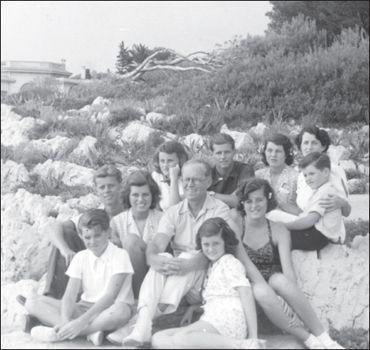
John F. Kennedy Library
CHAPTER ONE
1941
The bridle paths on Cape Cod are mostly old cranberry roads. Deep underground, clear waters help feed a vast aquifer system. The wet, peaty terrain is among the best in the nation for cranberry-growing, and as I look at it from the air, flying home after a week in Washington, this fertile swath of land can resemble a pink-and-green patchwork quilt in harvest season.
I rode on horseback along those peaceful bridle paths with my father when I was a small boy, on summer mornings in 1941, just months before America entered World War II. My father wore flannel shirts and scuffed horseman's boots on those rides, and looked about like any other fellow on Cape Cod who liked to ride horses.
A year and a half earlier, in another place, I had seen my father in different attire, different circumstances: wearing a tall black hat and black cutaway coat, and getting in and out of limousines with important-looking men, many of them with bushy white mustaches, who wore similar black clothes and serious expressions. The Kennedy family was in London, where my father was ambassador to the Court of St. James's. I was seven then, and understood dimly that a big war was happening, and that it might come to London soon, and that my dad was working very hard to prevent this. He could not prevent it, and we all came back home. Now America was on the brink of war. I understood that my two eldest brothers were thinking about enlisting.
I understood these things, and yet they were abstractions, fleeting elements in the half-real, half-dreamed universe of a small boy's mind. None of us, perhaps excepting my father, could anticipate what the war would mean to us: the terrible sacrifices it would exact within our family. Not even my father could imagine the centrality of the Kennedys in the postwar world: the struggles of Jack, and then Bobby, and then to some degree myself, to build upon our country's military victory with victories for social justice and democracy.
The plaid-shirted figure on horseback in front of me on those morning rides was not--and never would be to me--primarily an American diplomat, or financial titan, or motion picture producer, or source of exotic legend. He was my father.
Such was the perspective of the boy on the trailing horse.
From my vantage point as the youngest of the nine Kennedy children, my family did not so much live in the world as comprise the world. Though I have long since outgrown that simplistic view, I have never questioned its emotional truth. We depended upon one another. We savored food and music and laughter with one another. We learned from and taught one another. We worshipped with one another. We loved one another. We were mutually loyal, even as we were mutually competitive, with an intensity that owed more to joy than to an urge for dominance. These values flowed into us on the energies of Joseph and Rose Kennedy. They helped us form bonds among one another, and to develop personalities based on those bonds, to an extent that remains to this day underappreciated by the chroniclers of my family. They sustain me still. They lie at the heart of the story I wish to tell.
I was nine years old in that summer of 1941, the final summer of the familiar world into which I was born. I was not clear why we had all come back home from England, but I was happy that we had. I was too young to fully understand that my father had resigned his ambassadorship. I was certainly too young to comprehend that he'd resigned because he had offended some people in England by saying that the British might not be capable of fighting a war against Germany. It would have been news to me that Dad had displeased President Roosevelt with these same remarks. Or that when he was away from the Cape house that summer, in New York and Washington, he was trying to persuade other people to join his effort at keeping America out of the war. Or that, despite their differences, Joseph Kennedy continued to support Franklin Roosevelt as president.
I just knew that on weekends, he and I would ride horseback together on the Cape, and that was all I really cared to know.
It's hardly surprising that these facets of my father's life were unknowable to me as a child. If my father were alive today, there are things I would like to ask him--about his relationship with FDR and his government service--but I've rarely investigated the myths surrounding him. Perhaps other sons and daughters of towering personalities might find it familiar: his presence within the family eclipsed nearly everything else about him. In some persistent region of my mind, Joseph P. Kennedy remains to me, eternally and solely, my dad. Just as I remain the ninth and youngest child of all the Kennedys.
Dad was always an early riser. At around six o'clock, I'd blink awake to a rap on my bedroom door on the second floor of our house at Hyannis Port, followed by, "You can come riding if you are downstairs in five minutes!" He meant exactly that. If I were late, he would be gone. I was seldom late.
Dad always bought his horses in Ireland, big Irish hunters that were strong and calm. Most times it was just the two of us, and I savored these chances to have him all to myself. Bobby was never interested in riding. Jack liked it, but he sometimes suffered asthma attacks afterward, and concluded that he was allergic to horses. Joe Jr. loved to ride, but he tended to gallop off on his own.
My father's horse was named Swifty. I rode Blue Boy, an old and gentle animal that all my brothers had ridden in years past. If it was harvest season, the cranberry-hauling pickup trucks would ramble along the roads and keep the vines at bay, and Dad and I could ride side by side. After the trucks left, the vines would quickly overtake the road again, and we'd ride single file. Sometimes in high summer they grew so fast that my father assigned me the task of clearing them away again, and this gave me the chance to plunge into one of those clear, chilly ponds for a quick swim. Other times, at low tide, I'd drop behind to gather up some of the clams that had ridden in on the waves: succulent Northern quahogs and sweet surf clams.
My father was a complicated man, and during our rides I came to know different sides of him. His temperament was never hard to discern. If he was in a cheerful mood, he would talk freely in his high, Bostonpitched staccato, and our conversations could be rich and animated: how well (or not) I was performing at school or at sports, a book he wanted me to read. If he was preoccupied, he'd be introspective and mute, his reddish hair aglow and his rimless glasses glinting in the morning light, with only the clop-clop of our horses to break the silence. Most typically, Dad liked to wax philosophical, thinking out loud about the family.
"The summer of 1941 was the last one that our family would ever have together," my mother has written. * Is that literally true? Were all eleven of the famously in-motion Kennedys ever together under the Cape house roof that year? I can't recall, but Mother usually had her facts straight. In any case, I can look back and see all of them as they might well have been on a given weekend morning, each one distinct yet a part of the whole; absorbed in the moment, wondrously alive.
Their familiar bedlam would be pouring through the windows as Dad and I returned from our ride, me still tingling from the chill morning air and my father's coveted companionship, avid for breakfast, imitating his stride. We would hear their raucous, contending voices and laughter, their high-spirited insults and their tramping on the stairs, as telephones rang, dogs barked, radios blared, and some passing virtuoso banged out a few notes on the living room piano en route to somewhere else. A visitor once recalled being startled by "so many young people... who looked alike when they grinned and managed to keep the atmosphere in the house at a fever pitch." Well, that was our family.
Joe Jr., rugged and magnetic, might have been locked in an early-morning duel of wits with Jack--these two were archcompetitors in a family of competitors. If Jack managed to outdo him at chess or in one of the word games he loved, "Categories" maybe, Joe tended to retaliate with a little friendly muscle. But as competitive as they were with each other, they were unbeatable when united: in 1938, the two of them crewed together to win the intercollegiate sailing championships on the waters off Annapolis.
I looked up to my older brothers. "Hero worship" wouldn't be too far off the mark. As long as I can remember, I wanted a boat so I could sail the way they did. They were my earliest sailing instructors, and they encouraged me more than they even knew. I did my first solo sailing under their watchful eyes. "You can go as far as that boat anchored over there, Teddy, then sail back to us... Stay inside the breakwater... Let me see you tack... Now gybe..."
I remember one July at the Cape when the cook had baked a big beautiful birthday cake for Joe, slathered with chocolate frosting. Joe loved chocolate frosting, so he sneaked into the kitchen while the cake was cooling, scraped all the frosting off the surface and sides, and sculpted it into a little pile on the side of the platter so that he could eat it all when the cake was cut. Jack was watching this. As soon as Joe left the kitchen, Jack charged in, scooped up the pile with one hand, and raced outdoors. Joe heard the commotion and lit out in pursuit. He chased Jack all the way to the end of the breakwater, where Jack dodged and ducked around a small navigation beacon, trying to balance the pile of warm chocolate in his hand, while Joe tried to trap him. Jack was rescued by Eddie Moore, Dad's secretary, before Joe could close in.
We competed in every conceivable way: at touch football, at sailing, at skipping rocks, and seeing whose seashell could float the farthest out to sea. We competed at games of wit and information and debate. We competed for attention at the dinner table, which meant a good deal of boning up: entry stakes for those conversations amounted to a substantial mastery of the topic under discussion. It is no accident that copious research and preparation have defined my methods as a senator: I will not champion a bill or a cause, no matter how complex, until I have understood it well enough to satisfy the standards my father set for table talk.
Competition, of course, is the route to achievement in America. As I think back to my three brothers, and about what they had accomplished before I was even out of my childhood, it sometimes has occurred to me that my entire life has been a constant state of catching up.
By "catching up," I mean with my own life and with the members of my family. I don't mean that I felt envious of any of them; I loved and respected every single one. I mean that they set an extraordinarily high standard for living a life in general, and in particular in public service. So from the very beginning I started really behind the eight-ball. My brothers and sisters were already on a very fast track. I was the ninth of nine.
There was no question of catching up to Joe Jr. in that summer of 1941. At twenty-six, he had already started to prepare himself for a career in politics. He had attended Harvard and the London School of Economics, and had served as a delegate to the 1940 Democratic National Convention in Chicago. There, he showed his independent streak by backing James A. Farley for the nomination against an unprecedented third run by Franklin D. Roosevelt, whom Joe Sr. continued to support despite their complicated relationship.
Dad respected his son's decision. He respected all our decisions that were not frivolous. His scrupulous neutrality regarding our life choices stands counter to one of the more persistent myths about the Kennedy family: that our father had somehow "designated" all his sons for office at the highest levels of government, starting with the presidency for Joe. This is simply not the case. My eldest brother's political ambitions were entirely his own, as was another ambition that ran even more sharply against our father's grain.
In agreement with Dad, Joe had made anti-interventionist arguments in his two years at Harvard Law School. But now, convinced of America's inevitable involvement in the war, Joe had dropped out of law school and put his political plans on hold to join the navy as an aviator.
Less than a year earlier, in October 1940, in a national radio address endorsing Franklin Roosevelt for reelection and at the same time pleading for American neutrality in the war, Joseph Kennedy Sr. had reminded his listeners, "My wife and I have given nine hostages to fortune. Our children and your children are more important than anything else in the world." Yet he uttered not a murmur of protest at his eldest son's decision, nor at Jack's that same summer.
Joe would commence training in the fall and earn his wings the following year. Then he would be sent off to England, and from there to the British coastal skies, headed for Europe, and then on to eternity.
In an essay for a privately printed book of reminiscences about Joe, which he edited, Jack wrote, "Joe did many things well, but I have always felt that he achieved his greatest success as the oldest brother. Very early in life he acquired a sense of responsibility towards his brothers and sisters, and I do not think that he ever forgot it." Joe, too, saw the family as his world, and Jack understood this.
Jack also saw our eldest brother as something of a puzzle. "I suppose I knew Joe as well as anyone," he wrote in that essay, "and yet, I sometimes wonder whether I ever knew him. He had always a slight detachment from things around him--a wall of reserve which few people ever succeeded in penetrating."
Jack, twenty-four that summer, might well have been describing himself. I cannot deny that he had qualities that made him enigmatic to some. He read more books than any of us, and perhaps the ideas in them drew his attention inward. I served in Washington--all too briefly--with Jack in the early 1960s, when he was president and I was a senator. In this sense we were adults together, and colleagues at the pinnacle of public service. Yet I always looked up to Jack. He was more than a revered older brother to me. He was almost a second father. In fact, he was my godfather, a role he had requested in a letter to our mother, written from Choate in 1932, shortly before I was born. "Can I be Godfather to the baby?" he asked. Rose Kennedy gladly consented. She held to the theory that godparents should play active roles in guiding younger children. Nearly fifteen years in age separated us, which meant that my childhood self saw him as a grown-up, and that perception never really changed, bolstered by his god-fatherly enthusiasm.
Jack claimed a broad mandate. Delighted that my arrival was February 22, the birthday of our first president, he waged an unsuccessful campaign for me to be named George Washington Kennedy. He invented wondrous games for us from the simplest objects on the seashore. Scallop shells became "floaties," or tiny racing yachts. Sometimes Jack and I would play "football" without a football. I would run a pass pattern as if I were the receiver and he the quarterback. But instead of throwing a pigskin, Jack would bat a softball on a line into my outstretched hands with the accuracy of Sammy Baugh of the Washington Redskins. Later he taught me to sail. He was my mentor, protector, wise counsel, and constant friend.
Jack was bedeviled by health challenges for all of his life, but he refused to let illness slow him down for long. He was resilient enough to play junior varsity football at Harvard, work as a ranch hand in Arizona, and sail competitively in Hyannis Port and elsewhere. He was fearless enough to tear around Europe in his own convertible in 1937; and, amid the tensions of 1939, to explore the Soviet Union, the Balkan countries, parts of the Middle East, Czechoslovakia, and Germany, returning to London on September 1, the day Germany invaded Poland. The book that resulted from these travels--an expansion of his Harvard senior honors thesis and titled Why England Slept--was published in 1940 and became a best-seller.
Jack would occasionally send us "mementos" of his travels, and some of these were rather exotic. During one of his Arizona visits, my brother decided that his Doberman pinscher was getting to be a nuisance, so he crated the dog up and shipped him back to the family in Hyannis Port, with special instructions for me to look after him. A delivery truck brought the dog to our house from the railroad station. A note fixed to the crate read, "My name is Moe and I don't bite." When I looked at Moe through the slats, I was glad for that news, because Moe was one big, muscular dog.
I opened the crate. Moe bounded out of the cage, gave me a glancing nip, knocked me over, and bounded full speed down the lawn. He circled a bit and then made for the McKelvey house next door. Johnny McKelvey, a boy a little younger than me, was standing in his yard, his eyes riveted on Moe. Moe bore in on Johnny and sent him flying like a tenpin in a bowling alley. Johnny started to bawl. His nanny came rushing out of the house and screamed, "Get up, Johnny! Get up! Your mother doesn't want you to ruin those nice new pants! You're getting a grass stain on them!" Johnny couldn't stop howling. Moe, meanwhile, was having a hell of a good time. He came charging back up to our house, tongue and tail waving. The delivery truck man, a true profile in courage, crouched, spread his arms, and somehow managed to grab him. Dad had been monitoring all this, and had reached an executive decision. "Put him back in that crate and ship him back!" he ordered me. I was happy to oblige; it gave me a rare chance to tease Jack. I wrote him a note back on the crate: "This dog that doesn't bite just jumped out of his cage and bit me. Teddy."
My eldest sister, Rosemary, was twenty-three in 1941. Luminously pretty and round-faced, with a widow's peak, dark brows, and a great smile that dimpled her cheeks, Rosemary was the one sibling with whom all the others were unfailingly gentle. Her affliction, diagnosed as mental retardation, left her struggling to comprehend things as quickly and as clearly as other people. She was a sweet and loving human being.
Rosemary enriched the humanity of all of us. Our sister Eunice seemed always to be near her, helping her through simple childhood games such as dodgeball, inviting her along and giving her assignments in sailing races. As she grew into adolescence, Rosemary knew she could count on Jack or Joe to escort her to dances at the Yacht Club at the Cape, or to the Stork Club in New York. I looked out for her too, when I could, though I was fourteen years younger--she was my godmother, after all. Dad wrote affectionate letters to her from abroad, and Mother actually altered her own handwriting from the swirling "fine Spencerian hand" on which she'd prided herself, to a simpler style that imitated typographical print, so that Rosemary would have less trouble following it.
But in the fall of that year, our father, concerned that Rosemary's condition would pose insurmountable dangers to her as an adult woman in the world, listened to doctors who assured him that a new form of neurosurgery would greatly benefit her and improve her quality of life. The doctors were wrong, the surgery further injured Rosie, and my parents were devastated. I, of course, knew and understood nothing of what had happened. Rosemary spent her remaining sixty-three years mostly in comfortable supervision at her home in a Catholic community in Wisconsin. Over the years, through her regular visits to Eunice's home or her summer days on Cape Cod or wintertime in Florida or Thanksgiving at Jean's, Rosemary remained a loving and inspirational presence in our family, not just for her siblings, but for the next generations too.
If Kathleen happened to be at the Cape with us, there'd be a touch of stardust in the house. Kathleen, twenty-one in 1941, had already made a glittering debut into London society before the king and queen in 1938, the year Dad arrived there as ambassador--a debut that she shared with Rosemary. Admirers of all ages and nationalities trailed in "Kick's" wake. She'd returned to America and completed two years at Finch College in Manhattan. She spent a good deal of time on the Cape that summer, before signing on as a reporter and reviewer at the Washington Times-Herald.
The war soon spoke to Kick's sense of duty, as it had to that of Joe Jr. and Jack. In 1943 she would put aside her reporter's notebook and mink coat and recross the Atlantic to London to join the grim, vital mission of the American Red Cross.
Eunice, lanky, athletic, and intense at twenty, might have been trooping up to the house from the tennis court after an early-morning match with a friend, a barrette clinging to her tousled hair. "Keep up your tennis and your golf," Dad instructed her from London in 1940. "I am still going to make a champion out of you." A champion she became: tennis player, swim team captain, and superb competitive sailor, winning many races at the Cape in those years. Eunice's famous drive, which she applied to good works in her adult life, may have been prompted in part by a wish to emulate Joe Jr. and Jack. She remarked in later years, "To us they were marvelous creatures, practically god-like, and we yearned to please them and be acceptable."
Pat might have been curled on a sofa in her robe and bobby sox, flipping through a copy of Variety or Photoplay as Dad and I headed into the house. She was seventeen in 1941, and dreamed quietly of the Hollywood glamour world that she would one day be a part of. She agreed with Kick and Eunice that in Joe Jr. and Jack the family had its own bright stars. "To us they were heroes, young gods," she once reminisced, echoing her sister.
Our father's career as a movie studio investor and producer in the 1920s and '30s inspired her. After directing and acting in several plays at Rosemont, Pat became a world traveler and travel writer, a producer for the beloved singer Kate Smith, and, in time, part of the Hollywood scene herself. She married the British screen actor Peter Lawford in 1954.
Pat always had a good eye for detail. In a 1946 diary entry, she gently lampooned Winston Churchill, who stayed at our Palm Beach house while in America to receive an honorary degree from the University of Miami: "We hadn't been in the house long before Winston appeared downstairs with an enormous cigar, bare-footed in his dressing gown, complaining as to whether quarter to ten meant quarter to or past. Mrs. C. calmed him [and] he went upstairs."
Multilayered, deeply religious, Bobby was loving and warm beneath his famously aggressive exterior. He was a collector of stamps in those early days, small and shy, a stubborn struggler in the classroom and on the playing fields. A resolute youthful reader of "serious" books: The Crisis, The Hurricane, and Men Against the Sea in one stretch of 1939. A year before that, he'd composed an essay about himself, probably for a school assignment:
I am thirteen years old, and about five feet two inches tall. I have got a lot of freckles. I have hazel eyes, and blond hair which is plenty hard to keep down because I have many licks, and so much of it. I am not very fat, but fat enough....
I have a pretty good character on the whole, but my temper is not too good. I am not jelous of any one, I have a very loud voice, and talk alot, but sometimes my talk is not very interesting.
My tablemate at breakfast--at a small separate table a short distance from the big family one--would likely be my sister Jean, the closest of the children to me in age. This arrangement did not necessarily thrill Jean. She was thirteen then, and yearned to be included among the older siblings privileged enough to sit with Mom and Dad. So did I, if truth be told, but the rules were the rules. Occasionally another sister would take pity on Jean and say, "I'll switch with you." No one ever said that to me.
My family's future ambassador to Ireland was a tender and shy little girl. She looked to Joe Jr., her godfather, for special attention among the elders, and Joe provided it. After the loss of him, it was Jean, in a wide-brimmed white hat and floral dress, who in 1945 would christen the destroyer USS Joseph Kennedy Jr. It was Jean who would introduce her Manhattanville College roommate Ethel Skakel, lively and prankish at seventeen, to the twenty-year-old Bobby, and then subtly steer the two toward one another until Bobby "got it" and married Ethel in 1950.
Also at the Big House, as we called it, and nearly as much "family" as we nine children, would be the Gargan kids--Joey, Mary Jo, and Ann. These were the children of Joseph F. and Agnes Fitzgerald Gargan, my mother's sister. After Agnes's death in 1936, my parents took the small trio into the Kennedy household for summers and school vacations. Joey was eleven in 1941, two years older than me, but he was my constant chum. Dad and Mother took good care of them and saw that they were interwoven into the family's fabric.
The small figure who held us all together might have been arriving at the house just as Dad and I were. She'd have stepped out of the blue two-door coupe that she drove to and from morning mass at St. Francis Xavier Church despite barely being able to see over the top of the steering wheel. Unlike the rest of us, my mother would have been dressed in a way befitting respectable society, in a tilted broad-brimmed straw hat and floral dress, her earrings and pearls in place, a small purse held tightly in her two gloved hands.
Both of my parents were deeply religious, and the family prayed together daily and attended mass together at least weekly. Yet it is Rose Kennedy, mainly, to whom I owe the gift of faith as the foundation of my life. It is a core factor in my understanding of who I am.
My own center of belief, as I matured and grew curious about these things, moved toward the great Gospel of Matthew, chapter 25 especially, in which he calls us to care for the least of these among us, and feed the hungry, clothe the naked, give drink to the thirsty, welcome the stranger, visit the imprisoned. It's enormously significant to me that the only description in the Bible about salvation is tied to one's willingness to act on behalf of one's fellow human beings. The ones who will be deprived of salvation--the sinners--are those who've turned away from their fellow man. People responsive to the great human condition, and who've tried to alleviate its misery--these will be the ones who join Christ in Paradise.
To me, this perspective on my faith has almost literally been a lifesaver. It has given me strength and purpose during the greatest challenges I have faced, the roughest roads I've traveled.
Mother was also our Pied Piper into the world of knowledge and ideas. She led us on educational outings to museums and concerts, to Concord and Bunker Hill and the Old North Church, rattling out improvised math challenges to us along the way. ("What is two plus two, subtract three, then add two?!") She was our unflagging grammarian and standard-bearer of decorous speech. Woe unto those of us who neglected to use "whom" after a preposition! Once Mother wrote to me, "I noticed you are quoted as using the word 'ass' in several expressions. I do not think you should use that word. I am sure you realize it really does not look very well in print." I was forty years old and a senator when she sent that one. It still hangs on my Senate office wall. Still later, she nailed me again: "I just saw a story in which you said: 'If I was president.' You should have said, 'If I were president'... which is correct because it is a condition contrary to fact."
She was moderator of our topical dinner table conversations, the topics--geography one night, the front-page headlines the next--announced in advance on cards that she wrote out and pinned to a billboard near the dining room. She was the disciplinarian of all our headstrong impulses, and was sometimes strict: spankings and whacks with a coat hanger were in her arsenal, as were banishments to the closet. On one such expedition, I stood in the darkness feeling sorry for myself, until I realized I was not alone: Jean was standing beside me, serving out her own time for some infraction of the rules.
But Mother was also the tender index-card archivist of the small moments, the letters, notes, and remarks that were the lifeblood of our family. "Having barrels of fun," I once cable-grammed her from the Riviera. "Send money for more barrels." She kept that one, and hundreds like it.
Through all of this, the house on Marchant Avenue in Hyannis Port was the Kennedys' safe harbor. My father liked to say that "home holds no fear for me." We understood what he meant. We knew that we could always always come home, that we could make mistakes, get defeated, but when all was said and done, we would be respected and appreciated at home. Dad himself had no fear because he knew in his heart that he was working hard for the family; he was doing everything he possibly could to show us how to lead constructive lives. But at the end of the day, it was up to each of us to carry out what he'd taught us. This was the abiding philosophy at the Cape house. And so it remains today for Vicki and myself, and everyone in the family who comes to stay with us.
We were just incredibly close, all of us, through all our younger years and after. And even though the Cape house was our base, and you'd think we would be restless to get away from it now and then, explore other places, that was not the case. Our whole lives were centered in this one place. We didn't really go out to other places to play. We didn't go off to other kinds of events. It was all here, all here: all the playing, all the enjoyment, all the fun.
For me, it still is. And always shall be.
The original structure was built in 1902 and known then as the Malcolm Cottage. My father rented it in 1926, while his growing family still lived in Brookline, Massachusetts. Dad bought the cottage and enlarged it two years later, as a summer retreat. My own earliest memories of "home" revolve around the house in Bronxville, New York, where I lived most of the time in my early years; but in 1941, Dad closed the Bronxville house down. In the decades that followed, as fate and fortune scattered us to far-flung cities and ports of call, it was the Hyannis Port house, paradoxically, that grew in its stature as our center.
It was the place from where I strode proudly on summer days into the surrounding neighborhood of graceful houses, with their pitched cedar roofs and shutters and gardens bursting with flowers, to pursue my career as a wage earner. I delivered newspapers and sweated and struggled behind those old manual lawn mowers to supplement my allowance of ten cents a week, eventually raised to a quarter.
It was the place where we could and did play practical jokes on one another, and on our dear mother, who was always a most satisfying victim. My favorite running prank was to find a pair of Jack's shoes, the dirtier the better, and place them smack dab on the polished top of Mother's grand piano. This would drive her absolutely crazy. She'd always come in and spot the shoes as if it were for the first time, and start in on Jack--didn't he know where to put his shoes? Didn't he know the piano was not the place for them? This joke, and Mother's clockwork response, continued while Jack was president, Bobby was attorney general, and I was a senator.
Even Jack's presidency didn't buy him much slack around the Cape house. Not many weeks after his inauguration, he was a bit fatigued as he joined the rest of us for our usual weekend at Hyannis Port. He slept in late on Sunday morning in his old first-floor bedroom--until he heard the footsteps of our father ascending the stairs after the eleven o'clock mass at St. Francis Xavier Church. Realizing that he was just seconds from being caught and scolded for missing mass, the president of the United States threw himself out of bed, yanked on a pair of pants, sneaked out of the door, hightailed it toward the garage, and scrambled over our neighbor Rodger Currie's fence to safety.
Just a few final random memories, now, of life in that sanctuary in those sweet summers before the war:
In the evening before dinner we'd gather in the living room, where my mother would play the piano. She played with great delicacy and finesse. She'd come downstairs at 6:30 and seat herself at the keyboard, and she'd play until the family had formed. Then she'd stop and the conversation would begin.
Once in a while Jack would drift into the room from vigorous games out of doors after changing into a clean shirt, an absolute requirement in my parents' home. When a lull softened the general din, he might nod to Mother, and then begin to sing, alone, to her accompaniment. My brother had a fine voice--a fact that very few people know. One of his favorite tunes was "September Song." Jack could imitate the gravelly voice of Walter Huston, who'd made it famous on Broadway, and still project the ballad's aching tenderness.
And the days dwindle down
To a precious few
September
November...
Sometimes Jack would sing that song directly to me.
At dinner, we would often sit down to platters heaped with clams and lobsters. We were not assigned seats, but Mother and Dad always sat in the same places. We each had a napkin, and that napkin was expected to last the entire week. If it suffered any stains--which of course is what napkins are designed to do--too bad. One a week. I had two or three important roles in our summer dinners. It was my special task to head down to the shore with two buckets and return with enough salt water to cook the shellfish. Another chore was to bring home fresh water from the pump at the golf course. Two of Dad's mealtime passions were good tomatoes and fresh water. Finally, if our dessert was ice cream, it would be ice cream that I had churned, by turning a handle for about forty-five minutes, over a bucket of ice. I was one of the few fellows who could claim that ice cream made me physically fit!
Our noisy dinner table always bore the foods of the seasons. When the corn was in, we had corn on the cob. And then we had corn pudding, and then we had cornbread. Every meal seemed made of corn. And when the blueberries came in, everything was blueberry: blueberry pie, and blueberry shortcake, and blueberry muffins. The same with the strawberries. And of course the cranberries.
But whatever dishes were set before us, the one "menu" item that never varied was conversation. After grace, ideas and information would start to flow. The spirit was generally upbeat but always informative.
Only rarely did the talk grow heated, and even then it had its comic side. I recall one mealtime when Joe Jr., who had recently traveled in Russia, began to wax enthusiastic over what he'd seen there. Joe was reliably his father's son when it came to economics and politics, but he'd been more than a little naive in his reaction to the way the Soviets described their system. "You know, there's something interesting about that communism over there," he declared to our father. "This idea of 'each according to their need, each according to their ability'..." That was as far as he got. Dad set his knife and fork down. "When you sell your car, and sell your boat, and sell your horse, you can talk to me about that," he exploded at Joe, "but otherwise I don't want to hear any more about it in this house! " And boom! up he got, and out the door he went. The kicker was that as my poor brother sat there openmouthed, my mother said to him, "Joe, you shouldn't upset your father."
After dinner, toward sunset, my father liked to retire to his porch on the second floor and sit in the corner by the window that looks out into the harbor and the lantern that was there. He would read into the late evening. But he'd also keep a lookout for his younger children as we trudged home from one last sail or game of tennis or flashlight tag. If you were "it," and if you shone a flashlight on a hiding child, they were out. Jack continued playing flashlight tag with the younger children as president.
A variation of flashlight tag, which we also played into adulthood, was a game we called Murder. We'd play with all the kids and adults and use the whole house at the Cape. Someone was "it," and if they tagged you, you were dead, but then you became the Murderer. The goal was to hide from the Murderer so that you were the last person not tagged. One night, Congressman Jack Kennedy was the second to last person tagged and he couldn't find the last person, who had crawled in Mother's hat box shelf. That person was Lem Billings, Jack's loyal lifelong friend whom he'd met at Choate. Since they couldn't find him, Jack proposed that everyone go to a movie. When we all came back two hours later, we found Lem still in that closet, covered with sweat and still waiting to be caught.
As children, we'd have to be home from our games by the time the streetlights came on, and of course as the summer days got shorter the lights came on earlier and earlier. If any of us arrived late, we'd pick up the gaze of Dad's steely blue eyes at about thirty yards, and then whatever excuses we'd invented would melt by the time we got to the door. Dad could see everything that was happening from that chair in that room. Everything in the world, it sometimes seemed.
Down in the basement was a small movie theater, with projector and screen, that Dad had installed. Through his Hollywood connections he could get new movies before they were released to the theaters. We saw the Walt Disney feature cartoons like Dumboand Snow White. Dad knew Walt Disney, who gave him several of his paintings, renderings of his cartoon characters. For a long time we had those paintings on a wall of our house in McLean, Virginia.
Later we'd watch adventure films: Four Feathers, the 1939 film about a young British officer who has to disprove his reputation as a coward during the invasion of North Africa. I think it is one of the great movies of all time, along with Call of the Wild and Captains Courageous. I loved the latter movie so much, in fact, that when Vicki and I adopted a new puppy recently, we named him Captains Courageous. I loved movies about the sea, and about men at war.
Later on, Dad would screen some romantic movies--but at the moment when the lead characters would start holding hands, he'd call out, "Teddy! It's time for you to go to bed!" Jean wasn't much luckier. Just as they got to the embracing and kissing stage, she'd hear that voice of his: "Jean, you've got to go up to bed!"
The cranberry fields are smaller now than they were in 1941--as is every childhood image when seen through a grown-up's eyes. But my favorite boyhood vista from our porch in Hyannis Port has not diminished. This is the shoreline, where the shallow waters of Nantucket Sound lap peacefully, then draw back toward the open sea. Tied up on the beach, in my memory, its flat stern bobbing in the surf, is a little boat.
When I was six, Joe and Jack began teaching me to sail in that little boat. They introduced me to the wind and the tides and the currents, and my life on the sea was under way.
The boats grew larger over my lifetime, and I ventured farther and farther from shore. I sailed alone, I sailed with my own family, I sailed in regattas, I sailed with political leaders and celebrities who were my guests. I've sailed with just about anyone I could get onto the boat with me. I took up painting, first with acrylics and later with oils, to pass time with Jack when he was recuperating from back surgery in the 1950s, and then again while I was recuperating from an injury in the 1960s, and most of my canvases have been of sailing boats, including my cherished antique wooden schooner Mya, and of the sea, and of harbors, safe harbors.