

The bronze statue of Boadicea and her daughters, in a scythe-wheeled chariot, sculpted by Thomas Thornycroft between 1856 and 1885, and finally erected by the London County Council in 1902. The lines of William Cowper are inscribed upon the plinth:
Regions Caesar never knew
Thy Posterity shall sway.
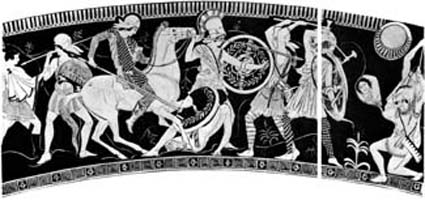
A crater of 460 BC showing Sthenelus, a companion of Heracles, in his war against the Amazon women; encounters with Amazons were often used in Greek art to symbolize the Greeks’ victories over their male enemies.
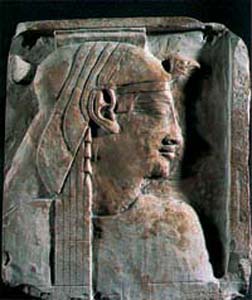
Ptolemaic votive plaque believed to depict Cleopatra as a goddess.
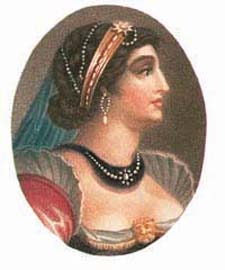
The voluptuous European conception of Cleopatra; an engraving by J. Chapman of 1804.
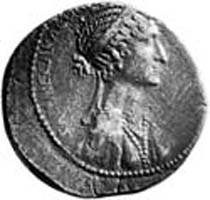
Silver coin of Cleopatra (with Antony on the obverse) issued in Syria c. 34 BC.

Judith beheads Holofernes in a nineteenth-century engraving by Schnorr von Carolsfeld.
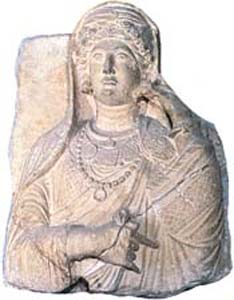
Although no authentic portrait or bust of Zenobia is known, her appearance can be imagined from that of this contemporary Palmyrene noblewoman; late third century AD.
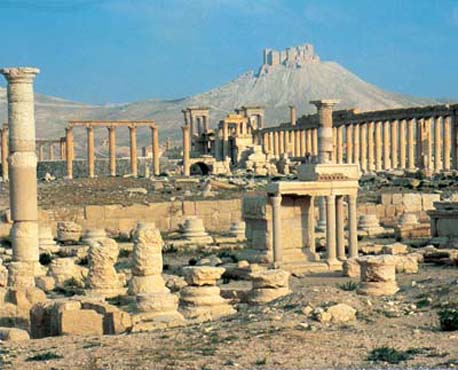
A general view of the ruins of Palmyra today.
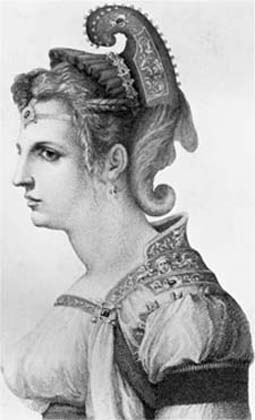
The romantic European image of Zenobia; an eighteenth-century engraving by William Sharp from a drawing by Michelangelo.
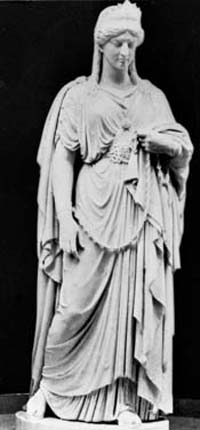
A nineteenth-century statue of Zenobia as a captive by Harriet Hosmer.
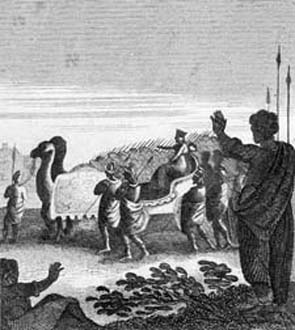
Semiramis, the legendary Queen of the Assyrians (based on Sammuramat, Babylonian widow of a ninth-century BC Assyrian king), seen in an engraving c. 1800.
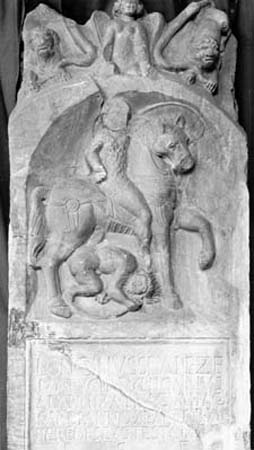
The tomb of Longinus (a Thracian member of an auxiliary cavalry unit) which was defaced and cracked by the Britons during the sack of Colchester; the crouching figure – probably a representation of death – may have been mistaken by them for a symbol of subjugation.
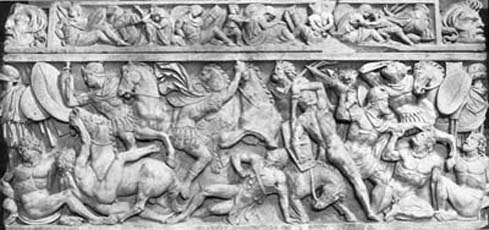
A battle between the Romans and Gauls, from a Roman sarcophagus; the armed Roman soldiers contrast with the naked Celtic fighters.
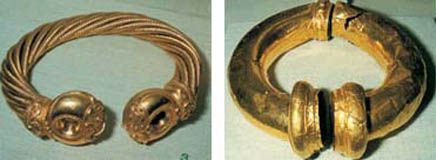
Gold tores from the hoards found at Snettisham in north Norfolk in 1948/50, which were deposited between 25 BC and AD 10; each tore weighs nearly 1,000 grams. Queen Boudica would have worn something similar, as described by Dio Cassius, when urging the Iceni to battle.
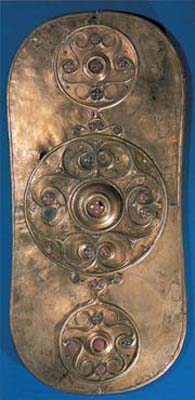
Two examples of superb Celtic craftsmanship, early first century AD (shortly before the Boudican period): a beaten bronze shield, which would have been backed with wood or leather, found in the Thames at Battersea,
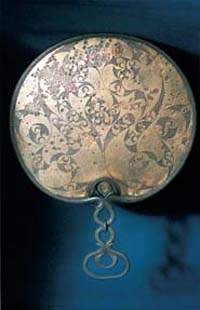
A decorated bronze mirror found at Desborough in Northamptonshire.
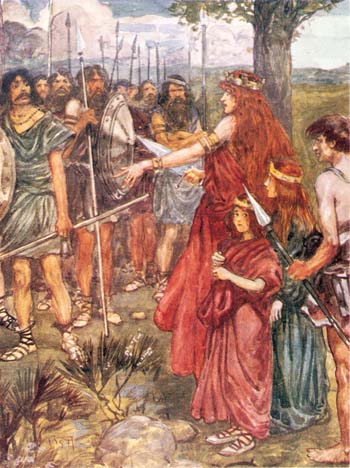
Illustration by A. S. Forrest to Our Island Story, A Child’s History of England by Henrietta Elizabeth Marshall; first published in 1905 – and written in Melbourne, Australia for the author’s children – this work provided formative images of history for many British children in the first half of the twentieth century, including the author.
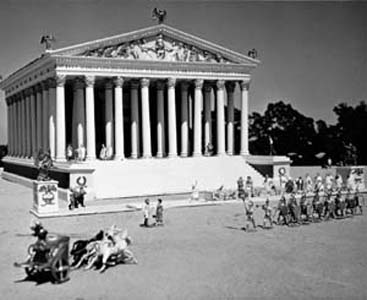
Model of the Roman temple of Claudius at Colchester, as it would have appeared to the Britons who, infuriated by this symbol of alien rule, sacked it in AD 60; from the Colchester and Essex Museum.
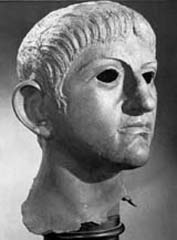
A cast of the bronze head of Claudius, found in 1907 in the River Aide, near Saxmundham in Suffolk and thought to have been hacked off its statue during the sack of Colchester (the jagged edges of the neck can still be seen); the head, an incriminating piece of evidence, was probably thrown into the river after the suppression of the revolt.
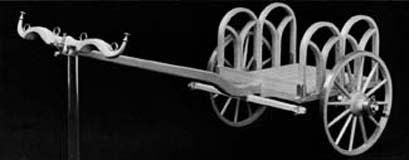
Model of a British chariot of the time of Boudica as it would actually have been (from the National Museum of Wales): a marked contrast with the scythe-wheeled popular image of the same subject.
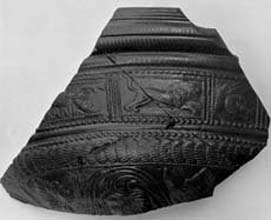
Fragment of a Samian bowl, burned black in the Boudican firing of Londinium, the heat of which has been estimated to have been in excess of 1,000°C.
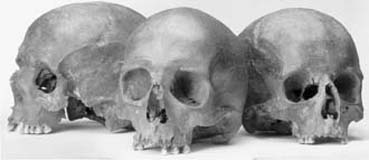
Skulls, dating from the early Roman period, found in the bed of the Walbrook river – possibly the heads of victims of the Boudican massacre, in view of Celtic tribal practice and the ritual significance of the head in the Celtic religion.
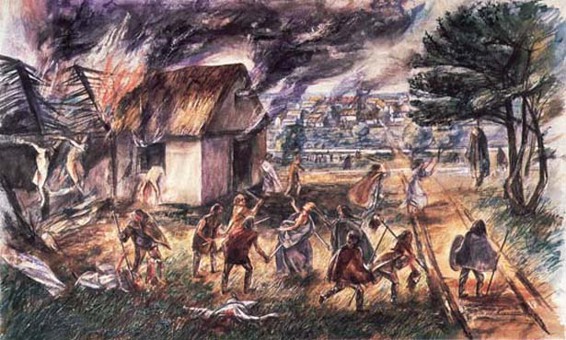
The Boudican firing of Londinium in AD 60, illustrated by Richard Sorrell, from the Museum of London; a red layer, about 13 feet below the streets of the modern City of London, still attests to the fierceness of the holocaust.
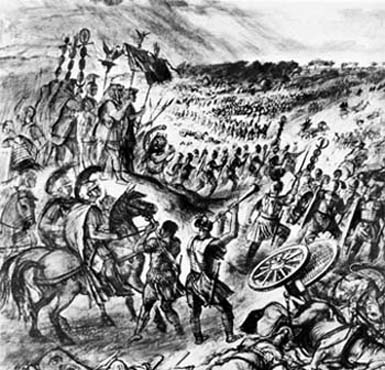
Two impressions of the Britons’ last battle against the Romans: a realistic recreation by Alan Sorrell, from the Museum of London,
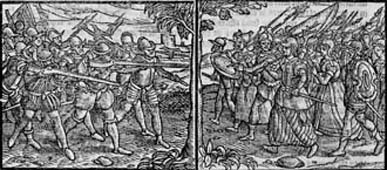
An illustration to Holinshed’s Chronicles of 15 77, showing Boadicea and her ladies in Tudor dress faced by Romans in helmets and doublets, armed with guns.
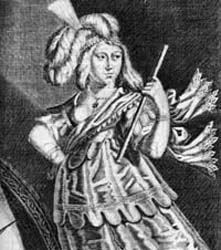
Images of Boadicea.
Illustration to Thomas Heywood’s Exemplary Lives of 1640 showing her in the Caroline court dress of the period, with plumed headdress and one breast exposed, the tore having become a pearl necklace with a cross, and the spear a baton.
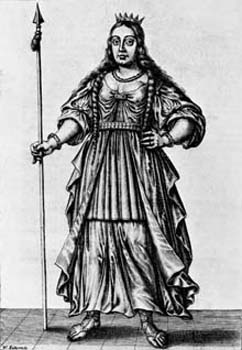
Engraving of the ‘Thrice Happy Princess’ by W. Fairthorne; an illustration to Aylett Sammes’ Britannia Antiqua lllustrata of 1676.
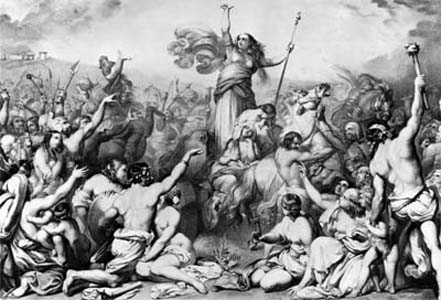
‘Boadicea haranguing the Britons’ by H. C. Selous (c. 1840); the Queen’s ill-treated daughters can be seen in a fainting condition at her feet.
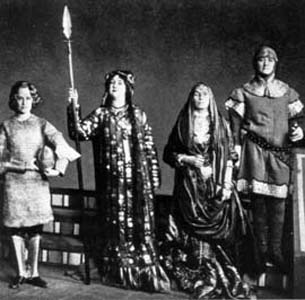
The Pageant of Great Women, performed to call attention to the suffragette cause in 1909 at the Scala Theatre by fifty-two actresses, designed and directed by Edith Craig; from left to right, Joan of Arc, Boadicea, the Rani of Jhansi, and (standing on the steps) Agnes Dunbar. A contemporary photograph from the Daily Mirror.
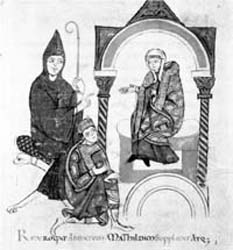
Canossa in 1077; Countess Matilda of Tuscany extends a supplicating hand to Pope Gregory vn, on behalf of the kneeling, penitent Emperor Henry iv; from Donizo’s contemporary Vita Mathildis.
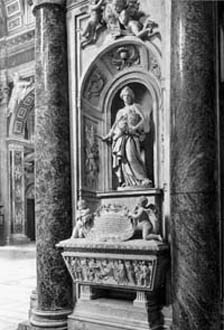
The tomb of Countess Matilda in St Peter’s, Rome, with a Latin inscription comparing her to the Amaon leader: ‘this warrior-woman disposed her troops as … Penthesilea is accustomed to do’.
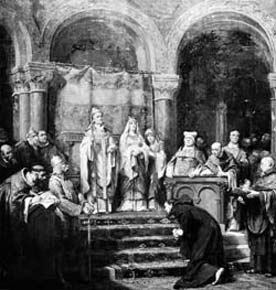
A nineteenth-century Belgian evocation of the scene at Canossa, painted by Alfred Cluysenaar.
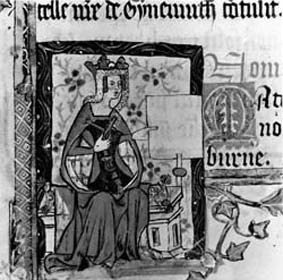
Fifteenth-century depiction of the Empress Maud (Matilda), claimant to the throne of England, from a history of England written by monks at St Albans.

The monogram of Queen Tamara, formed from the letters TAMAR in the Georgian knightly hand, and employed in the copper coinage of her reign.
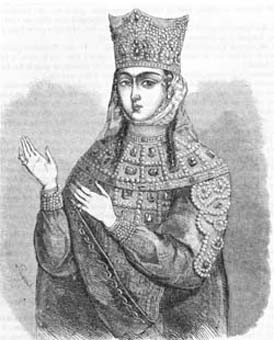
Queen Tamara of Georgia; an engraving published in 1859.
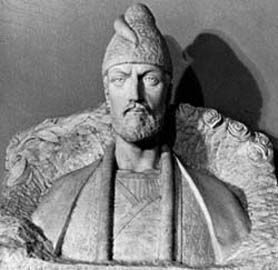
Marble bust of Shota Rustaveli, the national poet of Georgia, author of The Knight in Panther’s Skin, and Queen Tamara’s court official, possibly her Royal Treasurer; sculpted in 1938 by Yakov Nikoladze.
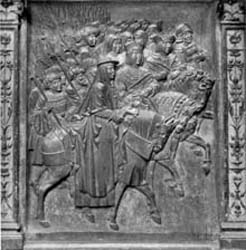
Triumphal entry of Ferdinand and Isabella, ‘the Catholic kings’ of Spain, into Granada in January 1492 following the conquest of the last Moorish kingdom; a bas-relief on the altar of the Royal Chapel in the Cathedral.
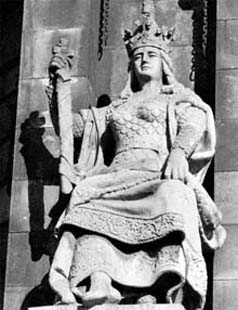
Isabella of Spain, a detail from the Columbus Monument in Barcelona, commemorating the fact that the Queen, as well as her husband, authorized Columbus’ voyage to the new world in 1492.
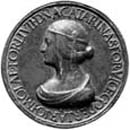
Medal (c. 1480) showing Caterina Sforza, the spirited daughter of the Duke of Milan; her fate, as a would-be female ruler of Forlì, contrasted unhappily with that of Isabella of Spain.
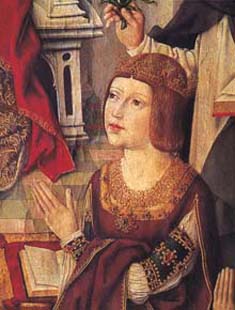
Queen Isabella of Spain; a detail from the painting The Madonna of the Catholic Kings.
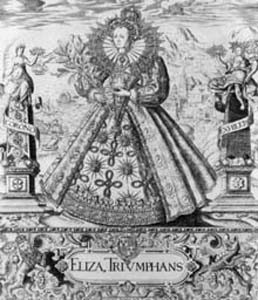
The earliest loose popular print of Queen Elizabeth I: William Rogers’ Eliza, Triumphans of 1589 (the year following the defeat of the Spanish Armada) shows the Queen as Peace, with an olive branch in her hand, while Victory and Plenty proffer her their crowns.
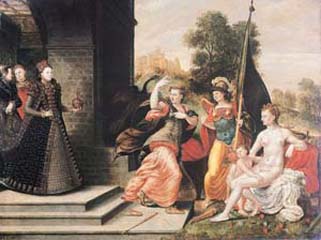
Queen Elizabeth and the Three Goddesses (Juno, Pallas Athene and Venus seen against a background of Windsor Castle), attributed to Joris Hoefnagel, 1569; it has been suggested that this allegorical picture refers to the Queen’s suppression of the Northern Rebellion, the first military initiative of her reign.
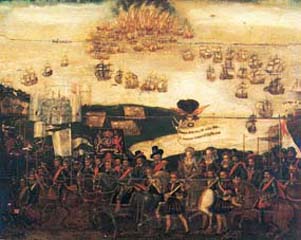
Panel from St Faith’s Church, King’s Lynn showing Queen Elizabeth reviewing her troops at Tilbury in 1588.
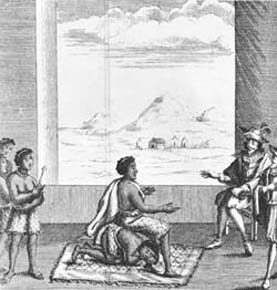
A group of illustrations of the life of Jinga Mbandi, the seventeenth-century Queen of Angola, from Relation Historique de I’Ethiopie Occidentale by Father J. P. Labat, 1732.
Queen Jinga being received by the Portuguese Governor, Correira de Sousa, in about 1622; according to the best-known legend about her, she commanded one of her servants to form a seat when the Governor failed to offer her a chair.
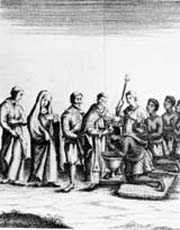
Queen Jinga receives Christian baptism as the Lady Anna de Sousa (in honour of the Governor); she subsequently returned to her tribal name, variously given as Zhinga, Nzinga and Jinga.
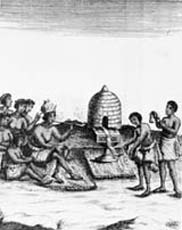
Queen Jinga venerates the bones of her brother, whom she succeeded as ruler. (Some stories hold that she had him murdered.)
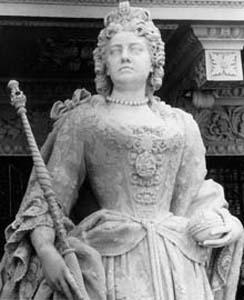
Statue of Queen Anne by Rysbrack at Blenheim Palace; the reality of her appearance was very different from this august image.
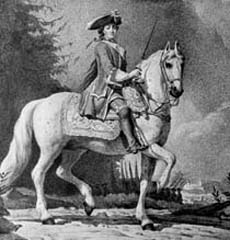
The Empress Catherine II of Russia, after a portrait by V. Erichsen painted in 1762, the year of her coronation; this followed the coup by which, at the head of the rebel regiments, she supplanted her husband Tsar Peter III. She borrowed a uniform to do so: ‘for a man’s work, you needed a man’s outfit’, she wrote.
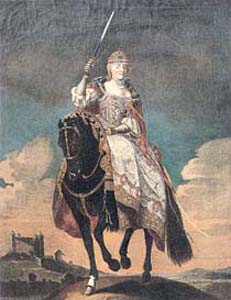
The Empress Maria Theresa of Austria at her coronation as Queen of Hungary at Pressburg in 1742; she mounted a charger and drew her sword to the four points of the compass to signify her role as Hungary’s protector, according to the ancient tradition of the Hungarian kings.
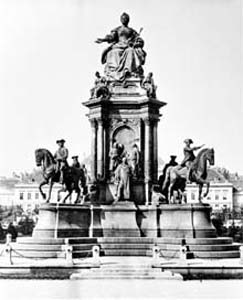
Nineteenth-century monument to Maria Theresa opposite the Hofburg in Vienna, showing her towering majestically above her male ministers and generals.
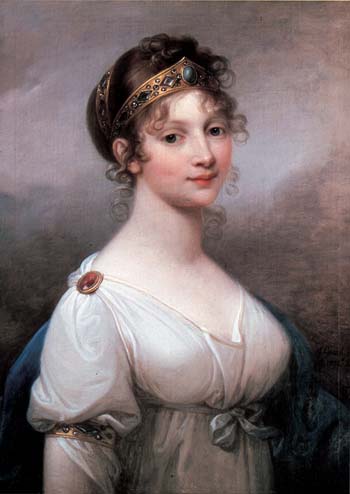
Queen Louise of Prussia, painted by Grassi in 1802 when she was twenty-six. ‘There prevails a feeling of chivalrous devotion towards her’, wrote an English diplomat at her court; ‘a glance of her bright laughing eyes is a mark of favour eagerly sought for’.
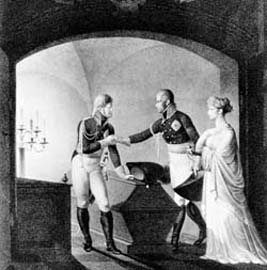
The celebrated print of King Frederick William III of Prussia and the Tsar Alexander I swearing brotherhood over the tomb of Frederick the Great, watched by Queen Louise; after Napoleon’s occupation of Berlin a cruel caricature of the same print was issued, with the Tsar as Nelson and Louise as Lady Hamilton, currently notorious in Europe as Nelson’s mistress.
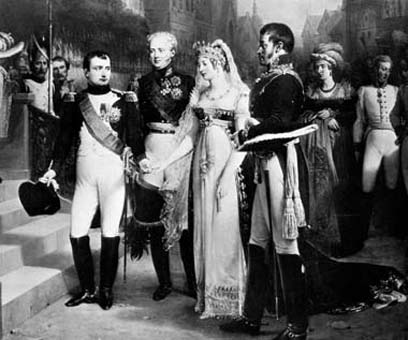
Napoleon receiving Queen Louise at Tilsit, 6 July 1807; the Queen is supported by her husband and watched by the Tsar. A detail from a picture by N. L. F. Gosse.
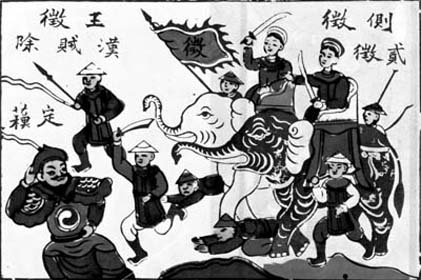
The sisters Trung Trac and Trung Nhi, Vietnamese heroines who led the first rising in their country against the Chinese in AD 39; from a popular Vietnamese print. The characters on the flag give the family name ‘Trung’ and above the sisters (right) their own names; at lower left is Su Ding, the Chinese governor, and top left the legend ‘Queen Trung drives out the Han’.
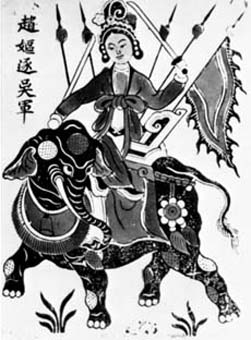
Vietnamese print of Trieu Au, who raised a thousand troops to liberate her country from the Chinese in AD 248; like the Trung sisters, Trieu Au is regarded as a patriotic heroine in modern Vietnam.
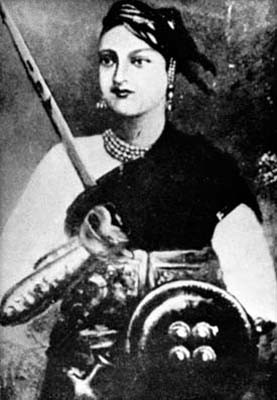
Contemporary painting, by an unknown artist, of Lakshmi Bai, the Rani of Jhansi; both Indian and British sources bear witness to her striking appearance.
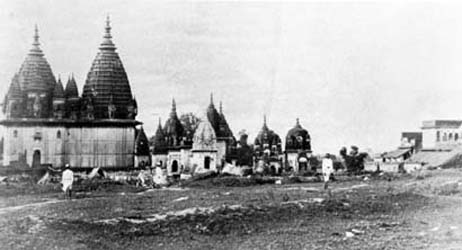
The site of the massacre of Europeans at Jhansi on 7 July 1857; the Rani was subsequently blamed – unjustly – for betraying them.
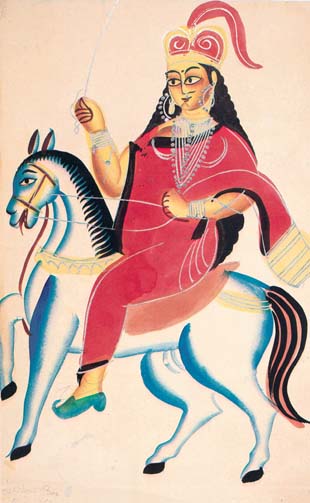
The Rani of Jhansi, a watercolour from Kalighat, 1890.
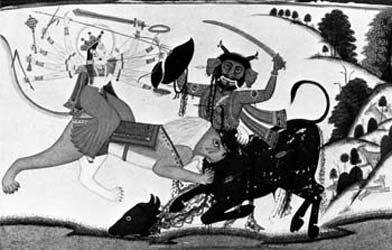
Hindu mythology contains several warrior goddesses; here Durga, wife of Siva, is seen, seated on her tiger, slaying the demon Mahesasura with the aid of her ten arms; unlike Kali, another of Siva’s wives and the goddess of destruction, Durga (to whom both the Rani and Mrs Gandhi were compared) is portrayed as beautiful and basically benevolent, despite her capacity for aggression.
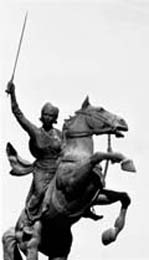
Statue of the Rani of Jhansi at Gwalior; she was killed here on or about 17 June 1858, leading her men in a battle to defend the fortress from the British assault under Sir Hugh Rose.
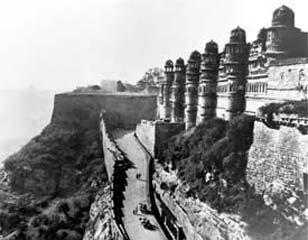
Gwalior fort.
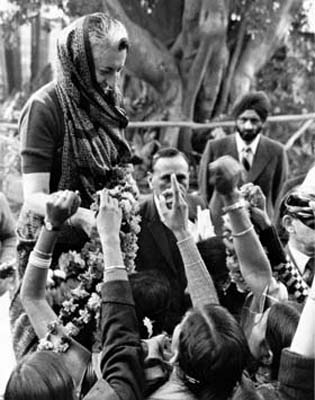
Well-wishers present garlands to Mrs Indira Gandhi, Prime Minister of India and Leader of the Congress Party. (The newspaper caption to this photograph read ‘Garlands for Mother Indira’.)
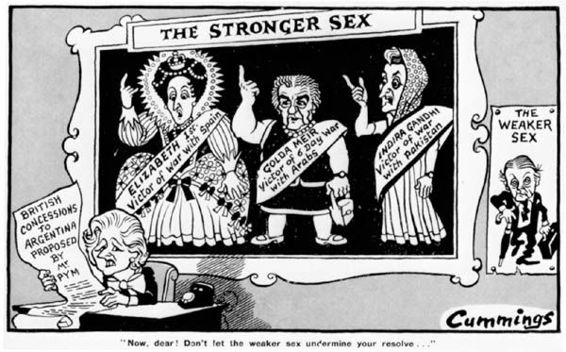
Cartoon by Cummings, linking Mrs Thatcher to other ‘Warrior Queens’ of the past, which appeared in the Daily Express on 14 May 1982, during the Falklands War, when it was suggested that her (male) Foreign Secretary’s warlike resolve was faltering.
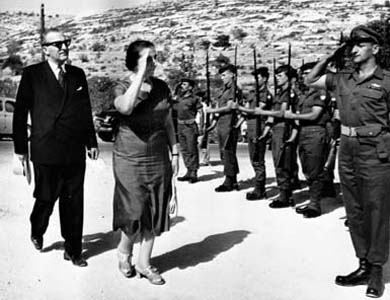
Mrs Golda Meir salutes the detachment commander of Israeli paratroops; her own ‘grandmotherly’ uniform includes a handbag.
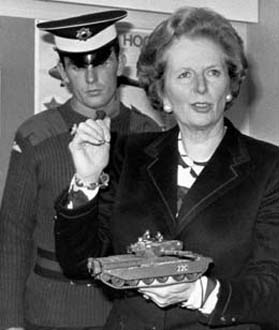
Mrs Margaret Thatcher with a model of a Chieftain tank (and tiny model soldiers manning it) during a visit to the 2nd Battalion Coldstream Guards in 1987; a larger Guardsman stands behind.
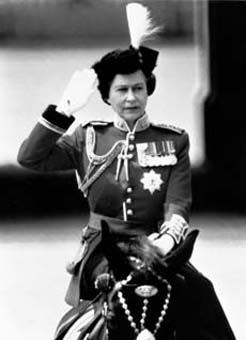
Her Majesty Queen Elizabeth II in military uniform at the Trooping of the Colour, enacting the purely ceremonial role of the ‘Armed Figurehead’.
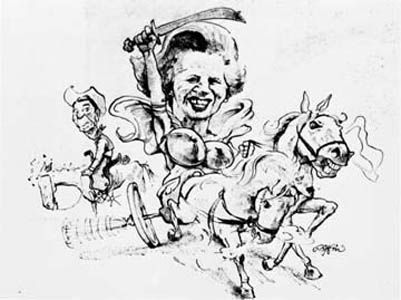
Cartoon of Mrs Thatcher in Boadicean breastplates and driving a chariot – Ronald Reagan, President of the United States, is seen, somewhat smaller, as a cowboy – following Mrs Thatcher’s appearance on American television after the conclusion of the Falklands War, in which she describec herself as having the ‘reputation of being the Iron Lady’. By Griffin, in the Daily Express, 24 June 1982.
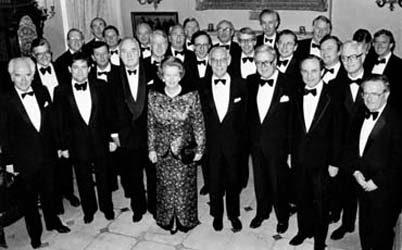
Mrs Thatcher at the dinner held on 26 January 1988 to celebrate her record as the longest-serving Prime Minister in twentieth-century Britain; she is surrounded by members of her Cabinet (her husband Denis Thatcher is on her left); it is noticeable that there are no female Cabinet ministers to distract attention from the central figure in her glittering brocade costume, among the attendant dinner-jacketed males.
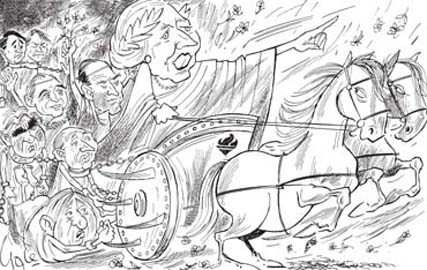
Cartoon (by Gale) of Mrs Thatcher as Boadicea which appeared in the Daily Telegraph on polling day, II June 1987; leading Labour, Liberal and Social Democrat male politicians are seen in chains trailing behind her scythe-wheeled chariot.