
2
Dico tibi verum, libertas optima rerum;
Nunquam servili sub nexu vivito, fili.
My son, I tell thee soothfastlie,
No gift is like to libertie;
Then never live in slaverie.
LATIN PRECEPT OF WALLACE’S UNCLE, THE PRIEST OF DUNIPACE.
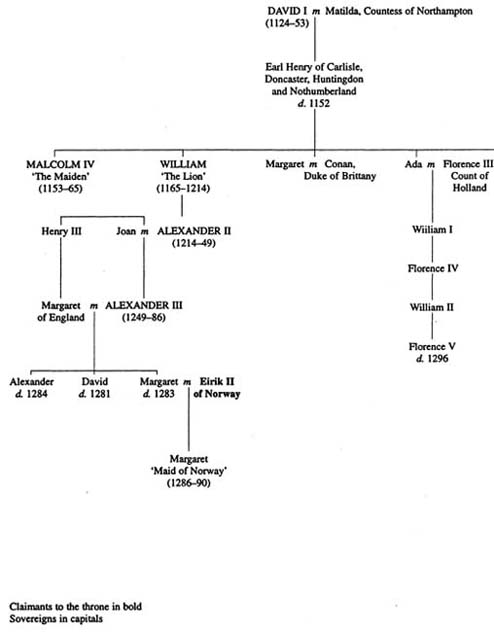
SCOTLAND’S problem, following the death of the Maid of Norway, was not the lack of an heir to the throne, but too many heirs. In all, thirteen candidates came forward, most of them basing their claims on descent, legitimately or illegitimately, from the Scottish royal house. Eirik II claimed the Scottish throne in right of his late wife and daughter. Had his wife lived after Alexander III he would have had a strong claim de jure uxoris, but her untimely decease made his candidature frivolous. John of Badenoch, the Black Comyn, advanced a claim based on descent from Donald Ban, younger brother of Malcolm Canmore. Despite his tenuous link with the royal family, the Black Comyn could back up his claim with the fact that he was one of the most powerful men in the land, a Guardian of Scotland and closely connected to the earls of Buchan and Mar. Seven of the claimants were descended from royal bastards, one the illegitimate offspring of Alexander II, five from the prolific William the Lion and one from Henry of Scotland, son of David I. As illegitimacy was regarded, even then, as a strong bar to inheritance, none of these claims could be seriously entertained. In view of the extremely tenuous nature of some of the claims it is a wonder that Edward I did not put himself forward as a candidate. After all he, too, was a direct descendant of Malcolm Canmore, whose daughter Matilda or Maud had married Henry I and become the mother of the English royal family.
It was singularly unfortunate that the descendants of Malcolm Canmore were not very fecund on the right side of the blanket. Malcolm IV died without issue, his brother Alexander II was succeeded by his only son Alexander III, whose sole surviving heir was the sickly infant Margaret. As a result of her death the direct line died out and it became necessary to go back to a common ancestor and ascertain who, among his descendants, had the strongest claim to the throne. David I, son of Malcolm Canmore, was that common ancestor.
Of the five legitimate descendants of David I, one did not bother to enter a claim. John II, Duke of Brittany, was a great-great-grandson of Margaret, younger sister of David, Earl of Huntingdon, by her marriage to Conan of Brittany. At best it would have been a weak claim, but in an age when the laws of primogeniture were by no means clearly defined, it was a claim worth making. Incidentally, John’s son Arthur II subsequently married Joleta of Dreux, the young widow of Alexander III.
Prince Henry, Earl of Carlisle, the only son and heir of King David I (1124–53), predeceased his father, dying in 1152. In turn, the Scottish throne passed to Henry’s sons, Malcolm IV (1153–65) and William the Lion (1165–1214). Their sister Ada married Florence III, Count of Holland. Ada’s great-great-grandson, Florence V, was one of the four legitimate claimants.
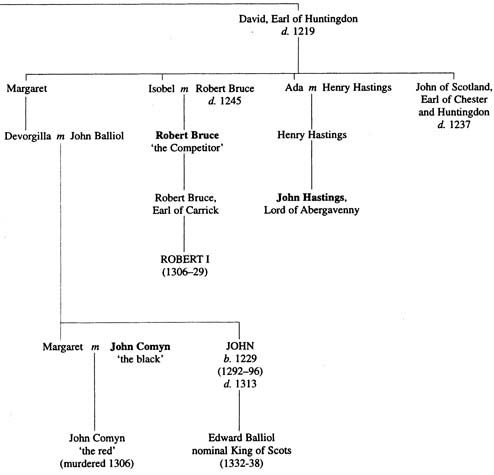
The other three were the descendants of David, Earl of Huntingdon (younger brother of Malcolm IV and William the Lion), who had died in 1219. Earl David had one son, known as John of Scotland or the Earl of Chester and Huntingdon, who had died without issue in 1237, and three daughters. These ladies married the scions of noble houses in Scotland and England and from them were descended the three other major claimants to the throne. John Balliol was the grandson of the eldest daughter Margaret, Robert Bruce of Annandale was the eldest son of the second daughter Isobel, and John Hastings, Lord of Abergavenny, was the grandson of the youngest daughter Ada. It should also be noted that Devorgilla, mother of John Balliol and founder of Balliol College, Oxford, was the youngest daughter of Margaret.
In addition, the eldest daughter of Margaret was Elena, whose own daughter Isabella had married Alexander Comyn, Earl of Buchan. He was the father (by a previous marriage) of John Comyn who claimed the throne. To complicate matters further, John Comyn had married Margaret Balliol, the daughter of Devorgilla and elder sister of John Balliol. Their son was John, commonly known as the Red Comyn, whom Robert Bruce, the future King of Scots, slew in Greyfriars Abbey, Dumfries, in 1306. Thus the Comyns were by turns allies and rivals of the Balliol faction.
For all practical purposes, however, the dispute resolved itself around Balliol and Bruce. By the law of primogeniture Balliol had the stronger claim, but the precedence of the grandson of an elder sister over the son of a younger sister was not clearly established. Whether Robert Bruce actually believed that he had the stronger claim is immaterial; he certainly acted as though this were the case, reinforced by the fact that he claimed to have actually been nominated as heir to Alexander II fifty years earlier when the succession, on a previous occasion, had not seemed secure. While the death of the Maid of Norway was still no more than a rumour, the Lord of Annandale and his henchmen assembled under arms and marched on Perth — a fact which Bishop Fraser was quick to point out to King Edward in his famous letter of 7 October.
Scotland in the winter of 1290 and the early months of 1291 was in danger of disintegrating into civil war. Again, the Bruces were at the bottom of the trouble. A large body of magnates rallied to their side. Towards the end of 1290 a document on behalf of the seven earls (only those of Fife and Mar were actually specified and the term ‘seven earls’ may have been intended to symbolise the leading magnates of Scotland as a whole), addressed a violent protest to the Guardians John Comyn and Bishop Fraser who had, by now, openly espoused the cause of John Balliol. ‘In the name of the seven earls and their adherents I seek urgently the help of the king of England.’ Precisely who ‘I’ was is not clear, for the document now preserved in the Public Records Office is only a copy, probably written by clerks employed by Edward I, from an original draft in which the name of the sender was denoted only by the Latin word talis (‘so and so’). But from the general tone and the overall purpose of the petition, it seems likely that Robert Bruce was the instigator. The actual letter to the Guardians has not survived.
The chief objection of the seven earls (probably Angus, Atholl, Buchan, Fife, Mar, Menteith and Strathearn) was that their ancient right of instituting the king had been swept aside by the Guardians, but this did not imply that they would refuse to recognise any decision taken by King Edward. At first glance it may seem strange that Robert Bruce should go so far as to seek Edward’s recognition of the traditional law of succession and the rights of the seven earls in this matter, but his background and training make this decision clearer.
Robert Bruce was the son of Robert de Brus and Isobel or Isabella, the second daughter of Earl David. The family appear to have lost their ancestral lands at Brix in Normandy but were extensive landowners in several English counties. A Bruce ancestor, while on a visit to the court of Alexander I, had secured the affections of the heiress to the lordship of Annandale, and by marriage brought this important Scottish barony into the family. Robert Bruce, son of Isobel and grandson of Earl David, was thus a degree nearer the common ancestor than Balliol. Besides being one of the great magnates of England and one of the principal vassals of Edward I, Robert Bruce the Competitor was an English lawyer, having been a puisne judge and Chief Justice of England in the reign of Henry III. The so-called petition of the seven earls, of course, dates from the autumn of 1290 when his position was much stronger than Balliol’s, and he was anxious merely to get Edward’s endorsement. Later, however, he was much less inclined to abide by Edward’s decision, when the case was going against him.
John Balliol, born in 1229, was the younger son of the Lady Devorgilla, sole heiress of Alan of Galloway, and John Balliol of Barnard Castle in County Durham. The family was Norman, of course, originating in Bailleul with extensive lands round Neville which it still possessed. Fortunately, John’s brothers died in their father’s lifetime and he gradually fell heir to vast estates in France and England (notably in Durham and Northumberland) as well as Galloway. Devorgilla’s death in January 1290 brought her son to prominence in Scottish affairs and his close kinship to the powerful Comyn family has already been mentioned. His position in County Durham gave him an entrée to the influential Antony Bek, while his wife Isabella was the daughter of John de Warenne, Earl of Surrey, and he was thus also connected, by marriage, to the rapidly rising house of Percy, the greatest landowners in Northumberland. Balliol was now in his early sixties but still had fine, sensitive features and deep-set eyes, and was not without considerable intelligence. History has dealt rather unkindly with him, attributing to him a certain fecklessness and lack of character; but even a much stronger personality than he might have fared no better in the tricky political situation of the 1290s. He was probably much shrewder than people ever gave him credit for. He was also noted for his exquisite manners, but courtesy and chivalry were qualities which counted for little against such a ruthless character as King Edward.
At this point Edward’s wife, Eleanor of Castile, died and any action he proposed taking was delayed by the period of mourning. In retrospect it can be seen that Edward was primarily concerned about maintaining law and order in Scotland rather than backing a claimant who would be pliant to his will, but fundamentally he was anxious to use the country’s leaderless condition to advance his own position as feudal overlord of the northern kingdom. It has to be conceded that Balliol was legally the right choice for the throne, and in this aspect Edward acted as impartially as any arbitrator should; but in every other sense Edward acted unfairly and high-handedly. While the merits of the various claimants were being considered at a measured legal pace (a process which stretched over eighteen months), Edward used the interregnum to strengthen his own position.
It was only now that the true character of the man revealed itself. This high and mighty prince, the greatest of the Plantagenets, was descended from the Angevins who had a long reputation for evil-doing, pagan practices and witchcraft. They were said to have originated with a Breton bandit named Tortulf the Forester whose descendant, Fulk the Red, had attached himself to the dukes of France and received the county of Anjou as a reward. The name Plantagenet came from the spray of yellow broom (Planta genista) worn on the helmet of Geoffrey the Handsome, Count of Anjou, whose son became Henry II of England. Henry’s sons, Richard the Lionheart and John, inherited the saturnine qualities of their Angevin forebears, both being noted for mercurial behaviour, violent tempers and a propensity to great cruelty. Edward inherited the drooping eyelid of his father, Henry III, and not a little of the brutality of his grandfather, but he was also of above average intelligence, articulate and possessed of a very sharp mind. Posterity in general remembers him for his legal reforms and the institution of Parliament, but he often twisted the law to suit his own ends and he was flawed by a malice and vindictiveness which made him a dangerous enemy. In hindsight, it seems that Eleanor of Castile exerted a moderating influence on her husband; but her death from fever on 25 November 1290 liberated him from any scruples he may previously have held. In fact, Edward had a long track-record of covert tyranny, although he did not always get away with his arbitrary and bullying tactics. In 1283, for example, he misappropriated the money collected for a new crusade but backed down when threatened with excommunication; eleven years later he resorted to the same tactics to extort over £80,000 from the hard-pressed clergy and on this occasion his effrontery paid off handsomely.
Edward apparently responded to Bishop Fraser’s naïve letter and magnanimously agreed to give his advice to the Scots regarding the succession. At the same time, however, he informed his privy council that ‘He had it in his mind to bring under his dominion the King and realm of Scotland, in the same manner that he had subdued the Kingdom of Wales.’1 His innate genius, rapaciousness and insatiable greed were greatly helped by the fact that Scotland not only lacked a strong monarch of its own, but was singularly lacking in any disinterested national leader. On the contrary, the blindness of almost all the Scottish nobles to any interests but their own, the resulting division, distrust and lack of moral principle among the magnates of the kingdom, and the absence of any military experience after eight decades of Anglo-Scottish peace, all conspired to make Edward’s task much easier.
Edward showed his hand on 16 April 1291 when he issued a summons to the barons of the northern counties of England, among whom were John Balliol, Robert Bruce, John Comyn and William de Ros, four at least of the expected claimants to the Scottish throne, to meet him at Norham-on-Tweed on 3 June. The choice of venue is significant for it was not only a convenient border crossing point but happened to have, close by, the formidable fortress of Antony Bek, Bishop of Durham. Even to this day, the ruins that tower above the wooded rising ground on the south bank of the Tweed, seven miles west of Berwick, are a spectacular reminder of Norman castle-construction at its grandest. Certainly in 1291 its massive walls and menacing fortifications must have impressed the Scottish emissaries with awe.
At the same time a mandate was issued to the sheriffs of York, Northumberland, Lancaster, Westmorland and Cumberland to assemble the feudal array of these counties at the same rendezvous. It appears that Edward had also, in some shape or other, invited certain of the nobility and clergy of Scotland to a meeting to be held at the same place on an earlier day. No document of this nature has survived but the terms of the invitation, its aims, and the parties to whom it was addressed may be inferred from what took place. Certainly there are still extant letters of safe conduct dated 4 May 1291 at Norham-on-Tweed, giving an assurance to the Guardians and other leading Scots that if they came to negotiate with Edward he would not put them at a disadvantage by virtue of their crossing the Tweed to the English side. When they did come to Norham, however, Edward promptly demanded that they acknowledge his suzerainty.
It has been postulated2 that, had Edward possessed tact, moderation and a sense of justice, he would have achieved his aims in the end. He might gradually have tamed Scotland into a vassal kingdom without resorting to any actual exercise of force. He possessed immense diplomatic skills, in addition to his native cunning, and had he behaved in a reasonable manner it is quite probable that Scotland would have been peacefully absorbed within a matter of years. After all, the Scottish nobility were also, for the most part, holders of estates in England and their allegiance to Edward was a foregone conclusion. The common people might be a different matter, but through the feudal framework they owed unquestioning allegiance to their lords and masters, and could therefore be counted upon to fall into line. No doubt this reasoning governed Edward’s subsequent behaviour; but it is singularly unfortunate that he should have treated Scotland with arrogance and high-handed disdain, and thus utterly misjudged the temper and character of the Scots.
While he was showing his hand to his privy council, Edward was also pursuing an apparently legal course of action. During the winter of 1290–91 he invited all the abbeys and monasteries of the kingdom to search through their chronicles for any entries dealing with Anglo-Scottish relations. Much of this material was pure myth concerning the origins of the Scots and the English. There was, for example, the tale of Dioclesian, King of Syria, who had thirty-three daughters by Queen Labana. These daughters killed all their husbands on the night of their mass marriage and for this dastardly deed the ladies were cast adrift in a rudderless vessel which bore them eventually to a distant island called Albion. Here the princesses mated with demons, the resulting offspring being a race of giants. Brutus, great-grandson of Aeneas of Troy, banished the giants, renamed the island Britain and left it in equal portions to his three sons, Locrinus, Albanectus and Cambrus from whom descended the people of England, Scotland and Wales respectively. Humber, King of Hungary, invaded Albyn and slew Albanectus, but was pursued and killed by Locrinus to whom Albyn (Scotland) reverted. From this incident derived the feudal superiority of the kings of England over the kingdom of Scotland. This ludicrous legend ignored the invasion and occupation of the island by Romans, Anglo-Saxons and Danes before the coming of the Conqueror; but, incredible as it seems, the greater part of this preposterous story was adopted and put forward in the claim of King Edward to be Lord Paramount of Scotland and was later solemnly set forth in the justification of his conduct addressed to Pope John XXII.
Armed with the results of these findings, Edward summoned an assembly of Scottish nobles and clergy who dutifully came on 10 May to Norham, in the ominous shadow of Bishop Bek’s castle. If they were not overawed by the military might of the Prince-Bishop of Durham, the Scots must certainly have been overwhelmed by the spectacle of the puissant Edward, King of England, Lord of Ireland and Duke of Aquitaine, his mighty prelates and barons with their respective retinues, including several of the men who were claiming the Scottish throne for themselves. Ranked among the assessors and officials was a remarkable personage, in the shape of a notary public of the Holy Roman Empire no less, one Johannes Erturi de Cadamo, whose duty it was to record the proceedings, with all that formality and precision for which the Normans had become distinguished, showing how thoroughly Edward had prepared for what was to come.
Either within the castle, or after adjourning to a nearby church, in the presence of this great assembly of Scots and English, Edward the great impresario unfolded his plans. According to the chronicler Walter of Hemingburgh, a statement was drawn up by the Dominican provincial, William de Hotham, one of Edward’s most trusted servants, and this was read to the Scots by Roger Brabazon, one of the King’s justiciars. This asserted that, from the earliest times, the King of England had always held the overlordship of Scotland. Edward used this claim for the moment to justify his self-appointed position as adjudicator in the Great Cause, but inferred that, henceforward, he would have to be regarded as Lord Paramount of Scotland.
The Scottish magnates (or at least those of them who were not party to the scheme for their own ends) were alarmed, dismayed and confused by this turn of events. They protested their ignorance of any such claim to superiority and urged that, while the throne was vacant, the matter should not have been raised. Edward exploded at this unexpected show of resistance and cried out, ‘By Holy Edward, whose crown I wear, I will vindicate my just rights, or perish in the attempt!’ Hemingburgh adds that ‘to make this speech good, the King had issued writs for the assembling of his army, so that, in case of the demand being resisted, he might conquer all resistance even to the death’.
Almost immediately Edward regretted his outburst and he quickly resumed the mask of the impartial lawyer. The Scots begged for time to consider the matter, so he graciously granted them twenty-four hours for consultation and deliberation. This was too obviously a mockery, so he relented and gave them nine days, later extended to three weeks, to bring forward whatever they could by way of a rebuttal. While the Scots were dithering, however, Edward took the precaution of summoning the feudal array, a large army which was within a day’s march of the Tweed when the King again met the Scottish delegation on 2 June, this time at Holly-well-haugh (now Upsettlington) on the Scottish side of the Tweed opposite Norham.
No fewer than eight of the claimants (Robert Bruce, Florence of Holland, Sir John Hastings, Patrick or Cospatric Dunbar, the Earl of March, William de Ros, William de Vesci, Robert de Pinkeny and Nicholas de Soulis) took part in the inaugural meeting and all of them readily acknowledged Edward as their Lord Superior. The following day John Balliol took the same oath, and by proxy John Comyn of Badenoch also gave his assent. On subsequent days the three other claimants put in an appearance and took Edward’s oath: Patrick Galythly, Roger de Mandeville and last, but not least, Eirik II of Norway. With the exception of the Earl of March, Galythly and King Eirik, all of the competitors were Norman or of Norman descent, and generally in possession of great estates in England. In fairness to the contenders, to have refused to take the prescribed oath would most certainly have resulted in the forfeiture of these estates. No fewer than nine meetings took place between Edward and the Scottish delegation between 2 and 11 June. Some were held on the village green at Upsettlington, others were held in Norham church and two were convened in the King’s apartments in the Bishop’s castle.
Edward himself seems to have taken no direct part in the proceedings. Instead, the Chancellor of England called on the magnates, prelates and community of the realm of Scotland to produce their answers to the claim of supremacy, and any evidence to prove the negative to Edward’s claim. The prelates and nobles made no answer and it was assumed that the representatives of the common people likewise remained silent; but a copy of the roll was discovered in the nineteenth century which showed a brief passage, suppressed in the generally accepted version, to the effect that the community had made an answer, but that this was declared by Edward himself to contain nihil efficax (nothing effectual). As the Scots, to Edward’s way of thinking, had produced nothing to the contrary, the King was now resolved, as Lord Paramount, to determine the question of the Scottish succession. Thereafter the competitors were asked whether they acknowledged Edward as Lord Paramount and were willing to ask and receive judgment from him accordingly. Bruce was the first to give his eager assent, closely followed by Balliol and Comyn and all the others. Ever the cautious lawyer, Edward had the details committed to writing and each claimant duly appended his seal to the document, copies of which were immediately sent to the various religious houses for preservation and publication.
Events now moved rapidly. On 11 June 1291 Edward ordered that every Scottish castle be surrendered to him. This was stated to be merely a temporary measure which would be revoked two months after the succession had been decided. As a further precaution Edward insisted that all Scottish officials be replaced by Englishmen. There was some measure of justification in this apparently high-handed action because Scotland was now teetering on the brink of all-out war between the Bruce and Balliol factions. As it happens, the majority of the candidates, including both Balliol and Bruce, issued statements acknowledging Edward’s superiority and agreeing to submit to his arbitration. Furthermore, they acquiesced in Edward’s demand that English forces take over the castles and other strongpoints in Scotland, even though none of the claimants had any power or authority to make such a concession. Interestingly, Edward also promised that in future, on the death of a Scottish king, he would demand nothing but homage and the rights incidental to it.
This important admission was probably wrung from Edward by the efforts of Bishop Wishart who, all along, strenuously resisted Edward’s claim and reiterated the words spoken by Alexander III in 1278 when he stoutly refused to do homage for his kingdom, maintaining that he owed homage only unto God for it. On 14 June, the day after the negotiations ended, Wishart and Bishop Crambeth of Dunkeld made independent copies of Edward’s concession and appended a document stating that the claimants’ recognition of Edward’s superiority had been made with the consent of the Guardians and the responsible men of the realm, thus indemnifying the claimants in case they had acted beyond their powers.
On 11 June the Guardians formally resigned their authority and were immediately reappointed ‘by the most serene prince, the Lord Edward, by God’s grace illustrious king of England, superior lord of Scotland’. At the same time, a new Guardian was appointed to secure Edward’s interests, an English baron named Brian Fitz-Alan of Bedale.
Two days later, on the green of Upsettlington, the Guardians and leading nobility of Scotland gathered to swear fealty to Edward as superior and direct lord of the kingdom of Scotland. Sir Alexander Balliol, a kinsman of the claimant, was appointed Chamberlain of Scotland and numerous documents are preserved recording payments to this high official whom Edward himself described as ‘Our chosen and faithful’. Among the magnates present on that momentous occasion were Robert Bruce of Annandale and his son Robert Bruce, Earl of Carrick. Seven other earls of Scotland did homage that day and in the ensuing six weeks barons, knights, freemen and religious leaders personally swore fealty to Edward, who set the seal on his success by making a grand ceremonial progress through the kingdom. Finally, to save everyone else the trouble of doing homage in person, Ayr, Dumfries, Inverness and Perth were designated as centres for those who had not already done so. The deadline for taking the oath was 27 July — comparatively short notice — and very severe penalties were to be imposed on those who refused or neglected to comply.
Responsibility for administering the oath at the first-named centre was Sir Ranald Craufurd in his capacity as sheriff; but conspicuous by its absence from the list of those complying with the order was Sir Malcolm Wallace of Ellerslie. When retribution was about to descend on his head (Ayr and Irvine being now garrisoned by English troops), Sir Malcolm and his eldest son fled north to the wild fastness of the Lennox. Sir Ranald took his daughter and her younger sons under his care for a time, before sending them to Kilspindie in the Carse of Gowrie where they were housed and looked after by another relative, possibly an uncle of Lady Wallace on her father’s side, whom Blind Harry describes as ‘an aged man’. This gentleman was the priest of the district and it was he who sent young William, now in his seventeenth or eighteenth year, to the church school in nearby Dundee.
This was in the nature of a seminary for young men intent on entering the priesthood. It was here that Wallace met John Blair who soon afterwards became a Benedictine monk. Subsequently he left his monastery to attend his friend as chaplain and comrade in arms. Later on he would conduct diplomatic negotiations with Rome and the Hanse towns and, in retirement at Dunfermline Abbey, would eventually write the Latin biography of Wallace that served as the basis for Harry’s epic poem. At this college William also met Duncan of Lorn and Sir Neil Campbell of Lochawe, youths who were to take part in his early exploits. It seems clear that William, as a younger son, was destined for a clerical career, following a tradition of both the Wallace and Craufurd families. The question has sometimes been asked why such a young giant, skilled in arms, should have settled on the priesthood, especially at a time when his father and elder brother were on the run and had sore need of his prowess. The answer is fairly obvious: the Church offered advancement to able young men and such a course would have seemed prudent in these unsettled times. Besides, the young student was living at Kilspindie and thus able to keep an eye on his mother and younger brother John. Oddly enough, Dundee was one of the few places at this time where there was the slightest opposition to the English takeover.
Although the submission of the Scots was far short of what Edward desired, it could not be said that they made much show of resisting his demands. The only sign of resistance was made by the Earl of Angus, Gilbert de Umfraville (an Englishman no less!), who refused to surrender the castles of Forfar and Dundee on the grounds that he had been appointed their custodian by the community of the realm of Scotland. This was merely a token show of resistance and the Guardians were not slow in finding a facesaving solution to this minor impasse.
Edward established a court of 104 auditors to decide who should have the crown, and the preliminary hearing was fixed for 3 August at Berwick. It has been suggested that Edward the lawyer took as his precedent the judicium centumvirile, the court of 105 which settled questions of property in the time of the Roman republic. The court was composed of twenty-four auditors seconded from Edward’s council, and forty auditors each nominated by Balliol and Bruce. Thus the claim of the other candidates was summarily dismissed and the court concentrated from the outset on the merits of the pleas put forward by the two principal protagonists. On 3 August, however, all the competitors appeared at Berwick before Edward and the assembled auditors, formally to enter their petitions. These documents were sewn up in a sack secured with the seals of the earls of Buchan and Mar and the bishops of Glasgow and St Andrews, and the sack was then deposited in Berwick Castle. That done, Edward, who had pressing business elsewhere, adjourned the court until 2 June of the following year.
The court reassembled on 2 June 1292 but was then adjourned once more until 14 October in order to allow the eighty Bruce and Balliol auditors time to consider their replies to the question by what laws and customs the right of succession should be determined. The actual hearings lasted from 14 October till 17 November, when Edward gave judgment in favour of John Balliol. The eighty Scottish assessors were unable to agree about Scottish law and could not decide whether the rules of succession (which Edward had laid down for England in 1290) could or should apply to Scotland. In the end they referred the matter back to Edward’s council which decided, at the beginning of November, that primogeniture rather than nearness of issue should be the criterion, and answered in favour of Balliol. The Scottish auditors were then asked to consider their verdict in the light of this decision and they, in turn, voted in favour of Balliol. Significantly, Bishop Wishart, James the Steward and a few others declared that although they had originally favoured Bruce they had now been converted to Balliol by these legal arguments. On 6 November Edward gave judgment in favour of Balliol against Bruce and then turned to consider the claims of the other contestants against Balliol.
Having lost his claim to the throne of Scotland and believing that a third of a loaf is better than none at all, Bruce now lent his support to the claim of John Hastings of Abergavenny. Hastings argued that Scotland was not really a kingdom at all, that its kings were never crowned or anointed, and that it was no more than a big barony held of the king of England. As such it was partible between the descendants of Earl David’s three daughters — just as his earldoms of Chester and Northampton had been divided among Bruce and the fathers of Balliol and Hastings in 1237, following the death of John of Scotland. Edward held, however, that Scotland was an impartible kingdom, and dismissed the claim of Hastings.
On 17 November, within the great hail of the castle at Berwick-on-Tweed, Roger Brabazon delivered the judgment in Edward’s name. By that time eight of the competitors had withdrawn, while two others, Comyn and Mandeville, failed to appear. Judgment was pronounced unequivocally in these terms:
As it is admitted that the kingdom of Scotland is indivisible, and, as the king of England must judge of the rights of his subjects according to the laws and usages of the kingdoms over which he reigns; and as, by the laws and usages of England and Scotland in the succession to indivisible heritage, the more remote in degree of the first line of descent is preferable to the nearer in degree of the second line; therefore it is decreed that John Balliol shall have seisin of the kingdom of Scotland.3
Thus, by means of a great lawsuit, the Scottish crown and the fate of the Scottish nation were disposed. Two days later the constables of the twenty-three leading castles of the kingdom were ordered to surrender their charges to Balliol. The great seal of the Guardians was formally broken into four pieces and carefully stored away in the English Treasury at Westminster ‘lest, if the seal remained intact, doubts should arise about the authenticity of documents, and as a sign of the king of England’s full sovereign lordship in the Scottish realm’. On 20 November Balliol swore fealty to Edward at Norham, for the realm of Scotland held of him as superior lord. Ten days later, on St Andrew’s Day, John Balliol was installed on the stone of Scone by John de St John, deputising for the infant Earl of Fife. At Newcastle on 26 December 1292, John Balliol did homage to his liege lord.
By the time Balliol ascended his throne, Scotland was effectively under English occupation. The surrender of the leading castles to King John must have been nominal rather than real, for their Anglo-Norman constables and custodians, together with their garrisons, remained in place. The nobility of Scotland might be quiescent and compliant with the new order; but the common people, coming in daily contact with the occupation soldiery, were another matter altogether. A fierce, proud people, angered at the manner in which their country was being treated as a chattel, and disgusted at the pusillanimity of their feudal superiors, could not let such an insult lie. Even before the Great Cause was settled there had been sporadic outbreaks in various parts of the country, beginning as brawls and riots between the overbearing soldiery and the irritated native populace and gradually escalating into ambushes and reprisals.
One such skirmish took place in 1291 on the flanks of Loudoun Hill at the head of the Irvine Valley. Blind Harry’s account of this incident is confused, doubtless the oral transmission having become garbled in the course of several generations. He states that Sir Malcolm Wallace Senior was slain in this encounter by an English knight called Fenwick; but he goes on to say that his son, Sir Malcolm Junior, also perished in the mêlée. In a passage where he mentions that Lady Wallace’s father was dead and her husband slain in battle, he continues:
Her eldest son, who was large in stature, and whose name, in truth, was Sir Malcolm Wallace, had his hough sinews cut in that press; on his knees he then fought and slew many of the English, until being attacked by numbers on both sides, he was borne down by their spears; so died that good and renowned Knight.4
As Sir Malcolm Wallace Junior was still alive in 1299,5 the story of the death of the hamstrung warrior must relate to his father. In any event it was a matter which left William with a smouldering resentment of the English, which gradually developed into an implacable hatred.
There has been some controversy over the date at which Wallace emerged as a guerrilla leader, one school of thought maintaining that his first acts of rebellion did not take place until 1296, after the fall of King John. This is supported by the theory that William was not born until 1278, but in view of the fact that he was commander of the Scottish army only months later, this theory is untenable. It seems obvious that such a skilled general must have served a long and hard apprenticeship in guerrilla warfare, and this is amply supported by the exploits narrated by Blind Harry, which some historians choose to ignore. Harry, to be sure, was often vague or confusing regarding chronology, but a careful study of his text helps to put the sequence of events in the proper context.
Thus, the period when the young Wallace first took up arms against the hated oppressors was unequivocably described. It was the time when ‘they had haile the Strengths of Scotland; what they would do durst few against them stand’.6 This was the term specifically used to describe the castles and strongholds surrendered to Edward while the claims to the throne were being adjudicated. This puts William’s first acts of defiance fairly and squarely in the year 1291, probably soon after his father was killed at Loudoun Hill. Later on, Harry states that Wallace’s campaigns against the English lasted ‘six yeris and monthis sevyn’,7 which, dating back from the Battle of Falkirk, puts the first incident late in 1291.
The chronicler John of Fordun, who died in 1384 and was certainly living within a few years of Wallace’s death, probably conversed with those who had known him well, and therefore his physical description of the hero, quoted in the previous chapter, may be taken as reasonably accurate. Lord Hailes, who was not disposed to credulity or romance, conceded that:
This singular person had every popular excellence; strength of body; keen courage; a spirit active and ambitious. By his affability he conciliated the affections of his followers; by the force of native eloquence he moulded their passions to his will; by calm, intrepid, and persevering wisdom, he generally maintained authority over the rude and undisciplined multitudes who crowded to his standard.8
Blind Harry represented William, with dramatic truth at least, as brooding painfully over the death of his father, and as being stirred to uncontrollable resentment at the treatment of the Scots within his personal observation. The destruction of his family, the exile of his mother and the oppression of his countrymen had already nerved his heart and hand to take action. The moment when he would strike the first blow in retaliation for his family’s sufferings was not far off.
The castle of Dundee had been handed over to the English baron, Brian Fitz-Alan of Bedale, along with other strongholds in Angus and Fife. Fitz-Alan, by now a Guardian of the realm and also one of the three Justices of Scotland, placed the castle in the hands of a constable named Selby, ‘a fierce man of war who had done much injury to the Scots, a man despiteful and outrageous in his dealings’. He had a son about twenty years of age who, with three or four companions, used to go into the town every day: ‘a proud, overbearing young rascal, wanton in mischief’. One day in December 1291 young Selby caught sight of William Wallace, brightly clad in green and towering head and shoulders over the others in the street. Selby accosted him saying, ‘Thou Scot, abide; what devil clothed thee in so gay a garment? An Irish mantle were the right apparel for thy kind; a Scottish knife under thy belt to carry; rough shoes upon thy boorish feet.’ So saying, he demanded the handsome dirk at William’s belt. Wallace’s response was swift and dramatic; grabbing the Englishman by the collar, he drew his blade and thrust it through his assailant’s heart.
Selby’s comrades pressed on William, but they were jostled by a crowd of onlookers and unable to draw their swords before Wallace killed or wounded some of them with his dirk. He then turned and fled to the town house of his uncle. At the close-mouth he ran into his uncle’s housekeeper and swiftly told her what had happened. Promptly she bundled him inside, gave him a russet gown of her own to cover him up, placed a wimple and mutch on his head, and set the beardless boy to work with a distaff and spindle. Moments later a party of English soldiers came down the street, searching all the houses for the assassin. Wallace crouched in the corner spinning for dear life, but the ruse worked and the soldiers went off again, threatening to raze the town to the ground and burn the Scots in their dwellings unless they surrendered the killer. The housekeeper coolly concealed Wallace until nightfall, when he made his escape back to Kilspindie through the back courts and alleys and evading the English patrols.
By the time William returned to Kilspindie Lady Wallace was beside herself with despair, news of the incident having spread like wildfire. Shortly afterwards the governor of Dundee issued a proclamation summoning all Scots resident in Dundee and the surrounding district to appear at a court of enquiry. William decided that the time had come to leave the area. Disguised as a pilgrim but carrying a short sword under his gown, he and his mother left Kilspindie and set out for Dunipace. Whenever they were stopped and questioned by patrols they said they were on their way to worship at the shrine of St Margaret at Dunfermline. This pious reference to the English-born saint, who had begun the anglicisation of Scotland, obviously went down well with the troops checking passers-by. The pilgrims took the ferry across the Tay to Lindores and trudged through the Ochil Hills to Dunfermline where they lodged for the night. The following day they fell in with some English pilgrims, including the wife of the Constable of Linlithgow who took a shine to the well set-up young pilgrim. Attaching themselves to this lady’s retinue, the Wallaces passed safely over the Forth, but declined an invitation to stay at Linlithgow, and went on to Dunipace.
This part of Stirlingshire was comparatively peaceful and William’s uncle suggested that the fugitives would be quite safe there; but William insisted on pressing on, determined to return to Ayrshire and avenge the death of his father. Shortly afterwards mother and son returned to Ellerslie. Sir Ranald rode out from Ayr and brought them the bad news that William had been outlawed for the murder of young Selby. Sir Ranald’s position as sheriff was in danger of being compromised; he hinted that while he could protect his sister, there was nothing he could do for her wayward son. He suggested that William remove himself from Ellerslie, where the English would sooner or later seek him out, and go to Riccarton to live with his uncle, Sir Richard Wallace. William went to Riccarton in February 1292 and stayed there until April. Harry states that Sir Richard had been blinded, disabled and enfeebled through loss of blood in some skirmish with the English, but gave the boy a good home.
On the twenty-third of that month, ironically the feast-day of St George, the patron saint of England, William went fishing at the Irvine Water nearby. On this occasion he was accompanied by a servant lad who carried his net and rod, but for once William had gone out unarmed — a mistake he never made again. Late in the afternoon, when William had caught several trout, the Lord Percy, then Captain of Ayr, rode past with a party of men. In this regard Blind Harry was surely mistaken, for Henry de Percy’s appointment as Warden of Ayrshire and Galloway came some years later. Interestingly Percy, born about 1272–74, was of an age with both Wallace and Robert Bruce, the future King of Scots. The scion of a Norman-French family with extensive estates in Louvain, he was one of the able young men whom King Edward promoted to high office, over the heads of older men. It is unlikely, however, that Percy was in Scotland in 1292, and certainly not in the exalted position Harry claims. But the salient points regarding Wallace’s encounter with troops of the Ayr garrison need not be disputed.
Later in the day, so goes the story, five of these Englishmen detached themselves from the retinue and rode down to the riverbank where they demanded Wallace’s catch. William politely offered them half, but the leader of the group dismounted and seized the lot. When William remonstrated that the fish was intended for the supper of an elderly knight, the Englishman retorted that William had his permission to go on fishing. William answered civilly that the Englishman was in the wrong. The latter, now angered at being addressed so familiarly by an upstart Scot, drew his sword and lunged at him. William parried the blow with his fishing-pole and struck his adversary such a blow on the cheek that he was knocked off his feet, his sword sent flying. Deftly, Wallace picked up the sword and despatched the Englishman with a single blow to the neck. The other four soldiers had now dismounted and rushed to the aid of their fallen comrade. William’s blood was up; he hacked one to the collarbone, another he struck on the arm with such force that both hand and sword fell to the ground. While the remaining pair fled, Wallace coolly ran through the man he had just maimed.
According to Harry, the two who escaped eventually caught up with their lord’s party and urged him to return to avenge the deaths of their three comrades. When Percy was told that they had been felled by a single assailant he laughed loudly and implied that if they were killed by one man they were hardly worth avenging. Meanwhile, Wallace took the horses and gear of the slain, put away his rod and line for the day, and returned to his uncle’s house. Sir Richard was crazy with despair, but William said that he would not remain any longer. He and his young page mounted two of the English horses and rode off to the east where the vast forests could give them refuge.
Harry’s account was either derived from a local tradition, or in turn helped to perpetuate the story. Be that as it may, the legend of Wallace’s encounter at Irvine Water was preserved locally by an ancient hawthorn known as the Bickering Bush. Like Wallace’s oak in Renfrewshire, this venerable tree survived into the early years of the nineteenth century, but by 1822 it was in decay and was then cut down and broken into small pieces by souvenir-hunters. The name survived in a local pub until it was demolished in the 1980s.