
6
Omnes autem hanc legem sive pro lege concorditer approbantes ipsum in capitaneum elegerunt.
With everyone harmoniously approving this law, or substitute for law, they chose him as their captain.
SCOTICHRONICON, XI, CAP. 28.
STIRLING, at the very heart of the kingdom, was of immense strategic importance. The lofty crag which towered over the surrounding plain was capped by one of the most impregnable castles in the British Isles. Through this plain meandered the mighty River Forth, tidal as far inland as Stirling and rapidly widening below the town to form that Scots Sea which so effectively kept the wild Highlandmen from overrunning the Lowlands. Stirling was, in the Middle Ages and for many centuries thereafter, very much the gateway to the Highlands, and the key to that gateway was the narrow wooden bridge which spanned the swirling Forth a little above the town. This solitary bridge was vital in any confrontation between the Scots and the might of England. With the exception of the beleaguered fortress of Dundee, all of Scotland north of the Forth was in Scottish hands. The large army which Earl Warenne and Treasurer Cressingham now led through the centre of the country aimed at relieving Stirling Castle and seizing the bridge, whence they could pour into the Highlands and pacify the territory then controlled by Moray and Wallace.
Both sides, in effect, were gambling everything on a single throw of the dice, but the stakes were high. If the English succeeded, then Moray and Wallace would be forced back on the defensive, reduced to mere partisan leaders. If they succeeded, however, they would be in a very strong position not only to drive out the English but to take the power over Scotland into their own hands. Never before had the community of the realm of Scotland stood up to the might of an English army. At Dunbar and Irvine the Scottish levies had been commanded by their feudal superiors; in one they had been soundly defeated, in the other ignominiously forced to capitulate. It says much for the common people, the lesser gentry, the burgesses and the peasantry who rallied to the Wallace banner on this occasion, that they were prepared to risk everything now. It also speaks volumes for the leadership and courage of the two young generals, both hardly out of their teens, who took the field against one of the most seasoned warriors of the period and the most experienced army in all Europe.
The forces under the command of Warenne and Cressingham now amounted to about a thousand horse and fifty thousand infantry, drawn from all the counties of England north of the Trent but also including sizable contingents from Ireland and Wales. A second army of eight thousand foot and three hundred horse was heading north from Carlisle under Percy. This formidable force included veterans of wars in the Holy Land and France, of campaigns in Wales and previous conflicts in Scotland. It was well equipped and armed; more importantly, it was an army which had never known defeat and the rank and file had enormous confidence in the generalship of their leaders. On the other side, the Scots had shown poor field-craft at Dunbar and a general lack of discipline, while the disunity of their leaders, so evident at Irvine only two months previously, was common knowledge in the English ranks. Warenne would have known how few of the Scottish magnates were ranged against him. His intelligence sources would have kept him well informed of how pitifully few Scots noblemen were supporting the upstart brigand Wallace. Young Andrew de Moray, Sir John Graham, Sir John Ramsay and the like were of little or no account. The great nobles had been tamed: they were either serving with King Edward in Flanders, languishing in the Tower and other English prisons, or hamstrung by hostages and sureties for their good behaviour, ever fearful of losing their lands and property in England if they did not toe the line. Those at liberty to make up their own minds were extremely unlikely to give support to — far less serve under — a landless younger son who did not hold even the lowest rank of nobility.
What the Scottish army had, though, was an unquenchable spirit. Its ranks were motivated mainly by patriotism. They were men who had endured the insolence and arrogance, the high-handedness and brutality of English rule in one form or another for seven years, and now they had reached the point at which they were prepared to give their lives rather than endure English tyranny a day longer. This was a volunteer army, and what it lacked in experience it made up for in motivation. The English army, on the other hand, was essentially a feudal host, its ranks drawn largely from men who were pressed into service as part of their obligations to their feudal superiors. Many of the foot soldiers had been conscripted under the system whereby the yeomen and peasantry were liable for call-up through the levies on each county. The army also included a sizable contingent of Welsh archers whose skill with the longbow would, in a few decades, give England the advantage over the French at Crecy and Agincourt. But in 1297 the Welshmen had only recently come under English rule; many of them would have fought against Edward in the campaigns of the 1280s, and their loyalty was questionable at the best of times.
The medieval concept of warfare placed heavy reliance on two factors, mail-clad cavalry and the feudal chain of command through the great earls and barons, the knights and lesser gentry, the esquires, yeomen and men-at-arms. The Scots, lightly armed and poorly trained, were a new phenomenon, a force composed of common people fighting on their own account, for a purely national idea and object.
One can scarcely imagine a grander setting for a great national showdown. On the south side of the Forth stood the ancient burgh of Stirling, clustered about the majestic and lofty rock crowned by its castle. On the far side of the plain were the beautiful Ochil Hills, sweeping up from the east and then dipping away towards the north, leaving the great outcrop known as the Abbey Craig as an outpost. The height of the castle rock and the Abbey Craig was accentuated by the flatlands in between, virtually at sea level, through which lazily wound the river in enormous loops. From the castle esplanade, or from the top of the Wallace Monument, that magnificent Victorian folly erected on the summit of the Craig, the views in all directions are breathtaking, but between them the battlefield would have been spread out at the spectator’s feet.
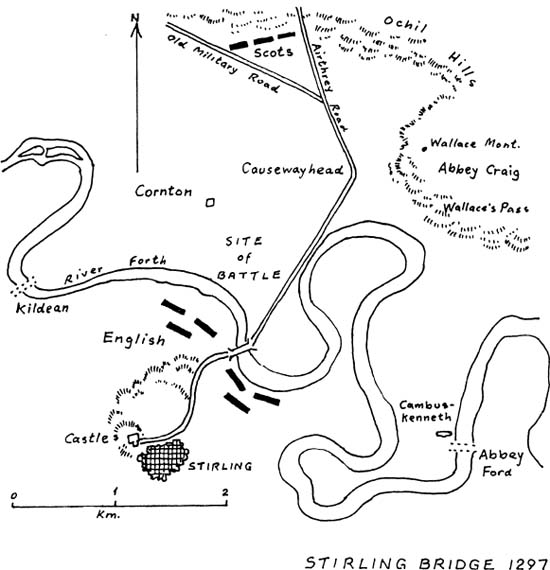
There has been perennial controversy regarding the precise location of the battle, for the wooden bridge which was the bone of contention has long since vanished without trace. One school of thought maintained that this bridge was at Kildean, much higher up the river than the existing bridges, but this does not accord with the description of the terrain given by the contemporary English chroniclers, who had no reason to lie about it. In more recent years the consensus of opinion is that the bridge spanned the river only a few yards upstream from the fifteenth-century stone bridge which still stands. At this point the Forth is about thirty metres wide. The current is relatively slow-moving, but the river is deep. There were only two fords, at widely separated points above and below the town and usable only at low tide, so that the narrow wooden bridge was effectively the only means of crossing the river. From the end of the bridge on the north side there was a paved causeway heading in a north-easterly direction terminating in the hamlet of Causewayhead (which exists to this day). The causeway lay across a broad haugh, a low-lying area of marsh, subject to inundation at high spring tides. If the bridge was so narrow that only two horsemen could ride abreast, the causeway was not much wider. Four horses at most could move side by side. To the left and right of the causeway the ground would have been much too soft and swampy for cavalry to operate.
In the approved medieval manner, the English commander gave the Scots the opportunity to surrender before the armies engaged in battle. This tactic had worked well enough at Irvine, when the Scottish magnates had caved in before Percy and Clifford without exchanging a single blow. On 10 September Warenne sent an envoy to the Scots, demanding their submission. This herald would later report back that the Scottish army was ‘on the other side of the hill, above the monastery of Cambuskenneth, with that robber William Wallace’.1 The writer of this manuscript also commented ominously that ‘there was not in the kingdom a spot where the English could have been so effectually shut up in the hands of the Scots, or a multitude in the power of a few’. Hemingburgh uses precisely the same language.2 Neither of these things could be said of the open ground at Kildean (where, in fact, lay the upper of the two fords). The hill above the monastery of Cambuskenneth was, indeed, the Abbey Craig which derived its name from that ecclesiastical establishment. Until the 1930s it was commonly supposed that the Scottish army was drawn up on the Craig itself (hence the location of the Monument erected in the nineteenth century) but James Fergusson then demonstrated cogently that this was impossible.3 The heavily wooded nature of the Craig today conceals the fact that its face is virtually sheer and there is no way that the Scots could have charged down it in battle order. Hemingburgh’s actual words are mox descenderunt de monte (‘presently they came down from the mountain’) which accords with the notion of a descent from ground considerably higher than the swampy haugh. This puts the Scottish army on the slopes and braes some way to the north of Causewayhead, and thus accords with the suggested location of the bridge. With consummate skill Wallace and Moray had drawn up their army on the lower flanks of the Ochils, north-west of the Abbey Craig, facing almost due south to the causeway and the river, above the modern suburb of Cornton.
Ironically, Hemingburgh prefaces his description of the battle with the statement that the Scots magnates had surrendered at Irvine because, though outnumbering the English in foot soldiers, they were woefully deficient in heavy cavalry. To Walter of Hemingburgh, what took place at Stirling was a contest of skill and strategy. At first it looked as if the events at Irvine might be repeated. Two or three days before the battle some of the Scottish magnates, including James the Steward and the Earl of Lennox, rode into the English camp and promised to parley with the Scots to prevent unnecessary bloodshed. They returned on 10 September, their mission unfulfilled, but as an act of good faith, they promised to contribute sixty men-at-arms to the English cause. That evening, however, there was a slight skirmish between the Lennox party and some English soldiers who had been out foraging. It may be that the earl was incensed at seeing the Englishmen laden down with their booty, for he himself mortally wounded one of the soldiers in the neck with a spear.
When this became known in our army, the men instantly ran to arms, and bringing the wounded, covered with blood, to the Earl Warren, demanded vengeance, at the same time calling out that faith was broken. To them the earl replied, ‘Have patience for this night, and if tomorrow their promise be not fulfilled, you shall take vengeance, the deeper on account of what has just happened.’
Taking a charitable view of the magnates’ action, it is probable that Lennox and the Steward were merely spying out the land for their compatriots and had no intention of taking part on the English side.
That evening Warenne gave orders that all should be prepared to cross the bridge early the following morning. At dawn, some five thousand foot soldiers, including the Welsh contingent, did cross the bridge but the earl, still recovering from his recent illness and obviously exhausted by his exertions, was fast asleep. This was a moment of indecision. In default of positive orders to advance the troops turned round and recrossed the bridge, an operation which must have done little to soothe the temper of the excitable Welshmen. When Warenne did get around to rising from his couch and donning his armour, he proceeded to hold a parade at which, in the custom of the period, the rank of knighthood was conferred on a number of youthful aspirants, many of whom would perish before the day was out.
During the accolade ceremony Lennox and the Steward reappeared, together with a handful of retainers well short of the squadron of cavalry that had been promised. The bland excuse proffered was that they had been unable to persuade the others to defect from the Scottish army. Even now, Earl Warenne dithered about attacking. From his vantage-point, gazing across the river to the foothills where the spears of the Scottish host glinted in the summer sunshine, it appeared that Wallace’s men were in an unassailable position, threatening the left flank of any force which crossed the river and advanced along the causeway. The lofty escarpment of the Ochils, rising steeply from the plain at sea level, must have seemed more formidable than it really was. An experienced warrior like the Earl of Surrey would have noted the swampy ground, unsuitable for armoured destriers, the distance to be covered, the fact that his army would be fighting uphill, and the fact that the Scots, with the hills at their back, had a ready means of melting away whereas the English force, once across that infernally narrow bridge, had no means of escape. If only he could entice the Scots down on to the plain to the north of the town where his cavalry could make mincemeat of them, just as they had done at Dunbar. But here the positions were reversed . . . Warenne’s unease as he appraised the situation is perfectly understandable.
But the English army was eager for battle; there would be muttering in the ranks and exasperated pleas from young bloods anxious to win their spurs; even the horses, sensing the tension in the air, would be restive. Still Warenne hesitated uneasily and, playing for time, he now despatched two Dominican friars across the bridge and up the causeway to offer the Scots terms for surrender. This parley was inconclusive, and the friars returned to Warenne with the news that Wallace appeared to have about 180 horsemen and a vast army of foot soldiers which they wildly estimated at forty thousand. Wallace’s answer to Warenne was unequivocal and uncompromising:
Tell your people that we have not come here to gain peace, but are prepared for battle, to avenge and deliver our country. Let them come up when they like, and they will find us ready to meet them even to their beards.4
Wallace’s defiant answer took the English commanders by surprise. Far from seeking a way out, as the Scottish magnates had done two months earlier, this upstart brigand was, in effect, inviting the English to attack him. This, and the obviously strong defensive position adopted by the Scots, unnerved the English and spread dissension among the general staff. Some hotheads urged an immediate attack to call the robber’s bluff, but saner counsels prevailed and, in time-honoured fashion, Warenne called a council of war to debate the issue. By now some part at least of Percy’s army had joined the main body, for one of the more conspicuous officers taking part in the deliberations was none other than Sir Richard Lundie who had changed sides at Irvine. This gives the lie to Blind Harry’s assertion, followed by some historians, that Lundie had fought alongside Wallace in his lightning northern campaign that summer. Sir Richard was a seasoned campaigner who also knew the terrain round Stirling intimately. With pardonable exaggeration Hailes says of him that he was ‘to all appearance, the only man of true judgment in the whole English army’. Sir Richard now addressed Warenne’s staff:
My lords, if we go on to the bridge we are dead men; for we cannot cross it except two by two, and the enemy are on our flank, and can come down on us as they will, all in one front. But there is a ford not far from here, where we can cross sixty at a time. Let me now therefore have five hundred knights and a small body of infantry, and we will get round the enemy on the rear and crush them; and meanwhile you, my lord Earl, and the others who are with you, will cross the bridge in perfect safety.5
This was sound advice but, incredibly, Lundie was overruled. Some field commanders probably did not repose too much trust in the turncoat knight anyway, mindful of the behaviour of Lennox and the Steward, but the general feeling was that it would be unwise to split the army. There were some who vociferously argued Lundie’s case, but the council degenerated into chaos at this point, everyone squabbling with his neighbour. At this juncture Cressingham spoke up. The Treasurer was totally lacking in charisma, and appears to have been despised and loathed by the English almost as much as he was hated by the Scots. Physically repulsive and grossly overweight, he had now exchanged his clerical vestments for armour and chain-mail. The sight of this pompous, fat clergyman accoutred for war was incongruous and was probably regarded with derision by the professional soldiers. Now he shouted down the babble and addressed Warenne. ‘There is no point in dragging out this business any longer, and wasting our King’s revenues for nothing. Let us advance and carry out our duty as we are bound to do.’
Warenne was annoyed by this interjection, and stung by the Treasurer’s reminder of the costs which had been incurred so far. At length, worn out by all the bickering and argument, the Earl of Surrey gave the command to cross the bridge. Just as Lundie had pointed out, this wooden structure was so narrow that no more than two horsemen could ride abreast, and even then only with the greatest care and difficulty which would have slowed up the proceedings even further. By now it must have been mid-morning at the very least, and the negotiation of the bridge took several hours. By eleven o’clock, therefore, only a part of the English army had crossed the river.
In the vanguard was Sir Marmaduke de Thweng, one of the few knights to distinguish himself on that historic day. Marmaduke, later first Baron Thweng (died 1322), was the son of Sir Marmaduke de Thweng of Kilton Castle in Cleveland and Lucy, sister of Peter Bruce. The Thwengs were thus vassals of the Earl of Carrick in his capacity as Lord of Cleveland, as well as closely related to him. Marmaduke’s elder brother Robert (dead by 1283) was, in fact, godson of Bruce the Competitor.6 Thweng rode ahead of the main body with a small band of knights to secure the northern end of the causeway and cover the English advance. Among the notable figures who did succeed in crossing the bridge were Cressingham himself, the standard-bearers carrying the banners of St George and the Earl of Surrey, Sir Robert de Somerville and his eldest son, and the Constable of Stirling Castle, Sir Richard de Waldegrave.
The heavily armoured knights and their great warhorses, the royal banners, the guidons, pennants and oriflammes of the leading knights and barons, all the pageantry and panoply of medieval warfare, must have made a stirring sight. The tension in the Scottish ranks less than half a mile away must have been fearful. It says a lot for the discipline which Wallace and Moray had instilled that the Scots held firm and resisted the urge to rush madly down the slope, as they had done at Dunbar, to engage the enemy. No doubt this tension mounted as more and more English troops slowly made their way across the bridge and fanned out on to the marshy haugh. It also says much for the nerve of the Scottish generals as, from the summit of the Abbey Craig, they observed the crawling files of the enemy far below and weighed up the chances of their spearmen and pitiful handful of cavalry. The main factor in Wallace’s favour was that he could choose exactly against what odds he would fight. It must have been a nerve-wracking business, trying to gauge the right moment. If he launched the counter-attack too soon, his troops would stand a better chance of defeating the smaller English force which had managed to cross the river, but this would leave the main army intact, to strike again and ravage the southern districts in revenge. If he waited until Surrey’s entire army had crossed, his lightly armed troops would be outnumbered and overwhelmed. According to Hemingburgh, the Scots waited until ‘as many of the enemy had come over as they believed they could overcome’, a point which seems to have been reached around eleven o’clock.
From his vantage-point Wallace gave the signal to attack by a single blast from a horn, it having been agreed previously that he, and only he, should blow a horn when the moment was right. The Scots had been waiting for the signal with great expectancy. As soon as the sound rang out and reverberated round the crags, the Scots, like some gigantic coiled spring, surged forward en masse, brandishing spears and swords and giving vent to blood-curdling yells as they charged. The spearmen on the right wing sped through Cornton Vale, hell-bent on securing the bridgehead. The speed and ferocity of this onslaught took the English by surprise and, indeed, it was apparently several minutes before the main party was even aware that it had taken place. The Scots hacked and stabbed their way to the bridge and neatly closed the trap. There was a stampede on the bridge itself, the closely packed troops unable to move forward and pressed hard by those coming behind. Many of them jumped or fell into the river and were drowned in the deep water, weighed down by their armour and equipment.
Meanwhile the main Scottish forces had descended the slopes, gathering momentum as they ran, spears levelled, straight into the English mass. The heavy cavalry, floundering in the marshy ground, proved ineffectual while the shock and impact of the Scottish charge sent the disorganised and unprepared English infantry reeling. Almost instantaneously came the realisation that the Scottish spearmen had seized the bridgehead, and this triggered off blind panic in the English ranks. By all accounts, the only man who kept his head on the English side was Thweng, whose squadron encountered the Scottish cavalry riding down the causeway. Thweng gave the command to charge and easily dispersed the more lightly armed Scots. His heavy cavalry would have given chase but Sir Marmaduke now quickly took in the general situation. To his dismay he noted that Edward’s and Surrey’s giant standards had disappeared in the confused mêlée half a mile to the south. More disturbing was the large mass of Scots now milling about the bridgehead and blocking retreat. One of Thweng’s knights suggested that, despite their heavy armour, they should try to swim across the river — one of its great penannular loops was only a few yards away and the water did not seem too deep; but Sir Marmaduke declared that he would not drown for any man, and called his knights to follow him closely, confident in his ability to clear a path through the Scots. Then, spurring his charger, he rode straight through the Scottish infantry, cutting a swathe with his great broad sword. His squire came close behind him, the body of Sir Marmaduke’s nephew (who had been mortally wounded) slung across his saddle, and, accompanied by a handful of other knights, they managed to reach the bridge and miraculously recrossed it.
About a hundred knights on horseback, some three hundred Welsh archers and almost the whole of the five thousand foot soldiers who had crossed the bridge perished that day. The Scots attacked in force from the north and drove the English into the loop of the river east of the causeway and the bridge. The bowmen had no room to manœuvre and were speedily cut down, leaving the foot soldiers at the mercy of the infinitely greater numbers of Scots. The carnage was well-nigh indescribable. With their fierce cry of ‘On them! On them! On them!’ the Scots pressed forward relentlessly until the last English soldier had been trampled into the mud or driven into the treacherous water. The slaughter was virtually total. No more than a handful of foot soldiers managed to divest themselves of their armour and swim the river to safety. Incredibly, one knight allegedly performed the impossible feat of crossing the river, horse, armour and all. Sir Marmaduke was the only notable figure to make his escape, and his gallantry was subsequently rewarded when he was appointed lieutenant to Sir William Fitz-Warine whom his kinsman Surrey installed as Constable of Stirling Castle in place of the unfortunate Waldegrave.
The Scottish losses were negligible except in one important respect: Sir Andrew de Moray received a severe wound from which he died several weeks later. The leading casualty on the English side was the Treasurer, who either toppled off his horse or was yanked off it, and was trampled to death under its hooves. The battle must have been lost by midday but the grim mopping-up operation would have gone on much longer, as the Scots took no prisoners as usual. All the while, Earl Warenne was a helpless observer of the massacre. His archers had been in the van and had been among the first to be cut down, otherwise he might have been able to direct deadly fire across the river. As it was, the force on the south bank could only look on aghast, as their comrades were butchered less than fifty metres away. As soon as Thweng and his knights had recrossed the river Warenne ordered that the bridge be cut down and set on fire to prevent the Scots crossing in hot pursuit. Some accounts state that it was the Scots who destroyed the bridge — indeed, Harry says that John the Wright, concealed under the bridge, on hearing the blast from Wallace’s horn, had pulled out the roller with such skill that the structure collapsed. But that would have been against the Scottish interest, and Hemingburgh is quite explicit on this point. Pausing only to tell the new Constable of Stirling Castle that he would return with a relieving force within ten weeks, Surrey gave orders for a speedy evacuation. Disregarding his age (he was sixty-six, which was old by the standards of the time and really too old for the commander of a great army) and his infirmities, Warenne mounted his horse and led his army southwards with due despatch, not pausing until he was safely on the far side of Berwick.
Where Sir Richard Lundie was during the battle is unclear, but he was presumably with the main force south of the river and had the grim satisfaction of seeing his gloomy predictions justified. Blind Harry, making the error that Lundie was on the Scottish side, has him fighting valiantly alongside Graham, Boyd and Ramsay but this is quite erroneous. When the Scots charged down from the slopes, however, the Steward and the Earl of Lennox, who had been somewhere at the rear of the main English force on the south bank, slipped away through the town with their handful of men and rejoined the main band of their retainers concealed in the Torwood south of Stirling. Opinion remains divided regarding the motives and intentions of these wily magnates; but once the outcome of the battle was certain they came out firmly on the Scottish side. From the Torwood they sallied out to harass the retreating English army, killing the stragglers and attacking the baggage-trains.
We do not know what the state of the tide was on that fateful day, but as soon as it had ebbed sufficiently the Scottish cavalry crossed by the ford near Cambuskenneth and began that relentless harassment of the English army which was to continue unabated all the way to the banks of the Tweed. Harry states that Wallace and Graham made a great slaughter of the retreating English at Hathyntoun (Haddington). They continued to harry the English as far as Belton near Dunbar but, wearied with the slaughter, they broke off the chase. The Lanercost Chronicle observed that Warenne only ‘escaped with difficulty and with a small following, so hotly did the enemy pursue them’. The demoralised English forces, mostly on foot, would have taken several days to reach Berwick, and in the ensuing period the Scots seized their pack-animals and repeatedly attacked them from the rear. The Earl of Surrey, in spite of his illness, rode at such a pace that his horse, according to Hemingburgh, ‘never tasted corn again’. Ironically, from Westminster on 12 September the Prince of Wales, regent during his father’s absence in Flanders, sent a directive to Warenne ordering him to remain in Scotland at all costs until the revolt in that realm had been put down. By the time this missive caught up with Surrey he was in York, intent on putting as many miles of English soil between himself and the ferocious Scots as he could.
Blind Harry claims that Wallace himself slew Hugh Cressingham, ‘with a great sharp spear, the head of which pierced right through the plates of the corslet and through his body, stabbing him beyond rescue’, but this must be regarded as poetic licence. Interestingly, the minstrel has nothing further to say on the subject, but this defect is remedied by the English chroniclers. Cressingham’s squire, who was lucky enough to escape the carnage, maintained afterwards that the Treasurer was so obese that he had the greatest difficulty in remaining in the saddle, and when he tried to turn and flee he toppled off his horse and could not mount again. To a Scot wielding a Lochaber axe he cried out, ‘For mercy, give me quarter,’ but as the Scot was unacquainted with Norman French he whacked him anyway. After the battle, as the Scots stripped the dead of their arms and armour, they came upon the corpulent body of the late Treasurer. Not content with stripping the corpse of armour and every shred of clothing, the Scots skinned their arch-enemy and otherwise mutilated him, his genitals being cut off and stuffed down his throat. The chronicler of Lanercost Priory (which the Scots had earlier ravaged) was particularly outspoken on this brutal matter. According to this writer, the Scots dried and cured the Treasurer’s hide and ‘of his skin William Wallace caused a broad strip to be taken from the head to the heel, to make there-with a baldrick for his sword’. The Scalacronica, on the other hand, merely notes that ‘it was said that the Scots caused him to be flayed, and in token of hatred made thongs of his skin’ (a statement which led some of the more fanciful Scottish writers of the eighteenth century to aver that the Scots had made it into saddle-girths). Walter of Hemingburgh, however, recorded more reasonably that ‘the Scots flayed him, and divided his skin among themselves in moderate-sized pieces, certainly not as relics, but for hatred of him’.