
The search for those guilty of the massacre in the trenches, the “real” enemy, began in Germany even before the deteriorating military situation at the front and its ultimate collapse made for open accusations of subversion against those least capable of defending themselves. The legend of the “stab in the back” (Dolchstofilegende) was preceded by the notorious “Jew count” (Judenzahlung) of 1916, an official inquiry aimed at gauging the alleged underrepresentation of Jews in the army. If, before the war, many generals had feared that the growing numbers of working-class recruits affiliated with the Social Democratic Party (SPD) would undermine the army’s reliability as a tool against social unrest, during the war the notion of casting doubt on the loyalty of millions of fighting soldiers stemming from the lower classes would have obviously been counterproductive and might have seriously demoralized the troops. But turning against the Jews, a numerically almost irrelevant minority actually striving to demonstrate its loyalty to the regime by dying with frightening zeal at the front, was an almost foolproof way to direct the people’s growing anger and frustration away from the political and military leadership without undermining morale (an old method employed often enough in Russia by the czarist regime). Out of a community of about half a million, some twelve thousand German Jews were killed in the war (fig. 5). Yet reports by Jewish soldiers indicate that they were encountering antisemitism even among their own comrades, a sentiment also reflected in the diaries and correspondence of the officer corps, some of whose members eventually became Hitler’s generals in the next war. In this respect the legendary battle community (Kampfgemeinschaft) was already in the process of becoming a racial or people’s community (Volksgemeinschaft), from which the Jews were excluded by definition. The rapid and vast growth of the populist, ultranationalist, and antisemitic Vaterlandspartei (Fatherland Party) during the latter part of the war, is also instructive in this context. The domestic enemy, whose presence could explain the military disaster and whose elimination would herald national salvation, was thus becoming an indispensable factor in the national imagery even before the fighting finally ended.
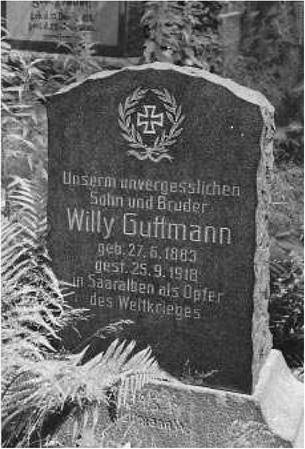
FIGURE 5. Dying for the Fatherland. Tombstone of soldier fallen in 1918 at the Jewish cemetery in Breslau, Germany (now Wroclaw, Poland).
The German sailors and soldiers who rebelled against their commanders were primarily motivated by a desire to put an end to the pointless carnage at the front and the Navy’s plan of a suicidal attack against the British. The widespread disenchantment among the troops would indicate that, by the last phase of the war, the myth of the battle community hardly expressed the rank and file’s perception of reality. But revolutionary situations are a highly fertile breeding ground for fantasies and distorted perceptions. The legacy of the immediate postwar years in Germany was one of seething animosities and mutual victimization, violence and terror, all crucial elements in the subsequent rise of the Nazi Party. The extremists on both the Left and the Right, but also to some extent the more moderate liberals and socialists, tended to view their political opponents as sworn enemies; the militants also often perceived themselves as victims. It is true that the Weimar Republic provided more opportunities for German Jews than ever before in the past, as can be seen from the growing prominence of Jews in the arts, academe, the media, and politics. At the same time, however, the 1920s were also a period of growing antisemitism, in which the Jews came to be viewed by much of the radical and conservative Right as the main cause and beneficiary of the military disintegration and the collapse of the imperial regime and all it had stood for. The impact of this atmosphere on German Jewry was just as significant, although reactions were anything but unified. Some Jews turned to accelerated assimilation, others sought to recover their Jewish identity, still others made efforts to emigrate, but most were aware of the mixed signals given them by gentile society and beset by a sense of crisis. Conversely, if the socialists could be accused of adhering to a pernicious ideology, the working class as such could never take the place of the nation’s foreign enemies, since the future army expected to undo the humiliation of the Versailles Diktat (the peace terms dictated to Germany) would eventually be raised from its ranks. To be sure, the carriers of “Bolshevism” had to be eliminated, but their followers were to be won over, not destroyed. Those on the lookout for domestic enemies needed a target group that would be both sufficiently visible and more or less universally disliked, perceived as both all-powerful and numerically marginal so that its elimination from society would not have a major detrimental effect on the nation, both an easy target for victimization and generally accepted as the chief instigator of its persecutors’ own victimhood. An enemy, that is, whose very persecution would serve to manifest the power and legitimacy of the victimizer, while simultaneously allowing the persecutor to claim the status of the “true” (past, present, and potentially future) victim.
While in Germany the aftermath of World War I unleashed new destructive energies, in France it hindered a unified resistance to future foreign threats and ultimately played an important role in French reactions to defeat and occupation in 1940. The mutiny of 1917 in the French army did not bring about a collapse of the front and, at least overtly, was not politically motivated. But the refusal of numerous battalions to participate in any more suicidal attacks reflected the transformation of the old elan, the spirit of the offensive a outrance (all-out offensive) into a grim determination to hold back the Germans and survive in the trenches. Indeed, long before the mutiny, the troops began a complex process of largely unspoken negotiations with their frontline officers regarding the manner in which the fighting should be conducted. Now the generals and politicians in the rear also had to accept the limits of the troops’ willingness to follow orders. This meant that if, in one sense, France as a nation was still seen as Germany’s victim, in another, more direct and intimate sense, the soldiers also saw themselves as the victims of their own amorphous authorities, against whose whims and ignorance of frontline reality they had a right to protect themselves even as they continued to defend the country from foreign invasion.
France held out to the end, despite the simmering anger of the troops, the waves of strikes in industry, political crises and changes of government, and very much thanks to the final massive involvement of American troops. Since France won the war, there was no need to look for the agents of disintegration, as happened in Germany. But the terrible price of victory was not blamed only on the Germans. While Georges Clemenceau and Philippe Petain purged the rear and the front of “defeatist” elements and could thereby claim to have overcome the crisis and ensured France’s survival, the growing realization during the interwar years of the devastation that 1914—18 had wrought on a whole generation, made the French extremely wary of anyone suspected of preparing yet another war. The question was not so much who was guilty of the previous war, but rather, against whom would or should the next war be fought, whose interests would it serve, and who was inciting the population to take part in another bout of mutual slaughter. In other words France became increasingly involved in searching for those elusive agents of future catastrophe, perceived as domestic warmongers and their alleged foreign allies, whose identity depended on the ideological stance and prejudices of the beholder. This both reflected and further propelled a deepening social and political rift in the nation that only enhanced the fear of another major war. If in Germany initial disintegration was followed by a redefinition of enemies and a determination to destroy them both at home and abroad, France was too preoccupied with arguing over the identity of its domestic enemies to perceive the real danger across the Rhine. Finally, following the debacle of 1940, Vichy collaborated with the German occupiers in seeking out and annihilating those domestic enemies identified by the Nazis and their French counterparts as the agents of national decomposition. Hence, while Germany extended its domestic conflict to the international scene, France imported its foreign enemy to settle a domestic dispute.