
The ubiquity of perpetrators and victims, and the frequent confusion between them, is at the core of the destructive energy characteristic of modern genocide, taking place as it does within an imaginary universe that encompasses every single individual in a cycle of devastation and murder. And, since a neutral position is no longer available, both individuals and collectives will naturally tend to present themselves as victims. Thus the unique features of the Nazi genocidal enterprise illustrate an important characteristic of state-organized industrial killing, whereby the fabrication of elusive enemies makes everyone into a potential victim and the assertion of elusive perpetrators makes everyone into a potential killer.
The question of German guilt was raised already during the war by their opponents: Were all Germans guilty, or were they themselves victims of a criminal dictatorship? Conversely, while the Jews were acknowledged to have been (among) Germany’s victims, the Allied war was not presented as being waged on their behalf, not least for fear of arousing antisemitic sentiments among the Allies’ populations. This created a great deal of ambiguity regarding the identities of both victims and perpetrators at the end of the war, much enhanced by the rapidly changing political and ideological circumstances after 1945. The Cold War transformed old enemies into allies and former allies into sworn enemies; denazification applied a narrow definition of perpetrators, thereby making for a highly inclusive definition of victimhood. The perceived need of the democracies to unite against Communism meant that normalization in the West was accomplished by representing the war as a site of near universal victimhood.
Germany’s destruction was there for everyone to see; in the midst of this landscape of utter desolation, the concentration camps easily blended in. Although seen as examples of Nazi depravity and criminality, they did not readily divulge the identity of their victims. Moreover, the death camps were situated far from what had remained of the Old Reich. The town of Auschwitz, for instance, which nationalists had long claimed to be an important landmark of the medieval German eastern expansion, was now dissociated from German history and presented as a remote Polish locality by the name of Oswiecim. At the same time, whereas the German and Austrian inhabitants of towns in the proximity of the camps had come to think of the inmates as “criminal elements,” in subsequent postwar representations they often appeared as political prisoners who had fought against the Nazis. Thus, for instance, Alain Resnais’s famous film Night and Fog (1955), which powerfully evokes the reality and memory of the camps, neither distinguishes between the concentration camps and the killing facilities, nor makes any mention of the fact that the vast majority of the victims in the death camps were Jews. This supplied the enormity of the Nazi “concentrationary universe” with a false logic, according to which the regime had simply, albeit ruthlessly, suppressed all opposition. It also implied that there had indeed been a tremendous amount of resistance to Nazism. The far more numerous victims who had been murdered in the name of racial ideology without ever presenting any objective danger to the regime were at best relegated to a position of secondary importance, if not altogether ignored (fig. 6). In other words, the genocide of the Jews, which defied the liberal logic by appearing wholly counterproductive to the German war effort, was left largely unexplained for many years following the Holocaust, whether by historiography, legal discourse, documentaries, or other forms of representation.
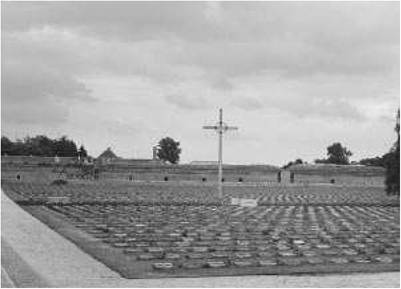
FIGURE 6. The competition of victims. Cross as monument to the victims of the Little Fortress in Terezin (Theresienstadt), Czech Republic. Note the smaller Star of David in the background (left). Jews were the majority of victims in this camp.
It has been noted that Germans experienced the last phases of World War II and its immediate aftermath as a period of mass victimization. Indeed, Germany’s remarkable reconstruction was predicated both on repressing the memory of the Nazi regime’s victims and on the assumed existence of an array of new enemies, foreign and domestic, visible and elusive. Assertions of victimhood had the added benefit of suggesting parallels between the Germans and their own victims. Thus, if the Nazis strove to ensure the health and prosperity of the nation by eliminating the Jews, postwar Germany strove to neutralize the memory of the Jews’ destruction, so as to ensure its physical and psychological restoration.
To be sure, the crimes of the Nazi regime became a necessary component of both West and East German identity and self-perception, even if the meanings ascribed to them were very different. But it must be stressed that Nazi criminality itself was persistently associated with the suffering of the Germans. Both the murder of the Jews and the victimization of the Germans were described as acts perpetrated by a third party; however, while Germans believed they had little in common with the Jews, they naturally felt their own suffering very keenly. Thus the Holocaust was an event carried out by one group of “others” on another such group, whereas the destruction of Germany was perpetrated by (possibly even the same) “them” directly on “us,” the Germans. In this manner, the perpetrators of genocide were associated with the destroyers of Germany, and the Jewish victims were associated with German victims, without, however, creating the same kind of empathy.
Postwar German perceptions of victimhood entailed both inversion and continuity. In the Federal Republic the Third Reich’s population was seen as the victim of both Hitler’s terroristic regime and Joseph Stalin’s no less criminal Communist order. This was reflected in the so-called Berufsverbot (employment ban), which barred German civil servants from membership in either Nazi or Communist organizations, thereby indicating that both ideologies were of an equally despicable nature. At the same time, however, the view persisted in some quarters that Germany had also been the victim of Western (and especially American) military might and imperialistic policies, now pursued by other means in a campaign of “cultural imperialism” that threatened the German way of life. A good example of this attitude was provided in the last part of Robert Busch and Edgar Reitz’s TV saga Heimat (1984), which presents the final loss of the homeland as occurring after Nazism, with the infiltration of American norms and values. The same can be said of Rainer Werner Fassbinder’s film The Marriage of Maria Braun (1979), where the “Americanization” of Germany during the “economic miracle” of the 1950s is shown as the moment in which the Mutterland lost its soul, and of Alexander Kluge’s film The Patriot(1979), whose central motif is that the destruction of Germany in the war—not least through Allied bombing—had erased its cultural and historical memory and identity. Instances of anti-Americanism were also strongly present during such events as the Vietnam and the Gulf Wars, accompanied by and associated with, growing anti-Israeli, and somewhat more couched antisemitic, sentiments particularly visible during the 1982 Lebanon War. Conversely, in East Germany, the official view of fascism as the product of capitalism made it possible to deny all responsibility for the Nazi past and to retain pre-1945 prejudices against the West. In both Germanies, therefore, Americanization took on the appearance of an elusive enemy, not least because of its appeal for so many young Germans on both sides of the Iron Curtain, also making it thereby into the enemy within. Moreover, while East Germany presented Communism as the destroyer of the criminal Nazi clique and its capitalist supporters, deeply ingrained prejudices against Russians never quite disappeared there either, making them into yet another elusive enemy whose presence could not be openly criticized. All of these themes were, of course, reflected in the German historians’ controversy, or Historikerstreit, of the mid-1980s, and, more recently, in the Goldhagen debate.
West German representations of the past have often included the figure of “the Nazi,” as can be found, for instance, in the early works of the writers Siegfried Lenz, Heinrich Boll, and Gunter Grass. This elusive type, rarely represented with any degree of sympathy, retains a complex relationship with its predecessor, “the Jew.” Serving as a metaphor for “the Nazi in us,” it inverts the discredited notion of “the Jew in us” (which postwar philosemitism in turn has inverted into a positive attribute). Simultaneously, it presents “the Nazi” as the paradigmatic other, just as “the Jew” had been in the past (and in many senses remains despite “his” newly discovered moral qualities). If the 1935 Nuremberg Laws could define Aryan only negatively as having no Jewish ancestry, postwar representations defined German as not being (truly) Nazi. Both instances made for an array of “racial” or ideological Mischlinge (half-breeds). After all, just as in the Third Reich, there was always the fear or suspicion that everyone might have some Jewish ancestor in the remote past (quite apart from the fact that many “pure” Aryans, such as Hitler and Joseph Goebbels, did not display the physical attributes expected from Nordic types), so, too, it was hard to find any Germans who had completely abstained from affiliation with the various agencies of the Nazi Party and its innumerable offshoots throughout the Third Reich’s twelve years. Only the Jews were innocent on both counts, having been excluded from both the racial and the ideological community. But Jews rarely appear in German postwar representations of the past. Hence only those who had, by their actions or words, shown that they were “pure” Nazis were seen as such by postwar Germans, and even in that case they were rarely pursued and punished with much energy or severity. The innumerable others were said to have been affiliated with the regime unwillingly, unknowingly, naively, innocently, opportunistically, but in any case not out of true conviction. They were not, therefore, “really” Nazi, which left open the possibility that they were “good” Germans.
The new enemy of postwar Germany, “the Nazi,” is thus both everywhere and nowhere. On the one hand, “he” lurks in everyone and, in this sense, can never be ferreted out. On the other hand, “he” is essentially so different from “us” that he can be said never to have existed in the first place in any sense that would be historically meaningful or significant for “us,” namely for contemporary Germany and especially for the vast majority of individual Germans, who were either not in positions of power in the Third Reich or belong to succeeding generations. Hence “we” cannot be held responsible for “his” misdeeds. Just like the Devil, “the Nazi” penetrates the world from another sphere and must be exorcised; conversely, “he” is a metaphor of the satanic element in humanity. Both faces of “the Nazi” abound in German representations of the Third Reich, and both greatly facilitate identifying with its (German) victims. But the latter view, that of “the Nazi” as an inherent potential in humanity, while it can be construed as apologetic, also generates deep anxiety about the ubiquity of evil even in our own post-Nazi universe.
The public discourse on the Holocaust in postwar Germany has, until recently, largely concentrated either on the social marginality of the perpetrators or on the anonymous forces that made it into a reality. The Jewish victims have rarely featured as anything more than the by-products of this process. So-called ordinary Germans appear to have been either untouched by or irrelevant to genocide, and arguments to the contrary have been seen and condemned as attempts to assign collective national guilt. The largely defensive reaction to such arguments shows the difficulty many Germans still have in accepting that the Third Reich had perpetrated crimes on such a vast scale with the support and complicity of large sections of the population. Instead, it is German victimhood and, in some cases, martyrdom that tends to be stressed time and again.
This can also be seen by reference to the debate over resistance to the Nazi regime. Notably, the conservative opposition, associated primarily with the bomb plot of July 20,1944, has received much more attention in the Federal Republic than the resistance by the communists and socialists, especially during the early years of the regime. This is partly related to the available documentation, partly to the ideological inclinations of postwar historians, and partly to the circumstances of the Cold War. It should be pointed out, however, that the Nazi regime associated socialist and communist opponents, both domestic and foreign, with the Jews, and persecuted them from the very beginning. Indeed, the early concentration camps housed mainly members of the left-wing opposition, along with a variety of “asocials.” Conversely, the conservative opposition came from the social and military elite and often had impeccable antisemitic credentials and a record of early support for the regime, which turned sour only when Hitler appeared to be taking Germany on a dangerous war course, or even later, after it became clear that, for all intents and purposes, the war was lost. This is not to cast doubt on the moral motivation of some conservative conspirators, or on the fact that they were appalled by the crimes of the regime. Yet it is just as true that they were potentially acceptable allies of Hitler, and for a long time they indeed served in that capacity, making possible the creation of the regime and the organization of the army that facilitated the disasters and crimes against which they ultimately rebelled. It should also be remembered that the conspirators were a very small minority, hardly representative of the milieu from which they stemmed. Nevertheless, during the Cold War it was as difficult for the Federal Republic to concede that resistance to Nazism had begun on the Left as it was for the German Democratic Republic to admit that the single most dangerous domestic challenge to Hitler had come from the old German elites. Moreover, the very notion of resistance to the regime during the war remained problematic, since it could be construed as another “stab in the back” along the model of 1918, a point of which the resisters themselves were well aware. Indeed, casting doubts on the legitimacy of the Nazi regime by praising the conspirators threatened the far more numerous officials who defended themselves from postwar accusations by asserting their legal and moral obligation to obey the regime, especially in wartime.
The resisters have therefore retained a dual position long after 1945. Seen as both conspirators and heroes, they represent the ambivalent attitude toward resistance to the regime, so well reflected in the treatment by the Federal Republic of lesser acts of resistance or subversion by the lower ranks in the army, such as insubordination, desertion, and self-inflicted wounds. The Wehrmacht meted out severe punishments for such allegedly political offenses, including the loss of pensions, and the Federal Republic, until very recently, upheld these sentences without consideration for the circumstances of the time, yet it pays pensions to retired members of the Waffen-SS or their families. If the senior officers who rebelled in 1944 have been glorified, rebellious soldiers of the rank and file were for long seen as traitors and criminals.
For historians, determining the identity of the Nazi regime’s domestic opponents is also a matter of definition, not always corresponding to contemporary perceptions. While scholars engaged in reconstructing the history of everyday life (Alltagsgeschichte) in the Third Reich have noted resistance by the population to this or that governmental measure, this level of resistance was not always perceived by the regime as outright opposition, especially since it was often accompanied by conformity with or support for other aspects of Nazi rule: if everyone was a potential enemy, complicity was nevertheless pervasive. Conversely, until recently, the everyday life of the regime’s declared enemies received little attention, an implicit acceptance of Nazi distinctions, internalized by much of the population, between “Aryans” and Jews. This has been changing in recent years, but it should be noted that there is still a general tendency to write the history of the Germans and the Jews separately, even though many German Jews saw themselves first and foremost as Germans, at least as long as the Nazis did not force them to think otherwise, as eloquently expressed in Victor Klemperer’s recently published diaries. It could thus be argued that postwar scholarship has institutionalized an ideologically imposed perception, with the result that the historiographies of perpetrators and victims rarely overlap. Although the lives of German Jews and gentiles were separated by the regime, it is the process of segregation that needs to be clarified rather than accepted as natural; and, although the categories of victims and perpetrators are distinct, it is the encounter between the two that facilitates genocide, while keeping them strictly apart only blurs the fact that persecution, discrimination, and murder are actions in which one side does something to another side, that is, where there is an encounter, physical and material, mental and imaginary, between the killer and victim.