

29
Stone mask, found in south-east Mexico
900–400 BC
The people who made this mask were the Olmec, who ruled in what is now Mexico for around a thousand years, from 1400 to 400 BC. They’ve been called the mother culture – the cultura madre – of Central America. The mask is made in polished green stone, and unlike a sculpted head it’s hollowed out at the back. The white, snake-like streaks in the dark stone give it its name, ‘serpentine’. When you look closely, you can see the face has been pierced, and has been ritually scarred.
The previous objects in this world history have taken me along the royal roads of the Persian Empire, into mythical battles in Athens and to some heavy drinking in northern Europe. Each object has shown how the people who made it defined themselves and the world around them about 2,500 years ago. In Europe and Asia it is striking that self-definition was usually in distinction to others – partly by imitation but usually in opposition. Now I’m looking at an object from the Americas, from the lowland rainforests of south-east Mexico, and this Olmec face mask shows me a culture looking only at itself. It’s an aspect of the great continuity of Mexican culture, a culture as old as that of Egypt.
Most of us in Britain don’t learn a lot about Central American civilizations at school; we may be taught about the Parthenon, and even perhaps Confucius, but we don’t on the whole learn a lot about the great civilizations occurring at the same time in Central America. Yet the Olmecs were a highly sophisticated people, who built the first cities in Central America, mapped the heavens, developed the first writing and probably evolved the first calendar there. They even invented one of the world’s earliest ball games – which the Spanish would encounter about 3,000 years later. It was played using rubber balls – rubber being readily available from the local tropical gum trees – and although we don’t know what the Olmecs called themselves, it’s documented that the Aztecs called them the people of Olmen, meaning ‘the rubber country’.
It is relatively recently that the Olmec civilization was uncovered from the jungles of Mexico; only after the First World War were their sites, their architecture and above all their sculptures found and investigated. Discovering when the Olmecs lived took even longer. From the 1950s new techniques of radiocarbon dating allowed archaeologists to suggest dates for the buildings and therefore for the people that lived in them. The results showed that this great civilization flourished about 3,000 years ago. The discovery of this ancient and long-lived culture has had a profound effect on modern Mexican notions of identity. I asked the celebrated Mexican writer Carlos Fuentes what it means to him:
It means that I have a continuity of culture that is quite astonishing. Many Latin Americans who are merely migrants from European countries, or do not have a strong Indian culture behind them, don’t appreciate the extraordinary strength of the culture of Mexico, which begins a very long time ago in the twelfth or thirteenth century before Christ.
We consider ourselves heirs to all these cultures. They are a part of our make-up, a part of our race. We are basically a Mestizo country, Indian and European. The Indian culture has infiltrated into our literature, into our painting, into our habits, into our folklore. It is everywhere. It is a part of our heritage, as much as the Spanish culture, which for us is not only Iberian but also Jewish and Moorish. So Mexico is a compound of many civilizations, and part of them are the great Indian civilizations of the past.
So who were the Olmecs? Whose face does this mask show, and how was it worn? Olmec masks have been intriguing historians for a long time. Scrutinizing their features, many scholars believed that they were looking at Africans, Chinese or even Mediterranean people, who had come to colonize the New World. I suppose if you look at our mask, wanting to see an African or a Chinese face, you can just about persuade yourself that you can; but the features are, in fact, entirely characteristic of Central American people. This face is one that can still be seen in the descendants of the Olmecs living in Mexico today. But the desire to discover European or Asian elements in ancient American societies, to find evidence of ancient links and influences, is deep and it is revealing. The similarities between the cultures of the old and the new worlds are so strong – both produced pyramids and mummification, temples and priestly rituals, social structures and buildings that function in similar ways – that scholars for a long time found it hard to believe that these American cultures could have evolved in isolation. But they did.
At only 13 centimetres (5 inches) high, the mask is obviously far too small to have been worn over anybody’s face, and it’s much more likely that it would have been worn round the neck or in a headdress, possibly for some kind of ceremony. Small holes have been bored at the edges and at the top of the mask, so that you could easily fasten it with a bit of twine or thread. On either cheek you can see what, to my European eyes, look like two candles standing on a holder. To the eyes of the Olmec specialist Professor Karl Taube, the four verticals most probably stand for the cardinal points of the compass, and they suggest to him that this may be the likeness of a king:
We have great colossal heads, we have thrones, portraits of kings and, very often, the concept of centrality, placing the king at the centre of the world. And so, on this finely carved serpentine mask, we see four elements on the cheek which are probably the four cardinal directions. For the Olmec, of major concern were the world directions and world centre, with the king being the pivotal world axis in the world centre.
As well as honouring a wide range of gods, the Olmecs also revered their ancestors – so it’s possible that this mask with its particular features and markings might well represent a historic king or a legendary ancestor. Karl Taube has observed that in many sculptures we find what seems to be the same person’s face, with incisions that represent tattooing; as this pattern is seen often, he suggests there might have been an actual individual who had this facial marking. Olmec specialists refer to him as the ‘Lord of the double scroll’.
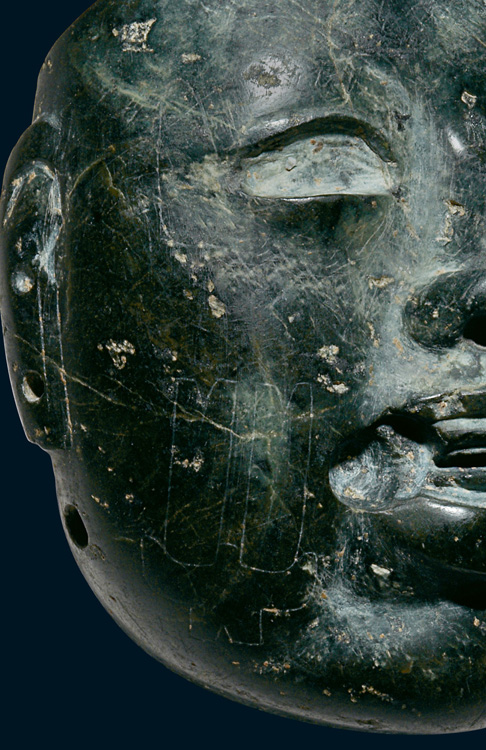
The incised symbols on the cheeks of the Olmec mask
Whoever he was, the man of the serpentine mask must have cut quite a dash when he appeared in public. The ears are pierced in several places, presumably for gold earrings. And there are what look like enormous dimples at the corners of his mouth. They must represent circular holes. We’re used now to face-piercings and studs, but these are bigger; this man must have been wearing plugs. Piercings and plugs are common throughout the history of Central America, and alterations like these, in the name of Olmec beauty, would have transformed the face. It’s only in masks like this that we can have any idea of what the Olmecs might actually have looked like, for the skeletons have completely dissolved in the acid soil of the rainforest. But the Olmec sense of personal beautification could go far beyond cosmetics or jewellery, into the realms of myth and faith. Karl Taube elaborates:
They would modify their heads – it’s often called cranial deformation, but I think that’s a loaded word. For them it was a mark of beauty. For newborns, they would bind their heads, and so they would become elongated – some people call it avocado head. But really what they’re evoking with their head is an ear of corn. The Olmec really were the people of maize.
Sadly there are only a few Olmec inscriptions – or glyphs – now surviving, and decipherment of their writing is tentative at best. There just isn’t enough continuous writing to let us be certain of what the symbols mean, so our understanding of their view of the gods and the natural cycle can be no more than speculation. But there are lots of objects such as pottery and sculptures bearing symbols, marks and glyphs, and they show us that writing was originally widespread across the Olmec heartland. One day we may know more.
Even if we can’t yet read their writing, we can learn a lot about the Olmecs from the buildings and the cities that have recently been uncovered. Major cities such as La Venta, near the Gulf of Mexico, had impressive step-pyramids with temple monuments for the worship of the gods and the burials of the kings. These would have formed the centre of the city. The pyramid itself was often topped by a temple, just as the Greeks, at roughly the same time, were building the Parthenon overlooking Athens.
But whereas the Parthenon stood on the naturally formed rock of the Acropolis, the Olmecs built artificial mountains – platforms is far too mild a word – on which to put their temples to overlook the city. The layout of the city, and its placing in an ordered landscape, typified not just Olmec but most later Central American urban centres – such as those of the Mayas and the Aztecs. All were variations on the Olmec model of a temple overlooking an open square, flanked by smaller temples and palaces.

The remains of La Venta, one of the centres of Olmec civilization
By 400 BC La Venta, along with all the other Olmec centres, was deserted. It’s a pattern that occurs with disconcerting frequency in Central America – great population centres are suddenly, mysteriously, abandoned. In the case of the Olmecs, it could have been the overpopulation of this fragile tropical river valley, or a shift in the Earth’s tectonic plates making rivers change their course, the eruption of one of the local volcanoes, or a temporary climate change caused by the shifting patterns of the El Niño ocean current.
But elements of the Olmec culture lived on in central Mexico. The ancient city of Teotihuacan, a city founded several centuries after the mysterious collapse of the Olmec heartland, contains a great pyramid around 75 metres (some 240 feet) high. From the top of the pyramid you can see the ruins of Teotihuacan – the monumental avenues, lesser pyramids and public buildings of a city that in its day was the same size as ancient Rome. It’s a city that owes a great deal of its shape to the models provided by the Olmecs. The culture of the Olmecs is truly the cultura madre for all Central America, casting a very long shadow, establishing models and patterns that were to be followed by other cultures for centuries to come.