
58
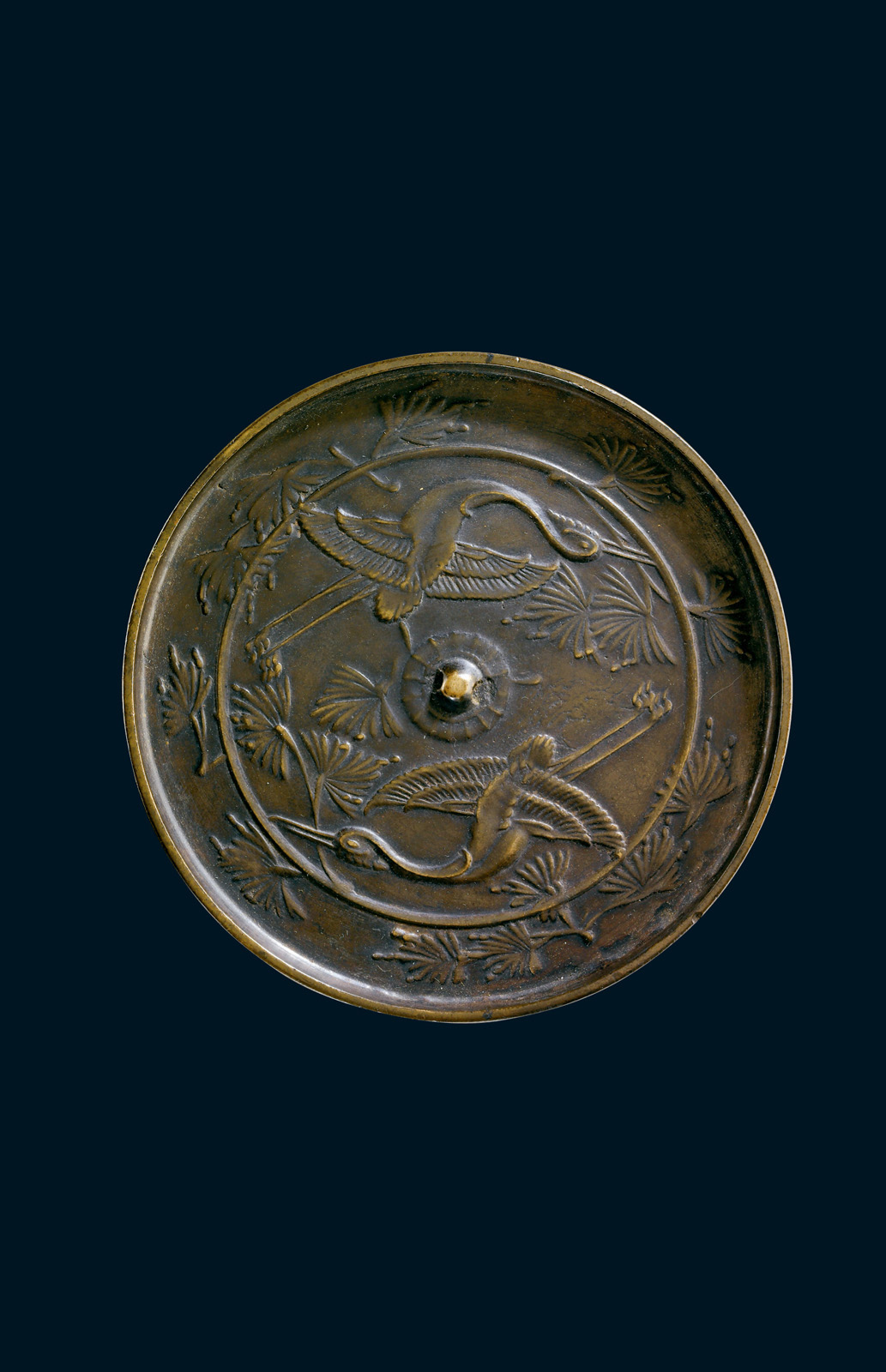
Bronze mirror, from Japan
1100–1200 AD
Most people have thrown a coin or two into a wishing well or a fountain for luck. Every day at the famous Trevi Fountain in Rome, tourists throw in coins worth about 3,000 euros to secure good luck and a return visit to Rome. People have been throwing valuable things into water for thousands of years. It is an extraordinary compulsion, and it hasn’t always been coins tossed with a light-hearted wish; in the past, it was often a deadly serious plea to the gods. In rivers and lakes across Britain archaeologists regularly discover weapons, jewellery and precious metals that were given to the gods thousands of years ago. In the British Museum we have objects from all over the world that were once solemnly or joyously deposited in water. One of the most fascinating is a mirror thrown into a temple pool around 900 years ago in Japan.
In a famous Japanese history called The Great Mirror, written around 1100, the mirror not only has a voice, but the power to reveal Japan to itself:
I am a plain old-fashioned mirror from a bygone age, made of good white metal that stays clear without being polished … I am going to discuss serious matters now. Pay close attention, everyone. You should think, as you listen to me, that you are hearing the Chronicles of Japan …
The British Museum’s mirror was made at about the same time, although it’s only very recently that we’ve found out exactly where it came from and what that new information tells us about the Japan of 900 years ago. The story our mirror can now tell is about lovers and poets, court women and goddesses, priests and emperors.
The mirror is circular, about the size of a saucer, and it sits comfortably in my hand. There isn’t a handle, but it would originally have had a loop fixed to it so that you could hang it from a hook. It is not made of silvered glass – the modern, silver-backed mirror we are all familiar with didn’t come into use until around the sixteenth century. Early mirrors like this bronze one were all made of metal, which was then so highly polished that you could see your face in it.
Like much else in Japanese culture, mirrors first came to Japan from China. Around 1,000 years ago, societies across Eurasia were vigorously trading goods and exchanging ideas and beliefs. Throughout the eighth and ninth centuries Japan had been an energetic participant in these exchanges, particularly with China. But lying right at the end of all the great Asian trade routes and isolated by sea, Japan, unlike almost any other culture, was able to opt out of this interconnected world. It is an option Japan has exercised several times in its history, as it did most strikingly in the year 894, when it stopped all official contact with China and effectively cut itself off from the rest of the world. Untroubled by outside influences or new arrivals, Japan turned inwards for several centuries, a decision which still resonates today, and developed its own highly idiosyncratic culture. At the court in Kyoto every aspect of life was constantly refined and aestheticized in the pursuit of ever more sophisticated pleasure. It was a society in which women played a key cultural role. It is also the era of the first significant literature written in Japanese – written, in fact, by women. As a result, it is a world we know quite a lot about, and it’s the world of our mirror. The person who first used it could well have been reading that first great Japanese novel – indeed one of the first great novels of the world – The Tale of Genji, written by the court Lady Murasaki Shikibu. Ian Buruma, an author and expert on Japanese culture, fills in the background:
Lady Murasaki was a little bit like Jane Austen. The Tale of Genji gives an extraordinary insight into what life was like in that aristocratic hothouse of the Heian period.
One thing that distinguishes medieval Japanese culture is that it was extremely aestheticized; it turned beauty into a kind of cult. And that included everything in daily life; not just objects – like mirrors, or chopsticks or whatever it was – but life itself, which was of course highly ritualized. In an aristocratic society it always is. That’s true of all aristocratic societies, but possibly the aristocracy of the Heian period went further than any other culture before or since. People communicated by writing poetry, they had incense-smelling contests, they were connoisseurs of every kind of aesthetic pursuit, and that included the relations between men and women. Of course, feelings came into it, and so that led to jealousies and all the normal forms of human behaviour which Murasaki recorded so beautifully.
We can see something of Lady Murasaki’s world of aesthetic refinement and incense-smelling contests in our mirror. On the back, the elegant decoration shows a pair of cranes in flight, their heads thrown back, their wings outstretched and pine branches in their beaks. Their necks curve to match exactly the curve of the circular mirror. On the outer edge are more decorative pine fronds. It’s a rigorously balanced, perfectly composed work of art. But as well as being beautiful, our mirror also had a meaning: cranes had a reputation for longevity – the Japanese believed that they lived for a thousand years. Lady Murasaki tells us of one of her contemporaries who, at a particular court event, wore a gown decorated with cranes on a seashore:
Ben-no-Naishi showed on her train a beach with cranes on it painted with silver. It was something new. She had also embroidered pine branches; she is clever, for all these things are emblematic of a long life.
The cranes also carry another meaning – these birds mate for life, and so are symbols of marital fidelity. The message on the back of our mirror is quite simply one of enduring love. At one point in The Tale of Genji the princely hero, before setting off for a long absence, takes a mirror, recites into it a passionate love poem and then gives it to his beloved, so that by holding the mirror once he is gone she will be able to hold both his message of love and within its polished surface the image of Genji himself. Our mirror with its faithful cranes would have been a particularly appropriate vehicle for such a declaration of love.
Japanese mirrors could also communicate darker messages, and not just between humans – through them we can enter the world of the spirits and indeed speak to the gods. Ian Buruma explains:
The mirror in Japanese culture does have several meanings, and some of them may seem contradictory. One is that it’s an object to ward off evil spirits, on the other hand it can also attract them, which is why if you go into a rather traditional household in Japan even today people often cover up their mirror when they don’t use it – they have a cloth that they hang in front of it because it might attract evil spirits. At the same time it’s a sacred object. In the holiest shrine in Japan, in Ise, the holiest of holy parts that nobody ever gets to see has one of the three great national treasures, which is indeed a mirror …
The mirror at Ise is in fact the mirror of the great Japanese sun goddess, Amaterasu. By ancient tradition, at the dawn of time Amaterasu ordered her grandson to descend from Heaven to rule over Japan, and to help him in this imperial task she gave him a sacred mirror that would give him and his successors perpetual access to the divine sun. To this day the sacred mirror of Amaterasu is used in the enthronement ceremonies of the Japanese emperor.
It is this particular ability of Japanese mirrors to allow humans to speak to gods that has ensured the survival of our mirror, which with eighteen others was given to the British Museum in 1927. All these mirrors are made of bronze and all have the same distinctive matt surface. But it was only in 2009 that a Japanese scholar researching in the British Museum was – for the first time – able to tell us why all nineteen mirrors look like this. It is because all of them came from the same place – all were found in a sacred pond beneath the mountain-shrine of Haguro-san in the north of Japan. At the beginning of the twentieth century this pond was drained in order to build a bridge for pilgrims. To the astonishment of the engineers, deep in the mud at the bottom of the pond they found around 600 mirrors (ours among them) which over the centuries had been consigned to the water. The visiting Japanese scholar, the archaeologist Harada Masayuki, sets the scene:
People started to make pilgrimages to the mountain because they found the landscape quite spiritual and holy, a suitable abode for gods. For example, the white snow that stays for a long time had spiritual significance. So the pond itself became a centre of worship, and people thought that there was a god in that pond. There was a belief among the Japanese people that in order to be reborn you had to do good things in this life. It was probably an extension of this idea that these exquisitely made and expensive mirrors were offered, entrusted, to a Buddhist priest, as a sign of piety – to dedicate to the god so that the giver could come back to the world again.
So we can now make an informed guess at the entire life story of our mirror. It was made in the sophisticated bronze-casting workshops of Kyoto around 1100, to be used in the rarefied world of courtly ritual and display, an indispensable tool for any lady or gentleman to prepare themselves for an aesthetic public appearance. At some point its owner decided to despatch it, in the care of a priest, on a long journey to the northern shrine, and there it was thrown into the sacred pond – still holding within it the likeness of its owner and carrying a message to the other world. What neither owner nor priest could have guessed was that it would one day be a message to us. And like the ‘Great Mirror’ itself, it tells to a modern audience a chronicle of Old Japan.