
5
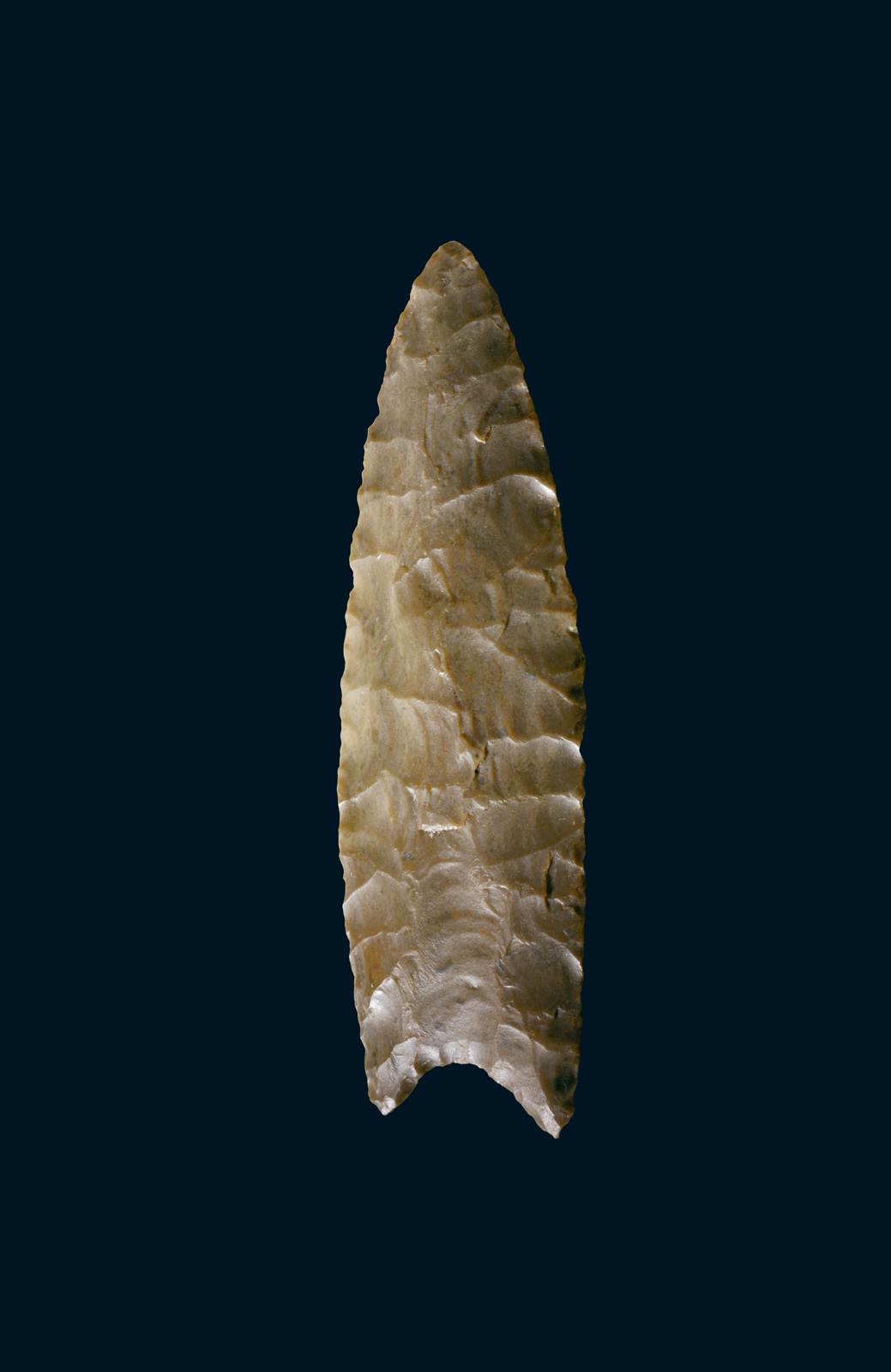
Stone spearhead, found in Arizona, USA
11000 BC
Imagine. You’re in a green landscape studded with trees and bushes. You’re working in a team of hunters quietly stalking a herd of mammoths. One of the mammoths, you hope, is going to be your supper. You’re clutching a light spear with a sharp, pointed stone at the end of it. You get closer – you hurl your spear – and it misses. The mammoth you wanted to kill snaps the shaft under its foot. That spear is useless now. You take another one and move on – and you leave behind on the ground something that’s not just a killing tool that failed, but an object that’s going to become a message across time. Thousands of years after the mammoth trod on your spear, later humans will find that pointed stone spearhead and know you were here.
Things that are thrown away or lost tell us as much about the past as many of those carefully preserved for posterity. Mundane everyday items, discarded long ago as rubbish, can tell some of the most important stories of all in human history – in this case, how modern humans took over the world, and how, after populating Africa, Asia, Australia and Europe, they finally got to America.
This small object is the business end of a deadly weapon. It’s made of stone and it was lost by a person like us, a modern human being, in Arizona more than 13,000 years ago. It sits in the North American gallery of the British Museum, among the magnificent feather headdresses, in a case beside the totem poles. The spearhead is made of flint; it’s about the size of a small, slim mobile phone, but in the shape of a long thin leaf. The point is still intact and still very sharp. The surface of both sides has beautiful ripples. When you look closely, you can see that these are the scars from its manufacture, where the flakes of the flint have been carefully chipped off. It’s a lovely thing to touch and stroke, and it’s very well adapted to its lethal purpose.
Perhaps the most surprising fact about this spearhead is that it was found in America. Modern humans originated in Africa, and for most of our history we were confined to Africa, Asia and Europe, all connected by land. How did the people who made spears like this get to America, and who were they?
Spearheads like this are by no means rare; it is just one of thousands that have been found across North America and that are the firmest evidence yet of the first human beings to inhabit the continent. They’re known as Clovis points, after the small town in the US state of New Mexico where they were first discovered in 1936, alongside the bones of the animals they had killed. So the makers of these stone points, the people who hunted with them, are known as Clovis people.
The discovery at Clovis was one of the most dramatic leaps forward in our understanding of the history of the Americas. Almost identical Clovis points have been found in clusters from Alaska to Mexico, and from California to Florida. They show that these people were able to establish small communities right across this immense area as the most recent Ice Age was coming to an end, about 13,000 years ago.
Were the Clovis people the first Americans? A leading expert in this period, Professor Gary Haynes, makes the case:
There’s some scattered evidence that people were in North America maybe before these Clovis points were made, but most of that evidence is arguable. Clovis look like the first people. If you dig an archaeological site almost anywhere in North America, the bottom levels are about 13,000 years old, and if there are any artefacts, they will be Clovis or Clovis-related. So it looks like these were the very first dispersers, who filled up the continent and became the ancestors of modern Native Americans, populating just about all of North America, and they came from somewhere up north, because the studies of genetics seem to prove that the ancestry of Native Americans is north-east Asian.
So archaeology, DNA and the bulk of academic opinion tell us that the original population of America arrived in Alaska from north-east Asia less than 15,000 years ago.
By about 40,000 years ago, humans like ourselves had spread from Africa all over Asia and Europe, even crossing seas to get to Australia. But no humans had yet set foot in the Americas. They got their chance thanks to major changes in climate. First, about 20,000 years ago, an intensification of the Ice Age locked up a great deal of water in ice-sheets and glaciers, leading to a huge fall in sea level. The sea between Russia and Alaska (the Bering Strait) became a wide and easily passable land bridge. Animals – bison and reindeer among them – moved across to the American side, and the humans hunting them followed.
The way further south into the rest of America was through an ice-free corridor between the Rocky Mountains on the Pacific side and the vast continental ice-sheet covering Canada on the other. As the climate warmed up 15,000 years ago, it was possible for large numbers of animals, followed again by their human hunters, to get through this corridor to the rich hunting grounds across what is now the United States. This was the new American world of the Clovis points. It was clearly a great environment for those go-getting humans from north Asia, but if you were a mammoth the outlook wasn’t quite so rosy. The ripples on the side of the Clovis point, which I find so beautiful, produce intense bleeding in any animal they hit, so you don’t need to be a dead shot and strike a vital organ; you can hit your prey anywhere and the blood loss will gradually weaken it until you can easily finish it off. And by 10,000 BC, all the mammoths, and a lot of other big mammals, had indeed been finished off. Gary Haynes lays the blame at the door of the Clovis people:
There’s a direct connection between the first appearance of people and the last appearance of many, if not all, of the large mammals in North America. You can trace this sort of connection across the world, wherever modern Homo sapiens turns up. It’s almost invariable that large mammals disappeared – and not just some animals but a large proportion, in North America something like two thirds to three quarters.
By around 12,000 years ago, the Clovis people and their descendants had not only spread across North America, but had also reached the southernmost tip of South America. Not long after this, warming climate and melting ice raised sea levels sharply so that the land bridge that had brought humans from Asia flooded once again. There was no way back. For the next 10,000 years or so, until the onset of sustained European contact in the sixteenth century AD, the civilizations of the Americas would develop on their own.
So about 12,000 years ago we had reached a key moment in human history. With the exception of the islands of the Pacific, human beings had settled the whole habitable world, including Australia. We seem to be hard-wired to keep moving, always wanting to find out what’s beyond the next hill. Why? The broadcaster and traveller Michael Palin has covered a good deal of the globe – what does he think drives us on?
I’ve always been very restless and, from when I was very small, interested in where I wasn’t, in what was over the horizon, in what was round the next corner. And the more you look at the history of Homo sapiens, it’s all about movement, right from the very first time they decided to leave Africa. It is this restlessness which seems a very significant factor in the way the planet was settled by humans. It does seem that we are not settled. We think we are, but we are still looking for somewhere else where something is better – where it’s warmer, it’s more pleasant. Maybe there is an element, a spiritual element, of hope in this – that you are going to find somewhere that is wonderful. It’s the search for paradise, the search for the perfect land – maybe that’s at the bottom of it all, all the time.
Hope as the defining human quality – an encouraging thought. What stands out for me in our journey so far of nearly two million years is the constant human striving to do things better, to make tools that are not only more efficient but also more beautiful, to explore not just environments but ideas, to struggle towards something not yet experienced. The objects I’ve described have tracked that move – from tools for survival not so different from what other animals might use, to a great work of art and the possible beginnings of religion. My next chapters examine how we began to transform the natural world by starting to farm. In the process, we changed not just the landscape, but plants, animals and, above all, ourselves.