
I. G. SIMMONS
Every year a study is published which pushes back the horizon beyond which the world was without human influence. Even if we confine ourselves to the last 10,000 years, the chronicling of the changes in the planet’s ecology and understanding them in historic terms present fearsome tasks of erudition and the explanation of complexity. If we think there may be relevance to today’s issues, and maybe even those of tomorrow, then the undertakings are increased many-fold. Generalizations are essential but full of pitfalls, although there are some threads that can be followed through the labyrinth, some of which are outlined in this chapter. In particular, the whole of human history can be seen as a series of projects in harnessing the energy which is necessary to survive but also to break land for cultivation, to build pyramids, whether in Giza or San Francisco, to fire arrows or to launch nuclear missiles. Thus a broad-scale but effective history of humanity can follow the accumulation of harnessed energy sources from sunlight to the atom. Within such a framework there are many millions of interactions between the world of biophysical nature and that of human cultures, but again some themes shine through: the ways in which some of these ecologies have, to use today’s anthropocentric terminology, proved “unsustainable” is one of them; another must surely be the driver of so much environmental metamorphosis, that of human population growth allied to demands for resources from the Earth. Yet it is clear to all that some changes are local whereas others affect the whole planet; there are both spatial and temporal scales of alteration.1 To talk of all this past in a short space and a comprehensible vocabulary brings its own headaches but it is suggested here that the tension between worldwide forces of coalescence in culture–nature relations and those of fragmentation provides a space for the broadest of approaches without totally losing focus. Each of these three central themes – harnessing energy, scales of alteration, and nature–culture interactions – is given a condensed but still meaningful treatment below, followed by short discussions of these contending forces of coalescence and fragmentation.
Harnessing Energy
The chronicle of the human role in occupying the thin zone of the planet that can support life is well documented in broad outline (i.e., Hughes 2007; Mosley 2010), with many contributors to the detail. This sequence is treated more specifically in other chapters of this volume (especially Fred Spier’s chapter on “big history,” but also those by Yoffee, Chase-Dunn and Hall, and Adas). One intention here is to present an overview of the last 10,000 years as a narrative of human access to energy sources and the ways in which planetary manipulation has led to so many material (and indeed nonmaterial) changes.
The story starts with gatherer-hunters concentrating their take of solar energy by small acts of manipulation: finding out that plants set out in middens grew very well, or that periodic fire allowed the growth of food plants that also had an enriched protein content. Their only true domesticate, the dog, helped concentrate prey animals during the hunt. Most foraging techniques moved towards the taking of more calories per unit of area than before, a process intensified when domestication of plants and animals created the field and the herd, with more calories and protein per unit of area per unit of time becoming available to humans. Both types of economy lived off recent solar energy, with dead wood the main representative of this older (“banked”) photosynthesis. One constraint on production in several climates was water supply to crop plants, which could be alleviated by irrigation, in the cause of which many water diversions were invented. The trend towards tapping more concentrated sources of energy took a leap when the potential of fossil fuels (first coal, then oil and natural gas) to release energy in large quantities, and especially to generate steam under pressure, spread from a few cradles to many “Western” countries and then to Japan. Such fuels underlie many of today’s environmental relations, along with later additions to the repertoire in the form of nuclear power and the interest in “renewable” energy sources now that the finite availability of the fossil hydrocarbons has been realized. Though transitions from one era to the next are often gradual, by 8000 BCE there was no going back from agriculture; the world was set on its industrial trajectory around 1750 CE and a “postindustrial” state became possible after 1950, with energy embedded in materials and services available to individuals as never before (Simmons 2008).
Scales of Alteration
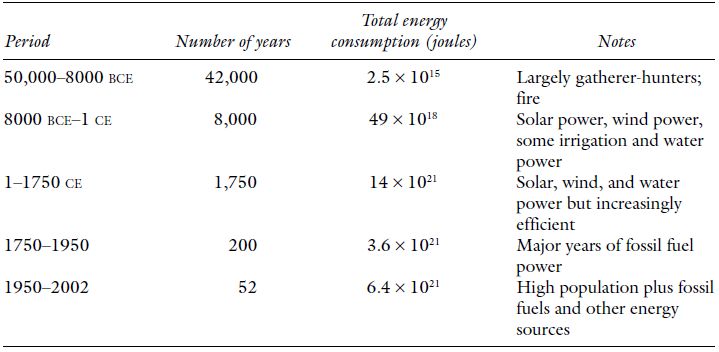
There are many environmental consequences of the skein interweaving human societies and the nonhuman. The scales of effect are sometimes obvious and may evoke a variety of responses, but equally not all are detectable except with sophisticated equipment and they may not enter the consciousness of any but a scientific interest group. Indeed, ideas with immense breadth like the Gaia hypothesis were for many years the scientifically unloved child of an individual (James Lovelock, 1919–); the bioaccumulation of pesticides was scarcely acknowledged in many countries until Rachel Carson (1907–1964) produced her catalytic book in 1962. But the microscale of interaction is present for us all, as when we swat a fly or mow a lawn. Yet nobody recorded the last Moa bird in Aotorea/New Zealand (ca. 1500) or the last dodo on Mauritius, ca. 1693. At a larger scale, there are regional changes that follow the deforestation of a watershed: not only are the trees replaced with lower-biomass species but the soil dynamics change, and often soil is lost downhill into runoff, which causes floods in the valleys and perhaps eventually delta formation in lakes and oceans. The loss of biodiversity is in large part due to habitat change rather than direct extirpation, often as an unintended result of environmental manipulation in the cause of the production of materials; its importance is being promoted as equivalent to that covered by the Intergovernmental Panel on Climate Change (IPCC) (Marris 2010; UNEP 2010). It is possible to change the ecology of almost a whole continent (although not at once) by eliminating a type of human–environment nexus, as when the dominant gatherer-hunters of North America were eliminated or took up other economic modes; few of the ecosystems of that continent present in 1500 were unchanged by 1900, and most of the metamorphoses involved the removal of pre-agricultural modes of subsistence. Table 9.1 makes the case for the era of agriculture (approximately 8000 BCE through 1750 CE) having had a major impact upon the Earth’s systems.
Table 9.1 Gross energy consumed by humans
Source: Data from Population Reference Bureau (Washington DC) based on the number of people who have ever lived multiplied by a representative figure for per capita consumption at each stage. So far the gross energy consumption and hence environmental impact is largest for the 1–1750 CE era.
Some alterations can be classed as worldwide, that is, they occur in all parts of the globe, although they are not necessarily connected into one system. Soil erosion is one example: it happens everywhere all the time, but in some places it is enhanced by land management systems that mobilize particulate matter. There is no evidence, however, to suggest the unification of the various inputs into one marine deposit. That is not true of molecules in suspension or solution in the oceans’ water, for persistent chemicals from runoff have turned up thousands of kilometers from their source and have also undergone bioaccumulation which has further dispersed them: think of the range of an albatross, for example (one bird can cover 6,000 kilometers in 12 days). There are also some truly global instances of human-driven change which involve the atmosphere of the whole planet. These are well known and their representation concentrates on the buildup of “greenhouse gases” after the nineteenth century, and the models that predict “global warming.” Even here, though, a greater historical depth is of value, since enhanced methane levels in the upper atmosphere may have been present ever since the introduction of wetland rice farming, about 8,000 years ago (Zong 2007; Ruddiman et al. 2008).
At all scales, some such trends are impermanent, whereas others seem irreversible. Shifting agriculture in forests seems to allow a more or less complete reversion to preexisting ecologies when a plot is abandoned, and it seems the “ozone hole” caused by CFCs may be repairable. On the other hand, extinction of species may not yield to the Jurassic Park treatment, in which modern technologies somehow bring back long-departed plants or animals. Current methane levels in the atmosphere are the highest in the last 400,000 years: at 1,850 parts per billion rather then the historically normal level of 600–700 ppb, they seem unlikely to diminish very soon (Shindell et al. 2009). The overall conclusion from the natural sciences seems to be that humans have been manipulators of species and ecosystems for much longer than has been implanted in the popular imagination, and they have been more penetrative than recognized by many scholars until perhaps quite recently.
Nature–Culture Interactions
The previous section only hints at the dauntingly long and complex list of linkages between humans and the nonhuman world, and at the ways in which changes have taken place over time. The idiosyncrasies of human culture have often led to diverse outcomes, so there is still controversy over why China did not develop industrialization in the way it happened in Europe; why early Islam rejected the wheel and printing; and even the reasons, long discussed, for the fall of complex cultures such as the Maya (Diamond 2005). In most of these there was an environmental component in the consequences, if not the causes, although the fall of Rome continues to be blamed on lead piping. Complex socio-ecological trains of causation like those proposed by Tainter (1988) are unusual: he hypothesizes that breakdowns occur when the energy of a group is largely consumed in feedback to keep the unit steady, rather than investing in innovation. So one difficulty in this historiography is that environmental components become simply existential elements of otherwise foregrounded historical processes, with which they compete for attention; when the strength of the king or the health of the peasants fails to convince, then “environmental factors” are a later resort. Even where the environment is the main focus, such matters become difficult across time and space and so very large-scale backdrops indeed have to be used: “the unending frontier” for early modern times, “something new under the sun” for industrialization (McNeill 2000; Richards 2003).
At the heart of any consideration of 10,000 years of human history there must surely be the driver of population growth. A species whose total number was perhaps 1 million gatherer-hunters in 8000 BCE became about 6.8 billion in 2010: perhaps 6 percent of all the people who have ever lived on Earth are alive today. The basic lesson for environmental change is the amount of energy to which succeeding eras have had access, and the use of this energy for environmental manipulation (Smil 1994). Although today’s distribution is highly uneven, the delivery of almost any form of “development” involves access to more energy: consider the embedded energy in the mobile phone as well as the energy costs of satellite telecommunications. An industrial society today consumes about 20 times the amount of energy of a solar-powered economy. Back-of-the-envelope reckoning suggests that the world during the twentieth century CE used 10 times as much energy as it had in the thousand years before 1900 CE. In the 100 centuries between the dawn of agriculture and 1900, humanity used only about two-thirds as much energy as in the twentieth century. The inevitable conclusion is that environmental interaction is a function of population growth multiplied by a factor for resource use; energy availability is a reasonable measure of that factor. The historical consequences of such a formulation include conflicts in which access to oil has been or will be crucial.
Many historians have written explanatory accounts for all of the above: they cannot be accused of ignoring nature. Their attitudes have ranged from a simple kind of determinism in which societies simply adapted to the surroundings, through the possibilities and opportunities made possible by enterprising individuals or enhanced technologies, down to the renewal of determinism implicit in the models of climatic change set out by the IPCC. The “new” relevance of nature can be seen in titles that include phrases like “a global and ecological narrative” (Marks 2006). As a way of making the variety of social and ecological relations within an overall environment-population envelope more comprehensible, two opposing features of society and nature can be highlighted and drawn out for examination. These features, which have been in tension for much of the last 10,000 years, may be categorized as coalescence and fragmentation. Coalescence can be briefly defined as the coming together of features, either of the natural world, as by species migration and interbreeding, or of the social world through the spread of near-identical social practices. Fragmentation, by contrast, affects ecosystems through either extinction or sequestration as a reserve of some kind, paralleled by the stratification of societies by differential access to energy or other resources. Such general ideas, although admittedly dogged by a Western delight in binary opposites, may help provide a useful foundation for examining both current and historic dynamics in the relations between environments, ecologies, and cultures.
Environmental historians have indeed looked at the dynamics of “natural” ecosystems in time, assessed the roles of technologies in accessing natural resources, looked at the effects of environmental policies, and focused on cultural values and beliefs about the nonhuman world. Are there ways in which scholars might improve our understandings even further? So far there has been a relatively low level of use of the findings of the natural sciences, particularly those of ecology. Similarly, fluency in languages other than English would help to interpret cultural variations in assessing the role of nature. The “soft” side of social context is also uncertain ground for many historians: poetry, music, and myths may well underlie grand narratives.2 (Think of how often news stories evoke Prometheus.) Many writers seem to find such comfort in their “discipline,” as if the named crystallizations of the nineteenth century (anthropology, sociology, geography) had been there for all time. Much too frequently ignored is the dictum of John Amos Comenius (1592–1670), the Czech founder of modern education, that knowledge should be “universal, disgraced with no foul Casme.”3
Coalescence
For the nonhuman world this term is interpreted to mean processes which bring together different phenomena and produce a wider spread of the resultant feature. A species may evolve in a unique temporal and spatial context but its spread carries its relationships over a wider area. (The archaeology of genus Homo demonstrates such diffusion.) The interaction of two species may produce a hybrid which is so successful as to colonize large areas: the salt-marsh grass Spartina x townsendii is one such case. At a more complex scale, ecosystems recovering from the Pleistocene ice ages extended their range and brought similarities to great tracts, as with the Boreal conifer forests or the temperate deciduous forests of the mid-Holocene. Where climate and weather are concerned, influence can be global: one obvious example is the massive volcanic eruptions whose particulate emissions produced a form of global dimming. One hypothesis suggests eruptions from the Lake Toba region of Indonesia some 70,000 years ago created a bottleneck in human populations, with subsequent genetic consequences. Indonesia also contributed eruptions of Mount Tambora that produced “the year without a summer” of 1815 and of Krakatoa in 1863, which reduced global temperatures by 1.2 degrees centigrade for about five years.
Analogous convergences in the social world are harder to find in gatherer-hunter groups since they mostly lived apart, but attention can be drawn to the ways in which some societies see no ontological distinction between human and “other” components: the Koyukon Indians lived in a world in which the surroundings had to be treated with respect since they were aware, sensate and personified; the cosmos simultaneously exhibited both being and sacredness (Nelson 1983; Ingold 1986). In preindustrial times the Silk Road might stand proxy for many convergences: rhubarb and silk and bubonic plague westwards, Buddhism and Islam eastwards. Of course, there were more complexities and some surprising distances, with Austronesians voyaging from Taiwan to Rapanui/Easter Island, and by the thirteenth century, a world system of trade circuits would have allowed the trade of expensive objects from England to Indonesia (Chase-Dunn and Grimes 1995). An inevitable common experience of humans thereafter was epidemic disease of the kind which brought exterminations of peoples in the Americas, Caribbean and Pacific. (See Pernick, this volume.) The appeal of new crops is well documented (sugar, tobacco, maize), and native flora and fauna were often replaced (most notably in the West Indies) by a relatively uniform set of introduced species (Watts 1987; Hobhouse 1999). No doubt the best-documented coalescences are those between Europe and the Americas (Bray 1993; Crosby 1993; Cronon 2003). If one adds concepts to the mix, then measurement of space and time led to map-making and navigation, and the establishment of empires with fixed ideas about faith, slavery, crops, and trade (Crosby 1997).
In later eras the application of steam power was seen as a universal blanket of change for good: “Every improvement of the means of locomotion benefits mankind morally and intellectually as well as materially,” said Thomas Macaulay (1849: 370), and material transmissions certainly improved with the advent of the railway, steamship, electric telegraph, powered flight, and radio, with TV following closely after 1950. Backed up with firearms and quinine, Western ways carried finished goods, raw materials and accumulated capital and this made possible thousands of environmental alterations seen through the same spectacles, that of profit. But even here there were unexpected attempts at convergence: an African Research Survey set up in the 1930s had as one aim the standardizing of the colonial policies of Britain, France, Belgium and Portugal. It was abandoned in 1940 but had developed environmental attitudes in opposition to the usual colonial rejection of traditional ecological knowledge (Tilley 2003).
Science also brought about coalescences, nowhere more so than in the system of Linnaean nomenclature of plants and animals, published in the eighteenth century and influential ever since, although not currently adopted in detail, especially since the advent of DNA sequencing. The transfer of species between continents accelerated with trade, and many species took rides as stowaways. To list even a small fraction would be tedious, but recall the export of trout from the UK to at least six pieces of the British Empire, including the Falkland Islands, and California’s 1860 contribution of Phylloxera to European winemaking. The general cure-all for plant diseases of dusting with sulfur or one of its compounds was part folk knowledge but also came from German science. Likewise, a more precise formulation of industrial fertilizers’ need to contain nitrogen also emanated from German laboratories. The leading element in prescriptions for chemical death, at least until the 1960s, was chlorine, which was built up into a variety of chlorinated hydrocarbons (CHCs), the most famous of which was DDT. What was not predicted was that the group would have very low breakdown rates even outside the target organisms, and so would become subject to biological amplification. This meant that very low concentrations, for example in water, could become lethally high as they moved up a predator–prey food chain. Rachel Carson’s book Silent Spring (1962) shone a bright light upon this trajectory. Many species became almost extinct until Western governments began to act. Residues of CHCs are distributed throughout the world’s oceans (where they are still available for uptake) and thence via aerosol formation at the water–air interface may be rained out on land surfaces and on, for instance, the Antarctic ice. There is a case, therefore, for seeing this industrial residue as having a global distribution.
An even stronger claim can be made for waste gases that, having been let off into the atmosphere, are only slowly scavenged out. They remain long enough to affect the general processes of the atmosphere. The likelihood seems high that climate will be affected by gases which contribute to the effectiveness of retaining radiation within the Earth’s system. In 1750, the concentration of carbon dioxide was about 280 parts per million and in 2010 it was 391 ppm, with a straight line of growth between these two estimations. Other industrial era emissions such as nitrogen oxides (270–285 ppm) and methane (700–1,850 ppb) followed the same trend between 1750 and today. Once in the atmosphere, moreover, their distribution is virtually homogeneous spatially: no matter who emits, everybody will receive consequences, although these may be to some extent spatially variable. This globalization is certainly material, is the subject of much intellectual activity, and is without doubt moral in its implications. Not all of it stems from the “means of locomotion,” but the centrality of motors of many kinds cannot be evaded.
A key concept since the 1990s has been “globalization.” In its material effects, this meant the human ability to transport and communicate worldwide, along with an added capacity to “use” the atmosphere and space. The development of satellites, (usually) reliable rocket propulsion, and instant electronic communication has produced a dominant technologically based culture with very few wishing to opt out. A related major cultural feature is commercial penetration, so that the same brand names are seen worldwide with only minor regional variations: Toyota and Coca-Cola are obvious examples, although the incidence of (unbranded) “pizza” seems to be even higher. Crisscrossing of the planet entrains all kinds of organisms and materials, not the least of which is the spread of disease, including phenomena like pandemics of influenza which emerge with panic-inducing rapidity.
All this commerce requires energy, and the world’s superpower (the United States) is the biggest consumer of all, even though the energy needs of countries emerging into industrialization (notably India and China) are also immense (and growing). Burning carbon-laden fuels has led to emissions which have enhanced the capacity of the atmosphere to retain heat and thus produce the “greenhouse effect.” The late twentieth-century emphasis on methane and CO2 was preceded by concern about CFCs and their production of “ozone holes” over the poles. The nature of a warmer globe has been assessed in two ways. First, any current trends which seem to fit the idea are assigned to that cause. Thus the rise in global temperature at the end of the twentieth century is seen as one result, as are species shifts (the retreat of the cold-tolerant, and the advance of the warmth-seekers). Second, complex models predict likely effects and their regional variations, including complex feedback effects of such elements as cloudiness or the breakdown of tundra peats giving off methane. This process has been the subject of immense amounts of science and is constantly reviewed and presented with appropriate caveats. Thus it represents the best that the natural sciences can contribute to the question of the global environment.
Although there is now one world as never before, there have been at least three waves of integration of the world. It starts with migration and trade in the period before ca. 1500; integration is then catapulted to a new level by access to fossil fuels and the accompanying technologies; and all these processes are then outclassed by the post–World War II integration led by the United States (Reynolds 2003) and which, in the current “postindustrial” era, qualifies for the first time as “global.” It is produced by a superpower, also, in the sense of access to energy applied through technology and driven by the distinctively high levels of consumption and the associated cultural-economic values of the United States.
Fragmentation
Here fragmentation is taken to mean processes such as the breaking up of ecosystems and the sequestration of species into reserves, or into the shields of patents, analogous to individuation within society, situations where an individual or small group can arrogate resources (in a broad sense) to themselves. For gatherer-hunters few internal examples are chronicled until relatively recent times, although there are the historic cases of groups which moved into and out of herding and farming. Some African hunters, for example, were once herders who had lost their cattle (Jolly 1966). In the colonial era from about 1800 to 1945, when the spread of industrial economies was accompanied by genocide, together with the loss of territory and autonomy, perhaps 50 million tribal people were killed, many of them gatherer-hunters. They were also subject to introduced diseases, such as those that killed 75 percent of the Yokut and Wintun people of California in 1830–1933, or those that contributed to the reduction in native Tasmanians from 5,000 to 111 in 30 years, with final extinction in 1876 (Bodley 1999). Even when European attitudes to hunting and gathering peoples became more protective, that way of life still diminished, not least because the thought patterns of the nation-state demanded assimilation, via school and mission. What was once the only way of life for humans is now confined to a few enclaves in remote and marginal environments, or is a barely recognizable form of it.
One of the abiding themes of the world’s agricultural millennia must be the new separations that became possible. Certainly by the early seventeenth century, when John Donne wrote of his world “’tis all in pieces, all coherence gone,” and when in ca. 1720–1740 J.S. Bach separated the fundamental harmonics of nature from those of a musical instrument in The Well-Tempered Clavier, the creative arts had latched onto a resonating theme in human history. Archaeological research shows how the fragmentation of objects, with parts being buried with the dead, both differentiated and cemented a social identity in Neolithic Europe. This suggests that there were social practices which brought about both tendencies at the same time (Chapman 2000). One major avatar of fragmentation in Western societies has been the growth of individualism, with the rise of the private sphere in Europe between 1000 and 1800 anticipating many trends of the twentieth and twenty-first centuries. This emergence had periods of acceleration, as in the wake of the Black Death, when there was less feudal control and the family unit became dominant. Much of this was cemented by the rise of the “artist” (as distinct from the artisan) in the Renaissance, and the affirmation of the standing of the individual human in the Reformation and the Enlightenment (Levine 2000). Few social historians fail to point out the way separations of role and withdrawals of behavior come alongside successful agriculture. It appears to hasten the dominance of men over women, for example, and sharpens the focus on the rich as they sequester resources which then appear as conspicuous displays of power. The grain surpluses of the Nile valley are thus transmogrified into the pyramids and other galaxies of treasure designed to procure eternal life. Smaller-scale actions have also attracted notice: the withdrawal of the lord and lady from a common hall of the medieval manor to their private room (“the solar”) behind the dais, and the early modern development of the corridor in large houses. Increased wealth meant an ability to own and organize land for pleasure, as in hunting parks and landscape gardens, and to exclude the lesser folk from them by means of restrictive (indeed often draconian) laws.
Agriculture provoked a cultural evaluation of noncrop species, with many being regarded as “other” and therefore liable to be extirpated. “Predators,” “weeds,” and “pests” became sharply differentiated in a way not native to foragers. Inevitably, some became extinct. Our focus today is often on the visible loss of tree cover and its fauna (as in the Caribbean) or the disappearance of a noted species (as with the retreat of the elephants in China), but we need also to remember the multiplicity of fungi, bacteria and other micro-organisms and the complex communities in which they lived that were also farmed out of existence. The highest profile of all such retreats has been given to forest cover. The calculation that a hand-powered pitsaw can convert trees to planks at about 100–200 board feet per day, whereas a water-powered saw of 1621 can raise that figure to 2,000–3,000 bf/day, is indicative of the advance of technology, though it is eclipsed by the steam-powered band saw of 1876 at over 20,000 bf/day (Williams 2006). The other great change was in wetland habitats, with worldwide shifts in land cover and land use on a variety of spatial and temporal scales. Attention has been centered on massive schemes in Russia, China, Holland, England and the United States before steam power was available to pump up water – so drainage relied on gravity or windmills and, to a lesser extent, horse mills (Williams 1990).
Such lists are potentially endless but must include the seas, where for instance silt runoff from the land can affect the breeding success of fish or even the food webs of adults; overfishing could occur even in preindustrial times if a heavy effort coincided with alterations in water quality or with climatic shifts bringing about alterations in water temperatures. The advent of fossil fuel-powered technology changed almost everything in one way or another. This included indirect changes, as with the success of pharmacology in disease control, helping to contain death rates, a shift with considerable environmental consequences. Equally important, perhaps, was the ability of technology in about 1900 to impose the fractured time of the stopwatch on human movements and thus make an assembly line for all kinds of goods. Not least among these was the automobile, whose ascent into private ownership was one of the most environmentally pervasive technologies of the twentieth century. One of the coalescent forces of industrialization was the emplacement of marginal groups within a wider nation-state context, with new actors, structures, and networks that might bail them out if they ran into famine or disease epidemics. At the same time, the boundaries of the nation-state and its component units might well not be the best for resource management, a situation still true of water, for instance, in the Middle East and many of the oceans. Entities like Tokugawa Japan, which had deliberately cut themselves off from the world for 250 years (1603–1868), survived famine, tsunami and earthquake without any outside assistance, yet crumbled when confronted with an industrial world in the form of steamships with large guns.
The diminution of the public in favor of the private has also had many ecological consequences. One of these was the need for the public bodies to acquire land for wider use. Instead of common land, there was now public access land under the name of “park” in one form or another.4 It was as though the rich preserved more nature (unless it could be the basis of tourist income) since they could call in resources from their economic periphery of poorer dependents. The poor had often no choice and either converted longstanding systems to cash crops for exports, at no matter what environmental cost, or transformed fragile ecologies into subsistence systems at great risk from environmental hazards such as floods, landslides, and even tsunami. The same industrial revolution which brought the world closer together, also estranged the human winners and losers, to say nothing of the nonhuman members of ecosystems. It begot multiple worlds, not all of which either understood or had sympathy for each other (Landes 1988). But they all stem from basic worldviews in which there were no overriding cultural reasons why nature should not be altered by breeding of species, by extirpation of pests, or by “improving” the land cover. Both agriculture and industrialism used technology as a pathway through which to direct human and solar energies, and there has been a broad acceptance of the social and environmental results that persists to this day.
One cultural evolution can be seen in the intellectual construct of modernism. Applied first to the arts between 1890 and 1914, it has come to express implications for the rational use of resources (as in town and country planning) and the styles of that rationality. The core of these ideas in the arts, politics, and science comes in the many spheres in which any element of continuity is broken up by the realization that the world and its representations are discontinuous. The atom was not a new idea in the nineteenth century, but its central role in physics and then indeed its fragmentation into smaller particles whose behavior is probabilistic comes from the twentieth century, as does the delineation of movement on film by capturing 16 individual frames per second in 1903. The early pictures of Piet Mondrian (1872–1944) show the representation of, for example, trees breaking up into fragments, and the pointillisme of Georges Seurat (1859–1891) makes every brush-stroke a series of dots. With words, James Joyce’s Ulysses (conceived in 1907) was a series of episodes only resolved by the magnificent soliloquy of Molly Bloom which shifts tenses as often as a restless sleeper. In the concert hall, the atonalities of Schoenberg (1874–1951) and Webern (1883–1945) provide little clue about the next note. Politically, the invention of the concentration camp sequesters whole noncombatant populations “for their own good,” a nostrum often credited to the British during the second Boer War (1899–1902) but more correctly the inspiration of Valeriano Weyler y Nicolau, a Spanish army officer in a Cuban war of independence, who constructed three campos de reconcentración in the province of Pinar del Rios in 1896 (Everdell 1997). This separation of function is also behind the analytic approach to planning which results in grid plans, outer suburbs, industrial zones and shopping malls, all with a single purpose.
In all these changes, two features need final emphasis. The first is the impact of colonialism (see Sinha, this volume) in so many regions of the world beyond the temperate zone: both wet and dry environments were subject to production systems and environmental management whose origins were in temperate areas and which might be imposed (although not always) irrespective of the different conditions. Thus shifting agriculture was often stigmatized as “primitive” and “wasteful,” even though it was usually a rational response to soil–vegetation combinations. The second is a common response to fragmentation of ecologies in places with very fast change in the nineteenth and early twentieth centuries. The United States is a prime example, with many public policies developed in the wake of rapid ecological transformation of forests and grasslands. But note the instrumental theme: the US National Parks Service in the 1950s promulgated a “parks are for people” policy (Sellars 1999). Any ontological continuity between humanity and its coexisting entities had been lost.
Two linked processes have dominated environmental history and its potentials in the early twenty-first century: miniaturization and advanced biotechnology. “My music” on an MP3 player replaces the shared experience of a concert and avoids anything that might be unexpected. The mobile phone replaces the community’s box; medication is formulated to a particular physiology, and “designer babies” will make it further into the world than the tabloid press. In such a setting, the rise of intellectual postmodernism, with its emphasis on avoiding the ubiquitous and the absolute in favor of the local and the relative, is not surprising (Sennett 2002; Bauman 2005). Being able to manipulate the basic material of the living cell has opened new vistas of tailoring. The main thrusts have been in matters of human health, such as replacement parts grown from embryonic stem cells, and the so-called GM (“genetically modified”) crops in which resistance to disease or to a herbicide is implanted in the crop’s genetic material. In 2012 it was clear that there is much more to be developed. Stem cell researchers largely brush off the ethical implications of their work (“we just do the science”) and GM advocates concentrate on higher yields without worrying about the social implications of the associated cost and supply structure. Beyond both, there is the fear that uncontrollable harmful organisms will be released and that insufficient international protocols will ever be in place to guard against the “Frankenstein Effect” (Mannion 1995: ch. 10). In the immediate future, the development of a new species by GM means that it can be patented, a new development in the history of humans’ relationship with the nonhuman. Biotechnology at the field level could mean coalescence as well, since many fewer crop varieties may dominate a region if a broad-spectrum tolerance is implanted.
A segmented market of individual choice militates for an analogous land-use pattern, with piecemeal conversions, for instance to supply seafood from shrimp farms at the expense of mangroves, soy-bean farms instead of tropical forest, and golf courses to replace agricultural land or pasture. On some coasts the makeover is virtually complete, with artificial islands extending the pleasure zone, as in Dubai. Thus “nature” becomes a separate category, with fences (often literally so) around “reserves”; the nonhuman world becomes in some cases (especially in National Parks) something recreational, to be entered or observed largely for pleasure – a reserve for tourism. Tiny cameras mean that no part of the life of a wild bird need be unobserved, on a TV screen; we are invited to “sponsor” an individual dolphin, panda, or tiger. There is a paradox in the sense that mini-cameras (and similar microtechnology) mean a heavier footprint and there has been little sense of decoupling the processes of the planet’s ecology from those of human economies, still less of the somewhat vague notions of dematerializing the economies of the world.
Tensions
It is evident that there is a tension between ideas and processes of coalescence and fragmentation. The immediate setting for many of these issues is that of consumerism. Former luxuries are now commonplace and so positional goods have to be sought, very often involving further environmental impact (Stearns 2001). In contrast, globalization has brought the limits to nature back into the frame, whereas in much of the nineteenth and twentieth centuries “environment” was simply a barrier between humanity and the modern world. The thinking may have changed but many of the forces associated with it (especially in terms of technology) continue to expand (Albrow 1997). It is a domain that exhibits many things at once, but the tension at its heart between rich and poor has many environmental consequences and all lead to an increased chance of instabilities of many kinds. These are likely to show greater amplitudes of fluctuation than in the past, and probably (in spite of the remarkable successes of modeling) predictable only imprecisely. Add to this the as yet unfathomable outcomes of biotechnology at the gene level and of nanotechnology, and history does not equip us at all well to deal rationally with such a world, even though it may help instill our sense of being members of a shared family. Humility is necessary, since this family includes the nonhuman. The Gaia hypothesis reminds everybody that there is no need to “save the planet”: it will survive no matter what histories humans have inflicted on it.
Notes
1 I think there is a difference between “worldwide” and “global,” with the wider term being reserved for phenomena that can occur in all the components of the planet, notably the deep oceans and the atmosphere.
2 Historians no less than almost everybody else probably subscribe to the myth that the species Homo sapiens will be here for ever.
3 Casme is an archaic spelling of “chasm.”
4 The etymology of “park” is interesting since it connotes enclosure rather than availability.
References
Albrow, M. 1977. The Global Age: State and Society beyond Modernity. Stanford: Stanford University Press.
Bauman, Z. 2005. Liquid Life. Cambridge: Polity.
Bodley, J.H. 1999. Hunter-gatherers and the colonial encounter. In R.B. Lee and R. Daly, eds, The Cambridge Encyclopedia of Hunters and Gatherers, pp. 465–472. Cambridge: Cambridge University Press.
Bray, W., ed. 1993. The Meeting of Two Worlds: Europe and the Americas 1492–1650. Oxford: Oxford University Press for the British Academy.
Carson, R. 1962. Silent Spring. New York: Fawcett Crest.
Chapman, J. 2000. Fragmentation in Archaeology: People, Places and Broken Objects in the Prehistory of South-Eastern Europe. London: Routledge.
Chase-Dunn, C., and P. Grimes. 1995. World system analysis. Annual Review of Sociology 21: 387–417.
Cronon, W. 2003. Changes in the Land: Indians, Colonists, and the Ecology of New England. Rev. edn. New York: Hill & Wang.
Crosby, A.W. 1993. Ecological Imperialism: The Biological Expansion of Europe 900–1900. 2nd edn. Cambridge: Cambridge University Press.
Crosby, A.W. 1997. The Measure of Reality: Quantification and Western Society 1200–1600. Cambridge: Cambridge University Press.
Diamond, J.R. 2005. Collapse: How Societies Choose to Fail or Succeed. New York: Viking.
Everdell, W.R. 1997. The First Moderns: Profiles in the Origin of Twentieth-Century Thought. Chicago: University of Chicago Press.
Hobhouse, H. 1999. Seeds of Change: Six Plants That Transformed Mankind. London: Macmillan.
Hughes, J.D. 2007. An Environmental History of the World: Humankind’s Changing Role in the Community of Life. 2nd edn. New York: Routledge.
Ingold, T. 1986. The Appropriation of Nature: Essays on Human Ecology and Social Relations. Manchester: Manchester University Press.
Jolly, P. 1966. Symbiotic interaction between black farming communities and the south-eastern San. Current Anthropology 37: 277–305.
Landes, D.S. 1998. The Wealth and Poverty of Nations. New York: W.W. Norton.
Levine, D. 2000. At the Dawn of Modernity: Biology, Culture and Material Life in Europe after the Year 1000. Berkeley: University of California Press.
Macaulay, T.B. 1849. State of England in 1685. In T.B. Macaulay, History of England, vol. 1, ch. 3. Leipzig: Bernard Tauchnitz.
McNeill, J.R. 2000. Something New under the Sun: An Environmental History of the World in the 20th Century. New York: W.W. Norton.
Mannion, A.M. 1995. Agriculture and Environmental Change. Chichester: John Wiley.
Marks, R.B. 2006. The Origins of the Modern World: A Global and Ecological Narrative. 2nd edn. Lanham: Rowman & Littlefield.
Marris, E. 2010. UN body will assess ecosystems and biodiversity. Nature 465: 859.
Mosley, S. 2010. The Environment in World History. London: Routledge.
Nelson, R.K. 1983. Make Prayers to the Raven: A Koyukon View of the Northern Forest. Chicago: University of Chicago Press.
Reynolds, D. 2003. American globalism: Mass, motion and the multiplier effect. In A.G. Hopkins, ed., Globalization in World History, pp. 243–260. London: Pimlico.
Richards, J.F. 2003. The Unending Frontier: An Environmental History of the Early Modern World. Berkeley: University of California Press.
Ruddiman W.F., et al. 2008. Early rice farming and anomalous methane trends. Quaternary Science Reviews 27: 1291–1295.
Sellars, R.W. 1999. Preserving Nature in the National Parks: A History. New Haven: Yale University Press.
Sennett, R. 2002. The Fall of Public Man. London: Penguin.
Shindell, D.T., et al. 2009. Improved attribution of climate forcing to emissions. Science 326: 716–718.
Simmons, I.G. 2008. Global Environmental History: 10,000 BC to AD 2000. Edinburgh: Edinburgh University Press.
Smil, V. 1994. Energy in World History. Boulder: Westview.
Stearns, P.N. 2001. Consumerism in World History: The Global Transformation of Desire. London: Routledge,
Tainter, J.A. 1988. The Collapse of Complex Societies. Cambridge: Cambridge University Press.
Tilley, H. 2003. African environments and environmental sciences. In W. Beinart and J. McGregor, eds, Social History and African Environments, pp. 109–130. Oxford: James Curry.
UNEP (United Nations Environment Programme). 2010. 2010: International year of biodiversity. At http://www.unep.org/iyb (accessed Mar. 2012).
Watts, D. 1987. The West Indies: Patterns of Development, Culture and Environmental Change since 1492. Cambridge: Cambridge University Press.
Williams, M., ed. 1990. Wetlands: A Threatened Landscape. Oxford: Blackwell.
Williams, M. 2006. Deforesting the Earth: From Prehistory to Global Crisis. Abridged edn. Chicago: University of Chicago Press.
Zong Y., et al. 2007. Fire and flood management of coastal swamp enabled first rice paddy cultivation in east China. Nature 449: 459–462.