
Race, Indo-European Linguistics, and Eurasian Nomads
XINRU LIU
The field of Indo-European linguistic studies emerged in the late eighteenth century, at roughly the same time that the British were taking the initial steps that ultimately led to their colonization of the Indian subcontinent. Since then, those who have engaged in Indo-European linguistic studies have not only sought out all the languages that belong to this family, but also those thought to be somehow related to it. Furthermore, given its early emergence, the study of Indo-European languages could be considered the vanguard of all modern linguistic studies. While searching for the original homeland of Indo-European speakers and the subsequent spread of their descendants, scholars realized that they had migrated over long distances and spread out over vast areas, and that they invariably had interacted with and exchanged various vocabularies with other branches of the family as well as with languages outside the system. The results of such studies soon demonstrated that a tool had been developed that allowed historians to trace human migrations, including those that took place in a prehistorical context where written records of such population movements are not available. This new tool also helped historians expand their horizons from areas whose populations were sedentary agricultural and urban societies to the vast Eurasian steppe where nomadic societies were more prevalent.
By the nineteenth century, when Indo-European linguistic studies had extended its reach to subjects other than languages, some Indo-European intellectuals began promoting the idea that their cultural and physical ancestry had given birth to a special and superior population that was fit to colonize other peoples’ lands and rule over their populations. In India and then in Iran, some of these modern intellectuals also became enamored of the word “Arya,” a title that ancient elites in both countries had bestowed upon themselves. Thereafter, scholars used this ancient term when presenting their concept of an “Aryan race,” a concept that eventually became associated with light-skinned European peoples whom they believed were the most excellent human beings on the planet. This concept then flourished as a “race science,” a field viewed as a credible natural science in the nineteenth century and the early twentieth century. However, twentieth-century developments in the biological sciences undermined this vision of the various races. In recent decades, scientists have traced all human beings back to a common ancestral group, a development which turned out to be the last straw for the already declining race science. Indeed, the repudiation of race science also challenged aspects of Indo-European linguistic studies. Thus, this field of language study is now taking up the challenges created by modern science and is thereby remaking itself. Historians, as well, now need to take advantage of the arduous work done by the linguists and archaeologists in Indo-European studies so that they too can explore key questions such as the Indo-European migrations and the interactions among populations living in forests, on the steppe, and in agricultural zones.
From William Jones to Max Müller
William Jones (1746–1794) was the first British scholar to discover that the British and their subjects in India shared a common ancestral language (1807, vol. 3: 34–35). At a young age, before he set out for India in 1784, Jones had already become an established orientalist scholar who had translated works in Persian, Arabic and Turkish into English. In order to support himself financially he had also studied law and was thus able to join the East India Company as a judge. This happened soon after the British East India Company took over the province of Bengal from the Mughal Empire. Although the empire’s rulers were Turkic-speaking Muslims whose ancestral homelands were in Central Asia, they chose Persian as an imperial language with which to rule over their Indian possessions. Thus, the British in India found Jones’s language skills very useful, given that they were dealing with a multinational and unruly merchant community, as well as a Mughal government still nominally sovereign over the British East India Company. Jones, however, soon discovered that most people in India spoke various dialects of Hindustani, and the majority of the population belonged to sects of Hinduism whose religious language was Sanskrit. Jones thus could rely on his knowledge of Persian to learn Sanskrit, as most Hindu Brahman intellectuals knew both languages. Among Jones’s many important studies of Sanskrit texts, his English translation of the Dharmashastra of Manu, Institutes of Manu, was especially useful to the English speakers who would be governing India.
Jones was only one of the numerous orientalists who studied Asian cultures and languages under colonial patronage. He was, however, the first among them to point out links between Sanskrit and Greek, and then, through Greek, to most of the European languages. Although many more languages were added to the Indo-European family after Jones’s death, he established the system’s basic structure, and the geographical scope covered by this language family. It was Max Müller, a German-born scholar and a professor of comparative philology at Oxford University, who linked Indo-European language speakers to the “Aryan race.” Living during the Victorian era, as British imperial glory reached its apex, Müller never so much as set foot in India. Nevertheless, he felt a deep affinity for Indian culture and especially the Sanskrit language. He argued that Indians who spoke languages descended from Sanskrit demonstrated that their ancestors had had similar – if not higher – intelligence levels to Europeans; that thus they both must have come from the same race, and were “Aryan Brethren” (Müller 1847 quoted in Trautmann 1997: 176). A major challenge to Müller’s theory of brotherhood between the British colonial elite and colonized Indians seemed to be the simple fact that India was an extremely diverse country, linguistically and ethnically. Furthermore, the caste system divided the population into numerous hierarchically ordered communities. Müller thus offered a two-race theory to explain India’s caste hierarchy. A group of people of the Aryan race, sharing intellectual properties and blood with their brothers in Europe, invaded India and established themselves as the Brahman caste and maintained their Indo-European languages. The dark-skinned indigenous people in India became their slaves, or at least belonged to low-ranking castes (Trautmann 1997: 174–175). This racial explanation of India’s social structure is full of flaws, but Müller could not see them, in spite of his good intentions to put the Hindu intellectual elite on a social par with its British rulers.
Indian intellectuals, especially those in the Hindu upper caste, soon embraced the theory, presumably because it made them equal to their rulers, at least intellectually. But other European scholars doubted that they shared ancestors with the dark-skinned Indians who had submitted to British rule. For these scholars, who called themselves “ethnologists,” the differences between races were physical, not linguistic, and they tried to diminish, and sometimes bluntly to deny, similarities between European and South Asian languages. To them, the superiority of fair skin and other Caucasian physical features seemed the very essence of European racial dominance over other people on the planet.
The Bible and Darwin
Throughout the years that William Jones was studying languages, he always assumed that all human beings on the planet were the descendants of the biblical Noah, whose three sons Shem, Ham, and Japhet departed from the holy land after the flood and thereby began the repopulation of the rest of the world. Based on the belief that all the Earth’s inhabitants who had not been on Noah’s ark died during this flood, studies of biblical chronology provided a relatively recent birth date for the current human race, not much more ancient than 6,000 years ago. Indeed, most scholars of the eighteenth and nineteenth centuries believed that the biblical flood had been part of a divine plan for human redistribution. Only the subordinate question of which of Noah’s sons had fathered which human stock remained a topic of debate. Jones believed that Japhet fathered the peoples who lived in northern parts of Eurasia, specifically those who lacked literacy and became nomadic pastoralists. By contrast, he believed that Ham’s descendants were the most cultivated people, and that they became the Indo-European speakers who settled in various “civilized” lands such as India, Egypt, and Europe. The children of Shem, lastly, became the Arabs and Jews who settled around the Red Sea. Jones saw them as a people who did not have much history, except for this descent from Abraham (Trautmann 1997: 51–52). Here, his reliance upon the Old Testament’s Book of Genesis, which provided the same creationist vision shared by Christians, Jews, and Muslims, prevented him from identifying candidates for the honor of being named the earliest speakers of Indo-European languages, languages that he considered the most intelligent ones on the Earth.
Max Müller, on the other hand, gave the laurels for being the earliest Indo-European or Aryan speakers to what he thought to be the most chivalric of human lines, the “Japhetic race,” which he believed had conquered and enslaved an indigenous Negro race in India (Trautmann 1997: 175). Although Müller was a passionate advocate for using intelligence (which he measured by the language that a people spoke) as a true identifier of the Aryan race, his use of a two-race notion to explain the complexities of South Asian languages and ethnicity opened the door to a linkage of race to language. In other words, the fair-skinned, intelligent Aryans conquered dark-skinned savages and subsequently built a civilized, albeit hierarchical society. Müller lived in the middle of the nineteenth century, when some scholars in the natural sciences in Europe were starting to abandon the biblical version of human origins. Charles Darwin, for example, published On the Origin of Species by Means of Natural Selection in 1859. It is no wonder that his tracing of human origins to apes shocked Christian societies in Europe, even though other natural scientists had also been moving toward a more rational interpretation of human origins than that presented in the Book of Genesis. In their analysis of botanical and animal species around the globe, they were concluding that the world must have existed much longer than suggested by the biblical chronology, and that human beings had lived on the Earth far earlier than any interpretation of the Book of Genesis could allow. For many of them, Darwin’s idea of natural selection of survivors was a more logical explanatory framework for the existence of humans.
The debate between religious and scientific interpretations of human origins is still underway. Indeed, the two sides have never stopped debating. To skeptics, one of the subjects that cannot be easily explained through natural selection is the existence of physical differences between ethnic groups. The environment may explain such phenomena as dark skin in tropical regions and fair skin near the North Pole, the argument goes, but natural selection alone cannot explain all the various physical differences among humans. InThe Origin of Species Darwin did not offer any explanation for differences among races because he realized that not all seemed to be related to survival in particular natural environments (Darwin 1979). Later, he did try to understand such physical differences in another book, The Descent of Man, and Selection in Relation to Sex. In this later book he suggested that differences in the aesthetic values of various groups in a species, including the human species, especially when choosing mates, could create and reinforce different physical traits that are not visibly related to survival (Darwin 1871). In recent decades, Jared Diamond, among others, has revisited this issue of physical differences among human populations, and enriched Darwin’s argument with more data (1992: 111–121).
The Failure of Race Science
During an age when there was high demand in “white” Europe for a moral justification of colonial rule over others, Darwin’s “sexual preference” explanation of racial differences could not be popular among those convinced that the success of modern Europe had been divinely predestined. Peoples of the Aryan race, who possessed the most intelligent languages and thus made up the most intelligent race, also had to be physically different from the less intelligent races. Armed with modern scientific methods, race scientists thus painstakingly searched for physical differences that distinguished Aryans from Jews and Arabs, who speak non-Aryan languages but do not look very different. Meanwhile, such race scientists categorized people in Africa, East Asia and the Americas as subhumans, as demonstrated either through their dark complexions or through other features that marked them as visibly different. In Europe and in the colonized lands, census officers busily took measurements of skulls, noses, arms and legs, and described the various shades of colonial subjects’ skin, the shapes of their body parts and even the characteristics of their hair, all to separate populations into races and subraces. Similarly, archaeologists worked all over the world taking the measurements of ancient human skeletons in order to determine which races had been the builders of various civilizations. In short, scholars of the Victorian era and the early twentieth century meticulously and scientifically accumulated a tremendous amount of data regarding human racial features.
Nearly all scientific observers today denounce such work, and dismiss it in its entirety. A scientifically valid race science never did emerge.1 Recently, such works as Barbara Katz Rothman’s Genetic Maps and Human Imagination: The Limits of Science in Understanding Who We Are (1998) and Stefan Arvidsson’s Aryan Idols: Indo-European Mythology as Ideology and Science (2006) have addressed this issue from a modern perspective. Simply put, Rothman says, the race scientists wanted to answer an impossibly elusive question. Despite their invocation of all the possible scientific means of physical anthropology, biology and paleobiology, statistics, and ultimately genetic distributions, they could not come up with any conclusive answers. Essentially, the nineteenth-century European imperial use of physical difference as a tool to distinguish discrete “races” turned out to be no more than an effective way to denigrate black Africans, as well as brown and yellow Native Americans and Asians. In the United States, too, during and after the Civil War, white Americans also grappled with racial tensions. They also used the tools of race science to divide people into ostensibly distinct groups that had, they said, different levels of intelligence and should thus occupy a different status in society.
Arvidsson, a Swedish scholar of Indo-European studies, has also addressed the question of why this nineteenth-century race science failed. Race, he says, was an issue studied not only by those in the physical sciences, but also by specialists in languages, religions, and cultures. Arvidsson’s study thus considers many of the other intellectual trends that contributed to the creation of the Aryan myth. For instance, peoples whose physical types seemed less obviously distinctive from European whites, in particular Jewish people, posed a difficult problem for these race scientists. Even more troublesome, the ancestral language of the Jews, Hebrew, was not Indo-European, and thus a language closely associated with the roots of Christianity could not be categorized as Indo-European. Whether or not they were devout Christians, European thinkers of the nineteenth and early twentieth centuries generally agreed that the values of Protestant Christianity had helped white people, including Americans, to further advance their already superior race. Another logical problem was that Christianity had not originated in Europe. Europe’s Indo-European ancestors, finally, had been barbarians on the edges of ancient civilized societies, such as the Roman Empire, whose peoples had worshiped an entire pantheon of gods. Arvidsson’s book discusses the many controversies caused by such inconvenient historical facts. And it points out that ultimately Nazi scientists were the ones who endeavored to solve the intrinsic contradictions of race science to create a more perfect theory of the supreme Aryan race, and who subsequently promoted Nordic-type, blond whites as the icons of the Aryan race.
Indo-Europeans/Aryans: Barbarians and Nomads
The failure of race science in general, and Aryan race theories in particular, did not in the end appreciably hinder the development of Indo-European linguistic studies. As a matter of fact, the search for answers to the wrong question led to an exploration of the human past that inadvertently provided the field with a much larger geographical and social scope. It also enriched the study of languages by providing more comprehensive studies of the people living on and moving across the Eurasian landmass. Although Nazi scientists tried to make a Nordic type emblematic of the model Aryan race among Indo-European speakers, they could not deny that the Germans had been barbarians in the eyes of classical Romans, even though the latter had darker hair and were shorter. And even if those Germans could somehow be called exemplars of the Aryan race, they were still indubitably latecomers to the civilized, urban Mediterranean world. Even the very term “Indo-European” was coined not by reference to the Germans, but to describe the complex relationship between Sanskrit and both Greek and Latin. Nevertheless, the search for a geographical origin of the Indo-European languages expanded the field’s knowledge from the Mediterranean and the Indian Ocean to western and northern Europe, and then to the Eurasian steppe. From the perspective of classical historians, the Celts and Germans were barbarians, a term they used for people whose speech seemed incomprehensible. Essentially they were deemed uncivilized “others.” Nevertheless, because they had now been classified as Aryans and thus spoke languages that shared roots with Greek and Latin, modern race scientists believed they had to have had special qualities that allowed them to conquer even the most civilized societies. Archaeologists and paleophilologists traced Indo-European/Aryans back to the second millennium BCE and discovered that the Mitanni, and probably the Hittites who replaced the Assyrians as Middle Eastern hegemons, had also been Indo-European speakers. Subsequently, Gordon Childe, a well-known archaeologist and historian, summarized a wide range of material-cultural data gathered by archaeologists and used it to provide a world history narrative in his book, What Happened in History (1942). Childe confirmed that these early Indo-European/Aryan populations should be seen as both barbaric and valiant. He concluded that the ancient Aryans, including both the Mitanni and the Hittites, had been associated with horses and horse chariots, and that they were able to monopolize the production of iron weaponry, a skill that gave them a key military and technological edge. Indeed, he concluded that the Aryans started the Iron Age (1942: 170, 175–177, 185, 191). Although Childe distanced himself from those scholars who identified languages with particular races, he did endorse the theory that all the Indo-European languages – Vedic Sanskrit, Persian, Greek, Latin, Celtic, and the various Slavonic tongues, Italian, Spanish, French, and Portuguese, as well as others – were descended from a “parent tongue” (1942: 176).
When tracing these earliest Indo-European speakers, of course, linguists quickly entered a domain without written records. Childe’s outline of the early world, although incomplete, became a model for those seeking to use material culture to reconstruct history. In the second half of the twentieth century, many archaeologists and historians likewise depicted these early Indo-European speakers as warriors fighting from horse-drawn chariots. Their writings generally agreed that the nomadic Indo-Europeans had transformed themselves from barbaric, illiterate hordes into semisedentary, agricultural and pastoral communities once they came into contact with sedentary peoples, and more often than not the conquerors became rulers of sedentary societies. The Coming of the Greeks: Indo-European Conquests in the Aegean and the Near East by Robert Drews (1988) is one such book that depicts the transition of horse-chariot-riding Mycenae into vine-growing and seafaring Greeks. Using archaeological data from the northern frontier of the Roman Empire, Barbarians Speak by Peter Wells (1999) similarly describes both the hostilities and the mutual dependence of Barbaric Germans and the Roman Empire. The archaeologists thus reconstructed at least some of the history of peoples who left few if any written records, largely because they could mine the written records kept by contemporary literate societies.
Reconstructing the ancestry of Indo-European languages depends also on fragmentary information gleaned from preserved vocabulary. Linguists have established patterns based on changes in sounds and syntax, and used them to determine how close the relationship is between different branches of the languages. They also analyze words in a language’s vocabulary that reflect the material cultures of the people who seem to have spoken the language. However, matching a language with material cultural assemblages poses serious problems both practically and theoretically. Consider, for instance, the association of the horse and chariots with Indo-European people. Linguists noticed that all known early Indo-European languages, though often geographically far distant from one another, used the same vocabulary when speaking about horses, horse gear, and horse chariots. Therefore, they posited that it had been Indo-Europeans who brought about a “chariot revolution” during the second millennium BCE, when steppe nomads developed this powerful weapon to conquer urban centers. The horse chariot became a focus of both Eurasian studies (archaeology) and Indo-European studies (linguistics). In particular, scholars wanted to know who were the first makers and drivers of horse chariots. The question could be phrased in two different ways. Had their developers been Indo-European speakers or people in some other linguistic group? Or, were they nomadic pastoralists who domesticated and trained horses on the steppe, or a sedentary people who manufactured sophisticated spoke-wheeled chariots? Associating the horse chariot exclusively with Indo-European speakers – the linguistic approach – soon reached a dead end. Though early Indo-European chiefs and kings, such as the Mycenae who entered Greece around 1600 BCE and the Vedic tribes who entered South Asia around 1500 BCE, all loved horse chariots and adopted names related to horses and chariots, other rulers, who did not speak Indo-European languages, seemed equally fond of horse chariots. For example, the Hyksos, who first brought horse chariots to Egypt, had a heterogeneous ethnic composition, and the Shang rulers in China (who literally took their chariots with them into the grave, believing that they would carry them to another world) were plainly not Indo-European speakers.
Asking whether nomads or sedentary peoples invented horse chariots, on the other hand, was a more productive question. A reasonable hypothesis is that nomadic people on the steppe invented the horse gear, including the reins, and that carpenters and bronze smiths in sedentary societies developed the sophisticated spoke wheels and chariot bodies. This would suggest that the invention of horse chariots most likely happened on some borderland that lay between the steppe and sown lands, in a place with ample quantities of timber and bronze. During the 1950s a discovery of 23 vehicles including chariots at Lchashen, on Lake Sevan in Armenia, almost confirmed this hypothesis (Cotterell 2005: 45). Lake Sevan is located in the highlands, where tree-covered mountains offered plenty of timber to make wooden parts of the vehicles, while just north of the mountains horses were readily available on the steppe. Not far to the south lay Mount Ararat and, beyond it, ancient agricultural lands. The chariots found at the site have been dated to circa 1500 BCE, but the four-wheeled wagon and the carts with solid wheels seem even older. In other words, Lchashen appears to be a virtual museum of vehicle development during the second millennium BCE.
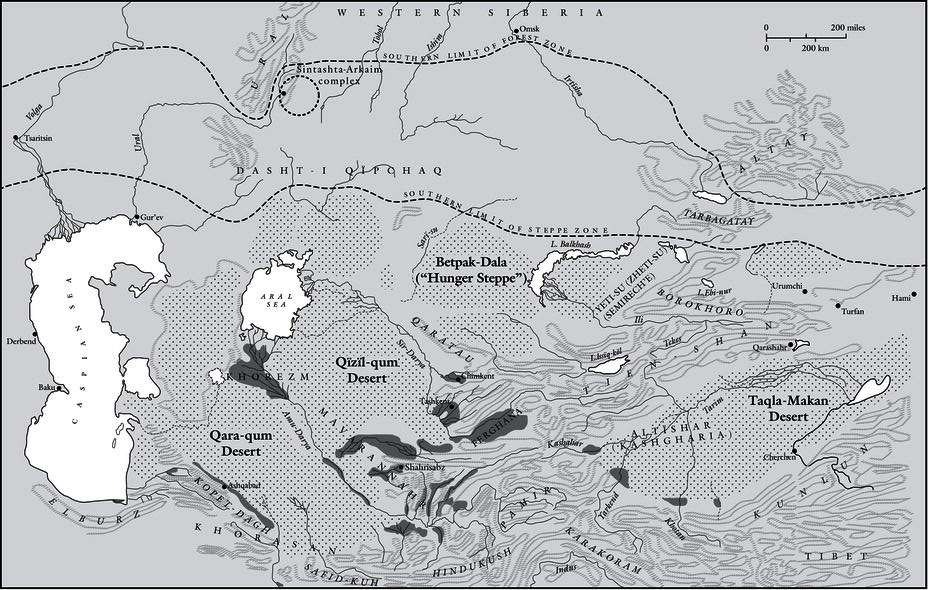
Nevertheless, the significance of this Armenian site has recently been overtaken by an even more astonishing discovery farther to the northeast. In 1992 a book entitled Sintashta was published in Russia. It described the discovery of early industrial settlements located east of the Ural Mountains on the northern steppe, far from any ancient agricultural-urban regions. The first site found was a fortified circular settlement filled with bronze metallurgy workshops. Several similar settlements, including a well-preserved site at Arkaim, were also discovered by Russian archaeologists. To date, at least 16 chariot graves have been discovered in nine separate cemeteries in the Sintashta-Arkaim complex, which has been dated to 1900–1750 BCE. For more than a decade information about these important discoveries remained accessible only to those who could read Russian. Now, however, readers of English can also find this information in David Anthony’s well-researched book, The Horse, the Wheel, and Language: How Bronze-Age Riders from the Eurasian Steppes Shaped the Modern World (2007).2 Indeed, the evidence uncovered in these horse chariot graves deep in the steppe suggests that scholars will be forced to abandon both the assumption that nomads could not produce their own manufactured products, and the core idea that they had to be constantly on the move. It is now clear that ancient peoples living on the steppe (see Map 16.1) were not only the inventors of sophisticated products, but also could create and sustain settlements, albeit relatively short-lived, to promote their own mobility.
So who were these innovative nomads? In particular, were they Indo-European speakers? David Anthony thinks so. As an archaeologist, he defends the field of Indo-European linguistic studies. He concedes that languages have nothing to do with human racial types, and that any correlation between a specific, archaeologically discovered material culture and a specific language is extremely difficult to establish. However, he proposes a new approach to analyzing the relationship between archaeological finds and linguistic reconstructions. He argues that even though one cannot directly link a certain kind of material culture or a certain physical type to a language, nevertheless a persistent, robust cultural frontier does seem to indicate the coexistence of two different cultures and two different languages. Furthermore, the shifting of such a frontier could suggest complicated interactions between the two peoples as well as migrations, and thus the spread of at least one of the languages to the other side (Anthony 2007: 106). Using this methodology, Anthony gathered a large amount of Eurasian archaeological data, including the Russian data mentioned above, and then he arranged it to create a historical narrative of the spread of Indo-European languages. Unlike most historians, he approaches the interface between the Eurasian steppe and various agricultural zones from the perspective of the steppe’s foragers and herders, instead of viewing it from the angle of ancient urbanites. His analysis gives a clearer picture of the development of a mutual dependency, as well as the existence of a volatile relationship, between these two zones.
In his chapter “The opening of the Eurasian steppes,” Anthony discusses the spread of the horse and then the horse chariot from the steppe to various Bronze Age states in the Middle East, as well as to other peoples living south of the steppe. In particular, the discovery in recent decades of the Bactria-Margiana archaeological complex (located in present-day northern Afghanistan and eastern Iran) reveals that agricultural oases and agricultural colonies had been established within this realm around 2100 BCE. Its people could thus provide way-stations for nomads driving horse chariots (thus good candidates for being Indo-European speakers) who migrated from the northern steppe toward the west and the south. The people who lived in this archaeological complex of walled towns and oases imported horses from the northern steppe, and traded with their contemporaries in urban western Asia. The language they spoke has yet to be determined. Sometime around 1800 BCE the population living in this complex began to decline, but the people who remained there did not abandon their sedentary agricultural-pastoralist society. Two or three centuries later, Vedic speakers arrived in South Asia with their horses and chariots, probably by way of this buffer zone.
If horse chariots are used as the gold standard, there is still a glitch in this picture of the spread of Indo-European-speaking nomads along with their material culture. The odd exception is the distribution of the Tocharian language family. This language was discovered and named in the early twentieth century, when many Tocharian manuscripts written on palm leaves and wooden tablets were discovered in the oases of the Tarim Basin (in present-day Xinjiang, northwestern China). It was one of several previously unknown languages deciphered from these manuscripts, and it seems to have been used mostly for writing Buddhist texts and commercial documents from the sixth to the eighth centuries CE. Tocharian clearly differed from other Indo-European languages found in this region (such as Khotanese and Sogdian) in that it was associated not so much with the eastern branches of Indo-European (such as Iranian and Sanskrit), but with Celtic and German. Indeed, it even has some features related to Hittite. Scholars have thus searched for the migration routes of these Tocharian speakers. One line of research has convincingly linked the Tocharian with the Yuezhi people, who migrated west from the northwestern border of agricultural China to a bank of the Oxus River, which they crossed into Bactria to eventually establish the Kushan Kingdom. Since then this region has been called the land of Tuharans, or Tokharistan. This migration is best explained by Craig Benjamin in his book The Yuezhi: Origin, Migration, and the Conquest of Northern Bactria (2007). While Benjamin’s book focuses on the Yuezhi people themselves, Connections across Eurasia: Transportation, Communication, and Cultural Exchange on the Silk Roads, co-authored by Xinru Liu and Lynda Shaffer (2007), addresses the interactions among nomadic peoples, including the Xiongnu, the Yuezhi, the Turks, and the Mongols, as well as their relationship with sedentary societies such as China, India, Persia, the lands around the Mediterranean shores, and the oases in Central and Western Asia. These works reveal both the mutual economic dependence and the hostility between two quite different kinds of people who lived in two different ecological zones. Among the nomads under study, the Yuezhi, or more generally, the Tocharians, the Sakas, and the Scythians, were likely Indo-Europeans. Nomadic people who spoke languages other than Indo-European, such as the Xiongnu, the Hephthalites, and the Mongolians, also seem to have been excellent horse breeders, valiant warriors, and savvy politicians.
Map 16.1 Central Asia, the land early Indo-European peoples once roamed. Note the location of the Sintashta-Arkaim complex, north of the Aral Sea. Other Bronze Age sites, including a number of copper mines, have also been found at a similar latitude, stretching from the Don River (just off this map’s western edge) to the Ishim River (east of Sintashta). These sites, taken together, offer compelling archaeological evidence for the presence of Indo-Iranian groups in the steppe between ca. 2100 BCE and 1800 BCE.
Source: Map of Central Asia based on Yuri Bregel, An Historical Atlas of Central Asia (Leiden: Brill, 2003), map 1.
In recent decades many dried corpses, dated from the second millennium BCE to the first millennium CE, have also been excavated along the rims of the Tarim Basin. Some of the corpses have high noses and socketed eyes, that is, the features of a “Caucasoid.” Those dated to the second millennium BCE, or the Bronze Age, have attracted the attention of both linguists and physical anthropologists. Although the skin color of these corpses, dried by the climate of the Taklamakan desert, has been hard to determine, the possibility of some linkage to European whites, or to speakers of the western branches of Indo-European languages, has been suggested. Some linguists think they may have spoken Tocharian, given that these people migrated to this location along steppe routes during the early second millennium BCE (Mair 1995; Mallory and Mair 2000: esp. ch. 9). This possible identification of a Tocharian-speaking Caucasoid or “Europoid” people living in the Tarim Basin has now been tentatively accepted by scholars of Eurasian studies.
Yet a more recent discovery in the same region, a burial ground on the bank of the dry bed of the Xiaohe (“Small River” – Chin.) near Loulan, Xinjiang, has raised questions about the Tocharian identification of the Europoid people who resided near agricultural China during the second millennium BCE. The corpses in this cemetery are so well preserved that their skin is still pale and their hair is still blond and thus there is no doubt that they were Europoid. They were buried in boat-shaped coffins, wearing fur hats, and were surrounded by baskets filled with wheat, millet and some gruel (Mair 2006). (Wheat was domesticated in western Asia, and millet was from China.) There is, however, no evidence of any horses or chariots, an important indicator of Indo-European speakers, according to David Anthony. These Europoid-looking people, living on the Xiaohe oasis between steppe and desert, would appear to have been farmers rather than horse-riding nomads. A peculiar phenomenon associated with these burials is that
Twigs and branches of ephedra were placed on or beside the body of every single person buried at SRC5. Some of the deceased were literally smothered in small bundles of ephedra and little bags of ephedra (as well as grains of wheat, millet, or barley) were sometimes tied along the edges of the capes wrapped around the bodies of the deceased. (Mair 2006: 299)
Both ephedra and hemp have been discovered in the Bactria-Margiana archaeological complex, and both are thought to be ingredients in the ritual intoxicant called “soma” in the Vedas and “homa” in Avesta Persian texts. If the ephedra indicates that the Xiaohe people were Indo-European in origin, they would most likely have spoken one of the eastern branches of the language family associated with Indo-Iranian, rather than Tocharian. In short, given what is now known, it is too early to say with certainty that Tocharian-speaking people migrated eastward along the steppe routes to the Tarim Basin during the second millennium BCE, or that their descendants were the Yuezhi who lived in the Tarim Basin and became famous for their horses, and then migrated westward to Bactria/Tokharistan where they built the Kushan Empire. Studies of the migration of Indo-European speakers in both prehistorical and historical times demonstrate that they could be city-dwellers, farmers, or horse-riding nomads. Likewise, they could be pale-skinned or dark-skinned. The association of a race with any particular language, in other words, has reached a dead end. On the other hand, using material cultures to match language affiliations is a more plausible approach, even though potholes often appear on this path as well.
Aryans and Brahmans
Although Max Müller spoke enthusiastically about the blood affinity between Europeans, including the British, and their Indian subjects, Victorian-age British and European race scientists continued to deny their equality with any dark-skinned Indo-European speakers in South Asia. Members of the Indian intellectual elite, on the other hand, more often than not Brahmans, entertained this racist interpretation of the caste hierarchy. Because of their Sanskrit heritage, they believed they were just as Aryan as their colonial overlords. Even though their identification with the Aryan race became a part of the nationalist discourse that condemned colonial rule, it also served as a defense of the privileged status of upper-caste Hindus, especially Brahmans. After the early twentieth-century discovery of ancient Indus Valley urban cultures, the archaeologist Mortimer Wheeler offered a new boost to the theory that invading Vedic tribes had become the upper castes in South Asia. The Indus Valley urban culture began to flourish around 2500 BCE, and started to decline in the early second millennium BCE. Excavations at Mohenjo Daro, one of the major cities on the Indus River, revealed what he thought was the scene of a “last massacre,” at the top level of the site. In a celebrated book, The Indus Civilization, first published in 1953, he portrayed the Aryans as successful invaders who wiped out the last of the Indus cities (Wheeler 1968: 131–132). This hypothesis seemed plausible and rational and was accepted by academics, and thereafter quickly made its way into Indian history textbooks.
In this “coherent picture,” the invading Aryan Vedic people and thus their descendants, the Brahmans and Kshatriyas, shared a similar physical appearance with European whites, while the indigenous Indus people were of a flat-nosed (i.e. ugly) variety. Physical anthropologists started busily measuring skeletons excavated from Indus Valley urban sites and trying to determine their racial types. They soon became mired, however, in the same sort of problems that had proved fatal to race science in other regions. The comprehensive data they accumulated provided no definite conclusions regarding the racial type of the Indus residents. Using the categories of race science, they found that the ancient Indus people belonged to a variety of races, including “Proto-Australoid,” “Alpine,” and “Mongoloid.” One particular skeleton had features that could have placed it within several different racial categories. Later, when the field of race science was waning, archaeologists reexamined the physical features of the ancient Indus people while studying their adaptation to the ecological environment and urban-agricultural life. This approach proved much more productive. They discovered that physically the ancient population on the Indus was not much different from the current one, and generally could have been linked to several large groups of people living in many places between the eastern Mediterranean and the western parts of Asia (Kennedy 1984).
Another fatal flaw found within the Aryan invasion theory was the inaccurate dating of the decline and disappearance of the Indus urban sites. After archaeologists began using carbon-14 to date the sites, they revised the time for the complete demise of Indus urban sites to circa 1700 BCE or even earlier. This made it clear that there had been at least a 200-year gap between the demise of the Indus civilization and the arrival of Vedic people. It also became apparent that the mid-second millennium date for the arrival of Vedic people in the Indus Valley was nothing more than an assumption. Given the lack of any datable archaeological remains for these 200 years, the linguistic dating of the Vedic arrival could not be pushed any earlier than circa 1500 BCE. Thus it is now clear that when the Vedic people who worshipped Indra arrived on the banks of the Indus River, they may have found the 200-year-old ruins of a city, but no people there to conquer.
No matter what language or languages were spoken by the ancient people in the Indus Valley and northern India in general, the arrival of a Vedic-speaking population led to an encounter between a pastoral nomadic population and a sedentary agricultural society. Indo-European linguistic studies and textual research on ancient documents have revealed some of the complexity of this encounter. In her book From Lineage to State (1984), Romila Thapar demonstrates that the Vedic language picked up a considerable amount of vocabulary from South Asia’s indigenous farmers. The warfare recorded in the Rg Veda and other epics seems to have occurred mostly between various Vedic lineages, and not so much with the “flat-nosed” Dasas or Dasyus. Indeed, local clans that had lived in India long before the Vedic people arrived were known to have joined with a Vedic lineage in order to pursue fights with another local lineage.
More recently, the linguist Asko Parpola has compared the Vedas with Avesta Persian texts and has concluded that the Iranian line of the Indo-Iranian branch and the Vedic line had actually been adversaries in Central Asia, and it was internal conflicts among these groups that caused the migrations of both lines to their later homes. Ashuras, demons in the Vedic culture, were Ahuras (gods) in the Zoroastrian religion; and Devas who were divine in the Hindu tradition were enemies of Ahuras in the Zoroastrian faith (Parpola 2002). Parpola also argues that the Vedic-speaking tribes were not the first Indo-European speakers to enter South Asia, and that Classical Sanskrit did not have its roots in the Vedic language, but was actually a continuation of another line of Indo-Iranian speakers who had arrived in India even earlier than the Vedic people. A battle over who would be dominant in northern India had broken out among various Indo-European lines and was recorded in the Rg Veda. Parpola argues further that the Dasas and Dasyuswere not indigenous to India, although they had arrived there prior to the Vedic peoples. Indeed he argues that the word “Das-” was of Indo-European origin. However, an article by the linguist J.P. Mallory, published in the same volume, disagrees with this view of the Indo-European origin of Dasa and Dasyu. Instead he suggests that the Bactria-Margiana archaeological complex was a way-station for Indo-European migrations to South Asia. Thus the chariot-driving Vedic people could have stayed in the agricultural and non-Indo-European-speaking zone of Bactria-Margiana, where they could have picked up some vocabulary or even some people, including the Dasa and Dasyu, on their way southward (2002: 38).
The history of Indo-European linguistic studies is a significant part of the intellectual history of the modern world. Early in its development it became entangled with the search for human origins and the resulting tensions between religious and scientific views of the world and its peoples. The discovery of linguistic similarities between the British colonizers and their Indian subjects gave birth to a false race science, but the search for the homeland of the Indo-European languages led to a study of nomadic peoples living on the vast Eurasian steppe and brought about the realization that the nomads were a well-integrated component of the human community. One limitation of Indo-European studies, in this regard, is that Indo-European speakers were not the only nomads who lived on the steppe and invaded and dominated sedentary lands. In their historical studies of nomads, scholars in this field often seem to forget or neglect the roles played in world history by those nomads who did not speak Indo-European languages. Nevertheless, one can easily understand why this happens, given the extraordinary amount of territory and time covered by these scholars, and the large quantity of important scholarship that this field produces.
Notes
1 This argument is developed more fully in Liu (2011), which also draws on some of these same sources.
2 Anthony discusses these Sintashta-Arkaim cemeteries, and their dating, on p. 397.
References
Anthony, David. 2007. The Horse, the Wheel, and Language: How Bronze-Age Riders from the Eurasian Steppes Shaped the Modern World. Princeton: Princeton University Press.
Arvidsson, Stefan. 2006. Aryan Idols: Indo-European Mythology as Ideology and Science, trans. Sonia Wichmann. Chicago: University of Chicago Press.
Benjamin, Craig G.R. 2007. The Yuezhi: Origin, Migration, and the Conquest of Northern Bactria. Turnhout: Brepols.
Childe, Gordon. 1942. What Happened in History. Harmondsworth: Penguin.
Cotterell, Arthur. 2005. Chariot: From Chariot to Tank, the Astounding Rise and Fall of the World’s First War Machine. New York: Overlook Press.
Darwin, Charles. 1871. The Descent of Man, and Selection in Relation to Sex. London: John Murray.
Darwin, Charles. 1979. On the Origin of Species by Means of Natural Selection. New York: Random House. First published 1859.
Diamond, Jared. 1992. The Third Chimpanzee: The Evolution and Future of the Human Animal. New York: HarperCollins.
Drews, Robert. 1988. The Coming of the Greeks: Indo-European Conquests in the Aegean and the Near East. Princeton: Princeton University Press.
Jones, William. 1807. The Works of William Jones, ed. Anna Maria Jones. 13 vols. London: John Stockdale & John Walker.
Kennedy, Kenneth A.R. 1984. A reassessment of the theories of racial origins of the people of the Indus Valley civilization from recent anthropological data. In Kenneth A.R. Kennedy and Gregory L. Possehl, eds, Studies in the Archaeology and Palaeoanthropology of South Asia, pp. 97–107. New Delhi: Oxford & IBH.
Liu, Xinru. 2011. Cong Yalian Ren dao Ouya Youmu Minzu, Tansuo Yinouyuxi de Qiyuan [From “Aryan” to Eurasian nomadic – Exploration of the origin of Indo-European languages], Lishi Yanjiu. Studies of History, 6: pp. 156–67.
Liu, Xinru, and Lynda Norene Shaffer. 2007. Connections across Eurasia: Transportation, Communication, and Cultural Exchange on the Silk Roads. New York: McGraw-Hill.
Mair, Victor. 1995. Prehistoric Caucasoid corpses of the Tarim Basin. Journal of Indo-European Studies 23 (3 and 4): 281–307.
Mair, Victor. 2006. The rediscovery and complete excavation of Ördek’s necropolis. Journal of Indo-European Studies 34 (3 and 4): 274–318.
Mallory, J.P. 2002. Archaeological models and Asian Indo-Europeans. In Nicholas Sims-Williams, ed., Indo-Iranian Languages and Peoples, pp. 19–42. Oxford: Oxford University Press for the British Academy.
Mallory, J.P., and Victor Mair. 2000. The Tarim Mummies: Ancient China and the Mystery of the Earliest Peoples from the West. London: Thames & Hudson.
Müller, Max. 1847. On the relation of the Bengali to the Arian and Aboriginal languages of India. Report of the British Association for the Advancement of Science, 349: 319–350.
Parpola, Asko. 2002. From the dialects of old Indo-Aryan to Proto-Indo-Aryan and Proto-Iranian. In Nicholas Sims-Williams, ed., Indo-Iranian Languages and Peoples, pp. 43–102. Oxford: Oxford University Press for the British Academy.
Rothman, Barbara Katz. 1998. Genetic Maps and Human Imaginations: The Limits of Science in Understanding Who We Are. New York: W.W. Norton.
Thapar, Romila. 1984. From Lineage to State. Delhi: Oxford University Press.
Trautmann, Thomas. 1997. Aryans and British India, Berkeley: University of California Press.
Wells, Peter. 1999. Barbarians Speak. Princeton: Princeton University Press.
Wheeler, Mortimer. 1968. The Indus Civilization. 3rd edn. Cambridge: Cambridge University Press. First published in 1953.