
DAMON IEREMIA SALESA
The largest single feature in the world, fully one-third of its surface, is the Pacific Ocean. So vast that all the land in the world would fit inside its perimeter, the Pacific is virtually incomparable. Though only a small fraction of the world’s people make the Pacific their home – Oceania – those people speak around a quarter of the world’s languages. The people of Oceania inherit some of the most ancient histories of humankind and some of its most singular achievements. Ancient civilizations that pioneered agriculture and horticulture, cultures that built some of the world’s most beautiful and impressive artifacts and monuments, and the greatest mariners of human history, the history of Oceania seems, to those who know it, as rich as in significance, complexity, achievement and human experience as any region on Earth. Yet outside of its bounds, and on the continents particularly, it is little known, marginalized, disavowed or excised. In world histories, as even in world maps, the biggest thing on Earth actually manages to be omitted or divided or occluded.
The Atlas of World History from Oxford University Press (2003, rev. edn 2010) can stand in for most historical works and their approach to the history of Oceania. A magnificent volume, the Atlas contains literally hundreds of maps in its over 300 pages. In all of these hundreds of maps, however, there is not a single one of the Earth that is Pacific-centered, nor are there any that actually offer a depiction where one can see the entire Pacific Ocean. On all the maps that depict the “whole” Earth, the Pacific Ocean is literally at the margins, dissected and excised, the bookends of the significant world. If one did not know it already, it would be impossible to surmise that a substantial proportion of the globe is absent from every single map: as is, for the most part, one of the continents, Antarctica. But unlike Antarctica, people inhabit the Pacific, and it is an ancient and necessary space for any world history. Of these hundreds of maps, only four have any interest in Oceania. One two-page spread depicts the peopling of Oceania over 11,000 years – although with most of the Ocean cropped out and many major archipelagoes unidentified; much later, readers find a two-page spread on Australia and New Zealand after 1790 (2010: 26–27, 202–203). This is hardly to single out the Atlas; its treatment of Oceania is typical. The Atlas simply makes visible and striking exactly what most world histories do in text: marginalizing, minimizing or occluding Oceania to the point of actually having to fundamentally misrepresent the Earth – even when their representations are in scales and projections of their own choosing. These representations are both powerfully silent and uninterested in Oceania.
Yet the histories of Oceania offer important challenges to many of the central tropes and narratives of world history. It is commonplace for world histories to be fashioned around divisions, categories and metaphors that cannot account for or describe Oceania, its peoples, cultures, or past. This is not simply a case of parochialism among specialists; as some have begun realizing, Oceania can restructure our understandings of many different scales and registers of the past. Any serious attempt to cast a world history that makes Oceania’s histories visible must grapple with the ways in which most “world histories” remain Eurasian-centric, land-centric and logocentric. Little wonder, then, that most such histories are unable to seriously engage or comprehend an extra-Eurasian, oceanic, and chiefly nonliterate immensity of human history. In these and other ways, global historians have tended to constitute their subject in ways that are unable to address the Pacific, or make it legible or visible. The answer is not simply to add the Pacific to an already defined world, to assimilate or annex it: but rather to understand how the trouble that Oceania presents is instructive in some of the blindspots and quiet hegemonies of world history.
Terms with which to talk about the Pacific are not straightforward among specialists, either. The complexity and vastness of Oceania mean that long-established categories for describing its geography and populations are generally unsatisfactory. The received tripartite division of the Pacific, where its peoples and lands are divided into Polynesia, Melanesia, and Micronesia, remains popular, not least because many contemporary people in these places share public identities that have partly been fashioned around these ideas. But the distinctions of Polynesia (“many islands”), Micronesia (“small islands”) and Melanesia (“black islands”) not only turn on crude nineteenth-century racial distinctions, but elide people, territory, language and culture in ways that are often either inaccurate and unhelpful. (See chapters by Liu and by Kramer, this volume.) These categories, for instance, are troubled even on their own terms by Fiji, which shares qualities, and is on the putative “border,” of Polynesia and Melanesia. Likewise such distinctions are substantively confounded by the presence throughout Melanesia of peoples, cultures and languages that are identified as “Polynesian” (usually called “the Polynesian outliers”). Rather than recognize the complexity that creates such situations, the usual answer is to stress that these people are, in a sense, out of place. Specialists may argue about the utility, as well as the analytical and political stakes, of these categories: but they remain in ordinary usage, and continue to order the self-views of most of Oceania’s people.
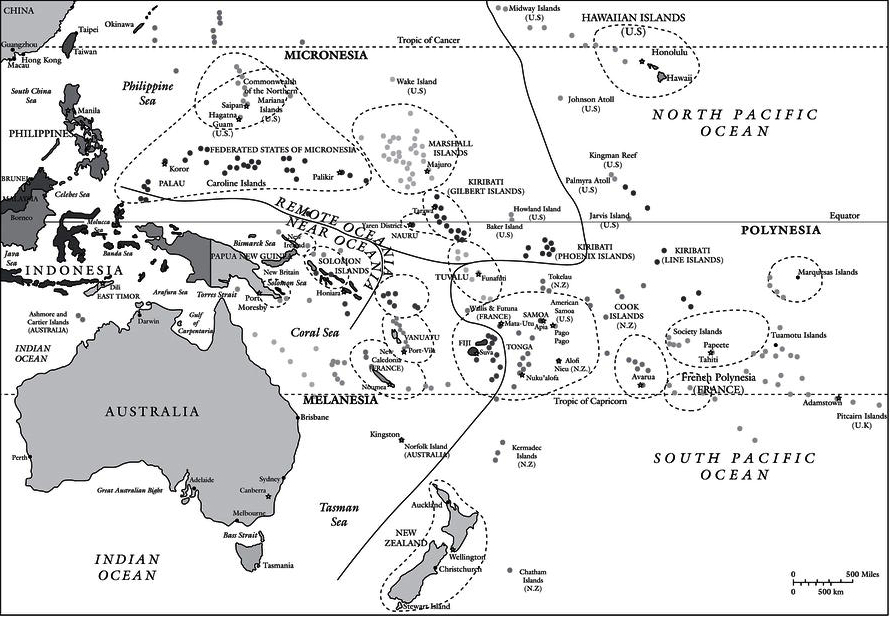
Other scholars of the Pacific have searched for different schemes to describe its peoples and places. Many of these distinctions are tuned to particular purposes, and do not claim fully to describe every combination of territory, people and culture/language. Of particular importance is the categorical distinction between “Near Oceania” and “Remote Oceania” (see Map 26.1), pioneered chiefly by Roger Green and other prehistorians and archaeologists. Along with the recognition of the continental shelves – where the outlines of Sunda and Sahul were once revealed by different sea-levels – these chart the great fields of human expansion into, and then throughout, Oceania. Near and Remote Oceania recognize this spatial and historical difference, as human relationships with each area hinge on the large break in time and space between them: between those that were settled at least 40,000 years ago, and those settled only in the last 3,000–4,000 years. Near Oceania is part of the chain of lands that stretched from island southeast Asia to the Pacific, and most of these islands could be seen from each other. Those that were not intervisible required voyages of around 150–200 kilometers – at the time of their settlement, probably the longest voyages humans had yet undertaken. But these great voyages paled against the magnitudes of the maritime task in moving from the Solomon Islands into Remote Oceania. The voyages grew longer and longer, and the targets mostly smaller. At this point, around 3,500 years ago, human voyaging began its deep-water history, with passages that began at over 350 kilometers and ended in the prodigious voyages to Rapanui (Easter Island), Hawai’i and New Zealand – surely among the great human achievements.
Map 26.1 Oceania, showing the major island groups and Near and Remote Oceania. Areas in close voyaging contact are within dotted lines.
Source: Based on map from Perry-Castañeda Library Map Collection, University of Texas at Austin, at http://www.lib.utexas.edu/maps/.
Yet because the variety of people and lands within Remote and (especially) Near Oceania is staggering, these categories are often too broad to tell stories accurately. In terms of language, for example, “Melanesia” remains the most diverse place in the world, with hundreds of languages of diverse origins. It exemplifies the difficult task of characterizing diversity in ways that are accurate but also usable to nonspecialists or at larger scales. Consequently, other distinctions are often mobilized: one common approach among linguists is to distinguish between the two groups of Oceanian languages – Austronesian and Papuan. In other cases, slippery terms appear to identify a historical population of people (and their culture) through material culture, such as a kind of pottery – for instance, “Lapita people.” These can be useful terms, but as with all terminological schemes they also present potential pitfalls to the comprehension and analysis of Oceania. Specialists in the region’s history have to stay on their toes when thinking through, and using, any particular terms (Clark 2003). Other disciplines underscore this need for care: genetic studies of the Pacific demonstrate in a different register just how complicated and interwoven the ancestry (as well as languages, technologies and cultures) of this region are. Although found on islands, the peoples of Oceania are enormously difficult to put into boxes.
This struggle to “come to terms” with the Pacific, and to find adequate ways to talk about its specificities and vastness, has another, perhaps more imposing opponent: the recent adoption of terms such as “Asia-Pacific” and the “Pacific Rim.” These common categorizations sit over Oceania, and serve to obscure and minimize it, fundamentally appending Oceania to a more populous but spatially smaller region (Asia), one that is already visible in – and often central to – standard renditions of the world. In a single imperious move Oceania is made at once less visible and distinctive, and incorporated into Asia as part of “Asia-Pacific” or the Pacific Rim. This makes little sense historically, but is useful as it meshes and supports, rather than troubles, standard projections of the globe. “Oceania,” the name I (like many other specialists) choose to use, places an opposite emphasis on the islands of the Pacific, exclusive of Asia and the Philippines. The term “Oceania” has its own problems, mostly due to its provenance in the same nineteenth-century moment as “Polynesia,“ “Melanesia,” and “Micronesia,” and it has its own vagaries – in some iterations it includes Australia and New Zealand, while in others it does not. Though an old term, coined elsewhere, Oceania now bears the standard for a new approach to the region, and has recently been reappropriated by Pacific and Pacific Islander scholars as a way to represent their reimagining and reinvigoration of the region.
In older models of world history – “Western Civilization plus” – there was virtually no place for the Pacific region. Insofar as the Pacific could be positioned in these kinds of narratives, it was either to gesture to the full arc of human settlement, or to describe the reach of modern empires, especially the British Empire. (See Sinha, this volume.) In such views Australia and New Zealand were consequently worthy of some attention, but only after James Cook or the British, not for the 40,000 or so years prior. The Pacific as prelude, and Europeans as the beginning of history: such a structure of “inclusion” is a well-worn treatment for histories outside Eurasia (and for many within). At any rate, it was rare for Oceania to be given more than a few sentences, even in books of prodigious size. The dominant theme was, effectively, that of invisibility. Recent world histories typically constitute their narratives very differently, and have been more robustly inclusive. But while this inclusion is apparent through a drawing in of non-Western civilizations, examples and features, whether Asian, African or Native American, this spirit of inclusivity usually dries up short of the coasts of the Pacific. In the ordinary phrasing of the global past, Oceania merits not even a passing mention.
No history can be total, and most world histories understand many of their own limitations. But the absence of Oceania and the Pacific is peculiar in at least two senses: not only is Oceania commonly invisible, and seemingly illegible, in most global narratives, but outside scholars rarely feel any compunction to rectify this. (Compare the increasing inclusion of, for instance, African civilizations.) The sources for this are evidently not only historiographical, but political and institutional, and are conspicuous in institutional and disciplinary arrangements. By these lights the marginalizing of Oceania is of a different order from that of either Africa or the (Native) Americas – which still literally and figuratively appear on the map, or in faculty corridors in Europe and North America. Outside of the Pacific region, ignorance of the history of Oceania seems congenital, but is also still entirely normalized. One world historian, for instance, whose work I otherwise enjoy, can obliviously declare that “there has not yet emerged an organized scholarly community focused on Pacific history” (Benton 2004: 427). This would come as news to the many centers specializing in Pacific history and culture, or the editors of any of the monograph series or journals, including, for instance, the Journal of Pacific History(established 1966) or the members of the Pacific History Association: just as it does to scholars, such as myself, who consider themselves Pacific historians. Oceania is demonstrably not an absence waiting to be called into history.
Thankfully, not all world historians are so silent towards Oceania, so a different engagement is evidently possible. This fact suggests that the marginality of Oceania owes less to selectivity, and more to limitations in historians’ knowledge or imagination. When world historians know more about the Pacific, they – for the most part – also become less convinced of its marginality. Jerry Bentley’s oeuvre is perhaps the best example of this point (Bentley and Ziegler 2008), also evident in the work of David Christian, who is oriented more to the Pacific as he teaches Big History from Australia, and incorporates far more elements of Oceania into his narrative than is customary or expected (Christian 2008). Likewise, J.R. McNeill, who has researched and written about Oceania, co-wrote a world history that includes and interpolates Oceania in ways that strongly distinguish it as a volume from others like it, and this is also evident in the well-known volume he jointly authored with his father (McNeill 2001; McNeill and McNeill 2003).
Scholars of the Pacific, meanwhile, have not stood still, and have been engaged with the turn towards global/world history from its outset. One obvious marker of this investment is the centrality of the University of Hawai’i in the institutional circles of world history, both as a point of origin for “world history” and as the home of both the World History Association and the Journal of World History. Yet, in many ways, this is largely due to the guiding efforts of particular individuals (Jerry Bentley, again). Moreover, the pages of the JWH are far from overflowing with articles on the Pacific (and it has not been a preferred publishing outlet for scholars of the Pacific). Indicative of both the limits and possibilities of an engagement between “world history” and scholars of the Pacific is a JWH article by Ben Finney, entitled “The other one-third of the globe” (1994). Finney, an esteemed scholar and a public intellectual well known throughout the Pacific for catalyzing and helping sustain the reinvigoration of ancestral Polynesian voyaging, wrote this essay as an accessible primer on over 40,000 years of Oceania’s history. Obviously, as his title suggests, he still saw the Pacific as neglected in the pages of the JWH, positing it as the lost third of the world.
A range of scholars of the Pacific have consciously responded to the rising challenges posed by world history, interest in it, and its increasing status. Ian Campbell, Tony Ballantyne, Rainer Buschmann, Andrew Pawley, and Paul D’Arcy all trained as Pacific specialists and have written substantially about world history (if, as with many world historians, as a second field), or about Oceania in ways that are inflected towards world history (Buschmann 2011; Campbell 1997; Pawley 2010). Paul D’Arcy’s The People of the Sea (2006) is particularly congenial to the scales and tasks of world history, but seems to have been little read by world historians. Incisive interventions by Tony Ballantyne, more directly engaging the historiography and problematics of world history, do so critically and from a perspective steeped in the Pacific (Ballantyne and Burton 2005; 2009; Ballantyne and Moloughney 2006). This raft of work pursues world history in ways that are recognizable by, and reflective of, traditions particular to those in Pacific history discussed above.
A very different angle of vision, but one at once global and centered on the Pacific, comes from a scientist who long worked in the Pacific. Jared Diamond’s stunningly popular Guns, Germs, and Steel (1997) is organized around a question putatively posed to him by a man from New Guinea, Yali: “Why is it that you white people developed much cargo and brought it to New Guinea, but we black people had little cargo of our own?” The central argument of Guns, Germs, and Steel is that the answer to “Yali’s question” has little to do with individual or cultural choices, but is preponderantly due to differences in environment, which become amplified into technological, biological, and political differentials. As Diamond himself later summarized it, his book was about “the differing rates of buildup of human societies on different continents over the last 13,000 years” (Diamond 2005). Diamond’s intent seems to be not just to produce a decentered, counterintuitive history, but also an antiracist and anti-Eurocentric argument. He argues that the differences Yali noted are the result not of inequalities in the potential of individuals or societies, but of originary differences in geography, biota, and other environmental factors. (See Simmons, this volume.) “Yali’s question” anchors Diamond to a particular nonmetropolitan space, and to the real-world concerns of peoples almost always excluded from history’s grand narratives. Such an environmentalist argument is not new, and Diamond’s claim to distinction is rather more that of synthesis and popularization than innovation, but his contribution remains nonetheless noteworthy. Diamond has offered a Pacific-centered vision of global history, where Oceania is treated as demonstrative, even exemplary, and where historiography (or historical narratives and plots) can begin and end in the islands, and with its peoples.
Yet Guns, Germs, and Steel has not been well received by Pacific Island specialists. Typically the harshest critics of Diamond were historians, many of whom have been exercised by what they consider his environmental determinism. (See chapters by Adas, Chase-Dunn and Hall, McKeown, and Yoffee, this volume.) But in the Pacific his strongest critics have been anthropologists: most academic Pacific historians, by contrast, have seemed uninterested. Some of these Oceanian critiques have been substantial and salient; others are familiar from, say, criticisms of Alfred Crosby’s work. But Diamond’s work in Oceania has also been scrutinized for his research methodology and accuracy (Errington and Gewertz 2004). This renewed scrutiny revealed much about Diamond’s work, including that the Yali in question was not the famous “cargo cult” leader, Yali, as had been assumed for years by all Pacific specialists, and which Diamond had done nothing to correct. Moreover, it seemed as if some of the interviews that Diamond used in his work had been misquoted, combined or fictionalized without attribution (Shearer et al. 2009). These critiques seemed to unmoor Diamond from much that was innovative about his work, and weakened the Oceanian edge that had been in some ways so striking.
Yet, although Diamond’s work has critical complications, its undeniable success – both in gaining a readership and composing a compelling narrative originating in Oceania – is proof positive that the current treatment of Oceania is not without alternatives. World histories centered on, originating in, or rich with Oceania will, almost by definition, be innovative. But there is more than simple novelty at stake, for there is much that is distinctive about the practice of history – teaching, writing, research, communal engagement – in the Pacific. Even the canonical, academic arm of Pacific history is far from standard when held against its European and North American counterparts. Although the serious, rigorous and specialized study of the histories of the Pacific is only about 50 years old, it has produced a dazzling array of works, many unrivaled in their quality, and many of which speak to scales of history larger even than the Pacific itself.
“Pacific history” as a subdiscipline has a distinctive genealogy. Typically it claims a specific point of origin: the assumption by James W. Davidson of the first chair of Pacific History at the Australian National University in 1949–1950. In the context of this time, Davidson’s vision amounted to a radical departure from previous academic efforts to study Oceania. Institutionally he represented a sharp departure from the previous situation, where amateurs and colonial officials had amounted to the only historians interested in the Pacific. Under Davidson, Pacific history professionalized: it took form around a PhD program (then still unusual in the Commonwealth world), and became research-driven. But these institutional arrangements merely brought the field’s practices into alignment with first-world institutions; what made Pacific history more distinctive, even radical, lay in its intellectual investments, the protocols of research and writing, and the political consciousness and commitment to decolonization foregrounded in historians’ work.
By the time Pacific history formally began, centuries of foreign empires in the Pacific had profoundly shaped the historiography of Oceania. Indicative of the kinds of denigration integral to imperial claims and colonial rule was the disparagement or erasure of a sense of value in the Pacific’s indigenous past. In the Pacific the sole subjects in which (“Western”) historians were interested were ones delimited by the activities of empires, Euro-American foreign policy, and the acts of a very small class of persons, almost solely foreign, white men. The only counterpoints to these narrow visions were located outside “history” per se: the historiographical efforts of missionaries, the vanguard of ethnographers, archaeologists and anthropologists, and a few travelers or white residents or indigenous writers. Few island or cultural groups had acquired written histories in a Western form; this was not simply a sign of a lack of interest, but of a disavowal by Euro-American scholars that Pacific Island cultures and peoples either had a history, or had one of any importance. This disavowal was precisely the first ground on which Pacific history had to struggle, to make the case that Pacific Islanders actually had histories, and that these histories were interesting and important. Pacific history had to reconstitute the subject of Pacific history so that it actually included Pacific islanders and cultures.
Pacific history as a disciplinary field thus made Pacific Island histories visible, and insisted that Pacific Islanders were subjects and actors in their own histories. To substantiate this reframing and reconstitution of histories hitherto ignored or invisible to foreigners, Pacific historians turned to innovative historical techniques. The most obviously distinctive step was the adoption of what Davidson called “participant observation,” an insistence that historians’ fieldwork was not only in the archives, but in the islands of which they were writing. This necessitated a deeper engagement with local languages and cultures, and aligned parts of Pacific history with what was elsewhere being called “ethnohistory.” Pacific history’s interdisciplinarity went well beyond anthropology, though, engaging archaeology, geography, the environmental sciences, political science, linguistics, and law. This interdisciplinarity, in confluence with historians’ accepted practices of archival rigor, always kept Pacific history from becoming narrow: Pacific historians had always to make their way to, and through, imperial and metropolitan archives, and empires remained central characters in modern Pacific history (Munro and Lal 2006).
Pacific history’s engagement with outside empires sat alongside, and in tension with, its deep commitment to locality and culture. In many instances it was the latter that seemed the most urgent, and before long there was some lamentation that Pacific historians were turning out monograph after monograph, and ultimately turning Pacific island groups into isolates. With few exceptions the first decades of these Pacific histories did seem to be suffering from what Kerry Howe called “monograph myopia.” There were few histories that tackled subjects that crossed or incorporated separate island groups, no synthetic overviews, and only one or two works that grappled with the largest scales or the interconnections that characterized living in Oceania. In this there seemed a parallel with anthropology, and it likewise meant that Pacific history did not present itself as easily assimilable to larger scales of history. (See Northrop, final chapter in this volume.) For decades the catchword in Pacific history was “agency,” a legacy of the struggle to reconstitute and revalue the subject of Pacific history, and one that tended to bring individuals and particular events into focus, but was less useful for capturing larger scales, structures, or comparisons. It severed rather than joined histories.
But there was an enormous exception to these isolated histories: one that turned Pacific historians to connectivities between and among islanders. This move was precipitated by the work of Andrew Sharp, which directly challenged the assumption historians, archaeologists and anthropologists had made about the sailing and exploratory prowess of Pacific Island ancestors. This view, typified in Te Rangihiroa Peter Buck’s Vikings of the Sunrise (1938), was singularly attacked by Sharp’s Ancient Voyagers in the Pacific, which recast these ancestors not as Te Rangihiroa had depicted them – heroic voyagers skillfully traversing the Pacific – but as gamblers taking their chances in a punitive lottery of sea, wind and current (Sharp 1957).This criticism was galvanizing, and drove a generation of scholarship that revisited and substantiated in great detail what technologies and knowledge lay behind the original exploration and discovery of Oceania. Sharp’s argument and analysis was systematically criticized and dismantled by later historical research – especially by Ben Finney and David Lewis, using contemporary sailing investigations with “traditional” Pacific island navigators (who do not use charts, compasses or other instruments) and a host of other techniques from archaeology to computer simulations (Lewis 1972a; 1972b; Finney 2003). Yet Sharp’s intervention proved to be the most powerful catalyst towards a better understanding of the variety of changing webs that connected and reconnected islands and archipelagoes: connections established before any Europeans had made any notable blue water voyages. This connectivity has become a defining feature of recent Pacific history, one through which the metaphors and narratives of the Pacific have been reimagined.
Pacific history has always grasped, and grappled with, the political nature and consequences of history and historiography, and as a result is already sensitized to some of the consequences of global history. This sensitivity was enhanced by the recency of the arrival of historiography in the Western-style – national textbooks, archives, historians, and so on – usually only since the 1960s. Given the sustained efforts required to achieve even this, it seems appropriate to be suspicious of moves that seem once again to marginalize or exclude Pacific Islanders from the “history club.” And while the explicit claims of world historians are inclusive, it is apparent that the key metrics of inclusion are decided upon by a very narrow group of practitioners, and that even compared to the profession at large these practitioners are disproportionately white, male, and metropolitan. These metrics of inclusion remain similar to those of earlier generations of world historians, and they have reinscribed the marginality or irrelevance of the Pacific to these narratives. Moreover, although the partiality seems so raw, patent and potent to those situated in Oceania, the language of these practitioners is yet again universalist: they are writing the history of “the human species,” our shared story – without, it seems, sharing the storytelling, telling the story in different ways, or asking if (or how) different peoples wish to be represented. Oceania now gets to be a part of the story, but still sings in the rear of the chorus, quietly, and to a tune chosen by far distant choirmasters.
On the one hand this is a familiar story about which local most powerfully gets to advance its claims to be global. (See Gerritsen, this volume.) The familiar political and economic strategies are, of course, conjoined with diverse cultural means, including the characterization and emplotment of the past. The choice of narratives by many world historians makes it clear that the cost of inclusivity in their grand narratives is high: because their measures of value so often remain calibrated to ethnocentric measures of “civilization,” technology and culture, Oceania’s histories appear to have little utility. Even now one finds that the Pacific is so profoundly disruptive to these grand narratives, it can still only be placed in a timeless “now,” where Pacific Islanders are seen as survivals of an earlier time: out of time and place in the contemporary world – living archives of an otherwise defunct earlier history. (See Pomeranz and Segal, this volume.) Most Pacific scholars (or African and Native American scholars for that matter) thought such notions had been put to bed, but they seem to retain currency in some realms, including world history.
Robert Strayer’s Ways of the World (2010), for instance, a popular US-based world history textbook, illustrates its first chapter (in a section titled “The ways we were,” subsection “The first human societies”) with one of its few mentions of Oceania. When it comes to some people, time, it seems, is of no matter: in a discussion of the deep human past, Strayer quotes a description of Australian aboriginals from 1770, placing it next to a photograph of present-day Aboriginal women and children (who are, according to the caption, digging for food). Flattening 1770, the present, and ancient times, Strayer explicitly casts Aboriginals as people without history, living in the present as relics of the past, out of time and place. Ironically, although the image is supposed, somehow, to represent a “Paleolithic” past, in it an older woman digs dirt with what appears to be a steel pole, wearing a green sweatshirt, while two young boys in shorts look on – one holds a mass-produced shovel and the other wears a baseball cap. Digging in the dirt is a shared characteristic of many systems of food production – including contemporary capital-intensive industrial horticulture – and presumably sweatshirts and baseball caps were uncommon in “Paleolithic societies.” No doubt Strayer did not consider putting a contemporary white American hunter, wearing camouflage clothing and holding an assault rifle or compound bow, as an illustration of the persistence of a Paleolithic hunting lifestyle. Yet he uses an image that could easily have been captioned “Australian woman digs hole: boys look on with shovel.” The salient feature, evidently, is the race of those photographed: and this example serves perhaps as another hint of why Oceania remains illegible in so many world history narratives.
If one challenge for world historians today is to learn about and engage Oceania, for Oceania’s scholars it remains a challenge to take what is distinctive about Oceania and renovate other kinds of large-scale history. Central to this task is the challenge of changing the narrative, to offer different kinds of emplotment, and to introduce a different range of characters. Currently, the subjects of world histories figure a fairly narrow range of political, environmental and regional actors: these are histories that value size and state actors, and a few other abstractions or aggregations that are visible through their methodologies and narratives. But world history seems to handle rather poorly the peoples whose lives are largely conducted “outside” of particular political or state formations. These are not “the people without history,” but peoples with “other” histories. In the Pacific many of these people live in polities and communities – small, but overlapping or intertwined – that are amazingly durable, politically congenial, and in key ways self-sufficient: yet which have always been engaged with distant places, foreigners, innovation and exchange. I have in mind the nu’u (“villages”) of Sāmoa or the kolo (“towns”) of Tonga: political, cultural and economic communities that have histories that cohere across many, many centuries. Always articulated with larger regional spheres, they were also tied to particular places, histories and cultures, and have become increasingly articulated and mobilized regionally and globally. Sāmoan and Tongan understandings were, however, always contextualized in the largest of known scales, and this persists today, where few places are more evidently global or transnational than Sāmoa and Tonga, with populations as large overseas as at “home,” and with their deep attuning to many different developments and places (Macpherson and Macpherson 2009; Besnier 2011). These, and similar places, offer unique occasions through which to reimagine world histories: they are indeed old, with deep histories of human achievement; but their durability in environments that are far from easy to inhabit offers a narrative of sustainability that is both remarkable and humbling (Macpherson and Macpherson 2009; Besnier, 2011). Even as these places sit on the “edge of the global,” longstanding styles of life – in agriculture, arts, politics and domesticity – are evidently not going away, and they remain vibrant, sustainable, dynamic and connected.
Each historical account, whether of the world or of Oceania, is redolent with views of the present. For decades the scholarly status quo, as well as that of development experts and metropolitan policymakers, has been that Pacific Island people, in their states, cultures and nations, were destined only for a position of global marginality, one where they would be dependent on the largesse of the world’s powerful and wealthy countries. By this view, Pacific Island nations, communities and peoples are small, weak, poor, remote, marginal and dependent. One influential characterization was that they were “MIRAB” societies, dependent for their lives on “Migration, Remittances, Aid and Bureaucracy” (Bertram and Watters 1985; Poirine 1998). This kind of analysis is also common among historians, including some specialists in the Pacific. As one Pacific historian declared in his recent survey of Oceania in world history, “Oceania and Australasia remain on the margins of world history,” their destinies being only to “generally modify the impact of these external forces rather than hope to shape them.” In his view, the peoples of Oceania (and Australasia) had been and would remain marginal, destined to be fought over by others, receptors rather than makers of global history, “linked to processes beyond its area over which they have no influence” and, at least in this view, with no hope to change (D’Arcy 2011).
Yet indigenous scholars, in particular, have challenged these ominous visions of dependency, powerlessness and marginality. The most often cited work in this vein, Epeli Hau’ofa’s “Our sea of islands,” was an explicit response to such assertions (chiefly of outsiders and elites) that Oceania is marginal, small, remote, hopeless and powerless. In making an argument that many Pacific scholars find visionary – especially indigenous scholars of the Pacific – Hau’ofa’s “Our sea of islands” contends that instead of seeing the Pacific Islands as remote and isolated “islands in a far sea,” it is more accurate to see them in the ways that Islanders have lived on them: as an ocean filled with islands, “a sea of islands” (Hau’ofa 1994). This view fits the term “Oceania,” and the argument also reconciles the largest and smallest of scales, seeing Oceania’s past and present in terms contrary to those who insist on the islands’ marginality and hopelessness. Oceania was not isolated but mobile, and not small, powerless or dependent, but expansive, agentive and substantially independent.
Hau’ofa remains the most widely read, but he was neither the first nor the only Pacific Islander to make such arguments. Such a view is in accord with the heroic creation accounts common in many Pacific Island cultures, and the daring and far-reaching – often cosmological – acts of the ancestors; and was no less evident in the work of modern Pacific writers. These writers, perhaps best characterized by the broad-based “Pacific Way” movement of the 1960s and 1970s, included Te Rangihiroa Sir Peter Buck, and a raft of other writers such as ‘Okusitino Mahina, Grace Molisa, Tuiatua Tupua Tamasese Taisi Efi, Konai Helu Thaman, Futa Helu, and especially the Sāmoan novelist and historian Albert Wendt.
Wendt (1976) was the first explicitly to reenvision the island Pacific as a “New Oceania” – in ways that were different from but compatible with Hau’ofa’s. This broadened, connected, islander-centered and politicized analysis of the Pacific present and past, which has at its heart interwoven archipelagic visions, recontextualized understandings of both local and large-scale histories of the Pacific Islands. Such an analysis has not been evenly embraced by metropolitan or foreign critics and scholars, but it has proven momentous for Pacific Islander students and scholars. Revealingly, while the numbers of indigenous Pacific Islanders working in disciplinary subfields of history (even in Pacific history) have remained sparse and fragile, indigenous Pacific Island students and scholars have been strongly attracted to the interdisciplines where these new analyses of Oceania – that are almost always historical in some way – prevail.
Increasingly, this archipelagic sensibility seems to characterize much that is distinctive about writings produced in the Pacific, but even more striking has been the recent emphasis on the ocean-going vessels that joined these archipelagoes. Pacific historians since Davidson have thought through a sense of islands and archipelagoes, using these metaphors and tropes to shape their narratives. If anything represents the newest trend among scholars of the Pacific, it has been this recentering around canoes and vessels: as subjects of study, as metaphors, tropes and symbols, but most particularly as implicit historical actors integrating the broad horizons of the Pacific. This new emphasis on connectivity is evident in ways that range very far from traditional types of maritime history. The touchstone collection Vaka Moana, the writings of Pa Tuterangi Ariki Sir Tom Davis, Dame Anne Salmond, Ben Finney and David Lewis, films such as Sacred Vessels (directed by Vince Diaz), or even my own work about the indigenous mobilities that dynamically constituted what might be called a “Brown Pacific,” all advance this sense of deep, expansive, durable yet changing connections over great distances and in large scale (Diaz 1999; Howe 2006; Salesa 2003; Salmond 2003; Davis 1992). In such a vein, canoes become vessels, not just for journeying across the ocean, between islands and islanders, but across time and scale as well.
In the multiplex ways of analysis this reframing of Oceania has inspired, the standard casting of Oceania as marginal or insubstantial has proven fundamentally contestable. If, as many different historians have persuasively argued, there is little analytical utility in crude center/margin metaphors, the world is better understood as meshes of relationships, as webs or “nested scales” or in other more complicated, distributed, ways. Scholars of the Pacific have, for instance, often shown how encounters in the Pacific were mutually formative with distant developments, whether this meant historical European ways of thinking about, experiencing and seeing the world (in a critical book, Bernard Smith called this the “European Vision” (1960)), or whether it meant more recent developments, from nuclear technologies (an industry critically active in the region) to anthropology, tourism and, not least, global militarism. In these realms the disposition of Pacific Islanders, their nations, cultures and states will remain critical and decisive in the next decades of global political arrangements: just as it has in the last. Guam, for instance, a critical pivot in American war planning through most of the twentieth century, is again absolutely vital, and informally referred to by US military personnel as “the tip of the spear.” The two great threats to Guam’s utility for the United States constitute very different kinds of challenge: on the one hand the military of its Asian competitor (China), and on the other the Chamorro nationalists and antimilitarism activists who seek to free Guam from US plenary power and the militarism it enables (Camacho and Monnig 2010). By such lights Oceania is less a margin than a frontier, a place where contestation and difference meet, where the stakes are higher and meanings are concentrated.
From such angles, answers to the challenges that world history and Oceania present to each other are not simply to append or include the Pacific, or to broaden the edges of the map so that its presence and people can be brought into focus. Even though recentering the world on unexpected locales, like Oceania, would at moments be very useful for its own sake, it seems far more important that to properly engage Oceania requires a reimagining of the fundamental narratives, categories, and subjects of world history. Oceania offers not just a disruption to (putatively) global narratives, but an invitation to remake them, and in key ways a suggestion of how this disruption might be undertaken. Arising from, perhaps, the world’s only truly Oceanic peoples, the archipelagic histories of Oceania both reveal, and potentially reorient, not only received histories but visions of the present. In this sense, a greater engagement with the Pacific and Oceania is not just additive or inclusive, but if undertaken fully may actually prove transformative. Quite literally, the world looks different when the Pacific is in it; and maps of time, and the world, also change shape when not just the Pacific, but Oceania, appears.
References
Ballantyne, T., and A.M. Burton. 2005. Bodies in Contact: Rethinking Colonial Encounters in World History. Durham: Duke University Press.
Ballantyne, T., and A.M. Burton. 2009. Moving Subjects: Gender, Mobility, and Intimacy in an Age of Global Empire. Urbana: University of Illinois Press.
Ballantyne, T., and B. Moloughney. 2006. Asia in Murihiku. In T. Ballantyne and B. Moloughney, eds, Disputed Histories: Imagining New Zealand’s Pasts, pp. 23–34. Dunedin: Otago University Press.
Bentley, J.H., and H.F. Ziegler. 2008. Traditions and Encounters: A Global Perspective on the Past. New York: McGraw-Hill.
Benton, L.A. 2004. No longer odd region out: Repositioning Latin America in world history. Hispanic American Historical Review 84: 423–430.
Bertram, G., and R. Watters. 1985. The MIRAB economy in South Pacific microstates. Pacific Viewpoint 26: 497–519.
Besnier, N. 2011. On the Edge of the Global: Modern Anxieties in a Pacific Island Nation. Stanford: Stanford University Press.
Buck, P. 1938. Vikings of the Sunrise. New York: Frederick A. Stokes.
Buschmann, R.F. 2011. The Pacific Ocean basin to 1850. In J.H. Bentley, ed., The Oxford Handbook of World History. Oxford: Oxford University Press.
Camacho, K.L., and L.A. Monnig. 2010. Uncomfortable fatigues: Chamorro soldiers, gendered identities and the question of decolonization in Guam. In S. Shigematsu and K. Camacho, eds, Militarized Currents: Toward a Decolonized Future in Asia and the Pacific. Minneapolis: University of Minnesota Press.
Campbell, I.C. 1997. Culture contact and Polynesian identity in the European age. Journal of World History 8: 29–55.
Christian, D. 2008. This Fleeting World: A Short History of Humanity. Great Barrington, MA: Berkshire.
Clark, G., ed. 2003. Dumont d’Urville’s Divisions of Oceania: Fundamental Precincts or Arbitrary Constructs? Special issue of Journal of Pacific History 38 (2).
D’Arcy, P. 2006. The People of the Sea: Environment, Identity, and History in Oceania. Honolulu: University of Hawai’i Press.
D’Arcy, P. 2011. Oceania and Australasia. In J.H. Bentley, ed., The Oxford Handbook of World History, pp. 546–563. Oxford: Oxford University Press.
Davis, T. 1992. Vaka: Saga of a Polynesian Canoe. Suva: Institute of Pacific Studies, University of the South Pacific.
Diamond, J. 1997. Guns, Germs, and Steel: The Fates of Human Societies. New York: W.W. Norton.
Diamond, J.M. 2005. Collapse: How Societies Choose to Fail or Succeed. New York: Viking.
Diaz, V., dir. 1999. Sacred Vessels: Navigating Tradition and Identity in Micronesia. Honolulu: Pacific Islanders in Communication.
Errington, F.K., and D.B. Gewertz. 2004. Yali’s Question: Sugar, Culture, and History. Chicago: University of Chicago Press.
Finney, B. 1994. The other one-third of the globe. Journal of World History 5: 273–297.
Finney, B.R. 2003. Sailing in the Wake of the Ancestors: Reviving Polynesian Voyaging. Honolulu: Bishop Museum Press.
Hau’ofa, E. 1994. Our sea of islands. Contemporary Pacific 6: 147–161.
Howe, K.R., ed. 2006. Vaka Moana: Voyages of the Ancestors: The Discovery and Settlement of the Pacific. Auckland: David Bateman.
Lewis, D. 1972a. The Gospel according to St Andrew. Journal of Pacific History 7: 223–225.
Lewis, D. 1972b. We, the Navigators: The Ancient Art of Landfinding in the Pacific. Honolulu: University of Hawai’i Press.
Macpherson, C., and L.A. Macpherson. 2009. The Warm Winds of Change: Globalisation in Contemporary Samoa. Auckland: Auckland University Press.
McNeill, J.R. 2001. Environmental History in the Pacific World. Aldershot: Ashgate.
McNeill, J.R., and W.H. McNeill. 2003. The Human Web: A Bird’s-eye View of World History. New York: W.W. Norton.
Munro, D., and B.V. Lal. 2006. Texts and Contexts: Reflections in Pacific Islands Historiography. Honolulu: University of Hawaii Press.
Pawley, A. 2010. Prehistoric migration and colonisation processes in Oceania: A view from historical linguistics and archaeology. In J. Lucassen, L. Lucassen, and P. Manning, eds, Migration History in World History: Multidisciplinary Approaches, pp. 77–112. Leiden: Brill.
Poirine, B. 1998. Should we hate or love MIRAB? Contemporary Pacific 10: 65–105.
Salesa, T.D.I. 2003. “Travel-happy” Samoa: Colonialism, Samoan migration and a “Brown Pacific.” New Zealand Journal of History 37: 171–188.
Salmond, A. 2003. The Trial of the Cannibal Dog: Captain Cook in the South Seas. London: A. Lane.
Sharp, A. 1957. Ancient Voyagers in the Pacific. Wellington: Polynesian Society.
Shearer, R.R., M. Kigl, K. Keleba, and J. Elapa. 2009. Jared Diamond’s factual collapse: New Yorker mag’s Papua New Guinea revenge tale untrue, tribal members angry, want justice. At http://www.stinkyjournalism.org/latest-journalism-news-updates-149.php(accessed Oct. 30, 2011).
Smith, B. 1960. European Vision and the South Pacific, 1768–1850: A Study in the History of Art and Ideas. Oxford: Clarendon Press.
Strayer, R. 2010. Ways of the World. New York: Bedford/St Martin’s.
Wendt, A. 1976. Towards a New Oceania. Mana Review 1: 49–60.