
ROBERT B. BAIN
The popularity of a high school course often masks the challenges students and teachers face in learning its content. Such, I think, is the case with world history. While it is the fastest growing subject of the secondary social studies curriculum in the United States1 – by 2005 over 75 percent of American secondary students were graduating having taken a course in world history, an increase of more than 125 percent in the last 30 years (Cavanagh 2007: 10) – world history is a course with distinctive and often unacknowledged challenges for secondary history teachers and students.
Obviously, one challenge is the amount of content “covered” in a course traversing all of human history. How can history teachers and students work with such a vast range and scope of content as studying the whole world’s history seems to entail? “How am I supposed to teach all that stuff?” is the teachers’ version of the students’ “how am I supposed to learn all that stuff?” Frankly, with the average world history textbook weighing in at a bit over 7 pounds, that is a good question to consider. For teachers and students, it is not easy to bring the whole world’s history into focus while avoiding the “one darn thing after another” approach, or the cultural cavalcade that plagues so much history instruction. The danger, of course, is a fragmentation of understanding – where students acquire knowledge in pieces, and are unable to weave what they learn into a coherent and usable picture of the past.
Of course, developing coherent history at a national, regional or even local scale is also a challenge. But it is a much more challenging task for teachers and students of world history because of the temporal and spatial scales nested within the world history enterprise. These require students to make connections among events and processes occurring across a vast range of time frames and within geographic settings of different sizes. To avoid fragmentation and to construct a coherent and usable understanding of the past requires world history teachers and students to learn to manage what Tom Holt (1995) has called “the levels problem,” a complicated issue of “establishing the continuity between behavioral explanations sited at the individual level of human experience and those at the level of society and social forces.” The historian’s task, Holt argues, and, by extension, I think the history teacher’s task, is “to simultaneously grasp the manifestations of the very large and abstract structures and the transformations of the world in the small details of life” (1995: 8). Michael Adas (1998) agrees, arguing that world history must “infuse the contextual analysis of world systems and structures and aggregate socioeconomic transformations with serious attention to ideas, human agency, and contingency.” Or to repurpose Emmanuel Le Roy Ladurie’s semicryptic categorization of historians, world history requires historians – teachers and students – to be both parachutists and truffle hunters.2 In this chapter, I argue that the intellectual capacity to move strategically among temporal and spatial scales is useful, even outright necessary, for both world history teachers and students if they are to avoid the fragmented approach of too many history courses that requires students to commit one fact after another to memory. A parachute and a nose for history’s truffles are required to make sense of all the events and changes teachers and students encounter in studying the world’s history. A small but instructive body of international research on teachers’ and students’ historical thinking suggests that without explicit instructional attention, thinking effectively across different scales is “unnatural” in both teachers and students.3 This essay suggests that making meaningful connections among world-historical events and processes is particularly challenging, for three identifiable reasons.
First, the resources for teachers and students in world history reflect the fragmentation and incoherence that history education seeks to mediate or avoid. Standards and textbooks rarely present teachers or students with a coherent path through the blizzard of facts, concepts, eras and cultures that define courses in world history. School-standards documents, constructed as they are in lists of learning outcomes, rarely develop instructional connections to help teachers link content to particular classroom approaches. Textbooks and standards documents, at least as written in the United States, reflect confusion within both the scholarly and educational fields about what exactly constitutes “world history.” There remains wide variation in the ways American state governments, curricular standards, published textbooks and working teachers present world history. Analysis of world history standards reveals sharp differences in periodization schemes, criteria used to judge historical significance, units of analysis, and the temporal-spatial scales that frame world history content. Although most American students graduate with a course labeled “world history” on their transcripts, in practice there are at least four variations for what this means, variations I define as (1) Western heritage, (2) serial area studies, (3) social science thematic history, and (4) global world history. Each has its own unique issues in helping students develop coherence. However, as common standards and mass-market textbooks are meant in part to help teachers develop these connections, the variation among models creates a complicating challenge. Further, and of fundamental intellectual as well as pedagogical importance, these models are not equal in their capacity to develop nested pictures of the world’s history. Some focus particularly on one or more regions of the world, or on disconnected and often achronological themes. Thus the tools ostensibly designed to assist teachers often place a burden on them to make meaningful connections, both for themselves and for their students.
Second, there is increasing evidence that teachers’ own knowledge of world history is also often in pieces, reflecting one or another of these models of history. Thus, teachers may also have difficulty moving fluidly across historical space or time, or among the various approaches to the global past. And finally, there is modest but informative work in the educational literature on the challenges students face in understanding changes that occur on large scales.4 Such research suggests that students have difficulties “seeing” the past at different scales, of conceiving of causal agency outside of individual human actions, or moving among and between what Braudel (1980) called the events, structures and longue durée. Teaching and learning world history requires teachers and students to “grasp the manifestations of the very large and abstract structures and the transformations of the world in the small details of life” and to become more aware of the challenges they face in doing so – but success will increase the possibilities of our improving instruction in real-life world history courses. (See Getz, this volume.)
A Teaching Problem: Figuring Out the Story and Connections
To introduce the issue more concretely, I begin with a “thought experiment” that my colleague Lauren McArthur Harris and I have used in workshops with hundreds of history teachers over the past 10 years. We ask teachers to construct three- to five-minute histories of the United States, of Western civilization, and of the world. With only a few exceptions, the results are strikingly similar. When asked to craft a short history of the United States, teachers typically get right to work, identifying familiar eras and events, and explaining relationships between them. The structure of these US histories is usually remarkably similar, with common key events: Native American societies, European settlement and colonization, the War for Independence, Constitutional Convention, Civil War and Reconstruction, westward expansion and industrialism, World Wars, Depression and New Deal, Cold War, and the civil rights movement. Not only do the teachers string events together, but they often capture processes that link these events into a narrative that builds meaning. Likewise, teachers quickly develop a coherent short story of Western civilization, often marked by common turning points and events: River Valley civilizations, classical Greece and Rome, Dark and Middle Ages, the Renaissance, Reformation, Enlightenment, nation-states, exploration, democratic revolutions, industrialism, imperialism, World Wars and Cold Wars.
History teachers, ranging from relative novices to seasoned veterans, thus had readily available large-scale stories to frame change over time in the United States or in Europe. Quickly they decided what events to include and which to omit, and how to connect included details to the large events that defined their histories. However, when asked to craft a short history of the world, the reaction was very different. Few got right down to the task. Most struggled over the most basic matters: where to begin, what to include, and how to order what they included. Some tried to tell multiple short histories of India, China, and Europe. Others used European periodization schemes (e.g., Middle Ages, Renaissance) to situate different civilizations, such as China or India, against a European backdrop. Most said it was a difficult if not impossible task, one for which they were not well prepared. Unlike US or Western history, constructing frames large enough to organize their thinking of world history proved a challenge. Teachers reported feeling bogged down with details, unsure about what to include, what to leave out, and how things were connected to one another.
Here is the crux of world history’s distinctive teaching and, consequently, learning problem. When confronted with lists of US or Western history standards or corresponding textbooks stuffed with details, most teachers appear to have a rough sense of key turning points and major events – a broad narrative on which they can hang the details. To use Ladurie’s categorization scheme of historians, when approaching more familiar national or regional histories most teachers are like parachutists gliding over the historical landscape. From that distance they can see the entire temporal and spatial topography and the relationships among large structures; and while floating down they are able to situate close-up detail as it comes into view. However, these teachers do not seem to approach world history from the grand perspective that distance allows, acting instead like Ladurie’s truffle hunters, noses in the dirt sniffing out disconnected but precious details.
Sense-making in history requires both a parachute and the nose for truffles or, to shift metaphors, the ability to view history using different lenses, including the wide-angle, medium-range and close-up lenses. The turn of mind to move among and see the relationships between different temporal-spatial scales defines all history, surely; but particularly world history.
Now, this is not a cry for creating some grand world-historical narrative of progress or regress, but rather an attempt to underscore the importance of teachers having usable “big” pictures or frameworks to situate and connect a wide range of macro- and microhistorical details, details located across multiple temporal and spatial scales. Frankly, the more familiar national or regional containers, while necessary, are not big enough for the task. If world history teachers cannot construct, when necessary, coherent global pictures, then it is understandable why so much world history appears to be a cavalcade of different and disconnected cultures, civilizations or events. And without the knowledge and habits of mind needed to build global, cross-temporal and regional connections, it is difficult to imagine that teachers will be able to help their students make such meaning from all the “stuff.”
Such is what Lauren McArthur Harris (2008) found in her study of 10 veteran and prospective world history teachers. Harris asked teachers to sort and build concept maps – big pictures – using a seemingly random stack of 18 historical events and concepts, such as the Atlantic Slave System, Bantu Migrations, the Renaissance, and the Cold War. The events and concepts Harris selected were located at different time spans and territorial scope. Some events crossed large expanses of time and huge regions of the world (e.g. Atlantic Slave System), while others lived in smaller bands of time and geographic area (Renaissance). As the teachers sorted and used these cards to build their concept maps of world history, Harris prompted them to talk aloud about their decisions. Thus, she not only saw how teachers used historical events to create a big historical picture, but was also able to hear their thinking for each move. Teachers did the card sort twice: first to capture their own understandings, and then to explain how (or if) they might structure these same events for students.
The differences among these 10 teachers were stunning. Using both chronology and temporal-spatial categories to sort and place the event cards on the developing concept map, the experienced teachers filled the space between cards with connecting lines and/or language showing dynamic relationships among and between events, regardless of the region, time period or scale in which the teacher initially categorized the card. Some of the veteran teachers, all with specific training in global or world-scale history, developed complicated conceptual maps by building contextual, comparative, causal, or consequential relationships among and between the events (see Figure 7.1). Like a road map with many roadways linking cities or points of interest, these cognitive maps showed potential links among historical events. As they constructed the webs, these teachers operationalized levels of thinking as they described the continuities and discontinuities they saw among macro- and microhistorical events, swiftly moving among and across events at different temporal and spatial scales.
Listen to one of these teachers as she moves among global and regional events trying to figure out where to place them or how to connect them:
Well it’s hard because these are so … I mean you’re looking at a global perspective but then you put them into areas where … I have Africa and I have Europe … But then you have things like the Silk Route, which involves Asia, Africa, and Europe, so I would kind of piece that out on its own. And then, the Incas and the Haitians are in the same area, however, I wouldn’t necessarily … I mean they don’t connect. And then the Development of Written Language, Agricultural Revolution, again those are things that affected a large area, although occurring more in the Middle Eastern area. They have such an impact on Europe and Africa and Asia. So I’ll put that … it all kind of interacts with one another, because when you’re teaching world history you’re looking at it not only from what happened in Africa or what happened in Europe but the global perspective of things. (Harris 2008)
Figure 7.1 An expert teacher’s concept map using multiple scales and multiple connections.
Source: Lauren McArthur Harris, “Building coherence in world history: A study of instructional tools and teachers’ pedagogical content knowledge,” PhD diss., University of Michigan, 2008, p. 305.
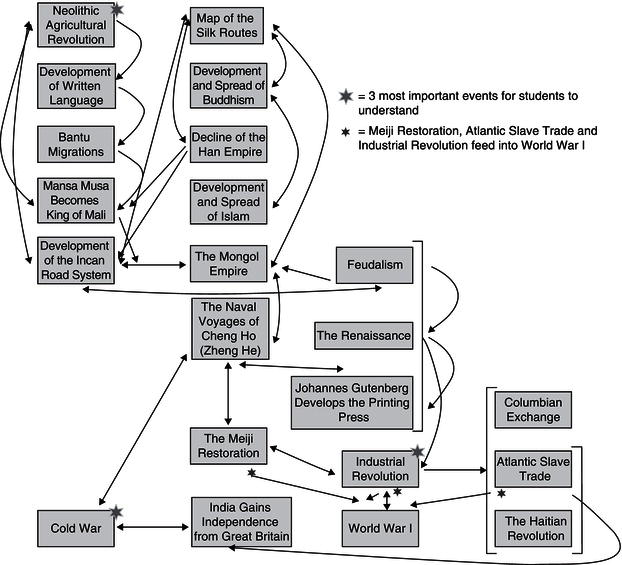
Messy thinking to be sure, but thinking that displays both the knowledge and habit of mind to make meaningful, nested connections among events ranging across various time periods and located in different geographic space. Such thinking defined all the “experts” in Harris’s study.
However, as shown in Figure 7.2, other, less experienced teachers constructed far less dynamic pictures, employing simple chronology to organize events or placing the cards into a handful of regional (e.g., Europe, Africa) or institutional categories (e.g., economic, political, or religious). Two key features differentiated these maps from the others discussed above. First, there were far fewer attempts to connect events, as the novice maps had significantly fewer connecting lines and language. Second, once an event landed in a category, teachers typically treated the event as an exampleof the category, such as government or trade. It lost historical specificity, although it is not clear to me whether these teachers initially had much detailed knowledge of the events to lose. Some novices drew connecting lines between categories, such as government and economy, but almost none between historical events. When they did make connections between events, novices rarely gave an explanation, and often drew the connections with hesitation. For example, a novice preservice teacher in Harris’s study explained that in teaching the Meiji restoration, she would “say what feudalism is, and use the [Meiji] Restoration as an example, but I don’t know how I’d do that.”
Figure 7.2 A novice teacher’s concept map organized by region with few connections.
Source: Harris, “Building coherence in world history” (as Figure 7.1), p. 308.
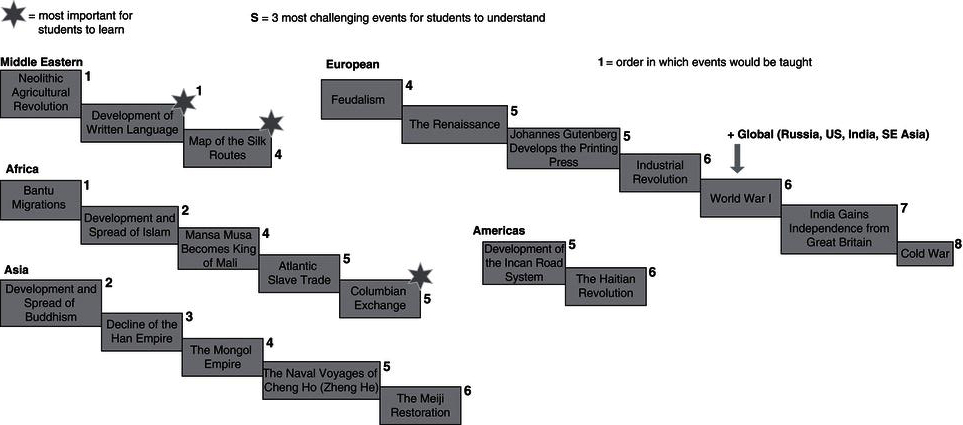
All the teachers in Harris’s study attempted to develop meaningful connections among the events of world history. And all the teachers did find ways to sort and group the historical events so that no event stood alone. However, only the first group of teachers explicitly situated events in their respective historical place, using global, interregional and regional scales, linking and nesting them, demonstrating multiple connections and pathways, and suggesting complicated understanding of change over time and space. Other teachers made significantly fewer connections, often using atemporal or aspatial categories to group the cards. And in discussing the events, these novices were more likely to treat them in isolation or to puzzle about how to connect them to others.
These differences, Harris argued, were not simply a matter of knowing the details of particular historical events, although that certainly played a role. Nor was the variation among participants related only to the raw number of years teaching world history or to specific courses taken. Rather, Harris speculated that participation in a curriculum and professional development specifically focused on world history at a global scale had helped prepared these “expert” world history teachers to see more useful conceptual schemes. Both knowledge of particular events and knowledge of possible connections spanning centuries, or millennia, across nations, continents or hemispheres, seemed to enable these teachers to develop more meaningful connections for themselves, and, Harris suspected, for their students.
Standards in World History
Ironically, some recent efforts in the United States to foster the growth of world history may have exacerbated this problem of developing a clear “framework” for teachers and students. In particular, the standards movement of the past 20 years has instantiated the tensions among frameworks described above. Although there has been modest change in the past 10 years, the main approaches to the subject continue to vary in periodization schemes, criteria used to measure historical significance, units of analysis, and the temporal-spatial scales that frame the world’s history (Bain and Shreiner 2005; 2006; Marino and Bolgatz 2010). Although now almost ubiquitous in the US secondary-school curriculum, world history has taken on specific content that differs greatly from state to state, textbook to textbook, school to school, and likely even classroom to classroom.
While there may be agreement over the value of world history, that does not necessarily mean there is agreement on what history students should study. Indeed, scholars analyzing state standards have found distinct patterns to the shape of world history: although the names used to describe specifics vary, the general picture is the same. World history appears to be structured around either a Western civilization model, or a thematic social studies frame, or an area studies approach, or a global history frame. These unfold as follows.
Western civilization model
This model has its origins in the Western Civilization framework that became a staple in US history teaching as early in the 1920s (see Pomeranz and Segal, this volume). Western Civilization has a familiar narrative that traces the development of “civilization” westward from ancient river valleys to Greece and Rome; through an interregnum variously called the Dark or Middle Ages; followed by a cultural rebirth and Reformation; and then transformation created by enlightened and scientific thinking, the rise of the nation-state, growth of national economic systems, democratic revolutions, and industrialism. The narrative structure has a coherence populated with familiar and important political events (e.g., the rise and fall of Rome, the French Revolution) and famous people (e.g., Galileo, Bismarck), stressing the “rise” of the West.
The world history version of this narrative adds cultures and civilizations beyond Europe, but without dramatically shifting the key events or the underlying narrative structure (see McKeown, this volume). In adding important “non-Western” content, this curricular pattern nevertheless continues to place Europe in the center of study. Although states call this sort of standard and curriculum “world history,” approximately 70 percent or more of the content is devoted to the study of Europe, and it relies upon Western Civilization’s periodization schemes and organizing features.5This pattern appears to be the most dominant among American state standards documents today, with about 29 states adding non-Western content to what appears functionally to be a Western civilization model.
Thematic world history
There are a few states that use political or economic themes to shape world history. While on the surface these appear to offer an opportunity to develop the coherence on a global scale that the Western heritage model lacks, typically these thematic approaches also suffer from an almost exclusive focus on European events and thus reflect a regional rather than world approach. Marino and Bolgatz, for example, found that the topics and themes mentioned are almost always those that are standards in the Western Civilization course, such as “revolutions, nationalism, industrialization, imperialism, and world wars.” They noted that while these topics could be “interpreted as global phenomena, they tend to be viewed here as distinctly European events” and when using non-Western topics, they are always situated in relationship to an event from European history (2010: 375). In focusing on large, grand generalizations and stressing broad themes or processes, these versions of “world history” draw attention to big ideas that appear to be global and crossing scales, but upon digging a bit deeper, reflect merely a different version of the regional, Europe-focused course structure.
Area studies history
A smaller number of state documents reflect features of a geographic or regional studies approach to world history. This pattern treats geographic regions of the world separately (e.g., Africa, Asia or the Middle East), often folding the history, geography and economics into one combined study. In many ways, this is analogous to the traditional Western Civilization course model, now applied to civilizations or regions outside of Europe or the United States. While no state exclusively embraces this approach for high school history, we did find a number of states whose standards reflected significant features of the Regional History approach, particularly in the middle school years. Many school districts also use a Geographic/Regional History pattern in offering world history courses to students.
“Global” world history
The last pattern, Global World History, constitutes a self-conscious attempt to locate history at different scales of time and space, specifically adding transregional historical processes to the study of regions and civilizations. This approach often asks students to move among different scales of time and space – sometimes focusing on a person or group, at other times on the nation, civilization, region, transregion, or even the globe.
The Advanced Placement (AP) World History course is the best example of an approach in the US that combines transregional and civilizational studies, requiring students to look both at and across regions of the world. According to the AP World History Guide, one of the distinctive features of a global history course is that it requires students to study large patterns over time and space, “while also acquiring the ability to connect local developments to global ones and move through levels of generalizations from the global to the particular.” For example, while studying the development of civilizations, the AP course also looks specifically at global processes and interactions, such as trade and migration across different types of societies over time. Because a global world history course, at times, unties school history from its typical mooring of the nation or civilization, AP provides specific guidance to teachers to help them balance attention to global processes with other features that constitute history. For example, AP limits its course of study to five chronological periods, five key themes, and the major civilizations within four regions. The AP course guide also specifies that “coverage of European history does not exceed 30 percent of the total course. This encourages increased coverage of topics that are important to Europe in the world and not just to Europe itself, as well as attention to areas outside Europe.” Comparative history plays a significant role in the global approach as students compare different political, economic and social systems (e.g., “compare industrialism in Japan and Western Europe,” or “compare Haitian, American, French, Mexican, or Chinese revolutions”).
The AP World History course remains the best example of the global world history approach in practice, and it appears that more US states are now starting to use this framework to organize world history. The standards in at least eight states show significant global, comparative and chronological features of this pattern. Over the last few years, this number has increased slightly. Because of its growing popularity and increasing success among both school districts and students, the Global World History pattern as typified by AP World History is an important approach to consider for a possible national assessment in the school curriculum, even though its shape and content still differ greatly from state to state, textbook to textbook, and school to school.
Recently, a few states have moved toward a more global focus, but within an existing (other) framework. For example, New Jersey has begun to pepper its standards with issues of globalization and comparative history, where the comparisons typically involve relating cases across regions or sometimes across regions and over time (e.g., “Compare slavery practices and other forms of coerced labor or social bondage common in East Africa, West Africa, Southwest Asia, Europe and the Americas,” or “Determine the global impact of increased population growth, migration, and changes in urban–rural populations on natural resources and land use”) (Marino and Bolgatz 2010: 375). The new Michigan standards nest their content along three different temporal and spatial scales, called (a) Global and Cross-temporal, (b) Inter-regional, and (c) Regional. This approach “offers a way to connect specific historical content to broad concepts and ideas” situated at the global and interregional scales, yet the nesting of standards at three different levels – that is, the connections from the regional to the global and back again – are not always clearly articulated, and thus the Michigan standards represent a “hybrid” of the global, the thematic and the area studies approach to world history (Marino and Bolgatz 2010: 386).
Figuring Out How Students See the Story and Make Connections
Seeing bigger global pictures and being able to make connections among historical events is only one facet of the professional problem faced by teachers of world history. Their jobs are more complicated than simply understanding world history for themselves, as they must also help students develop such understanding. Thus teachers have to understand how adolescents build meaning from events scattered over the grandest scope of time and space, and recognize the challenges students face in learning to see (or care about) the world from such distances.
Research suggests that adolescents are not typically parachutists, particularly when it comes to understanding historical change. A number of studies reveal a tendency for students to gravitate toward the “personal” to explain historical change, often pushing large-scale structural factors, such as economics, politics or ideology, aside. For example, Carretero and his colleagues (1997) asked sixth, eighth and tenth graders as well as graduate history majors to explain the causes of pivotal events in history that occurred in 1492. The researchers asked the students to put in rank order five types of historical explanations – personal, political, economic, ideological, or global – for the Columbian voyages, the European “discovery” of the Americas, and transformations in Spain. Only graduate history majors valued political, economic or global explanations (such as “changes in international trade generated new economic and political needs in Spain”) over personal explanations of human wants or desires (such as “Columbus wanted personal wealth and glory”). Further, the graduate students attempted to locate personal actions within larger structural contexts. However, pre-collegiate students consistently ranked personal agency, that is, the intentions and desires of the historical actors, as the most compelling explanations for these historical changes. Most surprising was how little change in causal reasoning occurred between grades six and twelve.
This finding presents a powerful challenge for history teachers seeking to push their students to understand large-scale structural changes and their impact in history, a particularly important goal for world historians. However, if teachers do not intentionally engage students’ tendency to see change as a byproduct of human agency alone, then students will be more likely to translate all structural trends into personal desires or to personify abstract categories, for example, “the middle class wanted X.”
Hallden’s research suggests that many students see history as the “the sum of the actions of each and every individual,” with human agency as the central driving force. In short, for students in these studies, there was “no room for structures or structural explanations … for formal constructs or impersonal structures” (Hallden 1997: 207). Compared with world historians, who look to impersonal structures as well as the actions of individuals to account for historical events, and indeed have been criticized by other historians for relying too heavily on abstract structural approaches (see Northrop, introduction to this volume), students seem to persist in locating their explanations of events in the “actions, reactions, and intentions of individuals or individualized phenomena” (Hallden 1994: 35).
In one evocative study, Hallden interviewed and observed a teacher whose major focus during a unit was large-scale political change in Sweden. However, after instruction, this line of thinking was almost totally absent from the students’ writing or their conversations about the class, obscured entirely by language such as “the middle class desired.” In another study, Hallden described a class where the secondary teacher was attempting to analyze the terms of German surrender, but the students only seemed interested in the “psychological reactions of the German people” (Hallden 1997: 206):
Student 5 (S5): Yeah, it wasn’t a treaty for them. They never agreed to it.
Teacher (T): Hitler said so, yes. But what I mean, it was after all the Treaty of Versailles.
S5: Yeah, but they weren’t satisfied.
T: Why weren’t they?
S: They were forced into it.
T: Yes, but what did the Treaty mean for Germany?
Student 8 (S8): They felt humiliated.
T: Yes, but what … I mean, concretely?
S8: That everything was their fault.
Students appear to hold to a Great Man/Woman view of history, while these world history teachers seemed to want students to situate human agency within impersonal political or economic structures. Although participating in the same discussion, at times it appeared that the students and the teachers were playing a slightly odd game of Jeopardy, one where the questions and answers never quite matched. Hallden argued that “students try to contextualize given information through their personalized concept of history. However, the historical period as presented by the teacher was described, and the events explained, mostly by reasoning at the structural level. If the students try to interpret such information in a personalized concept of history, they are likely to get lost” (Hallden 1994: 39).
Teachers, then, should consider that students may be grafting new explanations for historical change onto an older, more familiar view that does not “entail structural conditions and structural reorganizations, but rather deals with individuals, personalized phenomena, and the actions performed by these agents” (Hallden 1994: 41). Students may not only act locally but also think locally. Such circumstances present a most difficult challenge precisely for those world historians who move with analytical facility along multiple structural levels, governed by a practice that the inquiry should embrace whatever geographical, social, or cultural field is appropriate (Dunn 2000).
Recent research in the United Kingdom also suggests the difficulties of students developing big-picture understandings of the past, and using that understanding to develop coherence and minimize fragmentation. For example, in a longitudinal study, Foster, Ashby and Lee found that most students see the past as “consisting of a catalogue of arbitrary and disconnected events.” A small number of students moved beyond these “event-like” views of history, going beyond simple “recounting discrete and unconnected events” to establish a “process-like” view, employing the “conceptual apparatus that enabled them to make connections across time” (2008: 9). In analyzing adolescents’ production of historical accounts across a range of tasks, Foster, Ashby and Lee found that students had historical content knowledge – thus belying the oft-heard claims, usually generated by standardized tests, that today’s students “don’t know any history” – but that they conveyed their knowledge as discrete events or concepts. For example, consider this typical event-like student response when asked to write a short history of England:
Medevil times, battle of hastings 1066, william of Normandy, Shakespear, King Eward, Henry VIII and his 8 wives, tudors, stuarts, Queen elizabeth, victoria, Elizabeth 2nd, world war 1&2, jack the ripper, magret thatcher, golf war, cold war, vietcong, vietnam, nuclear bombs, hollywood, cinema, cars, planes, the moon, space travel, tony blair, George Bush, Iraq war, terrorism, £ V euro, euro all other currency in europe except £. (Foster et al. 2008: 26)
It is clear that this student has substantive knowledge, but it is “arbitrary and disconnected.” Consider, however, a student who seemed to display similar conceptual or substantive knowledge but also had the conceptual tools to make connections over time scales:
Timeline: Roman Invasion – dark Ages – Medieval ages – 1066 Norman invasion – Tudor era – Stuart era – Industrial Revolution – WWI – WWII – now (2007) War in Iraq. Britain was shaped, both socially and economically through numerous different countries. The multicultural Britain of today is the result of the Roman invasion, the Norman invasion, French influences, American influence, African influence. Socially, Britain is not British, it is a blend of numerous different cultures. Britain has been shaped by hundreds of wars, from the Roman invasion in the 1st century through to the civil war and relatively recently, both world wars. (Foster et al. 2008: 27)
Meeting the Challenges
As I have been arguing, world history teachers need a distinctive form of analytical flexibility to build curricular and instructional coherence. As world-historical thinkers, they need content knowledge of connections and interactions across multiple scales of time and space, and the turn of mind to analyze plausible connections among the personal, national, regional, interregional, and global. As world history teachers, they need an understanding of students’ preinstructional ideas about change, agency and scale, and pedagogical ways to engage and challenge students’ views. These may well be world history education’s most characteristic and necessary intellectual and pedagogical attributes.
So what does this mean for historians, for history teacher-educators, and most importantly, for teachers charged with the responsibility of teaching world history, especially but not exclusively in the United States? I see three implications: first, for teacher preparation and professional development; second, for future research on student learning, and finally and most immediately, for the actual teachers and students of world history today.
First, teachers simply need more course work in world history. Deep knowledge of world history makes a self-evident difference, as teachers cannot teach well what they do not know well. States, universities and school districts should therefore extend opportunities to both preservice and inservice teachers to work with world historians. However, simply requiring more course work may not be enough unless we also require that a portion – half – of the course work be specifically in world history.
However, it is important to remember that course work is only a proxy for what teachers will need to know to teach well. Studies of teachers’ knowledge seem to show that the quantity of content knowledge – while necessary – is not sufficient. Indeed, many teachers know details about the events of world history, but are not able to fit the pieces together, or make them cohere around intellectual problems or big questions to drive inquiry. World history, as I have argued, is too often in the mind of teachers and students a fragmented study of civilizations and nation-states, with little attention to interconnections except for an occasional comparison that serves to emphasize political and cultural differences. Therefore, special courses for teachers focusing on connections and comparisons across multiple scales are needed. Further, history instructors must do more than teach history when working with teachers; they must also explain the intellectual moves and conceptual devices they use to develop coherence. History courses for teachers must go beyond teaching the “stuff” or merely using historian’s general habits of mind, but must also make visible these ways in which historians make sense of the past and how they represent their understandings, so others may learn to do the same.
There are few models of instruction that make these pedagogical moves visible to learners while they are learning the content. At the University of Michigan, we designed such a course to accompany “Zoom: A History of Everything,” Douglas Northrop’s “big history” course for undergraduates (see chapters by Spier and by Ward, this volume). In addition to the large lecture and recitation section, interested students registered for an additional history section where the object of study was the instruction itself, both in the lecture and the recitation sections. Students kept pedagogical notebooks as well as content notebooks, looking for representations they thought particularly instructive (or not), the big questions or ideas that organized content, and the conceptual devices that signaled connections among different scales of time and space. The course asked the students to be trifocal in considering the content as students of world history, as world historians, and as world history teachers (see Ball et al. 2008; Ball 2000; Bain and Mirel 2006).
Second, we need to pay more attention to the experiences of students learning world history. We know very little about how students understand the relationships between macro- and micro-explanations of historical change, make formal comparisons, consider relationships between structure and culture, or pursue historical questions at different temporal-spatial scales. Yet, such is exactly what learning world history entails. Frankly, when it comes to student learning, our field is working in the dark.6 We need more studies of students working in and on world history, and more of these studies available and accessible to teachers of world history.
Teachers with whom we work have met with historians to create concept maps out of the lists of standards. With the help of knowledgeable world historians, teachers can connect individual objectives to big ideas or, better still, to big historiographic problems that may organize instruction and drive student learning. For example, some world history teachers engage their students in extended investigations to weigh competing claims about Europe’s altered position in the world between 1500 and 1900. Such work connects required content of great variety while forcing students to continually use content to develop and revisit previously developed arguments. Many world historians have taken up such questions, and their monographs and counter-monographs demonstrate ways teachers and students might move along multiple scales and use a wide range of events and processes to make historical arguments.
To help teachers see these large-scale, coherent frames for world history, we have used books such as David Christian’s This Fleeting World (2008), a 90-page history of humanity, or John and William McNeill’s The Human Web: A Bird’s-Eye View Of World History (2003). Without claiming these books are the narrative, they do offer teachers a frame upon which they can hang the things they must teach. And since neither is a complete picture of the world’s history – such is impossible – each is also open to critique and modification.
Teachers could make “scale” an explicit tool in their course, an intentional and visible feature of a course and of instruction. When I taught in a high school, I did this by – very early on – taking students out into the hall, where they took and compared two “mental pictures” of me, one when we were at opposite ends of the hall and the other when they were as close to me as was politely possible. We then compared the two pictures of “Bain in the Hall,” with me asking students if one was better than the other, or what kind of information could be gleaned from each perspective, and whether the two views of me were connected or related to each other in any way. Thus, I introduced them to scale and the change in perspective that it entails. We used the hall as a cognitive tool and figuratively asked for each chapter in the text, or each primary source, or each map, “where in the hall” the author was standing in relationship to his or her subject. For students whose default perspective was the local, the hall became a tool to both remind them and enable them to shift or understand scale.
Of course, this is but one way to make scales a critical and visible feature of instruction. We have used films such as the Powers of Ten (Eames and Eames 1968) or the History of the World in Seven Minutes (WHFUA 2011) to offer students an experience with shifting scales. The key point is to avoid the assumption that students are with you, or the materials you use, when you shift scales – rather, make it always visible.
A final but related suggestion is to consider using different temporal-spatial “containers.” In another recent study, Harris and I analyzed the impact on teachers who were using a global history curriculum (Bain and Harris 2010). We found that developing a conceptual frame large enough for other stories to come into focus was a critical step in designing coherent instruction. In particular, teachers learned to use “Afro-Eurasia” or the “Atlantic World” to burst through the usual nation-state or continental boxes and enable their students to see how human interactions and history went across the borders of our standard or familiar geographic containers.
If world history in schools is to become more than disaggregated bits and pieces of information, then teachers and students need to develop both a big-picture understanding of the past and multiple ways to connect the fragments to the big picture. This does not mean teachers and students should construct a grand narrative and then force all events to fit the framework, or ignore those that do not. The intentional and overt movement back and forth along varied temporal and spatial scales can enable students and teachers to consider how views from different “levels” of time and space illuminate those above and below, encouraging students both to use the big picture to assess the details and to use the details to evaluate and reassess the big picture. Critical judgment need not be abandoned as teachers and students work to develop coherent frameworks. Making visible the movement among and between historical explanations located at the level of human experience and those at the larger structural levels – intellectual movements that world historians can make with ease but that research suggests are very difficult for students and teachers alike – should help students develop a more coherent and usable picture of the past. Becoming aware of the challenges that such intellectual work demands is a first step toward meeting them.
Notes
1 With few exceptions, this chapter focuses on world history as taught in secondary schools in the United States, not globally.
2 Although it is often quoted by historians, I have never been able to find the place where Ladurie wrote or said this. Recently, J.H. Elliott reported that in a correspondence Ladurie urged Elliott to cite him as the source of these distinctions “with confidence” (Elliott 2009: xviii).
3 Sam Wineburg (2001) makes the compelling argument that the type of thinking in which historians engage needs to be taught: thinking practices such as sourcing, corroborating, contextualizing, or historical empathy are not things people generally “pick up.”
4 See, for example, Shemilt (2000; 2009); Lee and Ashby (2000); Leinhardt et al. (1994); Lee (2005); Howson (2007); Foster et al. (2008); Bain (2000; 2005); Seixas (1996); Vosniadou and Brewer (1992).
5 For the issue of periodizing in world history, see Green (1998).
6 Of course, work by people such as Sam Wineburg (2001), Peter Lee (2000; 2005), Linda Levstik (2001), and Peter Seixas (1996) have deepened our understanding of students’ thinking over the past 30 years. However, most if not all of this work has been done with students studying regional or national history. Few studies have focused on world history.
References
Adas, Michael. 1998. Bring ideas and agency back in: Representation and the comparative approach to world history. In P. Pomper, R. Elphick, and R.T. Vann, eds, World History: Ideologies, Structures, and Identities, pp. 81–104. Oxford: Blackwell.
Bain, Robert B. 2000. AP world history habits of mind: Reflecting on world history’s unique challenge to students’ thinking. In J. Arno, ed., Teacher’s Guide: AP World History, pp. 237–243. Princeton: College Entrance Examination Board.
Bain, Robert B. 2005. They thought the world was flat? HPL principles in teaching high school history. In J. Bransford and S. Donovan, eds, How Students Learn: History, Mathematics, and Science in the Classroom, pp. 179–214. Washington DC: National Academies Press.
Bain, Robert B., and Lauren McArthur Harris. 2010. External Evaluation: World History for Us All. San Diego, CA: World History for Us All. At http://worldhistoryforusall.sdsu.edu/downloads/Long%20Beach%20Report%202010.pdf (accessed Mar. 2012).
Bain, Robert B., and Jeffrey E. Mirel. 2006. Setting up camp in the great instructional divide: Educating beginning history teachers. Journal of Teacher Education 57 (3): 212–219.
Bain, Robert B., and Tamara L. Shreiner. 2005. Issues and options in creating a national assessment in world history. History Teacher 38 (2): 241–272.
Bain, Robert B., and Tamara Shreiner. 2006. The dilemmas of a national assessment in world history: World historians and the 12th grade NAEP. World History Connected 3 (3), at http://www.historycooperative.org/journals/whc/3.3/bain.html (accessed Mar. 2012).
Ball, Deborah Loewenberg. 2000. Bridging practices: Intertwining content and pedagogy in teaching and learning to teach. Journal of Teacher Education 51 (3): 241–247.
Ball, Deborah Loewenberg, Mark Hoover Thames, and Geoffrey Phelps. 2008. Content Knowledge for Teaching. Journal of Teacher Education 59 (5): 389–407.
Braudel, Fernand. 1980. On History. London: Weidenfeld & Nicolson.
Carretero, Mario, Asunción López-Manjón, and Liliana Jacott. 1997. Explaining historical events. International Journal of Educational Research 27 (3): 245–253.
Cavanagh, Sean. 2007. World history and geography gain traction in class: Seeds of internationally themed lessons were planted in the 1980s. Education Week (Mar. 21): 10.
Christian, David. 2008. This Fleeting World: A Short History of Humanity. Great Barrington, MA: Berkshire.
Dunn, Ross E., ed. 2000. The New World History: A Teacher’s Companion. Boston: Bedford/St Martin’s.
Eames, Charles, and Ray Eames, dirs. 1968. Powers of Ten. Short documentary film.
Elliott, John H. 2009. Spain, Europe and the Wider World 1500–1800. New Haven: Yale University Press.
Foster, Stuart, Ros Ashby, and Peter Lee. 2008. Usable Historical Pasts: A Study of Students’ Frameworks of the Past. Technical Report, ESRC Award Number RES-000-22-1676. Swindon, UK: Economic and Social Research Council.
Green, William A. 1998. Periodizing world history. In P. Pomper, R. Elphick, and R.T. Vann, eds, World History: Ideologies, Structures, and Identities, pp. 53–68. Oxford: Blackwell.
Hallden, Ola. 1994. On the paradox of understanding history in an educational setting. In G. Leinhardt, I.L. Beck and C. Stainton, eds, Teaching and Learning in History, pp. 27–46. Hillsdale, NJ: Lawrence Erlbaum.
Hallden, Ola. 1997. Conceptual change and the learning of history. International Journal of Educational Research 27 (3): 201–210.
Harris, Lauren McArthur. 2008. Building coherence in world history: A study of instructional tools and teachers’ pedagogical content knowledge. PhD diss., Educational Studies, University of Michigan.
Holt, Thomas C. 1995. Marking: Race, race-making and the writing of history. American Historical Review 100 (1): 1–20.
Howson, John. 2007. Is it the Tuarts then the Studors or the other way round? The importance of developing a usable big picture of the past. Teaching History 127: 40–47.
Lee, Peter J. 2005. Putting principles into practice: Understanding history. In J. Bransford and S. Donovan, eds, How Students Learn History in the Classroom, pp. 31–77. Washington DC: National Academy of Sciences.
Lee, Peter J., and Ros Ashby. 2000. Progression in historical understanding among students ages 7–14. In P. Stearns, P. Seixas, and S. Wineburg, eds, Knowing, Teaching, and Learning History, pp. 199–222. New York: New York University Press.
Leinhardt, Gaea, et al. 1994. Learning to reason in history: Mindlessness to mindfulness. In M. Carretero and J.F. Voss, eds, Cognitive and Instructional Processes in History and the Social Sciences, pp. 131–158. Hillsdale, NJ: Lawrence Erlbaum.
Levstik, Linda S. 2001. Crossing the empty spaces: Perspective taking in New Zealand. Adolescents’ understanding of national history. In. O.L. Davis, Jr, E.A. Yeager, and S. Foster, eds, Historical Empathy and Perspective-Taking in the Social Studies, pp. 69–96. Lanham: Rowman & Littlefield.
Marino, Michael, and Jane Bolgatz. 2010. Weaving a fabric in world history? An analysis of US state high school world history standards. Theory and Research in Social Education 38 (3) (Summer): 366–394.
McNeill, John Robert, and William Hardy McNeill. 2003. The Human Web: A Bird’s-Eye View of World History. New York: W.W. Norton.
Seixas, Peter. 1996. Conceptualizing the growth of historical understanding. In D.R. Olson and N. Torrance, eds, Handbook of Education and Human Development: New Models of Learning, Teaching and Schooling, pp. 765–783. Oxford: Blackwell.
Shemilt, Denis. 2000. The Caliph’s coin. In P. Stearns, P. Seixas, and S. Wineburg, eds, Knowing, Teaching, and Learning History: National and International Perspectives, pp. 83–101. New York: New York University Press.
Shemilt, Denis. 2009. Drinking an ocean and pissing a cupful: How adolescents make sense of history. In L. Symcox and A. Wilschut, eds, The Problem of the Canon and the Future of History Teaching, pp. 141–209. Charlotte, NC: Information Age.
Vosniadou, Stella, and W. Brewer. 1992. Mental models of the Earth: A study of conceptual change in childhood. Cognitive Psychology 24: 535–585.
WHFUA (World History for Us All). 2011. History of the World in Seven Minutes. Video for the Classroom, WHFUA project, San Diego State University and National Center for History in the Schools, University of California at Los Angeles.
Wineburg, Sam. 2001. Historical Thinking and Other Unnatural Acts: Charting the Future of Teaching the Past. Philadelphia: Temple University Press.