
24
The Apulians... are strong bodied with fine complexions and white
skins, energetic in matters of business, faithful, highly intelligent,
and very kind hearted.
G.B. Pacichelli, “Il Regno di Napoli in Prospettiva”
One reason why early travellers seldom visited the Murge was that there were no mail-coaches. Carriages had to be engaged by the day, the worst in Italy, according to Octavian Blewitt in 1850. If they were unavailable you had to hire horses instead, “one of which, as the sumpter horse, will carry portmanteaus, and enable the padrone, who generally travels on foot, to get a lift occasionally.” Yet Blewitt was impressed by the roads, built “by the present King Ferdinand II, who has done more in twenty years to improve the internal communications of the kingdom than his ancestors in many centuries.” After the fall of the Borbone monarchy, no new major roads were built in Apulia for nearly another hundred years.
Canosa attracted travellers, being close to Cannae. A Greek colony founded by Diomedes of the Great War Cry, its coins bore Greek inscriptions while its people remained bilingual until the time of Augustus. The oldest diocese in Apulia, founded in the fourth century, then wrecked by the Goths, it recovered only to be sacked by the Saracens, after which the Byzantines moved the archbishopric to Bari. In 1734 Bishop Berkeley thought Canosa “a poor town on a low hill”, although he was intrigued by its pre-Christian tombs. A century later Ramage echoed Horace’s grumble that its bread was full of sand. “I find that the traveller still has the same complaint to make, owing to the soft nature of the rock from which their millstones are made.” Today modern Canosa has bound the medieval town in a ring of high-rise flats.
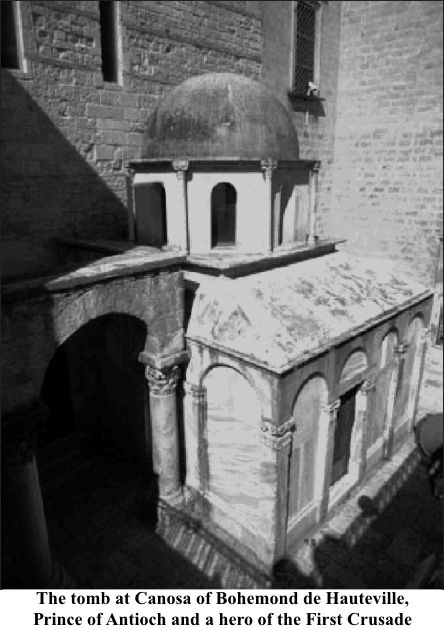
The body of the Norman hero Bohemond lies at Canosa in a tomb reminiscent of an Arab turbeh (mausoleum). During his colourful career he twice defeated the Byzantine emperor and played a key role in the First Crusade, becoming Prince of Antioch. He then spent two years as a Saracen prisoner before being ransomed, returning to Europe and marrying the King of France’s daughter. The Byzantine chronicler Anna Comnena says that Bohemond was just like his father, Robert Guiscard, and she had met both, “Father and son resembled locusts, Robert’s child devouring anything missed by his father.” His tomb just outside the cathedral is a small, square building of white marble with an octagonal cupola, an inscription on its Byzantine bronze and silver doors telling of his bravery. Inside, a flagstone bears a single word in Lombardic script:
BOAMUNDUS
In 1712 Canosa was acquired as a principality by the Capece Minutolo. Their ancestors may have known Bohemond, who died in 1111, since they were at the coronation of the first Norman king, just a few years later. Their name was originally ‘Caca Pece’, pitch-shitter, from having thrown pitch at enemies besieging their castle; each branch of the Capece took an extra name, Minutolo meaning dwarf. The most famous Capece Minutolo was Prince Antonio, Minister of Police in 1821, who had the Carbonari revolutionaries flogged. “He regarded the French Revolution as the fatal result of renouncing medieval institutions and beliefs, which could still, if revived, produce a generation of Galahads”, writes Sir Harold Acton. But the Prince of Canosa’s private life was not quite that of a Galahad – he fathered three bastards by a rag-picker’s daughter.
First settled by Peucetians, Ruvo di Puglia became a staging-post on the Via Traiana, Horace’s Rubi. An attractive little town, perched on the edge of the Murge 732 feet above sea-level, its few visitors are charmed by an exquisite Apulian-Romanesque cathedral on top of a Paleo-Christian predecessor, itself over a Roman house-church. The campanile is a Byzantine watch-tower, while Frederick II built the castle of which only a solitary, crumbling bastion survives.
Ruvo’s other attraction is the Museo Jatta, containing Greek and Apulian ceramics dating from the 6th to the 3rd century BC Giovanni Jatta bought vast estates round Ruvo from the Carafa family in 1806 and began to collect Attic and Apulian artefacts discovered in graves on his land. The city had had close links with Greece in the 5th century BC, importing quantities of kraters, vases and cups and then in the following century Greek artisans to found a factory. This local ware, admittedly of far less beauty then the Attic, was usually destroyed when found, until the beginning of the nineteenth century when it suddenly became immensely sought after. His son became an archaeologist, adding to what would be-come one of the greatest collections of Apulian ware in Italy.
Janet Ross tried to see the Museo Jatta in 1889, without success. “Signor Jatta has gone to Bari, bearing the keys of the museum in his pocket”, she was told. “Some of the streets are exceeding pictur-esque; all are dirty”, observed Mrs. Ross. “The people were very civil, but evidently unused to strangers.” No one explained to her what had paid for the kraters. It was sweated labour, most of the town’s male population being day labourers on the enormous latifondi owned by the Jatta and Cotugno families. In 1907 a general strike was broken by 200 armed peasants from the Jatta estates, who fought a pitched battle with the strikers, hunting them through the streets with knives and guns.
Bitonto was once an important Roman city on the Via Traiana, retaken for Byzantium in 975 by the Catapan Zacharias. In a purple-draped litter, Frederick II’s body passed through in 1250 on its way to Tàranto to take ship for Sicily, escorted by barons in black and weeping Saracen bodyguards. The citizens are unlikely to have wept – the Emperor had put an inscription over their main gate reading “Gens bitutina, totia bestia et assinina” (the people of Bitonto are all beasts and fools).
The castle’s round towers date from Bitonto’s expansion in the fourteenth century. Unlike Apulian ports, it prospered under the Spaniards, famous for its oil, still the best in Apulia. In 1734, Charles of Bourbon routed the Austrians outside the city, restoring theRegno’s independence and founding the Borbone monarchy. Augustus Hare calls Bitonto’s cathedral “the noblest in Southern Italy”. The ultimate example of Apulian Romanesque, inspired by the church of San Nicola at Bari, it dates from the first half of the thirteenth century and was built with unusual speed, probably within twenty-five years, so in style it is all of a piece. A white mar-ble pulpit dated 1229 has a panel portraying Frederick II and three of his sons, with the name of the priest who carved it, “Nicolaus sacerdos et magister” (Nicholas priest and teacher).
Swinburne thought Bitonto’s inhabitants “more polished and improved in their manners than those that dwell along the coast”, commenting on “an air of affluence”. Yet, Hare says it was impossible for him to sketch in Bitonto because of “the violence of the half savage crowd in every lowest stage of beggary and filth.” Decline had set in, partly due to large scale planting of vines during the 1870s and 1890s, followed by the ravages of phylloxera which appeared in the Salento in 1889 and had almost destroyed the entire Apulian wine industry by 1919. There were bloody riots in 1920, the town hall being stormed and food shops looted. A few years before, Edward Hutton had sensed the misery here, writing of “a curiously lonely city”.
Although undistinguished at first sight, the little city of Gioia del Colle has a certain charm. Significantly, on certain Sundays since time immemorial, generations of Gioiesi have picnicked together on a low hill to the north-east, Monte Sannace, the site of the city of their Peucetian ancestors. Gioia became an important Norman fief in 1089, its first lord being Robert Guiscard’s brother, Richard the Seneschal, who built the castle. The Emperor Frederick II rebuilt it when he returned from Jerusalem, giving it an appearance that is half Teutonic and half Arab. A Gioiese legend claims his bastard son Manfred was born in the castle, together with his other children by Bianca Lancia. The castle was a key Hohenstaufen fortress, guarding the road across the “heel of Italy” from Bari to Tàranto. Trapezoidal in plan, it has two huge square towers, the Torre de Rossi and the Torre Imperatrice. Frederick II used it as a hunting-lodge since in his time, and for long after, Gioia was surrounded by dense wood-land. Pacichelli calls it “a sumptuous and ornate palace with a gallery of choice pictures and a theatre”, adding reverently that the Princes of Acquaviva often stayed here, accompanied by their court. Made into a county, during the seventeenth century Gioia del Colle was bought, together with the principality of Acquaviva nearby, by the Genoese moneylender Carlo De Mari, who henceforward referred to his “stato di Acquaviva e Gioia” (state of Acquaviva and Gioia). His tombstone at Gioia styles him “Prince of Acquaviva, Patrician of Genoa and Knight of Naples”, but he began his career behind a counter. The castle was lived in until not so very long ago, by Donna Maria Emanuela Carafa from 1806–68, and by Marchese Luca De Resta into the twentieth century. It now houses the Museum.
“Nothing else worth seeing remains in this busy city of peas-ants”, says Edward Hutton, yet the Baroque façade of the Franciscan friary that dominates the main square, built in 1633 at public expense, surely deserves at least a glance. So does the little neo-Classical Teatro Rossini, built in 1832, bombed during the Second War but triumphantly brought back into use in 1997, and also the seventeenth century Dominican monastery which houses the Municipio (town hall).
During the spring of 1809 the brigand Antonio Mirabella informed the commune of Gioia that he was “Prince Leopoldo di Borbone” and had surrounded the city with 1,500 Calabrians equipped with cannon. Terrified, the commune let him into the city, and after a Te Deum (hymn of praise) in the chiesa madre (mother church) to celebrate the restoration of Borbone authority, he and his army were given a banquet in the friary. When they sat down, however, the ‘Prince’ looked suspiciously unregal while his ‘troops’ were a mere handful of ragamuffins, clearly intent on getting drunk as quickly as possible. Armed men were called in and several brigands were killed, but Mirabella escaped to the woods.
The friary was later turned into a police barracks, part being set aside as the Unione, a club for the city’s élite. Nicola De Bellis of unhappy memory once held court here. During the agricultural disturbances of the early 1900s, Gioia suffered miserably, De Bellis, who was its mayor as well as its deputy, ensuring that the landlords’ overseers had police help in breaking strikes. At elections no-one dared to vote against the “King, Tsar and God of Gioia del Colle”, police and gangsters with revolvers patrolling the streets to see that the hostile or uncommitted stayed at home. On one occasion the city voted unanimously for De Bellis. In 1920 mounted estate guards rode down a hundred striking field-hands just outside the city, killing ten labourers and wounding another thirty.
Until quite recently, after funerals at Gioia the coffins were taken from the church-door to the graveyard on a hearse drawn by black-plumed, red-hooded horses. This could often be seen en route, sometimes bound for a funeral in Massafra, Noci or Santeramo, or returning at night to Gioia. Once there was an accident in the dark, a car killing two of the lead horses, but the service was soon resumed, to meet popular demand.
Gioia del Colle acquired a brief notoriety in 1999 during the Kosovo war, when planes flew from a NATO aerodrome outside the city to drop bombs from a safe altitude onto the Serbs, and pound them into submission.
There is not much to bring a sightseeing traveller to San Michele, apart from the Museum of Country Life in an otherwise uninteresting castle. This has a fine collection of ploughs, olive-wood presses for wine or oil, pruning-knives for olive-trees, short-handled mattocks that deformed a man before he was fifty and yokes for the oxen that were used until the Second World War. What look like lacrosse-sticks were nets for catching small birds by night. Preserved in jars of wine and bay-leaves for feast days, these birds were often the only meat ever tasted by labourers and their families.
At Capurso the Royal Basilica of the Madonna of the Well houses yet another miraculous icon. Together with the gigantic Franciscan friary that once served it, the basilica was built by King Charles VII in 1740, his son Ferdinand IV adding its majestic Baroque façade thirty years later. Rooms at the side contain ex-votos (trusses, corsets, sticks, splints, crutches, wooden limbs, wedding-dresses and baby-clothes) while a gallery of crude paintings shows the Madonna saving suppliant donors. In 1705 she appeared in a vision to a priest of Capurso, Don Domenico Tanzella, who had been diagnosed as incurably ill, and told him to drink the water from a nearby cistern. After being completely cured, he explored the cistern and found the icon. Pilgrims still toil down the long stairs below the basilica to drink the healing water.
The cistern here began as a grotto chapel for Basilian monks, who painted a fresco of the Virgin on the rockface – the icon. Like so many other Apulian shrines, Capurso is Byzantine in origin.