
IN THE SUMMER OF 1937, MRS. EDITH MAY PRETTY, A WIDOW living on her estate in Suffolk, East Anglia, recounted to Vincent Redstone, a local historian and Fellow of the Society of Antiquaries, her dream of the previous night. She had seen “a large white horse with a helmeted rider, then the burial of a man and the flashing of gold objects as they were placed in the grave beside him.”
The occasion was the Woodbridge Flower Show, and Mrs. Pretty, known as a lover of the rhododendrons and pine trees surrounding her isolated house on a hill above the river Deben, had heard the rumors. A plowman had found a gold brooch at Sutton in 1835. The Ipswich Journal of 1860 reported that a local blacksmith had converted into horseshoes the numerous “iron screw bolts” turned over in a field. An old man with a long folk memory spoke of a fabulous treasure buried beneath the strange mounds of earth visible from her bedroom window. Local farmers reported vague rumblings about grave robbers who had perished long ago. Her nephew came with a dowser’s rod and assured her there was gold buried under the largest barrow. Vincent Redstone mentioned the stories about Viking burial mounds in the course of their conversation about the hybrid tea roses that year.
What provoked Mrs. Pretty’s dream? Was it the distant memory of a childhood visit to the pyramids of Egypt? She had seen grave digging in the Nile Valley. Was it the diggings of her father, an engineer and amateur archaeologist, who had excavated a Cistercian abbey adjoining their house, Vale Royal, in Cheshire? Was it the loneliness of living with her seven-year-old son after the death of her husband, Colonel Frank Pretty, commander of the Fourth Battalion of the Suffolk Regiment, four years earlier? Was it those trips to London to visit her spiritualist medium, who she hoped would put her in touch with the dead? Was it the coming of the war that gave a sense of urgency to discovering what lay beneath the eighteen tumuli just beyond the garden wall? Edith Pretty had seen the disruptions of war and of human folly even in peacetime. She had served with the French Red Cross at Vitry-le-François and Le Bourget, France, in 1917. She was one of England’s first women magistrates.
Vincent Redstone did not hesitate. The very night of the Woodbridge Flower Show, he wrote to his friend Guy Maynard, curator of the Ipswich Corporation Museum. “She has invited me to luncheon to consider the mounds. I suggested that I should bring you with me as having useful experience. Any day but Thursday would suit.” Luncheon discussion on Monday, July 26, turned around the exquisite flowers in this year’s show, the slight increase recently in visitors to the museum, the deliciousness of the summer strawberries in double cream. Vincent Redstone raised the topic of the mounds. Mrs. Pretty suggested they have a look for themselves. Together they decided to call a local archaeologist to give them sound advice.
Several days later, Basil Brown, who described himself in his diary as having “reliable knowledge of Geography, Geology, and Astronomy,” arrived on bicycle, carrying nothing more than a bag of books.1 A fellow archaeologist describes Basil Brown as “a character: his pointed features gave him the, not inappropriate, appearance of a ferret and were invariably topped with a rather disreputable trilby hat, while a somewhat moist and bubbling pipe protruded dead ahead from his mouth. … He had … gravitated to archaeology without any real training thanks to a quite remarkable flair for smelling out antiquities…. His method was to locate a feature and then pursue wherever it led, in doing so becoming just like a terrier after a rat.”2 Basil Brown agreed to stay in the top room of Mrs. Pretty’s chauffeur’s cottage and to direct the digging, assisted by her farmhands, Bert Fuller and Tom Sawyer, for thirty shillings per week.
The men began digging the first mound but found nothing.
Mrs. Pretty, who watched from her bedroom window, descended the stairs and came out of the house. “Why don’t you try one of the smaller mounds?” she inquired. Whether the suggestion was sheer intuition, triggered by memories of how her father worked, or the residue of her dream, the results were immediate. Basil Brown could tell from the different-colored soils that this was a burial site and, by the raggedness of refill, bits of turf, and broken pieces of clay and shards of a jug in the “robber trench,” that he was not the first to dig there. Henry VIII had “dug for treasure in a mound at Sutton Hough but nothing was found, and John Dee, the Court Astrologer, was commissioned to search for treasure along the coast by Queen Elizabeth, and apparently came to Sutton.”3Before long, Basil Brown held in his hand pieces of cremated human and horse bone, an ax head, pottery shards, and an iron fragment with a domed head at one end and a square plate at the other. On June 28, 1938, Vincent Redstone arrived with other locals, J. Reid Moir, a tailor of Ipswich turned paleontologist and chairman of the Ipswich Museum Committee, and Mr. Spencer, museum assistant, both of whom offered advice about where and how to dig.
Toward the end of summer, Mrs. Pretty observed great excitement among the diggers. Basil Brown held a small rusted object in his hand. “I think that what we have here is part of a ship’s rivet,” he said. “A lot has rusted away, but these rivets were much like a bolt. They would be used to hold the planks of a ship together.” The excitement was tempered by the coming of winter, which made further digging difficult.
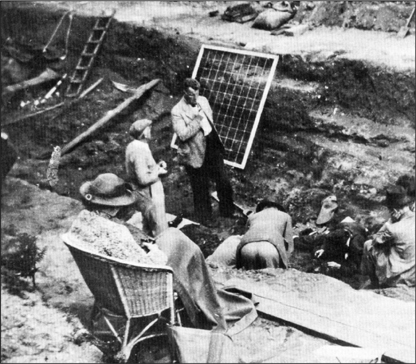
Mrs. Edith May Pretty watching the Sutton Hoo dig on her estate in Suffolk
PHOTO COURTESY OF RUSSELL CARVER
Excavation resumed on May 8, 1939. Basil Brown was assisted this year by William Spooner, Mrs. Pretty’s gamekeeper, and John Jacobs, her gardener. She hired two constables, P. C. Ling of Sutton and P. C. Grimsey of Melton, to guard the excavation day and night. The diggers found more rivets, aligned every twenty centimeters so as to suggest the joinings of a ship whose wooden hull had rotted away. “We thought it was a Viking ship burial,” Brown writes in his diary on Friday, May 13; “Mrs. Pretty seems to be greatly interested,” on May 18; “It is now evident that we are up against a far larger thing than anyone suspected,” on May 22; “Now we have beaten the record for ships found in burial mounds in the British Isles,” on June 2. By the end of the month, Basil Brown had found the other end of the ship, which provisionally measured eighty-three feet. On the evening of Sunday July 2, he attended a meeting at the Woodbridge Spiritualists’ Hall, in the course of which the medium, Mrs. Florence Thompson of London, addressed Brown specifically, describing several people she could not place. “I see green fields which you left for a more important position. Now I see sand, all sand. Someone is holding you up in your business. Assert yourself and go on digging.” He reported the results of the “séance” to Mrs. Pretty, who telephoned Reid Moir of the Ipswich Museum to expedite excavation of the ship.4
The news of the discovery of a longship ninety feet in length spread as far as the Department of Archaeology at Downing Street, Cambridge. Within days, Charles W Phillips, Fellow of Selwyn College, Cambridge, arrived. Astonished at the find, he rang the British Museum and the Government Office of Works. At the end of June, Phillips was put in charge of a new team of professional—academic—archaeologists: Stuart and Peggy Piggott, who cut short their summer painting holiday to arrive on July 19; O. G. S. Crawford, who came to make the photographic record; and W. F. Grimes from the Ordnance Survey Using “a stout coal-shovel at the end of a long ash handle,” penknives, a pastry brush, dustpans, and the bellows from Mrs. Pretty’s fireplace to blow off their finds, they continued to dig. On the morning of July 21, 1939, the diggers hit gold—the first piece of jewelry from the dig named after Edith May Pretty’s farm: Sutton Hoo.
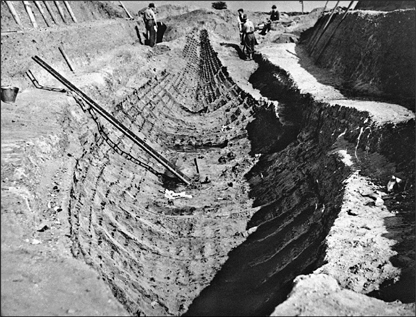
Outline of Sutton Hoo longship
©COPYRIGHT THE TRUSTEES OF THE BRITISH MUSEUM
Before the richest grave in Great Britain, Charles Phillips was heard to mutter, “My godfathers!” and could say nothing but “Oh dear, oh dear” all day The treasure continued to come—gold ornaments, a buckle, a scepter, a shield, a great silver dish, ten silver bowls, a hammer, a gold purse frame with coins, and a large sword. So great was the find of a single day that when the diggers returned to Bull Hotel, where they were lodged, and Stuart Piggott was asked, “Well, old boy found any gold today?” Piggott replied, “Oh yes, my pockets are absolutely full.” Piggott reports carrying the box “containing the great gold belt buckle in my rather sweaty hand in the pocket of my coat.” He met T. D. Kendrick, keeper of British and Medieval Antiquities of the British Museum, at the Woodbridge train station and showed him the buckle in the passenger waiting room. In just seventeen days, 263 objects were brought from the ground. The treasure overflowed the sweet sacks, wooden boxes, and tobacco tins that had been requisitioned to hold them. Mrs. Pretty could not fit the valuables in her safe. She stashed the overflow of objects, buried for thirteen centuries, under her bed. Work was suspended on July 25, Mrs. Pretty would later testify, “as I was giving a sherry party.”
The treasure horde of Sutton Hoo had attracted the attention of a British nation on the verge of war. On August 14, 1939, the digging having finished for the year, a treasure trove inquest was held at the Village Hall of Sutton to determine to whom the riches belonged. The jury consisted of eleven residents of Sutton and three of Bromeswell, including a bank official, a blacksmith, a tavern owner, the secretary of the Woodbridge Golf Club, a garbage collector, a grocer, farmers, and a schoolmaster.5 Officials from the British Museum were present alongside the coroner as the pieces of gold and silver that were not too fragile to travel were exhibited.
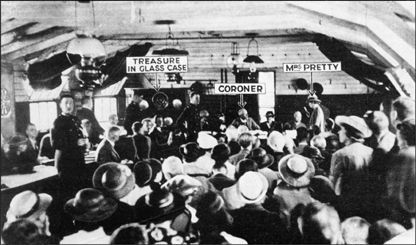
Sutton Hoo treasure trove inquest, August 14, 1939
The coroner opened the proceedings by reminding the jury that the custom of treasure trove went back to the thirteenth century: If it could be proven that whoever had buried the treasure had intended to return to claim it, it belonged to the king. If not, it belonged to the owner of the land.
Edith Pretty testified that she had always had an interest in the tumuli on her property; she recounted her conversation with Mr. Redstone at the Woodbridge Flower Show, her interview with Mr. Maynard of the Ipswich Museum, the employment at her expense of Basil Brown, the men of her estate, and a police guard. C. W Phillips of Cambridge testified that indeed “the work was done under the control of Mrs. Pretty, who paid all the paid labour.” The coroner questioned Professor Phillips about the presence of Merovingian gold coins, about the stones in the jewelry. He read “Exhibit B,” Phillips’s description of Anglo-Saxon funeral rites: “The custom of burial in a barrow or tumulus is one which has been common in Britain from 2000 B.C. till as late as the seventh centuryA.D. when the conversion of the inhabitants to Christianity brought it to an end.” The effort required for such a burial, the digging of the trench, the hauling of the boat from the river inland, its burial along with precious objects belonging to the dead man, and the public celebrations that accompanied the burial of an Anglo-Saxon chieftain all pointed, Professor Phillips testified, to the public nature of the entombment. Despite the presence of subsequent grave robbers, “there was no intention on the part of those carrying out the burial to recover [the buried objects] later.”
The coroner read his statement, concluding that “from the disposition of the precious objects, no less than those of more utilitarian nature and of iron or bronze, it was apparent that the whole deposit was that of the personal belongings of the individual buried in the ship, and intended for his use in the future world.” The coroner questioned the archaeologist Stuart Piggott, who despite the lack of a body claimed to have no doubt that “there had been a skeleton there.” Then he gave the jury its charge, to find evidence “to justify them in finding that the person who owned the objects 1,300 years ago hid and concealed them with a certain amount of secrecy, and with the intention at some convenient time of resuming possession.” It was decided that the Sutton Hoo treasure was not treasure trove and “that there is no evidence that the aforesaid articles of silver and gold or any of them had ever been in ancient times hidden or otherwise concealed, IN WITNESS whereof as well the said Coroner as the Jurors have hereunto set their hands and seals on the day and year and at the place first above written.”
The Sutton Hoo treasure belonged to Edith Pretty Soon after the inquest, her spiritual counselor arrived from London. Her family urged her to keep the jewelry Charles Phillips argued in favor of presenting the finds of Sutton Hoo to the nation. In the end, Mrs. Pretty gave it to “the whole country so that everyone can visit the British Museum in London and share the excitement of the treasure for themselves.”
World War II erupted nine days later, and the treasure, much of it wrapped in damp moss to preserve it in something like its natural element, was again buried in the out-of-service underground tube between Holborn and Aldwych. A man from the British Museum watered the moss every day. Mrs. Edith May Pretty was made a dame of the British Empire, an honor she declined. She died in 1942. After the war the artifacts excavated from her estate at Sutton Hoo, the largest find of grave goods from the Anglo-Saxon world, were placed on permanent display
Sutton Hoo was in all likelihood the burial mound of King Rædwald, the first of the East Anglian kings to be converted to Christianity Rædwald lapsed back into pagan ways, however, before his death in 624 or 625, as attested to by the presence of only cremated remains in the place of his body, by the abundance of objects interred with him, and by the placement of the mound outside the sanctified ground of a church, all contrary to Christian burial rites.
Anglo-Saxon because it was found in East Anglia, Anglo-Saxon because it was buried between the arrival of the Angles and the Saxons in Great Britain and that of the Vikings several centuries later, Anglo-Saxon because English archaeologists call it that, the treasure of Sutton Hoo is a global find. The provenance and style of its artifacts range from around the known world—England, the Continent, Scandinavia, and the Middle East. Many of its objects came from the British Isles: a bronze cauldron and iron chain-work like those from Roman Britain; an enameled circular escutcheon with millefiori glass inserts and a large hanging bowl of thin bronze, both identified with Celtic workmanship. The arms from the grave are similar to those found in the burial mounds of Scandinavia: a “ring-sword” made either in Sweden or by Swedish armorers in England, a helmet, and drinking horns. The ship, ninety feet long and fourteen feet wide, is of the Viking type.
Of the coins of the Sutton Hoo horde—thirty-seven small gold coins, three blanks, two small ingots—all were struck on the Continent in the area of France, Belgium, Rhineland, and Switzerland controlled by Merovingian Franks. No two are from the same mint. One coin can be traced to the area of Clermont-Ferrand, northeast France, and the Frankish king Theodebert II (ruled A.D. 595–612). The jewelry—twenty gold pieces, buckles, hinges, clasps, ornamental studs, and strap mounts, containing in all over four thousand garnets—is worked in a cloisonné technique, gold cells upon a gold backing filled in with melted colored glass, practiced in Kent, though originally from the Middle East. The great belt buckle, which weighs nearly a pound, is filled with zoomorphic interlace. The greater alloy of the gold—13 percent versus only 2 percent for the rest of the jewelry—means that it was probably made in England, but, like the purse lid showing a man spread between two beasts, it resembles ornaments from Sweden. The regular lines and cells in “step-pattern cloisonné” of the shoulder clasps, which may derive from Roman parade armor, anticipate the great carpet pages of Hiberno-Saxon illuminated manuscripts from Northumbria of only half a century later.
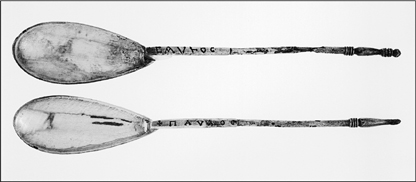
Greek silver spoons from Sutton Hoo inscribed SAULOS and PAULOS
© COPYRIGHT THE TRUSTEES OF THE BRITISH MUSEUM
Much of the Sutton Hoo treasure traveled to East Anglia from the Middle East: the heavy bronze bowl from Christian or Coptic Egypt; the silver bowls of a Byzantine type; and two spoons, in late classical mold, inlaid in niello, a black paste of silver sulfide, with the names “Saulos” and “Paulos” in Greek characters. A great silver dish 28.5 inches in diameter bears the stamp of the Byzantine emperor Anastasius I (ruled A.D. 491–518) and is thought to have been made on the edges of the empire. Other pieces of silver are from Eastern Europe or the Middle East.
The provenance of the Sutton Hoo hoard makes it less of an Anglo-Saxon than an international discovery and contains an important lesson for the Bayeux Tapestry which bears on its surface an astonishing mixture of elements from the Scandinavian, Continental, Anglo-Saxon, and Mediterranean worlds. The embroidery is neither Anglo-Saxon nor Norman, neither English nor French. It is not, as has been suggested, purposely ambiguous or a coded message put forth by Anglo-Saxon weavers to undermine the legitimacy of their Norman conquerors. It is not a form of resistance to occupation. The Tapestry is a weaving together of the disparate cultures on both sides of the English Channel after the trauma of 1066, a treaty of peace. Like the monumental written charters and constitutions of the West—the Magna Carta of 1215, the American Constitution, the Declaration of the Rights of Man—the Tapestry is a social contract in written and visual form between the warring parties of a great territorial dispute. Its embroidered surface does not represent one people alone but produces an amalgam of aesthetic elements belonging to the several cultures of the Anglo-Norman world. Its deepest function is to join in a unified work of art contending factions seeking political and social representation both before and after 1066.
Many elements of the Tapestry are clearly marked in cultural terms. Without seeking the original source of a particular design, one can see a resemblance between its embroidered images and objects and those associated with particular parties to 1066— Scandinavian, Anglo-Saxon, Norman, and Continental.
SCANDINAVIAN
Though the Bayeux Tapestry is a unique work of art, it resembles more than any other medieval form the textiles of the Scandinavian world. Among the artifacts and remains discovered by a farmer in a field in Oseberg, Norway, southwest of Oslo, in 1904—a Viking ship, sleds, beds, household utensils, agricultural tools, chests, personal belongings, and the bones of fifteen horses, two bulls, four dogs, and two women—are looms and other implements for weaving, tents, beds, pillows, and a badly damaged piece of cloth that has subsequently been restored. We know that textiles were part of Scandinavian burials from the Arabic description of a funeral by Ibn Fadlán, who visited the Rus or Swedish merchants on the Volga in 922 and reported upon returning to Baghdad, “On the tenth day after the man’s death, his ship is hauled ashore to be prepared for the ceremony, a bench covered with carpets of Byzantine silk and cushions is placed on board, and a tent is erected over it.”6 In the funeral pyre around the ship, the body was burned with food, beer, fruits, a dog, two horses, two cows, a cock, a hen, and one of the dead man’s female servants or slaves. The grave goods as well as the bones of Ose-berg, the richest of the Scandinavian burials, may have belonged to the grandmother of King Harald Fairhair, Queen Åsa, who died in the middle of the tenth century.
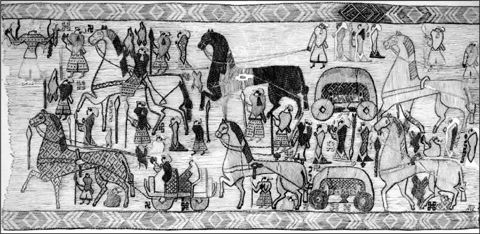
Fragment of textile from Oseberg, Norway, buried ca. A.D. 950
© MUSEUM OF CULTURAL HISTORY, UNIVERSITY OF OSLO, NORWAY
Unlike the Bayeux Tapestry, the Oseberg textile contains no writing and seems to tell no historically specific story. As with the Tapestry, however, its horizontal borders are filled with a geometric chevron design, and the central panel shows a frieze of knights, weapons and shields, birds and swastikas, and horses pulling wheeled chariots with cargo or passengers in procession. The Oseberg textile depicts either the migration of a people or the journey from this world to the next. The horses and chariots resemble Roman models and are themselves draped in places with textiles—cloth within cloth. The headdress, tunics, and triangular pantaloons, wider around the ankles than on top, have the appearance of those found on an Eastern frieze. The figures in profile as well as the overall array of figures in intersecting and overlapping planes evenly disposed across a vertical field so resemble an Egyptian hieroglyphic tableau that one wonders if the hanging buried with Queen Åsa, like the funeral cloths described by Ibn Fadlán, did not come from the Middle East.
A similar fragment of cloth was found in 1867 in the tomb of Haugen at Rolvsøy Norway Dating from around A.D. 900, it depicts a scene of five men and two women near a Viking ship.7 An eleventh- or early-twelfth-century linen, discovered in 1910 in Överhogdal, Sweden, is bordered on all sides by a geometric chevron pattern. Its colored embroidery, filled with animals, some distinctly reindeerlike, features images associated with Old Norse cosmology—Yggdrasil, the world tree, holding together heaven and earth; Odin’s eight-legged horse, Sleipnir—alongside Christian symbols, crosses on tops of buildings resembling a church. Like the Bayeux Tapestry, the Oseberg, Rolvsøy, and Överhogdal textiles, tjells, or “refills,” are woven with colored wools and are long and narrow, indicating that they, too, were intended to be hung around the walls of a home or, after Christianization, in a church. Other examples of Scandinavian textiles—that from Baldishol, Norway, with its mounted knight, and that of Skog, Sweden, with a church and horses—were woven sufficiently after 1066 that the traits they share with the Bayeux Tapestery could be the result of its influence rather than the reverse.
If the Bayeux Tapestry is most like Scandinavian textiles in its material form, its contents are most Scandinavian in the depiction of the sea and especially of boats. The Tapestry is a major source of knowledge about medieval naval archaeology. The vessels of both Harold’s crossing from Bosham to Normandy and William’s crossing from Normandy to Great Britain are Viking ships, though Viking sails were square, not curved and triangular. We know this from Icelandic sagas. King Harald’s big ship, like that of William in panel 98, is lined by a wall of shields atop the gunwales. “In the words of the poet Thjodolf”:
The doughty king of Norway
Lined his dragon longship
With a wall of living shields;
No foe could find a gap there.8
The Tapestry’s ships are like those on the picture stones of the Scandinavian world. The eighth- or ninth-century Tjängvide Stone from Gotland, Sweden, depicts armed warriors standing on a ship with a square sail, low sweeping hull, and elongated and soaring stern and prow, as in the Tapestry ships, the whole surrounded by a border of plaits and decorative knots. The eighth-century Ardre Stone, also from Gotland, Sweden, displays a ship with a serpentlike figure at both ends; and on the eighth-century Lärbo Stone, warriors disembark, swords raised, from the dragon ship to fight the enemy on land. Both images as well as others are bounded by a braided chain. Braiding of this type is, in fact, an important feature of the aesthetics of the Scandinavian world and is sometimes found even on the hull and prow of the boats themselves. The vessel uncovered in the Oseberg burial mound, constructed some decades before Queen Åsa’s funeral in the mid–tenth century, is seventy feet three inches long and sixteen feet nine inches wide. Its beam is limned by a frieze of animals with a slim midriff and wide rounded shoulders and hindquarters entwined in a vegetal chain that climbs the high curved prow, where interlace takes the shape of a spiral, and spiral twists into a sea serpent. The Viking ship was a “dragon,” as they were called in Icelandic sagas. “The Long Snake” of King Olaf Tryggvason (ruled 995–1000) was, according to the poet Snorri Sturluson, “the best-fitted and the costliest ship ever built in Norway,” but King Harald’s is a close second: “Above the prow, the dragon / Rears its glowing head; / The bows were bound with gold / After the hull was launched.”9
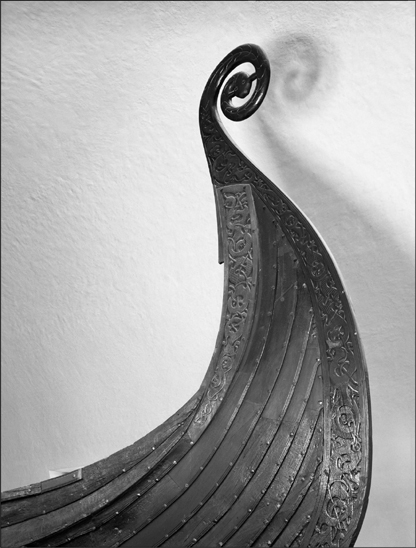
Prow of ship buried in Oseberg, Norway, ca. A.D. 950
PHOTO BY EIRIK IRGENS JOHNSEN, © MUSEUM OF CULTURAL HISTORY, UNIVERSITY OF NORWAY
The vessels of the Bayeux Tapestry are capped at either end by the knotted dragon heads and beaked sea serpents of the Nordic world. Some of the figureheads on Harold’s ships in panels 9–12 are abstract tangles of ornamental wide ribbons, their tendrils miming the waves of the sea, while others assume monstrous human shape. The figures on the prow and stern of William’s ships in panels 94–100 are less knotted and more beaked. Both show design elements of the most illustrious Viking artifacts. The interlace of the stern post of Harold’s second ship is very like that of the celebrated Jelling Stone of Jutland, Denmark (ca. 965), with its central figure, possibly a religious icon, ringed by interlocking ribbons in the so-called Mammen style associated with the tenth-century iron ax with gold and silver inlay found at Mammen, Jutland, Denmark.
Much of the offensive and defensive arms and armor in the Tapestry is of Scandinavian type, though the close alliance of England with Scandinavia made for a great mixing of weaponry in the Viking age. Both Normans and Anglo-Saxons attack and defend themselves with weapons from the North. Harold’s army fights primarily on foot, using the Danish bearded ax. In the first clash in panel 144, the Norman cavalry with couched lance meets the Anglo-Saxon shield wall and axes not unlike those found at Mammen, Denmark, in the Viking camp of Trelleborg, Denmark, as well as in the English digs of the period of Scandinavian occupation. The battle-axes that Harold’s men still swing after his death in panel 168 are distinct from the woodman’s ax or the carpenter’s adze used for the felling of trees and the construction of William’s fleet in panel 83, or the adze in the hands of the naked figure in the lower border of panel 38. The swords wielded by both parties to the Battle of Hastings are of the straight, broad-bladed, steel type, the immediate successor of Viking swords found along the estuaries and rivers where they raided, the Vikings having discovered the process for the carbonization of iron to make steel. The mail garments, or hauberk, loaded onto Norman ships in panel 88 and worn at Hastings are, again, a form of body armor mentioned in sagas from the North as well as in the epics of medieval France. The Beowulf poet sings of the “tangled war net,” the “ringed mail coat,” the “ring-clad lord,” the “riveted shirt of mail,” and “armour of net-like cunning linked by the smith.”
The Bayeux Tapestry was made almost a hundred years before the first use of heraldic emblems as signal devices for the recognition of friend and foe in battle. Yet the twisted-tailed dragons found in the borders of panels 31, 39, 40, 47, 56, 57, 101, and 102; on the shields of William’s knights in 15, 26, and 33; on the shield of a Norman with sword striking an Anglo-Saxon with ax in 165; and on the banners of both a fallen and a standing warrior next to arrow-struck Harold are devices of the heraldic type. And they are ascribed by some to the Scandinavian world. Similar dragons are found on the back side of the Jelling Stone as well as among the intricate carvings of the Oseberg excavation—on one of the poles of the sled named after the archaeologist Haakon Shetelig and on the runner of the fourth sled, with its twisted tail, wings, and lip lappet. So, too, the dragons of the Tapestry resemble the animals associated with the Scandinavian Ringerike style, such as that ornamenting a weather vane from Heggen, Norway, or the animals inscribed on rune stones from Stora Ek, and Norra, Åsarp, Västergötland, Sweden. The dragons of the Bayeux Tapestry lack elaborate foliate tendrils, and only the dragon on a Norman shield in panel 165 has the tusks of a true Ringerike beast.
Where the Tapestry is most Scandinavian is not in the depiction of arms and armor, which the Anglo-Saxons shared with the North, but in the peaceful objects of furniture and architectural design that are part of the embroidery’s interior space. From the very first panel, the chair in which King Edward sits is built upon legs decorated with the dog’s head and feet that are also found on the seat of Guy of Ponthieu in the interview with Harold in panel 20; on William’s throne at Rouen in panels 38 and 80; on the chair of the man who seems to be observing earthly events in the border just above Mont-Saint-Michel in panel 43; and on Edward’s chair at what may be Westminster Abbey in the scene of conversation with Harold upon his return from France in panel 65. So closely do these details of interior design resemble the animal head-posts from the ship burial at Oseberg, Norway—the “academician’s” animal head-post, the “Baroque Master’s” head-post, and the “Carolingian master’s” head-post—that it is hard not to see them as embroidered renderings of sculptured and decorated everyday objects, bedposts or chair posts—made of wood. The Scandinavian character of the Tapestry’s furniture is sustained, moreover, in larger elements of architectural design, if not in the nature of the buildings themselves. The post resting in the water on the seaside building in the scene of Harold’s return to Britain in panel 62 is capped by an animal head whose lobelike tendrils may be ears or horns. Horned dragon heads, tongues unfurled, crown the door or gateposts, linked by a decorated upper lintel and wrapped in ascending spirals, between which stands the mysterious figure of Ælfgyva in panel 39.
Finally, a recurrent ornamentalizing tendency characteristic of Norse design lies in the Tapestry’s trees. For a work as monumental as the Bayeux Tapestry, made in a world in which people lived closer to nature than in our own, there are remarkably few images of the natural world and nothing on the order of a representation of landscape. On the contrary, the depiction of nature is highly schematic, emblems stitched in outline without the filling-in of laid couch work (see p. 91). The sea is rendered by a series of concentric undulating lines, a hill by the same lines at a sharper angle. Trees, however, are an exception. The tree that stands before Bosham Church in the scene of Harold’s arrival from London before embarking for the Continent in panel 4, the tree that grows between Guy of Ponthieu’s palace and the emissaries who arrive from Duke William’s court in panel 22, and the tree planted before William’s throne room upon their return in panel 27 are not sketchy or schematic. Rather, they are elaborately full and stylized, their knotted vegetation filled in, their tendrils ending either in palmettes or in trefoil branches. Strands of undulating interlace lie at the tips of the branches that one art historian, at least, links to “the Ringerike style [of] eleventh-century Norway, Sweden and Denmark.”10Others, however, maintain that the woven trees found in the Tapestry are closer to the trees and other ornaments found in Anglo-Saxon manuscripts such as the Old English Hexateuch (ca. 1030) currently in the British Library, or the scene of cutting wood from a volume of eleventh-century astronomical treatises, or the initial “D” from a Psalter (ca. 1020) produced at Winchcombe, Gloucestershire, or this calendar illumination for the month of July.
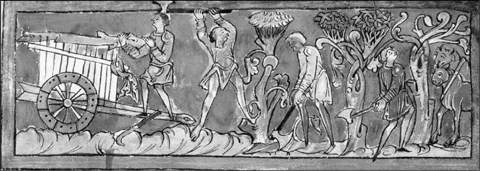
An eleventh-century calendar illumination, month of July
MS. COTT. TIB. B.V. F. 6R. © BRITISH LIBRARY/HIP/ART RESOURCE, N.Y.
ANGLO-SAXON
In all the controversy surrounding the origins and making of the Bayeux Tapestry, of this there can be no doubt: The arts and crafts of Anglo-Saxon England were more highly developed than on the Continent. Stone, ivory, and wood carving, metalwork andjewelry, and especially manuscript illumination flourished under Anglo-Saxon leaders as well as under the Danish kings who ruled England until the Norman Conquest. The Anglo-Saxons and Irish produced the Book of Kells and the Lindisfarne Gospels, the intricacy of whose ornamentation remains unsurpassed. Scholars from the British Isles raised the level of learning at the Monasteries of Fulda and Bobbio. When Charlemagne sought to reform education in the empire he hoped would rival Rome, he sent to England for Alcuin, and when Alcuin arrived at Charlemagne’s court, he requested that books be forwarded from home. Alcuin sent for pupils from York “to bring into France the flowers of Britain.”
Sculptures and other objects from England of the Anglo-Saxon period share formal elements with the Tapestry The linear carving from Breedon-on-the-Hill, Midlands (eighth century), shows figures framed in a friezelike series that might have been a narrative. The Franks Casket, with sides inscribed with Old English text in runic signs, portrays scenes difficult to identify but that include the story of Romulus and Remus, the adoration of the Magi, and the sack of Jerusalem by Titus. The Ruthwell, Bewcastle, and Acca’s crosses from Northumbria, the Lowther Cross from Westmorland, the Jedburgh Cross from Roxburghshire, and the Easby Cross from Yorkshire all exhibit running plant scrolls, some inhabited by animals, to be compared with the scrolling leaves and animals of the Tapestry’s borders. The spiraliforms running along its edges belong to the forms most associated with Anglo-Saxon jewelry, such as the brooches discovered at Pentney Norfolk, from the second half of the ninth century or the brightly colored millefiori enameled hook escutcheon from the Sutton Hoo hanging bowl.
It is, however, the manuscripts of pre-Conquest Britain that are closest both in form and in content to the Bayeux Tapestry. In a period in which book illumination in Normandy was limited to the floral decoration of initial letters or the filling with figures of “inhabited” initials, Anglo-Saxon book painters saturated the vellum pages of Latin and vernacular works with hundreds of pictures. Canterbury, in particular, was a center of illuminated manuscript production, and several of the books that were known to have been there before the Conquest are of a style and contain images that keenly resemble those of the Bayeux Tapestry: the Harley Psalter, the Ælfric Hexateuch, a copy of Prudentius’s Psychomachia, and the Saint Augustine Gospels.
The Harley Psalter, a prayer book copied around 1000, takes dozens of pictures from its model, the Utrecht Psalter, which is thought to have been made near Rheims in the middle of the ninth century. Both model and copy show figures finely sketched in ink or colored outline, which are then enhanced with transparent washes or more opaque paint to produce landscape, architectural, and figure drawings that are extremely lively and even give the impression in places of illusionistic space. The Utrecht style of drawing with fill is comparable to the Tapestry’s technique of embroidery, the stem stitch corresponding to the outline of a drawing, and the laid couch work similar to the enhancing wash or tint between or in and around the lines. Images that may have been taken from the English copy of the Utrecht Psalter include the sower of seeds below panel 22, which is incorporated into the fable “The Swallow and the Linseed” with which we began the previous chapter. Harley 603 also yields a mine of distinctive classical architectural forms, some of which seem to have been integrated into the Tapestry’s buildings, such as the circular pavilion with a pedimented façade in panel 25.
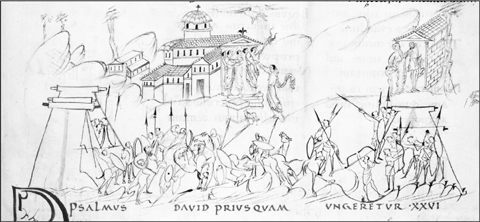
Scene from the eleventh-century Harley Psalter illustrating Psalm 27: “Though an host should encamp against me, my heart shall not fear… for in the time of trouble the Lord shall hide me in his pavilion.”
BRITISH LIBRARY, MS. 603, F. 15R
The Bayeux Tapestry Master probably knew the Ælfric Hexateuch, named for Abbot Ælfric of Eynsham (955–1020), a major figure in English pre-Conquest culture. This Old English version of the five books of Moses and the book of Joshua from the Old Testament contains some 394 illustrations in various states of completion. Some are framed and independent of one another as well as of the text, while others are linked in series, so as to produce a continuous narrative considered by some to be a precursor of the Tapestry’s linear means of telling its story, as in the case of the sacrifice of Isaac. So many figures from the Ælfric Hexateuch reappear in embroidered form that some consider it to have been one of the pattern books used by the Tapestry’s designer.
In panel 1, Edward’s and Harold’s fingers touching in the scene of instruction before Harold’s trip to the Continent parallels the scene of Joseph giving instructions to his steward in the Ælfric Hexateuch. The man with a slingshot in the border beneath panel 23, another image incorporated into “The Swallow and the Linseed,” resembles that of Abraham as bird slinger. Conan II’s escape by rope in the course of William and Harold’s siege of the town of Dol at the end of the Breton campaign looks very much like the escape of one of the spies from Jericho in the book of Joshua; even the bricks of the town walls are similar. Edward’s reception of Harold upon his return from Normandy in panel 64 seems to reproduce Isaac’s blessing of Jacob, right down to the length of the seated Edward’s fingers. The long necks of the standing figures can also be found in the “wrung necks” associated with the Winchester style of illumination, as in the example of the evangelist Luke from the Judith of Flanders Gospels in New York’s Morgan Library. The carpenter wielding an adze in the scene of boat building for William’s fleet in panel 84 is a dead ringer for the Ælfric Hexateuch Noah with whom he shares shoulders and beard.
Other images from the Tapestry trace their provenance to Anglo-Saxon manuscript illuminations. In the scene of plundering along the English coast in panel 107 the curious figure holding what looks like a coil of rope—which contains the only piece of embroidered linen thread among the wool of the Tapestry—is so close to the figure of Labor in the late-tenth-century manuscript of Prudentius’s Psychomachia that we must assume either that the Tapestry maker was inspired by this copy of a late classical work or that there was a common source. Finally much has been made of the scene of Norman feasting before the Battle of Hastings in panel 112 as a reproduction of a manuscript image of the Last Supper and possibly the version contained in the Saint Augustine Gospels, which shows a round table, with Odo in the seat of Christ.
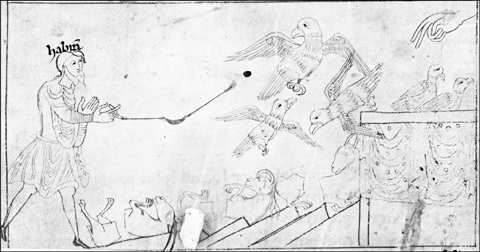
An eleventh-century Anglo-Saxon Bible illustration of Abraham driving away the fowls
BRITISH LIBRARY, COTT. CLAUDIUS B, IV, F. 26V
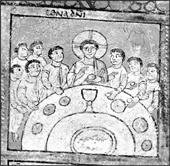
Miniature of the Last Supper, St. Augustine Gospels, Canterbury
CORPUS CHRISTI COLLEGE MS. 286, F. 125R; COURTESY OF THE MASTER AND FELLOWS OF CORPUS CHRISTI COLLEGE, CAMBRIDGE
The Bayeux Tapestry is a multimedia work with images and writing, and the forms of the Latin inscriptions running its length like sub- and supertitles belong, according to some linguists, to the Anglo-Saxon world. The abbreviation “7” for “et” is in the period used more readily in the manuscripts copied in Great Britain than in those of the Continent. Certain spellings, especially those connected to people and places, are characteristic of Anglo-Saxon copyists. The AT HESTENGA CEASTRA in panel 116, for example, using ATfor“ad” and CEASTRA for “castellum,” looks like an insular form. The same is true for the name of Edward the Confessor, which appears twice as EADWARDUS. The “William” of the Conqueror appears in different spellings, three times in the Normanized form ofWILGELM—using the intervocalic G to approximate the French Y-sound, as in BAGIAS for “Bayeux”—compared with fifteen instances of WILLELM current in Anglo-Saxon texts. The most convincing philological evidence of Anglo-Saxon script, however, lies in the Old Danish personal name of Harold’s brother GYRD (panel 151), the Earl of East Anglia. Only an English-speaking clerk could have spelled Gyrth with a barred D, a form of the runic letter thorn, for TH.
The name ÆLFGYVA, alas.
Between the dragon head-posts and lintel of panel 39 stands a woman below the inscription UBI CLERICUS ET ÆLFGYVA “Here a clerk and Ælfgyva.” The cleric’s arm extends within the frame to touch her head. A naked figure crouches in the border below
One of the great mysteries of the Bayeux Tapestry Ælfgyva has been identified as an abbess installed by William the Conqueror at Barking; Harold’s sister involved in an unhappy love affair with a clerk from Rouen; Edith, daughter of Count Ælgar, sister of Counts Edwin and Morcar, the widow of Griffith, king of the Welsh, to whom Harold is married; Eadgifu, the former abbess of Leominster, who was the lover of Sweyn Godwineson, Harold’s elder brother and possibly the mother of Hakon, who went with him to Normandy in the early 1050s and was released in 1064; William’s great-aunt Queen Emma/Ælfgyfu, whose first husband was the Anglo-Saxon king Æthelred, with whom she had King Edward the Confessor, and who, it is rumored, passed off the newborn child of a priest as the son and heir born of her second husband, King Cnut; and, finally, William’s wife, Mathilda, and possibly the patron of the Tapestry, compelled by modesty to “use the adopted name of Ælfgyva.”
Amid the myriad identifications of Ælfgyva as well as the scandal surrounding both her image in the Tapestry and her historical reputation, one thing, and one thing alone, is certain. The name Ælfgyva—sometimes written Ælfgyfu—is of Anglo-Saxon origin. Witness Emma, the sister of William’s grandfather Duke Richard of Normandy, who changed her name to Ælfgyfu when she married the Anglo-Saxon king Æthelred.
NORMAN AND CONTINENTAL
When it comes to elements of the Tapestry identifiable with Normans, the evidence is very slim; this despite the fact that its subject and conception relate a great Norman victory The name “Turold” above the dwarfed figure holding the horses of William’s emissaries to Guy of Ponthieu in panels 23–24 was a name common in eleventh-century Normandy. Turold is one of only three figures of the Tapestry singled out by name and who are not identifiable historical personages. And like Ælfgyva, Turold has elicited a certain amount of controversy ever since Agnes Strickland in the 1840s claimed that the Tapestry was “designed for Matilda by Turold, a dwarf artist, who, moved by a natural desire of claiming his share in the celebrity which he foresaw would attach to the work, has cunningly introduced his own effigies and name, thus authenticating the Norman tradition, that he was the person who illuminated the canvas with the proper outlines and colours.”11 Others have identified the Turold of the Tapestry as the Turold who became abbot of Peterborough after the Conquest; as Turold who was chaplain to William II; as Turold of Brémoy bishop of Bayeux in the twelfth century; and as the Turold mentioned at the end of The Song of Roland and who has in turn been recognized as the poet, the scribe, or the performer of France’s first epic. Along with Wadard, who in panel 107 guards the provisions of the Norman troops, and the scout Vital, who in panel 128 reports to William, a Turold of Rochester was known to be a vassal of Odo and to have held land in Kent.
Some of the buildings of the Tapestry have been ascribed to specific Norman sites and architectural types, both in overall structure and in detail. William is represented in panel 37 at his ducal seat in Rouen, an original Norman palace if ever there was one, though the building shown is a vague combination of generic features belonging to Tapestry buildings on both sides of the Channel. On their way to Brittany, William and Harold pass by Mont-Saint-Michel, an authentically Norman monastery, despite its location at the western perimeter of the duchy near the border of Brittany. The warriors lay siege to three strongholds of the Norman motte-and-bailey type at Rennes, Dol, and Dinan, schematically represented wooden structures atop an earthworks mound; and this is just the type of defense the Normans construct in panel 116 after landing on the English coast.
The earliest example of Romanesque architecture in England—Westminster Abbey, where Edward is buried in panel 67—is considered to have been inspired by such Norman buildings as the main abbey church at Jumièges, rebuilt between 1040 and 1067. One of the characteristics of Norman design, the chevron pattern found on the edges of capitals and arches of Romanesque churches, appears as a series of diagonal bars separating the animals and other figures along the Tapestry’s upper and lower borders. William wears a garment covered by such zigzags as he rides past Mont-Saint-Michel in panel 42. The zigzag reappears within the diagonal bars beneath William, who observes Harold taking his oath, beneath Harold accepting the crown, and in the space beneath the Norman feast and war council.
Though the zigzag or chevron is characteristic of Norman and of Romanesque design, its origins stretch much farther east than England or France, to the Middle East, as can be seen in a fragment of marble cornice beneath the dome of the north church of the monastery at Constantine Lips, Constantinople, constructed in A.D. 907. The alternating diagonal bands inhabited by plants and palmettes along with the accosted birds, in this case peacocks reminiscent of the Roman world, recall the edges of the Bayeux Tapestry, which contain many elements from antiquity and especially classical animal fables. The fable “The Swallow and the Linseed” is only one of the Aesopian tales to be found in the borders. These distant travelers hark back to Aesop the slave and Greece of the sixth century B.C., whence they made their way to Rome and to Western Europe via adaptations and translations in the first century A.D. and Latin copies known widely in the medieval West.
The fables in the margins of the Bayeux Tapestry have been interpreted in a variety of ways—as having a purely decorative function and little relation to the central narrative; as constituting a running commentary on specific main panels and thereby elucidating the character and motivation of the drama’s main protagonists; as relating less to the central narrative than to one another; as being a moralization of Harold’s betrayal; and as being a satire of the Norman point of view from the English side and thus a form of immediate resistance to invasion. Yet amid the scholarly disagreement, one thing is clear—that the Tapestry fables, which have traditionally served as a mirror of princes, a guide to noble behavior, and a warning to those who behave ignobly, are of particular relevance to the Tapestry’s central story of succession, alliance, oaths taken, betrayal, and revenge. They turn around reversals of fortune, issues of royal justice and privilege, right reason, and ambition.
In “The Mouse and the Frog,” in the lower border of panel 11, a frog, anxious to swallow a mouse, tries to drown it by attaching a string to its foot and plunging into deep water until both are swept away by an observant kite, which ignores the mouse and devours the frog instead. Here the moral is very simple, and in an Old French version of the fable from the second half of the twelfth century, Marie de France, the first woman writer of the Anglo-Norman world, insists upon the logic of the Golden Rule. Marie’s rendering has particular significance for the Bayeux Tapestry, for she claims to have translated her Aesopian tale from the English book of the Anglo-Saxon king Alfred; and even if this is not true, it is likely that Marie and the Tapestry Master were working from a common source.
With cunning villains this is clear:
They never will have friends so dear
That they, in honour of their friend,
Could bear a single penny spend.
Without compunction, they are gladIf they can trick their good comrade.
And yet it happens every day:
Those folk who torment in this way
And think that others they’ll ensnare, will
Find that they place themselves in peril. (v. 83)12
What would the medieval viewer of the Tapestry familiar with the popular animal tale have taken from “The Mouse and the Frog”? He or she might have thought in the first instance of Harold as a “cunning villain” who placed himself “in peril.” Or the wider story of the Conquest, which we will take up in our next chapter, might have come to mind. That is, the attempt by Harold’s brother Tostig, allied with the Norwegian king Harald Hardråda, to capture England just two weeks before the Battle of Hastings and William the Kite’s swooping down to seize the land that both Harald and Harold contested.
“The Wolf King,” in lower border panel 10, recounts the tribulations of the lion king’s withdrawal from the world. In council, the animals request “that he provide another lion.” Yet, the lion “answered that he had no heir.”
And thus it was they chose the wolf
For no one else was bold enough
To dare take anyone but him
(Though all thought wolf a villain grim).
The lion agrees to the appointment of a wolf as his successor under the condition that the new king take an oath not to eat meat.
But when he had been bound by oath,
And when the lion had set out,
Such craving wolf had for meat
That he made plans to use deceit. (v. 37)
This is a fable that could not have failed to resonate with the dramatic crux of the Bayeux Tapestry, the childless Edward the Confessor’s impending death, the struggle for succession, oaths, deceit, and both Harold’s and William’s ambitions, their cravings for meat.
Hunting is one of the obsessive themes in the Bayeux Tapestry, which contains, after all, a consuming great manhunt in William’s slaying of Harold, who is depicted consistently ready to hunt and was known historically as a skillful hunter. Harold leaves his initial council with Edward in panel 3 with a falcon on his arm, as hunting dogs give chase to rabbits. The falcon is still on his arm as Harold boards ship in panel 7, and dogs, perhaps those seen running in panel 14, are carried aboard. Harold is captured by Guy of Ponthieu as soon as he makes landfall, and together they ride toward Beaurain, each with a falcon on his arm. Harold and Guy arrive at William’s palace with falcons and hunting dogs still in tow in panel 34. Nor is hunting as a theme limited to the main panels. It figures prominently in the lower borders: in the bird slayer of “The Swallow and the Linseed” under panel 23, and in the chase beneath panel 27, which is of special significance. It occurs as the messengers arrive at William’s court to announce Harold’s capture, and the hunter with horn and hounds moving from left to right is met head-on by a hunter with a stick and hounds coming from the opposite direction. This is one of the few instances in the Tapestry in which action moves from right to left. The juxtaposition of hunters moving toward each other leaves the stag, caught in the middle like Harold in William’s custody, in the position of a cornered beast.
The scene of human hunters is preceded in the lower border of panels 15–16 by a fable known in the Middle Ages as “The Lion, the Buffalo, and the Wolf,” in which the animals of the hunting party track and kill a deer. When the time comes to share the spoils of the chase, the lion claims the kill, which has been divided into four parts, to be entirely his. The first part, he argues, is his rightful portion as king; the second part comes to him as a member of the hunting party; the third is his “by right because he killed the deer;” and the fourth belongs to him, the lion threatens, “because anyone who took it would be his mortal enemy.”
In “The Wolf and the Lamb” of the lower border of panel 7, a lamb, accused by a wolf of drinking upstream from him, points out that in reality he is downstream (“my water comes from you”); to the accusation that his father did the same six months prior, the lamb argues logically that he was not born yet—all of which serves only to precipitate violent attack, as language gives way to animal instinct or appetite:
“So what?” the wolf responded next.
… The wolf then grabbed the lamb so small,
Chomped through his neck, extinguished all.
Several Aesopian fables appear more than once. “The Crow and the Fox,” which is featured in the lower borders of panels 6 and 40 and in the upper margin of panel 63, contains the well-known story of a crow with a piece of cheese in its mouth and a clever fox who flatters the crow into singing, thus causing the cheese to drop into the fox’s possession. Though most versions end with the fox running off with the cheese, the Tapestry designer adds a third image of this tale made famous in the seventeenth century by Jean de La Fontaine, by showing in the upper edge of panel 63 the cheese back in the mouth of the crow. Thus, we might understand that William is the crow, Harold the fox, and the cheese the kingdom, all in consonance with Edward’s known designation of William as his heir, Harold’s brief seizure of the crown, and William’s ultimate recovery of what originally was his. The reversals of the tale are rendered by the artist as a reversal of physical positions relative to each other, which is particularly significant in fables that are about being on the bottom and coming out on top. In its initial rendering in the border below panel 6, the crow is on the left and the fox on the right, yet in the border above panel 63, the crow is on the right and the fox on the left. “The Fox and the Crow” summons up the great replacement in the post-Conquest world of Saxons by Normans in the holding of the cheese/land, of which William’s own half-brother Bishop Odo of Bayeux offers such a stunning example when he became Earl of Kent and the greatest landholder in England after the king.
“The Wolf and the Crane,” which appears in the lower border of panel 9 and the upper border of panel 62, shows a similar reversal of figures and of fortune. A wolf that has a bone stuck in its throat summons a council of animals for help, and when none seems apt, the crane volunteers:
Her neck was long, her beak was great;
With these, the bone she’d extricate.
The wolf promises a “grand reward
If he were cured, his health restored.”
But when the crane has performed the service of which only it was capable, the wolf breaks his promise:
“Already her reward she has!
When she into my throat was poking.
I might have cut her off by choking.”
“The Wolf and the Crane,” which, like “The Fox and the Crow,” appears above and below Harold’s departure to and return from the Continent, turns around deceit, opportunism, and a turning of fortunes translated into shifting positions vis-à-vis each other. In the rendering in the border beneath panel 9, the crane is on the left and the wolf on the right, yet they end up in just the opposite relative location in the margin above panel 62. Interestingly too, the reversal is also graphic, for the repetition of both “The Fox and the Crow” and “The Wolf and the Crane” occurs precisely where it is written HIC HAROLD DUX REVERSUS EST AD ANGLICAM TERRAM (“Here Duke Harold returned to England”), the Latin past participle of reverto, revertere signaling both a return and a turning around of fortune. While the Norman crane can refer only to the captured Harold, whose head, while he was in Normandy, was literally in the mouth of William the wolf, the English crane refers to William, whose head, upon Harold’s return, is about to enter the mouth of Harold the wolf when he usurps the crown that William considered to be legitimately his.
The image of that usurpation came to the Tapestry from Continental sources and stands as a unique moment within a work of art that is both long in physical extension and long in temporal duration, covering as it does some two to two and a half years from the time of Harold’s trip to Normandy until his death at Hastings. The scene of Harold’s coronation in panel 72 contains the only image in the Tapestry’s 230 feet of figures looking directly at the viewer. Archbishop Stigand faces forward in the emblematic pose of prayer such as can be found in works like an eleventh-century image of Saint Clement from the lower basilica of San Clemente in Rome.
While the great majority of the Tapestry’s 626 human figures are shown in strict profile with only half a face and one eye showing, and a few are shown in some version of three-quarter view with a face partially averted, Harold upon the throne is shown frontally Seated and crowned, Harold holds what is not quite a scepter, but a rod, or “virga,” in one hand and an orb topped by a cross in the other; his feet, set at an angle oblique to each other, rest upon a raised pedestal; his robe is draped in a “V damp fold;” the figure is contained, as in many of the Tapestry’s interiors, by what seems like a constructed architectural frame. These are the attributes of imperial power from Rome and Byzantium to Jean-Auguste-Dominique Ingres’s portrait of Napoleon painted in 1806.
The full face is one of the ways of representing both spiritual and worldly sovereignty passed from late antiquity to the Middle Ages. Frontal Harold in majesty surely had its predecessors in the portraits of the evangelists and Christ in majesty found in the ancient Italian style, in the portrait of Saint Luke from the Evangelary of Saint Augustine (sixth century); in an illumination from the eighth-century Irish Gospels of Saint Chad; or in an image from the “Poem of Caedmon,” which originated with Bede in the seventh century and was supposedly translated by King Alfred in the ninth. The depiction of kingship in this last image is in many ways closest to the Bayeux Tapestry not only because of the royal pose, but because of the odd calculation of heads and limbs attached to the seven men standing next to the king on only five feet. The five men standing to the right of Harold in majesty in panel 73 share eight feet among them.
The most obvious predecessors of frontal Harold, and the means by which earlier images of kingship passed to the Tapestry Master, are the imperial Carolingian portraits such as the image from the year 846 of Charles the Bald, grandson of Charlemagne, with scepter and orb with a cross painted upon it. The reign of Charlemagne, or the Carolingian Renaissance, is associated with the dream of Roman revival, and the ambition is preserved in the portraits of emperors long after Charlemagne’s death in 814 and long after the dream of imperial unity had devolved into chaos. The Ottonian or Germanic emperors of the tenth century preserved the frontal system of representing sovereignty, as can be seen in a portrait of Otto II, with scepter and orb with cross in his hands and feet upon a pedestal, all contained with an artificially constructed architectural space, from the region of Trèves of around 985; or in the manuscript illumination of Otto III, emperor from 983 to 1002, from Reichenau of 998 (see insert, figure 3). The Bamberg Apocalypse, probably also made at Reichenau around 1001, shows the frontal Otto III with scepter and orb being crowned by Saints Peter and Paul.
The embroidered portrait of King Harold in majesty, in the tradition of the emperors of centuries past, puts him on a plane different from every other of the Tapestry’s figures, which are in profile. The faces in profile, which include both horses and men, appear as if they are two-dimensional. In their alignment along the plane of action, the face and figure in profile are inscribed in time and move in the direction of history. They are oriented and point to a narrative climax at the Battle of Hastings. The same is true of the less frequent figures shown in three-quarter view whose two eyes we can see, though unlike Harold they do not look back. On the contrary, their eyes seem to be looking at some other person, object, or activity along the Tapestry’s horizontal scenic plane. Taking only such faces nearest frontal Harold, what is surely the three-quarter Odo in panel 80 receives the order from William to construct the Norman fleet; the woodsman in panel 83 looks attentively at his coping ax; one of the three-quarter carpenters in the upper part of panel 84 appears to be handing something to his co-worker, while one of the carpenters in the lower portion of 84 works assiduously on the gunwales of a boat. The full face of Odo in the feasting just before battle in panel 112 casts its glance upon the others at table or the servants, but his visual field does not penetrate beyond the bounds of the Tapestry. Unlike Harold in majesty, Odo does not look back.
In looking back at the viewer, Harold assumes the full measure of kingly power. The image of the frontal saint, Christ, or emperor shares in the uncanny visual phenomenon of painted or embroidered or sculpted eyes that seem to be looking at the viewer, that appear even to follow the viewer, who moves from side to side relative to the fixed portrait that we know to be un-moving and inanimate. The frontal eyes come alive, and what they see is no less than everything. They are all-seeing and omniscient in keeping with a depiction of imperial power as omnipotent. Harold in majesty is all-powerful because he is depicted as in the line of emperors and kings painted in this way and because no one and nothing escapes his gaze. He is for a brief moment in the Tapestry’s long and tightly woven narrative outside of history and time. Like the true ruler, he has only one role: to see and to be seen. His being, abstracted from becoming, renders visually the assumption that things are as they seem and will always be as they are. The appearance of Halley’s comet in the upper border of the next scene and the ghost ships in the border below, however, are sure signs that time is suspended only temporarily and that history is about to return to reclaim its own.
Why would the Tapestry Master have included a picture of imperial Harold in a narrative intended to commemorate the Norman Conquest and ending with Harold’s ignominious death?
Harold in majesty is an integral part of the Tapestry’s deepest function—that is, to unify the contending parties to the shock of Hastings and to the territorial dispute that continued to shake England long after 1066. William may have vanquished Harold upon the battlefield, but subduing the whole of England, as we shall see in our conclusion, took considerably longer. The residue of resentment and bitterness among the Anglo-Saxon population—the “Norman yoke”—persisted, as we saw in chapter 3, well into the nineteenth century, when it shaped early understandings of the Tapestry. The depiction of Harold in majesty does not necessarily make the Bayeux Tapestry an Anglo-Saxon creation, nor does it place its maker on the side of the English. Along with the demonstration of Harold’s physical strength in pulling men out of the treacherous river Couesnon in panel 45, it gives the Anglo-Saxon party its due by showing Harold, who was, after all, the most powerful man in England with the exception of William, as a king in the line of kings. Frontal Harold is part of the Tapestry’s aesthetic and strategic weaving of the inhabitants of Anglo-Normandy into a people.
Harold in majesty gives the strongest indication of how the damaged Tapestry might have ended were it not in shreds in the aftermath of Harold’s death and the flight of the English. If the Tapestry still possessed the seven feet thought to be missing at the end, there is little doubt that we would have seen an image of William in majesty to counterbalance that of Harold as the last in the line of omniscient and powerful imperial frontal faces. William’s last look would have been the last word.
Some of the objects and images of the Tapestry identified with Scandinavian, Anglo-Saxon, Norman, and Continental culture were themselves mixed even before the Conquest. The elements most truly Scandinavian or Anglo-Saxon turn out to be either a blend of both or, as we shall see, something else altogether. It would be surprising for things to be otherwise, since English and Scandinavians were in contact in the British Isles under the more or less constant domination of Danish and Norwegian leaders from the ninth to the mid–eleventh century. The difference between a Viking and an Anglo-Saxon longship can be a hard call for the trained archaeologist. The figures on the prows and sterns of Viking ships are similar to the golden beaks on the ships of the Anglo-Saxon kings—Æthelstan, Cnut, and Hardecnut. Harold Godwineson presented to King Edward a ship with a golden lion at the stern and a golden-winged dragon at the prow In Caedmon’s verse paraphrase of Genesis as well as in the Ælfric Hexateuch, both produced in eleventh-century Canterbury, Noah’s Ark is figured as a Viking ship with a dragon prow very much like those of the Tapestry.
The resemblance between Viking and Anglo-Saxon dragon-headed prows is striking, and both recall the use of animal heads to eject Greek fire from the fronts of boats of the Byzantine world, which visitors and mercenaries from Scandinavia might have encountered well before the Norman Conquest. Anna Comnena (1093–1153), daughter of Emperor Alexius I (ruled 1081–1118), recounts in the memoir she wrote about her father that “from time to time he used to board a ship … and give advice to the shipwrights about their construction…. On the prow of each vessel he had the heads of lions and other land animals affixed; they were made of bronze or iron, and the mouths were open; the thin layer of gold with which they were covered made the very sight of them terrifying. The [Greek] fire to be hurled at the enemy through tubes was made to issue from the mouths of these figure-heads in such a way that they appeared to be belching out the fire.”13
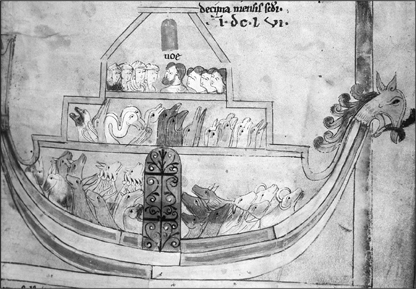
An eleventh-century Anglo-Saxon Bible illustration of Noah in the Ark
MS. COTT. CLAUDIUS B. IV, F. 14R. © BRITISH LIBRARY/HIP/ART RESOURCE, N.Y.
The arms of the men from the North were indistinguishable from the arms of the British Isles, as there were Swedish armorers working in England, and swords, shields, and helmets captured in battle were often reused. A helmet found at Coppergate, York, inscribed with the Old English name “Oshere,” is decorated with lappet-lipped animals that degenerate into plant scrolls resembling the decorated objects of the Oseberg, Norway, ship burial. The chain mail depicted in the Tapestry is identical to the “tangled war nets” from Scandinavian digs or to the mail incised upon a stone frieze from Old Minster, Winchester. An eleventh-century carving in Saint Paul’s church yard, London, is as fine an example of the Scandinavian Ringerike style as the beast etched on a bronze weather vane from Heggen, Norway, of the same period. The Scandinavian dragon on Norman and English shields may be the Dragon of Wessex, Harold’s emblem, stretched upon a standard in panel 168; both are similar to the wyvern, or winged dragons, in sculpture of the Midlands, as in the Easby Cross, Yorkshire. The shield dragons of the Bayeux Tapestry are similar to that on the shield excavated at Sutton Hoo. And startling as it might seem, nothing resembles the shield dragons of the Bayeux Tapestry so much as metal pieces from the Middle East such as a door knocker from southeast Anatolia currently in the Berlin Museum of Islamic Art.
Whether the mixing of elements from the Scandinavian, Anglo-Saxon, and Norman worlds occurred before or after the Tapestry was embroidered is of little consequence. The overall purpose and effect of such a blending lies in the desire for unity among the peoples to whom such elements might have once, if ever, originally belonged before, as a people, they became entwined.
Such a peaceful vision of the making of what had to be a collective artistic undertaking works implicitly in favor of the Norman conquerors who had the most to gain from the peaceful reconciliation of parties in the decades after 1066. But this does not make the Tapestry a Norman creation, nor does it mean that it was embroidered on the Norman side of the English Channel. It does suggest that the Tapestry expresses a will for peace that may have been shared by both Anglo-Saxons and Normans who may also have worked together in assembling the necessary materials and blending them into an embroidery. Leaving aside for the moment the fact that England and Normandy were a single entity after the Conquest, it is hard to imagine an undertaking of the magnitude of the Tapestry without the consent and active support of the Normans. After all, it took the thirty-five women of the Leek Embroidery Society thirteen months to sew a reproduction, and this time was shortened because the design was taken from the original (see p. 83). It is equally difficult to imagine the actual embroidery upon linen without the skill traditionally ascribed to Anglo-Saxon textile workers. So we are left with a view of the Bayeux Tapestry that resists the will to make it either English or French. We are left with a Tapestry that is mixed and international and with a work of art with a longer reach than what was available in the proximate cultural environment of either England or France. For one of the ways that a peaceful blending of peoples might come about is through the focus upon a common enemy or a third term, which for the makers of the Tapestry, as well as for Normans after the Conquest, was to be found in the Middle East. It is to the Tapestry’s Eastern elements and to the world of Byzantine silks that we now turn.
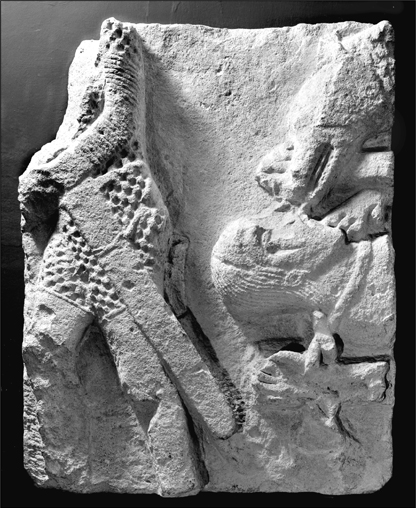
Stone frieze with sword and armor from Old Minster, Winchester
© JOHN CROOK AND WINCHESTER EXCAVATIONS COMMITTEE