
IT IS HARD TO IMAGINE THE EXTENT TO WHICH THE WORLD changed for Anglo-Saxons on October 14, 1066. Having sustained three bloody battles, Fulford, Stamford Bridge, and Hastings, the English nobility had been depleted by bloodshed, “its downfall,” in the words of William the Conqueror’s modern biographer David Douglas, “one of the best documented social transformations of the eleventh century.”1 Of all the land in England, after the Norman Conquest, only 8 percent remained the possession of those who held it in 1066, according to the survey William the Conqueror ordered in 1086, the Domesday Book. For Anglo-Saxons, the Conquest was doom: “So very thoroughly did he have the inquiry carried out,” the Anglo-Saxon Laud Chronicle reads for the year 1085, “that there was not a single ‘hide,’ not one virgate of land, not even—it is shameful to record it, but it did not seem shameful to him to do—not even one ox, nor one cow, nor one pig which escaped notice in his survey.”
Though the great majority of Anglo-Saxons submitted to Norman rule, many resisted. An anonymous thirteenth-century manuscript speaks of a group of nobles, inhabitants of that part of England known as the Danelaw because it had been ruled by Danes, who sent to the Danish king Sweyn to help them escape their conquerors. The leader of the embassy to Denmark was none other than “Godwinus iunior,” King Harold’s younger brother. A Scandinavian fleet arrived in 1069, and Sweyn himself in 1070, to harry the coast of Yorkshire and East Anglia, until William bribed the Danes to leave. Sweyn’s death in the mid-1070s meant that help would not be forthcoming from the North. The Anglo-Saxons “groaned aloud,” in the phrase of the historian Orderic Vitalis, “for their lost liberty and plotted ceaselessly to find some way of shaking off a yoke that was so intolerable and unaccustomed.”2
In one of the most astonishing examples of the fallout from Hastings, ten years after the Conquest, a large contingent of Anglo-Saxon landholders “turned into money all the estates that they had in England” and left their homeland in 350 boats.3 They had no idea where they would land, but almost anywhere seemed preferable to servitude in what had been their home. The Icelandic Saga of King Edward the Confessor identifies the leader of the rebels as Sigurd, Earl of Gloucester, who with “a great force of many picked men” sailed along the coast of France, Spain, and through the Straits of Gibraltar into Norva-Sound—the Mediterranean. There they sacked cities in what is now Morocco, taking “so much fee in gold and silver that it was more even than what they had taken away with them from England.” They captured the islands of Majorca and Minorca. From the Baleares, Sigurd’s men stopped in Sicily and Sardinia, where they heard of great strife in Micklegarth— Constantinople. For the Anglo-Saxon freebooters, where there was strife, there was also opportunity for “great advancement.”
Sigurd’s men arrived in the harbor of Constantinople, which had been blocked by pagans “some winters after the fall of King Harold.” Liberating the besieged city, they were welcomed by the emperor and inhabitants. “They stayed a while in Micklegarth, and set the realm of the Greek King free from strife.” Some of the exiled Anglo-Saxons joined the emperor’s personal guard, the very Varangians that the Norwegian Harald Hardråda had led and left some thirty years earlier. Others, having been independent chiefs while in England, found “that it was too small a career to grow old there in that fashion, that they had not a realm to rule over.” They begged the Greek leader to “give them some towns or cities which they might own and their heirs after them.” The emperor, not wishing “to strip other men of their estates,” granted them land that had once belonged to him but that since had been captured by “heathen men free from tax and toll.” Should they manage to retake the territory “some six days and nights’ sail across the sea in the east and northeast from Micklegarth,” the land “should be their own and their heirs after them.”
After many battles, Sigurd’s men were successful. The English exiles, landholders once again, established a new territory, which they named appropriately “Nova Anglia”—New England. The towns were to be called London and York “and by the names of other great towns in England.” And so, in or around 1078, in the region identified by some historians as part of what is now the Crimea, we find the first New England, New London, and New York. As feisty as the New Englanders of the United States, the New Englanders of the Crimea were unwilling to live under Eastern religious rule, so they sent to Hungary for bishops and priests. Their fellow exiles who stayed in Constantinople as part of the emperor’s Varangians were among the force that in 1082 fought back the attempt of Normans settled in Sicily to capture Byzantium, and in this way they participated in some small measure in resistance to further Norman conquest.
For the Anglo-Saxons who left England after the Battle of Hastings, it may have seemed that the world they knew had ended. For those who stayed, however, the world merely changed, and there is no better embodiment of such change than the Bayeux Tapestry, which both reflects a past historical moment and, by the very nature of that reflection, alters the universe into which it was received. The Tapestry records the events leading up to Hastings, but the way it figures them visually carries new ways of conceiving time, places new emphasis upon everyday life and the secular world, proffers a vision of history as a logically connected continuum, makes an unseen connection to the classical past, and sets the stage for Anglo-Norman ambitions in the Mediterranean and the Middle East. Understood as an instrument and not just an image of historical change, the Tapestry, like all truly founding works of art, operates deep in the zone where form is retained as perception, perception is embodied in ideas, and ideas generate actions and consequences within the wider world.
The first clash of the Battle of Hastings, shown in Bayeux Tapestry panel 144, is an extraordinary historical moment, capturing as it does the second in which the world shifts, embodying a clash of peoples and of civilizations brought into being by dramatic changes in military technology that would cast a wide shadow over the later Middle Ages. Hastings stood not only for the displacement of Anglo-Saxons by Normans, but for the victory of light and mobile Norman knights with couched lances supported by the longer-range weapon of the archers over fixed ax-wielding infantry, a “conflict,” in the phrase of historian Lynn White, “between the military methods of the seventh century and those of the eleventh century.”4 The author of the late-eleventh-century Song of the Battle of Hastings, Guy of Amiens, tells us that the English, “a race ignorant of war, scorn the solace of horses and trusting in their strength, they stand fast on foot.”5 Panel 144 arrests this transformation in its initial and grandest stage, as the troops in the first line, attached to their horses by stirrups, use the lance as a shock weapon and not a projectile. This shift inaugurates the era of the mounted knight and of a system of land tenure based upon knight’s service, the feudalism synonymous with Anglo-Norman society and, indeed, with medieval society in the centuries after the Conquest.
The Tapestry records an instant in time within a world in which images of chronological time and of earthly events were less important than depictions of the defining dramas of biblical history within the scope of Christian providence. Yet this instant is not recorded instantaneously as, say a painting—or later a photograph—might have captured it in an isolated frame that the viewer could seize with a single look. If ever a work of art defied instantaneous apprehension, it is the Bayeux Tapestry, which by its very length cannot be taken in all at once. The Tapestry covers in its 230 feet the chronological events from Harold’s trip to Normandy, which probably took place in the fall of 1064, to the Battle of Hastings two years later.
The Tapestry’s temporal dynamism is obvious in the light of comparable scenes from the Harley Psalter, which like the embroidery shows ranks of warriors in battle yet depicts combat as if in a frozen frame (see p. 116). The immobility of the figures of the Psalter is due in part to the fact that we see its pages all at once: The eye is not forced to move from left to right as it does in viewing the Tapestry Yet it is also a function of the way in which the Tapestry’s figures embody the successive stages of the charge of approaching knights, while those of the Harley Psalter, despite their formation in a line, are arrayed randomly with respect to the common maneuver. The comparison is all the more striking when one considers the ease with which action might be rendered via the medium of drawing and wash versus the slowness of embroidery by stem stitch and couched fill.
The moment of contact between the armies of William and Harold is slowed, as in the example we saw earlier of the transmittal of the order of attack (see p. 147). What may have taken a minute or so is dissected into discrete segments depicting the successive split seconds of an event as it unfolds. Yet the Tapestry’s rendering of action is odd to the eye and more subtly configured: What appears to be the collective motion of multiple figures is, in fact, one figure engaged in the sequential stages of a single action. The row of knights who one by one hold the lance like a javelin over their head, then move it to a couched position under the arm, are like the individual figures of an animated cartoon, each of which is immobile yet seems to move when displayed with sufficient speed as a series of identical, though slightly altered, images in a flip book.
The stop scroll motion of charging knights is one of the animating principles of the Tapestry, one of the ways in which scenes of movement and of violence come powerfully alive; and it is there almost from the start. As Harold’s men board the boat for the ill-fated trip to Normandy in panels 6 and 7, we observe what appear to be five separate figures. Yet each is resolutely engaged in one, and just one, phase of embarkation: The first looks back to the scene of feasting in panel 5 while pointing to the boat, as if he were summoning those still in the hall; the second descends the stairs of the building, holding in his hand a stick that touches the water; the third holds a similar pole, both feet in the water; the fourth holds a dog while wading toward the boat; and the fifth holds a dog in one hand and a falcon in the other, one foot raised from the water as if to step aboard. Each member of the party carries out a separate action in the progression from building to vessel, yielding the impression that every individual figure passes through the actions of the group, which is reassembled in the boat.
In the felling of trees to build the Norman fleet, three woodsmen move through the phases of swinging an ax: The first prepares by drawing it back over his shoulder, the second is in full swing, and the third follows through. In the shooting of the arrow that eventually lands in Harold’s eye, eighteen archers in a line enact successively the steps of loading, drawing, raising, and firing a bow.
Great controversy has turned around the relation between the two figures in panel 169. Some maintain that while the figure on the left with the arrow in his eye under the inscription “Harold has been killed” is indeed Harold, the figure lying on the ground is another knight, possibly even one of Harold’s brothers, Leofwine or Gyrth, who have died in panel 151. Though the lack of an arrow in the eye suggests that the second knight is not Harold, the presence of needle holes extending from the nasal guard in a line that crosses the sword lying next to him indicates the original stitching of an arrow in the eye of what in this case is surely the fallen Harold. Recognition of the way the Tapestry Master uses stop scroll motion to portray the movement of a single figure through the ad seriatim representation of several figures supports an understanding of two Harolds in the successive stages of dying: Hit by the arrow in the first, he falls to the ground in the second.
The slowing of time, the dissection of time, and the concentration upon the successive instants of a determining historical moment are part of what we might think of as the modernism of the Bayeux Tapestry, which was as startlingly new for its era as, say, Pablo Picasso’s Demoiselles d’Avignon was for the twentieth century. In its ways of looking back at the events leading to 1066, the Tapestry looks forward to a world in which time is an increasingly secular concept, material objects are interesting in and of themselves, and the rational causes of earthly events outweigh any higher notion of causality The Tapestry was innovative for its time, and it is still modern in the terms in which we define our own modernity, which explains its enduring appeal.
For a great work of art created in an intensely religious age and with the necessary participation of ecclesiastics, who alone were sufficiently literate to write its inscriptions, the Tapestry is remarkably lacking in religious spirit. Time in the Tapestry is not theaeternitas of medieval theologians, for whom earthly events were part of the middle time between the first and second comings of Christ, an anticipation of the final redemption. What we might think of as the narrative economy of the Tapestry—that is, the relation of the time of viewing to the time of events—is uneven. Relatively short time spans sometimes occupy multiple panels, as is the case of the first clash at Hastings, and events of relatively long duration are depicted in a single panel or two, as in the stylized scenes of council, of Edward on his deathbed, or of shipbuilding. The plasticity of time in the Tapestry is synonymous with its secularization, a function of particular activities and occasions and of individual perception. This is one way that we can understand the frequent use of HIC and NUNC (“Here” and “Now”) in the inscriptions. The writing in the space between actions and events serves as a constant reminder that the here is now.
Direct references to religion in the Tapestry are few and far between. Harold swears an oath on holy relics, and the very Latin word sacramentum betrays its sacred nature. According to chroniclers, William carries the relics hung around his neck into battle along with the papal banner, though both are difficult to locate precisely. Archbishop Odo is a man of God, and he is depicted in the feast before battle in the seat of Christ at the Last Supper. Odo, however, fights as fiercely at Hastings as any other warrior. Archbishop Stigand appears in the orans posture of prayer in panel 72 but plays no larger role in the Tapestry’s version of the drama of 1066. The hand of God appears over Westminster Abbey in the scene of Edward’s burial, yet Christian providence is balanced by Halley’s comet, the “hairy star” seen ominously after Harold’s coronation. Numerous chroniclers mention a comet that appeared in February 1066, reached its perihelion on March 27, and attained its maximum brightness in April. Astronomers tell us Halley’s comet would have seemed brighter in 1066, when it passed between earth and sun, than in 1985–1986, when it traversed the far side of the sun.
In the absence of emphasis upon religious persons, objects, ritual, or atmosphere, the Tapestry is surprisingly focused upon the things of this world. Its designer is concerned with earthly events, with real places, everyday activities, and even the artisanal crafts of the age. Like the real objects—matchbooks, newspapers, fabric—collated into certain cubist paintings as a defining element of our own modernism for its blurring of the line between life and art, the Tapestry draws upon the images of real events, buildings, and places: Mont-Saint-Michel; the fortresses of Dol, Rennes, and Dinan; Bayeux; Westminster Abbey. One of the reliquaries on which Harold swears contains a named jewel still famous a century later. “The ‘eye of the bull,’ I have heard it called,” observes the poet and chronicler Robert Wace in the Roman de Rou, his Old French account of the Scandinavian settlement of Normandy and the Norman invasion of England.
The Tapestry integrates scenes of daily life: seasonal activities like hunting and sowing, but also daily activities like cooking and eating. The stop scroll movement of panels 109–111 shows the successive steps in the preparation of spits and skewers of meat and of bread as they pass from fire and oven to table. This scene of feasting before the Battle of Hastings is remarkable in the attention to detail, to the tools used in the cooking and handling of food: the shape of the mechanism turning the spit, the lineup of skewers, the tongs with which bread is lifted, and the shape of the sideboard improvised from shields on which the food is laid on plates and bowls. A close look at panels 110–111 reveals six figures: The first holds spits of meat in his right hand, while handing the spits of meat in his left hand to the second figure, who receives spits in his left hand while passing skewers with whole chickens through a doorway to the third figure, who receives them with his right hand and holds a bowl with a long-handled spoon with his left hand. Between the bowls and plates lie several cleavers or hacking knives. The fourth figure has placed his left hand on a bowl while he passes something not quite visible in the direction of the fifth figure, who blows a horn to announce dinner. To his left, a figure with a twisted body looks back at the scene of food preparation upon the sideboard while clearly moving into the space of eating. A figure kneels in the open space of the hemicyclical dining table, a towel draped over one arm, as he places a large bowl before the diners. Bowls, plates, knives, and fish lie upon the table at which are seated six figures whose own bodily postures and gestures, in particular the raised pointing left arm of the fifth in the series, move us across the scene of supper and into the succeeding interior space of the war room, where William orders trenches to be dug at Hastings. In what is an extraordinarily smooth transition from kitchen to council, involving as it does some sixteen human figures and focusing upon the implements and activities of the cooking, preparation, and eating of food, the Tapestry Master offers as good a glimpse at the everyday life of eleventh-century knights as can be found.
With similar interest and attention to detail, the Tapestry shows the stages of fleet building in panels 81–84, the felling of trees, the shaping and shaving of lumber, the joining of planks, the launching, mooring, and loading of boats. Amid the four carpenters wielding hammers and carving tools stands a shipwright directing the others, as indicated by an arm raised in the gesture, used throughout the Tapestry, of command. In the upper boat of main panel 84, one of the shipbuilders holds what looks like a measuring device in his two hands. From the scene of shipbuilding, four men standing in the water launch the boats while a fifth attaches the ropes to a mooring post in a series of stop scroll motions in which the objects from panel 85 are literally pulled across the Tapestry into panel 86.
The loading of the boats in panels 88–90 is remarkably precise in the display of the embarkation of the weapons and victuals of war. Nine figures bear full coats of mail suspended on poles, helmets, bundles of swords, an ax, and a lance, while two others tow a cart on which sit a keg of wine, five helmets, and twenty arrows pointing upward and set in a vertical rack. Between them men carry on their shoulders smaller containers of liquid, a slender barrel and a bladder, as well as a sack of grain. In panel 102, the Tapestry shows the unloading of horses, an innovative technical feat unknown to the Normans of Normandy before 1066 and to which we shall return in the discussion of the strategic contributions to the Conquest made by the Normans from the Mediterranean and Middle East.
The Tapestry Master is interested in the particularity and the working of things, in the division of tasks that go into a common enterprise, in the ways that men make, shape, and consume everyday goods as well as the special staples of war. He is a stickler for details—the mustache that distinguishes Anglo-Saxons from Normans, the tunics lifted as men step into the water at Bosham, the plumb line dropped from a boat in Harold’s landing on the Norman coast, the weather vane placed atop Westminster Abbey, the carved dragons on the prow and stern of warships, the stone dropped by one worker on the head of another in building the fortifications at Hastings, the harness, saddlery, and even the sexual excitement of horses. One of the steeds held by Turold in panel 24, the horse on which Harold arrives at William’s palace in panel 34, Harold’s mount upon return to England in panel 63, and William’s charger brought to him by the reins in panel 121 are all depicted in an impressive state of equine erection.
In the presentation of the political happenings of a two-year period and the one-day battle that displaced the leaders of a population and changed the nature of the known world, the Tapestry Master sews as seamless a transition from one scene to the next as can be imagined. He is interested in the working of things, and the eye of the viewer often lingers over details or is distracted by the decorative figures and fables in the margins. Yet the smooth progress of history drawn as a linear progression from one scene to the next renders a world in which events—from beginning to end—seem inevitable. The Tapestry Master shows astonishing skill in linking the discrete events of the embroidery and in keeping its action moving from left to right, and this via the attuned crafting of trees, architecture, and the human body.
The odd stylized trees of the Tapestry are a transitional device, marking geographical space, indicating departure, arrival, or a change of direction. Trees signal Harold’s arrival in Bosham in panel 4 and in panel 16 link Guy of Ponthieu’s capture of Harold to their departure in the direction of Guy’s castle at Beaurain. This second example is interesting because the horses and men to the left of the tree face left, and those on the right face right, the exception being the dogs on the left who have already begun to run toward Beaurain. The tree serves as a means of illustrating the action of turning around, and its interlaced branches, which cross one another before fanning in the direction opposite their rooting in the trunk, make the visual bond.
The crosshatched tree along the Norman coast is a link between scenes, as is the tree of panel 21, whose branches weave together the spy behind a pillar of Guy of Ponthieu’s council chamber and the shoulders of Guy’s men receiving messengers from William in panel 22. A similar effect is produced by the tree that makes the transition between William’s messengers riding to the left and the arrival of the news of Harold’s capture. A lookout who has climbed this tree in panel 27 balances the branches facing the scene of William’s court. A reversal of direction at the point of Harold’s arrival at Rouen is marked by two trees whose entwined branches point both left and right. Bidirectional interlaced trees stand at the departure and arrival scenes of the news of Harold’s usurpation on both sides of the Channel in panels 76 and 79. Three such trees signal a shift in direction and the beginning of battle in panel 122, and a similar trio separates Norman and Anglo-Saxon scouts in panel 131.
The Tapestry’s trees are not three-dimensional, as in nature. They are flat and are woven as if their branches were made of single strands of enlarged thread frayed at the end by leafy tendrils. Pointing right and left, they bind the scenes on either side and thus keep the figures moving through complicated itineraries, like that of William’s messengers who ride from Rouen to Beau-rain and back, and through discrete physical spaces, like the inside and outside of Guy’s and William’s castles, in smooth transition from left to right across the breadth of the embroidery
Architecture in the Tapestry has a similar function, the joining of buildings marking a movement from one interior space to the next and thus a progression through time. This is true, for example, of the buildings beginning in the scene of Harold’s interview with King Edward upon his return from Normandy in panel 65 and ending with the far end of Westminster Abbey in the scene of Edward’s burial. The room in which Harold stands before the seated Edward is bounded on the left by a tower with circular staircase, windows, and turret and on the right by a similar tower, which is itself attached by a sloping roof to a shorter tower that forms one side of the inclined roof, on which stands the man placing the weathercock atop Westminster Abbey, linked to the original interior by a series of connected towers and roofs. The same is true of the building in which Harold is crowned, the first in a series of three rooms separated by turrets with doors and roofs in which Harold’s counselors look back at the new king and then forward in the direction of Halley’s comet.
The human bodies that inhabit and move through the buildings of the Tapestry work sculpturally to keep things moving. Figures on one side of a crowd scene might be planted in one space, while those on the other side move toward another. Individual bodies are sometimes twisted so as to indicate motion from left to right. The figure leaving Harold’s hall at Bosham faces back to the room while his left foot and arm are turned toward those already engaged in boarding the boat to Normandy. The same is true in panel 20 of the spy whose right side of the body and right ear are turned attentively to the happenings at Guy of Ponthieu’s court in Beaurain yet whose foot, planted on the other side of the pillar behind which he hides, is turned in the direction of where such news might be transmitted. One of Harold’s men, who observes him swear on relics, has one foot planted on land and turned toward the water that will carry him back to England, while a second knight, whose right leg crosses the first knight’s left leg, is turned bodily toward the water in which he stands. It is as if they are in two scenes, interior and travel, at once.
Of the eleven courtiers who stand in two rooms after Harold’s coronation, those on the left face toward the new king and Stigand, while those on the right are turned progressively toward the appearance of Halley’s comet. In the scene of the issuing of the command to build the invasion fleet, the woodsman in panel 80 listens with his head turned to William and Odo, while his body—both feet, both arms, and ax—seems already to have left the room in execution of the ducal order. The knight in panel 135 turns his head toward William, delivering the command of attack, while his mounted body rides forward into battle. In panels 154–156, the twisted bodies of horses connect the scenes of chaotic battle to the left and right. The William of panel 160, rumored to have been killed, turns his raised visor to look back, showing those behind him that he is still alive, while riding forward above the very place in the Tapestry where archers begin to load the arrows that will end the fight.
A remarkable variant of the bodies twisted between scenes lies in the bodies with distended necks depicted within tableaux. The courtiers in Harold’s interview with Guy of Ponthieu extend their necks to the right, while the spy behind a pillar stretches his to the left in a gesture meant to transmit the idea of attentive listening. Those surrounding the Norman throne in panel 37 crane their necks to take in the exchange between the captured Harold and William. The same is true of those in panel 59, where Harold swears his oath on relics. The Harold in panel 64, newly returned from Normandy and standing before the ailing king Edward, exhibits what is perhaps the longest neck in Western art. The Tapestry Master might have intended Harold’s long neck to emphasize the bowed head acknowledging guilt atop a shrinking body. This is, after all, a world in which inner states are revealed primarily through external gestures and bodily signs. Edward, whose own strained neck may be a sign of his failing health and weariness, points the long finger of admonishment—in fact, one of the longest fingers in Western art—at the cringing Harold.
Long fingers and craning necks are characteristic of the Winchester style of illuminated manuscripts found in and around Canterbury both before and after the Conquest (see p. 115). They are an integral part of Anglo-Saxon representations of the body, just as the hip-shot women, whose hips sway so severely as to appear out of joint, are a part of Gothic painting and sculpture. Yet the dislocated finger and the “wrung neck” style of the Tapestry is neither just a borrowing from elsewhere nor a consistent means of representing the body On the contrary, the strained necks of courtiers and kings appear exclusively among the standing figures in fixed portrayals of council, in scenes, in other words, in which physical movement is reduced to a minimum and action consists primarily of conversation. Like the twisted bodies turning between preceding and succeeding tableaux and thus linking one scene to the next, the wrung necks motivate time within a tableau. They are a means of keeping time moving at those moments of verbal exchange when, visually speaking, time slows down and, as we have seen, even the inscriptions are mute. The “wrung neck” style flattens the visual axis along which the eye moves and thus preserves forward motion in the telling of the Conquest story.
A similar technique is found in the overlapping of figural planes within and between tableaux. In the depiction of shields, boats, horses, and mounted knights, the right part of the object on the left lies regularly over the left part of that to its immediate right. The shields lining the gunwales of Harold’s boats traveling to Normandy and returning to England, like the shields lining the gunwales of William’s fleet crossing the Channel, so consistently protrude over one another from left to right that they resemble the bristly scales of an echinodermal fish. The layering of the boats of William’s fleet mirrors the shields along their upper edges: Boats to the left overlap those to the right. The horses and riders who cross the river Couesnon at the beginning of the Breton campaign partially cover one another from left to right, as do those who participate in the first clash, beginning with William’s order of attack, through the meeting of the wall of Anglo-Saxon shields, which are themselves overlaid, left over right. Despite the chaos of battle, the knights who mount the final attack remain faithful to this important visual rule of the Tapestry’s means of recounting a great military victory: Figures on the left partially cover those to their immediate right.
Consistent overlapping of perspectival planes is not a function of the making of the Tapestry Embroidery from left to right would have produced, in the arrangement of stem and laid couch stitches, just the opposite—a layering such that the threads sewn progressively to the right covered those to their left. The counterlayering of shields, boats, and knights is another of the techniques the Tapestry Master uses to maintain movement of the eye from left to right, rendering the impression that history itself has but one direction, and that direction aligns with the well-known outcome of the events leading to victory. Movement backward would be against the Tapestry’s visual grain.
Here we find ourselves before one of those moments at which the form of an art object and its meaning coincide. The overlapping of planes in scenes of movement, the extension of necks in stationary sets, the presentation of faces in some degree of profile, and the twisting of bodies between tableaux all contribute to a flattening of history along a horizontal plane. The actions and events of the Tapestry are so smoothly intertwined that, as in the thrusting, forward-moving technique of stop scroll motion, the end of history seems inevitable. How different the unidirectional nature of the Tapestry is, for example, from the repeat patterns of Byzantine silks, in which the pleasure of decorative design removes the eye from time and from the urgency of a story. Or how different from the disposition of a tympanum over the portal of a Romanesque or Gothic church, in which Christ sits in the middle of the figures to his left and right in the sculptural depiction of some future moment of final redemption outside historical time. The symmetrical design of both silk and tympanum could not be further from the Tapestry’s impatient movement along the flattened axis of human history, from left to right, and from the beginning of the events in and around the English succession to their visual, chronological, and unavoidable end.
In the masterful visual and dramatic presentation of the events leading to the Norman Conquest of 1066 as if they were inescapable, the Tapestry most resembles the great victory friezes of late antiquity—the Column of Trajan, which commemorates the emperor’s successful campaign in Dacia (113), and that of Marcus Aurelius (180), both still standing in Rome. Like the Tapestry, Trajan’s Column contains set motifs not only of battle, but of the transportation by ship of troops and equipment, marches through enemy territory and encampment, council in which the emperor is seated among his advisers, negotiation, reconnaissance, rallying of troops, and equestrian charge. Certain scenes of the Tapestry resemble those of Roman victory columns even more precisely. The Dacians on Trajan’s Column cross a marsh just as William, Harold, and their men cross the river Couesnon; Roman woodsmen fell trees for fortification just as William’s woodsmen cut timber for construction of the Norman fleet; Roman soldiers build castles in scene LXVIII of the column in a fashion somewhat like that of the laborers crossing spades in the fortification of Hastings in the Tapestry The most avid proponent of the direct influence of classical victory columns upon the Tapestry Master, O. K. Werckmeister, sees in the three-arched, gabled porch at the right end of the stretch of water into which the finished Norman vessels are being pulled in panel 87 a version of a structure in embarkation scene XXXIII of Trajan’s Column.6 The mother fleeing with her child by the hand from an English house torched by Norman pillagers in panel 118 closely resembles the mother and child in scene XX on the Column of Marcus Aurelius.
Scholars have wondered from the start if the Tapestry Master could have drawn not only set motifs and particular images, but the very concept of “continuous pictorial narrative” from the monumental victory friezes of Rome, either directly or via some intermediary.
The case for direct contact is sustained by the fact that despite the height of Trajan’s Column, which renders its uppermost parts inaccessible to the eye of a viewer on the ground, all but one of the motifs that reappear in the Tapestry are located in the lowermost third of its one hundred feet. In the tenth and eleventh centuries, Anglo-Saxons as well as Normans were regular visitors to Rome, often on the way to or from the Holy Land. Harold’s brother Tostig, slain by Harold at the Battle of Stamford Bridge, accompanied their brother Gyrth, who died with Harold at Hastings, to Rome in 1061. The Anglo-Saxons maintained an ecclesiastical community in Rome, and the last Anglo-Saxon abbot of Saint Augustine’s Abbey, Canterbury, traveled to the Holy City His replacement, Abbot Scotland; Bishop Geoffrey of Coutances, who took part in the Norman Conquest; and William’s archbishop of Canterbury, Lanfranc, had all been to Rome. Before undertaking the invasion of England, William sought the blessing of Pope Alexander II, who gave him a banner “as a token of kingship,” though he was not yet king. The pope, as we shall see, relied upon protection from Normans not only in the Holy City, but throughout the Mediterranean. Odo maintained a palace in Rome until his disgrace in 1082. Normans rescued the pope from imprisonment when Germans sacked Rome in 1084. There was, in other words, plenty of opportunity for either Anglo-Saxons or Normans to have seen Trajan’s Column or that of Marcus Aurelius before the Tapestry was embroidered.
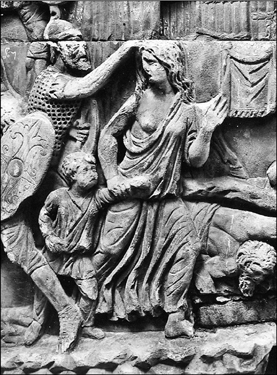
Woman and child fleeing, Column of Marcus Aurelius, Rome
© ALINARI/ART RESOURCE, N.Y.
The image of woodsmen felling trees in the Anglo-Saxon manuscript calendar month of July is close enough to the images of woodcutting both on Trajan’s Column and on the Tapestry for it to serve as an example of how a single motif might have been transported from Rome to England (see p. 114). A potential route of transmission lies among the Germanic rulers to the East. Partisans still of Charlemagne’s dream of restoring empire, the Ottonian emperors were frequent visitors to Rome. Sometime between 1015 and 1022, Saint Bernward of Hildesheim, who had lived with his pupil Otto III on the Aventine in Rome, ordered a twelve-foot-high Christian version of Trajan’s Column. The eight spirals of Bernward’s Column, representing the life of Jesus along with his triumphant entry into Jerusalem, still stand in the east choir of the Church of Saint Michael, Hildesheim. (Harvard University’s Busch-Reisinger Museum owns a full-scale reproduction.) We have seen that the Tapestry Master turned to Byzantine, Roman, and Ottonian imperial models in the representation of frontal Harold, and it is possible that the very idea of a scrolling monumental victory narrative arrived in England or France via the Ottonian heirs to Rome, whom the Normans, in a medieval version of manifest destiny, sought in their turn to replace.
The Tapestry’s insistent movement from left to right coincides with the movement of history from east to west, of which the Norman Conquest represents an important stage. The Conquest represents the ultimate step in a career: “A king obtained a kingdom, a duke a dukedom, / and so he obtained the title of Caesar. / He alone, while he lived, ruled a double office / and was more exalted than all caesars and dukes”—so exclaims Baudri de Bourgueil in a poem addressed to William the Conqueror’s daughter Adela (v. 555). And it represents the ultimate stage in the unfolding of history. For William’s biographer William of Poitiers, Caesar’s invasions of England from Gaul in 55 and 54 B.C. are exemplary events in the planning of William’s crossing of the Channel. “Who could hope that within the prescribed space of one year a fleet could be built, or that oarsmen could be found to man it when it was built?” he asks. “Who would not fear that this new expedition would reduce the prosperous condition of their native land to utter wretchedness? Who would not affirm that the resources of a Roman emperor would be unequal to such a difficult enterprise?” Yet for William of Poitiers, the example of Rome is not rooted in a sufficiently distant past. He compares Duke William’s avenging of the wrong done him by Harold to Agamemnon of the house of Atreus, who “went to avenge the violation of his brother’s bed with a thousand ships.” “Greece also tells the story,” writes William of Poitiers, “of how Xerxes joined the towns of Sestos and Abydos, separated by the sea, with a bridge of boats. As for us we proclaim in truth that William linked together by his sway the wide extent of the Norman and English lands.”
William’s biographer hitches him to the glory of Greece and of Persia. The Persian Xerxes I, having placed a bridge of boats across the strait of Hellespont, was defeated by the Greeks at Salamis in 480 B.C. For William of Poitiers, the courage that Duke William shows in ordering a copious breakfast on the morning of the Channel crossing, despite the failure to locate the rest of his fleet, makes him the equal of Aeneas, whose destiny took him from the flames of Troy to Italy and whose descendants were the founders of Rome. “Virgil, the prince of poets, would not have thought it unfitting,” William of Poitiers observes, “to insert in his praise of the Trojan Aeneas (who was the ancestor and glory of ancient Rome) an account of the confidence and purpose of this banquet.” William the Conqueror, he assures us, “so surpassed” even the bravest of his army “in courage as well as in wisdom that he deserves to be placed above certain of the ancient generals of the Greeks and Romans…. Against Harold, who was such a man as poems liken to Hector or Turnus, William would have dared to fight in single combat no less than Achilles against Hector, or Aeneas against Turnus.”
Passing through Rome, the lineage from ancient Greece to England is unbroken. The twelfth-century historian Geoffrey of Monmouth derives the name “Britain” from Aeneas’s grandson Brutus, who left Rome to found a new Troy in England, which was until that time called Albion. Geoffrey’s Latin History of the Kings of Britain was translated into Anglo-Norman French by Robert Wace, who in the Roman de Rou insists that the Norman charge up the hill at Senlac is led by the “gonfanon that came from Rome.” As a later rendering of the Trojan War, the Norman Conquest of England fulfills the manifest destiny of the Normans, whose legitimate patrimony stretches from Achilles to Aeneas, to William, and from Greece to Rome, Rome to Rouen, and Rouen to London.
The Bayeux Tapestry is a Janus-faced work. Looking back to Rome and the triumphal columns associated with Roman conquest, its own ways of presenting history and the history it presents make a powerful statement of Norman ambitions in the wider world. The Tapestry adapts a local artistic medium— Anglo-Saxon embroidery—to a classical form: the victory frieze. Understood in this light, the Tapestry both contains the image of the papal banner from Rome and is a long banner pointing back to Rome—more precisely, to the combined operations of Normans and the pope in the decades before the Conquest of 1066 and culminating in the First Crusade of 1096–1098.
Scandinavians from the North, like Harald Hardråda, were not the only travelers to the Middle East, nor was Byzantium the only destination. Those who had settled in Normandy also maintained contact with visitors from the East. Richard II (ruled 996–1026), William the Conqueror’s grandfather, received at his ducal seat in Rouen monks from Mount Sinai, upon whom he bestowed generous gifts. Richard’s son Duke Robert the Magnificent (ruled 1027–1035) died while on a pilgrimage to Jerusalem via Constantinople, where he had mixed dealings with Emperor Michael IV Leaving young William to deal with his obstreperous barons, Robert was first buried in Nicaea. The twelfth-century historian William of Malmesbury tells us that William dispatched a messenger to bring his father’s bones back to Normandy when the Turks captured Nicaea in 1086, but the returning messenger, upon learning of William’s death in 1087, had Robert I reinterred among the Normans of Apulia.
Many Normans, whose northern ancestors had settled along the coast and riverways of northwestern France in the tenth century, had by the 1130s found Normandy too small, so they left to seek their fortunes in the South. According to Amatus of Montecassino, whose History of the Normans recounts Norman exploits in the Mediterranean, the first Normans to intervene in the Mediterranean were pilgrims coming back from Jerusalem in 999—“before a thousand years after Christ,” in Amatus’s phrase. Stopping in Salerno, under siege by Arabs from Sicily, they borrowed arms and liberated the city, whose inhabitants “thanked them greatly, offered them gifts, promised them great rewards, and entreated the Normans to stay” Though the pilgrims declined, they returned to Normandy with gifts of “citrus fruit, almonds, preserved nuts, purple cloth, and instruments of iron adorned with gold to induce the Normans to come to the land of milk and honey and of so many beautiful things.”7
The Mediterranean was ripe for the intervention of newcomers. Native Latins or Italians, the papacy, Greeks or Byzantines, and Saracens or Arabs had fought for centuries among themselves to control “the land of milk and honey and of so many beautiful things.” All were in search of mercenaries to help settle old territorial disputes. The Greeks already employed Scandinavians, sometimes even against the Normans of Normandy who had resettled in the South, though the more southern Normans had ambitions upon Byzantium itself, the more the Eastern emperors turned to Anglo-Saxons for protection.
The first Norman to gain noble title in the Mediterranean was Count Rainolf, who in 1029 received the town and territory of Aversa along with the hand of the sister of the Duke of Naples. A Norman contingent participated in the reconquest of Sicily under the Byzantine general George Maniakès in 1038–1040. Among these were two sons of Tancred of Hauteville. Tancred was a knight and landholder of moderate means, yet his Norman patrimony in the region known as the Cotentin was insufficient. Eight of his twelve sons went abroad, and eventually Apulia, Calabria, and Sicily would be theirs.
In 1053, a united Norman force defeated the papal army at Civitate as Pope Leo IX looked on from the ramparts of the city Civitate marked the beginning of the Norman military miracle. The confrontation between the old Germanic tactics of the pope’s Swabian elite, with their two-handed swords, and lance-wielding Norman knights on horseback was a preview of Hastings, where the Norman light cavalry would thirteen years later defeat the Anglo-Saxons and their Danish “bearded axes.” It also marked the beginning of the alliance between the Normans and the papacy, which chose to ally with those it could not defeat. In the late 1050s, Pope Nicholas II invested Robert Guiscard, son of Tancred of Hauteville, as Duke of Apulia and Calabria, and Richard of Aversa, son of Rainolf, as Prince of Capua. Together they joined the pope’s campaign to recapture Italy and Sicily from the Byzantines and the Saracens. Bari fell in 1072, Salerno in 1076, Benevento and Naples in 1077 The Normans took possession of northern Sicily, Palermo, in 1072. By 1080—that is, just about the time of the embroidery of the Bayeux Tapestry—the Normans controlled all of southern Italy and a large part of Sicily as well. Even before Pope Alexander II sent a banner to William to carry with him in crossing the English Channel, he invested Roger of Hauteville, Robert’s younger brother, with a papal banner and absolution for all who fought with him against the heathen. Roger, the eighth and youngest Hauteville, became Count of Sicily in 1072.
A few Norman travelers made it as far as Constantinople. According to the churchman Adémar de Chabannes (989–1034), a group of pilgrims who left France in 1026 celebrated mass in Hagia Sophia. Ivo of Bellême, bishop of the Norman diocese of Séez, undertook a voyage of penance to southern Italy and Constantinople, imposed upon him by Pope Leo IX at the Council of Reims in 1049 for having burned down the Church of Saint Gervaise at Séez. While in the Mediterranean, he solicited pious gifts from former parishioners. Geoffrey of Montbray bishop of Coutances in Normandy, went around 1050 to Apulia and Calabria to visit a former member of his diocese, Robert Guiscard. He returned, in the phrase of his biographer, “with lots of gold and silver, precious stones and luxurious cloths as well as other rich gifts … with which he enriched his church both inside and out.” In 1066, Geoffrey of Montbray crossed the Channel with Duke William.
The Normans of Normandy remained in contact with their southern brothers and cousins, and some returned to participate in the Conquest. Guy of Amiens, author of The Song of the Battle of Hastings, mentions that men from Apulia, Calabria, and Sicily joined William’s invasion force. And the anonymous author of The Song of Roland, composed in or around 1098 and imbued with the spirit of the First Crusade in its glorification of Charlemagne’s campaign in Spain in 778, makes what appears to be a slip in his catalog of the emperor’s exploits:
An amazing man, Charles!
conquered Apulia, conquered all of Calabria,
crossed the salt sea on his way into England,
won its tribute, got Peter’s pence for Rome. (v. 371-374)
Eighth-century Franks never captured Apulia (Puglia) or Calabria, nor did they cross “the salt sea” to recover “Peter’s pence for Rome.” But the Normans did, and one of the explicit goals of the Norman Conquest was to bring the Church of England, which had strayed in the appointment of Stigand as archbishop of Canterbury within the Roman Pale.
The Italian and Sicilian Normans who responded to William’s call for troops contributed to the Conquest a knowledge of warfare that they had gained and tested in the Mediterranean. Hugh of Grantmesnil, who came from a modest aristocratic family that came to power under William’s grandfather Duke Richard II, had fought in the South with the sons of Tancred of Hauteville. Hugh was with William at the Councils of Bonneville-sur-Toques and Lillebonne, where the invasion of England was planned, and as we know from Robert Wace’s Roman de Rou, he narrowly escaped death at Hastings. The Normans who had fought in the South brought back not only the experience of use of light cavalry and the couched lance as a shock weapon, tested at Civitate in 1053, but methods of encampment dating back to Roman military tactics. The writings of Caesar and Vegetius were still known to educated men of William’s court. Normans of the eleventh century turned to the Roman example of a successful crossing of the English Channel, just as Napoleon and Hitler turned, in nourishing their own designs upon England, to the Norman Conquest and its embodiment in the Bayeux Tapestry
Before 1066, Duke William had been used to military incursions no larger than the raids, sieges, and short decisive battles by which he managed, beginning at the age of nineteen or twenty, when he defeated rebellious barons at Val-ès-Dunes (1047) to his defeat of the French king and the Count of Anjou (1057), to secure the duchy of Normandy under his command. We have some idea of what William’s early military career might have been like via the Tapestry’s depiction of the excursion to Brittany and the attacks on Dol, Rennes, and Dinan.
The invasion of England, however, was an undertaking of a wholly different magnitude. It is estimated that the building of a fleet of 700 ships in three months would have taken 40,000 to 50,000 trees and occupied the labor of some 8,400 workmen, though it is assumed that William requisitioned as many existing vessels as possible in order to spare just such an expenditure. If 8,000 troops fought at Hastings, it is reckoned that another 6,000 men were at the garrison at Dives-sur-Mer in roles of support—cooks, carpenters, smiths, priests—as well as the ship crews dedicated to the actual transport. The encampment of 14,000 men and 2,000–3,000 horses represented supply and waste problems of staggering proportions, given, by the calculation of Bernard Bachrach, that each 1,500-pound horse produced 65–70 pounds of feces and 8–8.5 gallons of urine each day, for a monumental total of 5 million pounds of feces and 700,000 gallons of urine during the month at Dives-sur-Mer—this in addition to the estimated 450 tons of human feces that had to be carted away.8
The organization that went into an encampment of this complexity and size in all likelihood came to Normandy from the Mediterranean with the Normans who had served abroad— whether in southern Italy, Sicily, or Byzantium—and who had gained in their time there knowledge of Greek methods of encampment and naval transport. The Byzantines developed signaling systems for night navigation and a protocol of “deep-sea harbor” using deep-sea anchor and windlass to prevent the very scattering of the fleet that William experienced on the night of September 27, 1066. In The Song of Roland, the troops who come to help the Saracens of Spain from the port of Alexandria set sail at night:
Great are the hosts of that enemy race
They steer ever onward, by sail, by oar.
Atop the masts on the ships’ high prows
carbuncles shine, lanterns on lanterns shine,
and cast forth from on high such blazing light!
the sea is fairer for it, in the dark night;
and as they come upon the land of Spain,
All that country glows with that pagan light. (v. 2,630)
The Byzantines were organized into three-hundred-man field command units based on ten-man groups, and the three hundred Normans who participated in the invasion of Sicily in 1038 could easily have learned about such a system from their Byzantine commanding general George Maniakès, as could the three hundred Norman horsemen who in 1041 served under Arduin, the topoterites of Melfi.
The transport of horses as depicted in the Tapestry is a remarkable accomplishment. Neither the Vikings nor the English took horses with them in crossing large bodies of water for the purpose of fighting but relied instead on the capture of mounts upon landing for attack. The transport of horses as part of William’s invasion fleet shows a commitment and an immediate preparedness to fight on horseback with lance, since the Normans depended on mounts trained in the maneuvers of thrusting and fitted with stirrups to hold the mounted knight in place.
The hauling of horses was practiced among the Greeks and Arabs, as it had been by the Romans who participated in Caesar’s crossings from Gaul to Britain in the first century B.C. The Byzantines had specially designed ships—híppagogoí—to carry horses, and records show that in the tenth century they transported over four thousand men and mounts in operations against Crete and Sicily Normans participated in the Byzantine ferrying of horses to Sicily in 1038; and in 1061, Robert Guiscard sent some three hundred horsemen across the Strait of Messina. Between 1060 and 1064, Normans launched no fewer than eight expeditions to Sicily accompanied by horse. The building of ships suitable for horse transport was a skill practiced in the Mediterranean ports of Pisa, Gaeta, Naples, Amalfi, and Sorrento. As Baudri of Bourgueil tells us, in the preparation of 1066, native Normans were not the only shipwrights, but “carpenters were summoned from all over the world and turned from building houses to building ships.”
In the decades following the Conquest, some Normans from southern Italy and Sicily who had not joined William entered the service of the Byzantine emperor, where they encountered the descendants of their Scandinavian ancestors, who had come to Constantinople directly from the North without passing through Normandy. Arriving in groups of several hundred under the command of leaders who had tested their mettle against the Saracens in Sicily or Calabria, Italian Normans aided the emperor in his struggle against the Turks of Central Asia. Some of the names of individual mercenaries are known. Roussel de Bailleul came to Apulia with Robert Guiscard, fought alongside his brother Roger against the Saracens around 1069, then passed to the East into the service of the emperor. He fought with Emperor Romanus IV (Diogenes) against Sultan Alp Arslan in 1071 as well as with Emperor Michael Doukas and the young Isaac Comnenus against the Turks in 1073. Leaving imperial service and living the life of an adventurer and freebooter, Roussel was eventually captured by the future emperor Alexius I Comnenus, imprisoned, and released, only to become head of the Varangians before his death in 1078.
While some of the Normans of Italy fought for the emperor of Byzantium, others wanted to be emperor. After his investiture by the pope, Robert Guiscard considered himself to be the successor upon Italian soil of the basileus, the Eastern emperor, who had once ruled Apulia and Calabria. Having amassed much territory in Italy, Guiscard dreamed of conquering Byzantium as well. The Byzantines continued to support revolts against him, and he had concluded a peace by accepting a marriage alliance in 1074 between Constantine, the son of Emperor Michael VII Doukas, and his daughter, who was sent to Constantinople, where she entered the imperial gynecaeum and took the Greek name Helen. The fall of Michael in 1078 furnished a pretext for invasion, which was prepared in 1080 and 1081.
To Robert Guiscard, the only safety lay in conquering Greece itself His forces reached Avlona and Corfu, which he captured, then turned to Durazzo, where Mediterranean Normans fought against English troops in the service of Alexius Comnenus— some of the very Anglo-Saxons, in fact, who had left England with Sigurd and had remained in Constantinople instead of heading with their fellow exiles to New England in the Crimea (see pp. 164–65). Guiscard was deterred from moving on to Constantinople only by a rebellion at home in Apulia, fomented by Comnenus.
After Durazzo, Pope Gregory wrote to Robert Guiscard to congratulate him on his victory against a Byzantine army, saying that he saw in his success “a token of St. Peter’s patronage and a promise of greater things to come.” The events of 1081 and 1082 in the Mediterranean took place only sixteen years after the Norman Conquest, in the very window during which the Bayeux Tapestry was probably embroidered. The “promise of greater things to come” would, of course, occur some sixteen years later, when the Normans of England and Normandy would join the Normans of Italy in the undertaking of the First Crusade, which many consider a second Norman Conquest.
William the Conqueror nourished imperial ambitions from the start of his rule over both Normandy and England, and such ambitions were inflected by a long view toward Byzantium. William had himself crowned in the Byzantine style—that is to say, by acclamation—and on Christmas Day 1066. The choice of date is significant, selected as it was in the line of Frankish, Ottonian, and Byzantine emperors who had themselves crowned on December 25—Charlemagne in 800, Otto II in 967, Otto III in 983, Henry III in 1046, and the Byzantine Michael II in 820. William’s steward before the Conquest, Odo of Mézidon, had spent three years in Constantinople, where he commanded a squadron of mercenaries. He spoke Greek and was present at the coronation ceremony of Constantine X Doukas on December 25, 1059. William’s crown, according to Guy of Amiens, author of The Song of the Battle of Hastings, was Greek in design: “He commanded that a noble crown of gold and jewels, such as would be seemly, be fashioned for him by a master-craftsman. Arabia provided gold, Nilus gems from the river; Greece inspired a smith skilled in the art as he who—scarcely inferior to Solomon—created Solomon’s wondrous and befitting diadem.”
In the imperial style of Byzantium, adopted in the West after the marriage of the emperor’s daughter Theophanou to Otto II, William wanted to have his wife crowned alongside him. However, according to William’s biographer William of Poitiers, Mathilda was still in Normandy, and his councillors convinced him to proceed with the coronation as soon as possible. Queen by title on December 25, 1066, Mathilda was not crowned in England until Easter 1068.
The coins struck by William after the Norman Conquest were of the Byzantine style, showing the ruler full frontal, sword drawn and held conspicuously in front of the face, such as can be seen on Continental coins that imitate the Greek, but especially on the coins minted by Emperor Isaac Comnenus (ruled 1057–1059). It is entirely possible that the Normans who had served at the imperial court in the East and were paid in such a coin type introduced them to the duchy The similarity of both the drawn-sword coins of Isaac Comnenus and of William to representations of William in the Bayeux Tapestry, such as that in panel 58, where he observes Harold swear his oath on relics, is striking and significant. William’s seal, like his coins, combines the Byzantine sword-type frontal pose and cruciform orb.
William in the posture and holding the attributes of Byzantine imperial power is a lesson in what the historian Peter Brown terms “cultural hydraulics” in describing the movement of ideas and images from the East to the West. In the centuries before the Conquest, men and ideas, men and goods, gold and coins, precious objects of all sorts, furs and clothes, manuscripts, and decorative textiles were readily transportable. They circulated via artists who emigrated, as many Greek artists did, as refugees during the iconoclast period of the tenth century, in which they were forced to find work abroad; or via artists who traveled west with diplomatic or trade embassies. Art objects circulated via pilgrims to the Middle East. They circulated as a result of gift, purchase, commission, and plunder. And when they circulated, they bore with them not only the ideas contained in the books of late antiquity but motifs and designs that captivated the eye, that reappeared in the art of the Scandinavians and the Anglo-Saxons, and that are, as we have seen throughout, an integral part of the Bayeux Tapestry.
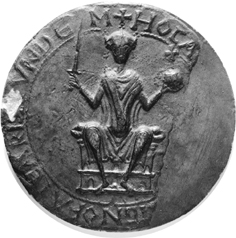
Sword-type seal of William the Conqueror
© BRITISH LIBRARY/HIP/ART RESOURCE, N.Y.
William in the mode of a sword-type coin, frontal Harold in majesty, Edward in dormition upon his deathbed, the fables, exotic paired animals, spiraliform, and foliate decorations of the borders are all images that reached the Tapestry Master from afar. Though they may have passed through other cultures—Ottonian, Salian, Roman, Scandinavian, Norman, and Anglo-Saxon— on their way either to England or France, they are nonetheless distant visitors from the East. The liveliness of contact among the Scandinavian, Norman, and Anglo-Saxon worlds and the Mediterranean means that the inclusion in the Bayeux Tapestry of material so charged with cultural meaning is both intentional and strategic. The orientalism of the Tapestry is not dead metaphor, but a living eye turned, at a point exactly equidistant between the Norman Conquest of 1066 and the First Crusade of 1098, toward the Middle East.
William ruled for twenty-one years after the Conquest and died in 1087, but his family along with Normans from Normandy as well as the Mediterranean responded to Pope Urban II’s call on November 27, 1095, for “liberation of the East, the Eastern Churches and the Holy Places from oppression and defilement by Unbelievers.” The precipitating event was the growing strength of the Seldjuk Turks, who menaced Christians in the East and cut off pilgrimage routes through Asia Minor, provoking an appeal for military assistance by Emperor Alexius Comnenus, who feared that not even the imperial city was safe. The armies of the West were to assemble in Constantinople before heading to Jerusalem.
Among the knights setting out for the Middle East were William’s oldest son, Robert “Curthose,” Duke of Normandy; his son-in-law Count Stephen of Blois; his nephew by marriage, Robert II of Flanders; and his half-brother Odo, who died en route. They were accompanied by the Normans Count Walter of Saint-Valery; the Counts of Montgomery and Mortagne; Girard of Gournay; Hugh of Saint-Pol; the sons of Hugh of Grantmesnil, who had been with William in 1066; and knights from England, Scotland, and Brittany. Passing through Rome and the Norman kingdoms of Italy, the first contingent reached Constantinople around the same time as southern Normans who had left directly for the East. The Normans were astonished by the richness of the city of Constantinople and by Emperor Alexius’s generous bestowal of coins and silks. “Your father, my love,” Stephen of Blois wrote to his wife, Adela, William the Conqueror’s daughter, “made many great gifts, but he was almost nothing compared to this man.”
Norman crusaders on their way to the Holy Land were joined by their southern cousins and in-laws, Tancred and William of Hauteville, Richard and Rainolf of Salerno, Count Geoffrey of Rissognuolo, Robert of Ansa, Herman of Cannae, Humphrey of Monte Scabioso, Albered of Cagnano, Bishop Girard of Ariano, and Bohemond of Taranto, who is said, upon hearing of the opportunity of crusade in the East, to have torn his most precious cloak in order to make scarlet crosses for those who would follow him. Bohemond’s army of Normans from southern Italy and Sicily were met by Robert of Sourdeval and Beol of Chartres, Normans from Normandy
Bohemond had fought with his father, Robert Guiscard, in their invasion of Greece in 1081. He knew the terrain better than most of the crusading chiefs, and when he arrived at Constantinople on April 9, 1097, he requested in a private audience with Emperor Alexius Comnenus to be made grand domestic of the East, a post that would have given him authority over land seized from the heathens. Alexius demurred but managed to extract Bohemond’s promise not to keep any territory taken from the Turks, an oath Bohemond would break in 1098 when he captured and became Prince of Antioch. In the biography of her father, Anna Comnena claims that “the sight of Bohemond inspired admiration, the mention of his name terror.”
“Our men were all, for the first time, collected together in this place, and who could count such a great army of Christians?” writes one of Bohemond’s vassals in an account of the First Crusade, the Gesta Francorum, of the combined armies of the West before the Seldjuk capital of Nicaea. “Then Bohemond took up his station in front of the city, then Tancred next to him, then Duke Godfrey and the Count of Flanders, next to whom was Robert of Normandy, and then the Count of Saint-Gilles and the bishop of Le Puy.” The unity of the heads of diverse states before a besieged city in the East has meaning in light of all that we have understood thus far about the intention behind the making of the Bayeux Tapestry and its binding social effects.