
I. CHAPTER OVERVIEW
From 1900 onward, everything seemed to have global significance. Wars were called “world wars.” Issues were thought of in terms of their worldwide impact, such as “global hunger” or “international terrorism.” Organizations formed to coordinate international efforts, such as the United Nations. And economies and cultures continued to merge to such a degree that eventually millions of people communicated instantaneously on the World Wide Web, feeding a massive cultural shift known simply as “globalization.”
It’s a complex 114+ years. We’ll help you sort through it. Here’s how we organized this chapter.
I. Chapter Overview
You’re reading it now.
II. Stay Focused on the Big Picture
This section will help you think about and organize the huge number of global events that have occurred over the past century.
III. The Twentieth Century in Chunks
This is the largest section of the chapter. In it, we plow through historical developments in four massive chunks. If you’re totally clueless on any part of this section, you might consider also reviewing the corresponding topic in your textbook. As you can see from the section titles, and as you hopefully remember from your history class, there were a bunch of very significant wars in the twentieth century. As you study, worry more about the causes and consequences than about particular battles, although with regard to World War II, it’s important to understand the general sequence of military and political events, so we’ve included quite a bit. Here’s how we’ve organized the information.
A. The World War I Era
B. The World War II Era
C. Communism and the Cold War
D. Independence Movements and Developments in Asia and Africa
E. Globalization and the World Since 1980
IV. Changes and Continuities in the Role of Women Finally, equal rights (in some places).
V. Pulling It All Together
Refocus on big-picture concepts after you review the specific developments in the previous two sections.
VI. Timeline of Major Developments Since 1900
II. STAY FOCUSED ON THE BIG PICTURE
As always, connections, causation, and big-picture concepts are important. As you review the details of the twentieth-century developments in this chapter, stay focused on the big picture, and ask yourself some questions, including the following:
1. How do nationalism and self-determination impact global events? As you review, notice how nationalism impacts almost every country that is discussed in this chapter. It serves as both a positive force in uniting people, and a negative force in pitting people against one another. Self-determination is closely linked with nationalism because it is the goal of most nationalists.
2. Are world cultures converging? If so, how? There’s plenty of evidence that world cultures are, in fact, converging, especially with regard to technology, popular culture, and the Internet. But on the other hand, there seems to be no shortage of nationalism or independence movements, which suggests that major differences exist. As you read the chapter, think about the forces that are making the cultures of the world converge and those that are keeping cultures separated.
3. How do increasing globalization, population growth, and resource use change the environment? Which resources are renewable and which are not? As the world grows ever more interconnected in trade and consumption of resources, think about what political, economic, and environmental decisions are made to maintain those trade relations.
III. THE TWENTIETH CENTURY IN CHUNKS
A. The World War I Era
At the beginning of the twentieth century, most of the world was either colonized by Europe, or was once colonized by Europe, so everyone around the world was connected to the instability on that small but powerful continent. Tragically, that meant that when European powers were at war with each other, the colonies were dragged into the fight. To be sure, European rivalries had had a global impact for centuries, particularly during the colonial period. The Seven Years’ War in the eighteenth century between the French and British, for example, impacted their colonial holdings everywhere. France, too, jumped in to help the U.S. in its revolution against the British.
But in 1914, a major fight among European powers had a far more substantial and destructive effect. The Industrial Revolution had given Europe some powerful new weapons plus the ships and airplanes that could be used to deliver them. Large industrial cities had millions of people, creating the possibility of massive casualties in a single bombing raid. A rise in nationalism fed a military build-up and the desire to use it. And after the unifications of Germany and Italy, Europe simply had too many powergrabbing rivals. Not a good combination of factors if you like, well, peace.
Shifting Alliances: A Prewar Tally of European Countries
In the decades leading up to World War I, the European powers tried to keep the balance of power in check by forming alliances. The newly unified Germany quickly gained industrial might, but it was worried that France, its archenemy since the Franco- Prussian War in 1870, would seek revenge for its defeat. So, before he resigned from office, Otto von Bismarck created and negotiated the Triple Alliance among Germany, Austria-Hungary, and Italy in the 1880s. On the side, Bismarck also had a pact with Russia. Otto played to win.
Over the next few decades, the major players of Europe became so obsessed with a possible war that their generals were already putting plans into motion in the event of an outbreak. After William II ousted Bismarck from power in 1890, he ignored Russia and allowed previous agreements between the two countries to wither. With Russia now on the market for friends, France jumped at the chance to make an alliance. Because France is to the west and Russia is to the east of Germany, a Franco-Russo alliance helped keep Germany in check. Meanwhile, Germany’s 1905 Schlieffen Plan called for a swift attack on France through Belgium, an officially neutral country that had a growing relationship with Britain. By 1907, Britain had also signed friendly agreements with France and Russia, creating what became known as the Triple Entente. Clearly, everyone was anticipating the possibility of war, which was a pretty safe bet considering the contentious climate.
Trouble in the Balkans: Europe in a Tizzy
Remember the Ottoman Empire? In the first two decades of the twentieth century, it was still around, but it was in such bad shape that Europeans were calling it the “sick man of Europe.” It kept losing territory to its neighbors. After Greece won its independence in 1829, the Slavic areas to the north of Greece, including Romania, Bulgaria, Serbia, and Montenegro began to win their independence as well. Bosnia and Herzegovina, however, were under the control of Austria- Hungary, as decided by the Berlin Conference of 1878, the same conference that led to the European scramble to colonize Africa. Serbia wanted Bosnia and Herzegovina for itself. To complicate matters, Russia was allied with Serbia, a fellow Slavic country.
It was in this political climate that Archduke Franz Ferdinand of Austria- Hungary visited Sarajevo, the capital of Bosnia, in 1914. While there, Gavrilo Princip, a Serbian nationalist, shot and killed the Archduke and his wife. In an age when Europe was so tightly wound in alliances, suspicion, and rivalry that a sneeze could have set off a war, the dominos quickly started to fall. Austria-Hungary declared war on Serbia. Russia, allied with Serbia, then declared war on Austria-Hungary. Because Russia and Austria- Hungary were on opposite sides of the Triple Entente-Triple Alliance divide, the pressure mounted on France, Italy, Germany, and Britain to join in. Britain was reluctant to honor its commitments at first, but when Germany implemented the Schlieffen Plan and stormed through Belgium toward France, Britain joined the fray in order to protect France. Italy, on the other hand, managed to wiggle out of its obligations and declared itself neutral, but the Ottoman Empire took its place, forming with Germany and Austria-Hungary an alliance called the Central Powers.
World War I: The War to End All Wars?
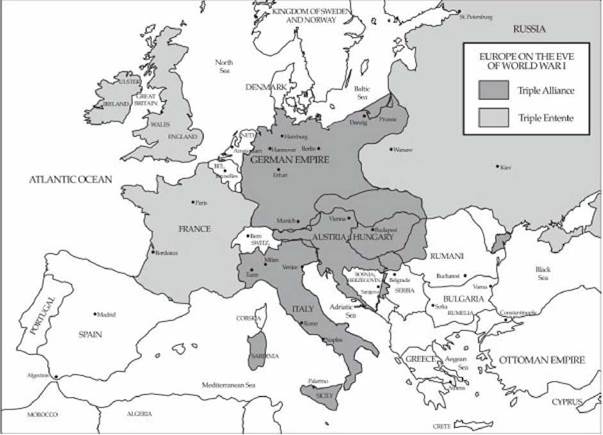
Europe on the Eve of World War I
Since the European powers had colonies or strong economic ties with most of the rest of the world, the original gunshot by a Serbian nationalist resulted in widespread casualties across the globe. More than 40 countries found themselves taking up arms, including Japan, which fought on the side of Britain, France, and Russia, now known as the Allies. In 1915, Italy managed to complete its about-face and joined the Allies as well.
The United States declared its neutrality at first, preferring to focus on its own internal affairs, a policy known as isolationism. But when a German submarine (wow, technology came a long way quickly) sank the British passenger liner The Lusitania in 1915, killing more than 100 Americans who happened to be on board, public opinion in the United States shifted away from isolationism. The next year, as Germany tried to cut off all shipments to Britain, thereby starving the island country, it attacked U.S. merchant ships en route to Britain, further fueling American sentiment toward war. Then the Zimmermann telegram—a secret message sent between German diplomats suggesting that Mexico might want to join forces with Germany and thereby regain the territory it had lost to the United States in the Mexican-American War of 1846—was intercepted by the United States. The public and President Wilson flipped out. On April 2, 1917, America entered the war on the side of the Allies. On November 11, 1918, after brutal battles, trench warfare, and enormous loss of life, Germany and the Central Powers finally gave up.
The consequences of the war were staggering. Eight-and-a-half million soldiers were killed. Around 20 million civilians perished. The social impact on the home front was substantial as well. Most governments took over industrial production during the war, while instituting price controls and rationing of products that were needed on the front lines. With huge numbers of men taking up arms, women moved into the factories to fill empty positions. This experience revved up the women’s suffrage movement, and became the basis for a successful push by women in Britain and the United States to gain the vote after the war.
Of course, World War II hadn’t happened yet, so no one referred to the war as World War I. Instead, most people called it the Great War, mistakenly thinking that there would never again be one as big or bloody. Indeed, the war was so horrendous that commentators called it “the war to end all wars.”
The Treaty of Versailles: Make the Germans Cry
Signed in 1919, the Treaty of Versailles brought an official end to World War I. France and Britain wanted to cripple Germany economically, so that it could never again rise to power and threaten to invade other sovereign states of Europe. The resulting treaty was extremely punitive against Germany, which was required to pay war reparations, release territory, and downsize its military. It also divided Austria-Hungary into separate nations, and created other nations such as Czechoslovakia. The treaty was a departure from President Wilson’s Fourteen Points, which was more focused on establishing future peace and a workable balance of power. However, Britain and France, for example, needed to justify the human and financial cost of the war and the duration of the war to their own demoralized populations and so found Wilson’s proposal unacceptable. So the victors blamed the war on Germany and then forced Germany to sign an extremely punitive treaty over the objections of the United States. The victors hoped that as a result, Germany would never threaten the security of Europe again. Instead, the treaty greatly weakened Germany’s economy and bred resentment among the German population, laying the groundwork for the later rise of nationalistic Adolf Hitler.
The League of Nations: Can’t We All Just Get Along?
President Wilson was the voice of moderation at Versailles. He had hoped that the postwar treaties would be an opportunity to establish international laws and accepted standards of fairness in international conduct. His Fourteen Points speech addressed these issues and called for the creation of a joint council of nations called the League of Nations. The leaders at Versailles agreed with the idea in principle, and they set out to create the organization to preserve peace and establish humanitarian goals, but when they got around to actually joining the league, many nations refused to do so. England and France were tepid, while Germany and Russia initially scoffed at the idea (though later joined). Worse, the United States openly rejected it, a major embarrassment for President Wilson, who couldn’t persuade the isolationist U.S. Congress that the league was a step toward lasting peace.
The Russian Revolution: Czar Out, Lenin In
By the time Nicholas II reigned (1894-1917), revolution was in the wind. The Socialists began to organize. Nicholas tried to rally Russians around the flag by going to war with Japan over Manchuria in 1904, but the Russians suffered a humiliating defeat. On a Sunday in 1905, moderates marched on the czar’s palace in a peaceful protest, an attempt to encourage him to enact Enlightened reforms, but Nicholas felt threatened and ordered his troops to fire on the protestors. The day has since been known as Bloody Sunday.
For the next decade, resentment among the working classes festered. In 1906, the czar attempted to enact legislative reforms by appointing a Prime Minister, Peter Stolypin, and by creating the Duma, a body intended to represent the Russian people, but every time the Duma was critical of the czar, he immediately disbanded it. In the end, the attempts at reform were too little, too late. The Romanov Dynasty would soon come to an end.
The Russian Revolution occurred even before World War I had ended. Russia entered the war with the world’s largest army, though not the world’s most powerful one, because the nation was not nearly as industrialized as its Western neighbors. Very quickly, the army began to suffer large-scale losses and found itself short on food, munitions, and good leadership. In February 1917, in the face of rising casualties and food shortages, Czar Nicholas was forced to abdicate his throne. The Romanov Dynasty came to an end. Under Alexander Kerensky, a provisional government was established. It was ineffectual, in part because it shared power with the local councils, called soviets, which represented the interests of workers, peasants, and soldiers. Although the provisional government affirmed natural rights (such as the equality of citizens and the principle of religious toleration—changes that were inconceivable under the czar), it wanted to continue war against Germany in the hope that Russia could then secure its borders and become a liberal democracy. But the working classes, represented by the soviets, were desperate to end the suffering from the war. The idealism of the provisional officials caused them to badly miscalculate the depths of hostility the Russian people felt for the czar’s war.
By 1918, the soviets rallied behind the socialist party, now called the Bolsheviks. Amid this turmoil, Vladimir Lenin, the Marxist leader of the party, mobilized the support of the workers and soldiers. He issued his April Theses, which demanded peace, land for peasants, and power to the soviets. Within six months, the Bolsheviks took command of the government. Under his vision of mass socialization, Lenin rigidly set about nationalizing the assets and industries of Russia. In March 1918, the soviets signed an armistice with Germany, the Treaty of Brest-Litovsk, which ceded a huge piece of western Russia to Germany, so Russia dropped out of World War I. It therefore wasn’t part of the negotiations during the Treaty of Versailles.
In the Baltic republics of what would soon be called the Soviet Union, and in the Ukraine, Siberia, and other parts of the former Russian Empire, counterrevolutionary revolts broke out. The Bolsheviks faced nonstop skirmishes between 1918 and 1921. To put down these struggles, the Bolsheviks created the Red Army, a military force under the command of Leon Trotsky. By 1918, the Red Army was a sizeable force, and with the support of the peasants, it defeated the counterrevolutionaries. But the counterrevolution had two lasting implications. First, the prolonged civil war deepened the distrust between the new Marxist state and its Western neighbors, who had supported the counterrevolutionaries. And second, the Bolsheviks now had a very powerful army, the Red Army, at its disposal.
Here Come the Turks: The Sick Man of Europe Is Put Out of His Misery
The Ottoman Empire, already on its last legs, made a fatal mistake by joining the losing Central Powers of World War I. In the peace negotiations, it lost most of its remaining land, and was therefore ripe for attack from the Greeks, who picked up arms in 1919. Mustafa Kemal, who later became known as Ataturk, “the Father of the Turks,” led successful military campaigns against the Greeks, and then overthrew the Ottoman sultan. In 1923, Ataturk became the first president of modern Turkey. He successfully secularized the overwhelmingly Muslim nation, introduced Western-style dress and customs (abolishing the fez), changed the alphabet from Arabic to Latin, set up a parliamentary system (which he dominated), changed the legal code from Islamic to Western, and set Turkey on a path toward Europe as opposed to the Middle East. However, he instituted these reforms against opposition, and sometimes was ruthless in his determination to institute change.
B. The World War II Era
Even though World War II didn’t get started until 1939, its causes were already well underway in the 1920s. In some ways, World War II isn’t a separate war from World War I, but instead the Great War Part II.
Stalin: The Soviet Union Goes Totalitarian
Once the Soviets removed themselves from World War I, they concentrated on their own domestic problems. Lenin first instituted the New Economic Policy (NEP) in the early 1920s, which had some capitalistic aspects, such as allowing farmers to sell portions of their grain for their own profit. The plan was successful in agriculture, but Lenin didn’t live long enough to chaperone its expansion into other parts of the Soviet economy.
When Lenin died, the leadership of the Communist Party shifted to Joseph Stalin.
Stalin believed the NEP was ridiculously slow, so he discarded it. Instead, he imposed his Five Year Plans, which called for expedient agricultural production by ruthlessly taking over private farms and combining them into state-owned enterprises, a process known as collectivization. The plans also advocated for the construction of large, nationalized factories. This process was achieved in the name of communism, but it was really totalitarianism. The people didn’t share in the power or the profits, and had no choices regarding participation. Untold numbers died fighting to protect their farms. Even more died in famines that resulted when Stalin usurped crops to feed government workers at the expense of the farmers themselves.
Stalin’s plans successfully industrialized the USSR (Union of Soviet Socialist Republics), the formal name for the Soviet Union, and improved economic conditions for the country as a whole, but Stalin relied on terror tactics, such as a secret police force, bogus trials, and assassinations. These murders peaked between 1936 and 1938. Collectively, they are sometimes referred to as the “Great Purge” because the government systematically killed so many of its enemies. Stalin also established labor camps to punish anyone who opposed him. It’s hard to know for sure how many Soviet citizens were imprisoned or killed during the 1930s, especially because so many died of famines during the collectivization process, but historians agree that millions of Soviets were slaughtered under Stalin’s direction.
The Great Depression: Capitalism Crashes, Germany Burns
World War I was shockingly expensive. Countries spent more than $180 billion on armaments, boats, and trench warfare. Europe spent an additional $150 billion rebuilding. The massive scale of the war meant massive spending, at a level that nations had never experienced previously, and in the years following World War I, capitalism financed most of the recovery. As a consequence, the financial headquarters of the world shifted from London to New York, which had become a major center of credit to Europe during and after the war. In other words, Americans lent Europeans money, and lots of it.
In particular, the economies of two countries relied on American credit: France and Germany. France had loaned huge sums of money to Russia, its prewar ally, but the Bolshevik government refused to honor the czar’s debts, leaving France almost out of luck, except that Germany owed it a bunch of cash as well. Germany experienced extreme financial hardship because of the wartime reparations they were required to make under the Treaty of Versailles. Germany’s answer was to use American credit to pay its reparations by issuing I.O.U.s to countries like France. France took these “payments,” backed up by American credit, and spent them on rebuilding its economy. From 1924 to 1929, this arrangement looked great on paper due to growth in both the United States and European economies. But in many ways, the growth was artificial, based on loans that were never going to be repaid.
When the U.S. stock market crashed in October 1929, a spiral of monetary and fiscal problems called the Great Depression quickly escalated into an international catastrophe, and shattered the illusion of financial health in Europe. American banks immediately stopped extending credit. The effect was that Europe ran out of money, which it never really had in the first place. Germany couldn’t pay its reparations without American credit, so France had no money either.
The depths of the depression were truly staggering. The United States and Germany were hit hardest. In both countries, almost one-third of the available workforce was unemployed. In the United States, out-of-work Americans rejected the dominant political party and in 1932 elected Franklin Roosevelt as president in a landslide election. But other countries had much more fragile political structures. In places where democracy had shallow roots, such as Germany and Italy, whose shaky elective assemblies had been created only a decade earlier after World War I, the crisis resulted in the triumph of a political ideology that was anathema (look it up!) to the very spirit of democracy— fascism.
Fascism Gains Momentum
Between the First and Second World Wars, fascist parties emerged across Europe. They did not possess identical sets of beliefs, but they held a few important ideas in common. The main idea of fascism was to destroy the will of the individual in favor of “the people.” Fascists wanted a unified society (as did the communists), but they weren’t concerned with eliminating private property or class distinctions (the principal aim of communists). Instead, fascists pushed for another identity, one rooted in extreme nationalism, which often relied on racial identity.
Contrast Them: Fascism and Totalitarianism
Fascism is a subset of totalitarianism. A totalitarian dictator rules absolutely, attempting to control every aspect of life. Fascist rulers are a particular kind of totalitarian ruler, often regarded as extremely right-wing because they rely on traditional institutions and social distinctions to enforce their rule, and are extremely nationalistic. Their particular brand of nationalism is often based on racism. Communist totalitarian leaders like Stalin are often referred to as extreme left-wing because they seek to destroy traditional institutions and class distinctions, even as they retain absolute power themselves. Therefore, they’re not referred to as fascist, but they’re just as militaristic and controlling. Put another way, in their extreme forms, right-wing (fascist) and left-wing (communist) governments use the same tactics: totalitarianism. In both cases, all power rests in the hands of a single militaristic leader.
Fascism in Italy: Another Step toward Another War
Italy was the first state to have a fascist government. The founder and leader was Benito Mussolini, who created the National Fascist Party in 1919. The Party paid squads, known as Blackshirts, to fight socialist and communist organizations, an action that won over the loyalty of both factory owners and landowners. By 1921, the party seated its first members in the Italian parliament.
Although the fascists held only a few seats in the legislature, Mussolini demanded that King Victor Emmanuel III name him and several other fascists to cabinet posts. To rally support, Mussolini organized his paramilitary thugs to march to Rome and possibly attempt to seize power. If the king had declared martial law and brought in the army, most believe that the fascists would have scattered. However, the king was a timid man —facing economically troubling times—who was not unsympathetic to the fascist program. So, he named Mussolini prime minister, and the fascist march on Rome turned into a celebration.
As the postwar economy failed to improve, Italy was demoralized. Mussolini faced very little opposition to his consolidation of political power. He dabbled as a parliamentary leader for several months before completely taking over Parliament in 1922. He then implemented a number of constitutional changes to ensure that democracy no longer limited his actions, and, by 1926, Italy was transformed into a totalitarian fascist regime. To rally the people in a nationalistic cause, Italy started to focus on expansion, specifically in North Africa.
The Rise of Hitler
Immediately following the end of World War I, a revolt occurred in Germany when the emperor abdicated. Germany might well have become socialist at this point. Workers’ and soldiers’ councils (not unlike Russian soviets) formed in cities like Berlin. Yet, because the middle class in Germany was quite conservative and a large number of Germans had been relatively prosperous before the war, a socialist or communist system was rejected in favor of a fairly conservative democratic republic, called the Weimar Republic.
At the same time, Germany was in economic crisis, and Mussolini’s success influenced Germany in many ways. The National Socialist Party (Nazis) rose to power in the 1920s, ushered in by the worldwide depression. As Germany’s economy collapsed under the harsh reparations dictated by the Treaty of Versailles and the faltering world economy, German people increasingly rejected the solutions of the Weimar Republic’s elected body, the Reichstag.
During this period Adolf Hitler rose to power as head of the Nazi Party. Like Mussolini’s fascism, Hitler’s Nazism inspired extreme nationalism and the dreams of renewed greatness for a depressed and divided country. But Hitler’s philosophies differed from Mussolini’s in their emphasis on the superiority of one race over others. Well versed in social Darwinism, Hitler was convinced that the Aryan race was the most highly evolved race, and that inferior races, such as Slavs and Jews, had “corrupted” the German race. He argued that Jews should be deported (later that changed to “eliminated”) and that Germans should take over Europe.
The Nazi Party gained political power in the 1920s with Hitler as its guide, or führer. At first, the Nazis received votes democratically and participated in the Reichstag. In the early 1930s, as the Great Depression devastated the German economy, Hitler received increasing support. In the election of 1930, the Nazi Party increased its seats in Parliament tenfold. By 1932, the Nazis dominated German government and many who disagreed with Hitler still backed him, thinking he was the country’s only hope. In 1933, Hitler became chancellor, or leader of the Reichstag. He then seized control of the government, known under his fascist rule as the Third Reich, and set his eyes on conquering Europe.
Contrast Them: Nationalism in Europe and Nationalism in Its Colonies
Nationalism was a driving force throughout much of the nineteenth and twentieth centuries, but it had a very different flavor in Europe and Japan than in most European and Japanese colonies. In Europe and Japan, nationalism fueled extreme racism, fascism, and domination. National pride became almost synonymous with national expansion and conquest of other peoples. In the colonies, nationalism meant self-determination, the ability to free the nation from rule by another and determine one’s own destiny. National pride meant national sovereignty, not colonial or territorial expansion.
Appeasement: “Peace for Our Time,” or Just Wishful Thinking?
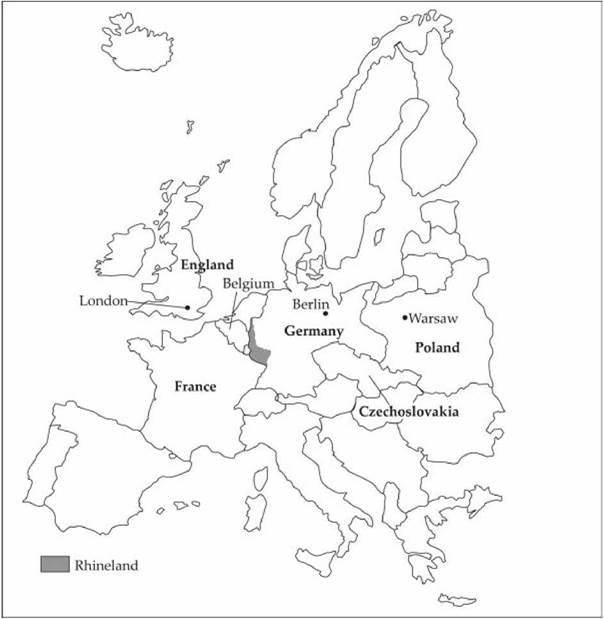
Europe on the Brink of World War II
In 1933, Hitler began to rebuild the German military. This was a clear violation of the Treaty of Versailles—which was specifically intended to limit future German aggression —but the other nations of Europe, especially Britain and France, chose not to object, fearing another war. Later that year, Germany again snubbed world opinion by withdrawing from the League of Nations.
Meanwhile, Spain, which had established a parliamentary democracy in 1931, was falling apart following the fall of the Spanish monarchy. In the summer of 1936, a group of army officers under the leadership of General Francisco Franco took control of large parts of Spain. Democratic loyalists organized to defend the state, and a brutal and divisive civil war ensued. Germany and Italy supported Franco’s troops, called “nationalists.” Although Franco was not a fascist, the Germans and Italians believed that the defeat of democracy in Spain was a step in the right direction.
France and Great Britain, still scarred from the loss of life and money in the Great War, adopted a nonintervention policy and refused to aid the supporters of the Spanish democracy. By 1939, Franco’s troops captured Madrid and installed a dictatorship in Spain that managed to stay neutral throughout the war that soon erupted in Europe. The message was clear: Germany and Italy were more than willing to exercise their influence and support antidemocratic uprisings.
Meanwhile back in Germany in 1935, Hitler continued his policy of restoring Germany to its former world-power status by taking back the Rhineland, a region west of the Rhine River that had been taken away from Germany after World War I. Still, the rest of Europe stayed quiet. In 1937, he formed an alliance with the increasingly militant Japan. Then, in 1938, he annexed Austria and moved to reclaim the Sudetenland from Czechoslovakia. At the Munich Conference of 1938, which included Hitler, Mussolini, and Prime Minister Neville Chamberlain of England, Hitler was given the Sudetenland, without the consent of Czechoslovakia, in return for the promise to cease his expansionist activities. This incredibly optimistic (some would say stupid) policy is known as appeasement. Chamberlain agreed to give Hitler what he wanted as a means of avoiding war, believing German claims that it would be satisfied with Austria and the northern half of Czechoslovakia and would not expand further. And Hitler, in fact, did stop his expansion—for one whole year. In 1939, Hitler invaded the remaining territories in Czechoslovakia.
The rest of Europe was shocked, but they didn’t do anything to kick the Nazis out of Czechoslovakia. Instead, in March 1939, while Italy was invading Albania, Britain and France signed a non-aggression pact with Greece, Turkey, Romania, and Poland that provided that if any one of them were attacked, they’d all go to war.
Meanwhile, the Germans signed the Nazi-Soviet Pact in August of 1939. Stalin and Hitler agreed that Germany would not invade the Soviet Union if the Soviets stayed out of Germany’s military affairs. Furthermore, the countries determined how Eastern Europe would be divided among them, giving Lithuania and eastern Poland to Germany and the remainder of Poland and Finland and the Baltic States to Russia. So Stalin got a measure of security, and Hitler got a clear path by which to take Poland. With a secure agreement with the Soviet Union, German forces marched into Poland. Two days later, Britain realized that all diplomacy had failed and declared war on Germany, and France reluctantly followed suit. World War II had begun.
Need to Read About Some More Aggression? How About Japan?
Remember in the last chapter, when we discussed the Meiji Restoration and how Japan defeated China in a war for control of Korea and Taiwan, thus making Japan an imperial power? Well, later on after the Russo-Japanese War of 1904, the victorious Japanese kicked Russia out of Manchuria and established its own sphere of influence there. As if demonstrating that Japan was now an equal among European states, the British offered them an alliance in 1905, a treaty the Japanese gratefully accepted. Japan was now not just an imperial power but a world power.
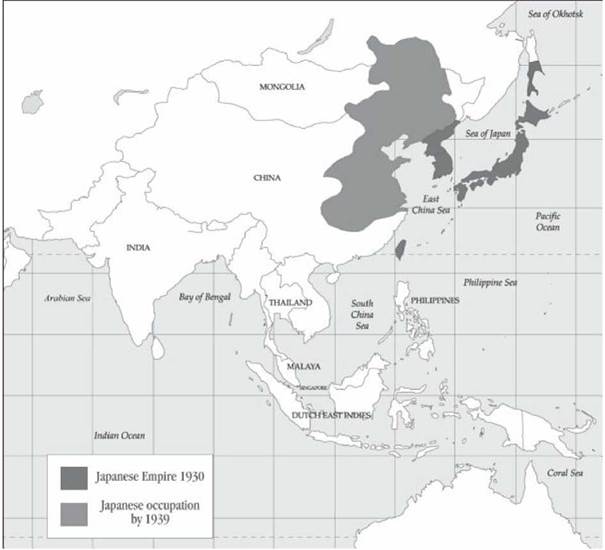
Japanese Territory by 1939
After World War I, in which Japan fought on the side of the Allies and was therefore one of the victors, Japan’s economy and military really started to thrive. In 1915, during World War I, Japan sent a list of twenty-one demands to China, requiring China to give it trading rights and outright control over aspects of the government and economy, an act that was even more aggressive than some of the spheres of influence that had been established (and were still in effect) by the Europeans. In the 1920s, the country backtracked a little bit and focused on internal developments, softening its position toward China. But by 1930, the Great Depression began to severely affect Japan and the Japanese militarists gained momentum, claiming that an empire would pull them out of the economic doldrums. In 1931, Japan invaded Manchuria, renaming it Manchukuo and establishing a colony there. After withdrawing from the League of Nations, Japan signed the Anti- Comintern Pact (against communism, specifically in Russia) with Germany in 1936, thereby forming the beginnings of an alliance that would eventually lead to a more formal one during World War II. In 1937, Japanese troops invaded China, pillaging towns and cities as they made their way down the eastern shore. One of the worst offenses was the aptly named, “Rape of Nanjing,” where in the city of Nanjing nearly 250,000 Chinese were slaughtered in a matter of a few weeks by occupying Japanese forces. Japan’s war with China eventually merged into the global conflagration of World War II that later started to burn in Europe.
A Quick Review of World War II: Tens of Millions Dead
Hitler’s forces were devastating. Their war tactic, known as blitzkrieg (literally “lightning war”), destroyed everything in its path with historically unprecedented speed. Poland’s flat open plains were tragically well-suited for the German run. The swiftly moving German forces acquired so much territory in the west of Poland that Stalin was forced to mobilize quickly lest he lose the entire country to the German Reich. Within ten days, Germany and Russia had divided Poland between them. Hitler then focused on the western front. In early 1940, Germany assaulted Holland and Belgium. Two days later, German forces entered France. Within a year, the Axis power controlled most of continental Europe.
Hitler assumed that Great Britain would crumble quickly after the fall of its ally, France. But a new leader, Winston Churchill, replaced Britain’s more diplomatically minded Chamberlain. Churchill proved to be a resolute and fierce prime minister. He refused to cut a deal with Germany, so Hitler launched a massive air bombing campaign in 1940 known as the Battle of Britain, which pitted the superior numbers of the German air force against the smaller numbers of the Royal Air Force. The British succeeded in keeping the German army out, and with their newly devised handy tool known as radar, they managed a successful, though costly, defense of the island.
In the meantime, Italy attacked Greece but was unable to defeat the country until April 1941, when German armies rushed in to help out. The Nazi-Soviet Pact tacitly gave the Balkan state to Russia, so the takeover of Greece had serious consequences. Now that Germany had taken control of the Balkans, their previous agreement was moot, so they invaded the Soviet Union too for good measure, advancing quickly. The resulting movement of men and supplies into the Soviet Union relieved pressure on the desperate British, the only Allied nation still fighting (other than the Soviet Union, of course).
Meanwhile in the Pacific, Japan continued its expansion in China and invaded Indochina (Vietnam). For trade reasons, the United States viewed this action as hostile, but the United States still didn’t want to get involved in the war, so it froze Japanese assets in the United States and imposed sanctions instead. At the same time, Japan entered into the Tripartite Pact with Rome and Berlin, ensuring worldwide implications for a war that had, up until that time, been two regional wars. Japan also made war plans against the United States if the United States refused to lift sanctions against Japan. The United States didn’t, and on December 7, 1941, the Japanese bombed a U.S. naval station in Hawaii at Pearl Harbor. The United States was stunned, and promptly declared war against Japan, and in response, Germany declared war against the United States.
It took a while for the United States and Great Britain to coordinate a land attack against Germany because they needed a foothold in Europe from which to begin their assault. In the meantime, the Allies fought the Japanese in the Pacific and Germans and Italians in Africa while the United States also secretly worked on its Manhattan Project—the development of an atomic bomb. By 1943, the United States and Britain were ready for their European offensive, and they started it by taking control of Italy. The next year, English, American, and Canadian forces launched their biggest offensive, landing on the French beaches of Normandy on June 6, 1944, which is now known as D- day. With the help of French resistance forces, Allied Forces battled their way across northern France in the summer of 1944 and liberated France.
On the opposite side of Europe, the Red Army won a stunning victory against the Germans at Stalingrad in 1942 and advanced steadily west for three years. By May 1945, the Allied forces closed in on Hitler’s troops from the eastern and the western fronts until they reached Berlin, ending the European theater of World War II. Hitler committed suicide.
The war in the Pacific continued to drag on for a few months. At great cost, the American forces defeated Japan from island to island in the South Pacific. But the Japanese refused to surrender, even though their fate was sealed. Believing that dropping an atomic bomb on Japan would end World War II quickly and result in fewer casualties than a prolonged war, President Truman of the United States ordered the dropping of an atomic bomb on the city of Hiroshima on August 6, 1945. The event marked the first time such a bomb had been used in warfare. The result was horrendous. More than 100,000 people were killed or injured and the city was completely leveled for miles. When the Japanese vowed to fight on, President Truman authorized the dropping of a second bomb on Nagasaki on August 9 with similar consequences. Japan finally surrendered and World War II was brought to a close.
The Consequences: So Much Changed!
The close of World War II brought with it enormous global changes. Since they are so numerous, it’s best to think about them in broad categories.
The Holocaust Revealed
Outside of Germany, few knew just how horrible the Nazi regime was until after the war was over. In an ongoing slaughter known now as the Holocaust, but known in Nazi Germany as “The Final Solution,” millions of Jews who lived in Germany and German- occupied lands were rounded up, blamed for every conceivable problem in society, and methodically killed in gas chambers and firing lines, their bodies disposed of in ovens and mass graves. As many as 6 million Jews were killed, making the Holocaust one of the largest acts of genocide in history (in addition, as many as 6 million Poles, Slavs, Gypsies, homosexuals, disabled people, and political dissidents were killed in the Holocaust). When the news of the atrocity spread after the war, public sympathy for the creation of Israel as a homeland for Jews rose sharply. More on that later.
The Peace Settlement
The United States and the Soviet Union became superpowers. Germany was occupied by the Allies—more on that later too. War crimes tribunals were established to prosecute and sentence Nazi officials. Japan was forced to demilitarize and establish a democracy. It did. It also embraced capitalism and became an economic powerhouse within a decade, but this time was friendly to the West.
Europe Torn to Shreds
In addition to a staggering loss of life (the Soviet Union alone lost more than 20 million soldiers and civilians), the infrastructure and communities of Europe were devastated. To help in the rebuilding effort, the United States instituted the Marshall Plan (named for George C. Marshall, the secretary of state who conceived of it) in 1947. The plan, in which billions of dollars of American money was made available for reconstruction, was offered to all European countries but only accepted by Western European nations. The plan worked: The economies of Western Europe recovered in less than a decade.
The Decline of Colonialism
European imperialism was already on the wane before World War II, but the war affected attitudes about empire, and inspired native populations to rise up against their oppressors. Much more on the decline of colonialism later in this chapter.
Big Changes for Women
Just as in World War I, in many countries, women worked outside the home during the war, raising money to support themselves or their families, while also helping the war effort. In Britain alone, more than three-fourths of adult women under age 40 were employed during the war. After the war, many women kept their jobs, or sought higher education, or otherwise began to broaden their horizons.
The Creation of International Organizations
After World War II, the Allies believed that a network of international organizations could reduce the probability that such a great war would break out again. The first of these international organizations was the United Nations, established in 1945 to replace the failed League of Nations. Given more muscle than the League of Nations, the primary goal of the UN was simple: to mediate, and if necessary to intervene in, international disputes between nations. As time passed, the UN expanded beyond the realm of political conflicts and increasingly involved itself in the monitoring of human rights and other social problems. But in addition to the UN, the World Bank, International Monetary Fund, and the General Agreement on Trade and Tariffs (now known as the World Trade Organization), were formed to create and manage a more integrated global economy. The Allies believed that countries that were more connected economically would be less likely to invade one another.
The Start of the Cold War
Although they were allies during the war, the United States and the Soviet Union had very different worldviews. One was democratic and capitalist, the other totalitarian and communist. Neither wanted the other to spread its influence beyond its borders, so even before the war ended, they were strategizing on how to contain each other. This strategizing lasted for nearly 50 years, and the following section in this chapter explains the consequences.
C. Communism and the Cold War
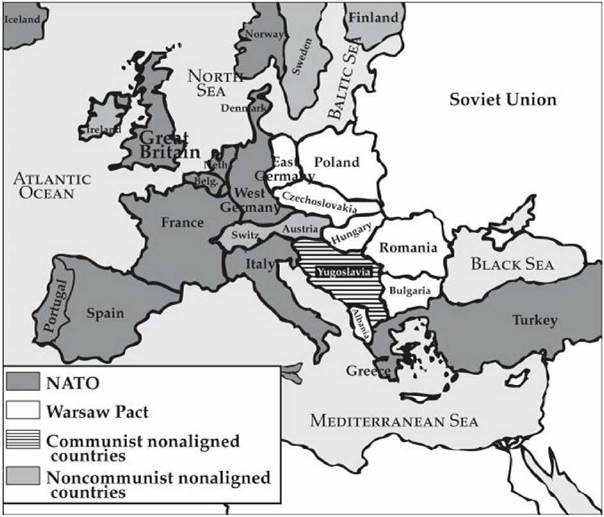
The Cold War in Europe
The Cold War lasted from 1945 through the early 1990s. Very few areas of the globe were unaffected. The two superpowers that emerged after World War II, the United States and the Soviet Union, not only vied for global domination, but also tried to pull the rest of the world into their standoff. Every time a government in any country across the globe changed hands, the Americans and Soviets evaluated it based on its leanings toward one side or the other, and in many cases actually tried to militarily influence the position it would take. All of this took place in the context of an arms race between the two superpowers in which nuclear arsenals became so massive that a global holocaust became possible at the touch of a button.
In 1945, no one would have predicted how polarized the world would become during the Cold War, or even that a cold war would develop in the first place.
Power Grab: Soviets and Americans Want Everyone to Take Sides
After Germany was defeated, the U.S.-Soviet struggle immediately influenced the chain of events. The biggest conflict was over future security. Both superpowers wanted arrangements in Europe that made it more likely for their worldview to dominate. The U.S. promoted capitalism and variations on democracy. The Soviet Union promoted communism, which, as practiced by the Soviets at the time, also meant totalitarianism. A good chunk of Western Europe was solidly in the American camp, but the bigger question was Germany and parts of Eastern Europe.
According to plans drawn up by the Allies during conferences at Yalta and Potsdam, in February and July 1945 respectively, Germany and other parts of Eastern Europe were divided into temporary “spheres of influence,” each to be occupied and rebuilt by respective members of the Allied forces. Germany was divided into four regions, each under the influence of one of four Allies: France, Britain, the United States, and the Soviet Union. Determined to protect its borders and ideology, the Soviet Union demanded that its neighboring states, places like Poland, Czechoslovakia, Hungary, Romania, and Bulgaria, be under its influence as well. The United States wanted those nations to have free elections. The Soviet Union refused and simply set up puppet states in those countries. This was the first hint of the beginning of the Cold War.
Meanwhile, in Germany in 1948, the French, British, and American regions merged into one, forming a democratic West Germany, while the Soviet Union’s region became East Germany. The capital, Berlin, was on the eastern side, and within that city, an eastern and western zone were created. The Soviets wanted all of Berlin to be within its control, so they cut off land access to Berlin from the west, an action known as the Berlin Blockade. The West retaliated by flying in food and fuel to the “trapped” western half of the city, an action known as the Berlin Airlift. Eventually, the Soviets relented and Berlin was divided in half. In 1961, the Soviets built a wall between the two halves, preventing East Berliners access to the West until the wall fell in 1989 (more on that later).
East versus West: Let’s Point Our Weapons at Each Other
By the late 1940s, Europe was clearly divided into East and West, each under the influence of their respective superpowers.
East Germany, Poland, Czechoslovakia, Romania, and Hungary became part of the Eastern bloc, also called the Soviet bloc or Soviet satellites. Yugoslavia was communist as well, but established its own path, having testy relations with Moscow. Western Europe, including Britain, France, Italy, Belgium, the Netherlands, Norway, West Germany, and eventually Greece and Turkey, became part of the Western bloc.
Under the Truman Doctrine of 1947, the United States explicitly stated that it would aid countries threatened by communist takeovers. This policy is known as containment, as in “containing” your enemy. To this end, the Western bloc formed a military alliance of mutual defense called NATO (the North Atlantic Treaty Organization). In response, the Eastern bloc formed a military alliance known as the Warsaw Pact. For more than 40 years, the two alliances loaded their borders with weapons, first conventional, then nuclear, and dared the other to strike first. Churchill called the line between East and West the Iron Curtain because Western influence couldn’t penetrate it and Easterners were rarely allowed to go to the Western bloc.
As for the rest of the world, the two superpowers quickly tried to influence developments to tip the balance of world power in their favor. Some countries allied with one side or the other (more on this later), but other countries, such as India, refused to take sides and sometimes accepted investment from both, a policy known as nonalignment.
Focus on: Nuclear Proliferation
Ever improving weapons technology was the force behind political strength in the twentieth century. This was true from the devastated battlefields of World War I to the hot spots and standoffs of the Cold War. Beginning with the atomic bombs dropped on Japan in 1945, the Eastern and Western superpowers raced to develop superior weapons and defensive technologies. Despite attempts to limit nuclear technology to just five powers (China, Russia, U.S.A., Great Britain, and France) through the Nuclear Nonproliferation Treaty (1968) and the watchdog International Atomic Energy Agency or IAEA (1957), weapons development continued even after the collapse of the Soviet Union. Israel, India, and Pakistan chose not to participate in the treaty and now each has some nuclear weapons capacity. North Korea has continued to develop nuclear material in violation of treaty terms and both Iraq and Iran have attempted to build uranium enrichment programs. Only South Africa has voluntarily dismantled its nuclear weapons program.
The Cold War affected different countries in different ways. On the next several pages, you’ll review how it impacted China, Korea, Vietnam, Cuba, and Europe.
China: Communists Make Huge Gains
China changed a lot after the fall of the Manchu Dynasty in 1911. Under the leadership of Sun Yat-sen, who led the Chinese Revolution of 1911, China became more Westernized in an effort to gain power and boot out the Europeans and Japanese, who had established spheres of influence in the country. Sun Yat-sen promoted his Three Principles of the People—nationalism, socialism, and democracy. It was hoped that nationalism would unite the people against foreign interests and give them a Chinese identity, state capitalism, or industrialization financed by the government, was useful in order to improve economic productivity and efficiency while not necessarily redistributing wealth, something Sun did not agree with. Although he advocated for a democratic system, Sun Yat-sen established a political party, the Kuomindang (or KMT), which was dedicated to his own goals.
Sun Yat-sen didn’t live long enough to see his plans implemented. His successor, however, Chiang Kai-shek, established the KMT as the ruling party of China, but only for a while. Throughout the 1920s and 1930s, two forces wreaked havoc on Chiang’s plans. The Japanese Empire invaded Manchuria and made an effort to take over all of China in the late 1930s. Meanwhile, the communists, allied with the Soviet Union, were building strength in northern China. The communists joined the KMT in its fight against the Japanese, but at the same time were bitter rivals of the Kuomindang in the struggle to control the future of China.
During World War II, the United States pumped money into the KMT’s efforts against Japan, while the Soviets weren’t as active in their support for the communists’ efforts against Japan, partly because they were focused on Germany. As you know, Japan was defeated. As in Europe, after the war, the powers of democracy and communism clashed, and the KMT and communists continued to fight the Chinese Civil War for the next four years.
By 1949, the communists under Mao Zedong had rallied millions of peasants in northern China and swept southward toward the Kuomindang strongholds, driving the Kuomindang farther and farther south until they finally fled to the island of Taiwan, where they established the Republic of China. The impact for mainland China was enormous. It became the People’s Republic of China, the largest communist nation in the world under the leadership of Mao Zedong. The two Chinas have been separate ever since, and both claim to be the “real” China. Taiwan eventually developed into an economic powerhouse, but it lost its credibility as the true China when the United Nations and eventually the United States recognized the People’s Republic of China as China in 1973. Taiwan has rejected China’s efforts toward reunification, but nevertheless the two nations have grown close together, especially as the economies of both nations have grown stronger and stronger.
Mao Zedong: His Own Way
After the success of the Communist Revolution in China in 1949, its leader, Mao Zedong, collectivized agriculture and industry, and instituted sweeping social reform using policies that were not unlike Stalin’s five-year plans. Most of these plans were relatively successful, and China greatly increased its productivity, especially in the steel industry. By the late 1950s, Mao implemented his Great Leap Forward, in which huge communes were created as a way of catapulting the revolution toward its goal of a true Marxist state. In reality however, the local governments that ran the communes couldn’t produce the ridiculously high agricultural quotas demanded by the central government. So they did what any fearful local government would—they lied about their production, leading to the starvation deaths of nearly 30 million Chinese people. By all accounts, it was more like a Great Stumble Backward. The successes of Mao’s initiatives in the early 1950s were erased, and agriculture and industry failed to produce results. Part of the problem was that the Soviet Union, up until that time the only foreign supporter of China, pulled away and eventually withdrew its support. The Soviet Union not only wanted the world to become communist, but it wanted the world to be communist under its control. China wasn’t following orders, so Soviet support for China cooled. The Sino- Soviet split left China on its own with its communal system in disarray.
Mao stepped back to focus on building the military—something that was essential if the country couldn’t rely on Soviet support—while more moderate reformers tried to turn the country around. The progress was quick and substantial; elements of capitalism were introduced into the economy and, in 1964, China tested its first atomic bomb, adding to the global arms race that was quickly building around the world. Mao was unimpressed, however. A purist, Mao was upset that the country was straying from its communist path, and so, in 1966, he jumped back to the forefront of his government and promoted his most significant domestic policy, the Cultural Revolution. Mao’s goal in the Cultural Revolution was to discourage anything approaching a privileged ruling class, as it existed in the West as well as among the Soviet communist elite. To accomplish this, Mao instituted reforms meant to erase all traces of a Western- influenced intelligentsia. Many universities were shut down for four years. The students and faculty, along with other “elites” including doctors, lawyers, and classically trained musicians, were sent to work on collective farms for “cultural retraining.” In addition, many political dissidents were either imprisoned or killed. When the universities were reopened, the curriculum was reorganized to include only communist studies and vocational training. During this time, Mao’s Little Red Book, a collection of his teachings on communism, became a popular symbol of the forced egalitarianism of the Cultural Revolution.
The whole plan failed miserably in advancing China economically or socially. By the early 1970s, China realized it needed to open itself up to Western ideas. In 1976, the new leadership under Deng Xiaoping quickly changed the education policy and began to focus on restructuring the economic policies.
Note the Change: Dynastic China to Communist China
For more than 2,000 years, Confucianism and a class structure dominated China. With the Communist Revolution, however, all traces of a class-based system were nearly erased. Traditional Chinese society valued large families, both because children were able to help on the farm and because Confucian philosophy gave identity to people based on their relationships—the parent/child relationship was one of the most important. When the communists took over, however, their program of collectivization made family farms obsolete. In addition, communists were not sympathetic to traditional values based on religious or philosophical beliefs that competed with the authority of the state. As the population of China continued to grow dramatically through the late twentieth century, the communists took a practical approach to the overpopulation problem and began a propaganda campaign aimed at the use of contraception and abortion. By the late 1980s, faced with ever-increasing population figures, the Chinese government instituted a one- child-per-family policy. Reactions to the policy were severe. Many refused to abide by the policy in the first place. Others followed the law, but some of them killed their firstborn female infants in the hope of getting a male child the second time around. Opposition became more widespread and the government relaxed its policy.
The equality demanded in a classless society resulted in considerable advances for women. Husbands and wives were treated equally, at least as far as the law was concerned. Women gained the right to divorce their husbands. They obtained property rights. They received equal pay for equal work and were encouraged to pursue professional and vocational careers.
China Looks West: Likes the Money, Not So Sure About the Freedom
More recently, China’s economy has been transformed from a strict communist command economy to one that includes elements of free-market capitalism. Deng Xiaoping’s government entered into joint ventures with foreign companies in which the profits and business decisions were shared. In addition, Deng allowed for limited business and property ownership to stimulate hard work and innovation. The reforms have been wildly successful. China’s economy is expanding faster than most of the economies of the world and reforms continue to be introduced slowly, which gives the economy time to adjust to the changes. However, despite the economic reforms, the government continues to remain strictly communist in the political sense, and has frequently resisted government and social reforms. In 1989, one million demonstrators converged on Tiananmen Square, calling for democratic reform. In an event known as the Tiananmen Square massacre, the government sent troops and opened fire. Hundreds were killed. Today, while China continues to reform its economy and is rapidly becoming a major economic powerhouse, the possibility for democratic reforms is still unknown.
Division of Korea: The Cold War Turns Hot and Now Possibly Nuclear
Prior to World War II, Korea was invaded by Japan and annexed as part of the expanding Japanese Empire. After Japan was defeated in World War II, Korea was supposed to be re-established as an independent nation, but until stability could be achieved and elections held, it was occupied by the Soviet Union and the United States in two separate pieces—the Soviet Union north of the 38th parallel and the United States south of it. This was very much like the way that Germany was split, and, just like in Germany, the two superpowers couldn’t agree on the terms of a united Korea.
In 1948, two separate governments were established—a Soviet-backed communist regime in North Korea and a U.S.-backed democracy in South Korea. Both superpowers withdrew their troops in 1949, but in 1950, North Korea attacked South Korea in an attempt to unite the two nations under a single communist government. The United Nations condemned the action and soon a multinational force, largely consisting of U.S. and British troops, went to the aid of the South Koreans. The UN forces made tremendous headway under General MacArthur, nearly reaching the Chinese border, but when it looked as if the North Koreans would be defeated, China entered the war on behalf of the communist North. The two sides battled it out along the 38th parallel, eventually leading to an armistice in 1953.
Today, the two nations remain separate and true to the political philosophies under which they were formed 50 years ago. The United States maintains a large military presence in South Korea, which has become an economic powerhouse. North Korea, meanwhile, has suffered through isolationist and just plain nutty rulers and massive food shortages, but has built up a huge military and acquired the technology to develop a nuclear bomb. It has already developed missiles capable of delivering those bombs to South Korea, Japan, China, or possibly even as far as the west coast of the United States. In October 2006, North Korea declared its first nuclear weapons test a success. Western scientists doubted their claims of success, but did confirm that some type of test had taken place. In response, the United Nations imposed additional, but largely symbolic, sanctions on North Korean imports (though China and Russia disagreed with the policy). Six Party Talks (including the U.S., North Korea, South Korea, China, Russia, and Japan) resumed, for the fifth time, and concluded with the agreement that North Korea was to shut down its reactor in July 2007 in return for extensive fuel aid. As of 2009, North Korea pulled out of the Six Party Talks for good, and has continued its nuclear enrichment program, and, as of February of 2013, has detonated three nuclear devices. The failure of the international community to reach a resolution on the Korean peninsula in the early 1950s has created a modern-day crisis of nuclear proportions. The secretive nature of the North Korean regime has made it harder for international observers to gauge the communist nation’s intentions, an especially frightening prospect for foreign observers who feared the instability the transfer of power could bring when Kim Jong-Il passed away in December of 2011. However, their fears were not realized as his son Kim Jong-un seems to be pursuing similar militaristic and aggressive policies towards the West as his father did.
Vietnam: The Cold War Turns Ugly
After World War II, the French tried to hold on to their colony of Indochina, but nationalists known as the Vietminh fought them back. By 1954, the Vietminh’s guerilla warfare techniques succeeded in frustrating the French, and an accord was signed in Geneva dividing the nation—you guessed it—into two pieces. The communists, under the leadership of Ho Chi Minh, gained control of the land north of the 17th parallel while Ngo Dihn Diem became the president of the democratic south. Under its new constitution, North Vietnam supported reunification of Vietnam as a communist state. Ho Chi Minh supported communist guerrillas in the south, and soon war broke out. France and the United States came to the aid of South Vietnam. Ho Chi Minh prevented them from taking over the north, but not before years of fighting led to hundreds of thousands of deaths. As United States forces finally withdrew in 1975, North Vietnamese Army and communist Viet Cong fighters took control throughout South Vietnam. A peace agreement eventually led to the reunification of Vietnam as a communist state under the leadership of Ho Chi Minh. The long-range impact was significant for the region, the world, and the United States. The world witnessed the defeat of a superpower by a small but determined nation. Communism took a major step forward in the region. And for the United States, the defeat affected foreign policy for decades, as the American public remained fearful of involving itself in “another Vietnam.”
Contrast Them: High-Tech Warfare and Guerilla Warfare
High-tech warfare, such as fighter jets, missiles, and tanks, are not only sophisticated and effective, but also costly and logistically complicated. Generally, nations that have mastered high-tech warfare, like the United States, take months to position their weaponry and put together a war plan. Once implemented, hightech warfare can be devastatingly efficient. Guerilla warfare, on the other hand, is behind the scenes, stealthy, and much lower tech. Individuals or small groups fight site-to-site, disrupting their enemies’ supply chains, or targeting seemingly random sites with small bombs and munitions. Each individual attack is generally less deadly, but since the attacks are flexible, random, and hard to predict, they can be very effective against a cumbersome, less flexible, high-tech opponent.
The Cuban Revolution: Communism on the American Doorstep
After Cuba won its independence from Spain during the Spanish-American War of 1898, the United States remained involved in Cuban affairs under the terms of the Platt Amendment, which also provided for the presence of U.S. military bases. During the following decades, the Americans invested heavily in Cuban businesses and plantations, but those investments generally only made the wealthy very rich with little or no benefit for the masses of peasants. From 1939 to 1959, the United States supported the Batista Dictatorship in Cuba, which continued the policies that benefited the wealthy landowners. In 1956, the peasants began a revolt under the leadership of Fidel Castro. Even the United States eventually withdrew its support of Fulgencio Batista. Using guerilla warfare techniques, the revolutionaries made tremendous advances, and by 1959, Batista fled. The Cuban Revolution was hailed as a great success against a dictator.
But then, Castro, the great promoter of democracy, took control of the government, suspended plans for an election, and established a communist dictatorship. By 1961, he had seized the industries and nationalized them, and executed his rivals. The United States, concerned about the communist dictatorship on its borders, freaked, especially when Castro established strong ties with the Soviet Union after the United States imposed an economic embargo on Cuba. In an attempt to overthrow Castro, the United States trained and supported a group of anti-Castro Cuban exiles living in the United States. The U.S. was convinced that an invasion by these exiles would lead to a popular revolt against Castro. But it didn’t work out that way. In 1961, President Kennedy authorized the Bay of Pigs Invasion, not with the full force of the mighty U.S. military, but with the small force of Cuban exiles, who were quickly captured after they landed, their revolt over before it began.
After the Bay of Pigs debacle, Cuba and the Soviet Union realized the United States might try something bigger next time around, so they mobilized. In 1962, U.S. spy planes detected the installation of Soviet missiles in Cuba, and Kennedy immediately established a naval blockade around the island, refusing to allow any more shipments from the Soviet Union. Kennedy made it clear to the world that if missiles were launched from Cuba, the United States would retaliate against the Soviet Union itself. The standoff became known as the Cuban Missile Crisis. For three months the world waited to see who would back down, and on October 28, the Soviets said that they would remove the missiles in exchange for a promise from the Americans that they would not invade Cuba. The Americans agreed to the settlement. This was the closest brush the world has had with full-out nuclear war.
When the Soviet Union collapsed in the early 1990s, the Cubans lost their main financial backer. This was a huge loss because it amounted to billions of dollars of aid. Still, Castro managed to hang on to his power, but economic conditions in Cuba deteriorated sharply after the fall of communism in Europe. From 2006 to 2011, Fidel Castro transferred his powers and responsibilities to his younger brother, Raul, in stages, handing over first the presidency and then his position as First Secretary of the Communist Party of Cuba, which he had held since 1965. The elder Castro stepped down due to illness but has periodically resurfaced in videos demonstrating his continued presence as a political force in his brother’s regime.
Conflicts with “Good Neighbors:” Cold War Tensions and Democratization in Latin America
Despite independence movements, democratic elections, and developing economies, the United States maintained a heavy hand in Latin America whenever possible (remember the Roosevelt Corollary to the Monroe Doctrine?). But some of this was also the product of Cold War tensions. Marxism’s anti-capitalist message had great appeal in less- developed countries and increased as U.S. investment in copper-mining and oil-drilling in the region intensified in the 1920s. Radical political parties developed in Mexico, Peru, Venezuela, Brazil, and much of Central America as complaints about imperial policies of the “Good Neighbor” to the north increased. As the U.S. confronted two world wars and the Great Depression, however, and Latin America became less of a priority, the region’s nations took the opportunity to explore alternative paths to economic development. These took various forms: the stability of single-party rule (Mexico’s PRI), the brutality of militaristic leaders (Argentina’s Juan Peron) or the development of socialist democracies (Nicaragua and Guatemala). It was the latter that garnered the most attention from the United States—still in the midst of an ideological war with the Soviet Union—resulting in U.S.-backed coups, the use of Nicaragua as a staging ground for the Bay of Pigs invasion, and the targeting of the Sandinista guerillas in Nicaragua and El Salvador during the 1980s.
Perhaps the biggest issues Latin America continues to face are their export economies. Reliance on products such as coffee, fruit, sugar, and oil has resulted in weak domestic economies and tremendous debt. So while there is a long history of democracy throughout the region, the lag in economic development, increasing debt payments from loans dating back to the 1970s and 1980s, and out- migration continue to challenge the region. However, in the first years of the twenty-first century, there has been tremendous growth throughout Latin America. Some is based on rising oil prices, but much can also be attributed to the development of new industries and trade agreements, both within Latin America and with the U.S. and Canada. Both Chile and Brazil are among the fastest-growing economies in the world.
Democracy has also taken interesting turns in Mexico and Venezuela in the last decade. The year 2000 was the first time a true multi-party election was held in Mexico since the formation of the state under the 1917 Constitution. The opposition, PAN or National Action Party candidate won the presidency. Mexico had a second national election with an opposition slate in 2006 and again, the PAN candidate won, though the PRI won the most recent election in 2012. Venezuela, on the other hand, has amended its constitution to allow its Socialist president Hugo Chavez a third term as the country has nationalized a number of industries including telephone and steel.
Europe: The Cold War Finally Ends
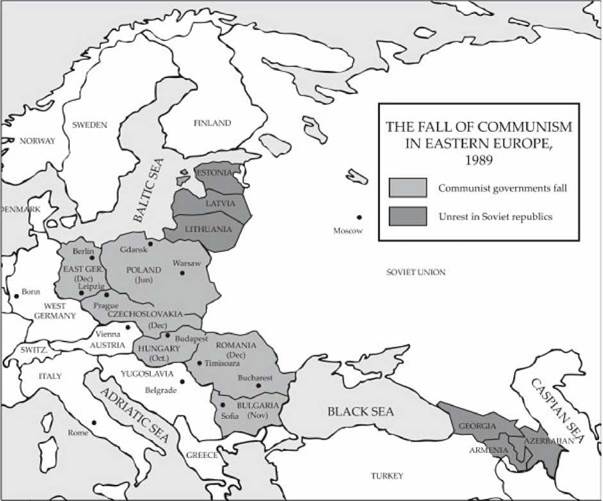
The Fall of Communism in Eastern Europe
During the Cold War, the standard of living in Western Europe improved dramatically, despite economic swings. In Eastern Europe, behind the iron curtain, the massive state- run industries couldn’t keep up with the innovations in the West. A growing divide between the “rich” West and the “poor” East was becoming obvious, and as it became obvious to the people who lived within the Eastern bloc, they began to revolt.
The revolt was as much about democracy and self-determination as it was about the economy. The Soviet Union was a huge patchwork of many different nationalities, many of which wanted to control their own destinies. What’s more, an increasing number of people in the Eastern bloc countries that were controlled by the Soviet Union, such as Poland, were also itching for democratic and economic reform. By the 1980s, groups of reform-minded individuals began scratching that itch.
Poland: Solidarity Grows in Popularity
The decline of communism brought sweeping reform to Poland and its government, which had been trying for years to prevent the spread of anticommunist sentiment. In 1980, more than a decade before the fall of communism in the Soviet Union, a group of workers began the Solidarity movement under the leadership of Lech Walesa.
Thousands of workers joined a strike for reform of the communist economic system. The government reacted by imposing martial law and arresting Lech Walesa, as well as other Solidarity leaders. Throughout the early- and mid-1980s, the government tried to suppress Solidarity. But in 1988, the reform- minded Rakowski became the Premier of Poland. Solidarity was legalized and in 1989, a member of Solidarity, Tadeusz Mazowiecki, became Prime Minister in the first open elections since the end of World War II. In 1990, the Communist Party fell apart in Poland, just as it was falling apart throughout Eastern Europe, and Lech Walesa was elected president. During the 1990s, the economy improved swiftly as Poland introduced market-based reforms and a new democratic constitution. Poland formally completed its integration into the West by joining NATO in 1999 and the European Union in 2004. Quite a change.
German Reunification: All This, Just to Be Back Where It Started
The decline of communism in the Soviet bloc directly led to the reunification of Germany as a free market democracy. East Germany cut ties with the Soviet Union and began negotiations with West Germany. Many Western nations feared that a united Germany would lead once again to a nationalistic regime, but the prospect for peace, economic and political reform, and an improved standard of living for the people of East Germany outweighed the concerns. When the Berlin Wall was torn down in 1989, signaling the fall of East Germany, a mass exodus of East Germans fled to the West. Businesses in East Germany continued to struggle because their outdated corporate structures, equipment, and machinery could not compete with the more efficient businesses in the western half of the nation. Unemployment was high in both halves of the newly united nation. Yet, the government did not abandon its ambitious reconstruction program aimed at the modernization of the former East Germany and the establishment of nationwide communication and transportation lines. Germany has therefore continued to press forward and has since emerged as a leading economy in Europe.
Just in case you haven’t been keeping track, in the last 90 years Germany went from being crushed in World War I, to being built up under fascist Nazis, to being crushed in World War II, to being occupied by four former enemies, to being divided in two, to being at the epicenter of the Cold War, to being reunified as a modern, capitalistleaning, democratic nation. That’s some pretty extreme historical whiplash!
The Soviet Union Collapses: Glasnost, Perestroika, Kaput
When Mikhail Gorbachev came to power in the Soviet Union in 1985, he instituted policies of glasnost (openness) and urged a perestroika (restructuring) of the Soviet economy. He may not have realized it at the time, but he set in motion a tidal wave of change that he wouldn’t be able to reverse. Legislation was passed to add elements of private enterprise to the economy. Nuclear arms treaties were signed with the United States. Gorbachev publicly and officially denounced the Great Purge, a huge deal because it showed that the Soviet Union was re- evaluating itself. The list of reforms and changes goes on and on, but the bottom line is that within six years, Poland and other former Soviet satellites declared their separation from the USSR. The Soviet Union itself disintegrated in 1991. Russia became its own country again, while the other parts of the old Soviet Empire, such as the Ukraine, Belarus, and Georgia, became independent nations.
Some observers were shocked by the degree to which so many different nationalities within the former Soviet Union wanted to form their own countries, and further shocked that most of the shifts in power happened relatively peacefully. But there were exceptions. In the same region that sparked World War I 80 years prior—the Balkans— nationalistic movements within the former Yugoslavia led to “ethnic cleansing” in which Bosnian and Albanian Muslims were raped and slaughtered by Christian Serbians in what was simply the latest horrific chapter in a centuries-long regional and ethnic conflict. The violence eventually led to the involvement of UN troops during much of the 1990s. Even in Russia itself, nationalists in different regions, especially in Muslimdominated Chechnya, want to break away, and have used guerilla warfare and terrorist methods to advance their cause.
During the 1990s, most of the new countries in the former Soviet bloc, especially those in Eastern Europe, created constitutional democracies with economic systems based on variations of capitalism. While the reform movements have been faster in some countries than in others, and while believers in communism make themselves heard and the transition from state-owned industries to privately owned industries has caused high unemployment and corruption in many countries, democracy seems to be taking a foothold in the region. Though much is uncertain about the future of the former Soviet bloc, a few things can be said for sure: by the end of 1991, the Cold War was over, the Warsaw Pact had disbanded, and the United States found itself as the world’s only superpower.
Democracy and Authoritarian Rule in Russia (yes, it’s Russia again!)
The new (old) country of Russia was (re)formed under a 1993 Constitution. Although, it had lost its Soviet satellite countries, this new Russian Federation was formidable in size, plentiful in natural resources, and full of corrupt Soviet bureaucrats looking to get rich under the new rules. On paper, the new Russia looks very much like a perfect Federal state with three branches, checks and balances and an independent court. But in reality, Russia’s abrupt introduction to both democracy and capitalism resulted in a ten-year period of corruption, high- unemployment, deep poverty, widespread crime and a nostalgia for Soviet-style control and discipline. The challenge for Russia’s first president, Boris Yeltsin, was to reform the structures of both state and society. This is an enormous task, requiring completely new systems of government and trade.
Yeltsin actually resigned in 1999 and for the next eight years former K.G.B. agent Vladimir Putin headed the Russian state. He was elected president twice, in 2000 and 2004, and was appointed Prime Minister in 2008 by the newly elected president Dmitry Medvedev. This new style of Russian democracy has been marked by corruption and an authoritarian strengthening of the executive branch, limits on opposition candidates, and a crackdown on a free press. In a move that alarmed international observers, Putin announced in 2011 that he would run for a third presidential term in 2012, stretching his leadership to 16 years (and perhaps beyond?). Despite some protests in Russia, Putin defeated several challengers in March 2012 to return to the presidency. Russia’s twenty- first-century economic growth has been considerable, helped by the rising price of oil (sold at great profit to western Europe), but old habits die hard and conflicts with the U.S. continue over plans for expansion of NATO, the placement of missiles in eastern Europe, and the sale of technology to Iran.
Contrast Them: “West” and “East”
During the Cold War, the two terms were frequently used to describe much of the world, especially the northern hemisphere. The “West,” led by the United States, was generally democratic, generally capitalist, and generally prosperous. The “East,” led by the Soviet Union, was communist, generally totalitarian, and generally substantially less prosperous in terms of per capita standard of living. Japan, incidentally, was part of the “West,” because after World War II it developed along pro-Western, capitalist, generally pro-democracy lines. After the fall of communism in most of the world in the early 1990s, the terms began to lose their relevance. A bipolar description no longer seemed to fit the complexities. The West grew dramatically, but should Russia be considered part of the “West”? Clearly, most of its former satellites wanted to be considered as such. What’s more, China, still communist, is transforming its economy and possibly irrevocably opening up its doors to the world, a movement called “Westernizing” but so far not leading to democratic reforms. As for the “East,” nobody’s sure what that refers to any more. Today, a new, perhaps overly general division between the “Western World” and the “Islamic World” is being used to describe world relations.
D. Independence Movements and Developments in Asia and Africa
After World War II, a wave of independence movements marked the beginning of the end of European imperialism. In an era when the United States and Western Europe were fighting a Cold War in part to defend people’s right to choose their own futures (self-determination) under democratic systems, it became difficult for Western colonial powers to reconcile their post-World War II principles with their imperialist policies. More importantly, it was increasingly difficult for the subjugated peoples to tolerate their treatment, so they rose up and demanded independence.
The Indian Subcontinent
After the Indian National Congress, a mostly Hindu political party, was established in 1885 to increase the rights of Indians under colonial rule, and then the Muslim League in 1906 to advance the causes of Islamic Indians, it took years for momentum to build into an organized resistance to colonial power. In 1919, the Amritsar massacre catapulted the movement.
In Amritsar, 319 Indians, some Hindu and some Muslim, were slaughtered by British General Dyer during a peaceful protest in a city park. They were protesting the arrest of two of their leaders who also were doing nothing other than protesting, were unarmed, and entirely surprised by the attack. Because the park was walled, there was no way to escape from the attackers. By all accounts, the slaughter was unprovoked and entirely unwarranted. When news of the massacre spread, Indians joined the self-rule cause by the millions. It was now a full-fledged movement.
During the 1920s, Mohandas Gandhi became the movement’s most important voice and organized huge protests against colonial rule. Gandhi’s philosophy of passive resistance, or civil disobedience, gained popular support in the struggle against British colonial rule. Instead of fighting with weapons, Gandhi’s followers staged demonstrations and refused to assist the colonial governments. This included massive boycotts of British imperial goods as well as strikes, such as when hundreds of thousands of workers refused to act as labor for the British colonial government’s salt factories. Gandhi’s nonviolent teachings, and his success, became enormously influential. They also partly inspired the civil disobedience of the U.S. civil rights movements led by Dr. Martin Luther King Jr.
At the same time, there was an increase in violence between Hindus and Muslims. While both groups worked together peacefully against the British, radical members of each group found it hard to tolerate the other. This disturbed Gandhi, who was raised Hindu but yearned for mutual respect among people of both religions. In the late 1920s, Gandhi began to call for Indian unity above religious considerations. Instead, the Muslim League actively pushed for the creation of a Muslim nation, and even bounced around a name for their future country: Pakistan.
Independence Won: Nations Two
After World War II, Britain finally granted independence to the Indian subcontinent. The long and relatively nonviolent struggle for independence had finally paid off. The terrible irony was that once independence was granted, the real bloodshed began. Radical Hindus and Muslims started killing each other.
There were two schools of thought regarding the newly independent subcontinent. The first, promoted by Mohandas Gandhi and, at first, the British, called for the establishment of a united India where both Hindus and Muslims could practice their religions. The second was a movement by Muhammad Ali Jinnah, whose aim was to partition the subcontinent and form a separate Muslim nation in the northern region, where Islam had become the dominant religion. The British eventually were convinced that a partition would save lives by separating people who seemed intent on killing each other, so when the British turned over the reigns to new leaders of independent India in 1947, it separated the country into thirds: India in the south and Pakistan in two parts, one to the northwest of India (Pakistan) and the other to the east (East Pakistan, currently Bangladesh).
Both parts of Pakistan were Muslim, while India was predominately Hindu, although officially secular. The result was chaotic. Millions of people moved or were forced to flee due to religiously motivated violence. Essentially, India and Pakistan exchanged millions of citizens, with practitioners of each religion moving to the nation where their religion was dominant. Gandhi’s worst nightmares were realized. Nearly half a million people were killed as they migrated to their respective “sides.” The move of so many people along religious lines only served to create an international conflict between Pakistan and India. Within a year, Gandhi himself was assassinated by a Hindu who was upset with Gandhi’s secular motivations. Today, the two nations are still fighting, especially in Kashmir along their borders, where religious self-determination still remains the big issue. What’s more, both countries have since become nuclear powers, and 2008 saw a significant increase in terrorism between the two nations as Pakistan became less stable.
Africa
After World War II, African nations also began to assert their independence. They were partly inspired by events in India and the rest of the world, but they were also motivated by the war itself. Hundreds of thousands of Africans fought for their colonial powers during the war. Many of them felt that if they were willing to die for their governing countries, then they had earned the right to live free.
South Africa became a significant British colony, complete with extensive investment in infrastructure and institutions. In 1910, the colony had its own constitution, and it became the Union of South Africa, still part of the British Commonwealth, but exercising a considerable amount of self-rule. Under the constitution, only white men could vote, so the native Africans had few rights. In 1912, educated South Africans organized the African National Congress in an effort to oppose European colonialism and specific South African policies. This organization, of course, was similar to the Indian National Congress, which was established for similar ends.
After South Africa, the nations north of Sahara were the next colonies to win independence. These nations had strong Islamic ties, and the mostly Muslim Middle East had already won its freedom in the decades prior (more on that later). Egypt, too, had won its independence early, in 1922, although it kept extremely close ties to Britain. In the 1950s, as the independence movement gathered steam in Africa, Gamal Nasser, a general in the Egyptian army, overthrew the king and established a republic. He nationalized industries, including the Suez Canal, and then became embroiled in Middle Eastern conflicts. Nasser’s actions emboldened other Islamic nationalists to seek independence, and soon the African nations along the Mediterranean were free.
South of the Sahara, independence was a trickier issue. The problem was that while nearly everyone wanted independence, most of the colonies had been raped of their resources. There had been little investment in human beings. The vast majority of Africans were uneducated, or only educated through grammar school. Unlike in India, where a substantial number of upper-caste Indians were highly educated and even attended universities in Britain, many African nations had few natives who were skilled professionals: doctors, scientists, lawyers, diplomats, businesspeople. This meant that once the colonial powers left, there would be few people left with the education and skills to immediately take charge and begin to build a productive, self-sufficient society.
As mentioned in the previous chapter, national unity among the natives was also hard to foster because the boundaries of so many African colonies had been drawn according to European needs, and took no account of African history or needs. Africans within the same colony spoke different native languages and had differing, sometimes opposing, customs, histories, and loyalties. For all of these reasons, even after attaining their hard- won independence, many African nations struggled to build strong, stable, independent countries.
Decolonization and nation building occurred in a variety of ways across Africa. The Algerians fought a bitter war for independence from France (1954-1962) while in the early 1960s Nigeria and Ghana negotiated their freedom into a Parliamentary governing style borrowed from England, but after a series of military coups, have adopted presidential systems. Kenya, under the leadership of Jomo Kenyatta, negotiated their constitution with Great Britain after a brutal crackdown engineered by coffee planters unwilling to lose such profitable property. Others, such as Angola and Belgian Congo, overthrew colonial governments, only to become embroiled in civil wars or in Cold War tensions. Zimbabwe was among the last to establish African majority rule in 1980 (see following section on South Africa).
Fifty-three of Africa’s 54 nations belong to the African Union, a political and economic confederation formed in 2001 to replace the Organization of African Unity or OAU. But success and stability is not guaranteed for any of these nations. Chad, Sudan, Uganda, Somalia, and Rwanda (see on the next page) as well as the newly renamed Democratic Republic of Congo (former Zaire) have been wracked by ongoing and devastating civil wars since the turn of the twenty-first century. Attempts to form stable democracies have been thwarted by a reversion to “big man” politics, corruption, military coups, and escalating debt payments (to IMF and World Bank—see Alphabet Soup later in chapter). Even relatively stable governments such as Kenya’s have seen political violence escalate in recent years.
Economically, most of Africa is still rich in natural resources, albeit different ones than the colonial powers were interested in. Palm oil and rubber have given way to petroleum and metals including nickel, cadmium and lithium—prized for batteries to power cell phones, laptop computers, and hybrid cars. So the former colonial powers plus some new industrial players (China!) remain interested and invested in the nations of Africa.
Note the Change: Globalization and the Rise of NGOs
NGOs, or nongovernmental organizations, have become an ever-increasing presence in our modern world. NGOs are typically private, often nonprofit, agencies that provide relief services and/or advocacy for groups that are generally not serviced or represented by their governments. Some familiar examples of NGOs include the International Committee of the Red Cross (ICRC), Doctors Without Borders, Amnesty International, and even the American Civil Liberties Union. It is often NGOs that lead relief efforts following natural disasters and during wars, particularly to countries and people who cannot afford to pay for such efforts. Organizations such as the World Wildlife Fund provide advocacy for the world’s animals, which of course do not have any representation in the world’s governments. But why have most of these organizations formed only in the years since World War II? Well, the major international governmental organizations that formed after World War II, such as the UN and World Bank, were criticized for only representing the interests of the world’s wealthier and more powerful nations (as they had been created by the victors of the war), and so many well-meaning individuals formed private companies to fill needs that were not being met by the world’s governments. Globalization, which has increasingly made it easier to communicate and travel around the world, has not only made it easier for NGOs to provide their services on a global scale, but has also made it much easier for them to raise the money needed to fund their operations.
Rwanda: Ethnic Genocide
The difficulties of establishing stable nations in Africa are exemplified by the situation in Rwanda. Ethnic strife, genocide, and human rights violations in Rwanda stem from conflicts between two groups: the Tutsi (15 percent of the population in Rwanda) who governed the Hutu (85 percent of Rwanda) during German and Belgian colonial occupation. Belgian rule in particular exacerbated interethnic tensions, setting the stage for bloodshed as soon as colonial authorities withdrew. Upon Rwanda’s independence in 1962, the Hutu revolted against the Tutsi leadership, leaving thousands dead and the two groups locked in bitter, bloody conflict. In 1973, a military coup by Juvenal Habyarimana unseated the government and eventually established a one-party republic in 1981. The military government worked to keep peace but encountered only modest success. That, too, was destroyed when Habyarimana’s personal airplane was shot down over his presidential palace in 1994, assassinating the Hutu general. Almost immediately, conflict escalated, with the Hutu needing little encouragement to exact revenge on the Tutsi population whose leadership they blamed for the assassination. One hundred days of genocide left as many as 800,000 Tutsi dead, and by the following year more than 2 million mostly Hutu refugees were sent or fled to neighboring Zaire, where many died from disease. Because the entire country has only 7 million people, the genocide and displacement in Rwanda ranks among the most devastating in recent history.
Compare Them: Independence in Africa and India
Both India and Africa successfully gained independence in the years following World War II, and both areas were tragically torn apart by ethnic and religious strife shortly following independence. In India, the tensions between Hindus and Muslims, which existed before the British colonized the subcontinent, re-emerged as they departed. In many African nations, independence served only as an opportunity for long-held tribal hatreds to resurface in power struggles. The colonial powers, of course, were no better. They had been killing each other for thousands of years.
It is a mistake to think that the colonial powers assimilated the native peoples entirely or completely eradicated the underlying cultures. While there’s no doubt they raped the colonies of their resources and in many cases ruthlessly subjugated the natives, they couldn’t erase the native people’s memories. Even after generations of colonial rule, Africans remembered old rivalries and hatreds and, in many cases, acted on them.
Developments in South Africa: The Rise and Fall of Apartheid
The year after the South Africa Act of 1909, the Union of South Africa was formed by combining two British colonies with two Dutch Boer republics, and although the British and Dutch colonists were given considerable rights to self-government, black people were entirely excluded from the political process. In 1923, residential segregation was established and enforced. In 1926, blacks were banned from work in certain skilled occupations that whites wanted for themselves. When South Africa won independence from Britain in 1931, the racial policies didn’t improve. In fact, a system of apartheid (“separation of the races”) was established in South Africa in 1948 as an all- encompassing way of dividing black (80 percent of the population) and white. By the late 1950s, apartheid was extended to the creation of homelands, areas of the country that were “set aside” for blacks. The homelands were in the worst part of the country, and comprised less than 15 percent of the nation’s land. The whites were given the cities, the resource-rich mines, and the best farmland. While many blacks were compelled to move to the homelands, others stayed in the cities, where they were segregated into black slums. If this starts to sound like District 9 (2009), there’s a reason a sci-fi movie about segregating aliens was set in South Africa.
In response, the black community organized. In the 1950s, Nelson Mandela became leader of the African National Congress, an organization determined to abolish apartheid. At first, he advocated peaceful protest, following the example of Gandhi. But in 1960, after the Sharpeville massacre in which 67 protesters were killed, the African National Congress supported guerrilla warfare. At Sharpeville, blacks were protesting a policy that forced them to carry passes to be in the cities in order to go to their jobs. The passes were issued at places of employment. This meant that if you worked and your wife didn’t, you couldn’t go into the city with her because she wouldn’t have a pass. The massacre rallied the anti-apartheid movement. Mandela was arrested in 1964 for his role in anti-apartheid violence and sentenced to life imprisonment.
After decades of increasing pressure from the black majority and the international community, South Africa finally released Mandela in 1990 and agreed to negotiate on the policy of apartheid. The government more than negotiated, it crumbled. In 1994, after apartheid was abolished, Mandela was elected president in the first free and open election in the nation’s history.
The Middle East
After the fall of the Ottoman Empire and the creation of the modern nation of Turkey at the close of World War I, the Middle East, which was largely comprised of old Ottoman lands, was temporarily put under the control of the League of Nations. As if the two European powerhouses didn’t already control enough of the world, France was put in charge of Syria and Lebanon, while Britain got Palestine, Jordan, and Iraq. Persia (Iran) was already carved up into spheres of influence between Britain and Russia during the nineteenth century. As for Arabia, it united as a Saudi kingdom immediately following the fall of the Ottoman Empire.
The Middle East during the twentieth century is complicated stuff, but a good chunk of the essential information involves the creation of the modern nation of Israel, so that’s where we’ll start.
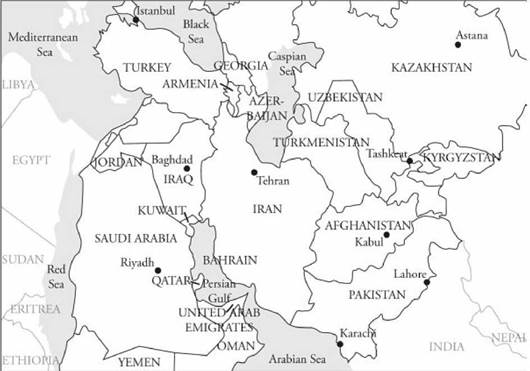
The Middle East
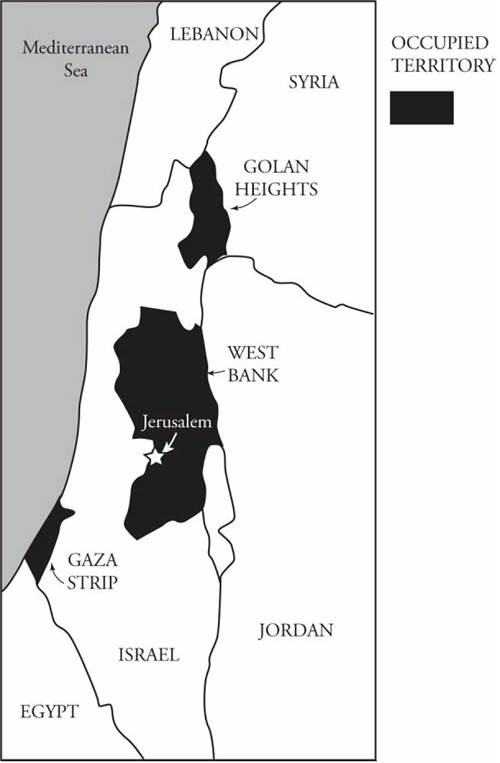
Modern Israel
Israel: Balfour Declares a Mess
If you remember way back four chapters ago, the Hebrews (Jews) occupied lands in Palestine at the time of the ancient Roman Empire. As is the case everywhere else on the globe, between that chapter and this chapter a series of conquests shifted power over the region a mind-numbing number of times. While a few Jews managed to stay in the region, most bolted for Europe or other areas as Palestine became increasingly entrenched in Islam. All the while, however, many Jews had wanted to return to what they believed was the “promised land.” But in the meantime, generation after generation of Muslim Palestinians had made that land home.
During World War I, Zionists (Jewish nationalists) living in Britain convinced Arthur Balfour, Britain’s foreign secretary, that a Jewish homeland in Palestine was both desirable and just. He issued what became known as the Balfour Declaration of 1917, which explicitly stated the right for a home in Palestine for the Jewish people, but he also stated that it should in no way displace the Palestinians who currently lived there. As history would have it, Britain gained control of Palestine in 1920 as a mandate from the League of Nations—which meant that it was to govern on behalf of the League of Nations—and was therefore in a position to make good on its declaration.
But the declaration was messy because it essentially provided that the Palestinians and Jews were to divide land that they both claimed. Not long after, many Jews, mainly Russian Jews fleeing violent, anti-Semitic mobs (pogroms), began streaming into Palestine. As their numbers grew, the Palestinians started to get uneasy. In the 1930s, huge numbers of Jews flooded the region to escape Germany as Hitler came to power. By the beginning of World War II, nearly 500,000 Jews had emigrated to Palestine. While Palestinians still outnumbered Jews, the Jewish population was now large enough to pull some serious weight, especially because money was pouring into the region from Jewish communities worldwide.
The Jewish Wait for a State Ends in 1948
In 1948, the United Nations (which had replaced the ineffectual League of Nations) officially created two Palestines, one for Jews and the other for Muslims (Palestinians). Sound familiar? It should. The same arrangement was made with India and Pakistan. The Indians and Pakistanis have been fighting ever since. This should give you a clue for what’s coming in the next paragraph.
As soon as David Ben-Gurion, the first prime minister of Israel, announced the official creation of the Jewish homeland on May 14, 1948, Muslims from six Arab countries attacked Israel in what became known as the 1948 Arab-Israeli War. But the Israelis shocked and awed them with their quick organization and military capability. Within months, the Israelis controlled most of Palestine, including the Palestinian parts, while Jordan held the remaining portions (the West Bank). Suddenly, Palestinians were without a home. They had no land to call their own.
As Jews flocked to Israel from all over the world, Israel and Arab countries continued to have skirmishes. In 1967, the amazingly short Six Days’ War resulted in total victory for the Israelis who took control of the West Bank from Jordan, the Sinai Peninsula and Gaza Strip from Egypt, and the Golan Heights from Syria. With the West Bank came control of the city of Jerusalem, Judaism’s historical homeland. However, Muslims throughout the region resented Israeli control of the Dome of the Rock, a revered Islamic shrine dating back to the Abbasid caliphate which is also the site of the Temple Mount, an important Jewish historical site. The territorial gains resulted in new waves of Palestinian refugees to Jerusalem. In 1977, Israeli Prime Minister Begin and Egyptian President Sadat signed the Camp David Accords, an agreement that did not mention Golan Heights, Syria, or Lebanon, but which led to Israel pulling out of the Sinai and Egypt becoming the only Arab country yet to recognize Israel’s right to exist. This was a huge blow to the Palestinians and other Arab nations. Sadat was assassinated and the lands gained in the Six Days’ War remain some of the most contested in the region.
In the years since, the Israelis and the Palestinians have been fighting over the Israeli occupation of the West Bank, Golan Heights, and Gaza Strip. The Palestine Liberation Organization (PLO), a group dedicated to reclaiming the land and establishing a Palestinian state, has so far been unsuccessful in negotiating a homeland. The efforts are complicated by the intifada (uprising), an on-again off-again movement that sometimes uses terrorism against Israeli citizens in an attempt to either destroy Israel or force it into withdrawal from the occupied territories.
In 2000, a new intifada reignited violence between Palestinians and the occupying Israeli forces. As suicide bombings became more frequent, newly elected Israeli prime minister Ariel Sharon approved the construction of a wall to be built between the Palestinian West Bank and Israel in order to protect Israelis against suicide attacks. Often compared to the Berlin Wall, Israel has been criticized by the international community for employing such a draconian measure to fight terrorist attacks.
Not limiting itself to criticism, however, in 2003 the international community, led by the United States, the European Union, the UN and Russia, proposed a “Roadmap to Peace,” which outlined a set of goals to achieve peace in the region. Progress on the Roadmap remained stalled until the death of Palestinian president (and former PLO leader) Yassir Arafat in November 2004. Arafat had been consistently blamed by Israel and the United States for blocking such progress. Following his January 2005 election, Palestinian president Mahmoud Abbas quickly signed a cease-fire with Israel that effectively ended the intifada that began in 2000.
Under a “disengagement plan” adopted by the Israeli government, all Israeli settlers were supposed to have vacated the Gaza Strip by August 2005. Residents of the settlements who did not leave were forcibly removed by the Israeli army, a military action which greatly divided the Israeli public. Additional settlements were disbanded in the West Bank as part of the same plan. It is likely, however, that lasting peace will remain elusive until the Israelis and Palestinians can reach agreement on issues such as movement into and outside of the Palestinian Authority- controlled territories, the disarmament of militant groups, and the potential independence of a Palestinian state.
The situation is made even more complicated by limited financial stability and political divisions among Palestinians. The governing Palestinian Authority is divided into two factions: Fatah, a branch of the former Palestinian Liberation Organization, and Hamas.
Translating to “Islamic Resistance Movement,” Hamas was founded as an offshoot of the Muslim Brotherhood in 1987. Because of their open willingness to support terrorist tactics, Hamas is frequently the target of Israeli military attacks. Despite similar goals for a Palestinian state, Hamas and Fatah are deeply divided, and violent clashes occur with increasing frequency. After the creation of a unity government in 2006, Hamas led a coup in 2007 which concluded with a Hamas-imposed government in the Gaza Strip and a Fatah-run West Bank. Further complicating governance, in retaliation, President Mahmoud Abbas (Fatah) named Salam Fayyad prime minister. Hamas contends that Fayyad’s appointment is illegitimate, as he was not voted into office. Israel’s current government, led by Prime Minister Benjamin Netanyahu, and the United States show willingness to work with Fatah; the United States and a number of European countries list Hamas as a terrorist organization and so do not negotiate with that party.
Israel’s border with Lebanon and Syria is another hotspot. Hezbollah, a militant Shia group backed by Syria and Iran, operates in the region. In 2006, Israel launched a major offensive against Hezbollah after two Israeli soldiers were captured in Israeli territory. These new hostilities threatened the stability of a country which had been the scene of intense fighting between Syrian, Israeli, and PLO forces throughout the 1980s and 1990s. Syria is widely seen to have a controlling hand in Lebanese politics. In 2005, when Prime Minister Rafiq Hariri was assassinated, fingers quickly pointed to Hezbollah and Syrian sources. A UN Special Tribunal was formed to investigate the assassination and the newest announcements state that findings can be expected in 2015. The Tribunal has already issued arrest warrants for four Hezbollah operatives.
The Iranian Revolution: The Shah Gets Shooed
Reza Shah Pahlavi rose to power in 1925 by ousting the then-ruling shah, who had allowed Persia to fall under European spheres of influence. Taking a stance similar to the Japanese during the Meiji Restoration, Reza Shah decided that the best way to beat the Westernizers was to join them. Iran (formerly Persia) modernized slowly at first, but once the Europeans left after World War II, the Westernization efforts gained momentum, and in the 1960s, the shah instituted land reform and education reform, and increased the rights of women, including the right to vote. Women also pursued higher education and careers, and began to adopt Western dress. All of this infuriated many Islamic fundamentalists who wanted to make the teachings of the Qu’ran the law of the land. Believing that the influence of the West was too strong, they sought to reverse the economic and social changes. Others believed that the shah was not reforming enough, especially with regard to the political system, which lacked significant democratic changes.
The shah reacted violently against dissent from both sides, pressing forward with his own mix of social and economic reform even in the face of strong public opposition. When President Carter of the United States visited Iran to congratulate it on its programs of modernization and Westernization, the Islamic fundamentalists had had enough. In 1979, the shah was ousted from power during the Iranian Revolution, which sent Iran back to a theocracy led by Ayatollah (“Mirror of God”) Khomeini. Iran is primarily Shia, and the ayatollah is the Shiite caliph (this was important during the Iran-Iraq war, as Iraq was ruled by Sunni Muslims). Immediately, modernization and Westernization programs were reversed, women were required to wear traditional Islamic clothing and to return to their traditional roles, and the Qu’ran became the basis of the legal system.
In 1980, soon after the revolution, Iraq invaded Iran following a series of border disputes between the two countries. Iran’s position was further complicated by Iraqi leader Saddam Hussein’s quiet support from the United States, which was still quite furious over Iran’s taking of U.S. hostages during the revolution. Even with some U.S. support, the Iran-Iraq war turned into an eight-year war of attrition with neither side gaining much ground until a cease-fire was signed in 1988.
Since the Ayatollah Khomeini’s death in 1989 (watch out—he was succeeded by the differently spelled Ayatollah Khamenei!), Iran has been characterized by a power struggle between powerful Islamic fundamentalist clerics and an increasingly vocal reform-minded and somewhat pro-Western minority. Most recently however, Iran has caused international concern (particularly in the United States) by pushing ahead with efforts to develop what they deemed “peaceful” nuclear technologies, claiming they have a right as an independent nation to develop such technology as they see fit. Along with the International Atomic Energy Agency and the European Union, the United States is currently calling on Iran to sign an international agreement limiting or even eliminating its nuclear programs.
From 2005 until 2013, Tehran’s ultra-conservative mayor Mahmoud Ahmadinejad was president of Iran. He was succeeded by the more politically moderate leader Hassan Rouhani. The American-led war in Iraq that began in 2003, the relationship of Iran and Iraq’s Shia populations, and Iran’s development of weapons programs and nuclear research have only complicated matters further.
Compare Them: Role of Women After Chinese Revolution and Before Iranian Revolution
In the West, women have benefited from substantial societal and legal changes, but the change has been gradual, over many generations. In China and Iran, the changes were quick. Within a single woman’s lifetime, she went from an extremely traditional, oppressive society to one in which she could vote (in the case of Iran), dress less traditionally, divorce her husband, become educated, and pursue a career. Of course, after the Iranian Revolution, those reforms were reversed immediately. At that point, women in China and Iran were in completely different situations.
Oil: Enormous Amounts of Goo
The Industrial Revolution was a huge bonanza for the Middle East. That’s because they’d been sitting on over two-thirds of the world’s known oil reserves since the beginning of civilization. Prior to the Industrial Revolution, it was goo. After the Industrial Revolution, it was fuel. As multinational corporations rushed to the Middle East throughout the twentieth century to obtain drilling and production rights, Middle Eastern governments like Saudi Arabia, Kuwait, Iran, and Iraq started to earn billions of dollars annually. But the goo also meant that the rest of the world had become very, very interested in the Middle East, because oil allowed the West to do one of its favorite things: drive. This world interest sometimes led to intervention and war.
Once the oil-producing nations of the Middle East realized how much power they wielded, they organized. In 1960, the region united with a few other oil- exporting nations, like Venezuela, to form a petroleum cartel known as OPEC (Organization of Petroleum Exporting Countries). With three-quarters of the world’s petroleum reserves, OPEC members collectively cut supply dramatically in the 1970s, sending the price of oil through the roof. Billions of extra dollars flowed into OPEC member nations’ coffers. Nations like Saudi Arabia used the extra money to modernize their infrastructures, and spent billions on attempts to improve their agricultural sectors. Since the 1970s, OPEC hasn’t been able to keep its members in line, and is therefore a much less powerful organization, but the individual members who make up the organization continue to wield huge power over the world economy.
E. Globalization and the World Since 1980 International Terrorism and War
Since World War II and the formation of the United Nations, there has been increased interest in maintaining international security. Some of the organizations that are charged with this task are from the Cold War era: NATO, the United Nations, and the International Atomic Energy Agency. Others, such as the International Criminal Court in The Hague (formed in 2002) were formed to prosecute war crimes and crimes against humanity, no matter who committed them. Still others, including Amnesty International and NGOs, such as Human Rights Watch and Doctors Without Borders, serve to publicize issues that threaten human health and safety and provide aid to those in need.
War in the Gulf: Oil and Saddam Hussein
Iraq invaded Kuwait in August 1990 under the leadership of Saddam Hussein because Iraq wanted to gain control of a greater percentage of the world’s oil reserves. Iraqi control of Kuwait would have nearly doubled Iraq’s oil reserves to 20 percent of the world’s total, and would have put it in good position to make advances on Saudi Arabia and the United Arab Emirates, actions that would have given Iraq control of more than half of the world’s oil reserves. The world, especially the industrialized West, reacted immediately. In January 1991, the United Nations, and particularly the United States, sent forces to drive the Iraqis out of Kuwait in what we now call the Persian Gulf War. The immediate impact of their success was the liberation of Kuwait and the humiliation of Iraq, which was subjected to UN monitoring, severe limitations on its military activities, and economic sanctions. Nevertheless, Hussein remained in power, and the UN forces left the region without moving forward to oust him. Hussein held on to his brutal dictatorship for another ten years while also, many argue, ignoring key elements of the peace treaty that allowed him to keep his power after his invasion of Kuwait.
In April 2003, a coalition of countries consisting primarily of the United States and Great Britain invaded Iraq to oust Saddam from power. Saddam’s government quickly fell to coalition forces but Hussein himself was not captured until December of that year. Sovereignty was returned to a transitional government in June of 2004, and a new democratically elected government was formed in May 2005. However, since the initial invasion, Iraq has been increasingly plagued with sectional conflicts among Sunni, Shiites, and Kurds, the conflicts defined by suicide bombings against coalition forces and more and more against Iraqi forces and civilians of rival sects. Even amidst the violence, the Iraqi government ratified a new constitution in October 2005, followed by a general election in December 2005, with legislative seats distributed according to “proportional representation.” This system allotted percentages of seats to women, Sunni Muslims, Kurdish Iraqis, as well as to the Shia majority. Despite delays in certifying the results of the December 2005 election, the newly elected government took office in May 2006, with Jalal Talabani, who is Kurdish, as president, and Nouri al-Maliki, who is Shia, as prime minister. The government has faced a number of challenges, and it remains to be seen whether it can successfully bring a violent insurgency to peaceful engagement in the political process. Even with the end of U.S. combat operations and the withdrawal of most coalition troops by the end of 2011, Iraq must also still contend with a number of opposing domestic and international interests as it tries to find stability in its new incarnation.
Taliban, Al Qaeda, Osama bin Laden
During the early 1980s, the Soviet Union sent thousands of troops to Afghanistan at the request of Marxist military leader Nur Muhammad Taraki, who had engineered a military coup against the previous government. Many Afghans opposed communism and Soviet intervention, however, and soon a massive civil war raged. Some of the resistors called themselves “holy warriors” and, with the aid of weapons from the Western powers who supplied the Cold War on every front, launched guerilla attacks against the superior military might of the Soviet Union. As internal problems escalated in the Soviet Union, Gorbachev agreed to withdraw Soviet troops from the region and a peace accord was signed. While communism fell apart in the Soviet Union and Eastern Europe, the problems in Afghanistan continued. The decline of communism removed the Soviet threat, but warring factions vied to fill the power void.
The power that finally triumphed after 14 years of fighting and more than 2 million deaths was called the Taliban, an Islamic fundamentalist regime that captured the capital of Kabul in 1996. The new government imposed strict Islamic law and severe restrictions on women. It also provided safe haven for Osama bin Laden, the Saudi leader of an international terrorist network, known as Al Qaeda, which has a serious distaste for Saudi Arabia and the United States. It’s believed that Al Qaeda’s main issue with Saudi Arabia is that the ruling family is too cozy with the United States and that they have allowed U.S. troops to remain in the country since the Persian Gulf War, which amounts to the presence of infidels in a kingdom that is home to Islam’s most holy sites. Al Qaeda despises the United States for what many believe are at least three reasons. First, the United States supports Israel, which the organization would like to see removed from the planet. Second, it has troops stationed in Saudi Arabia, and third, the United States is the primary agent of globalization, which Al Qaeda believes is infecting Islamic culture.
On September 11, 2001, Al Qaeda operatives managed to take control of four American passenger jets and fly two of them into the World Trade Center in New York City, one into the Pentagon in Washington, D.C., and one (presumably unintentionally) into a field in Pennsylvania. The towers of the World Trade Center fell to the ground, killing more than 2,500 civilians. The deaths of the people on all four planes and those killed at the Pentagon bring the total number of casualties to almost 3,000. The United States immediately launched a war on terrorism, targeting Al Qaeda and the Taliban. Within months, the Taliban was removed from power and U.S. and UN forces occupied the country of Afghanistan. Al Qaeda, on the other hand, still survives, though its leadership is being directly attacked and eliminated, most notably with the death of Osama bin Laden in May of 2011.
Although smaller in scale, suicide bombing and terrorist attacks (many linked to Al Qaeda and similar groups), continue regularly. They are a problem throughout the Israeli territories, between Sunni and Shia factions in Iraq, targeting tourists in the cities of Saudi Arabia, Egypt, and Turkey, and among Muslim separatists in Russia. Coordinated attacks occurred throughout Lebanon in 2004 and 2005, killing the former Prime Minister Rafiq Hariri (among others), while larger-scale attacks occurred in March 2004 on commuter trains in Madrid, Spain, in July 2005 on the London subway system, and the following July on trains in Mumbai (Bombay), India. While the Madrid attacks were attributed to Basque separatists, the remainder of the attacks were credited to Islamic fundamentalists.
World Trade and Cultural Exchange
The end of the Cold War removed the last obstacles to true global interaction and trade. Currencies were no longer tied to old alliances, and new business opportunities emerged. This deregulation, along with the development of systems of instantaneous communication such as the Internet, resulted in globally integrated financial networks. Commercial interdependence intensified in the 1980s as eastern Asia began to flex its industrial and commercial muscles.
Competition further drove global developments, and regional trading blocks were created such as North American Free Trade Agreement (NAFTA) in the early 1990s. The European Economic Community (EEC), originally formed in 1957, transformed into the modern European Union (EU) tied to a single currency, the euro. The ease with which goods and ideas are transported across the world has resulted in cultures being more homogenous and integrated. This does not mean that local culture is lost, but it does mean that one can satisfy a craving for a Starbucks latte inside Beijing’s Forbidden City. It also means almost instantaneous access to a wider range of music, art, literature, and information. Much of this is facilitated by the spread of English as the language of business and communication across the globe. This began in the eighteenth century with the far-flung colonies of the British Empire and continued with the emergence of the United States as a global power after World War II.
The European Union or EU was formed to give the United States some economic competition by banding Europe together in a single market. The real impetus to expand the powers of the EU came in the early 1990s when the collapse of the Soviet Union simultaneously opened Europe and left the U.S. unchallenged as the world’s superpower. In 1989, the EU had 12 members; by 2011, it had 27, of which 10 were former Soviet satellite nations. The EU has three branches: executive, legislative, and judicial. Elections are held throughout Europe every five years. The formation of a monetary union, the Eurozone, in 1999, led all but three nations (UK, Sweden, and Denmark) to adopt a unified currency, the euro, in 2002.
While economic integration initially seemed relatively easy and produced a few boom years, in the crisis of the late 2000s (which began slightly earlier in Europe than in the U.S.), it became clear that stronger economies such as Germany’s had borne the freight of weaker, over-extended economies such as Greece’s, and by 2010, economic collapse in states such as Greece, Ireland, and Portugal threatened to destabilize the entire Eurozone. This has provoked sharp debates about economic integration that have now piled onto existing concerns about political and judicial integration, putting national interests and questions of sovereignty at stake.
Note the Change: The Threat of “McDonaldization”
Consider for a moment since the first McDonalds restaurant opened in California in the late 1930s just how far and to how many people the company and the fast-food culture has come. Take a quick jump over to McDonalds’ website and you can view the list of over 100 countries in which McDonalds has restaurants today, including Saudi Arabia, Pakistan, and Egypt. But why point out these Muslim countries? The so-called “McDonaldization” of the world can be used as both an example and a metaphor for the spread of what is predominantly a Western popular culture to the rest of the world. Many countries, such as India and even China, have embraced the fruits of Westernization, integrating and assimilating aspects of Western culture into their own. Other groups however, including fundamentalist movements in some Muslim countries, have rejected this “invasion” of modern Western culture, which they see as a threat to their traditional Islamic ways. Responses to the perceived threat of globalization have included many acts of international terrorism in an effort to fight the encroachment of the West as symbolized by the international spread of such Western cultural icons as Starbucks, Wal-Mart, and Disney.
To Be Rich Is Glorious: The Rise of China and India
“Socialism with Chinese Characteristics” or “To Be Rich Is Glorious” sum up Deng Xiaoping’s plans for China after the death of Chairman Mao. Since normalized trade relations with the United States in the 1990s and acceptance into the World Trade Organization in 2001, China has become an industrial and economic juggernaut. What began with the creation of special economic zones exempt from the strict controls of communism in the late 1980s has become the world’s warehouse and discount store! In the last ten years, China’s imports have increased from $82 billion (1999) to $338 billion (2008) built on a wide array of everyday consumer goods, toys, and apparel. This new and profitable industrial revolution has funded a building boom throughout China, brought the 2008 Olympic games to Beijing, and contributed to a rising and educated middle class who now shop and eat at 300 Starbucks and 800 McDonalds stores. But economic success has also led to a crackdown on Internet freedom. Politically, it is pretty much the same old China. The CCP allows some local elections and the New York Times is available online, but one party is clearly in charge and watching what you Google.
India, the world’s largest democracy and one of its fastest growing economies, has spent the past two decades making itself indispensible to the globally connected world. In 1991, India was broke, the leading contender for prime minister had been assassinated and the country desperately needed a way to reinvent its economy and industries. Since loans from the IMF required economic reforms and austerity measures, major industries were privatized and others were publicly traded. India’s greatest advantage is its highly educated and skilled population, yet the focus on traditional industry advocated by Gandhi had left India isolated and unable to compete globally. The desperation of 1991, at a time when technology and computer chip industries were developing in the United States was a moment of opportunity for Indian investors and workers, many of whom had migrated to Silicon Valley. Indian entrepreneurs brought these new ideas back to Indian companies such as Infosys and Tata, developed technology to route global calls, and built on the global demand for software, new technology, and support.
Both India and China are nuclear powers with two of the world’s largest armies. Both are currently dealing with belligerent neighbors (Pakistan and North Korea), both have complicated relationships and history with Western powers, both have yet to deal with tremendous economic inequality and poverty within their borders, and as members of the G20 (see Alphabet Soup) both have figured out a way to keep growing while much of the industrialized world is in an economic slowdown.
Global Alphabet Soup
With globalization of trade come many agencies and organizations designed to protect and facilitate trade. The earliest of these were the International Monetary Fund or IMF (1945) with 185 members and the World Bank (also founded in 1945). Both organizations were formed to stabilize world economic relationships and to loan financial assistance when needed. At the same time, the General Agreement on Tariffs and Trade, or GATT, was agreed upon to reduce barriers to international trade. GATT became the World Trade Organization, or WTO, in 1994. The WTO boasts 153 member states—most of the world’s active trading nations—who adhere to the WTO’s rules and regulations regarding trade relationships.
An organization of note is the Group of Six, or G6, created in 1975 as a forum for the world’s major industrialized democracies. Its original members included U.S., Great Britain, West Germany, Italy, Japan, and Poland. They have since been joined by Canada in 1977, and by Russia in 1997, and are now know as the G8. Recently, Russia was excluded from the forum by the other members on March 2014 as a result of its involvement in the 2014 Crimea crisis in Ukraine. So the group has changed yet again and now meets as the G7 group of nations. This informal summit of the world’s most powerful leaders meets annually to discuss issues of mutual or global concern such as climate change, terrorism, and trade.
In addition to the G8, a group of 19 nations plus EU representatives make up the G20 or the Group of 20 Finance Ministers and Central Bank Governors. Beginning with the financial crises of the late 1990s, this group represents key industrialized as well as developing economies.
Environmental Change
Until the 1980s, environmental issues focused on localized pollution or waste management, but along with global integration in every sector came global environmental concerns. Most recently, these concerns have focused on food; as suppliers become ever more distant from their consumers and trade agreements open up supply routes, safety regulations may not follow.
The “green revolution” of the 1950s and 1960s led to increased agricultural productivity through industrial means—chemical fertilizers and pesticides, biologically engineered foods, more efficient means of harvesting, and more marginal lands available for agriculture. While this resulted in inexpensive and plentiful food supplies, it destroyed traditional landscapes including rainforests in Indonesia and South America, reduced species diversity, and fostered social conflicts that might not have otherwise existed. As has been true throughout history, marginal lands can not sustain the population increases they initially produce with new industrial technologies. This is especially notable in eastern and sub-Saharan Africa, where political and financial mismanagement contributed to widespread famines in the 1970s and 1980s.
Bottled water has become ubiquitous and widespread, but water is a crucial natural resource that is often carelessly managed by cities at the expense of their hinterlands. This is not a rapidly renewable resource and needs to be regulated for drinking and for agriculture. A similar pattern is seen with industrialized countries consumption of oil— they want more and they want it cheap! Oil fuels industry, transportation, and heating of homes and businesses. The insatiable appetite for oil reserves on the part of industrialized democracies can lead to strange political and economic alliances (see the previous section on the Middle East). Although some progress has been made in developing alternative fuel options, like ethanol, there are big drawbacks to them as well. Clearly, much more research into viable alternatives to fossil fuel is needed.
Finally, a quick note on global warming. It’s getting warmer and human activities, including fuel consumption, heating, and cooling, are contributing to this. What the results of these warming trends will be is uncertain. On the positive side, there will be longer growing seasons in temperate parts of the world, but the negative will be more extreme conditions in marginal areas—longer periods of drought in some, flooding and disappearance of coastlines in others. The first Earth Summit on global climate change was held in 1992 in Rio de Janeiro. Five years later, the Kyoto Protocol was an attempt to make a global agreement on ways to reduce environmental damages, but because the United States has refused to ratify the Protocol (and Canada denounced it in 2011), it remains controversial and unable to function to its full potential. Industrialized nations continue to struggle with balancing potential damage to the environment with the growth potential of their business sector, and it is the business of production and consumption that has been of primary importance to policymakers.
Global Health Crises
Within globalization efforts, the relief of health crises is a primary focus. Non- profit organizations like the WHO (World Health Organization) work to lower infant mortality as well as to combat various diseases, such as influenza, which kill millions in third- world countries due to a lack of appropriate medical care and medicine. This problem has existed as far back as 1918, when a flu epidemic killed millions across the globe, but is still important today. Recent outbreaks of bird flu and swine flu, two strains of influenza passed from animals to humans, show that such epidemics, especially in countries without the U.S.’s high level of sanitation, are still an issue.
Another AP, Perhaps?
Much of what you are learning in your AP World History class could prepare you for the AP Human Geography Exam, too. Check out AP Central for further information about that exam and pick up a copy of Cracking AP Human Geography for detailed review.
AIDS is another notable global health crisis, especially in sub-Saharan Africa, where almost 25 percent of adults in some countries live with HIV (the virus that causes AIDS). While AIDS treatments can help those with the disease to live relatively normal lives, there is no cure as yet for this fatal illness, and only those in wealthier countries tend to have access to the most advanced treatments. Currently, global efforts to combat this health crisis are focused on prevention, and the WHO and other organizations are working on changing the social norms and behaviors of at-risk populations, particularly in Africa where the AIDS crisis is at its worst.
Other notable global health issues today include diseases which, in developed countries, are not a threat, such as cholera. New treatments for cholera, such as oral rehydration therapy, have drastically lowered mortality rates associated with the disease in Bangladesh, India, and neighboring countries. Global health issues highlight the disparities that, despite the ongoing process of globalization, still exist between first- world, industrialized countries and those that are not.
The Age of the Computer
The single most important technological advance since the 1980s has been the rise of computers and, in turn, the Internet. Beginning in the 1970s, new hardware was developed by American companies such as Compaq and IBM, which allowed computers to radically shrink in size (by using a silicon chip to store data). The PC, or personal computer, became a reality, since this advance meant that computers no longer took up entire rooms. By the late 1980s, an early version of the World Wide Web existed, though only those with advanced technical knowledge had access.
In the 1990s, more homes got computers; commercial software, such as web browsers and the services and programs offered by America Online, introduced the Internet to the American population at large, transforming both the home and the workplace. The Y2K scare, which involved a possible glitch in computers caused by the switch of dates to the new millennium, pointed out how dependent industry and society were on computers and the Internet. Y2K did not cause an actual crisis, and personal computers and similar technologies, including cell phones, are all the more crucial today to the personal and global business lives of many.
More recently, social media and the spread of the Internet have had huge ramifications worldwide. Social media, such as Twitter, has changed the way news is reported and has played a huge role in political developments in Middle Eastern countries where, during the “Arab Spring” of 2011, oppressive regimes in several nations were toppled due in part to the exposure—via social media—of the problems in those countries. Internet censorship exists in many nations, notably India and China, but overall this technology has served to bring people together both in business and in other aspects of life, changing the way we receive our news, take classes, and even shop. One current concern, however, is the growing gap in access between those in developed and those in undeveloped countries. The importance of the Internet and computer technology may serve as a barrier to globalization in countries without the infrastructure to join this “digital revolution.”
IV. CHANGES AND CONTINUITIES IN THE ROLE OF WOMEN
Finally, the upheavals and changes of the twentieth century resulted in really dramatic changes in women’s social, political, and economic roles. The integration and global connectedness of the world made access to education and political freedoms far more widespread, especially among the middle and upper classes. Change came more slowly to the lower and working classes, but still it came.
Politically, women gained the right to vote in many parts of the world by the first quarter of the twentieth century. By 1930, that right had been gained by women in much of Latin America, India, China, Japan, and most of Europe. After World War II, most of the newly independent African countries included women’s suffrage in their constitutions, and it is only in the most fundamentalist of the Middle Eastern countries that women still do not have the right to vote. However, having the right to vote differs significantly from having the education and opportunity to vote. In most Asian and African countries, female access to formal political power continues to be limited.
Contradictions also exist between theory and practice in communist and formerly communist countries. Under communism, everyone was equal, women played key roles in the Communist Revolutions in Russia, China and Cuba, and educational opportunities were opened especially in professions such as medicine. Women were also generally given equal legal rights including those of inheritance, divorce, and child rearing. However, in reality, discrimination and gender issues continue. Almost all key positions within the Communist parties were and are held by men. In China, the one-child policy and mandatory sterilization disproportionately impact women and female children. State-sponsored sterilization was also common in Puerto Rico and India. Additionally, the end of communism and the loosening of economic restrictions seems to present more opportunities for men than for women.
Family structure changed dramatically in the twentieth century, especially in the industrialized world. Birth rates dropped, birth control was widely available, and marriage rates declined as divorce and second marriages became more common. The twentieth century also saw dramatic changes in the role of women at work. Beginning with wage labor in factories during the World Wars, women’s presence in the workforce has become more widely accepted. A shift to profitable industries in chemicals, textiles and electronics, has provided further economic opportunities for women. By the mid- 1980s, education and access in Westernized and industrialized countries allowed women to participate fully in the work force. But women in agricultural economies continued to have their labor under-enumerated and throughout the world, women’s pay has yet to fully equal that of her male counterparts, nor are women compensated for the time they spend on a “second shift” as primary caregivers of young children.
V. PULLING IT ALL TOGETHER
You’ve read about a lot of stuff in this chapter. Two world wars. A cold war and all its consequences. The end of European imperialism. The rise of the United States as a superpower. Islamic fundamentalism in the Middle East. These are all huge issues. And it’s hard to discern immediately how you can connect them all together, other than to say that there were a lot of wars and a lot of hatred. Yet, beyond the morbidity and feelings of helplessness that a careful study of history can engender, there are also a lot of ways to think about history that can help you evaluate how people and the world function.
In the last chapter, we talked a lot about nationalism, and it certainly didn’t stop in the twentieth century. Nationalism not only led to fascism in Nazi Germany, but also to independence movements after World War II in India and Africa, and in Europe and Asia after the fall of the Soviet Union. Sometimes it was based on broad cultural characteristics—Gandhi, for example, unsuccessfully wanting everyone to look at themselves as Indians, not as Hindus or Muslims—and other times it was very narrowly defined—Serbs, for example, or Nazis.
Regardless of its forms, nationalism affected all of the major global events in the twentieth century. In both World War I and II, the aggressors were highly nationalistic. The independence movements following World War II were nationalistic. And the Cold War, because it pitted two opposing worldviews that were so strongly identified with the nations of the Soviet Union and the United States, was arguably a nationalist struggle as well. National pride was on the line. And in the end, superpower status was on the line, too.
By the late twentieth century, whether because of nationalism or not, there were a huge number of independent nation-states. Each former colony in Africa was independent. Lots of new countries formed from the old Soviet Union. What’s more, most of the countries were developing along democratic lines, though some along militaristic or Islamic theocratic lines, and capitalism seemed to be making huge gains after the fall of the Soviet Union, which leads us to the next question.
Is There Currently a Convergence of Cultures?
This is a tough question to answer. It could go either way, and if you study history enough, you can argue for both sides.
On the one hand, globalization is clearly occurring, and it’s been occurring for a long time. It’s just that now it’s getting a lot faster and it’s penetrating more and more hidden parts of the globe. Centuries ago, trade, conquest, and exploration were forms of globalization because they brought people together, essentially “making the world smaller.” Big movements like the Scientific Revolution, the Enlightenment, and the Industrial Revolution can certainly be categorized as movements toward globalization because they weren’t culturally specific, but rather could be applied nearly anywhere around the globe. They brought people closer together because they led to certain ways of thinking that were attractive and accepted by different kinds of people. If people start to agree on how the universe is organized or how governments should be organized, that is most certainly a convergence of cultures.
In the twentieth century, globalization really got going. Aided by transportation, communication, and imperialism, anything produced in one country could be received in another. Popular examples of globalization are the appearance of the same multinational companies everywhere (seeing a McDonalds in Istanbul) and certainly the use of the Internet, but globalization is much broader than even these examples. Globalization led to and continues to lead to an interconnectedness of entire economies. The Great Depression in the 1930s proved that the economies of most industrialized nations were heavily intertwined. Today, the economies are so intertwined that a fall in stock prices in Tokyo will have an instantaneous impact on the stock market in the United States.
As more and more countries start to look the same (independent, democratic, constitutional), their economies function in similar ways (stock market, low barriers to trade, strong banking system), and their cultures look the same (educated people who know English, Hollywood movies playing at theaters, cell phone in their hands), it can be strongly argued that there is a convergence of cultures.
On the other hand, globalization doesn’t necessarily mean convergence. Globalization just means that everything is spread all around the globe all the time. It doesn’t mean that people accept, like, or want what’s being hurled at them. It just means that it’s available. Some argue that globalization will lead to an increase in the number of people who lash out against it, sometimes aggressively or violently. Globalization isn’t well received in Islamic fundamentalist countries, or in countries that are trying hard to maintain a historical cultural identity, like France.
But more significantly, it can’t be denied that the biggest movements of the twentieth century were rooted in self-determination and nationalism. The whole point of self- determination is for nations to chart their own course. If self-determination and nationalism mean that a country is going to use its independence to do what every other country does, then why be independent in the first place? Clearly, people want to chart their own course. They fought wars for the right to do so. They must have been doing so for a reason. So it makes sense that globalization will have its limits. And isn’t the world a whole lot less consolidated today than it was under European imperialism, when that small continent ruled the world? Doesn’t that suggest the opposite of global convergence?
In the end, there’s no right answer to this question. The challenge is not to accurately predict the future, but to have an understanding of history to make a reasonable, defendable argument about the direction that history seems to be taking. If you can discuss globalization, nationalism, and self-determination in the same essay or conversation without totally losing your mind, you have command enough of the issues and complexities to be confident in yourself. Keep reading, keep studying, and keep thinking.
Important Terms
Abdicate
Allies
Armaments
Armistice
Atomic Energy
Capitalism
Cold War
Collective/Collectivization
Communism
Conservative
Containment
Decolonization
Deposed
Democratization
Doctrine
Egalitarian
Ethnic Cleansing
Exodus
Fascism
First World
Front Line
Globalization
Global Warming
Guerilla
Intervention
Isolationism
Jihad
Legislature
Liberal
Militarism
Nationalism
Nationalize
Nation-State
Natural Resources
National Socialist Party (Nazi)
Nuclear
Radical
Recession
Reform
Reparations
Revolution
Rivalry
Secular
Sectarian
Terrorism
Third World
Totalitarian
Westernization
People, Places, and Events
Apartheid
Asian Tigers
Aswan Dam
Ataturk, Kernel Mustafa (Turkey)
Ayatollah Khomeini (Iran)
Balfour Declaration
Berlin Airlift
Berlin War
Bolshevik Party
Castro, Fidel (Cuba)
Chiang Kai Shek (China)
Churchill, Winston (England)
Cuban Missile Crisis
Cultural Revolution
Deng Xioaping (China)
Eastern Bloc
European Economic Community
European Union
Fourteen Points
Gandhi, Mahatmas (India)
Garvey, Marcus
Great Leap Forward
Hitler, Adolph (Germany)
Ho Chi Minh (Vietnam)
Holocaust
Hussein, Saddam (Iraq)
IAEA (International Atomic Energy Agency)
IMF (International Monetary Fund)
Intifada
Iran-Iraq War
Iron Curtain
Israel
Korean War
League of Nations
Lenin, Vladimir (Russia)
Mao Zedong (China)
Marshall Plan
NAFTA (North American Free Trade Agreement)
NATO(North Atlantic Treaty Organization)
OPEC (Organization of Petroleum Exporting Countries)
Pahlavi, Shah Reza (Iran)
Palestine Rape of Nanjing
Six Days War
Stalin, Josef (Soviet Union)
Sun Yat Sen (China)
Third Reich
Treaty of Versailles (1919)
Trench Warfare
Trotsky, Leon (Russia)
Truman Doctrine
Union of the Soviet Socialist Republics (USSR)
United Nations
Vietnam War
War on Terror
Warsaw Pact
Wilson, Woodrow (USA)
WTO (World Trade Organization)
World War I
World War II
Young Turks Party
VI. TIMELINE OF MAJOR DEVELOPMENTS SINCE 1900
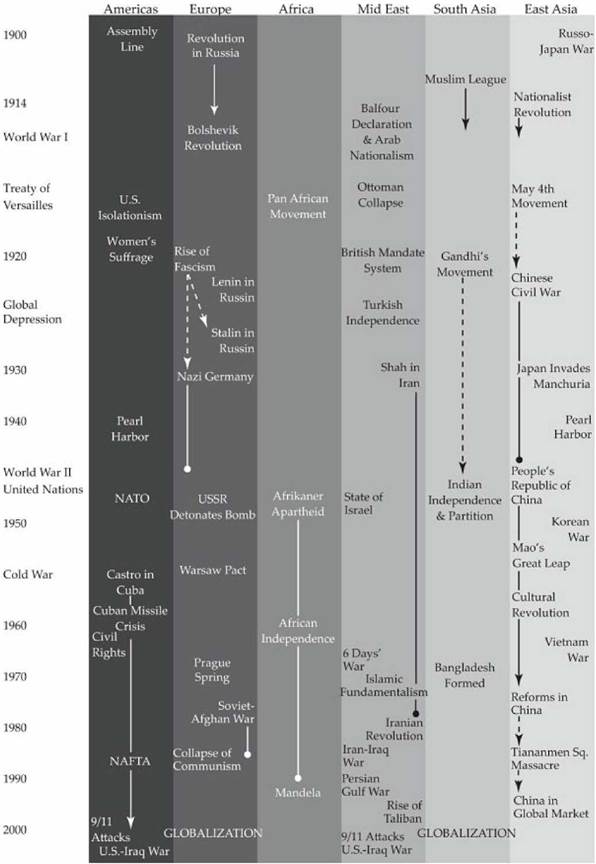
REFLECT
Respond to the following questions:
• For which content topics discussed in this Chapter do you feel you have achieved sufficient mastery to answer multiple-choice questions correctly?
• For which content topics discussed in this Chapter do you feel you have achieved sufficient mastery to discuss effectively in an essay?
• For which content topics discussed in this Chapter do you feel you need more work before you can answer multiple-choice questions correctly?
• For which content topics discussed in this Chapter do you feel you need more work before you can discuss effectively in an essay?
• What parts of this Chapter are you going to re-review?
• Will you seek further help outside of this book (such as a teacher, tutor, or AP Central), on any of the content in this Chapter—and, if so, on what content?