
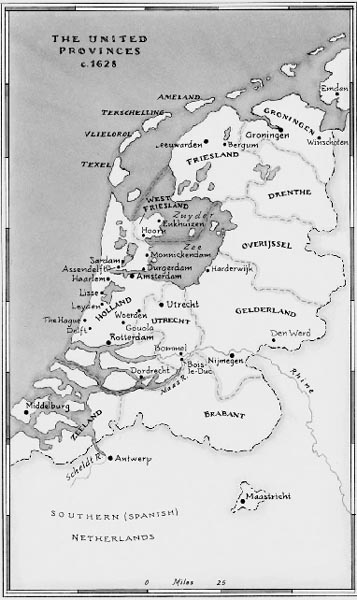
MAP: THE UNITED PROVINCES c. 1628
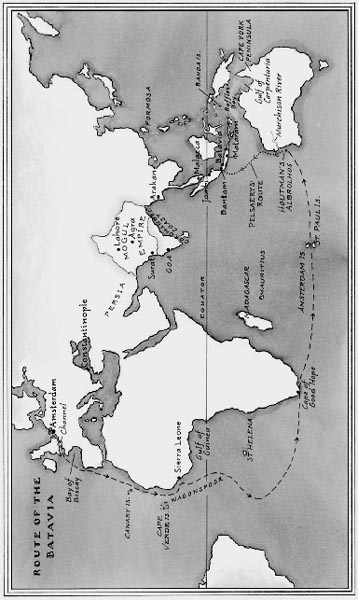
MAP: ROUTE OF THE BATAVIA
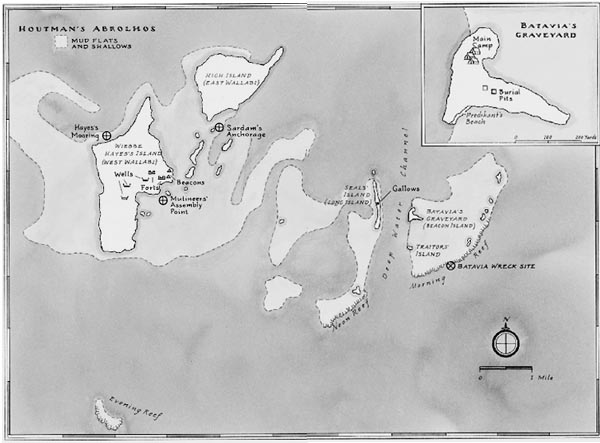
MAP: HOUTMAN’S ABROLHOS
Prologue
“The pack of all disasters has moulded together and fallen on my neck.”
FRANCISCO PELSAERT
THE MOON ROSE AT DUSK ON THE EVENING OF 3 JUNE 1629, sending soft grey shafts of light skittering across the giant swells of the eastern Indian Ocean. The beams darted their way from crest to crest, racing each other for mile after mile across the empty vastness of sea, until at last they caught and silhouetted something for an instant, a great black mass that wallowed in a trough between the waves.
In another second, the shape surged onward, rushing up the shifting wall of water in its path until it breasted the next swell. As it did so, it reared up momentarily and the moon fixed it as it slapped back into the water and sent plumes of fine white spray into the air on either side.
In the half-light of the southern winter, the black mass stood revealed as a substantial ship, steering north with the sting of a sharp wind at her back. She was built in the European style, squat and square-sailed, and she looked unbalanced, being considerably lower forward than she was aft. Her curved beak of a prow hung so close to the sea that it was frequently awash with a foam of dark water, but from there her decks curved sharply up like some massive wooden scimitar, rising so steeply that she towered almost 40 feet out of the water at the stern. As the ship came on, the moon was bright enough to pick out some of the larger details along the hull: her figurehead (a wooden lion springing upward), a tangled mass of rigging, the giant iron anchors lashed upside down along her sides. Her bows were blunt, and both the broadness of her beam and the fullness of her draught marked her as a merchant vessel.
Although the moon was bright that evening, there was too little light for the ship to be identified by the flags that writhed and snapped from all three of her masts, and there was little sign of activity on deck. The gunports had all been closed, and not even the quick glint of a lamp or two, shining through chinks in the hatches, hinted at life within. But an enormous lantern, five feet tall, hung over the stern, and its yellow glow illuminated the richly decorated woodwork beneath just well enough for a keen eye to pick out painted details that revealed the great ship’s name and her home port.
She was the East Indiaman Batavia, seven months out of Amsterdam on her maiden voyage and still some 30 days’ sailing from her destination, the Dutch trading settlements on the island of Java. Behind her, trailing in the phosphorescence of her wake, lay 13,000 miles of sea. Ahead were another 1,800 miles of uncharted ocean that had, by the end of the third decade of the seventeenth century, been crossed by only a handful of European vessels. There was rumor and speculation aplenty, among the geographers of England, the Netherlands, and Spain, about what might lie over the horizon in the immense blank that stretched south on their globes from the known waters of the Indies, but little information and no certain knowledge. The few charts of this unknown region that the Batavia carried were fragmentary in the extreme, and all but useless as navigational aids. So she sailed on blind into the gathering night, trusting to God and the skipper as the hourglass trickled away the minutes to midnight and the change of watch.
The ship had been brand-new when she left the Netherlands, but she was weathered now. Her upperworks, which had been painted pale green with embel-lishments in red and gold, were chipped and worn and scoured by sea salt. Her bottom, which had once been smooth and clean, was now festooned with so many barnacles and weeds that their drag slowed her progress north. And her hull, built though it was from oak, had been subjected to every conceivable extreme of temperature, so that it now shuddered as the ship rolled in the swell. First the Batavia’s timbers had swollen in the northern winter, for she had left Amsterdam late the previous October when the northern seas were already cold and stormy. Then they had been shriveled by the sun as the ship sailed along the fever coasts of Africa, swung west on passing Sierra Leone, and crossed the equator headed for Brazil. Off the coast of South America she had at last turned east, picking up a current that carried her to the Cape of Good Hope and then fierce easterlies that took her through the Roaring Forties and the Southern Ocean, where it was winter once again and perpetual gales hurried her onward, between the barren little islets of St. Paul and Amsterdam and into the unknown waters to the east.
At least it was warmer now, and the storms had abated as the Batavia headed north after more than seven long months at sea. But the endless discomforts of the voyage had if anything grown worse, and outweighed the slow improvement in the weather. The fresh food was long gone, the water was alive with worms, and below deck the ship herself stank of urine, unwashed bodies, and stale breath. Worst of all, in its own way, was the plodding monotony of the endless days at sea, which ate away the spirit of the passengers and undermined the efficiency of the crew.
At 12 the watch changed. The new watch, the midnight watch, was always acknowledged to be the most difficult and dangerous of all. Working conditions were at their worst, and the alertness of the men could not always be taken for granted. For these reasons it was customary for the skipper himself to be on deck by night, and as the last grains of sand slid through the glass, a small doorway opened on one of the upper decks and he came up.
The master of a Dutch East Indiaman was a man who enjoyed almost unlimited power in his small kingdom. He commanded a ship that had cost 100,000 guilders to build and contained a cargo that, in the Indies trade, was worth many times more. He was charged with the safe navigation of his vessel and responsible for the lives of all the hundreds of souls under his command. But, on the Batavia as on every other Dutch East Indiamen, the skipper was also the subordinate of an officer who typically had no experience of the sea and little understanding of how to manage a ship.
This man was the upper-merchant, or supercargo. He was, as his title implied, a commercial agent who bore the responsibility of ensuring that the voyage was a profitable one for his own masters, the directors of the Verenigde Oost-indische Compagnie—the United East India Company—which owned the ship. In the first half of the seventeenth century, the VOC was not only the most important organization, and one of the largest employers, in the United Provinces of the Netherlands; it was also the wealthiest and most powerful company on Earth. It had become wealthy and powerful by putting trade and profit ahead of every other consideration. Thus the supercargo and his deputy, the under-merchant, had the authority to order the skipper to make sail, or stay at anchor in some flyblown port until the holds were full, even if death and disease were striking down the crew.
The master of a Dutch East Indiaman was therefore in rather an unusual position. He was expected to combine the powers of seamanship and leadership that have always been demanded of any skipper with a degree of tact and even submissiveness that did not often come easily to men hardened by many years at sea. He had command of his ship from day to day, it is true, but he might at any moment be given an order he would be expected to obey. He could set a course but did not decide where his ship was heading. In port, he had very little power at all.
The skipper of the Batavia was a tough old seaman with considerable experience of the Indies trade, a man named Ariaen Jacobsz.*1 He came from Durgerdam, a fishing village just a mile or two northeast of Amsterdam, and he had been a servant of the VOC for two decades or more. The upper-merchant, who was called Francisco Pelsaert, was in many respects Jacobsz’s opposite—not only in wealth and education, which was to be expected in this period, but in origin as well. For one thing, Pelsaert was no Dutchman; he came from Antwerp in the Southern Netherlands, the great rival of Amsterdam. Moreover, he had been born into a Catholic family at a time when the VOC required its officers to be Protestant; he lacked Jacobsz’s powers of leadership; and despite long service in the Indies, he was as indecisive as the skipper was self-confident. The two men were not friends.
As for Ariaen Jacobsz, he was a veteran of several voyages to the East and probably in his middle forties, which would have made him one of the oldest men on board. That he was a superb sailor is beyond doubt; he had already skippered another large VOC merchantman with some success, and the East India Company was not in the habit of trusting its newest ships to indifferent officers. But the records of his service show that Jacobsz was also choleric, quick-tempered, and sensitive to any slight; that he sometimes drank to excess; and that he was a lecher who was not above imposing his attentions on the female passengers whom he carried in his ships.
These, then, were the men charged with safeguarding the Batavia in the early hours of 4 June 1629. It was not a responsibility that weighed heavily on the skipper. For 211 days at sea, watch had followed watch with scarcely a noteworthy incident. The conditions on this night were good; the wind was blowing in gusts from the southwest, and with no sign of any storm or squall the weather was almost perfect for sailing. The ship was sound, and the noon position that Jacobsz had computed the previous day put the Batavia 600 miles distant from any known land. There seemed no need for particular vigilance from the men on watch, and since there was little or no real work to be done, some at least were able to talk and rest. Jacobsz himself stood gazing out to sea from a vantage point on the upper deck. A lookout watched beside him, and the steersman was stationed just below the skipper’s post.
It was at some time after 3 a.m., when the alertness of the crew was at its lowest ebb, that the lookout, Hans Bosschieter, first suspected that all was not well. From his position high in the stern, the sailor noticed what appeared to be white water dead ahead. Peering into the night, Bosschieter thought he could make out a mass of spray, as though surf was breaking on an unseen reef. He turned to the skipper for confirmation, but Jacobsz disagreed. He insisted that the thin white line on the horizon was nothing more than moonbeams dancing on the waves. The skipper trusted to his own judgment, and he held the Batavia’s course, sailing on with all her canvas set.
When the ship struck, she therefore did so at full speed.
With a tremendous crash, the Batavia impaled herself on the half-hidden reef that had been lying in her path. In the first second of impact an outcrop of coral 15 feet beneath the surface tore the rudder half away; then, a moment later, the ship’s bow hit the main body of the reef. Massive though she was, Batavia’s forward momentum brought her lurching out of the water, and her foreparts ground their way over the first few feet of the obstacle in a roar of shattered rock and splintered wood. The whole ship howled as shards of coral gouged their way along her sides, and her hull trembled from the blow.
Up on deck, Jacobsz and Bosschieter and the other men of the midnight watch were flung to the left and sent staggering against the Batavia’s sides and railings as the ship smashed into the reef. Down below, in the dark and crowded living spaces, the rest of the ship’s passengers and crew, another 270 people in all, were tipped from their hammocks and sleeping mats onto the deck. Lamps and barrels, crockery and ropes torn from their fastenings rained down on their heads, and in an instant the ordered, sleeping ship became a pitch-black pandemonium.
It took only a second or two for the Batavia to shudder to a halt. The coral cradle that the ship had torn out of the reef forced her stern down into the water and twisted her hull at an unnatural angle, like a human body broken in a fall. The noise of the initial collision rolled away into the darkness, to be replaced by the roar of breakers striking the hull and shouts of fear and panic from below.
The upper-merchant was the first on deck. Pelsaert had been lying half-asleep in his cabin in the stern, only a few feet from the spot where Jacobsz and Bosschieter had been standing, and the impact of the collision had thrown him out of bed. Picking himself up off the cabin floor, he hurried up, still clad in his nightclothes, to discover what had happened.
He found the ship in chaos. The Batavia had taken on a list to port and her timbers were shaking under the repeated pounding of the waves, which piled up under her stern and kept her bottom grating ominously against the coral. A cold veil of sea spray—thrown up by the impact of the surf against the hull—hung in the air all round the ship, and wind whipped the spume across the decks and into the faces of the half-naked men and women who now began to swarm up through the hatches from below, soaking and half-blinding them as they emerged.
Pelsaert fought his way onto the quarterdeck. The skipper was still there, yelling orders to the crew. Even the upper-merchant, with his limited knowledge of the sea, could tell immediately that the situation was serious. “What have you done,” he screamed to Jacobsz over the general din, “that through your reckless carelessness you have run this noose around our necks?”
The Batavia’s position was indeed desperate. Not only was the ship stuck fast on the reef; her 10 great sails still billowed from the yards, pinning her ever more firmly to the coral. The timbers of the bow had been crushed in the collision, and though there were as yet no serious leaks below, it seemed from the groaning of the hull that her seams might burst at any moment. Worst of all, they were lost. The Batavia—at least in Jacobsz’s opinion—was nowhere near any known shoal or coast. None of the other officers had had cause to question the skipper’s estimate of their position. So no one had the least idea of where they were, what they had struck, or the nature and extent of the shallows they had blundered into.
The blustery southwesterly was whipping up the seas around them and the moon had almost set, but they set to work to try to save the ship. The most urgent need was to reduce the stress on the hull. Seamen were sent clambering up the masts to furl the Batavia’s 8,900 square feet of canvas, while down on the gun deck the ship’s high boatswain*2 and his men ran back and forth, urging the rest of the crew to lighten the ship by throwing overboard almost anything that could be moved. They carried tarred rope “starters” to lash the back of any man who shirked his duty, but there was little need to use them. Every sailor on the ship knew that without this urgent action he might not live to see daylight.
The Batavia’s gunners seized axes and swung at the cables that lashed their cannons to the deck. Freed from their constraints, the massive bronze and iron pieces—weighing around 2,200 pounds each—were maneuvered out through the ports and into the sea, lightening the ship by up to 30 tons. A rain of boxes, rope, and other gear from the main deck followed the guns. While this was happening, another group of sailors took the smallest of the Batavia’s eight anchors and secured it to a good length of cable. When morning came, the anchor would be run out from the stern into deeper water and the cable attached to a capstan in the hope that the ship could be hauled backward off the reef.
By now it was nearly dawn. The wind scoured the decks with ever-greater savagery, and it began to pour with rain. Up on the poop, Pelsaert called for the sounding lead, a slim cylinder of metal on a long line used to determine the depth of the water around a ship. As quickly as he could, the leadsman sounded all around the ship, finding no more than 12 feet of water around the bows and a maximum depth of 18 feet at the stern, only fractionally more than an East Indiaman’s normal draught of 16 1/2 feet.
This was a terrifying discovery. The chief hope was that they had had the luck to run aground at low water. If so, the Batavia might yet refloat herself as the tide rose. But if they had struck at high tide, there was so little water under the ship that the receding sea would quickly leave her stranded and make it impossible to wind her off with the anchor, adding to the stresses on the hull and perhaps even breaking her back by snapping the great keel in two.
With the work of lightening the ship complete, they waited, wondering if the tide was high. It was only at some time between five and six in the morning that it became clear that chance was against them: the waters under the hull were not rising but falling. Slowly the jagged tips of the reef on which they had been stranded began to emerge above the waves, and before long the people on the ship found themselves surrounded on three sides by raging surf and claws of coral. As the waters receded, the Batavia began to bump violently on the reef. It became impossible to stand or walk on deck; attempts at salvage had to be curtailed, and both passengers and crew could do little but sit in miserable huddles, listening to the awful grating of the hull.
Dutch East Indiamen were built strong. Their timbers were twice as thick as those of other merchantmen. But they were not designed to withstand stranding on a coral reef and, in particular, their bottoms were not made to take the full weight of the massive mainmast unsupported. This mast, 180 feet of Scandinavian pine, weighed well in excess of 15 tons with all its canvas, yards, and rigging and ran down through all four decks to rest directly on the keel. Now, with the whole ship nearly clear of the water, fierce surf was thrusting the Batavia up off the reef six or seven times a minute, then ebbing rapidly away to let the hull crash back against the coral. And the mainmast had been turned into a gigantic pile driver, repeatedly smashing down onto the keel and threatening to grind right through the bottom of the ship.
Without her mainmast, the Batavia could scarcely sail. But with it, she would certainly founder there upon the reef. It was imperative to relieve the stress on the hull, and there was only one way to save the ship. Shortly after dawn, Jacobsz gave the order to fell the mast.
In the age of sail, cutting down a mainmast was an act of such dire significance that the skipper customarily accepted responsibility for the consequences by striking the first blow with his own axe. Jacobsz swung, then several others joined him in hacking at the mast where it passed down through the main deck. But, in their haste, they failed to calculate the necessary trajectory. Instead of falling overboard into the surf, the enormous mast with its spars and rigging thundered down onto the Batavia herself, crushing gear and railings, thoroughly entangling itself in the equipment left on deck, and causing a huge amount of damage.
By good fortune, no one was killed or even injured, but the ship’s company surveyed the devastation with horror. The mast could not be moved, and it was obvious there was no longer any chance of saving the Batavia. The only hope for those on board was that there was at least some land in the vicinity that would not disappear beneath the waves by noon, when the tide was full.
The upper-merchant clambered as high into the stern as he was able and looked north. Now that the sun had come up and the tide had receded, he could see they had run onto the southern tip of a huge, crescent-shaped reef. A single line of breakers stretched for two miles to the east of them, and one mile to the north and west. But in the distance Pelsaert could see islands.
The largest—and the only ones of any size—appeared to him to be nearly six miles away. But several pancakes of broken coral lay much closer than that—three to the northwest and at least one more to the east. Breakers surrounded the islet on the eastern side of the reef, and it seemed unlikely they could land on it. But the merchant could see that half a mile to the west of their position, the reef was broken by a clear deep-water channel that led into the heart of the mysterious archipelago. With a modicum of care, it might be possible for the ship’s boats to penetrate the reef and ascertain which, if any, of the islets would provide them with a haven.
The Batavia’s yawl, which was the smaller of the two boats that the big ship carried, had been launched while it was dark and now lay bobbing alongside in the surf. It was well suited to the task, and about seven in the morning the skipper and a handpicked crew pulled away to scout the archipelago. At nine o’clock they returned with encouraging news. They had visited several of the smaller coral islands, Jacobsz reported, and none seemed likely to be submerged by the tides.
Ariaen’s discovery meant that there was a reasonable chance of saving the Batavia’s passengers and crew. But Pelsaert still faced something of a dilemma. The VOC, he knew, did not look kindly on servants who were unlucky or incompetent enough to lose its property. His duty to his employers was certainly to save the cargo first and worry about the lives of the passengers and crew only when the valuables were safe. But he doubted this was a realistic course of action. Even if he could keep control of the sailors, it seemed unlikely that the panicky soldiers and civilians on board would stand by while the boats ferried boxes of trade goods and chests packed full of silver to the islands. So the upper-merchant compromised. “Because of the great Yammer that there was in the ship,” he duly noted, “of Women, Children, Sick, and poor-hearted men, we decided to put most of the people on land first, and meanwhile to get ready on deck the money and most precious goods.”
It was the right decision. At 10 a.m., before the first boatloads of survivors could be got away, the relentless pounding of the surf finally put an end to the resistance of Batavia’s tortured hull. The ship burst open below the water line, and tons of foaming reef water began to pour into the hold. The breach was so vast that the caulkers and the carpenters had to flee before the swiftly rising flood. A good many of the supplies on board were lost, and it was only with considerable difficulty that a little food and water were salvaged from the stores.
The sight of bales of trade goods floating in the flooded hold was sufficient to persuade most of the passengers and crew to abandon ship, and the main deck was soon crowded with men and women jostling for positions along the sides. As was common at the time, there was no real order to the evacuation. The strongest forced their way into the boats, leaving women, children, and senior VOC officials behind. A dozen others leapt into the sea and attempted to swim to land. They all drowned in the surf.
Ariaen Jacobsz and his sailors worked all day, but, fully loaded, the Batavia’s two boats could hold no more than 60 people and the conditions were atrocious. Transferring frightened people from the pitching deck into a rolling, yawing boat was dangerous work that could not be hurried; a moment’s inattention or the least miscalculation might hurl the fragile little craft against the ship, smashing them to pieces. And, once in the boat, the survivors had to be rowed the best part of a mile along the deep-water channel before they could be set ashore.
The boats’ crews took them to the closest of the islands the skipper had scouted earlier in the day. It was tiny, a mere mushroom of coral rubble that measured only 175 yards from end to end and offered no real protection from the biting wind. During the afternoon, four more boatloads of survivors arrived. They did what they could to make themselves comfortable, but the islet was hard and flat and sterile, lacking not only food and water but even sand on which to lie and rest. There was no shelter. All in all, it left a good deal to be desired.
By nightfall, with the rescue operation hardly half-completed, some 180 people had been set on land. But parents had been separated from their offspring, husbands from their wives—and it had been so imperative to pack as many people as possible into the boats that the luckless survivors on the island found themselves with virtually no supplies. Jacobsz and his men had managed to land about 150 pints of poor drinking water, a dozen barrels of bone-dry bread and—at the insistence of the upper-merchant—a small casket of the most valuable trade goods, packed with precious stones, worked gold and jewelery that would have fetched 60,000 guilders*3 in the Indies. Such huge wealth was worthless on the reef; a few guilders’ worth of sailcloth and blankets would have been of greater use.
At sunset, back on the Batavia again, Jacobsz motioned Pelsaert to one side and insisted that his place was on the island. “It won’t help at all that we save water and bread,” the skipper said, “for everyone on land drinks as much as he can. To forbid this has no result unless you order otherwise.”
Twelve chests of VOC silver were still waiting on the main deck, but the merchant knew there was little more food or water to be had. He and Jacobsz jumped down into the yawl, intending to call at the little islet and introduce some form of rationing before returning to Batavia for the money. But no sooner had they pulled away than a violent squall arose and the little boat had to run for safety inside the reef. Fierce winds whipped up the waves, and once again the stricken ship all but disappeared in a storm of surf and spray. It was evident there was no chance of boarding her again before dawn, and it was only with some difficulty the boat’s crew contrived to fall back to the little island. They reached the survivors as they were settling down to an uncomfortable night. The conditions on the islet were appalling and, exhausted as they were, they slept only with difficulty, hard coral fingers in their backs.
On the Batavia, the plight of the other passengers and crew was equally unpleasant. About 120 people remained for the time being on board the sinking ship. For those on deck, the wind and rain brought with them the threat of exposure. Meanwhile, down below, the situation had deteriorated sharply in the absence of both the merchant and the skipper. Not every member of the crew had chosen to flee up to the main deck when the ship’s hull burst. A good number—convinced, perhaps, that they were dead men anyway—preferred to break into the gun-deck stores and drink themselves into oblivion among the casks of alcohol. One, Allert Janssen, a gunner from Assendelft in the North Quarter of Holland, made his way to the bottle room in the stern where the officers stored their personal supplies of wines and spirits. There he found his way barred by Lucas Gerritsz, the steward’s mate. In normal circumstances, Janssen’s very presence there, so close to the officers’ quarters, would have been a flogging offense; now, though, it was different. The gunner drew a knife and slashed at Gerritsz’s back, bawling: “Out, cats and dogs—you have been masters here long enough, now I [will be master] for a while.” The steward ran for his life, leaving the bottle room unguarded, and soon several of Janssen’s shipmates had joined him in sampling the fine wines and spirits within. Denied much alcohol for the better part of a year, these men quickly became dangerously drunk.
A second party of delinquents, led by a young VOC cadet named Lenert van Os and freed now from all fear of punishment, began to smash open the sea chests on the gun deck. They worked their way back along the ship, plundering as they went, until they reached the officers’ quarters in the stern. No one tried to stop them and, emboldened by drink and desperation, they broke down the door of Pelsaert’s quarters. A drunken young sailor named Cornelis Janssen, who was nicknamed “Bean,” was among the first to enter. He reeked of alcohol and had festooned himself with a considerable array of knives. One blade had been thrust through the fabric of his hat, and several others protruded from the pleats of his breeches. Confronted with this piratical apparition, the remaining cabin servants fled, leaving the merchant’s personal possessions to the mob. They rifled through the cabin and a Frisian seaman, Ryckert Woutersz, broke open Pelsaert’s sea chest and scattered the contents all about in the search for valuables. Soon he came across the upper-merchant’s personal collection of medallions. They were distributed among the rioters as booty.
Up on deck, the abandoned treasure chests of the VOC became an irresistible lure for anyone courageous or foolhardy enough to brave the shrieking wind and growling surf. An old soldier from the German town of Heidelburg named Jean Thirion proved bolder than the rest and chopped open one of the chests with a hatchet. Seeing what was happening, a handful of loyal sailors drove him off, and a carpenter was summoned to nail a length of plank over the breach. But by now discipline had all but broken down throughout the wreck. By morning the loyalists had themselves dispersed and a swarm of treasure seekers once again surrounded the damaged chest. They prized off the carpenter’s plank and tipped the contents out on deck. Thousands of guilders, enough to make a man rich for several lifetimes, bounced across the planking, but such was the seriousness of the Batavia’s plight that even Thirion and his drunken friends saw little point in hoarding them. Instead they turned the coins into playthings, hurling great handfuls of currency at each other’s heads in jest.
It was at about this time that Cornelis Janssen, still wearing his suit of knives, emerged from the Great Cabin with his share of the merchant’s booty: a gold medallion set in agate. Walking to the side, he tucked the medal into his hat with other valuables and tossed it into the sea. “There lies the rubbish,” shouted the inebriated Bean, “even if it is worth so many thousands.”

Back inside the coral crescent, where the roaring seas were calmed by their passage across the reef, rescue work got under way again an hour before dawn. The first priority was to move the majority of the survivors to a larger island. Filling both the boats with a total of 60 people, the sailors hauled up the deep-sea channel and around to the north side of a larger, womb-shaped island a mile from the Batavia. It was some 350 yards long and nearly as far across at its western end, but it tapered sharply to the southeast and for most of its length it was no more than 50 yards wide. Like the mushroom-shaped rock on which they had spent the night, it offered little in the way of shelter and no fresh water, but at least there was a small sandy beach where the boats could land, and room on the island for all the Batavia’s passengers and crew. By the afternoon about 180 men, women, and children had been transported to the larger island, together with a portion of their scant supplies of bread and water. Pelsaert, with 40 of the best seamen and a handful of favored passengers, remained on the islet, where the skipper had taken care to retain almost all of the water and a good deal of the food.
Conditions outside the reef remained atrocious. With considerable daring, one more trip was made from the Batavia to land and a new group of survivors was brought to safety inside the coral, but after that the weather closed in once again and by afternoon the skipper did not dare to bring rescue boats alongside the ship. There were still 70 men on board, the majority of them much the worse for drink and the excesses of the night before, but sober enough by now to realize that the Batavia would soon break up under the constant pounding of the waves. For several hours Pelsaert kept the rescue boats hovering nearby, as much in the hope of recovering the money chests as of saving lives. He prayed for a break in the bad weather, but none came. At dusk the upper-merchant retreated back inside the shelter of the reef, calling to the men on deck that they should construct some rafts and save themselves.
By nightfall on the second day, therefore, the situation at the wreck site had deteriorated further. The survivors huddling within the reef had been split between two islands, and the rescue of another boatload of people from the ship meant there were now 60 more mouths to feed. But supplies were already running dangerously low. Despite their attempts at rationing, the water was all but gone. If more could not be found within a day or two, they would all die of thirst.
On the smaller islet, Pelsaert and Jacobsz debated what to do. The discovery that they had been wrecked in a coral archipelago had persuaded the skipper that they were probably somewhere in an all but unknown chain of islands that the Dutch called Houtman’s Abrolhos*4 after Frederik de Houtman, the merchant who had first nearly run aground on them some 13 years before. The islands were completely unexplored, and it was uncertain whether any of them held fresh water. But they were known to lie several hundred miles to the east of the Batavia’s last estimated position, and a little less than 2,000 miles south of the Indies. If the ship was indeed in the Abrolhos, it might at least be possible for some of the survivors to reach Java in her boats.
The first imperative, however, was to find water. Pelsaert still wished to salvage the VOC’s money chests from the wreck, but he suspected—probably quite correctly—that malcontents would seize the boats and conduct their own searches of the nearby islands if he failed to take decisive action quickly. He knew that to lose control of the yawl and the Batavia’s larger longboat would be disastrous, not only to his shaky authority over the now-scattered refugees from the wreck, but also to his own prospects of survival. And supplies of water really were running short. So the upper-merchant authorized a search of the archipelago, beginning on the morning of 6 June. He also decided to transport one barrel of fresh water to the people on the larger island to the north.
Ariaen Jacobsz and his officers approved of the search for water, but grim realism left them aghast at Pelsaert’s determination to succor those on the womb-shaped island, which—being within sight of the wrecked ship lying stranded on the reef—had quickly been dubbed “Batavia’s Graveyard.” The 180 people on the island were stranded on a waterless lump of coral with neither a boat nor rafts upon which to escape; they had, the skipper reckoned, probably already consumed their supplies. The arrival of the upper-merchant with one small barrel of water would be of little comfort to them. They were much more likely to try to seize the boat.
Jacobsz told Francisco Pelsaert this, and he also warned the merchant that he could no longer expect the men to obey his every order. In situations such as this, those who had the skills to save themselves would do so—at the expense of others if need be. It was unrealistic to expect the rough-hewn sailors of the VOC to be exceptions to this rule, and they were unlikely to volunteer to help their comrades to the north if there was any chance the people there might damage one of the boats. “They will keep you there, and you will regret it,” the skipper warned Pelsaert. “Secondly, there is no-one who will sail with you.”
To the sailors’ surprise, the upper-merchant persisted, and at length the high boatswain, Jan Evertsz, and six men were persuaded to take him to the larger island in the yawl. The sailors remained wary, though, and insisted that they would row away if Pelsaert went ashore and was held against his will. But it did not come to this; as they approached Batavia’s Graveyard they saw such a crowd of people gathered on the beach that Evertsz grew apprehensive. When the merchant made as if to leap into the shallows with his barrel, the high boatswain hauled him back into the yawl, and the men rowed rapidly away, with the cries of those they left behind still ringing in their ears.
This unpleasant incident robbed Francisco Pelsaert of resolve. Next morning, rather than renewing his attempts to resupply the island, he accompanied some seamen who were going in the yawl to search for water elsewhere in the archipelago. This time they sailed several miles to the north, to two big islands the merchant had first noticed from the wreck. They dug for water in several places but discovered nothing more than a little brackish rainwater in hollows by the shore. For Pelsaert and for Jacobsz, their last real hope was gone. It now seemed certain there was no fresh water anywhere nearby. Moreover, the storms that had plagued them on the night of the wreck had blown themselves out and there was no prospect of more rain.
Next morning they began to build up their longboat’s sides in preparation for a lengthy ocean voyage. While they were working, the Batavia’s yawl, which Pelsaert had sent over to the wreck, appeared on the horizon. Eleven men were on board, led by an officer named Gillis Fransz, but the longboat was a much more substantial craft than the little yawl and could hold 40 people in reasonable comfort. Fransz and his men were expert sailors, and when they asked to join the crew of the larger boat, their request was eagerly accepted.
Pelsaert and Jacobsz sailed four days after the Batavia had hit the reef, leaving nearly 200 frantic, thirsty people on Batavia’s Graveyard, and another 70 stranded on the wreck. A braver commander, and a better leader of men, might have insisted that his place was with the bulk of the survivors. Pelsaert, by his own account, did wish to stay and help those whom he now left behind: “It was better and more honest to die with them if we could not find water than to stay alive with deep grief of heart,” he wrote. But the sailors were determined to leave the archipelago, and in the end the upper-merchant chose to save himself. On the morning of 8 June he joined the sailors and the favored passengers in the Batavia’s longboat. There were 48 of them, including two women and a babe in arms. Towing the yawl, they set sail and headed slowly north.
As he went, Francisco Pelsaert glanced back toward the crescent of white water that marked the reef, and the battered hulk that had once been his command. On board were several dozen of the worst cutthroats and drunkards who had sailed from Amsterdam, and one senior VOC official. He was the under-merchant—after Pelsaert, the most senior man on board. His name was Jeronimus Cornelisz.