
9
IN HIS MONUMENTAL theory about the many worlds of quantum mechanics, Hugh Everett argued that all the branches of the wave function have equal chances of existence as universes. However, my derivation showed that not all universes produced from the branches of the wave function trapped in the landscape of string theory have equal chances to come into existence. In fact, I found that for some, the chances of existence are nearly zero.
There are two factors that play an essential part in the selection criteria and the survival chances of the universe. The first one is the energy these quantum wave packets “borrow” from the landscape vacua, the energy that initiates an inflationary growth in the infant universes. But there is more to the story.
The second factor, which plays an equally important role in determining whether the inflationary growth happens and if a universe will come into existence from its respective wave packet, is the amount of quantum fluctuations present inside each wave-universe.
Quantum fluctuations are present in the wave function and on the landscape vacua left over after compactification (the process used to get the eleven-dimensional string theory down to four dimensions). Because we are treating these proto-universes as quantum objects, all of them will unavoidably contain quantum fluctuations. I had not accounted for these fluctuations in my previous calculation, but I realized that they must have played a crucial role in the creation of our universe because they are equivalent to matter particles.
The emerging picture of these quantum universes had them contain two ingredients: the energy of the landscape vacua where they were localized, and matter particles in the form of quantum fluctuations. And due to another unavoidable aspect of quantum theory, branches in the wave function of the universe—just like any group of quantum particles—will engage in a type of quantum cross talk, where they appear to communicate instantaneously with each other. We call this interaction quantum entanglement.
Today, quantum entanglement plays a pivotal role in studies of neural networks and the mind and in the development of quantum computing, quantum information, and artificial intelligence. But in theoretical physics, entanglement proved to be central to the understanding of our origin from the quantum multiverse. As we will see, entanglement is also what finally, and surprisingly, enabled the scientific testing of our theory about those very origins.
Historically, quantum entanglement bothered Einstein more than any other aspect of quantum theory, as he firmly believed in only one objective reality and wanted to know what all this mess of possible entangled universes meant for the real world. He maintained to the end that a major piece was missing from the quantum puzzle, especially in light of what he derided as the “spooky action at a distance,” an instant speed of communication resulting from entanglement. To make his case, in debating with Bohr, he did what he could do better than anyone—he came up with a series of thought experiments that produced paradoxes for quantum theory.*
These debates were an amazing intellectual feat between two giants of twentieth-century physics. Both respected truth and each other’s opinion. In a letter to Bohr in 1920, Einstein wrote, “Not often in life has a human being caused me such joy by his mere presence as you did.” Each time Bohr was pushed into a corner by Einstein’s thought experiments, he had to think just that bit harder to figure out the answer and win the argument. Quantum theory advanced further an inch at a time.
The issue of “spooky action at a distance” and Einstein’s paradoxes were ultimately settled by the realization that entanglement relied heavily on the dual nature of quantum particles as waves. Being strictly quantum in nature, these entangled particles could not transfer classical information. Since the phenomenon of entanglement was confined exclusively to a quantum world and did not exist in the classical world, the speed-of-light limit for exchanging information in our classical world was safely preserved.
So how does entanglement work in a quantum world? An easy way to visualize this is to think of a familiar particle: an electron. Electrons have a property called spin that is a purely quantum-mechanical effect; spin does not have a counterpart in the classical world we are familiar with. One way to picture the spin of an electron is as a rotation around its axis. The amount of spin on a particle is its quantum identity; like a birthmark, it cannot change. Different quantum particles have different spins. Electrons have a choice of a spin up or a spin down.
Now imagine an atom that has two electrons and, thanks to some symmetry, is in a state of zero total spin—that is, if one electron is spin up, then the other must instantly flip to spin down; if one spins clockwise, the other one must spin counter-clockwise. The spin of the two always adds up to zero. Crucially, this symmetry exists whether the electrons are in the same orbit around the same atom or are spread across the universe.
How do the two electrons know about each other’s spin orientation and organize themselves to opposite spin directions at all times, no matter their location? There is only one way: Somehow the pair of electrons are instantly “communicating” this information about their spins to each other so that if one electron flips spin up, then the other automatically knows about it and flips spin down instantly. This interaction among quantum particles is quantum entanglement, and in our example, the two electrons are entangled. Like a strong marriage or a pair of twins, once two quantum particles are entangled, they remain entangled for life; if we were to separate our pair of electrons by vast distances—say, by placing one electron on the surface of the sun and the other on Earth—they would continue to be entangled and maintain instant communications about their spins.
If this feature seems odd, that’s because it is. Instant communication of information (from one electron to the other, in this example) across vast distances implies infinite speed for the information to travel, whereas we know, thanks to Einstein, that nothing in nature can travel faster than the speed of light. Indeed, this is why Einstein objected to this feature of quantum theory, disparagingly calling it “spooky action at a distance.”
Despite its appearance, however, quantum entanglement does not in fact violate Einstein’s speed-of-light limit in nature. In our scenario, no classical information is traveling with infinite speed. To see how this can be possible, recall the wave-particle duality of quantum mechanics. Because of it, quantum particles (whether electrons or quantum infant universes) are not simply point-like objects that exist in one location or another; they are also waves that spread all the way to infinity. Thus, two different far-flung quantum particles need not travel to meet each other (or transmit information across the distance between them); they are in contact with each other over vast distances at all times. They are quantum entangled.
Recalling that quantum entanglement operates purely in the quantum realm, I realized that, although I started my derivation of the origin of our universe at a time when we were just a quantum wave-universe, a branch of the wave function of the universe on the landscape of string theory, somehow this theory needed to wipe out entanglement with the other branches, to produce a classical universe like the one around us today, and do so in a coherent way.
In order to achieve this quantum-to-classical transition for our universe, I needed the effect of a second piece in my theory: quantum fluctuations, which have a major role in determining where potential universes get stuck on the landscape and where and how they survive.
These neighborhood fluctuations were a reminder of why it was important to take them into account when exploring the microscopic processes of the wave function. The impact of quantum fluctuations on each wave packet and on the landscape vacua they occupied completely changed the odds of producing a universe out of these wave packets. At the same time, adding an infinite number of fluctuations into an already complicated set of mathematical equations for how the wave function of the universe passes through a vast landscape seemed like an impossible task.
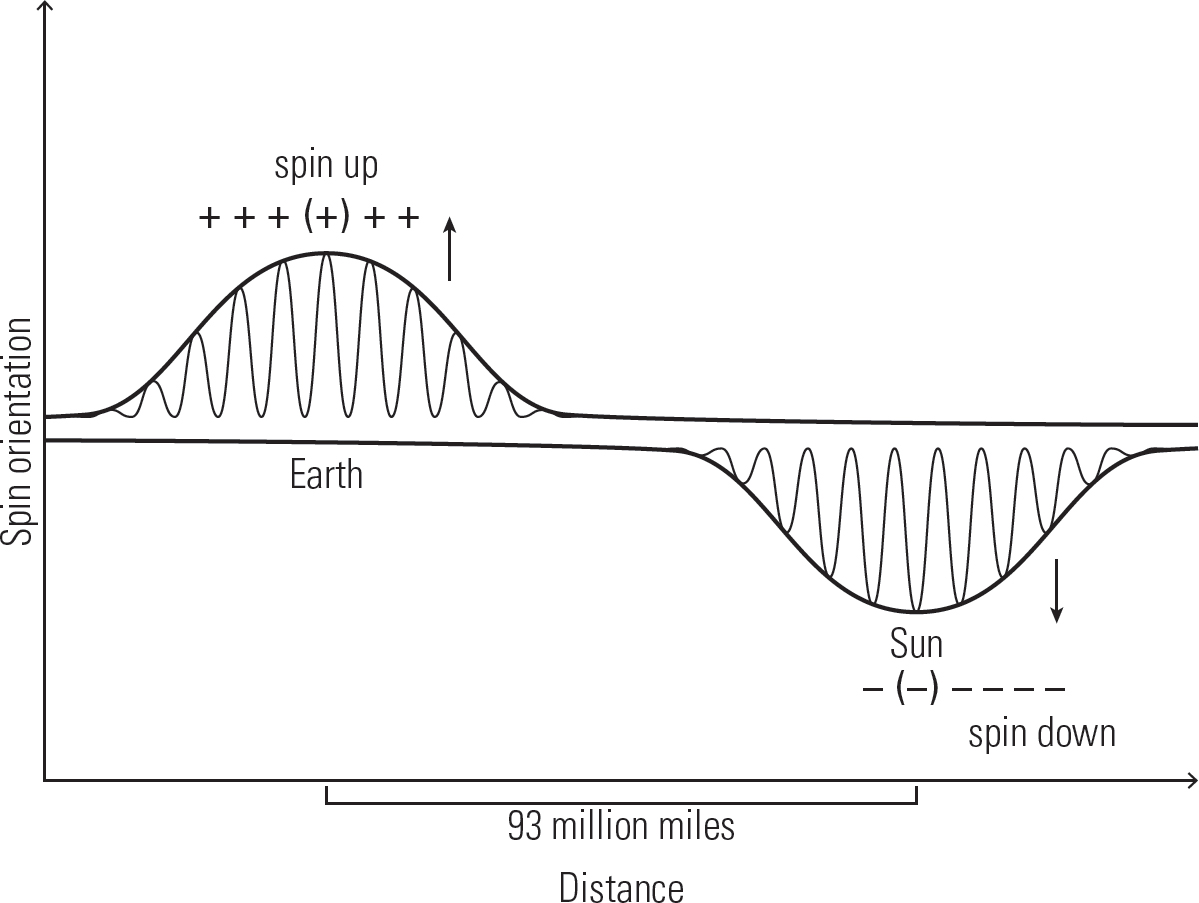
Figure 12. Entanglement of two electrons (one thick line, one double line). As waves, both electrons spread to infinity. If they were point particles, they would need to send light signals across the distance between them—in this case, the distance from the sun to the Earth, which would mean that each signal would take eight minutes to travel from one to the other. But as waves, they are constantly in contact, so there is zero distance they need to travel to communicate and therefore no delay in their exchange of information. Thus, when one goes spin up, the other one knows of it instantly and flips spin down; in the same manner, should one spin go to the right, the other will go to the left instantly. This happens without breaking the speed-of-light limit.
Ultimately, my curiosity won out. But I was aware this was too much work to handle alone. I knew the perfect person to help—he was not only an expert in quantum cosmology but also a delightful person with a great sense of humor. So one morning after I finished my classes, I called Rich Holman in the physics department at Carnegie Mellon University. I was counting on Rich to provide a second pair of eyes and to play devil’s advocate for any blunder or mistake I might accidentally make. Rich was intrigued, and what started as a single project turned into many years of enjoyable and fruitful collaboration. At various points when we thought we were stuck, Rich lifted the gloom with one of his jokes and his cheerful attitude.
We began the daunting task of repeating my previous calculation of the wave function of the universe on the quantum landscape but this time taking into account an infinite number of fluctuations weakly coupled with our branch in addition to the nearly infinite number of landscape vacua. The collection of these fluctuations filled the landscape and “watched” the branches of the wave function as they spread through the landscape. (Think back to Hugh Everett’s work on Schrödinger’s cat-in-the-box thought experiment in which he concluded that as quantum objects, both the cat and the observer are able to constantly watch each other.)
But classical universes cannot be entangled quantum particles. Therefore, quantum universes that begin as entangled waves in a universal wave function of the universe, in a state of constant communication, have to separate from each other on the great universe-factory chain and acquire their own independent individuality in order to become classical universes. They break free from entanglement through a process called decoherence.
Decoherence destroys the kinship among the wave packets and makes them decouple from one another as they transition from quantum waves to inflating universes. It washes out entanglement among quantum particles and, with it, their quantum nature. Decoherence is how they transition from being quantum objects to becoming classical universes. Think of it as an irreversible border crossing between the two worlds: a quantum world, where the entropy is zero and the governing rules are different, and a classical world, where entropy grows and time moves irreversibly forward.
Microscopically, decoherence is triggered by the interaction of the wave function with the environment, or the “bath” of quantum fluctuations, in which it is immersed. The interaction with the bath pins them down to single values and locations, thereby forever destroying their inherent quantum uncertainty.
One way of understanding decoherence is to think of the process of separating pure gold from ore. Placing gold ore in a hot bath of borax causes many of the different minerals in the ore to melt. Each mineral reacts differently to the borax bath. As their melting temperatures are reached, these minerals separate from one another, and the gold, which experiences the least interaction with the borax, sinks to the bottom.
In our case, the ore is the wave function of the universe mixed with all the branches. The bath in which this wave function is immersed and with which it interacts is the collection of quantum fluctuations that are trying to stop the universes from growing. As a result of this entanglement with the fluctuations bath, branches of the wave function separate—that is, they decohere—from one another while they are also taking energies from the landscape vacua in order to undergo their own Big Bang inflation.
Decoherence occurs during the brief instant when the branches of the wave function of the universe located on the energy sites of the landscape are about to go through their individual cosmic inflation processes to grow and produce individual universes. Once decoherence is completed, each growing universe acquires its own individual identity and is free of quantum uncertainty; it becomes decoupled from the other growing universes, producing its own space-time independently of similar processes in other developing universes.
I didn’t realize then the impact that accounting for the bath of fluctuations and decoherence would have on deriving the probability of our origins. It turned out that this would be the key to solving the mystery of our universe’s unlikely origin.
But decoherence and entanglement are two sides of the same coin. Wave packets of the universe that settle in high-energy sites along the landscape can survive the squeeze of fluctuations’ attractive gravity with only a few “dents”—minor changes to their original shape—and continue through the phase of rapid cosmic inflation to produce a macroscopic universe like ours. Since the separation—decoherence—of the branches of the wave function of the universe (which become universes) is triggered by their entanglement with the environmental bath of fluctuations, I further wondered if we could calculate and find any traces of this early entanglement—the cross talk among all the branches that produced universes—imprinted on our sky today. If I could rewind the creation story all the way back to its quantum landscape roots, when our wave-universe was entangled with others, then the moment of decoherence is where we could follow the evolution of the universe to the other side, when our universe was just a quantum wave packet, beyond the reaches of our classical world.
As we worked back through the calculation of the wave function of the universe on the quantum landscape, now factoring in an infinite number of fluctuations as well as a nearly infinite number of landscape vacua, Rich and I discovered what we had been hoping to find all along. Interaction with the bath of quantum fluctuations triggered the branches of the wave function to decohere from one another without changing their properties in the process of measurement. Our next step was to calculate the net effect these fluctuations had on the evolution of each of these individual branches when they became classical universes. Considering the complexity of such a system, we had no way of knowing or anticipating what the solutions would be. But after half a year of intense work, what we found proved worth the effort.
When the branches of the wave function evolved to become individual universes, we discovered, they did so by taking the energy from different energy vacua where they had settled on the landscape. Then these branches went through the process of decoherence to disentangle from each other, acquire their own individual identity, inflate and become growing classical universes.
What we discovered was that infant universes that started at very high energies were the most likely universes to be produced out of the quantum landscape, just like we knew from astrophysical observations and the theory of cosmic inflation to be the case in our own universe! For the first time, our results demonstrated that, although our universe was not eternal, it had a moment of creation 13.8 billion years ago, and there was absolutely nothing special about it, and, just as thrillingly, that the origin of the universe could be calculated and derived instead of supposed. Penrose’s conclusion on the improbability of our origin turned out to be incorrect, once we figured out how to peer behind the curtain of space-time and glimpse the larger canvas of the cosmos, the multiverse from which our universe had been born. The mystery of the improbability of our universe’s existence disintegrated once you looked at the bigger picture and the dynamical processes within it, the vastness of the quantum landscape multiverse, where universes were constantly being created as long as they had sufficient energy.
Furthermore, in contrast with Everett’s picture of the many worlds of quantum mechanics, we found that not all the branches of the wave function of the universe have an equal chance to produce a universe; the probability of each branch becoming a universe depended on a dynamical selection rule: the energy of the landscape on which the branch had localized and on the amount of quantum fluctuations captured within it. In the absence of a selection criterion, Everett had assumed that each branch of the wave function had an equal chance of bringing a universe into existence. The concept of decoherence was formally discovered more than two decades after Everett wrote his dissertation. Since he had no way of assigning weights to the branches of the wave function of the universe, he based his theory on what is known as “the principle of ignorance”—if we cannot estimate the chance each universe has to exist, then we should assume that all universes, both high-energy and low-energy, have equal chances of existence. The emerging selection mechanism for the infant universes that start from landscape energies that Rich and I derived showed that this is not the case. For some universes that start at low energies, the chances of existence are nearly zero. And for many others, a whole multiverse of high-energy ones like our universe, the chances of success are very high. Only the fittest infant universes survived. If you recall, the probability was simply the square of the solutions found; therefore, different solutions for the branches of the wave function correspond to different probabilities for producing a universe.
Physically, fluctuations behave like matter particles, meaning they would take that tiny quantum universe and try to crunch it under their weight into a black hole. (In physics, we say that matter has a positive heat capacity, meaning it possesses attractive gravity.) In contrast, energy would explode that initial universe by driving it into a cosmic inflationary phase. (In physics, we say that the gravitational field of energy, unlike matter, is a negative heat-capacity system, meaning it has repulsive gravity.) Each branch of the wave function of the universe contains the energy it has taken from the landscape valley where it is confined and the energy it has taken from the particles in the form of fluctuations. And this is how the infant wave-universe ends up in a wild tug-of-war: a fight for dominance between the energy the branch took from the landscape vacua on which it settled that is trying to drive it through an accelerated expansion and the pull from the fluctuations behaving like matter inside them trying to stop growth and crunch them into something roughly resembling a black hole.
How does this process work? When I talked about Big Bang inflation and dark energy, I explained that dark energy takes a tiny quantum universe and tends to inflate it very quickly. But recall that matter has attractive gravity—it takes that initial quantum universe and crunches it into a point, compressing its contents, as happens inside black holes. We know from Einstein’s equations (“matter and energy tell space how to curve”) that this is what happens to a tiny universe filled with matter or energy. Each of these branches of quantum universes that are still wave packets, localized somewhere on the landscape’s valleys, contain both matter (which, through quantum fluctuations, is trying to stop expansion of the quantum universe) and energy (which, taken from the landscape, is trying to drive the quantum universe into inflated growth). Whichever one is stronger in their tug-of-war determines if a universe will be born out of that particular energy site on the landscape.
This means that, contrary to previous estimates, which gave the smallest chance of existence to our universe, universes that start inflating at high energies—as our universe did—have the highest chance of coming into existence and growing into macroscopic universes. Wave packets that settle at low-energy sites in the landscape cannot grow; they remain squeezed to their quantum size and can never produce an observable large classical universe. They become what we call terminal universes, remaining microscopic quantum wave packets for eternity. We could in fact calculate the survival chances a wave-universe had in producing a big classical universe depending on which vacua it had settled on.
A selection mechanism for the creation of universes from the landscape quantum multiverse was at work—the competition inside each branch between the behavior of matter (contained in the fluctuations) and gravity (as determined by the landscape energy that drives the universe through Big Bang inflation). Through this tug-of-war, nature displayed its own version of Darwin’s natural selection: it gave infant universes unequal chances of survival and even wiped out the terminal universes from existing in the classical world.
As in the case of a Schrödinger-like equation in quantum mechanics, the Wheeler-DeWitt equation for the wave function of the universe on the string-theory landscape gives not one but many solutions of infant wave-universes, each of their branches localized in different vacua of the landscape (some on high and some on low energies). Therefore, even though some of those solutions—the terminal universes—are removed in our theory, the number of surviving universes that start out from high-energy landscape vacua and grow is still very large; they produce an entire quantum multiverse.
By including gravity and fluctuations in our equations, we transformed the string-theory landscape into a “fitness landscape.” Only the fittest universes, the ones that settled in high-energy vacua in the landscape and inflated at high energies, survived, grew, and produced macroscopic universes.
This is the key to what we had discovered: The odds of our existence had changed! This time, solutions for the most probable universes produced out of the quantum landscape started out at very high energies, as our own universe had! Our derivation of the chance for our existence demonstrated that there is nothing special or fine-tuned about the origin of our universe; our universe’s chance of existence is high simply due to evolutionary selection, determined by the quantum dynamics of gravity and matter.
The week after we finished our calculations was an emotional roller coaster. The day after we finished, Rich and I were stunned at having managed to do all the calculations. The next day, we might have been the happiest people in the country, and we couldn’t stop smiling. And on the third day, we were crushed with doubt, reminding ourselves that the enticing answer we thought we had found was such a huge claim, it was probably wrong for reasons we hadn’t yet identified.
If I’d learned any lesson from reading about the history of scientific ideas, it was humbleness.
I recalled one of the stories my dad told me about Enrico Fermi, the Nobel laureate physicist and architect of the atomic bomb whose old office had been on the same hallway as mine when I was a postdoctoral fellow at Scuola Normale Superiore in Pisa. As my dad told it, despite the excitement of being close to finishing the atom bomb, that last evening Fermi asked his team to stop work on their nuclear calculations and take a break.
The moral of the story, my dad explained, was that you should exercise caution and restrain your excitement. Don’t rush important things. It is easy to make a mistake when you’ve almost reached the end of a scientific marathon and are tired. As hard as it is, walk away from it for a while. Then, once you have detached from it, return with fresh eyes, double-check, triple-check, and check again. A week after Rich and I finished our calculations, that is what we did. After that, we put the project away for about a month, then rechecked the calculations before sending it to a journal and posting it on the online physics archives.
When we reached the end of our calculations, Rich and I felt simultaneously elated and nervous. We had found a way to mathematically derive the answer to the origin of our universe and of the world that lies beyond its space and time boundaries. We believed that we were correct. But would the rest of our universe agree?
At the same time that Rich and I were celebrating our discovery, we were also giving serious consideration to the other, alternative answers to the landscape crisis that were emerging thanks to work being done by our colleagues in the physics community.
One of the alternative approaches to avoiding the “landscape crisis” was to add an intellectual asterisk to the string-theory landscape. This approach rationalized and limited the choices offered by the landscape of string-theory discovery by using something called the anthropic principle.
The anthropic principle argued that observers actually picked which universes were viable to live in to allow for their habitation. Anthropic-principle reasoning is very much like a twenty-first-century restatement of Bohr’s collapse of the wave function, or (reaching further back) a rephrasing of Descartes’s famous aphorism “I think, therefore I am.” These efforts to solve the landscape crisis were essentially advocating, “I think, therefore the universe exists,” with its observer of the universe, like us, always capable of witnessing its existence. But rather than selecting the one “true” quantum particle, we were selecting the one “true” universe and discarding the rest of this string-landscape vastness as irrelevant.
The anthropic principle is more philosophical than scientific and can best be expressed by this logical tautology: This universe exists and is the true universe because we, as sentient beings, can see and witness its existence. We came to be here through a long and complex process that involved galaxies and star factories. And stars would not exist had it not been for the fine-tuning of the constants of nature and the fine-tuning of cosmic inflation to produce our universe today. Thus, for life to arise, the universe had to begin in a very special state with all its ingredients and forces fine-tuned. Therefore, even if our universe had a ridiculously small chance to exist, as Penrose estimated, it is still the only one with the right conditions for structure and, ultimately, life to arise, so it is no surprise that we find ourselves in it.
Fine-tuning has a very specific connotation in physics—it means that the constants of nature, like the mass or charge of an electron, which determines the strength of forces of a universe, have to be set to an exact numerical value, the value they take in our universe. Even a small change in only a few of the equations and values for these laws of nature would result in the creation of a radically different universe—or no universe at all. Thus, using the existence of life and saying that life could only exist if the universe was fine-tuned as the criteria for selecting our present universe seemed to anthropic-principle supporters to resolve the “landscape crisis.” It offered a picture for how one “real” universe could emerge out of the vast number of possibilities.
Additionally, according to the anthropic principle, the only virtue of having a vast landscape, or any type of multiverse, for that matter, was to increase the chances that a fine-tuned universe like ours would be found. It presumed that only very few universes—preferably one—like ours are available. It further conjectured that life could only exist in a universe exactly like ours, a universe with exactly the same special constants of nature, Big Bang inflation, and dark energy. I was skeptical of the validity of these assumptions. Anthropic selection started off by assuming the very answer we wanted to hear and then tried to rationalize its choice.
At the time, the anthropic principle was embraced by many of the titans of theoretical physics, many of whom I greatly respected. But to me, it seemed like giving up on solving the problem. The more I thought about it, the more I believed that the anthropic principle actually unleashed a new set of questions, starting with the very basic “Why did this happen and not that?” The world-renowned British physicist Paul Davies in his book The Mind of God refers to this problem as the “God-of-the-gaps,”* which he defines as the special divine-intervention scenario that we humans employ in order to address a gap in our understanding or explanations. The modern origins of this “God’s-eye view” date to early-seventeenth-century France where, as I have noted, the French philosopher, mathematician, and scientist René Descartes expounded on his belief that human beings have a higher moral status than every other organism and are the preeminent species on Earth. Thus, he argued, reality can be assessed only through a human perspective. In positing his premise of cogito ergo sum (“I think, therefore I am”), Descartes declared his strong advocacy for the power of human reasoning as the way to understand the workings of nature and the cosmos. In doing so, Descartes also pioneered what became known as the scientific method. In many ways, this legacy of Cartesian dualism, the belief that “I think, therefore the universe exists,” unfortunately seemed to underlie the reasoning behind the anthropic principle in cosmology.
But everywhere I looked, the ranks of supporters for the anthropic principle were growing; in fact, the Nobel laureate Steven Weinberg had used anthropic arguments to make a case for the existence of dark energy before it was observationally discovered, a prediction that only increased enthusiasm about the anthropic principle among its supporters.
The anthropic principle certainly seemed to solve the issue of the lack of testability for a theory about the universe by placing us center stage as its observers. This meant that the only viable universes were the ones like ours; if another universe did not have the right conditions for stars, galaxies, and, ultimately, life to arise and bear witness to its existence, then it might as well not exist. The problem I had with this approach was that indirectly, scientists had already decided on the answer they wanted—namely, the only “good” universe was ours.
As the multiverse research gained momentum, so did the elaboration of the anthropic principle. Its proponents justified the multiverse as the perfect setting for increasing the chances to find a universe like ours. I was not convinced that these arguments were a scientifically derived answer to our origins enigma. Perhaps my reluctance had something to do with the fact that this new spin on the multiverse—a spin meant to reduce the possibility of many universes to a single one like ours sounded familiar. Among other things, it reminded me of a sad event from my dad’s life, a moment when he had his own universe’s possibilities dramatically curtailed.
In my dad’s day, the highest recognition an Albanian student could receive was a scholarship to study in the Soviet Union, and competition for scholarships was fierce. Each year, the best student at every high school was awarded a gold medal at graduation. A gold medal guaranteed a scholarship to study in Moscow.
My dad, despite his family’s many difficulties, excelled academically, often completing two grades in one year. He far exceeded the standards required for the gold medal. His teachers, especially his math teacher, assured him that the honor was a foregone conclusion. My dad even took it upon himself to learn Russian to be ready for his scholarship.
Graduation day arrived. Just as the principal was about to hand my dad the medal, the school’s Communist Party secretary snatched the medal away and gave it to another student, who was as shocked to receive it as my dad was to lose it.
Later, my dad would joke about this incident and say that it was a blessing in disguise for two reasons. First, having learned Russian, he now had access to all the literature of the West, since no one in the Albanian government had thought to ban Russian translations of works of science, history, art, or music. Second, many Albanian gold-medal students returned from their studies with Russian wives, but after Albania severed relations with the Soviet Union in 1967, all the Russian wives and their children were rounded up, put on a plane, and deported to Russia. Most of the Albanian fathers never heard from or saw their wives or children again until the 1990s. The very few men who refused to break up their families were sentenced, along with their wives and children, to forced-labor camps. My dad said he could not have survived losing his children like that.
But my father also could not stop talking about the medal. In his later years, he even wondered if we could request that the Ministry of Education dig through its archives and find the documentation proving he had won the medal. A misappropriated prize from a long-ago high school graduation. The odds of it being found seemed low, to put it mildly.
For a long time, I could not understand for the life of me how someone like my dad, who more than once gave his only jacket to a stranger on the street when he thought that person was colder than he was, could be so obsessed with a medal. This was a man who seemed to care nothing for possessions, who, to my mom’s horror, and without hesitation, gave his life savings to a friend and later gave his entire monthly paycheck to a student to pay for his wedding because the young man’s own family was so poor. He was a man who wouldn’t even know if he was wearing different-colored socks if my mom didn’t check his clothing daily, a man to whom material possessions and false praise meant nothing. A man with no vanity and no bitterness—how could a gold medal from his teenage years mean so much?
When I asked my father why the medal was so important to him, he candidly explained that he had sacrificed a great deal, living with few clothes and not enough food, in order to attend school, but he had looked up to his teachers, and learning was what kept him going. He saw his adult experiences of being mistreated and betrayed and backstabbed by friends and colleagues as part of human nature, one group of adults hurting another one out of envy or professional jealousy. The Communist system then did the rest of the damage. But as a child, he had the greatest respect for his teachers. He maintained that teachers had the noblest role in caring for the well-being of children, and only the cruelest of societies would force teachers to hurt an innocent child.
After my father lost the medal, his math teacher stood by him and consoled him by telling him that there was another prize that everyone wanted. It was a prize that no one could take away and no money in the world could buy: the power of his own mind. But those words of encouragement hadn’t quelled his deep disappointment.
Despite my father’s explanations, it was only when I became a parent myself that I began to understand the impact of this experience on him. I could not imagine such an experience happening to my daughter. To work so hard only to have her just rewards snatched away by those she trusted the most—it would be devastating.
In my own life, I had been given the chances that had been denied to my father. I needed to make the most of those opportunities, not simply follow the easier path, even if that meant challenging some deeply held beliefs of my own.
If I was going to make an affirmative case for the multiverse, I needed to scrutinize anthropic reasoning. Working with my collaborator and friend Fred Adams, the distinguished astrophysicist at the University of Michigan in Ann Arbor, I decided to investigate how anthropic selection and the related fine-tuning of the universe might work in practice. As an astrophysicist, Fred knows a lot more than I do about the astrophysical aspects of stars and galaxies, how these structures formed in the universe, and how stars became factories that produced elements heavier than hydrogen. His expertise would allow us to find out if structures would form in universes that had very different conditions than ours, such as different strengths of gravity or electromagnetic forces.
To understand the basis for anthropically selecting a universe, we posed a series of questions: What does a habitable universe look like anyway? Is it a universe where laws are universal and where the fundamental constants of nature—such as Newton’s gravitational constant, electron charge, and proton mass—are fixed and fine-tuned to maintain exactly the same values that we observe in our universe and that we know have allowed life to arise here? Is a habitable universe one that contains dark energy—which, Weinberg found, might be necessary to produce habitation?
We quickly realized that if a universe contained dark energy, it would not be habitable in the far future. It would be difficult to justify the existence of such a universe using anthropic arguments. A universe that contains dark energy ends up empty, cold, lightless, barren of life, and incapable of creating new structures because it is not allowed to change its entropy state, resulting in a cosmic heat death of all its structures and observers. It may have a relatively brief time available for habitation, but after that, it spends eternity in the empty state of heat death. It is precisely the wrong scenario to allow life to hang around long enough to witness the creation of a flourishing universe.
Later on, Fred and I and two other colleagues, the pioneering physicist Stephon Alexander at Brown University and Evan Grohs, then at the University of Michigan, expanded our investigation into the merits of the anthropic arguments. We inquired whether the fine-tuned values of the constants of nature observed in our universe provided the only possible conditions for life. For life to arise, we need a handful of requirements, including a certain amount of complexity of at least 10^15 particles in the universe and long-lived stars that act as factories to produce heavy elements from lighter elements under the gravitational pressure inside the star’s core.
The result of our investigation surprised even us: Habitable universes could exist even if we made the strength of gravity a lot weaker or a lot stronger and even if we changed other constants of nature (like the constant that controls the strength of electromagnetism) by many millions of times from their known values. We concluded that the constants of nature in our universe are not specially selected to allow for habitation. Even worse for the anthropic argument, we found that our universe seemed only borderline habitable based on the anthropic selection rules. There were many other possible universes with very different constants of nature from ours that would be more likely to allow life to arise.
These findings made me even more convinced that the application of the anthropic principle was like throwing in the towel on science. However, support for an anthropic selection of our universe from the landscape was continuing to increase. In a new twist, the string-theory landscape was being retooled as an elaborate justification for anthropic selections; the landscape’s vastness increased the chances of finding an anthropically fit (that is, habitable) universe, while the rest of the possibilities became redundant.
I thought this way of thinking was dangerous; I believed that the existence of our universe could not and should not depend on who observed it. How could we simply select our origin on the basis of our own habitation? It increased my motivation to demonstrate that the answer to our universe’s origins did not require anthropic reasoning but could be derived through physics equations and the laws of nature.
In fact, I came to believe that the answer to the question of how we can scientifically glimpse our origins was staring us right in the face—it was in the skies above.
After Rich’s and my initial excitement over reaching a solution, reality sank in. We had a promising theory that, for the first time, derived the answer to the long-standing enigma of our universe’s small chance of existence. But it was a theory of the multiverse, a topic that was still beyond the pale to many physicists. To convince the scientific community—and ourselves—that we were on the right track, we had to find ways to test our theory. We had to demonstrate that the multiverse could in fact be subjected to scientific scrutiny and prevail.
The scientific community had long held a deep conviction that testing the multiverse was impossible due to the speed-of-light limit, which permits us to observe only objects within the horizon of our universe. But Rich and I were not discouraged. Our theory that our universe originated from the quantum landscape multiverse was based on mathematical derivations using the Wheeler-DeWitt equation of the formalism of quantum cosmology—the only valid theory of quantum gravity at the time when our universe was a quantum particle seething with high energies. Recall that we used the Schrödinger equation when calculating the paths of, say, electrons moving in real space-time under the influence of some potential energy; the Wheeler-DeWitt equation is the Schrödinger equation’s equivalent in cases when quantum particles, such as the electrons in our example, are branches of the wave functions, meaning when they are infant wave-universes moving on an abstract space of energies instead of on physical space-time. The Wheeler-DeWitt equation’s solutions, just like in quantum mechanics, are proportional to the probabilities that the infant universe takes a particular path on that abstract space of energies.
Of course we were aware that so far our results were highly theoretical and that being taken seriously by our community required us to find ways to test it. But ours was a theory of the origin of our universe from a quantum multiverse, which brought us face to face with the most difficult issue: How could a theory of the multiverse be tested?
Scientific investigations of problems like the creation of the universe, which we can neither observe nor reproduce and test in a lab, are similar to detective work in that they rely on intuition as well as evidence. Like a detective, as pieces of the puzzle start falling into place, researchers can intuitively sense the answer is close. This was the feeling I had as Rich and I tried to figure out how we could test our theory about the multiverse. Rationally, it seemed like a long shot, but intuitively, it seemed achievable.
Finally, a potential solution hit me. I realized that the key to testing and validating this theory was hidden in quantum entanglement—because decoherence and entanglement were two sides of the same coin! I could rewind the creation story all the way back to its quantum-landscape roots, when our wave-universe was entangled with others.
I already knew that the separation—the decoherence—of the branches of the wave function of the universe (which then become individual universes) was triggered by their entanglement with the environmental bath of fluctuations. Now I wondered if we could calculate and find any traces of this early entanglement imprinted on our sky today. Could we look for vestiges of the landscape era—evidence of cross talk, quantum communication between all the branches of the wave function of the universe that had produced individual universes?
This might sound like a contradiction. How could our universe possibly still be entangled with all the other universes all this time after the Big Bang? Our universe must have separated from them in its quantum infancy. But as I wrestled with these issues, I realized that it was possible to have a universe that had long since decohered but that also retained its infantile “dents”—minor changes in shape caused by the interaction with other surviving universes that had been entangled with ours during the earliest moments—as identifiable birthmarks. The scars of its initial entanglement should still be observable in our universe today since it is simply a blown-up version of its infant self.
The key was in the timing. Our wave-universe was decohering around the same time as the next stage, the particle universe, was going through its own cosmic inflation and coming into existence. Everything we observe in our sky today was seeded from the primordial fluctuations produced in those first moments, which take place at the smallest of units of measurable time, far less than a second. In principle, during those moments, as entanglement was being wiped out, its signatures could have remained stamped on the inflaton and its fluctuations. There was a chance that the sort of scars that I was envisioning had formed during this brief period. And if they had, they should be visible in the skies.
Understanding how scars formed from entanglement is less complicated than you might imagine. I started by trying to create a mental picture of the entanglement’s scarring of our sky. I visualized all the surviving universes from the branches of the wave function of the universe, including ours, as a bunch of particles spread around the quantum multiverse. Because they all contain mass and energy, they interact with (pull on) one another gravitationally, just as Newton’s apple had its path of motion curved by interacting with the Earth’s mass, thus guiding it to the ground. However, the apple was also being pulled on by the moon, the sun, all the other planets in our solar system, and all the stars in the universe. The Earth’s mass has the strongest force, but that does not mean these other forces do not exist. In analogy, the net effect that entanglement left on our sky is captured by the combined pulling on our universe by other infant universes. Similar to the weak pulling from stars on the famous apple, at present, the signs of entanglement in our universe are incredibly small relative to the signs from cosmic inflation. But they are still there!
I will admit it . . . I was excited by the mere thought that I potentially had a way to glimpse beyond our horizon and before the Big Bang! Through my proposal of calculating and tracking entanglement in our sky, I may very well have pinned down, for the very first time, a way of testing the multiverse. What thrilled me most about this idea was its potential for making possible what for centuries we thought was impossible—an observational window to glimpse in space and in time beyond our universe into the multiverse. Our expanding universe provides the best cosmic laboratory for hunting down information about its infancy because everything we observe at large scales in our universe today was also present at its beginning. The basic elements of our universe do not vanish over time; they simply rescale their size with the expansion of the universe.
And here is why I thought of using quantum entanglement as the litmus test for our theory: Quantum theory contains a near-sacred principle known as “unitarity,” which states that no information about a system can ever be lost. Unitarity is a law of information conservation. It means that signs of the earlier quantum entanglement of our universe with the other surviving universes must still exist today. Thus, despite decoherence, entanglement can never be wiped from our universe’s memory; it is stored in its original DNA. Moreover, these signs have been encoded in our sky since its infancy, since the time after the universe started as a wave on the landscape. Traces of this earlier entanglement would simply stretch out with the expansion of the universe as the universe became a much larger version of its infant self.
I was concerned that these signatures, which have been stretched by inflation and the expansion of the universe, would be quite weak. But on the basis of unitarity, I believed that however weak they were, they were preserved somewhere in our sky in the form of local violations or deviations from uniformity and homogeneity predicted by cosmic inflation.
After discussing this possibility, Rich and I decided to calculate the effect of quantum entanglement on our universe to find out if any traces were left behind, then fast-forward them from infancy to the present and derive predictions for what kind of scars we should be looking for in our sky. If we could identify where we needed to look for them, we could test them by comparing them with actual observations. And for the first time, we could demonstrate that the multiverse could be tested.
Rich and I started on this investigation with help from a physicist in Tokyo, Tomo Takahashi. I first got to know Tomo at UNC Chapel Hill in 2004 when we overlapped by one year. He was a postdoc about to take a faculty position in Japan, and I had just arrived at UNC. We enjoyed interacting, and I saw the high standards Tomo maintained for his work and his incredible attention to detail. I knew he was familiar with the computer simulation program that we needed in order to compare the predictions based on our theory with actual data about matter and radiation signatures in the universe. In 2005, I called Tomo, and he agreed to collaborate with us.
Rich, Tomo, and I decided that the best place to begin our search was in the CMB—cosmic microwave background, the afterglow from the Big Bang. CMB is the oldest light in the universe, a universal radiation “ether” permeating the entire cosmos throughout its history. As such, it contains a sort of exclusive record of the first millisecond in the life of the universe. And this silent witness of creation is still all around us today, making it an invaluable cosmic lab.
The energy of the CMB photons in our present universe is quite low; their frequencies peak around the microwave range (160 gigahertz), much like the photons in your kitchen microwave when you warm your food—hence the name cosmic microwave. CMB photons in the present epoch “heat” our sky to temperatures of about 2.7 K, or -271°C. (Or, if you prefer, -455°F.) But although the CMB is extremely cold, it is not cold enough to escape observation. Three major international scientific experiments—the COBE, WMAP, and Planck satellites, dating from the 1990s to the present—have measured the CMB and its much weaker fluctuations to exquisite precision. We even encounter CMB photons here on Earth. Indeed, seeing and hearing CMB used to be an everyday experience in the era of old TV sets: when changing channels, the viewer would experience the CMB signal in the form of static—the blurry, buzzing gray and white specks that appeared on the TV screen.
But if our universe started purely from energy, what can we see in the CMB photons that gives us a nascent image of the universe? Here, quantum theory, specifically Heisenberg’s uncertainty principle, provides the answer. According to the uncertainty principle, quantum uncertainty, displayed as fluctuations in the initial energy of inflation, is unavoidable. When the universe stops inflating, it is suddenly filled with waves of quantum fluctuations of the inflaton energy. The whole range of fluctuations, some with mass and some without, are known as density perturbations. The shorter waves in this spectrum, those that fit inside the universe, become photons or particles, depending on their mass (reflecting the phenomenon of wave-particle duality).
The tiny tremors in the fabric of the universe that induce weak ripples or vibrations in the gravitational field, what are known as primordial gravitational waves, hold information on what particular model of inflation took place. They are incredibly small, at one part in about ten billion of the strength of the CMB spectrum, and therefore are much harder to observe. But they are preserved in the CMB.*
Cautiously optimistic, Rich, Tomo, and I set to work to predict the remaining scars from this early quantum entanglement, what we jokingly described as a search for “avatars” of the quantum landscape multiverse in our own universe—traces of other universes that we would find in our sky as anomalous signatures. This would enable us to bypass the boundaries nature imposes on us by the speed-of-light limit and peer into the multiverse. In our curiosity, we were like three kids with a box of chocolates that we couldn’t wait to open.
Using quantum cosmology, we computed the strength of entanglement of all the surviving universes with our own, from its quantum landscape multiverse time. We added this contribution to the primordial fluctuations of cosmic inflation (which gave rise to both the CMB and all forms of matter) and fast-forwarded its location projections to the present-day universe. This enabled us to derive and forecast where and how, in our theory, the CMB and matter distribution in our present sky are tweaked and modified by earlier contributions from entanglement.
Unlike the uniform, homogeneous distribution of CMB and matter sourced by cosmic inflation, entanglement’s contribution to our sky varied with distance—meaning it was not uniformly distributed across the cosmos. Therefore, although contributions from cosmic inflation and entanglement are blended in the same sky, they can be separately identified. In fact, when they were observed, the entanglement signatures on our sky became known as “anomalies” because they break, however slightly, our overall universe’s uniformity and homogeneity. Therefore, they cannot be explained by the standard model of cosmology—cosmic inflation—for a single universe, the key prediction of which is uniformity and homogeneity.
In short, estimating how entanglement modified the early universe everywhere in space-time allowed us to predict their possible locations in our sky. These entanglement scars were our road map to the multiverse. These predictions had intrigued me most; they had the potential for making observational detection possible. However, none of us anticipated the surprises that were about to arrive from the observational front. Up to that time, we had assumed that the current observational power was not strong enough to detect the signatures that we predicted. In other words, we thought we would likely not know whether our theory was right or wrong in our own lifetimes.
It turned out that the observational imprints entanglement leaves on our sky are strong enough to be detected. They trigger very specific, mild deviations from the uniformity and homogeneity of cosmic inflation. Through the entanglement scars on our sky, we opened a window that allowed us to see and test a rich world beyond the horizon of our universe—the multiverse.