
TWO
|
Son: |
Dad, will you help me find the least common denominator in this problem? |
|
Dad: |
Good heavens, son, don’t tell me that hasn’t been found. They were looking for it when I was a kid! |
Anaximander set an example of how to frame a paradox and how to respond to it. His followers understood that solutions require disciplined reason-giving. But they had not yet developed the practices that constitute proof of a proposition. To some degree, astronomy and engineering gave the ancients a running start. But the strongest influence on proof practices came from mathematical lore.
THE MATHEMATICAL SETTING
Anaximander’s vision of the world was basically accepted by his successors. However, the Greeks never got comfortable with infinity. They associated reality with what is well formed. Infinity is boundless, limitless, and indefinite. How can what is real be based on what is ill defined?
Anaximander’s successor, Anaximenes, tried to firm up infinity. Whereas Anaximander thought that the infinite was a mix of earth, air, fire, and water, Anaximenes believed air was the underlying basic element. Fire is dilated air. When air is compressed it becomes a cloud. Compressed further it becomes liquid water. Yet further compression yields earth, then stone. As air becomes compressed, it becomes colder, denser, heavier, and darker. Anaximander’s opposites are just so much thinning and thickening of air. Quantitative changes account for qualitative differences.
If the underlying nature of reality is quantitative, then arithmetic and geometry become keys to the structure of reality. These keys had already been partly crafted by the Egyptians. Herodotus reports that the Egyptian interest in fractions and geometry sprang from the pharaoh’s practice of taxing farmers in proportion to their arable land. When the Nile flooded part of a farmer’s property, the farmer’s tax liability would be scaled down to the amount of land remaining for farming.
Commentators on the history of mathematics characterize the Egyptian interest in mathematics as unrelentingly practical. However, any culture that develops mathematics develops recreational mathematics. A scroll known as the Rhind Papyrus contains the earliest recorded arithmetical and geometrical riddles. From this manual we learn that the Egyptians of the Twelfth Dynasty (ca. 2000-1788 B.C.) had a close approximation to π (they put it at 3.16) and that they knew the formula for the volume of a truncated pyramid: V = (n/3) (a2 + ab + b2), where a and b are lengths of the sides of the base of the pyramid and n is the height of the pyramid. Yet the Rhind Papyrus also makes it evident that the Egyptians relied heavily on trial and error in their calculations. They solved multiplication problems by repeated addition.
Many scholars, especially those who are mathematicians, are struck by the absence of proofs in Egyptian mathematics. But this is the rule rather than exception for ancient societies. The Babylonians and Mayans and Hindus only take a passing interest in verifying their results. The steps leading up to the discovery were a means to an end. They did not regard the process of reasoning as a supporting structure that should be publicly displayed. An architect does not use glass walls to assure everyone that the beams are sound. Early mathematicians are content to report their discoveries.
The Greeks changed mathematical thinking. Their descendants wanted to live in glass houses.
THE PYTHAGOREANS
Pythagoras (ca. 582-500 B.C.) insisted that mathematical evidence be public in the sense that his colleagues should be able to survey the lines of reasoning. But Pythagoras actually forbade proofs (or even theorems) from being disseminated to outsiders. Pythagorean mathematics along with the rest of the cult’s doctrines were sacred secrets.
This secrecy makes it difficult to divine the basis for Pythagoras’s ritualistic insistence on proof. From what has been divulged, we can infer that the demand for strict deductive demonstration issued from spiritual perfectionism. Pythagoras taught that, as punishment, our souls are entombed in our bodies. Our souls yearn to join the divine celestial bodies from whence they originated. Death does not bring release for the immortal soul because it transmigrates into an animal that is just being born. After going through animals that dwell on land and in the sea and in the air, the soul once again enters the body of a human being. Eating meat is therefore cannibalism.
The purpose of life is to live in accordance with what is highest in us. We revere our divine origin by observing taboos, such as by abstaining from meat, alcohol, and intercourse. More positively, we express our desire for purity by pursuing wisdom. Pythagoras was the first to call himself a philosopher (a lover of wisdom).
The purest form of inquiry is mathematical. Here one frees oneself from reliance on the senses. One proceeds immaterially, deducing results from self-evident truths. The uncertainties of the empirical realm are transcended.
Pythagoras’s mathematical approach to nature yielded stunning successes. He discovered musical intervals by inventing the monochord (a one-stringed instrument with movable bridges). The ratios responsible for these consonant sounds seemed to be repeated by the positions of heavenly bodies. In addition to the mathematical relationships discovered in natural phenomena, Pythagoras believed that they existed in ethics. Mathematics gains a foothold in morality through notions of reciprocity, equality, and balance.
Pythagoras used a geometrical representation of numbers that made it natural to think that the world is generated out of numbers. The Pythagoreans represented numbers by means of pebbles arranged on a flat surface. Square numbers were constructed by surrounding one pebble with gnomons. A gnomon is a set of units that resembles a carpenter’s square (fig. 2.1). This notation probably helped Pythagoras solve the arithmetical problem of finding triangles that have the square of one side equal to the sum of the squares of the other two. But it also suggests a way of bringing more and more of reality under the control of numbers. By adding larger and larger gnomons, one brings larger and larger regions into the space surrounding the original “one.”
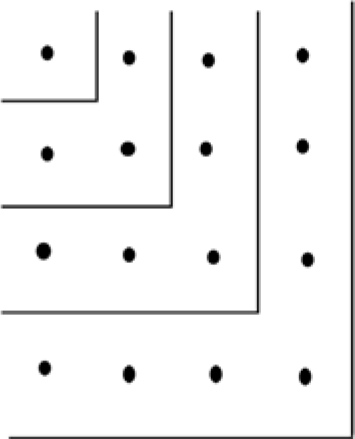
Fig. 2.1
The numbers are the whole figure including the space as organized by the pebbles or dots. If there were no space between the dots, there would just be a single big dot. Pythagoras thought of big numbers as spatially bigger. Thus, all of reality is encompassed by the natural numbers.
Pythagoras’s metaphysical mathematics embodied an aesthetic appreciation for beautiful arguments. Some of the Pythagoreans’ lovely proofs are immortalized in Euclid’s Elements.
The most famous result attributed to Pythagoras is the Pythagorean theorem. It is even mentioned at the end of The Wizard of Oz. After the Scarecrow discovers that he has a brain, he is presented with a diploma. To illustrate his newfound acumen, the Scarecrow states that the sum of the square roots of any two sides of an isosceles triangle is equal to the square root of the remaining side.
Well, the Scarecrow’s heart is in the right place. The Pythagorean theorem actually states that in a right triangle the square on the hypotenuse is equal to the sum of the squares on the sides containing the right angle.
We more commonly come to grief with the Pythagorean theorem when precisely specifying the shapes of objects. For instance, the official rule book for Little League baseball defines home plate as an irregular pentagon (fig. 2.2). This figure is impossible because it requires the existence of a (12, 12, 17) right triangle (Bradley 1996). According to the Pythagorean theorem, the squares of the sides of a right triangle must add up to the square of the hypotenuse: a2 + b2 = c2. But 122 + 122 = 288 ≠ 289 = 172.
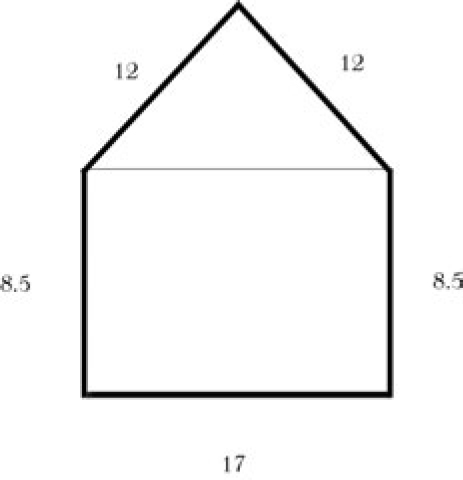
Fig. 2.2
Does the rule book make Little League baseball an impossible game? Many key terms of baseball (strike, run, etc.) are defined in terms of home plate. Children appear to be playing baseball. But if we stick with the official definition of home plate, then they are merely playing a game that resembles Little League baseball (in the way a rounded square resembles a round square).
We instead regard the rule book’s definition as a flawed effort to tidy up a word that we already understand. The point of the definition was to achieve uniform playing conditions. What really makes something a home plate is its playing a certain role in baseball. This can and has been done without anyone defining the precise shape of home plate.
The Pythagorean theorem does not invalidate any Little League baseball games. However, the Pythagorean theorem did undermine Pythagoreanism. The trouble started when Hiappasus of Metapontum applied the Pythagorean theorem to a 1-1 right triangle. By the Pythagorean theorem, the hypotenuse equals  If there is a ratio that equals
  then it is some fraction p/q lying between 1 and 2. What could it be? Not 3/2 because (3/2)2 = 9/4 which is greater than 2. Not 5/4 because (5/4)2 = 25/16 which is less than 2. Hiappasus derived a contradiction from the supposition that there is a pair of numbers that works. Contrary to Pythagorean doctrine, some things are not commensurate with the natural numbers.
THE RELIGION OF DEDUCTION
Hiappasus leaked his result to outsiders. He was expelled by the Pythagoreans and then drowned at sea. The Pythagoreanssaid this was punishment by the gods for his indiscretion.
Would the gods have backed a false theorem? The Pythagoreans pictured the gods as purely intellectual beings. As such, they should be logically perfect beings who believe all the logical consequences of what they believe. A logically perfect being sees how the Pythagorean theorem implies that the hypotenuse of a right isosceles triangle is incommensurable with its sides. So the gods could not be surprised by Hiappasus’s proof.
The Pythagoreans were mistaken in viewing deduction as a divine activity. As perfectionists, they tried to emulate the gods when constructing mathematically rigorous proofs. But we reason only because of our imperfections. A being who believes all the logical consequences of what he believes has no need to reason.
The paradox posed by Hiappasus can be formulated as a set of four individually plausible but jointly inconsistent propositions.
1.Reality has a mathematical structure.
2.If reality has a mathematical structure, then all relationships can be represented by numbers.
3.The numbers are the natural numbers: 1, 2, 3, . . .
4.The hypotenuse of an isosceles right triangle is incommensurable with its sides.
The first proposition is fundamental to the Pythagorean outlook. The second proposition spells out their commitment to modeling the world in terms of ratios. The ratio was supposed to specify the essence of the thing. This implies that an isosceles right triangle lacks a specific nature. Yet a 1-1 right triangle has the same nature as a 2-2 right triangle. What could they have in common if not the same mathematical relationship? The third proposition, which the Pythagoreans would have regarded as hardly worth stating, is a truism about what number means. The last proposition is Hiappasus’s surprising theorem.
The Pythagoreans perceived the result as a serious threat to a core element of their philosophy, proposition 1. To us, this refutation does not seem as injurious to a mathematical picture of reality because we accept the existence of irrational numbers. But for many of Pythagoras’s followers, mathematical metaphysics no longer added up.
There were two reactions to this predicament. Heraclitus renounced the assumption that reality must live up to our rational expectation. Reality goes its own way, embodying the very opposites that power riddles of the universe. Our senses reveal a world in chaos and flux, a world that overflows the dams and channels erected by reason. Real life throws us borderline cases, chance happenings, and developments without beginnings or endings.
Parmenides’ reaction was to renounce the assumption that there could be a number of things. If there is only one thing, then there can be no problem of incommensurability. Everything will then square with reason. You just need to stick with reason and not get distracted by your senses. The next chapter is devoted to Parmenides’ resolute approach.