
FOUR
Sisyphus was condemned to push a boulder uphill only to have it roll back under its own weight. Hades condemned him to do this over and over, for eternity in the underworld. Is the attempt to solve paradoxes equally futile? Most of the central paradoxes that philosophers now study were being discussed over two thousand years ago.
Albert Camus argues that Sisyphus is a heroic figure. Sisyphus gains victory in defeat; the very attempt to do the impossible ennobles him. Some philosophers justify the struggle with paradoxes in the same defiant way.
I do not think you can try to do what you believe to be impossible. You try by moving toward your goal. If you believe that nothing you do can bring you closer, nothing you do counts as trying.
Happily there is no need for heroism. History shows that most paradoxes are short-lived. Each generation’s sample of paradoxes is biased toward leftovers that have resisted past efforts. Even these exceptionally hardy paradoxes are sometimes solved. The methodological point of this chapter is to substantiate this optimism by recounting Zeno’s paradoxes.
ZENO’S PARADOXES OF PLURALITY
Parmenides visited Athens in 450 B.C. He was accompanied by his favorite pupil Zeno. Young Socrates might have been a favorite of Zeno; Plato passes on gossip that the two were lovers. In any case, Zeno of Elea (ca. 490–ca. 430 B.C.) had written a well-regarded book in defense of his teacher. Whereas Parmenides’ arguments spring from the semantics of negation, Zeno’s arguments pull infinite rabbits from finite hats.
Some of Zeno’s arguments bolster Parmenides’ rejection of anything having size. If an object has a size, then it has parts. This collective is actually a conglomeration of things rather than a single thing. Therefore, the only genuine individuals must have no size. But if an object has no size, then it is nothing at all. Go ahead, add a sizeless object to another object. There is no increase in size. If thousands of sizeless objects were put together, they would still not add up to anything. Since sizeless things do not differ from nothing, they are nothing.
Zeno had a second argument against size. If a thing has size, it has an outer part. For example, the skin of an orange projects beyond the pulp. Each projecting part will itself have some parts that project beyond other parts. The projection principle applies endlessly; so any object with a size must be infinitely large. In sphere S (fig. 4.1), part S1 projects beyond the core S2. This outer portion S1 can be divided again (fig. 4.2) into an “inner outer” portion, S1.2, and an outer portion, S1.1. The outer layer S1.1 can in turn be divided into an inner part S1.12 and an outer part S1.11 (fig. 4.3). We can go on to S1.111, then S1.1111, and so on. If there is some minimum size for each portion, then the sphere as a whole will be infinitely large.
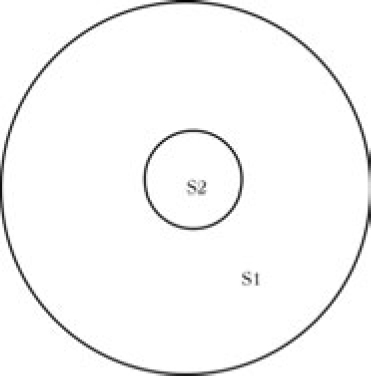
Fig 4.1
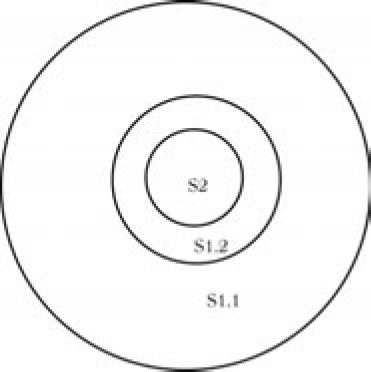
Fig 4.2
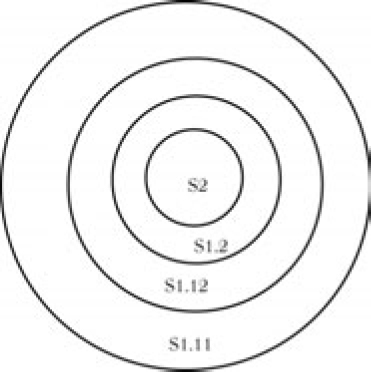
Fig 4.3
Zeno advances a third argument against plurality. If there is more than one thing, then there is some particular number of them. This might be a huge number but it is still a finite number. This is the point of Archimedes’ calculation in The Sand Reckoner. To counter the association of largeness with infinity, Archimedes patiently calculated that the number of grains of sand needed to fill a sphere as big as our universe is less than 1051.
Having persuaded us that there must be a finite number of things, Zeno turns around and argues that it equally follows from “There is more than one thing” that the number is infinite. For between any two things, there must be a third thing. If there are two separate things, some third thing must separate them. This third thing must itself be separated from its neighbors. Since there must be a further separator whenever one separator is postulated, the number of things is infinite.
Many witnesses to Zeno’s reductio ad absurdum arguments believed he was showing off his debating skill. First, Zeno would prove one side of the case and then, in a turnabout, prove the other side. Thus the couplet by Timon of Philius: “Also the two-edged tongue of mighty Zeno, who, / Say what one would, could argue it untrue.” But Zeno does not think that everyone can be refuted. Parmenides, for one, cannot be refuted.
Unlike Parmenides, Zeno does not offer direct arguments in favor of a particular truth. He always proceeds indirectly, reducing the competing doctrines to absurdity. Socrates tries to make sense of Zeno’s book (from which Zeno has just read aloud):
“Zeno, what do you mean by this? If existing things are a many, you say, then they must be both like and unlike. But this is impossible, since unlike things cannot be like or like things unlike. That’s what you are saying, isn’t it?”
“Just so,” Zeno replied.
“Then if it is impossible for unlike things to be like, and for like things to be unlike, then it is impossible for things to be a many; for if there were a many, impossible consequences would follow. Is that the purpose of your argument—to maintain against all comers that there cannot be a many? And do you regard each of your arguments as proof of this, so that in your view the arguments put forward in your treatise are just so many proofs that there is not a many? Is that right, or have I misunderstood you?”
“No,” said Zeno, “you have grasped admirably the whole purpose of the work.”
(From Plato’s Parmenides 127 D)
Many of the mathematicians and physicists who present Zeno’s paradoxes assure their readers that Zeno is not crazy. They say he is just challenging us to clarify our ideas. But the above passage from Plato suggests that Zeno is not interested in prompting us to develop better theories of familiar phenomena. Zeno contends those phenomena do not exist. When an atheist asks, “Could God make a stone so big that he himself could not lift it?” he is not inviting the theist to develop a coherent theory of omnipotence. The atheist is using the stone paradox to refute the possibility of God. Zeno is equally destructive. Zeno wants to serve his teacher Parmenides by exposing the absurdity of all rival positions. He makes the point explicitly in his reply to Socrates:
The truth is that these writings were meant as a kind of support to the arguments of Parmenides against those who try to ridicule him by saying that if the whole is one, many absurdities and contradictions follow. This treatise of mine is a reply to those who say that there is a many, and it pays them back with interest; for it shows that consequences still more ridiculous follow if what is is a many than if it is a one, if you pursue the matter far enough.
(From Plato’s Parmenides 127 D)
ZENO’S PARADOXES OF MOTION
Zeno is more famous for his defense of Parmenides’ claim that there is no motion. Plato does not mention any of these arguments. We learn about them principally through Aristotle.
The best known of these puzzles is the bisection paradox. Can you walk across a room? To reach the opposite side, you must first walk halfway across. After that, you must walk half of the remaining distance. And then half the new remainder. There are infinitely many of these halfway points. No one can perform infinitely many acts in a finite amount of time.
Zeno’s second paradox of motion pits Achilles against a tortoise. Since Achilles is the faster runner, we give the tortoise a head start. Can Achilles overtake the tortoise? To pass the tortoise, Achilles must first make up for the head start. But by the time he has covered that distance, the tortoise has moved ahead further. Achilles must therefore make up for that distance. But once Achilles has done that, the tortoise has moved again. Although this new distance is shorter, Achilles must still make up for it. But the enterprise of making up this endless sequence of distance debts is futile. Achilles cannot pass the tortoise because he cannot catch up infinitely many times.
The third paradox asks whether a moving arrow is at rest. An arrow is at rest if it is in a place equal to itself. At any given moment, even a very speedy arrow cannot be where it is not. Therefore, it must be where it is, and so in a place equal to itself. So a flying arrow cannot move.
The final paradox of motion concerns opposite movement of objects in front of fixed observers in a stadium (fig. 4.4). Let AAAA represent the fans. Let BBBB and CCCC represent two complex bodies that move in opposite directions at equal speed until they are aligned with the fans. Is this convergence possible? After moving, the first B has moved past two As. Yet the first C has passed four Bs. Therefore, the first C has moved twice as fast as the first B. This contradicts the opening assumption that the blocks were moving at equal speeds.

Fig. 4.4
ARISTOTLE’S SOLUTION
I remember having trouble understanding the stadium paradox. Doesn’t Zeno realize that velocity is relative? BBBB and CCCC are moving equally fast with respect to AAAA but are moving twice as fast with respect to each other.
Aristotle’s solution to the “paradox” simply draws the distinction we find so obvious. I thought this was uncharitable to Zeno; could such a brilliant philosopher be guilty of so obvious an equivocation?
Well, what is obvious varies with one’s background. Lead cups are obvious hazards to us. But Zeno did not grow up with public health warnings about lead poisoning. Nowadays, we regularly travel in moving compartments that are themselves environments for moving things (such as a conductor walking down the aisle of a train). We take for granted the fact that the earth itself is moving much faster than any vehicle. We have gotten into a habit of relativizing motion. Perhaps Zeno and Aristotle never acquired this habit. Then, Zeno could have made the mistake and Aristotle would have needed to think carefully to correct Zeno.
Another possibility is that Zeno intended the stadium paradox as a refutation of the hypothesis that time consists of discrete, indivisible units. In this setting of atomic time, the rightmost B and the leftmost C have passed each other. Yet there is no moment at which they are aligned. Since the two moments are separated by the smallest possible time, there can be no moment between them—it would be a time smaller than the smallest time from the two moments we considered. The moral would then be that if time exists, there are no smallest units of time. Zeno could then couple this conditional conclusion with some other argument against the possibility of time being continuous. That would give him the result that time is unreal.
Aristotle’s solution to Zeno’s other three paradoxes of motion employs the distinction between actual infinity and potential infinity. After the immortal Apollo is born, he becomes older and older without limit. But he never reaches an infinite birthday. He is always younger than his father Zeus. Both of their ages are potentially infinite but never actually infinite. When Apollo strides across a room, his path can be divided endlessly in half. But contrary to the bisection paradox, this potential infinity does not mean that Apollo actually performs infinitely many journeys in a finite amount of time. When Achilles races the tortoise, there is no limit to the number of times he catches up to a position previously occupied by the tortoise. But this potential infinity of catchups does not mean Achilles actually caught up infinitely many times. Similarly, the flight of an arrow can be analyzed into an unlimited number of subflights. Whenever we divide its flight into n parts we could have divided it into n + 1 parts. But this does not mean that the flight of the arrow is a collection of actual subflights.
ZENO’S ARGUMENT AGAINST PLACE
Parmenides had already presented an argument against place. Common sense distinguishes between an object and the room it occupies. After all, an object can move from its place and another object can take its place. Indeed, the object can simply vacate the area, leaving an empty place. Since the object is what is and the place is what is not, Parmenides’ objections to nonexistent things bear down on places.
One reply to Parmenides is that places are not mere nothings. The stalls in a stable are places but only come into being with the creation of the stable. Zeno’s rejoinder is that if places exist and everything that exists has a place, then each place will have a place. There will be an infinite hierarchy of places.
In A Room of One’s Own, the egalitarian Virginia Woolf argues that everyone should have their own room. Zeno shows us that Woolf can ill afford to extend the franchise to rooms themselves.
ZENO AND THE MILLET SEED
Zeno amplified Parmenides’ case against the senses by alleging perceptual inconsistencies. In a dialogue with Protagoras, Zeno asks whether a single millet seed makes a sound when it falls. Protagoras answers no. Zeno continues: A bushel of millet does make a sound when it falls. A single millet seed makes up some fraction of the bushel. Therefore, the millet seed must make a little noise when it falls. For the sound of the bushel is just a composite of the sounds of the seeds that constitute it. Thus, our senses falsely indicate that the millet seed makes no sound.
This just seems like the fallacy of composition. The fact that the parts lack a property (audibility) does not imply that whole lacks the property.
To save Zeno from triviality, some suggest that the millet seed is a rudimentary version of the paradox of the heap. The underlying argument would then be a slippery slope: The fall of one seed does not make a sound. If n seeds do not make a sound, then n + 1 seeds do not make a sound. Therefore, a bushel of seed does not make a sound.
If the millet seed counts as rudimentary sorites, then what about Democritus’s (ca. 460–ca. 370 B.C.) dilemma about cones?
If a cone were cut by a plane parallel to the base [by which is clearly meant a plane indefinitely near to the base], what must we think of the surfaces forming the sections? Are they equal or unequal? For, if they are unequal, they will make the cone irregular as having many indentations, like steps, and unevenessess; but, if they are equal, the sections will be equal, and the cone will appear to have the property of the cylinder and to be made of equal, not unequal, circles, which is very absurd.
(Plutarch 1921, 179–80)
A cone is a pile of infinitely thin circular disks. If the disks get progressively smaller, then the “cone” will be a tiered structure, like a wedding cake. If the disks are equal, then the “cone” will be cylinder. One can interpret this dilemma as skepticism against the principle that insignificant differences can accumulate into a significant difference.
Attributing the sorites paradox to Democritus or Zeno is overly generous. Zeno is reported to have invented about forty paradoxes. It is natural for them to have varied in quality. Like the rest of us, Zeno may have owed his success to his large number of attempts.
REACTION TO ZENO
Most philosophers now believe that Zeno’s paradoxes have been solved by the transfinite arithmetic invented by Georg Cantor at the end of the nineteenth century. Since the theory is discussed in chapter 22 and rigorously presented elsewhere, I shall content myself with the simplest Cantorian reply: Zeno mistakenly assumes speed limits. People can go fast enough to perform a hypertask in which infinitely many acts are performed in a finite interval of time. You exit a room by acting more and more quickly. You move halfway in ten seconds, then next half in five seconds, the next half in 2.5 seconds, and so forth. In twenty busy seconds, you are across the room.
There have been challenges to the feasibility of hypertasks. J. F. Thomson (1970) tried to prove the logical impossibility of performing an infinite number of tasks. Consider a lamp that has a single button which turns the light on if it was off and off if it was on. Since the lamp starts in the off position, it will be on if the button is pressed an odd number of times and off if pressed an even number of times. Now suppose that Thomson manages to press the button an infinite number of times by making one jab in one minute, a second jab in the next half minute, a third in the next quarter minute, and so on. At the end of the two minutes of jabbing is the lamp on or off? It cannot be on because Thomson never turned it on without also turning it off. Nor can it be off: for after first turning it on, he never turned it off without also turning it on.
The appearance of contradiction is a mirage generated by the incompleteness of the supposition. Thomson’s instructions only specify what happens at 2 - ½n-1 minutes, not the second minute itself. Consider a man who tells us that every number less than 1 is either fair or foul. In the sequence ½, ¼, 1/8, . . . the first member is foul, the second fair, alternating so that ½n is foul if n is odd and fair if n is even (Bennacerraf 1970). Now, is the limit of the sequence fair or foul? It cannot be foul because there is a fair after every foul. But neither can it be fair because there is a foul after every fair. The dilemma is spurious. The instructions only cover the sequence, so nothing is implied about a number outside the sequence.
Others suggest that the “paradox of the gods” cannot be handled by Cantor:
A man decides to walk one mile from A to B. A god waits in readiness to throw up a wall blocking the man’s further advance when the man has traveled ½ mile. A second god (unknown to the first) waits in readiness to throw up a wall of his own blocking the man’s further advance when the man has traveled ¼ mile. A third god . . . & c. ad infinitum. It is clear that this infinite sequence of mere intentions (assuming the contrary to fact conditional that each god would succeed in executing his intentions if given the opportunity) logically entails . . . that the man will be arrested at point A; he will not be able to pass beyond it, even though not a single wall will in fact be thrown down in his path.
(Bernardete 1964, 259-60)
If we add the assumption that the man will not stop unless a barrier is put in his way, we get a contradiction.
This paradox rests on an underestimate of the ways intentions can conflict (Yablo 2000). I am able to pick a number bigger than any number you pick. And you are able to pick a number bigger than any number that I can pick. But that does not mean we can exercise these abilities simultaneously.
Now suppose there is an infinite queue of demons who are calling off yes or no in reverse order. Each demon is interested in being the first to say yes but resolves to say no otherwise. At first blush, we expect that some demon will say yes. But this is logically impossible given that they all stick to their plan. For suppose one of the demons says yes. Then all of the demons behind him say no. But then his immediate predecessor would have said yes because all of his predecessors said no.
The wall gods are like the yes-no demons. Each god is able to block the traveler. But since a god blocks only if he is the first blocker, the traveler cannot be stopped.
Alfred North Whitehead remarked, “To be refuted in every century after you have written is the acme of triumph . . . No one ever touched Zeno without refuting him, and every century thinks it worth while to refute him.” (1947, 114) I think this compliment will not be paid by future centuries. There are still paradoxes involving hypertasks. None of them overturns the verdict that all of Zeno’s paradoxes were solved by Cantor a hundred years ago.
Cantor’s triumph shows that some important paradoxes can be solved. We now have answers to Zeno’s riddles that satisfy the exacting standard set by modern mathematics. Twenty-four hundred years is a long wait. But remember that the comparison was with Sisyphus, who labors for eternity.