Dear Mr Durrell,
My name is Miriam. I have written to ask your advice on the following:
• Would it be at all possible for me to get a baby lion?
• If so where would I get it and do you know about what the cost would be?
• How old is the youngest I could get it (take it from its mother)?
• Where would I have to keep it?
• How old would I be able to keep?
• What would I feed a very small, baby lion?
• How large would he actually be?
And anything else you think I would need to know! Thank you very much . . .
In any large collection of wild animals you are liable to have your crop of illness and accidents, and sometimes these prove fatal, for animals are no less mortal than man. Under the heading ‘accidents’ you have, I’m afraid, to include the behaviour of the average member of the public. We have had, in the past, instances of monkeys being given razor blades and the great apes lighted pipes and cigarettes, so that they burnt themselves. Unless you have somebody permanently on watch it is difficult to guard against this sort of behaviour.
Take, for example, the case of our two macaws, Captain Koe and McCoy. Now these were colourful birds and of a benign disposition, so when the weather was fine we would take them out of their cage and put them on a low granite wall that ran along the side of the mammal house where they would sit in the sunshine, preen their brilliant feathers and exchange hoarse chuckling conversation with any visitor who happened to be passing. One day, an exceptionally large lady, presumably exhausted by her tour of the zoo, went to rest on the wall where Captain Koe was sitting. Believe it or not, she actually sat on top of him. That anyone could sit on a bird the size of a macaw, with such multicoloured brilliant feathering, may seem incredible. It is a great pity that Captain Koe couldn’t have retaliated by biting the lady in question for there was ample target for him to aim at and macaws’ beaks are among the biggest of the parrot family. However, he was simply squashed.
Our maintenance man, who happened to be passing at the time, noted the incident. The woman herself seemed completely unaware of the fact that she had done anything unusual. The maintenance man picked up the bird and brought it immediately to the office. Luckily, at that precise moment we had Tommy Begg, our veterinary surgeon, in the zoo doing his weekly check-up on the animals, and he immediately attended to Captain Koe. Both legs had been broken and these Tommy splinted skilfully, but in addition to this the ribs and breast-bone had been crushed and some of the ribs had pierced the lung. So, in spite of all we could do, in a short time the macaw was dead.
The thing which amazed me most was the woman’s behaviour. Even allowing for the fact that she was short-sighted and couldn’t see a large bird clad in brilliant scarlet and blue feathering sitting on a wall, after she had sat on it she must have known that she had done some damage. Not only did she not come to the office to explain her mistake and inquire after the bird’s condition, but she did not even bother to phone up and find out how the bird was getting on. This is only one instance of the attitude of the general public. I should think, on average, one spends about seventy percent of one’s time protecting the animals from the public rather than the other way round.
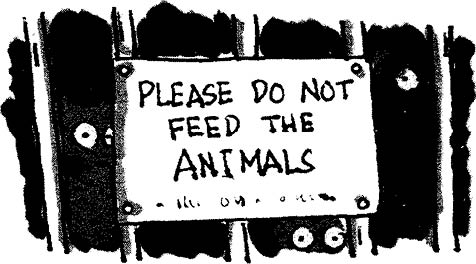
Like any sensible zoo, we do not allow the public to feed the animals. This is because they might give them the wrong sort of food, or too much of something that they happen to like particularly, and this will prevent them from eating the carefully balanced diet we have worked out for them. For instance, the great apes will go on eating chocolate, rather like children, until they feel sick, and then they will refuse their evening meal which would have done them much more good. They may then perhaps develop stomach trouble, and you have a long job curing the complaint that has arisen from wrong feeding. But some of the public who come to the zoo don’t take the slightest notice of the signs that we have all over the place, saying ‘Please do not feed these animals’, and continue to hurl bars of chocolate and other tidbits with gay abandon through the bars of the cages. One has, in any sizeable collection of animals, enough veterinary work to do during the course of the year without it being added to by the stupidity, and sometimes the cruelty, of the visitors.
At one end of the zoo grounds we have a small lake, and here we kept a mixed collection of water fowl, including some quite rare species. They had lived there happily and bred for quite a number of years. Then we had a particularly hot summer. The little stream that fed the lake died away to a mere trickle and the lake itself became more and more shallow. Soon we started finding the odd dead bird which, after post-mortem, gave no satisfactory answers as to why it had died. And then, suddenly, we had a crop of about six birds die all at once, including two of our rare specimens. Tommy Begg viewed with mystification the dismal row of corpses that awaited him on his Monday morning visit.
‘What the hell’s the matter with that lake?’ he demanded, irritably. ‘We’ve had the water tested, and there’s nothing wrong with these birds as far as I can see.’
Then he had an idea.
‘The only thing I haven’t looked for is gizzard worm,’ he said. ‘I wonder if it could be that?’
Seizing the nearest body, which happened to be that of a Spurwinged goose, he carefully slit the gizzard with his scalpel. There was nothing to be seen. Then he opened the crop of the bird, and found the solution to the mystery. For the crop contained approximately an egg-cupful of twelve-bore lead pellets. Examining the crops of the other dead birds we found an equal quantity of lead shot in each one, and in one of them we even found the metal end of a twelve-bore shotgun cartridge. Now the crop of a bird can really be described as its teeth, in the sense that most birds take a certain quantity of sand or gravel or even small pebbles with their food. These lodge in the crop and help to grind and masticate the food as it passes through. As the sand or gravel or small stones are worn away over a period, the bird picks up a fresh supply to replenish its ‘teeth’. These birds had, from somewhere or other, found a large supply of lead pellets and had naturally eaten them, presumably mistaking them for small pebbles or gravel. They certainly acted as teeth in the crop, but the food was wearing them away and the birds were suffering from lead poisoning.
Of course, as soon as we realised the mysterious cause of these deaths, we caught up all the birds on the lake and searched the shore line carefully to see if we could find the source of the pellets. As there were so many of them in the crops of the birds that had died, we felt sure that they must have come across a whole boxful of twelve-bore cartridges, or something similar, but though we searched hard we could not find the spot where the birds had found them. One of the birds that we had removed from the lake started to sicken. It was obviously suffering from lead poisoning, so we tried to save it by the use of calcium disodium versenate injected intravenously. Unfortunately this failed and the bird died. How such a quantity of lead shot could be found in the lake remained a mystery for some time, until we discovered that until after the war the lake had not been a lake at all. It had just been a small valley with a tiny stream running through it. The owner of the property, our present landlord, Major Fraser, had dammed it up and turned it into a small lake. We came to the conclusion that, during the German occupation of the island, somebody had been in possession of a quantity of twelve-bore cartridges and, afraid of being found with them, had buried them in the valley. The gradual action of water and mud had worn away the cardboard cases of the cartridges and had released the pellets in a heap into the water, and during the exceptionally hot summer the water level had dropped, thus allowing the ducks and geese access to areas of mud which they would not otherwise have been able to reach.
There are, of course, a number of other things that happen in the zoo against which you are completely powerless to protect yourself. For example, our African civets gave birth to a litter of cubs. This was quite an event as not many zoos had managed to breed civets. For three days the female proved an exemplary mother and then, for some reason unknown to us, she turned on her cubs and ate them.
Then there was the case of our Serval cats. These handsome, long-legged cats, with their pricked ears, short tails and coats a lovely orangey-brown heavily spotted with black, are very beautiful creatures indeed, and we were extremely pleased when Tammy had two kittens. She too proved to be an excellent mother and for about a week the kittens throve and suckled well and she seemed very contented. And then, one day, on looking into her den, we discovered both cubs dead. Why this should have happened we had no idea. The cubs were completely unmarked so they obviously hadn’t been bitten by her. But a post-mortem soon revealed what the trouble was. They had died of suffocation. Tammy, during the night presumably, had rolled over, lain on top of the cubs, and suffocated them both without realising it. This sometimes happens to domestic cats, with their first litter of babies, until they’ve learnt the arts of motherhood
But I think probably our most complicated veterinary problem occurred when our lioness, Sheba, became pregnant. Everything seemed to be going fine, and she was getting near her time. I had to go into town one day to lunch with some friends, and, as I always do when I leave the zoo, I left the address and the telephone number of the restaurant, so that should there be any emergency they could get in touch with me immediately. I had no sooner finished lunch than I got a telephone call to say that Sheba had started to give birth, but that she had got one youngster half out and half in and, strain though she would, she didn’t seem able to pass it. The cub was obviously dead. I grabbed a taxi, got back to the zoo as quickly as I could, and Jeremy and I reviewed the situation. She had been straining then for two or two and a half hours and, as I said, the cub was limp and dangling and obviously dead, but she was unable to dislodge it and seemed in great distress.
‘What we ought to do,’ said Jeremy, ‘is get her into a small cage. Then perhaps we could help her in some way.’
Unfortunately the den was rather a large one and in order to get her into a smaller cage we would have had to go in with her and drive her. This was a risk I was not prepared to take. I had an idea. I knew that the London Zoo possessed a Capchur gun. This is like a revolver except that it shoots a dart which acts like a hypodermic syringe, penetrating the animal’s flank or whatever part of the body you are aiming at, and giving it an injection which can be an anaesthetic, an antibiotic or something similar. I thought that if I phoned London Zoo there was a chance that they would fly it over to me so that we could use it on Sheba. I went into the house and put in a call to London Zoo.
Needless to say, this was a Saturday. All crises like this seem to happen on a Saturday. When I eventually got through to London Zoo sanitorium they said, yes, indeed, they had a Capchur gun, but that the only person allowed to use it was their chief veterinary officer, Dr Oliver Graham Jones. The police were very strict about it and would not allow it off the premises. Well, I’d known Oliver Graham Jones for a number of years, and I knew that he would bend the law a little if he could. I asked if I could speak to him. They were terribly sorry, they said, but he was at home for the weekend. Well, could they get me his private number? Yes, they could, and they did, and in due course I got Oliver on the telephone. I explained the situation to him and he was most sympathetic.
‘But, my dear boy,’ he said, ‘the first thing is, I can’t send the thing over without police permission, and, secondly, unless you’ve used one of these before they can be extremely dangerous. Unless you get the right charge in the gun, the syringe that it propels, instead of acting purely as a hypodermic, acts more like a rifle bullet and you’re liable to kill your animal rather than cure it. They’re tricky things to handle.’
‘Well, there’s nothing for it, then,’ I said. ‘We’ll have to try and drive her into a small crate. That’ll mean going in, I suppose, with flaming torches.’
‘Good heavens!’ said Oliver, shocked to the core. ‘You can’t do that! You might all be killed – especially when she’s in that condition. She’s not going to take kindly to that sort of treatment.’
‘Well, there’s nothing else to do, is there?’
Oliver thought for some moments.
‘How long,’ he said, ‘would it take me to get over to Jersey?’
‘It depends on the flights,’ I said, ‘but, possibly, about an hour.’
‘Well, if you can get me a flight I’ll go to the zoo, get the gun, and come over and do the job for you.’
‘That’s marvellous,’ I said, enthusiastically. ‘I’ll get on to our travel agent right away and ring you back.’
Now to add to the complications it was the height of the holiday season and practically every plane was booked by honeymooners or families coming to spend their holidays in Jersey. I got on to our friendly travel agents and explained the situation to them. Could they possibly get me a seat from Heathrow to Jersey on a flight as soon as possible? They said they would ring me back; so for half an hour I paced the room, metaphorically chewing my fingernails. Then the phone rang. It was the travel agents: there was just one seat on a Heathrow flight, leaving at about five-thirty. I told them to phone Heathrow and warn them to expect Dr Oliver Graham Jones. I then phoned Oliver back and told him.
‘Good lord,’ he said, ‘that doesn’t give me very much time. Anyway, I’ll do the best I can.’
‘I’ll be at the airport to meet you.’
‘Right,’ he said. ‘I only hope to God I don’t get caught in a traffic jam.’
I was at the plane to meet him, and hurried him to the car. Oliver has dark hair and large brown eyes and looks as though he is a successful Harley Street specialist rather than a veterinary surgeon. As we drove to the zoo I told him what had happened so far. The cub was still half-way out, and Sheba was still straining and obviously in great distress. I’d alerted our own two veterinary surgeons, and they had brought up the necessary apparatus because, as Oliver had told me on the phone, we might have to do a Caesarean operation to save her life. When we got to the zoo, our veterinary surgeons were there with all the necessary apparatus. A table had been hurriedly put in the outside of the lion cage and floodlights were rigged up over it. It made a very rough operating theatre but it was the best we could do in the time. Then Oliver had a look at his patient who, exhausted by straining, was lying down in one corner. She snarled rather pathetically at us. ‘Yes,’ said Oliver. ‘We haven’t got much time. It’s a jolly good thing I managed to catch that plane.’
He carefully unpacked the Capchur gun which he had brought with him and loaded the syringe with the necessary anaesthetic. Then, taking careful aim, he fired at Sheba. There was a dull ‘phlunk’ as the dart hit her flank. She gave a small jump and glanced down, but apart from this took no notice at all. Presently, as the dart started to take effect, she got to her feet and staggered a few steps about the den, then lay down again. We got a long pole and prodded her gently. There was no response, so we knew that she must be unconscious. Then we went round to the other side of the den and lifted the sliding door in order to drag her out. I wanted to go in first to rope her legs, but Oliver wouldn’t hear of it. He explained that sometimes in the case of these anaesthetics, although the animal gave all the appearance of being unconscious, it could come round for just a brief enough second to make a nasty mess of you. So he went in first and I followed him. He put a bar of wood in her mouth and tied her muzzle securely round it. This not only helped to keep her mouth open so that she could breathe properly, but also prevented her from biting us should she regain consciousness. We then roped her feet and proceeded to haul her out. She was a tremendous weight and it took six of us to lift her on to the table. Polite as a professional Harley Street specialist, Oliver asked Mr Blampied and Mr Begg if they would like to perform the operation. They, equally politely, said that as he had been kind enough to come so far they thought the honour should go to him. The first thing to be done was to remove the cub. This was a fairly simple process. On examination, it proved to be most peculiar. It was almost as though somebody had put a bicycle pump beneath the skin and had pumped it full of air. Its bones were all flabby and soft, and its face was misshapen because of this gas-forming material inside the skin.
The next thing was carefully to shave the area on the side of her stomach where the incision had to be made. This was done with an electric hair-clipper which Mr Blampied had brought with him for the purpose. The area having been shaved, and Oliver having washed his hands and disinfected them, he was ready to start the operation. It was now fairly late and getting darkish, so we turned on the spotlights that we had arranged above the table. Their glare revealed that, outside the wire of the lion cage, were congregated the entire staff, all determined to watch the operation. I asked Oliver if he would mind if they came inside the cage so that they could get a closer look at what was going on, and Oliver said he would be delighted. So the staff trooped in and formed a semi-circle round the table, and Oliver, as he operated, gave a running commentary on what he was doing.
First he made a longitudinal slit along her side. As soon as he had actually penetrated the stomach itself, it deflated with a hissing noise and the most disgusting stench I have ever smelt in my life poured out. Oliver’s hands moved rapidly and deftly. He enlarged the incision, seeming totally unaware of the stench which had sent one or two members of the staff slightly white, and then carefully dipped his hands into the lioness’s stomach and, one by one, removed two more cubs. They were in exactly the same bloated, blown-up condition as the first one. All three cubs were placed in a bucket for future examination to try to ascertain exactly what the trouble was. Then Oliver had to remove the afterbirth, wash out the interior and sew up the stomach and the skin over it. This was covered with a thick layer of antibiotic powder, and she was injected with penicillin and streptomycin as an additional precaution. At this stage her breathing was shallow but regular. Throughout the operation she had been kept under an ordinary anaesthetic, that is to say with a mask over her mouth and nose, under the control of Mr Blampied.
We slid her carefully off the table on to an improvised stretcher, carried her down and put her in a cage which had been specially prepared for her and which was big enough to allow her to stand up but not to move around, for the one fear was that she would try to get up too quickly and burst her stitches. The important thing was to keep her warm so that she didn’t develop pneumonia, and so she was covered with blankets and hot water bottles were put all round her. Her tongue and mouth which, with the anaesthetic, had naturally grown very dry, had to be moistened with glucose and water at frequent intervals. This meant that Geoff, who was looking after the lions at the time, had to stay up all night replenishing the hot water bottles and keeping her tongue and mouth moist. At one point in the middle of the night, when he thought that she wasn’t warm enough and couldn’t find anything more suitable, he even went and took the eiderdown off his own bed to put over her. The following morning, recovery seemed to be progressing quite normally. We could get a reflex from her eye and she was obviously semi-conscious, but not conscious enough to be able to do anything really serious in the way of attacking us.
The swab, taken from her stomach, was examined at Leeds University, and a very unusual form of gas-forming organism, Clostridium sordellii, was isolated. Apparently, this organism can be picked up from the earth and is reasonably common in cattle, but hitherto hadn’t been found in any member of the cat family.
After the operation had been completed, I had taken our troop of veterinary surgeons up to the flat for a drink, before driving Oliver to his hotel.
‘Tell me,’ he said to me, ‘how many of your staff were present during the operation?’
‘All of them,’ I said. ‘Including the ones that were on day off.’
‘Good lord,’ said Oliver. ‘I wish I had such enthusiasm in London. I doubt if anybody would have turned up if I had been doing an operation like that. And yet you got all your staff to come.’
‘I didn’t get them to come,’ I said. ‘They came of their own accord.’
‘Remarkable,’ said Oliver. ‘Try and keep them like that, won’t you?’
‘That’s exactly what I intend to do,’ I said.
And I hope that is what I have done.
When Sheba had fully recovered we decided to keep her separated from Leo for at least six months, because we did not want her to become pregnant again too quickly after so serious an operation. When they were eventually put back together they were very pleased to see each other and in next to no time Sheba was pregnant again. Of course, we watched her with the greatest anxiety, but by this time I had sent to America and managed to obtain a Capchur gun of our own, so we felt that, should anything go wrong we at least wouldn’t have to drag Oliver from London Zoo. Sheba gave birth to two fat, healthy cubs, without any difficulty whatsoever, and we all heaved a heartfelt sigh of relief. But her drama was not yet over. Once the cubs were big enough to be taken from the mother, Sheba became pregnant once more.
As she had just given birth to two cubs quite normally, we felt sure that this next pregnancy would be the same. But when she was ready to have the cubs she picked up the gas-forming organism again, and once more we had to go through the same performance. With the Capchur gun we anaesthetised her, and then Mr Blampied and Tommy Begg did a Caesarean and removed two cubs, both with the same extraordinary blown-up look about them as the first ones had had. Sheba was stitched up, given the usual injections of penicillin and so on, and moved once more into the cage that she had occupied for so long. Everything seemed to be progressing satisfactorily and then, one day, to our horror, she did the one thing that we hoped she would not do and could not guard against. Although the cage was long and narrow it did allow her to stand up and move about slightly. She must have stood up during the night to try and turn round, and in consequence had burst all her stitches.
Once more she had to be knocked out and the wound re-stitched. This was an extremely difficult job, for when the original stitches had burst, they had torn away all the flesh along the edge of the wound, and so, in order to close the gap, one now had to do huge stitches, some four or five inches in width, in order to find sufficient firm skin and flesh to stitch through. When this was over she was given the usual antibiotics and put back in her cage. The following morning she had recovered sufficiently to be able to raise her head and drink a little glucose and water. She was given a further penicillin injection and an Ionalyte drip was set up. But at midday her breathing seemed peculiar and, despite the administration of a heart stimulant, Sheba died. We were, of course, bitterly disappointed, but we felt we had done everything we could to try to save her. This third operation had been just too much for her strength to cope with.