Sirs,
We will be grateful if you can attend our dance tonight which will be at 9.00 p.m. prompt. The dance is for our sister Regina who joined the police force and is now out. It is just a sendoff dance. You are all invited to this dance.
Awaiting for an immediate reply.
The address is
J.B. Musa Bambawo
M.C. J.P. Musa
As I had suspected, catching the Colobus was one thing, keeping them alive was quite another. The chief difficulty was not that they did not settle down to captivity; they were almost resigned to it immediately. The difficulty lay in feeding them. In the wild state they live in the uppermost branches of the trees and feed almost exclusively on leaves, moss and other coarse green matter and, I rather suspect, the occasional bird’s egg or lizard forms part of their diet. In consequence, the stomach, instead of being a simple sac as in other monkeys, has developed into a succession of dual lobes to extract the greatest possible nourishment from this rather un-nutritive bulk of food. In many ways these resemble the stomachs of the hooved animals that chew the cud. Often, in the Colobus, the stomach is so large that a quarter of the animal’s weight can be attributed to it and whatever it contains.
To begin with we could feed them with the natural foods that we obtained from the forest around us, and they ate ravenously. But this, I suspect, was something to do with the shock of capture because, within twenty-four hours, their appetites had trailed away to almost nothing. We began to get worried indeed. In desperation, we went down to the market in Bambawo, at the bottom of the hill, and bought large quantities of the green-stuffs that the Africans grow to make their stews and food with. There were several different varieties of this – some resembled spinach, some a rather large-leafed clover – and we tried these on the Colobus. To begin with they displayed no interest at all, then they started feeding, in a rather desultory fashion. And then, as though they had decided to accept their fate, all the Black-and-white ones started feeding quite normally on the green-stuff that we got from the market, but the Red-and-black ones continued to eat just sufficient to keep themselves alive. They were so totally different in character that you wouldn’t have thought that they were both Colobus. The Black-and-whites were alert and lively and soon tamed down so that they would take food from your hand. The Red-and-blacks, on the contrary were sullen and morose and seemed to withdraw into themselves in what could only be described as a fit of sulks.
The two things that worried me most were, firstly, that we were shortly due to go back to Freetown to catch the boat home, and secondly, that we had, in some way, to teach the Colobus to eat something other than their natural food – something which we could supply them with on the voyage, like apples, carrots, and so on. Unfortunately, most of these foods were unobtainable in Bambawo or in Kenema. We did manage to obtain some apples at colossal cost, but the Colobus merely sniffed at them and threw them away. In the hope that we might be successful in catching Colobus, I had got the Accra to bring out with it large quantities of carrots, cabbage, and every other sort of vegetable I could think of that might tempt them, but the scorn with which they received the apples made my heart sink, I began to think that they wouldn’t be willing to feed on any of the foodstuffs that we could give them on the ship.
Eventually, it came to the point where the Red-and-blacks were so sullen and withdrawn, and eating so little, that it was obvious it would have taken months of patient work to adapt them to captivity and to an unnatural diet. To my intense disappointment I decided that we would have to let them go, and this we did. However, as compensation for this, the Black-and-whites continued to thrive and do well, although they would still look with scorn upon anything like apples or bananas. Because the green-stuffs withered so quickly in the heat, they had to be fed four or five times during the day, and this was terribly time-consuming, for we not only had the filming to do but the rest of the collection to look after as well.
It was just about that time that I did one of those stupid things that one is liable to do on any trip. We had been two or three miles down the road into a patch of forest to film a sequence, travelling in the small Land Rover that the BBC had brought up country with them. When we had finished filming and were returning home, I sat on the tail-board of the Land Rover and, presently, travelling quite fast, she hit an enormous bump in the road. I was thrown upwards and sideways and landed, fortunately, back on the tail-board, but badly bruising the base of my spine and breaking two ribs. Up till then I had always considered that a broken rib was really not all that painful. I have now changed my views completely. It is extremely painful. First of all, I had great difficulty in sitting down, owing to the bruise at the base of my spine; secondly, if I bent down, or even if I breathed, the ribs caused me the most exquisite agony. This made the animal work even harder because, when cleaning cages, you are forced to bend over quite often, as when carrying buckets of water or doing similar operations. The only pills I had with me were ordinary headache pills which didn’t have the slightest effect on the pain. I hoped that after a few days this would wear off. Unfortunately it didn’t; if anything, it got worse, and I knew that I wouldn’t be able to cope with the collection and the filming that needed to be done on board ship. We needed a third person.
As luck would have it, I knew that Jacquie was getting back to England from the Argentine at roughly the same time as the Accra was leaving to come out to West Africa and pick us up. I cabled her and suggested that she came out on the Accra, but without telling her why. All this had to be done through Catha at the zoo, of course, because I was not sure of the exact position of Jacquie’s ship and so couldn’t cable her direct. I presently received a cable in reply saying that Jacquie’s ship would arrive at such a time as to give her only forty-eight hours to make all the arrangements to catch the Accra at a completely different port. Was it imperative that she join me? I didn’t want to cable back the truth of the situation, because I knew that it would worry her, so I merely cabled: ‘Jacquie joining me not imperative. Merely that I love my wife.’ This had the desired effect of getting her on to the Accra , and also caused a certain amount of consternation to the various telegraphists through whose hands it had to pass. Apparently, one isn’t supposed to be so outspoken in cables.
The day eventually came when we had to leave the beef mines and travel down to Freetown. On any collecting trip it is always a difficult decision to try to make as to whether to travel by day or by night to your destination. If you travel by day your animals get terribly hot and the bumpy roads don’t enable them to eat. If you travel by night, though you still have the bumpy road to contend with and your animals can’t get any sleep, at least they are cool. I decided that we would travel by night. We had to have three lorries, as well as our giant Land Rover, to transport all the animals that we had collected. The thing that really worried me was the baby animals as they would suffer most on the journey down to Freetown.
It was at that moment that Sharp came to our rescue. He reappeared in our midst, and immediately offered to drive me with all the baby beef, as we called it, in his small Land Rover truck down to Freetown – which he could do in a matter of a few hours, whereas the lorries would take all night to do the trip. We could also travel by day in his Land Rover and stop whenever necessary in order to feed the babies. So, early one morning, Joe Sharp and I left the beef mines with all the baby beef packed into the back of his Land Rover. Long John was to follow that night with the BBC team and the lorries. As we drove away from the beef mines for the last time I glanced over my shoulder at the sloping range of hills with its beautiful forest. I don’t think I have ever been so sorry in all my life to leave a camp site.
Joe drove as rapidly as he could without making it too bumpy for our animal passengers, and we reached Freetown in record time. Here the Diamond Corporation had once more been kind enough to lend us the superb Hollywood flat that we had had at the beginning of the trip, and moreover, had put at our disposal two large open garages for the animals. I installed the baby beef in the flat and went to bed immediately, for I wanted to be up and about when Long John arrived with the convoy of animals. They were due at six o’clock in the morning, but six o’clock came and there was no sign of the convoy. At quarter past six I began to get a little worried; at half-past six I was even more worried . . . Had one of the lorries run into a ditch and overturned, killing all our precious animals? Or was it just something holding them up, like a puncture? At seven o’clock I was just getting desperate, though there was nothing I could do. Joe and I kept peering out of the windows hopefully, but there was still no sign of the lorries. Then, at about a quarter past seven, the first dusty vehicle lumbered up and drew to a halt in front of the flats. By this time all the other occupants of the flats who knew of the animals’ arrival were waiting eagerly on their balconies to get a view of what we had caught. As lorry followed lorry and was parked in the courtyard, their eyes grew rounder and rounder with astonishment. We unpacked all the beef and, to my great relief, I found that none of them seemed to have suffered at all from the journey, except the leopard, Gerda, who was in a slightly worse temper than normal. We stacked them in the garages and then got on with the job of cleaning and feeding them as hurriedly as possible, for I had to go down to the docks to meet Jacquie when she arrived on the Accra .
Joe drove me down to the docks, and I took with me a small cardboard box which contained a comfortable bed of cotton-wool and a baby forest squirrel that had just got its eyes open and had been brought in by a hunter at the last moment. These diminutive squirrels are the most enchanting creatures. They have greeny-gold bodies with a white stripe down each side, neat little ears, and a great plume of a tail which is fringed with black on the outside and red in the centre. I knew that Jacquie adored squirrels and it was the only thing I had to take her as a welcoming present. After a certain amount of confusion, because I hadn’t realised that you needed a pass, we were eventually allowed through the gate and there was Jacquie standing on the docks, looking mutinous.
‘Where have you been?’ she said, as a nice, wifely greeting.
‘Trying to get on the bloody docks,’ I said.
She came forward to kiss me and I said, ‘Don’t squeeze me too hard because I’ve a broken rib.’
‘What the hell have you been doing?’ she asked belligerently. ‘Have you been to see a doctor? Are you strapped up?’
‘No, I’m not. I’ve only just arrived. Here . . . This is a present for you.’
This was an effort to take her mind off my problems. She took the box with the utmost suspicion.
‘What is it?’ she said, looking at me.
‘It’s a present,’ I said. ‘Go on . . . open it.’
She opened it, and immediately forgot all about my broken rib, and everything else, as she crooned over the tiny little scrap of squirrel that lay in the palm of her hand.
‘Come on,’ I said. ‘Let’s get back to the flat.’
‘It’s absolutely sweet. When did you get it?’
‘About five minutes before we left, as a matter of fact. But I took her because I thought you might like her.’
‘She’s adorable,’ she said. ‘Have you fed her yet?’
‘Yes, it’s had its feed,’ I said. ‘It’s all right. You can change its nappies when we get back to the flat. Only let’s get back there, for heaven’s sake; there’s a lot of work to do.’
‘All right,’ she said.
‘Oh, by the way,’ I said, ‘this is Joe Sharp. A friend of mine.’
‘Hallo, Joe,’ she said.
‘Hiya,’ said Joe.
So, after this demonstrative greeting of a husband and wife who had been parted for some four months, we made our way to the Land Rover and drove back to the flat.
As soon as we got back to the flat Jacquie installed her squirrel in the bedroom and then said to me,
‘Where’s the telephone directory?’
‘What on earth do you want a telephone directory for?’ I inquired.
‘I’m going to phone a doctor about that rib of yours.’
‘Don’t be silly. He can’t do anything.’
‘He can do something,’ she said. ‘You’re going to see a doctor. I’m not going to do anything else until I’ve done that.’
‘All right,’ I said reluctantly. ‘I can go to the flat above. There’s a chap called Ian up there. He’ll know of a doctor, I suppose.’
So I went up to Ian and got the name and address of a doctor from him, and went down again to the flat. Jacquie was on the phone to the doctor in a few minutes, and explained the situation to him. He very kindly said he’d come round. When he arrived he peered at the large bruise on the base of my spine and told me that I’d probably cracked my tail bone, and then he prodded me vigorously in the ribs so that I leapt about twelve feet in the air with a yelp of pain.
‘Ah, yes,’ he said. ‘I see you’ve broken two ribs.’
He then proceeded to bandage the whole of my chest very tightly so that I could hardly breathe.
‘You are not to bend down, or carry anything heavy, or do anything like that,’ he said. ‘Not for a while, anyway. By the time you get back to England it should have healed, though. I’ll give you some pills that’ll take care of the pain.’
The painkillers worked, and I felt better in consequence, but wearing the bandage tightly wound round me in the heat of Sierra Leone was almost more than I could bear, and in the end I was forced to take it off.
‘It’s obvious that you’re not going to be much good on board ship,’ said Jacquie, ‘if you can’t bend and you can’t lift heavy things. And if you and John are going to be busy with the filming, that leaves me to look after the entire collection, practically.’
‘Oh, we’ll manage somehow.’
‘Well, I don’t think it’s very wise,’ she said. ‘What about getting Ann out?’
Ann, as I have explained was my secretary, and she had just returned from Argentina with Jacquie.
‘Do you think she can get out here quickly enough?’ I asked. ‘The Accra will be back here fairly soon, you know.’
‘If we cable her today I think she might be able to get a plane,’ said Jacquie.
So we cabled and received a reply almost instantaneously, telling us that she’d got a flight. A couple of days later Ann, a brisk and efficient blonde, arrived and was enchanted by the collection. She’d always had a great love of animals and to help with the cleaning and feeding on board the ship was no chore as far as she was concerned.
I explained to her about the Colobus.
‘The trouble is that they need finicking with,’ I said. ‘And, quite honestly, we won’t have the time to do it on board ship. I’m not sure how they’ll take the new diet, either. So I want to make the entire Colobus group your responsibility and even if you do nothing else, just get the damned things to feed so that we can get them back alive.’
‘I’ll try,’ she said. ‘But from what you’ve told me it doesn’t sound as though it’s going to be very easy.’
‘No, it won’t be easy,’ I said. ‘At least, I don’t think so, unless they suddenly go mad over cabbage or something. Anyway, we’ll just have to wait and see.’
It was not long after Ann’s arrival that we got a new addition to the collection, which proved to be one of the most enchanting of all the animals. As we were having our pre-dinner drinks one evening, the telephone rang and Jacquie answered it.
‘It’s Ambrose,’ she said to me. ‘He says he’s got a pig for you.’
Ambrose was Major Ambrose Gender of the Sierra Leone Army and I had met him previously when we were in Freetown. He had been introduced to me principally because he appeared on the local television as ‘Uncle Ambrose’, doing a children’s spot in which he always had an animal of some sort to show them and talk to them about. I picked up the phone.
‘Hallo, Ambrose,’ I said.
‘Ah, Gerry!’ he said, his deep voice ringing musically. ‘I’ve got you a pig. It’s a lovely pig. It’s called Blossom.’
‘What sort of a pig is it?’ I inquired.
‘I’m not sure, but I think it’s what you call a Red River hog.’
‘Good lord! That’s marvellous!’
Red River hogs were my favourite of all pigs. When adult they’re covered with bright, ginger-coloured fur, and they have long tails and great white plumes on their ears.
‘Can you come and collect it?’ said Ambrose.
‘Yes. Where are you?’
‘Well, I’m just going down to the studio to do my spot. Why don’t you come down and watch me, and then you can pick up the pig.’
‘All right,’ I said. ‘What’s your spot tonight?’
‘Oh, I’m showing the Police dogs again. They went down so well last time that we’ve had letters pouring in asking for a repeat performance. Only this time I’m not going to let them bite me.’
The last time Ambrose had shown the Police dogs he had wrapped a cloth round his arm so that one of the dogs could attack him, which it did with such vigour that it bit him in the arm, straight through the cloth.
‘Right. What time do you want us down at the studio?’
‘In about half an hour,’ said Ambrose.
‘O.K. We’ll be there.’
We had a hurried dinner and went down to the studio. It was small but well equipped. The extraordinary part about it was that the great swing doors were never locked when they were on the air, and there was a row of chairs at the back, so that anybody from outside who happened to be passing and wanted to see what was going on in the television studio could simply wander in and sit down. This laxity horrified Chris to the core of his soul.
‘It would never work in the BBC,’ he said.
‘Ah, but this is not the BBC,’ said Ambrose. ‘This is Sierra Leone Television.’
Ambrose was of medium height and very good-looking, with enormous glistening eyes that always had a sparkle of humour in them. It must have been his military education, undertaken at Sandhurst, that had forced him to grow a magnificent black moustache which he curled up at the ends.
‘I’m just about to do my spot,’ he said to me. ‘So can you wait till afterwards and then I’ll give you the pig?’
‘All right,’ I said. ‘I’d like to see you with these police dogs, anyway.’
Recently, there had been great outbreaks of burglary in the Freetown area, and the police, in desperation, had imported three trained police dogs as a deterrent. They certainly seemed to act as one. The three dogs and the three handlers stood there, the dogs panting with the heat of the studio and the lights. Ambrose took up his position in front of the cameras.
‘Good evening, children,’ he said. ‘This is Uncle Ambrose with you once again. Now, we’ve had so many letters asking to see the Police dogs again, that I’ve got them on the show for you tonight. First, we will show you how obedient these dogs are. They follow their handlers everywhere.’
The handlers walked solemnly past the camera, the dogs trotting at their heels. They did a circuit and came back and stood in a line.
‘Now,’ said Ambrose, ‘to show you how obedient they are their trainers will tell them to sit where they are, and then the trainers will go to the other side of the studio and you will see how the dogs will obey them.’
The trainers told the dogs to sit, which they did in a panting line, and then walked over to the other side of the studio.
‘You see,’ said Ambrose, a broad and happy grin on his face. ‘Now this dog, here, he’s called Peter and he’s five years old. This one here is called Thomas and he’s four years old . . .’
At this point the third dog, which had got thoroughly fed up with the whole thing, got up and walked over to the other side of the studio, away from the glare of the lights.
‘And that,’ continued Ambrose, unperturbed, pointing in the direction in which the dog had disappeared, ‘that is Josephine, and she’s a bitch.’
I regret to say that our entire party had to stuff handkerchiefs into their mouths to prevent their laughter being heard by the audience. After a few more demonstrations of how the dogs worked, Ambrose rounded up his little programme and then came over to us, beaming and sweating.
‘Now,’ he said, ‘I can give you Blossom.’
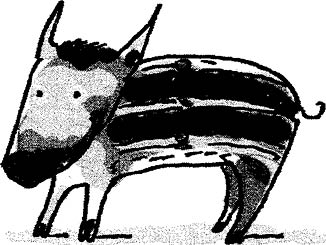
He went over into the corner of the studio and came back with a remarkably small box. I’d been expecting a large crate. He opened the lid of the box and out trotted the most adorable piglet I’d ever seen. She was a dark chocolate-brown in colour, striped longitudinally with bright yellow bands so that she looked like a strange furry wasp of some sort. She had a delightfully snubbed nose, eager bright little eyes, long floppy ears and a long floppy tail. She came out of the box squeaking and grunting with delight, and nosed round our legs eagerly, searching in our turn-ups to see whether she could find anything to eat. We all fell instantly in love with her and carried her back to the flat in triumph. The following day I got a local carpenter to build a proper cage for her.
It was nearly time for us to leave, and I was getting rather worried about how we were going to transport all the animals from the Dicor flats down to the ship. I’d made inquiries in Freetown, but apparently it was very difficult to hire lorries. Ambrose came round for a drink one evening and I happened to mention this to him and asked him if he knew of a lorry firm that could supply us with three lorries for such a short journey.
‘What do you want to hire lorries for?’ he inquired.
‘We’ve got to get the animals down to the docks somehow. We can’t carry them single-handed.’
‘But you have the army, my dear fellow,’ said Ambrose.
‘What do you mean – I have the army?’
‘Well, the army, of course. I’ll give you three army lorries to take them all down.’
‘Ambrose, you can’t do that!’ I said. ‘You can’t just commandeer army vehicles to carry animals to and fro to the docks.’
‘Why not?’ he said. ‘I’m a major; I’m in charge of the army. Of course I can. What time do you want the lorries here?’
‘Well,’ I said, ‘are you really sure this is all right? I don’t want to get you court-martialled or anything.’
‘Don’t you worry, Gerry,’ he said. ‘Don’t you worry. I’ll fix it. Just tell me what time you want the lorries here, and they’ll be here.’
So we fixed a time, and sure enough, when the day came the army lorries rolled up to the Dicor flats and the drivers got out and all stood in a line and saluted smartly. It was most impressive. We loaded up the animals carefully and drove down to the docks. Here, they were slung over in great nets on to the ship and down into the hold, while I directed operations as to where each cage should go. The sailors from the ship, and the Chief Officer himself, were exceedingly helpful, but the operation took about an hour and it was in the blazing sun, so it wasn’t at all a comfortable occupation. I could only stand by helplessly as I couldn’t even lift a crate. However, at last all the animals were neatly stacked in the hold and then we went up on deck and had a last beer, while the ship drew slowly away, and Freetown grew into a mere glimmer in the distance, and the ship’s Tannoy blared out ‘Rule, Britannia!’ over the oily waters.
The first thing that Long John and I did was to go down below and make our mark with the butcher. He is almost the most important man on the ship when you’re carrying a cargo of animals, for it is he who has to hard-boil eggs for you or prepare rice, and it is he who is in charge of the cold-room where all your precious foodstuffs are kept. I was a little bit anxious because I hadn’t heard whether or not the foodstuffs that I’d ordered had been put on board in England. Fortunately, they were all there: stacks of carrots, crates of beautiful cabbages, apples and pears, and various other delicacies with which I hoped to tempt the Colobus. I told the butcher approximately how much we would need every day, but I warned him that, as the sea air always seemed to have the effect of sharpening the animals’ appetites, this order would probably be increased as we went along. He was most helpful and said that he would be glad to do anything to assist us.
The film work that we had to do was quite considerable because the team had not been with us when Long John and I had come out on the Accra, and so we had to film sequences of what were to appear as Long John and I on the outward voyage to Freetown, as well as those for the homeward trip. Then we filmed the routine work of looking after the animals down in the hold. There was a fair amount of work that Long John and I could do, but being occupied with the filming the bulk of it had to be done by Ann and Jacquie. Also, I was somewhat restricted in the jobs that I could do because of my wretched ribs. I could feed the leopards, for example, who were now eating chickens and rabbits with a ferocity that had to be seen to be believed. I could stand and chop up food for the other animals, and I also made it my special task to help to feed Blossom.
This was not so much feeding as an all-in wrestling match. We couldn’t put her food in the cage because she’d immediately upturn it, and all the fruit and milk and everything would become so sticky and filthy that it would be impossible to clean. So we let her out of the cage to be fed twice a day. She had a large, flat, baking-tin which we piled high with succulent fruit and vegetables, and then filled with milk, and as soon as you sat down in front of her cage and put the tin on the ground, she would start screaming at the top of her voice and banging her little snub nose against the door. This was the tricky part of the operation. You had to open the door and grab her firmly, if you could, to prevent her rushing at the plate, misjudging the distance, and overturning the whole lot, which is what she did on frequent occasions. So, as you opened the door, you tried to grab one of her long floppy ears and hang on to it like grim death, because she came through the door like a bullet out of a gun. Then you’d lead her carefully to the pan and she’d plonk both her stubby front feet into it, little hooves widespread, and dig her nose in and guzzle, uttering purring grunts of satisfaction, and occasionally high-pitched squeaks.
Even when the last drop of milk had disappeared from the pan, and the last crumb of food had been found and eaten, she was still not totally convinced that there wasn’t some more to be had if she searched for it, and she would go – if you didn’t prevent her – at a mad gallop round the other cages. Normally, she ran round to where the monkeys were, but on one occasion she ran towards the leopards’ cage and I only just caught her in time. The cleaning slot at the bottom of the leopards’ cage was just wide enough for them to be able to get their paws out, and that might have been the end of Blossom. Blossom, however, as the leopards snarled and clawed at the wire to try and get at her, displayed no signs of fear whatsoever. She gave high-pitched indignant screams, gnashed her little tushes at the leopards and struggled madly in my arms trying to get down and fight them. The leopards were about twenty times her size and yet she seemed absolutely unafraid of them.
Ann, as I had asked her to, devoted herself entirely to the Colobus. As I had anticipated, it was a whole-time job. It was not only a question of getting them used to a completely new series of foods, but also of teaching them new feeding habits. Colobus monkeys have no thumbs. In the wild state they move so rapidly and perform such prodigious leaps through the branches that a thumb would only get in the way, and so these have been reduced to mere knobs. This makes it difficult for a Colobus to pick anything up, because it has to do it with the side of its hand, rather like somebody brushing crumbs off a table. Also, of course, if you are feeding in the top of a tree, you take a mouthful of something and then drop it and it disappears a hundred and fifty feet to the forest floor below; then you move on to the next branch. But in a cage you can’t do this. Up country, and in Freetown, where we’d been feeding them on leaves, the matter was fairly simple because we would just push the leaves in through the wire at the top of the cage so that they dangled down and the monkeys could pluck them at their leisure and drop whatever they didn’t want. But they would never go down and pick it up off the floor. Now we had no leaves to feed them on, and the nearest approach to leaves that we had was cabbage. This they didn’t particularly care for. They also didn’t particularly care for any of the other things we had, such as carrots, pears, apples, grapes and so on.
It was a battle between Ann’s will to make them live and the monkeys’ desire not to eat the food provided, and thus die on us. For hour after hour she would squat in front of the cages, patiently teaching them how to pick things up and trying to get them even just to sample a grape or a piece of carrot – just to see what it tasted like – because they would sniff at it and throw it down with disdain without even trying it. The biggest of our Colobus group was an old male who I reckoned must have been some thirteen or fourteen years of age, and we had christened him The Sod because he hated everybody. In particular, he hated Ann. There was a tremendous battle of wills between The Sod and Ann throughout the voyage. If the food was simply put into his cage in a plate he would upset the whole thing and then, to show his disdain for the diet and for Ann, would shuffle himself round and round, backwards, on his behind in the sawdust, so that all the fruit and sawdust got mixed up together in a most indigestible and horrible mess.
Ann had to try another method. Already The Sod hated her with a great loathing which almost seemed to give him his interest in life, and so she would sit patiently in front of his cage holding out food on the palm of her hand. As The Sod could get his arm through the wire of the cage, he would leap at the wire, banging his head against it vigorously, and shoot out his arm in an effort to catch hold of Ann’s hand and pull it near enough to the wire to give it a good bite. This would send the food flying across the hold. One day, after this had been going on for some time, Ann decided to try him with a piece of coconut for a change. She thought the white flesh of the coconut would shine more noticeably in her hand, and anyway he’d shown such contempt for most of the other foodstuffs that had been offered to him.
Now, it may have been coincidence but this time, in trying to grab Ann’s hand, he grabbed the coconut instead and, pulling his hand back into the cage, sniffed at it before dropping it on the floor. With incredible patience, Ann went on with this performance hour after hour until at last The Sod began to show signs of wearing down. He still banged his head on the wire when he saw her, but in snatching at her hand he would grab the coconut, smell it and eat a bit of it. Soon he was taking it from her with considerably more gentleness and it was obvious that we had found something that he really liked. Gradually, both he and all the other Colobus began to understand how to feed from a dish on the floor and they ate a bit more each day. Our spirits rose, for although they were still only eating a small quantity, they were now starting to eat grapes and carrots and bits of apple, and most of all, they were taking their milk which we reinforced with vitamins. So at least we felt that they were getting enough nourishment to keep them alive. But it was a herculean task and it required all Ann’s patience to keep them going. Fortunately, we had no bad weather to contend with, for I think if we had had a heavy sea it might well have made the Colobus seasick. This would have been the last straw, and I’m sure we would have lost them.
At last we got to Las Palmas, rushed ashore and made straight for the local market. Here we purchased everything that we could lay our hands on that we thought might tempt the Colobus, though many of them, of course, were things they’d never seen before: spinach, for example, and strawberries and cherries, and every imaginable kind of green-stuff and fruit that we could use. These we carried in triumph back to the ship and tested out on the Colobus. Needless to say, they turned up their noses at the expensive cherries and strawberries, although they did take to cherries a little later on. The spinach they tried but it didn’t seem to satisfy them. However, there was one thing – a strange, bean-like thing – that Ann had spotted at the last moment in the market, and which we’d taken some of just in case. If we’d only known, we’d have brought back a whole sackful, because the Colobus went mad over them and gorged themselves for as long as the supply lasted.
At last we arrived at Liverpool. To my delight, it was a blazing hot summer’s day. I thought our troubles were nearly over, for all we had to do now was to get the animals from the ship to the airport and fly them straight across to Jersey. By that evening, I thought, they’d be safely installed and having all the love and care and attention that they could possibly want from the staff. As the ship steamed slowly in to tie up at the docks we were busy down in the hold, nailing sacking and cheap blankets over the fronts of the cages. I always take this precaution, not so much to protect the animal as to prevent people from poking and prying and possibly getting themselves bitten, and frightening the animal in consequence. Also, the animal tends to feel safer in the dark when the cage is being bumped and battered about. Once again they were piled in the great nets, hauled over the side, and put on the docks where the lorries were ready to transport them to the airport and the special charter plane that was waiting for us. We got them all neatly stacked into the lorries and I heaved a sigh of relief. It would only be a matter of a couple of hours now, and we’d be back in Jersey, I thought. Then a small man made his appearance and asked me whether I was Mr Durrell. Beaming happily, I said I was.
‘Well, sir,’ he said, ‘it’s about them leopards of yours.’ My heart sank.
‘What about them?’ I inquired.
‘Well, sir, you haven’t got any permits for them.’
‘But I have,’ I said. ‘We approached the Ministry, the Ministry passed the permits, and said that as the leopards were only in transit to Jersey they didn’t have to be quarantined in England.’
‘Well, I haven’t got any documents to that effect, sir,’ he said.
‘Look . . . You’ve only got to phone up the zoo . . .’
‘I don’t know about that, sir. If I haven’t got the documents, I can’t pass them.’
I took a grip on myself. I’d had to deal with petty officialdom so often in the past and I knew that to lose your temper was the worst possible thing you could do.
‘Let me phone up the zoo, then,’ I said.
‘All right, sir. But I’m afraid you’ll have to pay for the call.’
‘I’m quite willing to do that,’ I said between my teeth. We went into his grimy little office and I put through a call to Catha.
Where in hell were the leopard permits? Catha said that she’d just received them herself at the zoo, and thinking this rather peculiar, she’d phoned up the Ministry, though feeling sure that a copy had been sent to Liverpool. No, said the Ministry, kindly, there was no copy sent to Liverpool because they were always sent to the people who were expecting the leopards, or whatever the animals happened to be.
I groaned.
‘All right,’ I said. ‘I’ll have to phone up the Ministry, Cath.’
She gave me the appropriate department and telephone number, and I got through to them. They were very apologetic, but the fact was that the permits had been sent to the right place, as far as they were concerned, which was the place that was expecting the leopards.
‘Well, will you kindly talk to this gentleman here?’ I said. ‘He is preventing me from taking the leopards to Jersey because he says he has got no permits . . . Will you assure him that the permits have been issued?’
I passed the phone over to the little man. He mumbled and grumbled and was as obstructive as he possibly could be, but in the end the man at the Ministry convinced him that the permits had been granted for the leopards. He put down the phone rather glumly. It had been the big moment of his day, and I’d spoilt it for him.
‘Can I go now?’ I said sweetly.
‘Yes, I suppose so,’ he said, in a disgruntled sort of way.
So we drove out to the airport. But all this had wasted at least an hour of our time and we’d had to phone to tell the plane to stand by. At the airport the animals were all put into the plane and we climbed in after them, sat down in our seats, and fastened our seatbelts. The plane revved up, roared for a moment or so stationary on the tarmac, and then started to take off. Then, suddenly, it stopped. It taxied back again, it revved up again, and once again it started to take off, and then stopped. We taxied back, and this time the engines were switched off altogether. Very apologetically, the pilot came through to see me.
‘I’m afraid there’s some mechanical fault, sir,’ he said.
‘We can’t take off.’
‘How long will it take to repair?’ I asked.
‘I’m afraid we don’t know, sir.’
‘Well,’ I said, ‘can the animals be left in the plane while she’s being repaired.’
‘We could do that, sir, or we could move them all out and put them in one of the hangars, if you’d prefer that.’
‘I think I would prefer that,’ I said, ‘because some of them need to be fed now.’
So all the animals were taken out of the plane again and put in a big spare hangar. Hours passed, and we fed them and gave them all milk. Presently, an official of the airline came to me and said that they were still trying to trace the cause of the trouble, and that they would let us know as soon as there was any hope of us getting off. I phoned Catha up at the zoo and told her what was happening. It came to lunch time, and then it was two o’clock, three o’clock, four o’clock. At five o’clock they came to me and said that they had tested the plane once more, and although they had thought that they had cured the fault, they hadn’t.
‘It’s no good,’ I said. ‘We’ll have to get another charter.’
‘Let us have one more try, sir,’ they begged.
‘All right,’ I said. ‘But I don’t like the idea of going up in a plane that’s liable to give out on me. I don’t like going up in planes at the best of times, let alone when they’re faulty.’
It was quite late in the evening when they came back and said that they had finally fixed the fault. By this time my ribs were giving me hell and I was in a thoroughly jittery mood because, to begin with, I don’t like flying, and secondly, the animals were liable to get chilled as the night was growing colder.
‘No!’ I said, suddenly, with firm resolve. ‘I’m damned if I’m going in that plane. I’ll get another flight.’
‘I can assure you, sir,’ said the captain, ‘it’s perfectly all right.’
‘I don’t doubt it for a minute,’ I said. ‘But I just have a feeling, and when I have a feeling I don’t fly – which is most of the time . . . I’m damned if I’m going to take up all my animals and myself and my wife in a jinxed plane. No, I’m afraid I’ll have to get another charter flight.’
‘Well, it’s just as you wish, sir,’ he said, disappointment in his voice.
So I went to see the airport officials, got their permission to keep the animals in the hangar, and then set about the task of trying to find another charter flight – which wasn’t as easy as all that. Eventually we did manage to get one. The following morning we raced down to the airport and peered anxiously into each cage, hoping that the cold night hadn’t affected any of the animals. It didn’t seem to have done any harm. Then they were loaded into the new plane, and this one actually took off. When we were airborne, I wiped the sweat from the palms of my hands, lay back, lit a cigarette and closed my eyes. It’s almost over, I said to myself; all we have to do is land safely in Jersey. The plane droned on through the sky and eventually the island appeared like a speck on the horizon. We dropped lower and lower and came in to an absolutely perfect landing, and as we taxied towards the airport terminal, there was a row of fork-lift trucks ready to take the cages, and practically – as far as I could see – the entire staff of the zoo.
The animals were unloaded, the press flashlights flared as they took pictures of the leopards and the chimps and all the other creatures being loaded on to the fork-lift trucks and then taken over to the vans that were to carry them to the zoo. Within an hour we were back home, the animals had been unloaded, and those that didn’t have to undergo quarantine were released into their new cages. A great feeling of relief poured over me. We’d actually got the Colobus back. Now we would have ample time to give them our full and undivided attention. Now, in addition to their normal diet, we would have an unlimited supply of green leaves to give them – from oak and elm and lime, and other such trees, and I felt sure that they would take to them and thrive. At least, I hoped it was going to be like that.