
Introduction
What is the Catholic thing? What makes Catholicism, among all of the competing philosophies, ideologies, and religions of the world, distinctive? I stand with Blessed John Henry Newman who said that the great principle of Catholicism is the Incarnation, the enfleshment of God. What do I mean by this? I mean, the Word of God—the mind by which the whole universe came to be—did not remain sequestered in heaven but rather entered into this ordinary world of bodies, this grubby arena of history, this compromised and tear-stained human condition of ours. “The Word became flesh and made his dwelling among us” (Jn 1:14): that is the Catholic thing.
The Incarnation tells central truths concerning both God and us. If God became human without ceasing to be God and without compromising the integrity of the creature that he became, God must not be a competitor with his creation. In many of the ancient myths and legends, divine figures such as Zeus or Dionysus enter into human affairs only through aggression, destroying or wounding that which they invade. And in many of the philosophies of modernity God is construed as a threat to human well-being. In their own ways, Marx, Freud, Feuerbach, and Sartre all maintain that God must be eliminated if humans are to be fully themselves. But there is none of this in the Christian doctrine of the Incarnation. The Word does indeed become human, but nothing of the human is destroyed in the process; God does indeed enter into his creation, but the world is thereby enhanced and elevated. The God capable of incarnation is not a competitive supreme being but rather, in the words of Saint Thomas Aquinas, the sheer act of being itself, that which grounds and sustains all of creation, the way a singer sustains a song.
And the Incarnation tells us the most important truth about ourselves: we are destined for divinization. The church fathers never tired of repeating this phrase as a sort of summary of Christian belief: Deus fit homo ut homo fieret Deus (God became human so that humans might become God). God condescended to enter into flesh so that our flesh might partake of the divine life, that we might participate in the love that holds the Father, Son, and Holy Spirit in communion. And this is why Christianity is the greatest humanism that has ever appeared, indeed that could ever appear. No philosophical or political or religious program in history—neither Greek nor Renaissance nor Marxist humanism—has ever made a claim about human destiny as extravagant as Christianity’s. We are called not simply to moral perfection or artistic self-expression or economic liberation but to what the Eastern fathers called theiosis, transformation into God.

Christ Pantocrator, Hagia Sophia, Istanbul. WORD ON FIRE
I realize that an objection might be forming in your mind. Certainly the doctrine of the Incarnation separates Christianity from the other great world religions, but how does it distinguish Catholicism from the other Christian churches? Don’t Protestants and the Orthodox hold just as firmly to the conviction that the Word became flesh? They do indeed, but they don’t, I would argue, embrace the doctrine in its fullness. They don’t see all the way to the bottom of it or draw out all of its implications. Essential to the Catholic mind is what I would characterize as a keen sense of the prolongation of the Incarnation throughout space and time, an extension that is made possible through the mystery of the church. Catholics see God’s continued enfleshment in the oil, water, bread, imposed hands, wine, and salt of the sacraments; they appreciate it in the gestures, movements, incensations, and songs of the Liturgy; they savor it in the texts, arguments, and debates of the theologians; they sense it in the graced governance of popes and bishops; they love it in the struggles and missions of the saints; they know it in the writings of Catholic poets and in the cathedrals crafted by Catholic architects, artists, and workers. In short, all of this discloses to the Catholic eye and mind the ongoing presence of the Word made flesh, namely Christ.
Newman said that a complex idea is equivalent to the sum total of its possible aspects. This means, he saw, that ideas are only really known across great stretches of space and time, with the gradual unfolding of their many dimensions and profiles. The Incarnation is one of the richest and most complex ideas ever proposed to the mind, and hence it demands the space and time of the church in order fully to disclose itself. This is why, in order to grasp it fully, we have to read the Gospels, the Epistles of Paul, theConfessions of Saint Augustine, the Summa theologiae of Thomas Aquinas, The Divine Comedy of Dante, Saint John of the Cross’s Ascent of Mount Carmel, The Story of a Soul of Thérèse of Lisieux, among many other master texts. But we also have to look and listen. We must consult the Cathedral of Chartres, the Sainte-Chapelle, the Arena Chapel, the Sistine Chapel ceiling, Bernini’s Ecstasy of Saint Teresa, the Church of the Holy Sepulchre, Grünewald’s Crucifixion in the Isenheim Altarpiece, the soaring melodies of Gregorian chant, the Masses of Mozart, and the motets of Palestrina. Catholicism is a matter of the body and the senses as much as it is a matter of the mind and the soul, precisely because the Word became flesh.

Church of the Holy Sepulchre, detail, Jerusalem. DENIS R. MCNAMARA
What I propose to do in this book is to take you on a guided exploration of the Catholic world, but not in the manner of a docent, for I am not interested in showing you the artifacts of Catholicism as though they were dusty objets d’art in a museum of culture. I want to function rather as a mystagogue, conducting you ever deeper into the mystery of the Incarnation in the hopes that you might be transformed by its power. I stand with the theologian Hans Urs von Balthasar, who held that the truth of Catholicism is best appreciated from within the confines of the church, just as the windows of a cathedral, drab enough when seen from the outside, shine in all of their splendor when viewed from the inside. I want to take you deep within the cathedral of Catholicism, because I’m convinced that the experience will change and enhance your life.
Catholicism is a celebration, in words and imagery, of the God who takes infinite delight in bringing human beings to fullness of life. I shall commence with Jesus, for he is the constant point of reference, the beginning and the end of the Catholic faith. I will try to show the uniqueness of Jesus, how his claim to speak and act in the very person of God sets him apart from all other philosophers, mystics, and religious founders. And I will demonstrate how his resurrection from the dead not only ratifies his divine identity but also establishes him as the Lord of the nations, the one to whom final allegiance is due. Next I shall explore the extraordinary teachings of Jesus, words at once simple and textured, that have, quite literally, changed the world. I will try to show how they constitutethe path to joy.

St. Joseph Cathedral, detail, Wheeling, West Virginia. DENIS R. MCNAMARA
Saint Paul referred to Jesus as “the icon of the invisible God.” By this he meant that Jesus is the sacramental sign of God, the privileged way of seeing what God looks like. And thus we will look at God—his existence, his creativity, his providence, his Triune nature—through the lens of the Word made flesh. Next I will turn to Mary, the vessel through whom God came into the world. I will stress that Mary is the summation of Israel, the one who gives full voice to the longing of her people for God, the one who is, hence, the prototype of the church, the new Israel. Jesus’s closing words to his disciples were an exhortation to go out to all the nations and tell the good news. Peter and Paul were the indispensable players in the early church, for they embodied this missionary spirit. I will show that these very particular first-century men are also determining archetypes in the life of the missionary church to the present day.
Paul consistently proclaimed that the church of Jesus Christ is not so much an organization as an organism, a mystical body. I will present the church accordingly as a living thing, whose purpose is to gather the whole world into the praise of God. And the central act of the church, its “source and summit” in the words of Vatican II, is the Liturgy, the ritualized praise of God. I will therefore walk through the gestures, songs, movements, and theology of the Liturgy. The entire purpose of the Liturgy and the church is to make saints, to make people holy. This is why Catholicism takes the saints, in all their wild diversity, with such seriousness and why it presents them to us with such enthusiasm. And so I will devote a chapter to painting small portraits of four friends of God in order to show what life in Christ concretely looks like. Holy people raise their minds and hearts to God; they seek passionate communion with their Creator; they pray. I will turn next, therefore, to prayer, and I will focus on certain very definite persons—Thomas Merton, Saint John of the Cross, and Saint Teresa of Avila—who give concrete expression to the mystical path. Finally, I shall consider the last things: hell, purgatory, and heaven. God wants intimate friendship with us, but friendship is always a function of freedom. How we ultimately respond to the divine love—the sun that shines on the good and the bad alike—makes all the difference.
I trust you will find that I have not written a plodding theological study, for this book is chockablock with stories, biographies, and images: Cardinal Francis George musing on the loggia of St. Peter’s after the election of Benedict XVI, Saint Thérèse of Lisieux’s “little way,” the candlelit procession at Lourdes, Edith Stein’s journey to Auschwitz, Irish penitents at Lough Derg, pilgrims proceeding on their knees to venerate the Virgin of Guadalupe, Mother Teresa picking up the dying off the squalid streets of Calcutta, Karol Wojtyla hunkering down in the underground seminary during the Nazi occupation, the prodigal son gathered into his father’s embrace, Paul imprisoned in Philippi, Peter crucified on the Vatican Hill, Angelo Roncalli’s “flourishing garden of life,” and many more. But since the Catholic tradition is smart, this book also contains theological arguments, sometimes of a technical nature. Again, I hear almost every day from atheists who write off religion as primitive, premodern nonsense. I summon Aquinas, Augustine, Paul, Teresa of Avila, Joseph Ratzinger, and Edith Stein—in all their intellectual rigor—as allies in the struggle against this dismissive atheism.
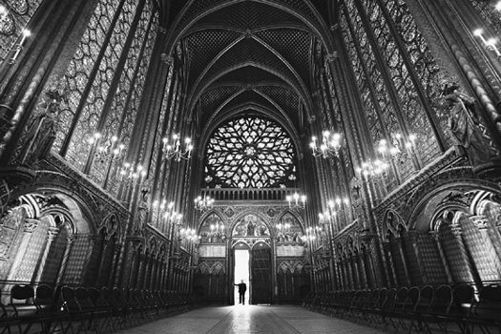
Sainte-Chapelle, interior, Paris. WORD ON FIRE
Perhaps some will find the lyrical sections of this book more compelling, and others will prefer the intellectual passages, and perhaps still others will savor the images and the pictures. Good. Part of the genius of the Catholic tradition is that it never throws anything out! There is something for everyone in its wide space, and I want very much to communicate something of that Catholic capaciousness in this book. G. K. Chesterton, one of the quirkiest, funniest, and most intelligent Catholic writers of the twentieth century, once compared the church to a house with a thousand doors. I hope you find this book an enchanting way in.