
CHAPTER 3
Everyone loves heroes! Ever since ancient times, people have been telling stories about men and women with super strength who risk their own safety to save the lives of others.
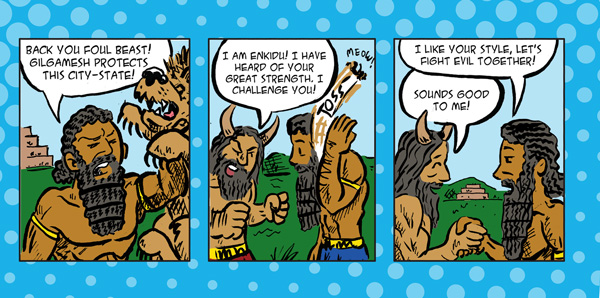
The oldest hero to appear in an epic was Gilgamesh, a hero from a region of the world called the Fertile Crescent. This area is where the countries of Iraq, Syria, Kuwait, and Iran are today. Gilgamesh was very strong and helped save his city–state from monsters and villains.
One of Gilgamesh’s first challengers was Enkidu, a powerful warrior whom Gilgamesh fought for weeks. Eventually, Enkidu was defeated and became Gilgamesh’s friend. Enkidu was one of the first sidekicks!
WORDS TO KNOW
epic: a long poem, usually about the life of a hero or heroine.
city–state: a city and its surrounding area, which rules itself like a country.
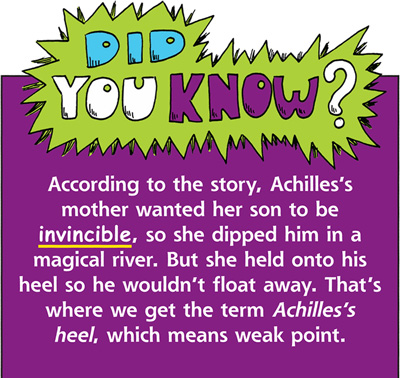
Ancient Greeks also told tales about superheroes, such as Achilles, who had only one weak spot—his heel. Another hero, Odysseus, battled monsters on his journey home from war. Stories and poems from the past often featured very strong people who protected weaker people.
WHY WERE STORIES ABOUT SUPERHEROES POPULAR BACK THEN? WHY ARE THEY POPULAR NOW?
EARLY SUPERHEROES
Comic book superheroes have several predecessors other than the ancient Greek heroes. One of those is the Scarlet Pimpernel. Created by a Hungarian writer named Baroness Emma Orczy, the Scarlet Pimpernel was a vigilante who saved wealthy aristocrats from the horrors of the French Revolution. It is one of the first instances of a hero using a disguise and an alter ego, two common characteristics of modern-day superheroes, such as Batman. The Scarlet Pimpernel was made famous in America through a new form of entertainment, pulp magazines.
WORDS TO KNOW
predecessor: someone or something that came before others.
vigilante: a person who takes the law into his or her own hands.
aristocrat: a person of royal blood or privilege.
French Revolution: a period of violent change in France between 1789 and 1799.
alter ego: a second personality in the same person.
invincible: someone who cannot be defeated.
pulp magazine: a cheap fiction magazine published between 1896 and the 1950s.
Pulp magazines were cheaply made publications that people bought for the exciting stories of romance, science fiction, adventure, westerns, and suspense. Many Americans were first introduced to characters such as Tarzan and Sherlock Holmes through pulp magazines. Other twentiethcentury heroes had their start in the pulps, too, such as Buck Rogers and Zorro. The covers of pulp magazines were bright and flashy and would sometimes have nothing to do with the actual stories inside.
TAKE A LOOK AT THE COVERS OF TODAY’S COMIC BOOKS—THEY HAVE A VERY SIMILAR LOOK TO THE PULP MAGAZINES OF THE EARLY 1900.
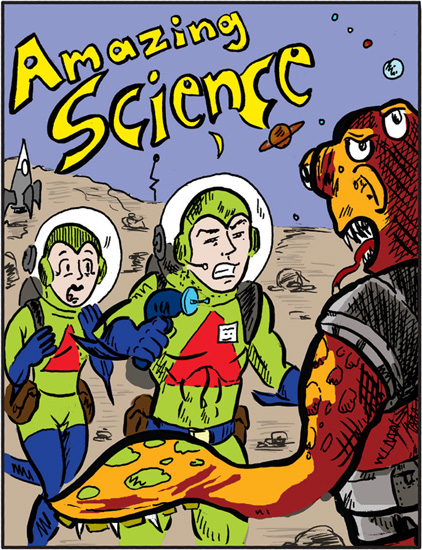
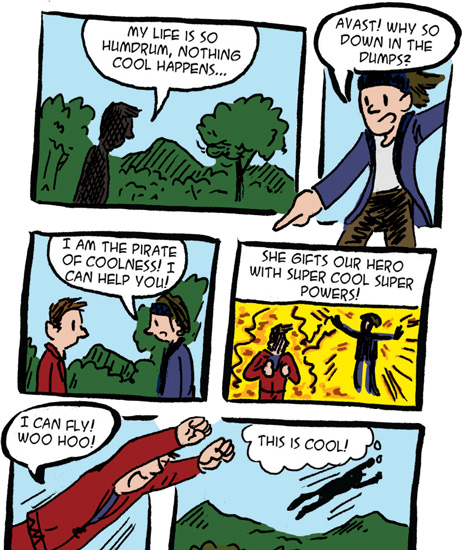
One of the most important science fiction pulp magazines was called Amazing Stories, which was about a future in which everyone had a jet pack or battled alien cultures on Mars. The cover of one Amazing Stories pulp shows a man flying through his neighborhood, aided only by a small device. It inspired a few important teenagers in Cleveland, Ohio, who created a superhero who would one day fly.
WORDS TO KNOW
science fiction: stories that deal with the influence of real or imagined science.
suspense: a feeling or state of nervousness or excitement caused by wondering what will happen.
RADIO!
The early twentieth century saw the rise of a very popular new technology—radio! Radio programs, many of them inspired by pulp magazines, were broadcast across the country. From coast to coast, people could listen to the same shows. Some of the first radio networks are still around today, although they mostly do television. The Columbia Broadcasting System (CBS) and the National Broadcasting Company (NBC) are two of these. These radio broadcasts helped make three modern heroes household names: Tarzan, Zorro, and the Shadow.
THE FIRST COMIC BOOKS
The first comic books looked like the Sunday newspaper supplements. These collections of material that had already been published were simply stapled together with a flashy cover. Soon, actual comic book publishers began to create new content, such as comic adaptations of Bible stories or historical events.
Few people thought that comic books could ever be popular. Newspapers, movies, radio, and pulps—that’s where people assumed they’d find excitement, action, humor, and drama. But they were wrong! A few key characters helped to make comic books very popular.
WORDS TO KNOW
broadcast: a program transmitted over a long distance.
network: a company that provides programs to be broadcast over radio or television stations.
adaptation: telling a story in a different way and in a new format. For example, making a musical out of a series of comic strips would be adapting the comics into the musical.
drama: an exciting event or series of events.
One of those characters was Superman. In 1932, two buddies named Jerry Siegel and Joe Shuster were working as a freelance team. Jerry was the writer and Joe was the artist. Together, they brainstormed the idea of an alien who looked just like us, but had abilities above and beyond humans. They wanted their hero to be larger than life with an energy you could feel coming off the page.
Siegel and Shuster’s idea was rejected by many publishers during a period of several years. Finally, they pitched their idea to a small publisher in New York City called Action Comics, which agreed to give them a try.
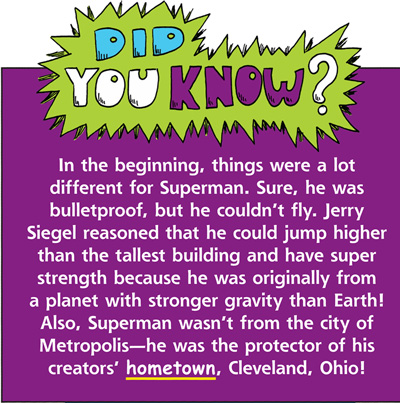
Superman first appeared as a man in a blue costume and a red cape with the letter “S” on his chest, lifting a car over his head. Superman wasn’t the only story to appear in this iconic issue. However, he is the only character people remember!
WORDS TO KNOW
freelance: to work on a project without being employed by the company assigning the work.
brainstorm: to come up with a bunch of ideas quickly and without judgment.
pitch: to present an idea.
 Check out the very first Superman cover. The publisher worried that people would find the idea of a man lifting a car ridiculous.

The publishers of Superman found their second big seller the following year. A young cartoonist named Bob Kane was inspired by movies and pulp heroes such as the Scarlet Pimpernel. He pitched the idea of a wealthy man who, at night, dresses in a bat suit to rid his town of crime. In a 1933 issue of Detective Comics, Batman first swings into the world. He proved to be another popular figure and helped to introduce what would become known as the Golden Age of comics.
THE GOLDEN AGE OF COMICS
The superhero comic books of the early 1930s are the beginning of what many comics historians call the Golden Age of comics. It was golden because it was so new and popular. Everyone wanted to read comic books, both kids and adults.
Comics during this era expanded beyond their stapled pages and were adapted into movies, radio programs, and daily comic strips in national newspapers. Sales of comics made publishers rich and comics artists famous.
WORDS TO KNOW
hometown: the place where a person, thing, or idea is born.
Golden Age: the period of comics history before the 1950s, considered to be the best and most popular by many fans and historians.
era: a set segment of time.
THE BIG SCREEN
Like radio, movies took inspiration from pulp magazines. One of the first popular science fiction movie series was about Buck Rogers, a famous pulp fiction and comic strip hero. Most movies had live actors and actresses performing superhuman feats, but animation has always been popular, too. One of the most famous early animated films is an adaptation of E.C. Segar’s Popeye by the Fleischer Brothers Studio. Never before had audiences seen the likes of Popeye, except in the funnies of course!
Watch one of the first animated movies of Popeye! How is it different from the cartoons kids watch today?
WORDS TO KNOW
animation: multiple drawings in sequence to show movement.
penciling: to create an original comic first in pencil.
dynamic: full of movement.
There were no restrictions on comics in the Golden Age. They could be about anything and people still loved them. This level of comics popularity would not be seen again in America for nearly 50 years. A few comics artists stand out for being especially innovative.
Will Eisner: Will Eisner started his comics career penciling and inking for other cartoonists. Eisner decided to make his panels more dynamic by matching the shape and design of the panels to the action within them.
In 1940, Eisner was given the chance to create his own superhero. Unlike the other cartoonists of his day, he had complete control over how the story was told and how it was published. He retained all the creative rights to his creation. Called The Spirit, Eisner’s comic followed the adventures of a former detective who was thought to be dead.
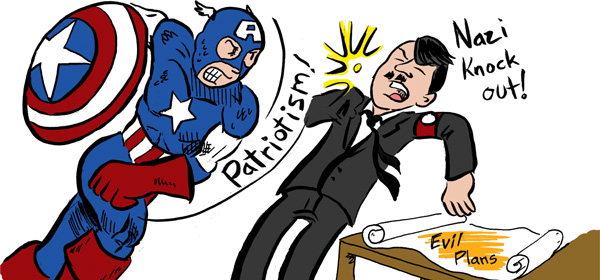
Joe Simon and Jack Kirby: During the 1930s and 1940s, a new, small pulp publisher called Timely Comics needed a hit superhero to rival the popular Superman. Writer Joe Simon, who was also the head editor of Timely Comics, teamed up with an old friend of his, Jack Kirby. Together, they invented the next great American superhero—Captain America.
The first Captain America comic was modeled on the most talkedabout news of 1940. Captain America was sent to do battle with the rising Nazi threat and Adolf Hitler himself. Would Captain America have been as popular if it had been published in a time of peace instead of a time of war? Why?
WORDS TO KNOW
creative rights: the right to use something that is created, often for profit.
Nazi: the main political party of Germany before and during World War II.
CAPTAIN AMERICA WAS AN IMMEDIATE SUCCESS.
The art and storytelling of Jack Kirby was unlike other comics of its day. Huge splash pages were used for the battle scenes. The characters were drawn as a cross between the flashy cover art of pulp magazines and the frenzy of newspaper comics such as Popeye. The comic world hadn’t seen anything like it.
MORE ABOUT JACK
Jack Kirby was born Jacob Kurtzberg to Jewish immigrant parents. He grew up in a poor section of the lower east side of Manhattan and learned how to draw from copying the art he saw on the covers of pulp magazines. Eventually, he found work as an inbetweener for the Fleischer Brothers Animation Studio, filling in extra drawings needed between key frames.
After the animation studio closed and moved to Florida, Kirby became a freelance cartoonist taking on odd jobs to pay the bills. His two hit comics for Timely, Captain America and Boy Commandos, inspired many future comics artists to start their own careers.
WORDS TO KNOW
splash page: large pages of comic action with no panels.
immigrant: a person who leaves his or her own country to live in another country.
inbetweener: an animator who assists the head animator by drawing movements in between key frames.
key frame: a drawing in animation that captures the major points of movement. For example, if a character is waving her arm from left to right, the key frames would show the arm on the left, middle, and right.
CARTOONING WOMEN
From the first decade of comics, women have been making comics for newspapers and comic books. In the 1920s, several women saw their comics published widely, and a few even got rich.
Edwina Dumm created a comic strip called Cap Stubbs and Tippie about the adventures of a young boy, his grandma, and Tippie the dog. Cap Stubbs and Tippie was one of the first comics made by a woman to be popular throughout America. It inspired a famous Halloween song and was eventually made into a weekly feature in Time Magazine, where the better printers allowed Dumm to create beautifully illustrated comics.
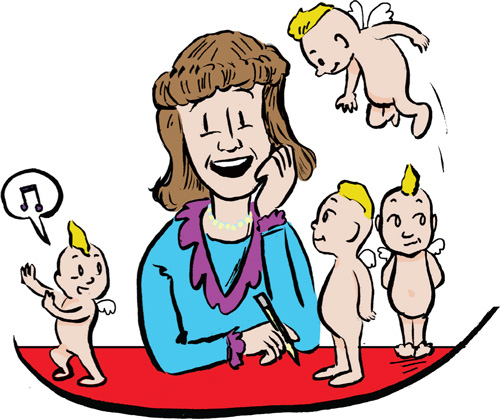
You may have heard of Kewpie dolls from your grandparents. The Kewpie doll came from a comic created in 1905 by Rose O’Neill. She told funny stories of little cherubs she called Kewpies. The comics were often colorful and were popular among adults and children.
Other women worked in comics and comic books throughout the Golden Age of comics, although many aren’t widely remembered today. Their work, however, did inspire future generations of women who would make memorable comics of their own.
WORDS TO KNOW
cherub: a type of angel, usually shown as a small child.
HEROES GO TO WAR
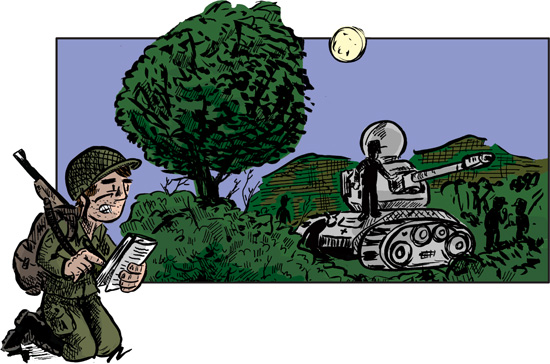
World War II officially began for the United States after the surprise attack on Pearl Harbor by Japan on December 7, 1941. Thousands of Americans signed up to join the armed forces, including many of America’s artists and cartoonists.
WORDS TO KNOW
Pearl Harbor: a U.S. naval base in Hawaii that was attacked by Japan in 1941.
Jack Kirby was sent to Europe, where his quick drawing skills were noticed by his commanders. They sent Kirby out as a scout to draw enemy encampments and artillery positions.
THE DANGEROUS JOB LATER INSPIRED SOME OF KIRBY’S MOST MEMORABLE COMICS.
WALT DISNEY AT WAR
Have you ever been to Disney World? Walt Disney also contributed to the war effort. His studios were commissioned by the U.S. Armed Forces to create short animated films for two purposes—to encourage Americans to buy war bonds and to educate soldiers about a variety of subjects. Walt Disney also led a team of artists that designed decals for the noses of American bombers and cargo planes.
Watch one of Disney’s war propaganda films. How do you think people in 1943 responded to these movies?
WORDS TO KNOW
propaganda: ideas or statements that are sometimes exaggerated or even false. They are spread to help a cause, political leader, or government.
Comic book characters also went to battle with America’s enemies during this time. Batman and Superman helped to foil Nazi spies. Lesser-known superheroes such as Plastic Man, who could bend and fold into any shape, thwarted Japanese spy rings. Of course, Captain America continued his battles with the Nazi forces. The superheroes were widely read by American troops.
While comic book heroes and artists were going to war, they had an even bigger fight waiting for them when they returned.
THE GOLDEN AGE OF COMICS WAS COMING TO AN END.
DRAW A SUPERHERO
Supplies: pencil, paper, colored pencils, digital camera, a friend (optional)
Some of this may be familiar since we use basic shapes and action lines to make our superhero. But heroes are larger than life, and the same thing is true with drawing them!
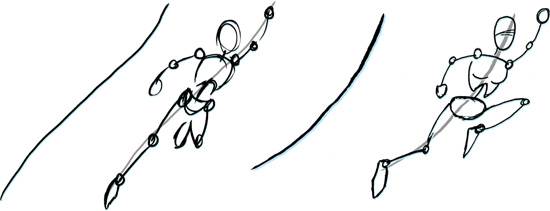
1 Start with an action line. If you want your hero to be flying, draw a big swoosh instead of the straight action line you used for standing still. If your superhero is going to be bigger than your regular characters, make your action line longer. Draw the head shape at the top of the action line.
2 Skip a little down the action line to allow room for the neck, and then draw a large triangle for the upper body. If you are drawing a male hero, make it big. If it’s a female hero, draw a slightly smaller triangle. Draw an oval where the hips will be, then add the socket circles for the shoulders and legs. Complete the skeleton arms and legs as you did in the last chapter.
3 Superheroes are also bulkier than regular characters. Add muscles to arms, shoulders, and legs. Go ahead and make them look exaggerated. Muscles make your character super!
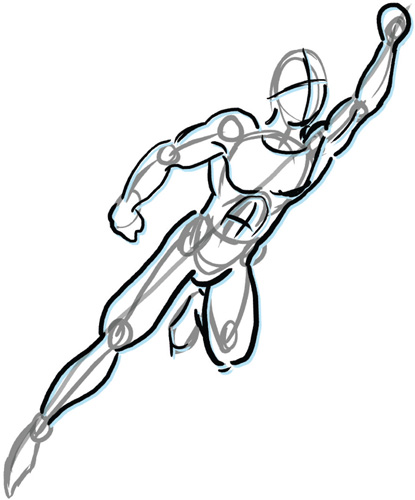
4 To draw the face, follow the same steps as before, but keep in mind that most superhero faces look more realistic than other comic characters. Look at your favorite superheroes’ faces for ideas and try to make your superhero strong and expressive. Giving your superhero a mask or hood will make drawing his or her face easier.
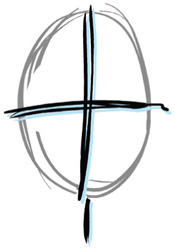
5 Wait, what about clothes? Don’t worry, you will outfit your superhero in the next project. But you can start brainstorming now!
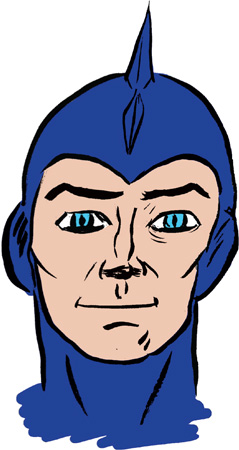
TRY THIS! Most comic book artists use friends as models for their superheroes. Find a friend and use a digital camera to take some pictures of different poses. How could you take a picture of a flying pose without making your friend jump?
THE NAZI BAN ON COMICS
The Nazis thought that American comics were one of the most powerful propaganda tools the Allied forces had. Because of this, the Nazis banned almost all forms of comics and would not allow anyone to have anything that depicted American characters such as Superman or Mickey Mouse. The Nazi ban on American comics changed the direction of European comics in the twentieth century. Almost no European superhero comics exist today.
WORDS TO KNOW
Allied forces: the armies of the countries that fought together against Germany in World War I and World War II.
DESIGN A COSTUME AND BACKSTORY
Supplies: pencil, paper, notebook, superhero drawings
Think of Batman, Spiderman, Iron Man, The Hulk, Wolverine, and Wonder Woman. What do all these characters have in common? That’s right, strong secret identities linked to their names and great costumes. Every great superhero needs a costume and backstory.
WORDS TO KNOW
identity: the characteristics that make a person an individual.
backstory: a story about the events leading up to the main story.
1Brainstorm ideas for a name for your superhero. Make a chart with two columns like the one below. In the first column, list 10 nouns. These are people, places, or things. In the second column, list words such as man, boy, girl, or woman. Now try matching some of your nouns in column one with the words in column two. Do any sound cool or interesting? If you don’t like any of the names you come up with at first, try another list of 10 until you find something you like.
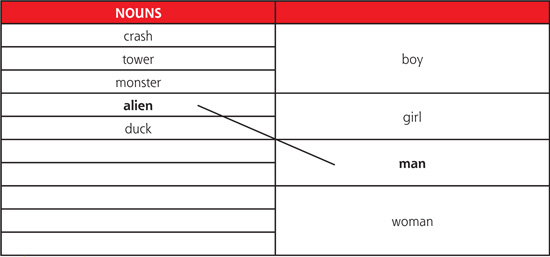
2Who is your superhero when he or she isn’t busy saving the world? How did he or she get his or her powers? Conduct an interview to find out! Write a list of 10 different interview questions. Here are some examples:
*“What do you do for work?”
*“What do you like to eat for dinner?”
*“Do you have children?”
*“How old were you when you got your powers?”
3Pretend to ask your superhero questions and write down what you think the answers would be. This will give you a more complete picture of who your superhero really is!
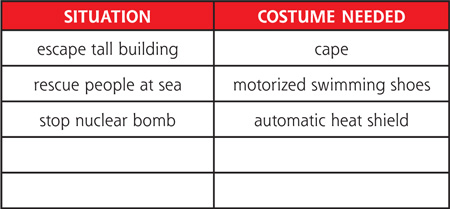
4Superheroes need costumes! Make a chart with two columns. In the first column, list different situations your superhero might encounter, such as rescuing people at sea or stopping nuclear bombs. In the second column, name the costume piece or gadget your superhero will need, such as a cape, motorized swimming shoes, or an automatic heat shield. Choose which ones you want to give your character.
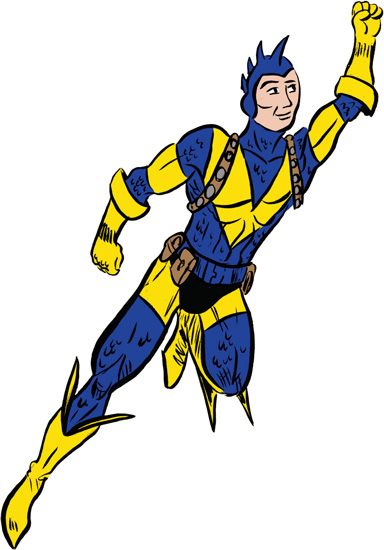
TRY THIS! Design a sidekick. How will the sidekick look compared to the main hero? Will the costume look different or the same? Why do you think some sidekick characters, such as Batman’s Robin, look very different and more colorful?
DESIGN A VILLAIN
Supplies: pencils, paper, markers with dark colors
Every hero needs a villain! Originally, a villain was someone who lived outside of a village. Now, a villain is anyone who wants to upset the normal way things are done. Some villains want revenge. Others want to rule the world. As you design your own villain, think about your hero. Who would be the opposite of your hero? Why would your hero need to protect the world from the villain?
1Come up with the shape of the villain. Villains are often the opposite of your hero. If you have a shorter hero, you may want the villain to be very tall. If your hero is really strong, the villain may need to look weak. Once you have a basic shape, draw the body as you would for a normal comic character.
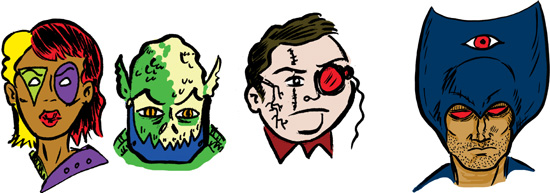
2Design the villain’s face. Think of villains you have seen in animated movies. What sort of facial features do they have in common? One of the most expressive parts of a villain’s face is the eyes. Look at some of the following examples to see how you can make a face villainous.
3Just like your hero, villains need a good backstory. What made them villains? Do they have diabolic plans? Were they childhood friends with your hero? Were they once heroes themselves?
WORDS TO KNOW
diabolic: extremely evil.
4Most villains have dark costumes. If you have seen any Disney films, you may have noticed that the villains usually have black and purple in their costumes. Play around with a few designs for your villain’s costume.
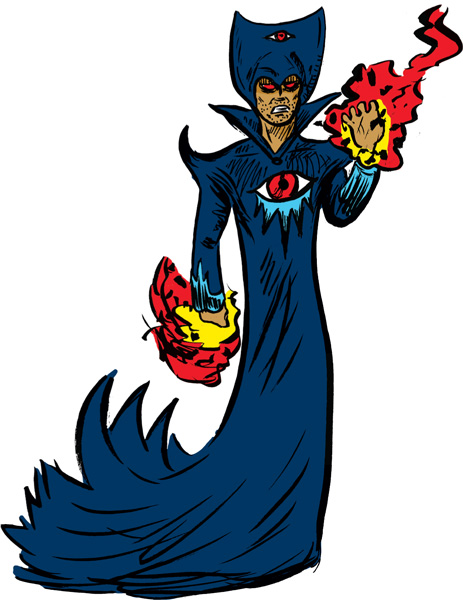
TRY THIS! Villains usually don’t work alone. They rely on minions or thugs to do their dirty work. Try to design a few minions or thugs for your villain. Design their costumes based on what you drew for the villain.
WILL EISNER
Will Eisner put comics to work for the armed forces. He was drafted into the service and began to draw for many army publications, most famously PS Magazine. He developed a popular character called Joe Dope who showed military men the wrong way to do something. It offered a humorous note to what was often boring content. The work he did during World War II inspired the Army to hire Eisner to create a comic book called Preventative Maintenance to be a part of PS Magazine. The comic showed soldiers how to do routine work on their machines. The complicated procedures were made easier to understand through the use of comics. Eisner worked on Preventative Maintenance for 24 years before returning to the world of popular comics.
WORDS TO KNOW
drafted: required to join the military.
MAKE YOUR COMICS MAKE SENSE
Supplies: pencils, paper, ruler, pens
By combining words and pictures, you can make a superhero comic that packs a punch!
1On scratch paper, draw thumbnails for your superhero comic. Make sure there are plenty of chances for action. Remember, your comic should have a beginning, middle, and end. Use as many panels as you need to tell your story.
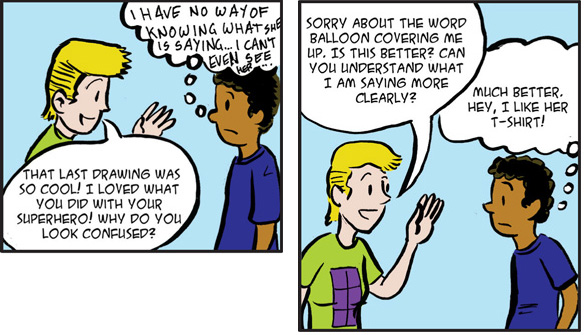
2While you sketch your thumbnail, include some words along with pictures. Here are a few rules about including words in your comics.
*Always have most of your words appear at the top of your panel
*Always write out your words BEFORE you draw your word balloons, thought clouds, and narrative boxes to make sure you have enough space.
*Avoid covering your characters with word balloons and thought clouds.
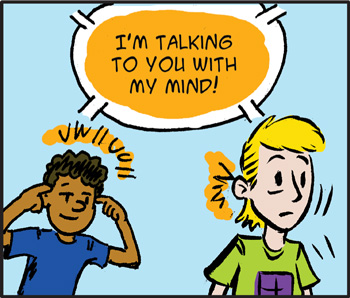
3Try to include a different type of sound or way of communicating in your comic, such as telepathy, radio, a different language, or yelling.
4Explore unique panel designs in your thumbnail. How can you use different panel shapes to show movement or emphasize the action?
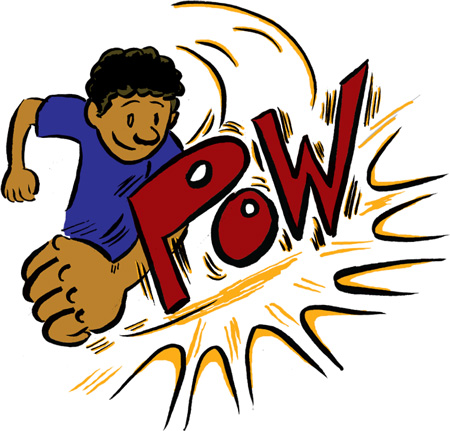
5Try adding some sound effects to your thumbnails. How will you make them look like different noises on the page?
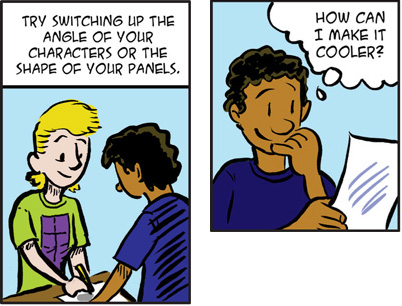
6Copy your thumbnails into your notebook. In the United States, we read left to right, top to bottom. Because of how we read, we need to lay out comic pages in same pattern. Check your comic to make sure your panel designs and sound effects make sense.
WORDS TO KNOW
graphic novel: a comic as long as a book, that tells one story.
TRY THIS! Check out some comic books and graphic novels at your local library. As you read through them, pay attention to panel designs and how the cartoonist uses word balloons. Can you find any other rules? Do any of the cartoonists break the rules? Did it make sense to change or break the rules?
MAKE A DYNAMIC COVER
Supplies: pencils, paper, hero design, villain design, colored pencils or markers, rulers, digital camera, a few friends
During the Golden Age, covers often made the difference between good sales and bad sales. Covers showed lots of action and the title was splashed across the top of the page. Words to help sell the comic were also placed in specific places.
1 Use a piece of scratch paper to do a few thumbnail drawings of your cover design. Think about where you want the title and how you want to show some action. Use stick figures to show the action between your hero and villain. Have your friends pose like the best design you come up with for the cover. Have one friend be the hero and the other be the villain. Take photos from a variety of angles until you find one you really like.
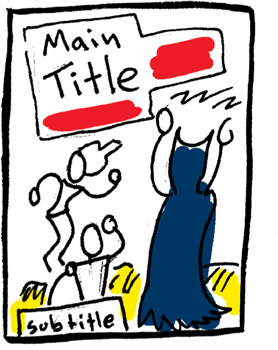
2 On a fresh sheet of paper, use a ruler to mark where the title and any other words will go. Use your photos as references to sketch out the action.
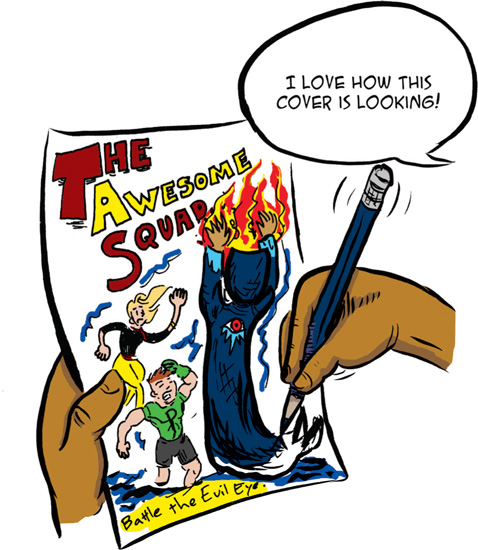
3 Once you are happy with the design, ink over everything with the pen. Then erase all the pencil marks. Now it’s time to add color. You can photocopy your cover design if you want to be able to experiment with color before creating a final color version.