

CHAPTER 5
Not every comics artist wanted to follow the rules of the Comics Code from the 1950s. Many wanted to explore serious subjects, and they wanted to take plenty of space to do it. Some comics artists began to produce and distribute their own comic books. With help from the Xerox machine, they could cheaply print lots of copies of their independent comics. The longer independent comics were called graphic novels.
INDEPENDENCE!
Imagine having someone tell you what your comics have to be about every time you sit down to draw. Does that like fun? Many comic book artists in the 1960s through the 1980s wanted to be able to express their creativity without worrying about the Comics Code. A few brave artists decided to do just that.
Larry Marder began publishing his comic, Tales of the Beanworld, in 1980. He was first inspired by the story his mother tells of how his head looked like a bean when he was born. In college he started drawing little bean-shaped characters that eventually became the cast of his comic.
As his comic evolved, Marder explored themes found within mythology and Native American cultures. His characters live in a place called Beanworld. What do you think Marder means when he says, “Beanworld isn’t a place, it’s a process?”
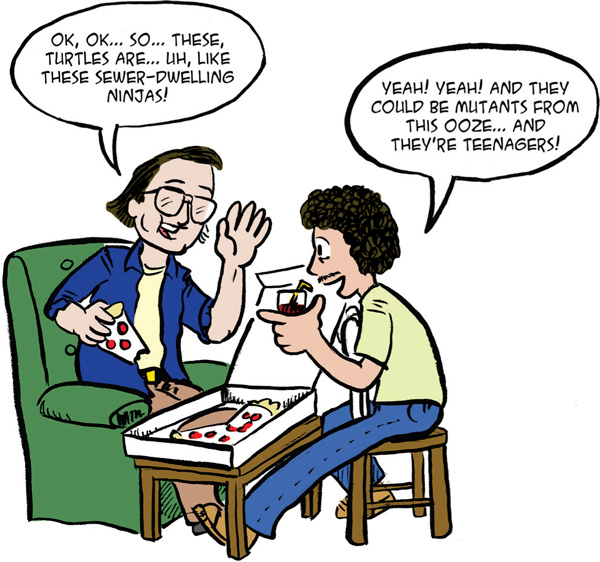
In 1984, two friends from Massachusetts published the first edition of a comic that would become an international, multi-million-dollar phenomenon. Teenage Mutant Ninja Turtles (TMNT) was created by Peter Laird and Kevin Eastman. Originally meant to be a joke about an absurd jumble of words, the comic was instantly popular among comic book fans. The two started their own publishing company, Mirage Studios, to publish the book.

WORDS TO KNOW
mythology: a set of stories or beliefs about a particular religion or culture.

TMNT made hundreds of millions of dollars for their creators through action figures, four feature-length movies, several video games, and two follow-up cartoon shows. Laird and Eastman remained true to their independent comics roots and founded the Xeric Grant to help support other independent cartoonists.
One reason independent comics were so successful was the direct mail system. Up until the late 1970s, comics could only be purchased at newsstands, drug stores, and supermarkets. New companies began to form to distribute comics to readers through the mail. Readers just needed to get a catalog from a distributor to order the comics they wanted.
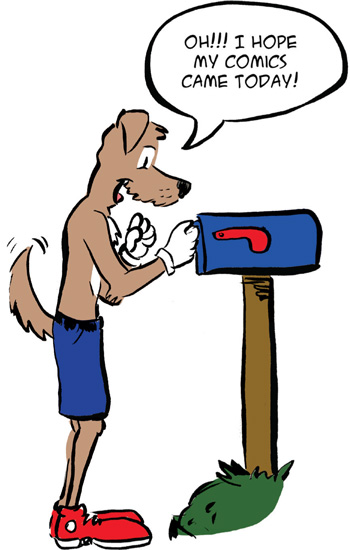
THANKS TO THE XEROX COPIER AND DIRECT MAIL, SELF-PUBLISHED MAGAZINES CALLED ZINES (PRONOUNCED “ZEENS”) COULD BE CREATED QUICKLY AND CHEAPLY, THEN SENT TO READERS.
WORDS TO KNOW
direct mail: a system used to sell things directly to subscribers through the U.S. mail.
zine: a self-published magazine, usually produced using photocopiers.
Early writers of zines, who called themselves zinesters, created zines about everything from politics to rock bands. Zines were often quickly made and easily sold or traded with other zine creators. It was a way to bypass the often difficultto-enter publishing world.
BEFORE THE INTERNET, ZINES WERE THE CHEAPEST AND MOST EFFECTIVE WAY OF GETTING YOUR STORY READ BY AN AUDIENCE.
Mini comics developed out of the independent zines of the 1980s. These self-published comics are very small, which make them easy to produce and distribute. A comics artist will often begin his or her career creating and selling mini comics until a publisher discovers him or her.

LOOOOONG COMICS
Many independent comic book creators collected their comics into thick paperback books to be sold in bookstores. Today, we know them as graphic novels and they are still very popular.
One of the first graphic novels was written in the 1970s. Canadian cartoonist Dave Sim drew a parody of other comics about magic and barbarians. He called it Cerebus after the title character, a barbarian warrior aardvark. Originally meant to be humorous, the comic grew into something bigger. Sim started to tell long stories in his comic about everything from religion to politics.
WORDS TO KNOW
zinester: a person who makes zines.
mini comic: a small, self-published comic.
parody: an imitation of something for comical effect.
Sim wrote the comic and drew the characters, but hired another artist to draw all of the background art. When a storyline was completed, Sim bundled the issues together in a thick, phonebookshaped package to sell. These collections are some of the first examples of the modern graphic novel. Together, they created one of the largest collected independent comics of all time—more than 6,000 pages long!
Another successful, long independent comic book from the late 1970s came from the husband-and-wife team of Richard and Wendy Pini. Their comic book was called Elfquest. The first issue appeared in a fantasy comic magazine called Fantasy Quarterly in 1977.
WORDS TO KNOW
fantasy: a genre of comics and literature based on myth and legend.
genre: a type of creative work, such as mystery, romance, or fantasy.
WHATCHA' CALL IT?
The term graphic novel became widely used when Will Eisner finished his work for the U.S. Army and returned to making comic books. He thought of a new way to present his comics to the world—not through a printed monthly comic book, but through a published, hardcover book sold in bookstores. The books were popular, and people started to take comics seriously again as an art form.

Some graphic novel artists found inspiration in very serious stories. Would you want to read a comic book about the Holocaust?
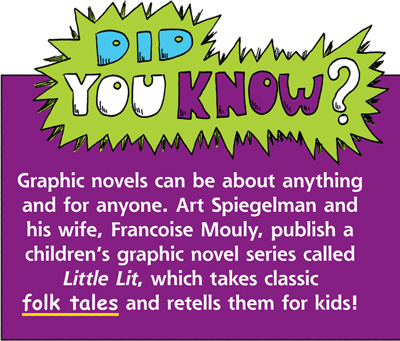
Art Spiegelman’s father was a survivor of Auschwitz, one of the most horrible Nazi concentration camps. Spiegelman decided to tell his story using animals as the characters. In his graphic novel, Maus, Jews were mice and Nazis were cats. He hoped that this technique would make the hard topic easier for readers to look at. He could show disturbing scenes without having to draw the suffering faces of real people.
WORDS TO KNOW
Holocaust: a time before and during World War II when the German Nazis tried to kill the entire Jewish race, as well as several other groups.
concentration camp: a prison where people were sent during the Holocaust to be killed or made to do hard work.
folk tale: a story told by a specific group of people, often involving magic and a moral.
Pulitzer Prize: a group of prizes awarded annually for work done in journalism, fiction, and non-fiction, as well as for photojournalism.
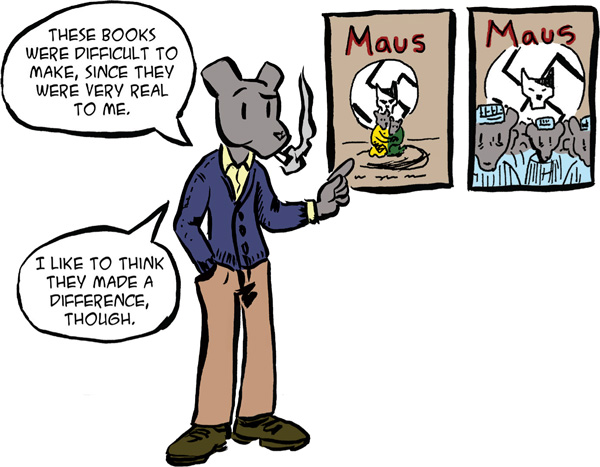
MAUS WAS COLLECTED INTO A TWO-VOLUME GRAPHIC NOVEL IN 1991 AND BECAME THE FIRST COMIC TO WIN THE PULITZER PRIZE FOR LITERATURE.
INDIE GRAPHIC NOVEL PUBLISHERS
Many of the new graphic novels were being published by small independent companies. The three major publishers were Top Shelf, Fantagraphics, and the Canadian publisher, Drawn and Quarterly.
THEY WERE INDEPENDENT BECAUSE THEY WERE NOT OWNED OR OPERATED BY ANY OF THE MAIN PUBLISHING COMPANIES OF THE DAY.
The work of these publishers helped change the perception of comics in America. Their graphic novels were more serious. As book critics and readers began to take note of the more mature work, major book publishers were inspired to start their own graphic novel imprints.
The first major publisher to enter the field was Pantheon Press, the publisher for Art Spiegelman. Pantheon could get graphic novels into major bookstores. In the mid-1990s, the comic book sections of bookstores were made up of mostly superhero comics with a few graphic novels sprinkled in. By the early 2000s, the comics section was renamed the graphic novel section and began to take up whole rows of shelves.
WORDS TO KNOW
imprint: a part of a publishing company that publishes a certain type of book.
IMAGE COMICS
The late 1980s and early 1990s saw some of Marvel Comics’s biggest sales, thanks to the artistic talent of its comic creators. These artists worked hard to produce the best superhero comics possible. However, most of the comics created by DC and Marvel were owned by the companies, not by the writers and artists. This meant the money from sales of comics, T-shirts, or movies went to the company. Some of the artists wanted more creative say and control over their characters.
In 1992, several artists and writers, mostly from Marvel, decided to quit working for the big publishers and start their own company. The result was Image Comics. It began with a simple idea: that the creators of comics should retain complete control over their characters and comic book stories.

The first comics to be published by Image were very successful. As the popularity of Image Comics grew, more comics artists joined Image to publish their own comics. Today, it remains one of the most successful independent comic book publishers and often is considered a mainstream comics publisher.
IMAGE REFUSED TO JOIN THE COMICS CODE AUTHORITY, WHICH MEANS THAT ITS COMICS CAN’T BE CENSORED BY ANYONE OUTSIDE OF ITS OWN OFFICES.
THE COMIC BOOKSTORE
As comic books and graphic novels started to become popular again, they needed a place where fans could find them. Comic bookstores popped up all across America during the 1980s and mid-1990s. People who loved comics could browse shelves stocked with books, T-shirts, action figures, and posters. They could even write a list of their favorite comic titles, and when the bookstore got a shipment, the employees would pull those titles aside and save them. This was called a pull list. Most big towns still have one or two comic stores and you can still make a “pull” of your favorite comics. Check them out sometime—you might even make some new friends who love the same comics as you!
WORDS TO KNOW
pull list: a list of comics that your local comic bookstore will order and set aside for you.
NEWSPAPER COMICS IN THE MODERN AGE
Independent comics creators and publishers weren’t the only ones enjoying the modern age of comics. Newspaper comics also thrived between the late 1970s and 1990s.
These newspaper comics had changed through the decades. When Charles Schulz introduced Peanuts in 1950, his use of a simple background was new and innovative. In the ’70s, ’80s, and ’90s, most comic strips relied more on memorable characters than complicated settings to stay popular.
If someone was to ask you the name of the fat orange cat who loves lasagna, you’d probably shout, “Garfield!” In the 1970s, Jim Davis created a strip that mostly took place on the floor or countertop, with very few extra details. The humans in the strip interacted with Garfield, but they couldn’t hear what Garfield was thinking. However, the audience knew Garfield’s thoughts, through the use of a thought cloud.
GARFIELD WAS A commercial SUCCESS! HE IS STILL FOUND ON EVERYTHING FROM COFFEE MUGS TO T-SHIRTS AND IS AN ANIMATED TV SERIES.

Not every cartoonist was interested in commercial success. In 1985, Bill Watterson introduced the world to a boy and a stuffed tiger in what many consider to be one of the top 10 comic strips of all time. People ages 6 to 96 love Calvin and Hobbes. No other comic strip has been so popular with such a wide range of ages.
Watterson says he was inspired partly by his own childhood and partly by the comic strip greats who came before him. These include Winsor McCay, George Herriman, Walt Kelly, and Charles Schulz.
WORDS TO KNOW
commercial: operating as a business to earn money.
 More Garfield!
Bill Watterson gave a speech at Kenyon College in 1990 that was made into a cartoon by comics artist Gavin Aung Than. Can you find similarities between Than’s comic and Watterson’s style of drawing?

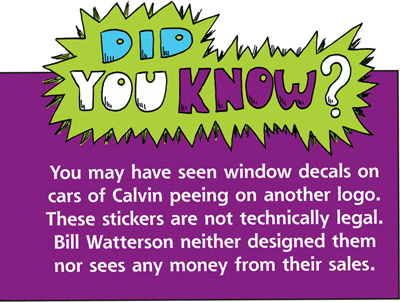
Plans were made for Calvin and Hobbes to appear on everything from socks to hats and there was even talk of a television series, but Bill Watterson said no. He wanted his strip to be enjoyed as a comic strip and nothing more. He successfully fought against marketing his strip on other products, something comics had been doing since The Yellow Kid almost 100 years before. Even after he retired Calvin and Hobbes in 1995, he still refused to allow his characters to be used in other places.
MANGA
Let’s take a moment and travel to Japan! Remember Hokusai, who invented manga? Cartooning was popular in Japan through the early twentieth century. After World War II, the Japanese comics from before the war were associated with the empire, which had fallen. No one wanted to read these comics anymore. The manga that took its place after the war became the most popular form of comics in the world.
Manga publishers sprang up all across the country. They printed their comics in quarterly, monthly, and even weekly editions. Manga books were the size of telephone books.
MANGA STORIES WERE ABOUT EVERYTHING, FROM LIFE AS AN OFFICE WORKER TO BEING A SPACE EXPLORER.
More Calvin and Hobbes!
The biggest name in manga grew to fame in the late ’40s and early ’50s. Osamu Tezuka was inspired by the comics and cartoons he saw from America, such as Walt Disney’s work. Tezuka chose to focus his early comics on a general audience and grew a large following of fans. His first anime, which is a form of manga-style animation, was called Astro Boy. It was one of the first Japanese comics to be seen by Americans. During the course of his career, Tezuka wrote and drew more than 150,000 pages of comics, as well as directed several animated features and series of his work.

OSAMU TEZUKA IS OFTEN CALLED THE WALT DISNEY OF JAPAN.
WORDS TO KNOW
anime: Japanese animation.
MANGA AND ANIME
Many Americans first experienced Japan’s comic style in the form of anime. Often people confuse anime and manga. Many of the manga that Tezuka created for print were then made into anime. Other times, the anime would inspire a printed run of manga. A good rule of thumb when you see Japanese cartooning is if it moves, it’s anime. If it doesn’t, it’s manga!
When manga became popular in America, the language translation was the easy part. The structure of the comic was harder. The Japanese read from right to left, which means their front covers are our back covers. In order for Americans to read them from left to right, the pages and panels had to be rearranged!
American readers at first didn’t understand certain expressions and gestures of manga characters, but it didn’t take long before people loved reading them. Today, American publishers no longer switch the layout of manga books. American readers are used to reading them from right to left, just like the Japanese!

COMIC-CON!
Comic book lovers often gather at conventions called Comic-Con. The Golden State Comic-Con was the first, in 1970 with 300 attendees. By 1980, it had been renamed the San Diego Comic-Con and more than 5,000 people went. Today, more than 100,000 people visit every year! Comic-Cons are held all over the world. Anyone can buy table space to sell his or her comics. Some of the best-known conventions are Stumptown, SPX, APE, and MoCCA. People even go dressed as their favorite characters!
WORDS TO KNOW
convention: a gathering of people who are all interested in a certain idea, topic, or event.
COSTUME FOR A COMIC-CON
Supplies: images of the character you want to dress as, paper and pencil, supplies for gadgets (such as recycled boxes, plastic cans, and wrapping paper tubes), fabric, scissors, glue, paint, used clothing
Many convention goers dress as their favorite characters. It’s called cosplay, and it’s a way to make conventions more fun.
1Sketch out your costume. Use pictures of your character as a reference to sketch out what you need to make yourself look like the character.
2Figure out what supplies you need to make each part of the costume. Can you get clothes at a used clothing store for your costume? These clothes can be cut up or painted and glued. Check the recycle bin for things such as cardboard and plastic.
3Using your sketch as a guide, begin making the different parts of your costume. Ask an adult for help if you need it. Make sure to try on all the parts as you make them.
4Be awesome. Wear your cool costume to a local comic convention. How many people knew who you were? How many other cosplayers did you meet? What kinds of tips did they share with you about making costumes?

TRY THIS! Gather a group of friends together to design costumes for a super team. Often, conventions have contests for the best group cosplay. See if you can win!
DRAW MANGA-STYLE CHARACTERS
Supplies: pencils, pens, paper
Comics look different in each part of the world. European comics often have a more sketchy style, while American comics have cleaner lines. Let’s look at how to draw Japanese manga characters before we do the harder work of learning how to draw their faces!
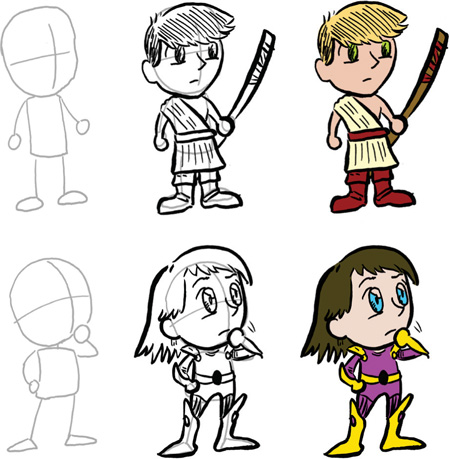
1Manga characters tend to have thin bodies, with long arms and legs. Start by drawing an action line for your character. Draw a larger-thannormal circle at the top for the head and then draw a thin rectangle for the body. Draw the sketchy skeleton for the arms and legs the same way you would for any other comic.

2Add meat to the skeleton, but not too much! Often, manga characters have more slender arms and legs than American characters. This allows for the great expressive poses that manga is known for.
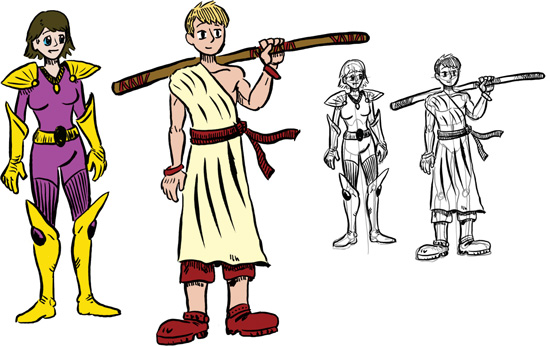
3Add clothes and ink your manga character. Erase the pencil lines and add color!
TRY THIS! Can you turn your hero and villain characters into manga?
WORDS TO KNOW
comic relief: the inclusion of a funny character or scene in an otherwise serious work.
TRY THIS, TOO! In manga, a certain type of character drawing is known as the chibi. A chibi is a shortened version of the main character and it often looks like a child. Chibi are used to show extreme emotions and for comic relief. Look at the step-by-step illustrations shown here. Can you turn your manga character into a chibi?
DRAW MANGA-STYLE FACES
Supplies: pencils, paper, pens
The design of the faces is what makes manga so recognizable. Let’s crack the code of what makes a face manga.
1Unlike the oval face shapes of American comics, the general shape of a manga face is a large circle. Draw a circular face shape.
2Just as in American comics, draw a vertical guideline down the middle of the face where the nose will go.
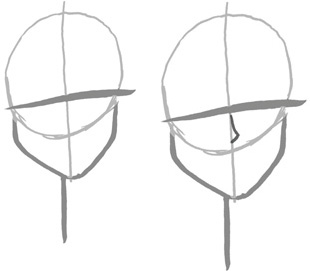
3Unlike American comics, the horizontal line doesn’t go through the middle of the face shape. Instead, it should go about two-thirds down from the top of the head. This is to give enough room for the large, iconic manga eyes.
4Extend your vertical guideline through the bottom of the circle. Add the jawline and chin by connecting the bottom of the vertical guideline with the right and left ends of the horizontal guideline as shown in the example.
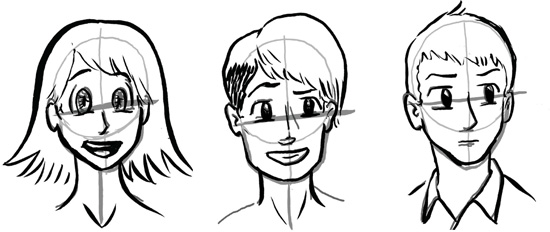
5Manga noses are either very small or hugely expressive. Using the examples shown here, draw a nose between the horizontal guideline and the bottom of the circle.

6Now draw the eyes following the step-by-step example shown below.

7Draw the mouth, eyebrows, and ears. The mouth will be smaller than the eye guides. Look at the examples of manga mouths. The eyebrows, aren’t much different from American eyebrows, and manga ears are either big or small, depending on your style.

8Manga hair is super fun to draw since it can be really wild. Most manga women have long, flowing hair, which can be bunched up, braided, or swirling all around them. Manga men, and women, also often have angular, spiky hair. Open up any manga from your local library to see these different styles. Remember to make sure the hair is connected to the head.
TRY THIS! Try to draw yourself and people you know as manga characters. Is it easier or more difficult than trying to draw them as American cartoons?
MAP A LONG COMIC
Supplies: ruled notebook, sketchbook, trusty pen or pencil
Writing your own graphic novel will take time. It took Art Spiegelman more than 10 years to finish Maus! You can get started on your own graphic novel by laying the foundation with thumbnails and a script.
1In your notebook, write a short paragraph describing what your graphic novel will be about. Will it be about space exploration? The Wild West? A historical event or past experience?
2Break down your story. Start with three parts: beginning, middle, and end. Write a little about what happens in each part. Now break each part into sections, or scenes. Write a few words for each scene to tell what is happening.

3Write a script. The script simply tells you what is going to happen on each page. Use your outline and write out what happens, section by section. Make sure you include some talking and notes for the actions. Break your script up into different comics pages as you go.
4Using your script, thumbnail out what each page will look like in your sketchbook. Make changes. Every cartoonist always makes changes to his or her script and thumbnails as the graphic novel develops. Don’t be afraid to change something if you have a cooler idea. That’s all part of the process.
