
4
As, from a well-blazing fire, sparks
By the thousand issue forth of like form,
So from the Imperishable, my friend, beings manifold
Are produced, and thither also go.
—Mundaka Upanishad
Even though you tie a hundred knots
The string remains one.
—Rumi
The Mystery of the Creative Impulse
The realization that all the phenomenal worlds, including our material plane, are virtual realities created by Absolute Consciousness leads to some very interesting questions. The merging and union with the cosmic creative principle, as it was described in the previous chapter, is certainly an extraordinary and very desirable experience from the point of view of an individual human being. Many spiritual traditions consider reaching this state to be the ultimate goal of the spiritual quest. Those who actually attain the union with the Universal Mind realize that the situation is much more complicated.
They discover that what they once considered to be the goal of the spiritual journey is also the source of creation. It becomes clear to them that, in order to create the phenomenal worlds, the Divine has to abandon its original state of pristine undifferentiated unity. Considering how fantastic the experience of identification with Absolute Consciousness is from the human perspective, it seems strange that the creative principle should seek an alternative, or at least a complement, to a simple experience of itself. This naturally leads to the question about the nature of the forces that compel Absolute Consciousness to relinquish its primordial state and to engage in the process of creating experiential realities like the world we live in. What could possibly motivate the Divine to seek separation, pain, struggle, incompleteness, and impermanence, in short, precisely the states from which we are trying to escape when we embark on the spiritual journey?
People who achieve in their inner exploration the identification with Absolute Consciousness often experience fascinating insights into the dynamics of creation. Before we start examining these revelations, it is important to remember that holotropic states in general, and those that involve transcendental levels of awareness in particular, do not lend themselves well to verbal descriptions. As we review these reports, we might find them interesting and intellectually stimulating or feel inspired by them, but we should not expect logical explanations that would fully satisfy our rational mind. Because of the inherent limitations of our intellectual faculties, the human attempts to understand the “reasons” or “motives” for creation will never be completely satisfactory. Reason is an inadequate instrument for the analysis of transcendental dimensions of existence and of principles that operate on a very high metaphysical level. Ultimately, true understanding in these matters is possible only through direct personal experience.
Individuals describing their experiences of identification with the Divine are not able to avoid anthropocentric perspectives and to overcome the limitations of language. Thus the creative impulse of Absolute Consciousness is often described in terms of certain psychological states that we know from our everyday life, such as love, longing, or loneliness. Their authors usually capitalize the first letters of such words to indicate that they mean transcendental analogs, or “higher octaves,” of such feelings rather than states that are directly comparable to those that we know from our everyday life. This is a practice well known from the writings of psychiatric patients who have experienced unusual revelations concerning transcendental issues and struggle to describe what happened to them.
The reports of people who in their holotropic states of consciousness have had insights into the “motivation” of the divine creative principle to generate experiential worlds contain some interesting contradictions. One important category of these insights emphasizes the fantastic resources and inconceivable capacities of Absolute Consciousness. Another group of revelations suggests that, in the process of creation, Absolute Consciousness seeks something that it lacks and misses in its original pristine state. From an ordinary perspective, these two categories of insights appear to contradict each other. In holotropic states, this conflict disappears and they can easily coexist.
Divine Cornucopia
The impulse to create is often described as an elemental force that reflects the unimaginable inner richness and abundance of the Divine. The creative cosmic source is so immense and overflowing with limitless possibilities that it cannot contain itself and has to express its full hidden potential. The experience of this quality of Absolute Consciousness is sometimes likened to a close-up view of the thermonuclear processes in the sun, the life-giving principle and source of energy for our planet. People who have this experience realize that the sun is the most immediate expression of the divine that we can experience in the material world and they understand why some cultures worshipped the sun as God.
However, they usually emphasize that this similarity should not be taken too literally, since there are also important differences between the sun as an astronomical body and the Cosmic Sun, the creative principle responsible for creation. The physical sun only contributes the energy necessary for the life processes, while the divine source also provides the Logos for creation—its order, forms, and meaning. Yet, in our everyday life, observing the sun seems to be the closest approximation to the experience of the divine source of creation as it reveals itself to us in holotropic states.
Other descriptions stress the immense desire of the Universal Mind to get to know itself and to explore and experience its full potential. This can only be done by exteriorization and manifestation of all its latent possibilities in the form of a concrete creative act. It requires polarization into subject and object, the dichotomy of the observer and the observed. These insights are reminiscent of the way creation is explained in certain Cabalistic texts, according to which there once was a state of previous nonexistence, in which “Face did not gaze upon Face.” The reason for creation was that “God wished to behold God.” Similarly, the great Persian mystic Jalaluddin Rumi wrote: “I was a Hidden Treasure, so I wanted to be known. … I created the whole of the universe, and the goal in all of it is to make Myself manifest” (Hines 1996).
Additional important dimensions of the creative process that are often emphasized are the playfulness, self-delectation, and cosmic humor of the Creator. These are elements that have best been described in ancient Hindu texts that talk about the universe and existence as lila, or Divine Play. According to this view, creation is an intricate, infinitely complex cosmic game that the Godhead, Brahman, creates from himself and within himself. He is the playwright who conceived the game, as well as its producer, director, and also all the actors who play the countless myriads of the roles involved. This cosmic game of games is played in many dimensions, on many levels, and on unimaginable scales.
Creation can also be viewed as a colossal experiment that expresses the immense curiosity of Absolute Consciousness, a passion that is analogous to the infatuation of a scientist who dedicates his or her life to exploration and research. However, the cosmic experiment is naturally infinitely more complex than anything that collective effort of all of the scientists of the world could possibly conceive of. All the fascinating discoveries of science that extend far into the microworld and into the remote regions of the universe just barely scratch the surface of the unfathomable enigma of existence. Science, as we know it, only explores in increasingly refined ways the nature and content of the final products of creation, but does not reveal anything about the mysterious process that underlies it and brings it forth.
The question that repeatedly emerges in nonordinary states is the degree of control that the Divine has in the process of creation. It is a problem that Albert Einstein often struggled with. Here it is stated in his own words: “What really interests me is whether God had any choice in the creation of the world.” The answers of the people who have reached this level of insight are not unanimous. Sometimes it appears that Absolute Consciousness is fully in charge of creation in its totality and in all its details. In this case, any surprises in the cosmic game occur only to individual protagonists. They are due to sudden lifting of their veil of ignorance that reveals significant aspects of divine knowledge that were previously hidden from them.
Occasionally, people experiencing holotropic states become aware of a significant alternative to this scenario. They see that it might be possible that only the basic parameters of creation are clearly defined, but the final outcome in detail remains unpredictable even for the Divine. This latter model of the cosmic game can be compared to a kaleidoscope or a chess game. The inventor of the kaleidoscope obviously realized that rotating a tube containing specially arranged mirrors and colorful pieces of glass would produce arrays of beautiful dynamic images. However, he or she could not possibly have foreseen all the specific constellations and combinations that would arise in the process of the use of this device.
Similarly, the inventor of chess could see the general potential of a game played on a board of sixty-four black and white squares with figures of specifically defined roles and movements. Yet it would have been absolutely out of question to anticipate all the infinite possibilities of specific situations that playing chess would eventually lead to. Naturally, the complexity of creation is infinitely greater than that of the kaleidoscope or the chess game. Although the intelligence of Absolute Consciousness is immense, it is conceivable that the unfolding of the cosmic drama can be beyond its control and can provide genuine surprises.
This is closely related to the question of our own role in the cosmic drama. If the universal script is written by the Divine in all the details, this does not leave us as individual players any possibility of active creative participation. The best we can do is to awaken to the fact that in the past our life has been inauthentic because we were misinformed about critical aspects of existence and about our own nature. However, if certain developments are unpredictable even for the Divine, various undesirable trends, such as the current global crisis, might require our assistance. In that case, we could actually become truly active players and valuable partners of Absolute Consciousness in the divine play.
Some people who have experienced insights into the “motives” for creation also emphasize its esthetic side. In our everyday life, we are often struck by the inherent beauty of the universe and nature, as well as those aspects of creation that are mediated by human activity, such as exquisite art and architecture. In holotropic states the ability to appreciate the esthetic side of all the different aspects of life and existence is greatly enhanced. When the “doors of perception are cleansed,” to use William Blake’s expression, it is difficult to miss the astonishing beauty of creation. From this perspective, the universe we live in and all the experiential realities in other dimensions also appear to be ultimate works of art and the impulse to create them can be likened to the inspiration and creative passion of a supreme artist.
Divine Longing
As I mentioned earlier, sometimes the insights concerning the forces underlying creation reveal “motives” that are of a different kind and even seem to be in conflict with the ones described above. They do not reflect overflowing abundance, richness, ultimate self-sufficiency, and mastery of the cosmic creative principle, but a certain sense of deficiency, need, or want. For example, it is possible to discover that, in spite of the immensity and perfection of its state of being, Absolute Consciousness realizes that it is alone. This Loneliness finds its expression in an abysmal yearning for partnership, communication, and sharing—a kind of Divine Longing. The most powerful force behind creation is then described as the need of the creative principle to give and receive Love.
Another critical dimension of the creative process that has occasionally been reported in this category seems to be the primordial craving of the divine source for the experience of the tangible material world. According to these insights, Spirit has a profound desire to experience what is opposite and contrary to its own nature. It wants to explore all the qualities that in its pristine nature it does not have and to become everything that it is not. Being eternal, infinite, unlimited, and ethereal, it longs for the ephemeral, impermanent, limited by time and space, solid, and corporeal. This dynamic relation between spirit and matter was portrayed in the Aztec mythology as the tension between two deities—Tezcatlipoca (Smoking Mirror) symbolizing matter and Quetzalcoatl (Plumed Serpent) representing spirit. A beautiful illustration of this cosmic dance between Quetzalcoatl and Tezcatlipoca can be found in the Aztec screenfold known as Codex Borbonicus.
The understanding of the active role of consciousness in creation is not necessarily limited to religion, philosophy, and mythology. According to modern physicists, the act of conscious observation changes probability of certain events into actuality and thus participates in the creation of material reality. In one of his lectures exploring the philosophical and spiritual implications of quantum-relativistic physics, physicist Fred Alan Wolf referred to the active role that consciousness plays in the creation of the material world. He speculated about the mechanisms underlying this process and suggested that the ultimate reason for creation of the material world might be the addiction of consciousness and spirit to the experience of matter. In everyday life, this craving of spirit for matter might be the deepest root of all our human attachments and addictions.
Another important “motive” for creation that is occasionally mentioned is the element of monotony. However immense and glorious the experience of the Divine might appear from the human perspective, for the Divine it is always the same and, in that sense, monotonous. Creation can then be seen as a titanic effort expressing a transcendental longing for change, action, movement, drama, and surprise. The countless experiential realities in many different dimensions and on many different levels offer infinite number of opportunities for adventures in consciousness and divine self-entertainment. The extreme forms of descriptions portraying creation as an act aimed at overcoming the monotony of undifferentiated Absolute Consciousness even refer to Cosmic Boredom. This again echoes passages from medieval Cabalistic texts that describe that one of the reasons God created the universe was to overcome boredom.
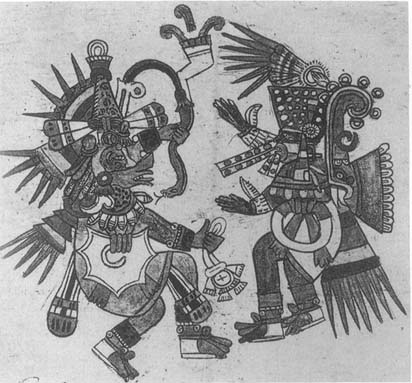
Figure 1.
Quetzalcoatl and Tezcatlipoca. The legends of ancient Mexico assert that the worlds of matter and spirit are coexistent and each has something that the other needs. In this painting from the Aztec Codex Borbonicus, the dynamic tension between Spirit and Matter is represented as the complementary cosmic dance of Quetzalcoatl (in his form of Ehecatl, god of wind and breath) and Tezcatlipoca, the Smoking Mirror.
Source: Stanislav Grof, Books of the Dead. Thames & Hudson, London, 1996, p. 93. Reprinted with permission of the Bibliothèque de l’Assemblée Nationale, 126 Rue de l’Université, 75007 Paris.
The creation of various phenomenal worlds also makes it possible for Absolute Consciousness to escape from the intolerable Eternal Here and Now into the comforting and predictable experience of linear time, limited space, and impermanence. This would then be the polar opposite and negative mirror image of the human fear of death and impermanence that underlies our deep craving for immortality and transcendence. For people who have had this experience, the threat of extinction of consciousness can be permanently replaced by the awareness that ultimately there is no way out of consciousness.
All those who have been fortunate to experience such profound insights into the cosmic laboratory of creation seem to agree that anything that can be said about this level of reality cannot possibly do justice to what they have witnessed. The monumental impulse of unimaginable proportions that is reponsible for creating the worlds of phenomena seems to contain all the above elements, however contradictory and paradoxical they might appear to our everyday sensibility and commonsense, and many more. It is clear that, in spite of all our efforts to comprehend and describe creation, the nature of the creative principle and of the process of creation remains shrouded in unfathomable mystery.
Dynamics of the Creative Process
Besides the revelations concerning the “reasons” for creation (the “why” of creation), the experiences in holotropic states often bring illuminating insights into the specific dynamics and mechanisms of the creative process (the “how” of creation). These are related to the “technology of consciousness” that generates experiences with different sensory characteristics and by orchestrating them in a systematic and coherent way creates virtual realities. Although the descriptions of these insights vary in terms of details, language, and metaphors used to illustrate them, they typically distinguish two interrelated and mutually complementary processes that are involved in creating the worlds of phenomena.
The first of these is the activity that splits the original undifferentiated unity of Absolute Consciousness into an increasing number of derived units of consciousness. The Universal Mind engages in a creative play that involves complicated sequences of divisions, fragmentations, and differentiations. This finally results in experiential worlds that contain countless separate entities that are endowed with specific forms of consciousness and possess selective self-awareness. There seems to be general agreement that these come into being by multiple divisions and subdivisions of the originally undivided field of cosmic consciousness. The Divine thus does not create something outside of itself, but by transformations within the field of its own being.
The second important element in the process of creation is a unique form of “partitioning,” or of isolating “cosmic screenwork,” through which the filial conscious entities progressively and increasingly lose contact with their original source and the awareness of their pristine nature. They also develop a sense of individual identity and absolute separateness from each other. In the final stages of this process, intangible but relatively impermeable screens exist between these split-off units and also between each of them and the original undifferentiated pool of Absolute Consciousness. It is important to emphasize that this sense of separation is purely subjective and ultimately illusory. On a deeper level, the undivided and undifferentiated unity continues to underlie all of creation.
The terms “partitioning” and “cosmic screenwork” are not quite appropriate in this context, since they suggest mechanical separation of elements and breaking of the whole into its parts. Such concrete images are much more suitable for crafts dealing with various materials, such as masonry or carpentry, than for the dynamics I am referring to. This is why many people borrow the terminology from psychology and compare this process with such mechanisms as forgetting, repression, or dissociation. We are talking here about the phenomenon that the writer and philosopher Alan Watts called “the taboo against knowing who you are.” According to the insights from various holotropic states, the split-off units of consciousness are not necessarily only humans and animals, but also plants and elements of the inorganic world, discarnate entities, and archetypal beings.
The relationship between Absolute Consciousness and its parts is unique and complex and cannot be understood in terms of conventional thinking and ordinary logic. Our common sense is telling us that a part cannot simultaneously be the whole and that the whole, being an assembly of its parts, has to be larger than any of its components. And because the whole is an assembly of its constituents, we should be able to understand it by studying its parts. Until recently, this has been one of the fundamental assumptions of Western science. In addition, the parts should have a specific location in the context of the whole and occupy a certain portion of its overall size. While all that has just been said about the relationship of the whole to its parts seems to be true and self-evident in our everyday life, none of these characteristics and limitations apply in an absolute sense to the cosmic game.
In the universal fabric, separate units of consciousness, in spite of their individuality and specific differences, remain on another level essentially identical with their source and with each other. They have a paradoxical nature, being wholes and parts at the same time. Essential information about each of them is distributed in the entire cosmic field and they, in turn, have potential access to the information about all of creation. This is most obvious in regard to human beings where we have direct evidence of these relationships in the form of an entire spectrum of transpersonal experiences.
In transpersonal states, we have the potential to experience ourselves as anything that is part of creation, as well as the creative principle itself. The same is true for other people who can experience themselves as anything and anybody else, including ourselves. In this sense, each human being is not only a small constituent part of the universe, but also the entire field of creation. Similar interconnectedness seems to exist in the animal and botanical kingdom and even in the inorganic world. Observations concerning the evolution of species and the paradoxes in quantum physics certainly point in that direction.
This situation is reminiscent of the descriptions found in the ancient Indian spiritual systems, particularly in Jainism and in Avatamsaka Buddhism. According to Jain cosmology, the world of creation is an infinitely complex system of deluded units of consciousness, or jivas, trapped in different aspects and stages of the cosmic process. Their pristine nature is contaminated by their entanglement in material reality and, particularly, in biological processes. The Jains associate these jivas not only with organic life forms, but also with inorganic objects and processes. Each jiva, in spite of its seeming separateness, remains connected with all the other jivas and contains the knowledge about all of them.
The Avatamsaka Sutra uses a poetic image to illustrate the interconnectedness of all things. It is the famous necklace of the Vedic god Indra: “In the heaven of Indra, there is said to be a network of pearls, so arranged that if you look at one, you see all the others reflected in it. In the same way, each object in the world is not merely itself, but involves every other object and, in fact, is everything else.” Similar concepts can be found in the Hwa Yen school of Buddhist thought, the Chinese version of the same teaching. Hwa Yen is a holistic view of the universe that embodies one of the most profound insights the human mind has ever attained. The essence of this philosophy can be succinctly expressed in a few words: “One in One, One in Many, Many in One, Many in Many.” The concept of mutual cosmic interpenetration characteristic for this school is beautifully exemplified in the following story:
The Empress Wu, who had difficulties understanding the complexity of Hwa Yen philosophy, asked Fa Tsang, one of the founders of the school, to give her a simple practical demonstration of cosmic inter-relatedness. Fa Tsang took her to a large hall, the entire interior of which—the walls, ceiling, and floor—was covered with mirrors. He first lit a candle in the center of this hall and suspended it from the ceiling. In the next moment, they were surrounded by myriads of glowing candles of different sizes reaching to infinity. This was Fa Tsang’s way of illustrating the relationship of the One to the many.
He then placed in the center of the hall a small crystal with many facets. Everything around the crystal, including all the countless images of candles, was now collected and reflected in the small interior of the brilliant stone. In this way, Fa Tsang was able to demonstrate how in Ultimate Reality the infinitely small contains the infinitely large and the infinitely large the infinitely small, without obstruction. Having done this, he pointed out that this static model was actually very limited and imperfect. It was unable to capture the perpetual, multidimensional motion in the universe and the unimpeded mutual interpenetration of Time and Eternity, as well as past, present, and future.
Metaphors for Creation
People who have envisioned in holotropic states the dynamics of the cosmic creative process and try to describe their insights often lack means of adequate verbal expression. They tend to resort to various symbolic images, metaphors, and parallels from everyday life, hoping that this will help to illustrate some of the experiences and ideas that they are trying to communicate. I will use the same approach in the following description of the creative process, using as illustration images drawn from the circulation of water in nature. References to such natural phenomena are particularly frequent in the accounts from sessions that contain cosmological visions.
Before the onset of creation, Cosmic Consciousness is a boundless undifferentiated field with immense creative potential.
Within it, creation begins as a ripple, as a disturbance of the original unity, that manifests as playful imagining and imaging of various forms. At first, the created entities maintain their contact with the source and the separation is only tentative, relative, and incomplete. Using the water metaphor, the original undivided unity of Absolute Consciousness would have the form of a deep and calm ocean of unimaginable magnitude. The image that can best illustrate the initial stage of the process of creation is the formation of waves on the surface of the ocean.
From one point of view, the waves can be seen and referred to as individual and separate entities. For example, it is possible to talk about a large, fast, and green wave, or one that is good or dangerous for surfers. At the same time, it is quite clear that, in spite of its relative individuality, the wave is also an integral part of the ocean. The differentiation of the waves from the ocean is playful, illusory, and incomplete. A sudden breeze can form waves on the surface of the ocean and when the wind calms down, these waves resume their original full identity with the ocean.
In the stage I have described so far, the creative source generates images different from itself, but these retain the connection with the source and awareness of their essential identity with it. Genuine creation requires that its products become separate and clearly distinguishable from the creative matrix. It begins in a true sense only when the connection with the source is severed and separate identity established. This may at first occur only for a fleeting moment. The corresponding metaphorical image would be that of a wave breaking in the wind or at the shore. As the solid body of water explodes into thousands of little droplets, these assume for an instant separate identity and independent existence, as they are flying through the air. This situation lasts only a very short time, until they all fall back and reunite with the ocean.
In the next phase, the separation is much more definite and the split-off units of consciousness assume their individual identity and independence for a considerable amount of time. This is the beginning of the partitioning, the “cosmic screenwork” or cosmic dissociation and forgetting. The original unity with the source is temporarily lost and the divine identity forgotten. A metaphorical parallel of this situation would be tidal water that got trapped in a pool on a rocky shore when the ocean receded during the low tide. This development involves long-term separation between the maternal waters in the ocean and the water in the pool. Yet during the next high tide the union will be reestablished and the separated mass of water will return to the source.
The continuation of the process of individuation results in a situation in which the separation is complete, convincing, and may appear permanent. A radical metamorphosis occurs and the split-off units of consciousness assume a new identity, quite different from the previous one. The original unity is obscured and concealed, but it is not completely lost. This stage of creation can be illustrated by a body of water that has evaporated from the ocean and has formed a cloud. Before becoming a cloud, the water underwent a profound transformation. The new entity now has a specific and characteristic shape and a life of its own. Yet the little droplets of water that can form in it betray the source and origin of this new phenomenon. They can easily condense, precipitate, and start their way to reunion with the ocean in the form of rain.
In the final phase, the separation is complete and the liaison with the source appears to be all but lost. The transformation is radical and total and the original identity is forgotten. The form of this new unit is distinct, very complex, and solidified. At the same time, the process of multiple divisions has advanced and the consciousness of the created entity appears to represent only an infinitesimal part of the original whole. A good example of this stage is the snowflake that crystallized in the cloud from the water that originally evaporated from the ocean. The snowflake represents only an infinitesimal fragment of the mass of water in the ocean and has a very specific individual shape and structure. The amazing array of forms that the snowflakes assume is a good illustration of the richness of creation characterizing the phenomenal world. The snowflake bears very little similarity to the source and in order to be able to reunite, it has to undergo fundamental changes of its structure and lose its identity.
We could go a step further and think about a block of ice. Here the water is so radically transmuted and so different from its original form that we would not be able to recognize its identity with water if we did not have the intellectual knowledge of the process of freezing and its effects. In sharp contrast to water, ice is dense, solid, hard, and rigid. Like the snowflake, to return to its original aquatic condition, it has to undergo a complete annihilation and lose what appear to be its essential characteristics.
Similar images likening various aspects of creation to water can be found in mystical literature of all ages. Here is how Rumi describes the Divine and its works: “That is the Ocean of Oneness, wherein is no mate or consort. Its pearls and its fish are none other than its waves. … Spirit is truly and always one; but its manifestations on different planes of creation are different. Just as ice, water, and vapor are not three things but only three forms of the same thing, similarly Spirit is one, but its forms are many. In the very highest transcendent realms, it abides as an extremely fine and subtle entity; but as we descend toward less subtle regions, this Spirit also takes less subtle forms.”
In the extreme situation, the source is not only lost and forgotten, but its existence is being denied. It would be difficult to find a fitting image for this stage of creation that would be related to the circulation of water in nature. The best example here is the atheist. This is how one of the people with whom I have worked saw the atheist’s dilemma in a holotropic state of consciousness:
An atheist represents the ultimate expression of cosmic humor. It is a split unit of divine consciousness that dedicated its temporary existence to a tragicomic battle for a clearly impossible task. It insists and is determined to prove that the universe and itself represent just accidental assemblies of matter and that the creator does not exist. An atheist has completely forgotten that he or she is of divine origin, does not believe in the existence of God, and can even passionately and violently attack all the believers. Sri Aurobindo described an atheist as “God who is playing hide and seek with himself.”
In addition to the images used above, the entire cycle of circulation of water in nature is often used in its totality to illustrate the character of the cosmic process. Depending on the weather, the ocean shows a beautiful and intricate play of waves that represents an entire world in its own right. The ocean water evaporates and forms clouds, which, in turn, have their own rich inner and external dynamics. The water in the clouds precipitates and returns to the earth in the form of rain, hail, or snow. This is the beginning of the way to reunion. The snow or hail melts, the drops of water merge into trickles and these form creeks, streams, and large rivers. After multiple confluences, this body of water reaches the ocean and reunites with its original source.
The Macrocosm and the Microcosm: As Above, So Below
Another area of everyday life that provides useful images illustrating the creative process is biology, particularly the relationship that exists between cells, tissues, organs, and the organism as a whole, on the one hand, and organisms, species, and ecosystems, on the other. This situation can be used to demonstrate how in the creative process the various units of consciousness are autonomous individuals in their own right, as well as parts of larger wholes and ultimately of the entire cosmic fabric.
The cells are structurally separate entities, but functionally they are integral constituents of tissues and organs. In turn, the tissues and organs are individual forms of increasingly higher orders, but they also have meaningful roles as parts of the entire organism. The fertilized egg in a certain sense contains the entire organism and the embryological development is unfolding of its inner potential. Similarly, the oak can be seen as an unfolded acorn.
We could also pursue this process in the opposite direction, farther into the microworld. The cells contain organelles that are made of molecules and the latter are composed of atoms. The atoms break down into subatomic particles and these, in turn, into quarks, considered currently the smallest constituents of matter. In none of the above examples can the parts be understood as separate entities independent from the system of which they are constituents. They make sense only in the context of larger wholes and ultimately as parts of the totality of creation.
The human body develops from a single undifferentiated source, the fertilized egg, by a complex sequence of divisions resulting in a large number and variety of highly specialized and diversified cells. In its final form, it has a hierarchical arrangement, where each part is also an integrated whole. A complex system of neural and biochemical regulations that transcends the anatomical boundaries on all levels ensures the functional unity of the constituent parts. In addition, each cell harbors a set of chromosomes containing genetic information about the entire organism. Genetic engineering, a science that is in its early stage, has already been able to create from the nucleus of a single cell a clone, an exact replica of the parental organism. The information about the entire body is thus contained in each of its parts in a way that makes the comparison with the cosmic creative process, as we described it earlier, very appropriate.
In the worldview of Tantric science, the relationship between the cosmos and the human organism is not seen as a mere metaphor or a conceptual aid. Ancient Tantric texts suggest that the human body literally is a microcosm that reflects and contains the entire macrocosm. If one could thoroughly explore one’s own body and psyche, this would bring the knowledge of all the phenomenal worlds (Mookerjee and Khanna 1977). This is graphically represented in the Purushakara Yantra, the image of the Cosmic Person. In this figure, the material world in which we live is situated in the area of the belly, the upper part of the body and the head contain the different heavenly realms, and the belly and legs harbor the underworlds.
The Buddha described the relationship between the body and the world in these words: “In truth I say to you that within this fathom-high body lies the world and the rising of the world and the ceasing of the world.” In the Cabala, the ten Sefirot, archetypal principles representing various stages of the divine emanation, are seen as the divine body of Adam Kadmon with the head, arms, legs, and sexual organs. The human body is a miniature replica of this primordial form. Similar concepts can also be found in Gnosticism, in the Hermetic tradition, and in other esoteric systems.
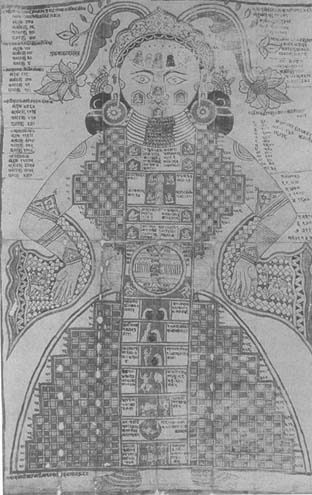
Figure 2.
Purushakara Yantra, or the Cosmic Man Yantra, a grand micro-macro vision of the universe. This eighteenth-century Tantric painting from Rajasthan, India, depicts the human being who has fulfilled his/her immense potentiality and become the entire universe. The seven ascending planes (lokas) represent experiences of celestial realms, the central plane those of the earthly plane (bhurloka), and the descending ones subnormal states of consciousness.
Source: Philip Rawson, Tantra: The Indian Cult of Ecstasy (Art and Imagination Series), plate 20, published by Thames and Hudson Ltd. Reprinted with permission of the Ajit Mookerjee Collection. Photograph by Jeff Teasdale.
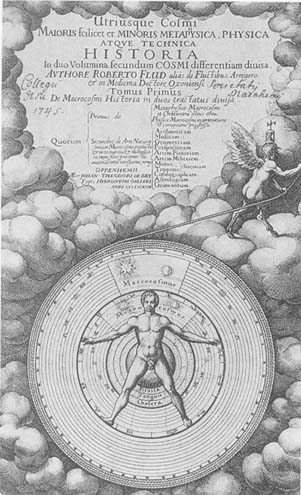
Figure 3.
The Hermetic Cosmic Man . Illustration from a seventeenth-century hermetic text by Robert Flud, Utriusque cosmi historia, as reproduced in A. Roob’s book Alchemie und Mystik, Köln, 1996, p. 543, depicting the human being as a microcosm reflecting the macrocosmos. The concentric circles representing the planetary spheres are related to the physical structure of the body. The nine angelic spheres point to the capacity of the individual human to use reason, intellect, and pure mind to achieve the status of the Cosmic Man and even God.
Source: Reprinted with permission of the Old Print Department of the Central Library of the Mannheim University.
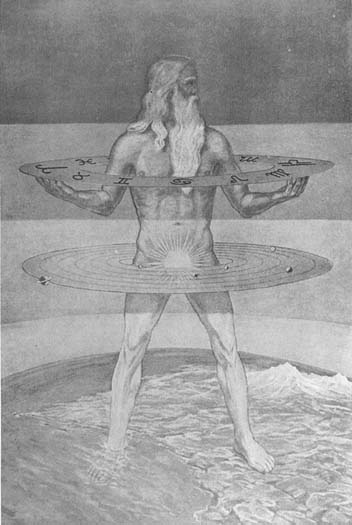
Figure 4.
Adam Kadmon, the Primordial Universal Man of the Cabalists is depicted here as holding the zodiac and supporting the entire solar system. The image of Adam Kadmon, embodying the ten Divine Emanations, the Sephiroth, was seen by the Jewish mystics as the most perfect reflection and representation of Divinity.
Source: Reprinted from Manly Hall’s The Secret Teachings of All Ages copyright and with permission of the Philosophical Research Society in Los Angeles, CA.
This deep connection between the individual human organism and the cosmos suggested by various esoteric traditions has been expressed in the famous statements “As above, so below” or “As without, so within.” The observations from modern consciousness research have shed new light on this ancient mystical concept that appears quite absurd from the point of view of materialistic science. Transpersonal psychology has discovered that in holotropic states it is possible to identify experientially with just about any aspect of physical reality, past and present, as well as various aspects of other dimensions of existence. It has confirmed that the entire cosmos is in a mysterious way encoded in the psyche of each of us and becomes accessible in deep systematic self-exploration.
The discussion of the hierarchical arrangements in the universe could also be extended beyond the boundaries of individual organisms, since each life form constitutes a part in larger groups and systems. Animals form colonies, schools, flocks, and herds, and belong to families and species. Individual humans are parts of a family, clan, tribe, culture, nation, gender, race, and so on. Living organisms—plants, animals, and humans—belong to various ecosystems that have developed within the biosphere of our planet. In the complex dynamic structure of the universe, each constituent part is a separate entity, as well as a member of a larger whole. Individuality and participation in a broader context are dialectically combined and integrated.
The Part and the Whole
The new relationship that modern science has discovered between the whole and its parts was explored and systematically described by the British writer and philosopher Arthur Koestler. In his book Janus, named after the two-faced Roman god, Koestler coined the term holon, reflecting the fact that everything in the universe is simultaneously a whole and a part. The root of this word, hol-, suggests wholeness and integrity (from the Greek holos = whole) and the suffix -on, used customarily in the names of elementary particles, denotes a part or constituent. Holons are Janus-faced entities on the intermediate levels of any hierarchy, which can be described either as wholes or as parts, depending on the way we look at them, whether from “below” or from “above” (Koestler 1978). The concept of holons has been recently further developed in a highly sophisticated and creative way by Ken Wilber (1995).
Holons can accumulate into larger agglomerates. Bacteria, for example, can form a culture or stars can be assembled into a galaxy. These are social holons comprised of elements of the same order. Holons can also create emergent holons of a higher order. Atoms of hydrogen and oxygen can combine into molecules of water, macromolecules can form cells, and cells can get organized into multicellular organisms. These are examples of holons of increasingly higher order. What is important from the point of view of our discussion is that in holotropic states all the different individual, as well as social, holons have corresponding subjective states. These states make it possible for us to experientially identify in a very authentic and convincing way with any aspects of existence that in our ordinary everyday consciousness we experience as objects separate from us.
We are thus able to experience conscious identification with atoms, molecules, or specific cells of the body, either as individuals or as ensembles. Besides experiencing ourselves as other individual human beings, we can also undergo experiential identification with entire human groups, for example, all mothers, soldiers, or Christians of the world. We can envision a single wolf or a pack of wolves and observe them as objects. In addition, we can also identify experientially with a single wolf, as well as experience the consciousness of an entire pack of wolves or even of the entire wolf species.
Some of the people who have experienced holotropic states reported that they experienced consciousness of an ecosystem, of the totality of Life as a cosmic phenomenon, or of our entire planet. In transpersonal states, all aspects of existence as they manifest on different levels and domains of reality, can under certain circumstances become potentially available for conscious experience. This is a very important observation that brings a strong support for understanding the universe and existence as a divine play of Absolute Consciousness.
The following account is an excerpt from the session of Kathleen, who participated in our psychedelic training program of professionals at the Maryland Psychiatric Research Center. It is an example of a transpersonal experience that encompassed all life and reflected its struggle for survival. It resulted in a deep sense of compassion with all living things and a dramatic increase of ecological awareness.
I seemed to have connected in a very profound way with life on earth. At first, I went through a whole series of identifications with individual animals from various species, but later the experience became more and more encompassing. My identity spread not only horizontally in space to include all living forms, but also vertically in time. I became the Darwinian evolutionary tree in all its ramifications. However incredible this might sound, I experienced myself as the totality of life!
I sensed the cosmic quality of the energies and experiences involved in the world of living forms, the endless curiosity and experimentation characterizing life, and the drive for self-expression and self-preservation operating on many different levels. I realized what we have been doing to life and to the earth since we developed technology. Since technology is also an outgrowth of life, the crucial question I had to deal with was whether life on this planet would survive.
Is life a viable and constructive phenomenon, or a malignant growth on the face of the Earth that contains some fatal flaw in its blueprint condemning it to self-destruction? Is it possible that some basic error occurred when the design for the evolution of organic forms was originally laid down? Can creators of universes make mistakes as humans do? It seemed at the moment a plausible, but very frightening idea, something I had never considered before.
Kathleen struggled for some time with the question whether it is possible that the creative principle might have made a fundamental error in bringing forth creation and that it might not be fully in control of the process. She concluded that this is probably the case and that the Divine might need assistance from humans to preserve its creation. Having opted for what I have described earlier as the “kaleidoscope” or “chess-game” theory of creation, Kathleen decided to become an active partner of the Divine in the battle for preservation of life. Here is the rest of her session:
Identifying with life, I experienced and explored an entire spectrum of destructive forces operating in nature and in human beings and saw their dangerous extensions and projections in modern technology threatening to make the earth inhabitable. In this context, I became all the countless victims of the military machinery of modern warfare, prisoners in concentration camps dying in gas chambers, fish poisoned in polluted streams, plants killed by herbicides, and insects sprayed with chemicals.
This alternated with moving experiences of smiling infants, charming children playing in the sand, newly born animals and newly hatched birds in carefully built nests, wise dolphins and whales cruising the crystal-clear waters of the ocean, and images of beautiful pastures and forests. I felt profound empathy with life, strong ecological awareness, and a real determination to join the life-affirming forces on this planet.
Ideas similar to Koestler’s concept of the holon were expressed in the seventeenth century in the work of the philosopher and mathematician Gottfried Wilhelm von Leibniz. In his Monadology, Leibniz (1951) described the universe as composed of elementary units called monads. These monads have many characteristics of the Jain jivas. As in the Jain worldview, in Leibniz’s philosophy all the knowledge about the entire universe can be deduced from the information contained in each single monad.
It is interesting that Leibniz was also the originator of the mathematical technique that was instrumental in the development of optical holography, a new field that provided for the first time a solid scientific basis for the concept of mutual interpenetration. Optical holograms demonstrate very clearly the paradoxical relations that can exist between the parts and the whole, including the possibility of retrieving the information about the whole from each of its parts. It is possible that in creating phenomenal worlds Absolute Consciousness is using the same principles that find their material expression in optical holography. In any case, the holographic model is the best conceptual framework we have to date for the world of transpersonal phenomena.
Creation and the World of Art
In holotropic states, we can realize that existence, human life, and the world around us constitute a fantastic adventure in consciousness, an amazingly complex and intricate cosmic drama. This parallels the concepts found in ancient Indian literature. The Hindu scriptures refer to the divine play of the universe as lila and suggest that the material reality as we perceive it in our everyday life is a product of a fundamental cosmic illusion called maya. Theater, film, and television are artificially created illusory representations of reality. For this reason, these media and various aspects of related artistic activities represent another frequent source of metaphorical images that people who have experienced holotropic states use in describing the process of creation.
The situation of an actor very closely parallels the role each of us plays in the cosmic drama. While on stage and performing a role, good actors can to a great extent lose contact with their real identities and become the characters they represent. For the evening of the performance, they can almost believe they are Othello, Joan of Arc, Ophelia, or Cyrano de Bergerac. Yet the awareness of their real identity remains available and is resumed after the curtain has fallen and the applause of the audience subsides. To a lesser degree, a similar process of identification with the dramatis personae and temporary loss of one’s own identity can occur in spectators watching a good movie or a well-performed theater play. The actor or actress have their basic everyday personalities to which they return when the play ends. People who have experienced holotropic states often suggest that something similar happens in the cycles of reincarnation. At the beginning of each lifetime, we assume a different personality and role and, at the time of death, we return to a more basic identity before taking on another incarnation.
Particularly interesting from this point of view is the situation of a playwright, because it can be used to illustrate the complexity of our nature and the problem of determinism versus free will. Since all the boundaries in the universe are ultimately arbitrary, we do not possess a fixed identity; each of us is the creator as well as the creation. The degree of freedom that we have changes dramatically depending on the aspect of creation and the level of the creative process with which we identify. This is similar to the situation of the author of a theater play or a screenplay for a movie. All the characters of a play have their origin in the imagination of the playwright and are thus initially different aspects of a single creative mind. For the purpose of a realistic and effective enactment of the drama the protagonists have to be represented as separate individuals.
This offers the author an opportunity for ambiguous identity in relation to the play and its characters. In the process of writing, he or she has far-reaching freedom to create and shape the characters and determine the course of events. However, the same author can also decide to become one of the players in his or her drama. William Shakespeare, for example, could decide to play the role of Hamlet or Richard Wagner to sing the part of Tannhäuser. In such cases, they would be to a great extent confined and determined by the same scripts that, in another context and on another level, they more or less freely created. In a similar way, each of us appears in the divine play in a dual role of creator and actor. A full and realistic enactment of our role in the cosmic drama requires the suspension of our true identity. We have to forget our authorship and follow the script.
The problem of ambiguity of our identity and of our role in the cosmic drama requires a word of caution. In the last few decades this issue has often been misunderstood and misrepresented in the New Age movement and in popular spirituality. In holotropic states, it is possible to connect with a level of consciousness where it seems very plausible that we have actually chosen our parents and the circumstances of our birth. We can also experience a state of consciousness in which it seems obvious that we are in essence spiritual beings and that as such we have made a free decision to incarnate and engage in the cosmic drama. We can also have a very powerful experience of identification with the creative principle or God. All these experiences can seem very real and convincing.
However, it would be a serious mistake to draw from such insights any conclusions concerning our ordinary identity or our embodied self. In this form we certainly did not make any of the above decisions. If applied to the body-ego, such statements as “You are God and you have created your universe” are confusing and misleading. I remember a workshop at the Esalen Institute in Big Sur, California, in which the leader authoritatively imposed the above statement on the participants. One of the women in the group got seriously upset, since she was the mother of a retarded child. The workshop leader’s statement implied that she had chosen this predicament and deliberately created this problem. This would have meant that she, as she experienced herself in her everyday life, was fully responsible for her child’s misfortune. Situations of this kind involve a serious confusion of levels and an incorrect use of logic that is technically called “error in logical typing.”
The Archetypal Beings and Domains
We can now return to the dynamics of the cosmic creative process as it is revealed in holotropic states of consciousness. I have already described and discussed the frequent insights suggesting that the Universal Mind creates virtual realities through a complex combination of multiple divisions and cosmic dissociation and forgetting. Absolute Consciousness projects itself into countless individual beings that experience themselves as separate from each other and also alienated from their source. In constant dynamic interaction with each other, they generate immensely rich experiential worlds. The material realm which we inhabit and with which we are intimately familiar seems to be just one of these worlds, the farthest outpost of this creative activity.
Of special interest is a domain that lies between our everyday reality and the undifferentiated Absolute Consciousness. It is a mythological realm that has been extensively studied and described by C. G. Jung and his followers. Unlike the material reality, it is not available to ordinary sensory perception; it can be directly experienced only in holotropic states. Jung referred to it as the archetypal realm of the collective unconscious. The beings inhabiting these realms seem to be endowed with extraordinary energy and have an aura of sacredness or numinosity. For this reason, they are usually perceived and described as deities.
The events occurring in this mythic realm unfold in a kind of space and time, but a space and time that are not identical with our experience of these dimensions on the material level. Archetypal sequences lack the geographical and historical integrity that is characteristic for events in material reality. Unlike the happenings in our world, which can be assigned specific spatial and temporal coordinates, the mythical sequences cannot be placed into a coherent fabric of space or time. While it is easy to geographically locate London or assign a specific historical date to the French Revolution, it is impossible to do the same with Shiva’s heaven or the battle between the Greek Olympian gods and the Titans. The stories inspired by the mythical realm usually begin: “Once upon a time, in a faraway land,” in order to discourage the listener from an attempt to place them geographically or historically into the familiar world of everyday reality.
However, the lack of fixed spatial and temporal coordinates does not make the archetypal world ontologically less real. The encounters with mythological beings and visits to mythic landscapes, as experienced in holotropic states, can be in every respect as real as events in our everyday life, or more so. The archetypal realm is not a figment of human fantasy and imagination; it has an independent existence of its own and a high degree of autonomy. At the same time, its dynamics seem to be intimately connected with material reality and with human life.
The archetypes are clearly supraordinated to the events in the material world and govern, form, and inform what is happening in our everyday reality. The insights from holotropic states of consciousness concerning these connections are similar to the ideas that have been expressed in various books written by the authors inspired by Jungian psychology. These writers showed that our personalities, behaviors, and destinies can be understood in terms of the archetypal divine principles operating in or through our unconscious (Bolen 1984, 1989) and that in our everyday human dramas we act out various mythological themes (Campbell 1972).
The following experience of Helen, a 42-year-old anthropologist, illustrates the way the archetypal world is experienced in holotropic states of consciousness and the insights this can provide.
The sequence that followed was of such grandeur and magnificence that I still feel a deep sense of awe just thinking about it. It was a vision of a world that had some characteristics in common with our everyday reality, yet the amount of energy it was endowed with and the scale on which it existed was beyond anything I could previously have imagined. I saw illustrious anthropomorphic figures, male and female, clad in splendid garments and radiating immense power. It resembled the ancient Greek descriptions of Mount Olympus where the gods feasted on nectar and ambrosia. However, this experience by far surpassed anything I had previously associated with this image.
These suprahuman beings were involved in what resembled social interaction, but their exchange seemed to be of enormous relevance. I felt that what was happening there was intimately connected with our everyday reality and was determining the events in the material world. I remember a particularly impressive detail that can be used as an illustration of this connection and the dimensions involved. At one point, I saw a splendid ring on the finger of one of these divine beings with a stone that seemed to be a cosmic version of a diamond. The reflection from one of its facets struck me as a blinding flash of light and I realized that it projected into our world as explosion of an atomic bomb.
Later I thought in connection with this experience of a movie that I had seen some time ago. I think it was called the Golden Fleece and it featured the adventures of Jason and the Argonauts. The events in this movie unfolded on two levels. One of them portrayed the realm of the Olympian gods, their interactions, affairs, conflicts, clashes, and alliances. Each of these deities had his or her sphere of influence in the cosmos. The protagonists of the story were favorites of some gods and targets of wrath of others. The emotions of the gods manifested on the earthly plane as dynamics of the elements of nature, sudden turns of fortune, or meaningful human encounters.
In view of this experience and the insights associated with it, I feel apologetic about the scientistic hubris with which I used to dismiss the cosmologies of “primitive cultures” as superstition and magical thinking. I realized that this reflected the naiveté of our society in regard to nonordinary states of consciousness. It was very clear to me that once we subject the observations from these states to serious study, our materialistic worldview will have to be drastically revised. We might not use the terms “deities” and “demons” like the “primitive” cultures and might replace them with more respectable terms, such as “archetypal figures.” However, once we become familiar with the archetypal dimension, we will not be able to ignore or deny its existence and its importance in the universal scheme of things.
While the above account describes a vision of celestial archetypal regions, other people experienced visits to domains inhabited by various creatures of darkness, as we know them from mythological descriptions of hells or underworlds of different cultures. The following excerpt from a narrative written by Arnold, a forty-year-old teacher, is an example of such an experience.
The next sequence took me into the world of underground tunnels and to what appeared to be sewage systems of all the great metropolis of the world—New York, Paris, London, Tokyo. … It seemed that I was getting intimately acquainted with the infrastructure of these cities, with parts and aspects that are indispensable for their existence. I realized to my surprise that there was an entire world there, hidden from the sight of most people and generally unappreciated. I was sinking deeper and deeper into a system of dark mazes until I realized that the domain I was entering did not any more belong to the world of our everyday reality.
Although it certainly felt like the deepest bowels of the earth, it was actually a mythological realm inhabited by strange archetypal creatures. It seemed to me that I was seeing the infrastructure of the cosmos, essential for its existence and proper functioning. Like the underground world of the cities, it was hidden and unappreciated. It was inhabited by gigantic and monstrous chthonic beings of fantastic shapes. They were endowed with titanic energies that made one think of tectonic shifts, earthquakes, and volcanic explosions.
I could not help feeling great appreciation for these homely creatures living their life in darkness and doing patiently the ungrateful labor of running the engine of the universe. They clearly welcomed my visit and responded with great joy to my unspoken compliments. It seemed that they were used to being feared and rejected and showed almost childlike craving for love and acceptance.
As these experiences indicate, there exist various dimensions of reality that are not part of the phenomenal world of our everyday life. They seem to represent different types and levels of experiential realities, different “cosmic channels,” to use an analogy with the world of modern electronics. We usually take the material world with all its wonders and complexities for granted and reject the possibility that there might be other domains of reality. However, if we think about it, the sheer mystery of existence—the fact that anything exists at all and that it is possible to experience worlds of any kind—is so stupendous and overwhelming that it makes the question about the specifics of their nature and content a trivial one.
From a larger perspective, the experience of a beautiful sunset over the Pacific Ocean, the vision of the Grand Canyon, or the panorama of downtown Manhattan is not less miraculous than that of Shiva’s heaven or the Egyptian underworld. If we accept the existence of a supreme principle that has at its disposal the technology of consciousness and is able to generate experiences, the fact that it can create realities with many different characteristics does not present any serious problems. It would be comparable to the task of a film or TV crew to use the existing technology and produce movies or programs with mythological themes rather than stories from everyday life.
The Mystery Play of the Universe
Since the Hindu philosophers refer to the cosmic process as lila, or divine play, it seems appropriate to illustrate the holotropic insights into the nature of reality by using the analogy with a movie, which is a modern technological version of a magic show. The intention of the moviemakers is to create a reasonable facsimile, a “make-believe” version, of material reality. They use all the available means necessary to achieve this goal. It is usually very easy for the spectators to imagine that the scenes unfolding on the screen represent real events in the material world. In some instances, the impact of a movie on some spectators can be so strong that they respond to it emotionally as if it were real. This happens in spite of the fact that they know intellectually that what they are watching is nothing but a play of electromagnetic waves of different frequencies within a single undivided field of light.
In holotropic states of consciousness we can discover to our surprise that the same applies to our experience of everyday reality. What appears to us as a world of solid objects is a play of vibrations that is essentially empty. Naturally, our experience of the world is fuller and richer than that of a movie, since it includes some dimensions that today’s filmmaking technology is incapable of conveying, such as tactile, olfactory, and gustatory qualities. In his famous science fiction novel The Brave New World, Aldous Huxley described a future form of entertainment, the “feelies,” in which this shortcoming was overcome, since the experiences of the spectators were not limited to the optical and acoustic realms, but included these other sensory qualities. And contemporary researchers in the field of virtual reality are already experimenting with specially designed gloves that would enrich the experience of electronically created visual and acoustic worlds by contributing the tactile dimension.
I described earlier the experience of the “immanent divine,” in which the material world is perceived as a dynamic play of cosmic creative energy. This experience also reveals the undivided unity underlying the world of separation. It shows that what we encounter in everyday life are not discrete individuals and solid objects, but integral aspects of a unified energetic field. However absurd this might appear to a naïve realist, this conclusion is in full agreement with the findings of modern physicists. They indicate that what we ordinarily perceive as solid matter is essentially empty. Twentieth-century science has thus provided support for the startling claim of Hindu sages that our perception of the world as made of dense material objects is an illusion (maya).
Let us now develop the analogy between filmmaking and the creation of material reality a step further. By simply watching the movie, we cannot fully understand the process we are involved in, since some important answers about what is happening to us cannot be found on the screen. What we see in the movies does not have independent existence and meaning of its own. The movie is a product of a very complex process and its essential stages are not included in our immediate experience of watching it. To really understand the events we are witnessing, we would have to replace the naïve experience of watching the movie with a systematic in-depth analysis of the process that creates it.
First, we would have to shift our attention away from the screen, turn around, and discover the device responsible for the illusions that we are perceiving. We would detect that its essential component is a powerful source of light that projects the images on the screen. On closer inspection, we would also find the moving celluloid strip that determines the forms and colors we are seeing. This situation is strikingly similar to Plato’s famous simile of the cave that he used in his dialogue The Republic to describe the illusionary nature of the material world.
In this dialogue Plato (1961b) likens the human condition to a situation in which a group of individuals is confined to the inside of a subterranean grotto. They are firmly fettered to the ground in such a way that they can stare only straight ahead. Behind these prisoners is a bright fire and a low wall above which pupeteers exhibit human and animal effigies and various implements. The prisoners are immersed in watching the shadows on the wall, the only aspect of the whole situation they can actually perceive. Fascinated by the show, they are completely unaware of the true nature of this situation.
In Plato’s simile, the objects of our familiar material world are likened to shadows that are cast by a fire on the wall of the cave, while the true nature of reality remains hidden to us. Plato also suggests that the prisoners in the cave believe that the echos of the sounds that originate behind them are actually produced by the shadows. In our movie example, we could similarly identify not only the source of the images, but also discover the origin of the sounds by tracing them to the magnetic tape that generates them.
When we continue our exploration, a closer scrutiny of the projection process will reveal that what we perceive as smooth and continuous movements actually consists of rapid sequences of discontinuous flickering images. This again parallels the insights from nonordinary states of consciousness concerning the nature of reality. I have repeatedly heard reports in this regard from people who had various forms of holotropic experiences. The same insights can be found in traditional spiritual sources. For example, according to Tibetan Buddhism, reality is radically discontinuous. The world is constantly flashing in and out of existence, being dissolved and recreated from one moment to another. Similarly, we ourselves do not have continuous existence from birth to death, but die and are reborn all the time. A modern, scientifically based version of the same concept appears in the philosophy of Alfred North Whitehead (1929).
The next step of our in-depth probing of the movie experience would take us outside of the movie theater altogether. We would discover that the film started as an idea in somebody’s mind and that all the processes necessary to make a movie were motivated by the intention to concretize the story in the screenplay and transform it into a convincing vivid experience. The reality portrayed in the movie does not have an independent existence of its own. It cannot be fully understood if we take it out of this larger context. The ultimate reason for the existence of the movie is the intention to provide a specific kind of experience. According to the insights from holotropic states, the same is true about our experience of the material world.
A naïve person, such as a child or a native from a preindustrial culture who has not had exposure to modern technology, could mistake a well-done movie for reality. In the future, holographic movies with holophonic sound, holographic television, and particularly advanced technology of “virtual reality” will make that distinction even more difficult. However, even at present, the idea that our cosmos might be a “virtual reality” produced by superior intelligence does not seem as far-fetched as it would have a hundred or even fifty years ago.