
PART III

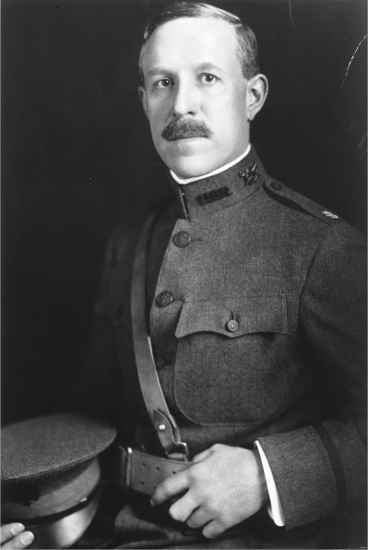
Colonel Hugh W. Ogden, Boston’s “soldier-lawyer,” ruled against United States Industrial Alcohol, finding the company liable for the molasses disaster.
(From the Collections of the University of Pennsylvania Archives)
 TEN
TEN 
Boston, Monday, August 9, 1920
It was midafternoon of the hottest day of the year, and waves of heat shimmied like dancing specters off Boston’s baked downtown streets. Sweating beneath his stiff, high collar, Hugh W. Ogden toiled in his 75 Federal Street office, high above the city, putting his business affairs in order. Through the open window, Ogden saw veins of lightning crackle across a purple-black sky to the north, heard the low rumble of summer thunder miles away, and smelled fresh rain mixed with sea salt on the warm wind that blew in from the harbor.
For the last three days, the weather pattern had been the same. Sweltering mornings and early afternoons, then violent thunderstorms lashing the streets when the heat of the day reached its apex around 3 P.M. Yesterday, hailstones had damaged crops in communities far north of Boston, and lightning set ablaze several wood-frame buildings in nearby suburbs like Lynn and Somerville. Ten people had collapsed from the heat. One sea captain who had piloted a steamer from Costa Rica declared that Boston was hotter than the tropics.
Ogden was hoping for a break in the temperature tomorrow. He would begin presiding over hearings in the molasses flood case at Suffolk County Court House in downtown Boston, and the old building held the heat like a cauldron. Superior Court Judge Loranus Eaton Hitchcock had asked Ogden to serve as an “auditor,” an impartial master who would hear evidence on liability, and possible damages, and issue a report on his findings. Depending on the nature of his report, the case could then move on to a full civil trial in front of a jury.
The court believed that, due to the complexity of the case, and the number of plaintiffs and potential witnesses, justice would be better served if a tough, fair-minded legal expert could first whittle down the essence of the arguments and find the nub of truth—or at least make it less cumbersome for a jury to arrive at its own truth. Ogden had agreed to serve as auditor, for a nominal stipend, after Judge Hitchcock had assured him that he would only need to carve out about six weeks from his schedule to fulfill the responsibility. Today, he would finish organizing his affairs for the next month and a half and referring his regular caseload to colleagues he respected.
Private practice had been good to Ogden since he arrived back in Boston as a decorated veteran one year ago. He focused on equity and corporation law, and found that his talents were well-suited to working alone. He was bold, aggressive, shrewd, opinionated, intuitive, compassionate, unorthodox, and he often took the measure of a man’s character before he took his case—a combination of contradictions that would leave him unfulfilled at a large law firm, where making money was the number one priority. Ogden liked making money as much as anyone, but he would never take a case just for money. In fact, he often took cases pro bono; the factors that mattered most to him were the quality of the individual he was representing, the merits of his client’s case, and his ability to help his client achieve justice. He loved private practice, and many of his clients had become his friends.
For a year, he had looked for a way to do more, to go beyond the pro bono work, beyond his contributions as a member of the Boston Chamber of Commerce and the ecclesiastical work he did for the Episcopal Church, and to find an honorable way to share his talents for a greater cause.
So when Judge Hitchcock had called, Hugh Ogden had answered. If he could help find the truth in the molasses case, six weeks of his time would be no sacrifice at all.

Ogden had never been part of, let alone presided over, a case so massive—but then again, almost no one had. The Boston legal community was abuzz about the Superior Court’s decision to consolidate the 119 separate legal claims against United States Industrial Alcohol into a single legal proceeding, creating in effect, if not by strict legal definition, the largest class-action suit to date in Massachusetts history and one of the largest ever in U.S. legal annals.
The Superior Court had decided to consolidate the cases during the preliminary filing stage, at the request of U.S. Industrial Alcohol. USIA had argued that the plaintiffs’ claims were similar, and, more practically, the courtroom simply wasn’t large enough to hold all the lawyers. More than 125 attorneys had crammed the courthouse, and many of Boston’s finest legal minds had been part of the overflow that spilled and shuffled into the hallway. The rest could barely move without bumping into each other. The comical scene symbolized the complexity of the case and the difficulty of trying them all individually. During a trial, there would have been no room for the lawyers, let alone witnesses, stenographers, and members of the press and public. USIA had recommended that the cases be consolidated and that two lead lawyers be appointed to represent each party; the court had agreed.
Ogden believed that the consolidation made sense, but he also suspected that USIA had another motive for requesting the unprecedented co-joining action. If the company’s lawyers could successfully discredit just one witness or refute one piece of documentary evidence, the defense could undermine all the plaintiffs’ claims, and their cases against USIA would tumble like a house of cards. Had the cases remained severed, one “poisoned” plaintiff witness would not taint the other claims.
The basic arguments for USIA and the plaintiffs could be simply stated, though Ogden knew this fact alone would not necessarily ensure a swift proceeding. The plaintiffs would claim that the molasses tank had been structurally deficient, built without safeguards, and carelessly located in a busy, congested neighborhood. They would seek financial damages for the victims’ families and for property owners. USIA would argue in defense that anarchists operating in Boston during the time of the disaster had dropped a bomb inside the tank just after noon on January 15, 1919, and the resulting explosion had destroyed the tank and caused the deaths, injuries, and property destruction. The company would also argue that the North End waterfront area, on the periphery of the neighborhood, had been used for years for commercial purposes.
If USIA could prove its case, the company almost certainly would be absolved of any legal liability. Ogden had already heard that USIA was spending more than $50,000 on expert witnesses to buttress its case—including scientists, metallurgists, academics, and explosion experts.
The anarchist argument intrigued Ogden, since he believed that it was plausible; whether it was provable was another question. The year 1919 had been the most chaotic and violent one he could remember. And while things had calmed somewhat in the early months of 1920, the spring had brought more disturbing events.
In early March, an anarchist named Andrea Salsedo, whom authorities believed was one of the key Galleanists behind the rash of bombings in June 1919, was arrested, and held in custody for two months while government agents questioned him. There had been rumors that Salsedo had cooperated with authorities and furnished the names of other prominent anarchists, but these had never been confirmed. Incredibly, when agents left him alone for a few moments in early May, Salsedo apparently jumped to his death from a fourteenth-story window. His fellow anarchists had protested loudly that Salsedo had first been beaten for information, and, after he had divulged all he knew, had then been hurled from the window, a claim that had never been proved and that Ogden found impossible to believe.
On April 15, two employees of the Slater and Morrill Shoe Company were shot dead and robbed of the company’s payroll in South Braintree, Massachusetts. Two men armed with handguns did the shooting, and the killers were picked up by colleagues in a getaway car, escaping with more than $15,000. On May 5, police arrested two avowed anarchists for the murders, Nicola Sacco and Bartolomeo Vanzetti. The pair gave false or evasive answers about their political beliefs and their whereabouts at the time of the murder, though both later protested strenuously that they believed they had been arrested for deportation purposes and had no inkling of the seriousness of the charges against them. Sacco and Vanzetti were now awaiting trial for the South Braintree murders. Vanzetti alone was also indicted, and later tried and convicted, for a Christmas Eve 1919 hold-up in Bridgewater, Massachusetts, and he was scheduled to be sentenced for that crime in about a week.
Ogden had the unsettling feeling that the controversial Salsedo suicide, coupled with the Sacco and Vanzetti arrests, could set the anarchists in motion once again.
If it did, the uproar would provide timely energy to USIA’s argument that anarchists had destroyed the Boston molasses tank in 1919. But Ogden knew that the court had asked him to preside over the molasses case precisely because he would not get caught up in any uproar. He would issue his report based strictly on the evidence in this case.
Any new anarchist activities, if they did occur, might infuse energy into USIA’s case. But evidence was something altogether different.
Now that there were only two small teams of attorneys working the case, Ogden’s courtroom would be sufficiently large to house them. Whether it would be big enough to contain their egos was still open to debate.
Ogden knew both lead attorneys—Damon Everett Hall for the plaintiffs and Charles Francis Choate for the defense—and thought it would be much more entertaining to be a third-party observer rather than the jurist caught in the crossfire between two of the most brilliant, powerful, resourceful, sharp-witted, and indefatigable lawyers in the state. Both were wealthy men whose lineages ran deep, whose ancestors arrived on American soil years before the Revolution. Both were men who believed they were entitled, that winning was practically a birthright.
Ogden liked Hall better as a man. Choate may have been the more intellectual barrister, but Ogden thought that his fellow Harvard Law School graduate’s aristocratic gentility often camouflaged a condescending air of superiority. Hall, a graduate of Boston University, was no less astute than Choate, but enjoyed a good legal street fight at the same time. He had a tough streak, an edge, a poker player’s willingness to take risks, even a sense of sarcasm in the courtroom that Ogden found appealing. Hall and Choate were both men of means, both well-respected attorneys, both scions of Boston’s oldest money, but Hall seemed more comfortable with average men, a trait Ogden believed he himself shared with the plaintiffs’ lawyer. Choate was diligent and honest enough, but also facile, bombastic, and often reluctant to get his hands dirty, traits Ogden found distasteful. The two men had chosen sides well in this case; it strained Ogden’s imagination to envision Choate representing poor Italian immigrants and Irish city workers in their fight against a major national corporation. Conversely, Hall would relish the task, viewing himself as a guardian of the common man’s rights.
None of this would matter tomorrow, of course. Once Ogden set foot in the courtroom and ascended to the bench, he would subjugate his personal feelings about both men, and rely on the rule of law and his own strength of judgment and fairness.
Ogden finished his work and prepared to leave the office, which for at least the next six weeks, would no longer be his regular workplace. He might stop in occasionally after the molasses hearings had concluded for the day, but he expected the testimony to consume most of his time. He had even informed Hall and Choate that he was willing to continue the hearings until 10 P.M. any time it was necessary, to give laborers a chance to testify without jeopardizing a day’s pay, or worse, their jobs. Both lawyers had grumbled before grudgingly conceding Ogden’s point and agreeing to the unusual schedule.
The lightning flashed in the northern sky and the thunder rumbled closer. Ogden hoped for a torrential late-afternoon rainstorm to cool the city.
One other prominent Boston attorney would play a role in how history would mark the molasses case. Dudley H. Dorr, owner of two Commercial Street buildings destroyed by the flood, became trustee for the consolidated cases brought by the plaintiffs. On July 1, 1918, Dorr had joined forces with Boston attorney Richard Hale to form Hale & Dorr, which would one day become Boston’s largest and most prestigious law firm. For now, Dorr’s participation in the biggest civil suit in Massachusetts history—the Great Boston Molasses Flood case—meant that the court proceedings were officially catalogued as Dorr v. United States Industrial Alcohol.
August 10–September 8, 1920
“This was one of the worst catastrophes which has visited the City of Boston in my remembrance,” declared attorney Damon Hall in his opening statement for the plaintiffs. “We have all been accustomed to make fun of cold molasses, but this experience, which occurred in the heart of Boston at noon in January, 1919, taught us that cold molasses has death-dealing and destructive powers equal to the tornado or the cyclone when it is suddenly unloosed.”
Hall’s statement came on Wednesday, August 11, the second day of the hearings; day one was a succession of scheduling and procedural details that needed to be ironed out at the outset of any major trial or hearing. The lengthiest haggling had come during discussion of the court’s start time. On Monday mornings, Damon Hall’s train arrived in Boston from his suburban Belmont home just before 11 A.M., and his colleague, Endicott Peabody Saltonstall, arrived at 10:30 A.M. Thus, Ogden agreed that Monday proceedings would begin at 11 A.M. Since all the lawyers would stay in Boston overnight during the week, Ogden ordered court to begin at 9:30 A.M. Tuesday through Friday. “I feel a little pressure to get started and moving on this case,” Ogden told the attorneys. Henry Dolan, one of USIA’s lawyers, urged Ogden not to hold hearings on Saturdays. Ogden agreed reluctantly: “These gentlemen who have families at the shore, I think would go on strike if we tried to sit on Saturday,” the auditor lamented.
After the procedural issues had been decided on Tuesday, Ogden adjourned the session, and Hall began his opening statement first thing on Wednesday. Hall was not a large man, but he commanded attention in the courtroom.
“Now I have no doubt that your Honor had occasion to see many of the devastated areas of France,” Hall said to Ogden. “If you take a little section of one of those devastated areas, and put in it dead men and dead horses, and then cover it with molasses, you get some idea of what this (scene) looked like a few minutes after this occurrence … on January 15, 1919, shortly before one o’clock, a time when fortunately a good many people who otherwise would be using Commercial Street were at their lunch … (this) giant reservoir constructed in the heart of a busy section, for the purpose of holding a heavy fluid, suddenly gave way, deluged the surrounding territory, took twenty-one lives, and did property damage amounting to hundreds of thousands of dollars.”
Hall said he would not use his opening statement “to place my finger upon the negligence, or unlawfulness, or whatever you call it, which was responsible for this accident … and I shall not, at this time, attempt in any way to advance any theories as to the cause of this accident.” That, Hall declared, would become apparent during his questioning of witnesses and in his closing arguments. In his opening, he would “stick to the facts” to outline his case. But in Hall’s skillful hands, the facts themselves carried more than a whiff of accusation.
“It is important for your Honor to know the size of this steel container,” he said. “The height of the steel reservoir was fifty feet, but it is very difficult to appreciate figures on their own. But the height of the tank, from the surface of the foundation to the top of its roof, was fully twice the height of this courtroom. The elevated (railroad) structure is about thirty feet in height. So this tank towered above the elevated structure for twenty feet. The diameter of this steel reservoir was ninety feet, or a diameter equal, substantially, to twice the length of this courtroom. It was an enormous reservoir, built and intended to contain an enormous amount of molasses.”
Hall painted a similar picture when he described the weight of the molasses in the tank. “When we speak of 2.3 million gallons of molasses, it is impossible for the mind to work readily to conceive what that means,” he said, “and so I want to just use one or two illustrations to show the weight of molasses in that reservoir at the time this thing occurred. Two million, three-hundred thousand gallons of molasses is something over 26 million pounds … thirteen thousand tons. One of our big Mogul locomotive engines weighs about a hundred tons. So that this steel reservoir contained on the day of the accident a weight of molasses equal to 130 hundred-ton locomotive engines … or thirteen thousand Ford automobiles, which weigh about a ton each.”
Hall described the suffering of the victims—the violent deaths of Bridget Clougherty, Maria Distasio, and Pasquale Iantosca; the valiant struggle of George Layhe before he succumbed under the firehouse; the pain-wracked torment of John Barry as he lay pinned a few feet from Layhe, awaiting rescuers. He listed the property that the molasses waves destroyed, including the elevated railroad, whose “enormous support pillars were doubled up as if they were willow trees” by the combined weight of the molasses and the steel pieces of the crushed tank. The molasses wave swept through the North End Playground, Hall said, “a place that was frequented in summer by thousands upon thousands of the dwellers of the North End; men, women, and children, particularly the women and the children who went to that playground to escape the heat of the city.”
When Charles Choate interrupted Hall’s opening by noting that the accident occurred in the dead of winter, Hall snapped back: “That is true, but you kept your tank there in July, as well as in January, and … there was coasting and skating on the North End Playground by the children of the city in the cold weather.”
Hall implored Ogden to tour the North End site to get a genuine feel for the area, to see how the 2.3 million gallons of molasses “let loose … the tank folded back and fell and the molasses went in all directions … north, south, east, and west, demolishing structures as if they were houses of cards … flooding cellars and destroying goods. Men who were eating their noon-day lunch were overwhelmed and drowned … a woman and two children were crushed. That is a picture of what occurred that day … when a structure, erected in such a locality, designed to be used as this reservoir was used, when it suddenly gives way, carrying with it death and destruction …”
As he had promised, Damon Hall finished his opening statement without mentioning a cause or blaming anyone for the molasses flood—yet, in his colorful choice of words, the passion of his language, and the graphic flavor of his descriptions, he left no doubt whom he held responsible for the disaster.
USIA’s lead attorney, Charles Choate, would not begin his opening remarks for several weeks, until after Hall had called some preliminary witnesses to describe the scene of devastation on the waterfront after the giant tank let loose.
On August 16, 1920, a week after the molasses flood hearings had begun, while Hall was questioning witnesses in Boston, Bartolomeo Vanzetti was sentenced in a Plymouth courtroom for a December 24, 1919, hold-up in Bridgewater, Massachusetts. The anarchist was sentenced to twelve to fifteen years, “one day thereof solitary imprisonment and the residue of said term confinement of hard labor,” although he had no previous criminal record and no one was hurt in the hold-up.
After the sentence, Vanzetti was sent to state prison to await trial with his fellow anarchist, Sacco, on the South Braintree murders.
Their anarchist comrades, who had been relatively quiet for most of the summer, began to stir again.
On Thursday, September 2, Charles Choate took center stage in Hugh Ogden’s courtroom to deliver opening remarks in what he believed was a winning strategy for USIA. It would take him most of the day, plus a second morning, Wednesday, September 8, when court resumed after the Labor Day holiday.
Choate got off to an inauspicious start when he arrived late, and before launching into the substance of his remarks, apologized to Ogden. “I know that your Honor’s mind will be open to a fair consideration of the facts (although) your Honor’s views have almost universally been opposed to mine,” Choate said. Ogden replied that neither Choate’s tardiness nor his differences with the auditor would have any bearing on the molasses case. “I sometimes think I have fatal facility for encountering men whose views are opposed to mine,” he said. “I am not offended in the slightest.”
Unlike Hall, Charles Choate’s opening argument did provide a window into the heart of the defense’s case. “What was there to have caused a tank containing a perfectly harmless substance, in common commercial use, to go down with every indication that its breaking was caused by some tremendous explosive force?” Choate asked. The tank was built “by reputable people, who were skillful in this kind of work … it was carefully painted and kept in perfect condition … there is no suggestion of a defect or deterioration in the tank which could account for the fracture in any way.”
No, Choate argued, the molasses disaster was not due to any accident, or structural defect, and once those causes were eliminated, “your mind is drawn irresistibly to the conclusion that the tank could not have collapsed without the operation of some agency which, in an instant of time, multiplied the pressure on that outside shell hundreds or thousands of times.”
Choate said USIA would show evidence of persons in the vicinity of the tank—“we can’t pretend to name them”—whose activities included “dynamite outrages in this immediate community … One was the explosion at Judge Hayden’s house. Others were the placing of bombs in police stations and the stealing of dynamite from storehouses.”
Choate reminded the court that anarchists had placed inflammatory posters along fences near the molasses tank, and that the “federal cordon was withdrawn” around the tank once the armistice was signed ending the Great War. “At the time of the accident no one connected with the defendant was on the premises,” Choate argued. “There was a flight of steps that led to the top of the tank which was necessary to permit the gaugers of U.S. Customs to make their measurements and keep their records … it was an easy thing for a person to go up those stairs, get onto the top of the tank, and drop down an explosive device through one of the four manholes.”
Choate said the defense would present evidence that USIA was involved “almost exclusively in the production of alcohol for making munitions” during the war, “and that fact was well known to the general public and evilly disposed persons alike.”
Choate then offered a glimpse of the company’s “expert witness” defense, revealing that USIA had hired metallurgists to conduct an experiment with a “replica tank” filled with molasses. “They used dynamite ignited by a fuse of the kind I have described, dropped it to the bottom, and that experiment disclosed fractures and ruptures and twisting and bulging of the plate that exactly agrees with what occurred here,” Choate said. “This study was conducted by scientific men of high repute … and shows, as conclusively as circumstantial evidence can show, the cause that produced this catastrophe.”
Much of the damage around the tank, Choate argued, was caused not by the flow of molasses but by the concussion of a dynamite explosion. “It was sufficient to break glass at a considerable distance, to throw and shatter all kinds of wooden and metal objects, to rend and shatter them into kindling wood, to spatter—and I used that word with a purpose—to spatter molasses to the places where the wave of molasses never reached at all … the appearance of things about the tank point to the action of an explosive, and could only attend the action of an explosive.”
Apparently concerned that Ogden would not be fully aware of what was at stake for USIA in the case, Choate stressed its importance: “There has seldom been a case tried in this County … that involved more important issues of law, or involved a larger sum of money than in the aggregate is involved here, because the damages that are claimed by these plaintiffs run into many hundreds of thousands of dollars.”
Why would they be entitled to anything, Choate argued, when it was clear that “for a person who had an evil purpose, and the opportunity to reach the top of the tank … it would have required no more than five pounds of dynamite—probably less—to have accomplished everything that happened there? And that dynamite could have been carried—as it has been carried scores of times when these outrages have occurred here in this community at about this time—in a pipe of comparatively short length, not over a foot long and not over three inches in diameter.”
With certainty and righteousness ringing in his words, Choate concluded: “There was some explosive agent introduced into that tank which so increased the pressure by its explosion that the rupture was due to that—and not to the static pressure of the molasses itself.”
Damon Hall and Charles Choate had drawn the battle lines with passion and precision in Hugh Ogden’s courtroom. The civil suit would determine who, if anyone, was responsible for the terrible disaster on Commercial Street in January 1919, and what should be done about it. Most of those who had been killed were the breadwinners for their wives and children, families who were now struggling to survive. Many of the injured had been out of work for months and now had little or no means of support. Some would never return to work.
A victory for Hall and the plaintiffs, if they could prove that the tank collapsed due to USIA’s negligence, would provide some financial relief for these people, even if lives could not be restored or injured bodies made whole. But if Charles Choate and his team could convince Ogden that the climate of unrest and violence in Boston and America in 1919 had incited anarchists to destroy the tank with dynamite, the victims of the molasses flood would likely wind up with nothing.
New York City, September 16, 1920
Charles Francis Choate was a brilliant and respected member of the Massachusetts legal community, a professional and a gentleman, a man about whom a colleague would one day say, “there was, there is, no better, braver, stronger man.” Such a man, a lover of the law, would be angered by the use of violence as a means to achieve results, would be appalled if innocent people were injured or killed because of that violence.
But in the places none of us like to visit—the darkest corners of the mind, the coldest reaches of the heart—Charles F. Choate must have felt a sense of perverse satisfaction when he received word on the afternoon of September 16 that someone, most likely an anarchist, had detonated a deadly bomb on Wall Street in New York City. As awful as the noontime explosion had been, killing nearly forty innocent people, the tragic event instantly enhanced the credibility of the opening argument Choate had delivered just days earlier, affirmed his circumstantial thesis, offered a timely and deadly reminder that violence was still a way of life for anarchists.
The Wall Street bombing was the most deadly anarchist action in America. In addition to the dead, more than two hundred people were injured, and property damage exceeded $2 million. The blast originated on the north side of Wall Street in front of the Subtreasury building and the U.S. Assay Office, directly across the street from the banking house of J.P. Morgan and an excavation where the New York Stock Exchange was building an annex. It was lunch hour, and an endless stream of office workers had just started pouring into the streets from buildings in the neighborhood.
“Suddenly, a cloud of yellowish, black smoke and a piercing jet of flame leaped from the street outside the Morgan offices,” reported the Associated Press. “Then came a deafening blast. A moment later, scores of men, women, and children were lying prostrate on the ground and the streets were covered with debris from thousands of broken windows and torn facades of adjacent buildings. Ten minutes later, the stock and curb exchanges, the financial pulse of the world, had closed. Panic and confusion reigned in the heart of New York’s financial district.”
Thousands of office workers fled in terror from adjoining buildings; scores fell and were trampled in the rush. The noise of the explosion had been heard throughout lower Manhattan and across the river in Brooklyn, “and brought thousands of the curious to the scene.” Downtown hospitals went on full alert, and makeshift medical stations were set up in the lobbies of nearby buildings, where nurses and doctors treated the less seriously injured. The few police on duty in the district were unable to cope with the crowds and downtown police stations were notified to send additional men. Subtreasury officials, fearing looters might try to rob the building—which the blast had seriously damaged—requested the assistance of military authorities at Governor’s Island, and officials dispatched a company of troops to guard the building.
Overnight, authorities launched a widespread investigation extending into every section of the country. Attorney General A. Mitchell Palmer called the blast “part of a gigantic plot” to overthrow the capitalist system. Extra guards were placed at all government buildings in Washington, D.C. William J. Flynn, chief of the Bureau of Investigation, went to New York the next day to oversee the investigation. He told the press that his agents had collected convincing evidence that the bombing was planned by a group of anarchists who perpetrated the “bomb outrages” of June 1919. The motive, Flynn believed, was revenge for the prosecution of Sacco and Vanzetti, and for Salsedo’s death earlier in the year, which anarchists still insisted was not a suicide.
Among the evidence Flynn cited were several circulars found by a letter carrier in a mailbox on the corner of Cedar Street and Broadway, a few blocks from the scene, with the following message printed in red ink:
Remember.
We will not tolerate.
Any longer.
Free the political prisoners
Or it will be sure death
For all of you.
AMERICAN ANARCHIST
FIGHTERS
The signature, combining those of Go-head! (“The American Anarchists”) and Plain Words (“The Anarchist Fighters”), convinced Flynn—most likely correctly—that Galleanists had been behind the Wall Street bombing. Later, Flynn announced that the anarchists had left the bomb in a horse-drawn wagon that they had hitched to a pole on Wall Street, “with the timing device set a few minutes ahead.” Three minutes later the bomb exploded. The horse and wagon were blown to bits.
A massive manhunt ensued. Detectives and federal agents visited nearly five thousand stables along the Eastern seaboard in a vain effort to trace the horse, according to historian Paul Avrich. Police did find the maker of the horseshoes, a blacksmith in Manhattan’s Little Italy section, “who recalled that the day before the explosion a (Sicilian) man had driven such a horse and wagon into his shop and had a new pair of shoes nailed to the hooves.”
Though the bomber was never found, Avrich has surmised that the Wall Street explosion was the work of Galleanist anarchist Mario Buda, a close comrade of Sacco and Vanzetti—“the best friends I had in America”—who believed he was retaliating against America’s financial power structure in retaliation for the September 11 murder indictments of his friends for the South Braintree killings. “The victims of the blast,” Avrich noted, “far from being the financial powers of the country, were mostly runners, stenographers, and clerks. Buda was surely aware that innocent blood might be spilled. He was a man, however, who stopped at nothing.”
Avrich traced Buda’s movements from New York to Providence, where the anarchist secured a passport from the Italian vice-consul, and a few weeks later sailed back to Italy. By the end of November, he was back in his native Romagna, “never again to return to the United States.”
Several days after the Wall Street bombing, Boston mayor Andrew Peters received a threatening letter, mailed from New York, accusing him of having the “blackest and yellowest” government in the country and warning him that he was being watched, and that a “better job” would be done in Boston than was done in New York. The letter was signed “The Reds.” Peters turned the letter over to police, but said he intended to take no special precautions to protect himself.
However, in Boston’s financial district, Secret Service agents guarded federal buildings, including the subtreasury, the post office, the Federal Reserve bank, and the Internal Revenue offices. “The financial section of Boston is plentifully supplied with plainclothesmen and a large number of uniformed men are patrolling the streets of that district as a precautionary measure against attempted repetition of the New York bomb outrage here,” the Boston Herald reported. Police officials gave orders for officers to act against “loiterers or suspicious looking persons or vehicles,” and to examine any vehicle, “motor drawn or horse drawn that may have a suspicious aspect.” Guards were also placed around the perimeter of the Massachusetts State House on Beacon Hill.
Once again, Boston was a city on alert, this time against an enemy that was difficult to identify and one that could strike from almost anywhere, at anytime.
There is no mention in the historical record of whether extra guards were placed around Boston’s courthouses. But in Hugh Ogden’s courtroom, the Wall Street bombing, just five weeks into the molasses hearings, could not have failed to create an impression among all parties.
Neither Hall, Choate, nor Ogden referred to the New York City tragedy specifically in open court, but each must have pondered one question in connection with the molasses case, from vastly different perspectives—Hall with distress, Choate with the moral outrage of one who is pained to be right about man’s capacity for evil, and Ogden with the quizzical conjecture of all good arbiters:
If anarchists could explode a bomb at high noon in the heart of New York City’s financial district in September 1920, couldn’t they have done the same thing at the same time of day in the heart of Boston’s commercial waterfront district in January 1919?
More than anything else, the outcome of the molasses case depended on the answer to this single question.