
PART I

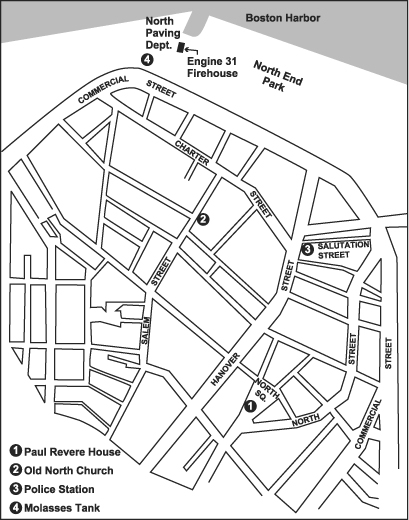
Map shows Boston’s North End and proximity of the molasses tank, paving yard, and firehouse to Paul Revere’s House, the Old North Church, and the Salutation Street police station, which was firebombed by anarchists in December 1916. This was part of a pattern of violent anarchist activity in Boston that USIA argued was responsible for the destruction of the molasses tank. (Map by Sarah Gillis, based on Boston Redevelopment Authority maps)
 ONE
ONE 
Boston, Late December 1915
An icy wind roared across Boston’s inner harbor, scraping salt pebbles from the ocean-spray spilling over the seawall and flinging them into Arthur P. Jell’s face. Jell tasted the salty grit between his teeth and felt the sting against his cheeks. Shivering, he cursed the wind as it sliced through his topcoat and into his chest, and flexed his aching fingers inside his thin cloth gloves. December could be Boston’s cruel-est month down at the water, if only because it was so unpredictable. Bostonians expected the shocking cold that swept in from the Atlantic every January and February. December, though, was a seasonal tease, red-raw as a fresh wound some years, others as soft and muted as an early-morning drizzle with no indication of the deep winter to come.
This year, to Jell’s annoyance, winter was not being cheated her first month, and the cold settled into his bones and his consciousness early. Every place he turned reminded him of the horrendous December weather: piles of grimy snow that workers had dumped against the freight sheds, puffs of frozen breath encircling the heads of crew members as they exhaled, relentless wind shrieking off the harbor. Winter had squeezed the color and depth from the world in front of him, leaving a series of flat, pale grays—water, sky, clouds, ships, the Bunker Hill monument across the bay in Charlestown, the seagulls that squealed overhead, dipping and gliding on the wind currents—all blending to form a bleak two-dimensional background painting.
In the foreground, the massive shell of the coal-gray tank stood out in stark contrast, the only thing that seemed real to Jell, something majestic being born from something ordinary.

The weather was only a little less foul than Jell’s mood as he watched crews of workmen scurrying up ladders and across shaky scaffolding. They were as anxious as he was to erect the tank. His tank. That’s how he felt about the gigantic steel structure that stood before him, so close to completion, but as yet unfinished, a promise unfulfilled. It was an embarrassment because it was still incomplete, more than a year after his bosses had put him in charge of the project with the clear and sober instructions that he should give it his highest priority. It was a race against the calendar to get it finished before the molasses steamer from Cuba docked at Boston Harbor in just three days. On the afternoon of New Year’s Eve, the ship would arrive, its crew ready to pump into the tank seven hundred thousand gallons of the viscous liquid that Jell’s company would later distill into industrial alcohol.
Delays had plagued the project from the start, but Jell still had time to salvage his reputation and his career with his employer, the Purity Distilling Company, and, more importantly, its parent company, U.S. Industrial Alcohol (USIA), if he could meet the December 31 deadline. After months of frustrating negotiations to lease the Commercial Street waterfront location, Jell was scrambling to speed construction along. He had ordered the Hammond Iron Works, the manufacturers and assemblers of the tank, to employ extra crews to finish the job—thirty men now toiled day and night on the tank. He had even approved the installation and expense of additional electric lighting so those crews could work around the clock. “It may be that objections will be raised to our running riveting machines at night, but until we are prevented from doing so, we wish to work both a day and a night shift,” he wrote in a letter to Hammond officials.
Now, Jell watched as workers bent the last of the giant steel plates into place and bolted them together with thousands of rivets. The full height of the tank would be achieved by fastening together seven vertical layers of rounded steel plates, each overlapping the layer below and held in place by a horizontal row of rivets. Vertical rows of rivets sealed the seams of each of the eighteen steel plates that formed the tank’s cylindrical shape. The tank would be the largest in the region by far, standing fifty feet tall, ninety feet in diameter, 240 feet in circumference, with the capacity to hold more than 2 million gallons of molasses.
USIA/Purity Distilling needed the huge tank to store the molasses after it was off-loaded from steamers that transported their shipments from Cuba, Puerto Rico, and the West Indies. Crews could then load molasses from the tank onto railcars that would transfer the sugary substance as needed to the company’s manufacturing plant in nearby East Cambridge. There, a small portion of molasses would be distilled into grain alcohol for rum, but most of it, more than 80 percent, would be distilled into industrial alcohol that would be used as a major ingredient in the production of munitions, especially dynamite, smokeless powder, and other high explosives.
USIA and its subsidiaries, including Purity, would sell the alcohol to major weapons manufacturers in the United States, as well as to the British, French, and Canadian governments, to produce munitions for the war against Germany that had broken out in Europe in August 1914. Since then, the demand for industrial alcohol to feed the munitions manufacturing process was greater than Jell had ever seen. Now, despite President Woodrow Wilson’s promises of neutrality, many citizens believed that the United States would become involved. If that happened, the U.S. War Department would become USIA’s largest customer and would order the company to ratchet up production even more.
Even without America’s involvement in the war, the demand for industrial alcohol by friendly European governments was straining current manufacturing capabilities. USIA, one of the nation’s largest industrial alcohol producers, was always in need of a readily available supply of molasses to produce alcohol more quickly and manage inventory more efficiently. Up until now, without a Boston tank of its own to store huge quantities of molasses temporarily, the company was forced to purchase smaller amounts of molasses as needed from a third-party broker with a tank in South Boston. This drove up costs, ate into profit margins, and left USIA at the mercy of another supplier at a time of burgeoning demand for industrial alcohol.
For USIA’s Boston operation to operate at peak efficiency, the Commercial Street molasses tank was the answer. Its enormous storage capacity along with its ideal location, sandwiched between ship traffic in the busy inner harbor and Boston’s major freight rail lines that ran along Commercial Street in Boston’s North End, made it a critical component in USIA’s growth plans.
As treasurer of the Purity Distilling subsidiary, Jell knew those corporate plans all too well, and realized that the company would lose out on profits if the tank was not finished by the time the molasses steamer arrived in Boston. The ship, owned by another subsidiary of USIA, the Cuba Distilling Company, would be delivering about half of her 1.3 million gallons of cargo to USIA distilleries in New York and the remaining molasses to Boston. If the Boston tank were not ready to accept the remaining molasses, the ship would have to find another USIA location to accept the delivery or even dump the product at sea. Either way, this would cost the company time and money.
Already the delay in finishing the tank was costing USIA dearly and causing Jell personal embarrassment. He had hoped the tank would be completed long before this, but negotiations had been difficult with the Boston Elevated Railway Company, whose waterfront land USIA was leasing for the tank site. He had begun discussions with Boston Elevated in January, but they stalled in the spring and early summer, and were not concluded until late September. It then took one month for the Hugh Nawn Construction Company to build the concrete foundation upon which the massive steel tank would sit. Fabricated steel plates for the tank didn’t arrive in Boston until the first week in December.
Even with a perfect December, Jell had recognized that the construction schedule would be tight—and December had been far from perfect.
First, death had visited the tank construction site. On the morning of December 8, Thomas DeFratus of Charlestown, a thirty-five-year-old laborer, toppled from a staging plank and plunged forty feet inside the tank to his death. Jell still remembered the doomed man’s scream and the anxious shouts of the other men. He felt sorry for DeFratus and his friends, many of whom were crying as they pulled their comrade’s broken body from inside the tank shell and awaited the medical examiner. But Jell was most distraught because the incident cost him a precious half-day of work by the time the body was finally removed to the North District Mortuary. Worse, for several days afterward, he watched the careful movements of the other men, their white-knuckled grips on the rungs as they climbed ladders, the methodical step-by-step high-wire walk across scaffolding, their boots sliding tentatively along planks searching for a toehold, their fingers brushing the side of the tank for balance. They were frightened men working in slow motion. Jell recognized that their fear had to run its course, and he was relieved three days later when the work pace had finally returned to normal.
His relief, though, was short-lived. On December 13 and 14, a vicious storm with gale-force winds pounded Boston. The newspapers called it a “superstorm,” the worst in a dozen years. Two massive fronts collided in upstate New York and dumped more than twenty inches of snow west of Boston as well as a torrential rain and a driving sleet within the city. Trains were delayed and streets were rendered impassable due to the flooding. Heavy wind knocked down electric power lines, chimneys, trees, and signs that hung outside of storefronts. The popular roller coaster at Nantasket Beach, south of Boston, was toppled by the wind, falling across the street, snapping wires and crashing against utility poles.
The superstorm with the fifty-mile-an-hour gale meant a two-day construction delay at the Commercial Street molasses tank. And even on the third day, crews spent most of the morning clearing debris from the site and pumping water that had collected in the well of the tank. Jell took some solace that the wind had not damaged the tank’s shell, which then stood about thirty feet high.
Workers made good progress between December 15 and Christmas Day—another lost workday for Jell—and then, as if to taunt him, a December 26 sleet storm forced him to stop work for another day. In a bizarre case of déjà vu, winds in this storm were so severe that they destroyed the Boston area’s other landmark roller coaster, this one on Revere Beach, north of the city.
Jell saw the weather as just one more obstacle jeopardizing the tank’s completion and one more factor conspiring to humiliate him.
The stinging wind continued to howl off the harbor, rattling the tank’s steel superstructure. Jell wriggled his toes, now numb inside his leather shoes. He clenched and unclenched his fingers to get his blood moving. Across the entire wharf area Jell saw men working; stevedores, longshoremen, and teamsters. They were big men with rough hands and strong backs, guiding horse-drawn wagons loaded with beer barrels, driving hogs from the railroad sheds to the steamers moored along the pier, or unloading heavy wooden crates from the cargo holds of those ships. He even saw a blacksmith pounding out shoes in front of the city-owned stables. Jell was not comfortable among such men or around such work, preferring the certainty of numbers and the warmth of his office to the randomness and discomfort that surrounded him on the wharf. These men earned their livings with the threat of injury, miserable weather, and erratic ship traffic always lurking. A longshoreman who wrenched his back or a stevedore who dropped a beer barrel and shattered his foot could be out of work for months with no means to support himself or his family. A teamster delivering tomatoes to the dock might see his product rot if a ship were delayed for days by a storm.
He also was uncomfortable in this neighborhood. To him, it was sooty, noisy, and crowded, filled with poor Italian immigrants speaking a strange language and practicing even stranger customs, and Irish city workers whose brashness made him uneasy. He longed for the project to be finished so he could return to his Cambridge office.
He recognized, though, that this was the perfect location for the molasses tank, a little more than two hundred feet from the ships, easy access to the tank for railroad cars along the spur track, and a fast one-mile rail trip to the East Cambridge distillery where the molasses would be distilled into alcohol. He had negotiated hard for this location and would bear standing in the cold now to watch the site take shape.
Behind him, Jell heard the clatter and screech of the elevated passenger train from South Station as it rumbled above Commercial Street, straining to negotiate the hard left bend in the track toward North Station. Jell did not turn, but imagined the sparks that flew when the train’s steel wheels bit into the searing cold rails. His eyes were drawn to the crews working on his tank and he watched the men wield hammers and bolt rivets, wondering how they could work in this kind of cold. Their problem, but his too. Speed was his overriding concern right now.
Arthur P. Jell had spent his entire working career in clerical, administrative, and financial positions, beginning at age fourteen when he had become an office boy with distillers Hiram Walker & Sons. In 1909, at the age of thirty, he moved to Boston to become secretary of the Purity Distilling Company. After two years as secretary, Jell was promoted to treasurer, the position he held when he was given responsibility for the molasses tank project in late 1914.
USIA president Frederic M. Harrison and vice president Nelson B. Mayer had been dangling a parent-company vice-presidency in front of him, the next logical step in Jell’s career. Such a promotion would include relocation to headquarters in New York City. When Harrison ordered him to begin work on the Boston tank project, there was more than a veiled implication that his success on this project would expedite his promotion and failure would doom his future with the company.
Jell had first contacted Hammond Iron Works in late 1914 to draw up plans for the Commercial Street tank and Hammond furnished completed blueprints in early April 1915, along with a price tag of $30,000 for the manufacture and erection of the tank. Since then, Jell had been involved in frustrating negotiations with Boston Elevated to agree on leasing terms for the site. “It looks as though the matter will be settled within a very few days,” Jell wrote to Hammond on April 9, 1915, a prediction that had proved laughable.
The leasing discussions with Boston Elevated ground to a halt over money and the details of the complicated arrangement. Boston Elevated had to assign USIA rights to build the large tank and an accompanying pump room, moor vessels alongside the wharf to unload molasses, install a 220-foot underground pipe to carry molasses from the ships to the tank, store the molasses, build a small auxiliary tank that acted as a molasses feeder between the large tank and the railroad cars, and build a “spur track” that would enable railroad cars to travel back and forth between the tank site and the main Commercial Street tracks.
Both sides also had to agree to language governing charges for gas, water, and electricity onto the property, as well as liability for any damages that occurred during USIA’s regular commerce. All of this took time, much more time than Jell or his company had estimated. “We regret very much that we are still unable to give you any definite shipping date for the 90-foot tank,” Jell wrote to Hammond on May 6, 1915. “We are far more anxious than you are to commence work on this, and we can assure you the delay has been unavoidable.”
The pressure on Jell to finish the tank project increased the very next day, May 7, when the British luxury liner Lusitania was sunk by a German submarine in the North Atlantic. America was outraged when the press reported that nearly 1,200 people had been killed, including 128 Americans, and sentiment began building for the United States to enter the war against Germany. Even the normally temperate New York Times editorialized on May 8, 1915: “From the Department of State, there must go to the Imperial Government at Berlin a demand that the Germans shall no longer make war like savages drunk with blood.” If America entered the war, the War Department’s demand for munitions, and therefore for industrial alcohol produced from molasses, would grow exponentially.
Even now, the demand for industrial alcohol from the big munitions companies—du Pont, Hercules Powder, Aetna Explosives—was hard to keep up with as they worked to feed the British and French war machines. The French and Canadian governments also placed large orders directly, and alcohol shortages were becoming commonplace. The production of munitions, quite simply, was America’s number one growth industry.
For USIA to get its fair share of this booming trade, Arthur P. Jell needed to finish the molasses tank on the Boston waterfront no later than the final day of 1915.
On September 24, 1915, after months of haggling, Jell had signed a twenty-year lease with Boston Elevated to rent the seventeen-thousand-square-foot waterfront parcel at 539 Commercial Street, sandwiched between the North End residential neighborhood and the inner harbor, for an annual fee of $5,000. The lease was to commence on November 1. “We are extremely anxious to have the work proceed as rapidly as possible and are quite willing to pay any additional expenses there may be in pushing the work forward so that the tank can be completed promptly,” Jell wrote to Hammond on October 1, 1915. Then on October 19: “We confirm the understanding whereby you are to furnish sufficient men to complete the tank by December 15th and we agree to pay … any additional expenses which may be necessary in order to hurry the work as much as possible.”
The Hugh Nawn Construction Company began work on the three-foot thick concrete foundation during the first week of November, and Hammond Iron Works shipped the steel plates to Boston around the first of December. When Hammond suggested that it might lose some time applying for proper permits from the Boston Building Department, Jell wrote back promptly: “You apparently did not understand that we had arranged so that it would not be necessary for your foreman to take out a permit in Boston, as the contractors who are building the foundation will allow us to erect the tank under their permit.” The building department considered the tank a “receptacle” and not a “building,” so the permit for the foundation was all that the city required.
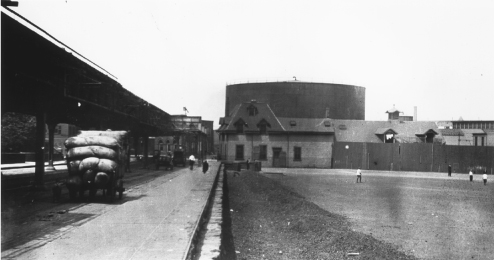
Before the flood, the molasses tank towered over adjacent structures and the elevated railroad tracks.
(The Bostonian Society/Old State House)
With his deadline approaching like a locomotive, Jell made an executive decision in late December. The contract with Hammond called for the fifty-foot-high tank to be tested for leaks upon its completion by filling it with water. Jell knew that the amount of water he would need to fill the tank would be so vast that he would have to tap into the municipal water supply, an expense he refused to authorize. Jell also knew it would have taken many days, perhaps weeks, to fill the tank. It was time he did not have. Instead, Jell ordered crews to run only six inches of water into the tank, enough to raise the water level above the first angle joint at the base of the structure. When no leaks occurred, Jell pronounced the tank sturdy, sound, and ready to use.
On December 29, 1915, two days before the Cuba Distilling Company molasses steamer arrived with seven hundred thousand gallons of molasses to off-load, Hammond Iron Works posted a letter to Jell along with a final invoice for the tank. “… In order to include it in this year’s business, and even if the tank is not, technically speaking, completely finished by December 31, we trust it will be satisfactory that our invoice is rendered under this date.”
Two mornings later, the huge tanker arrived in Boston and disgorged her molasses cargo smoothly, filling the tank to a level of about thirteen feet.
Nearly a year of frustration had ended. Arthur Jell had met his impossible deadline and USIA was in business on the Boston waterfront.
From the first day of the tank’s completion, USIA paid the Boston Police Department for a policeman to be on a “fixed post” at the tank. Jell and USIA were taking no chances. Anarchists, who were militant radicals who opposed the war, hated government, and loathed capitalism—especially those large American corporations that fed the war effort—were making their presence known across the country with incendiary speeches, audacious threats, and violent activities.
During November and December of 1915, there were suspicious explosions and fires at strategic manufacturing plants across the country. Fire destroyed the Bethlehem Steel Works in Pennsylvania, which was producing guns for the Allies. An explosion rocked the du Pont Powder Mill in Wilmington, Delaware, killing thirty men and injuring five. A man was arrested in Pittsburgh after threatening both to blow up the Westinghouse Electric and Manufacturing Company plant and assassinate President Woodrow Wilson. Guards were doubled at principal government buildings in Washington, D.C., including the State, War, and Navy departments after numerous bomb threats and a bomb explosion destroyed a room in the Capitol in the summer of 1915. Throughout 1914 and 1915, a rash of bombings shocked New York City. In one brazen attempt, a bomb was placed in the courtroom beneath the seat of magistrate John L. Campbell, who had convicted and sentenced an anarchist for inciting a riot. The judge was about to ascend to the bench when the bomb was discovered and disarmed.
At the start of 1916, Jell and other Bostonians saw the danger creep closer to home. On New Year’s morning, a Massachusetts State House night watchman making his rounds discovered a wicker suitcase tied to the doorknob of the sergeant-at-arms’ office. Suspicious, he called state police to investigate. They discovered a pipe inside the suitcase filled with several sticks of dynamite—a faulty fuse had prevented the bomb from exploding. On the morning of January 2, an explosion rocked the New England Manufacturing Company in the Boston suburb of Woburn. Rumors quickly circulated that the company had received a letter two weeks before threatening to blow up or set fire to the plant unless it stopped producing goods and shipping them overseas to the warring nations in Europe.
Beyond these incidents, Boston Police had issued warnings that Boston’s North End was fast becoming the headquarters for some of the leading Italian anarchists in America, who preached the violent overthrow of the U.S. government and the capitalist economic system.
Jell feared that because the USIA Cambridge factory converted molasses into industrial alcohol for munitions, the Commercial Street molasses tank could be an inviting target for anarchists or others who opposed the war in Europe. After the prolonged delay in securing a location for the tank, the company had lost precious time and significant revenue. USIA’s bottom line would be strained severely if the North End tank were damaged in any way—or, worse, destroyed.
Arthur Jell considered twenty-four-hour police protection a worthwhile investment.
Boston, February 1916
His first day on the job, Isaac Gonzales watched and listened intently as his new boss, William White, led him around the tank property and explained the logistical operations involved in getting molasses from the waterfront to USIA’s manufacturing plant in East Cambridge. He learned how the ten-inch-wide discharge hose from the molasses tankers was to be bolted to the permanent pipeline on the wharf using two flanges with a gasket in between. He learned how to control the flow of molasses into the 220-foot main intake pipe that traveled from the wharf to the tank to prevent clogging. He learned how to climb down into the tank when it was being filled to be sure the intake pipe opening remained clear. And he also learned to discharge molasses from the big tank to the auxiliary tank and then into the railcars when orders came in, so the trains could transport the thick liquid to the Cambridge distilling plant.
Isaac felt at home around ships, the sea, and molasses. Born in Puerto Rico, he spent four years as a seaman and often traveled back and forth between his home island and Cuba to load molasses for the trip north. He settled in the United States after he was discharged from his ship in Baltimore, making his way to Washington, D.C., where he worked as a messenger for a lawyer specializing in international law, and later, for the U.S. attorney general’s office as an engine repairman at a D.C. office building. In 1910 he moved to Boston, where he worked at a series of laborer’s jobs before joining Purity/USIA. Like many others during the recession of 1913 and 1914, Isaac had been down on his luck. He was living at the Boston YMCA when staff members told him about this job, and he was determined to succeed.
It was freezing when Isaac arrived at the Commercial Street dock early in the morning, and the deep cold continued into the mid-afternoon. The wind off the harbor slashed at his face and tossed cold, gray seawater onto the wharf. Isaac wore a heavy wool coat, a knit hat pulled low over his ears, thick gloves, and heavy work boots. White asked him to attach the hose into place, which forced him to remove the gloves to get a grip on the flanges, the gasket, and the nuts and bolts. Isaac made a note to wear thinner gloves the next day, cold or not.
Looking up at the tank, Isaac saw that thick molasses was seeping from between many seams, congealing around the rivet lines and spreading slowly downward and outward. It did not flow rapidly down the sides of the tank because of the cold—molasses never really froze, but Isaac knew it developed the consistency of heavy pudding in frigid temperatures. More troubling than the seeping, though, were the noises that came from inside the tank. He heard low rumbles over the wind, like distant rolls of thunder.
Isaac knew the sound that molasses made as it was fermenting, “boiling” as he called it, a phenomenon that became even more pronounced with dramatic temperature changes. But this sound seemed different to Isaac. Maybe it was the way the wind snapped and whistled as it bounced off the tank’s walls. Maybe it was something else. But the rumbling noises in the tank made the hairs on the back of his neck tingle. It was as though the giant steel container was alive and he was hearing the low growl of an angry animal.
President Woodrow Wilson, speaking on February 1, 1916, from the rear platform of a train at whistlestops throughout Iowa, addressed thousands of Midwesterners who braved subzero temperatures, waved American flags, and listened intently to his plan to keep the United States out of the European war. He insisted that the best way to accomplish this was for the people and Congress to support his national defense preparedness program, which involved increased munitions production for the purpose of shipping arms to friendly nations overseas. A well-supplied England and France would lessen the need for U.S. intervention.
Munitions production was good for the U.S. economy, too. In fact, it had been the astounding growth of this sector throughout 1915 that had rescued America from economic recessions in 1913 and 1914.
Wilson’s biggest challenge was convincing Iowans and the country that munitions manufacturers were not influencing his policy decisions. Wilson told a crowd of fifteen thousand people in Davenport: “It seems to be supposed that a small body of men, who have a chance to make money out of the manufacture of munitions, have something to do with the policy of the government of the United States. I have yet to discover any such influence.” The government, Wilson said, would control the supply and prices of munitions, “and prevent any undue profit to anybody.”
Wilson, in part, was responding to a so-called “monster petition,” signed by more than a million people, that had been delivered to the Senate and called for an embargo on arms and ammunition production and exports from the United States to warring nations. The petition consisted of a thousand rolls of paper—each tied in red, white, and blue ribbon—that reportedly would stretch more than fifteen miles if the unrolled sheets were laid end to end.
The petitioners were misguided, Wilson said. Defense preparedness at home and assistance to friendly nations abroad were the most effective ways for the United States to exert its influence to end the war. “Do you want the situation to be such that all the president can do is to write messages and utter words of protest?” he asked the crowd. “If these breaches of international law should touch the very honor of the United States, do you wish to do something about it? America can not be an ostrich with its head in the sand.”
For Arthur Jell and U.S. Industrial Alcohol, the president’s message was important and welcomed. It meant, most likely, that munitions production, already booming, would continue to increase. Even with government oversight of production, pricing, and profits, this was good news indeed.
Later in February, Jell formally acknowledged Hammond Iron Works’ efforts to complete the tank on time, writing, in part: “We take this opportunity of expressing our appreciation of the manner in which you rushed this work, as by completing the tank at the time you did, we saved a considerable amount of storage charges. We feel that considerable credit is due to your foreman and the men under him for the assistance they rendered in hurrying the work forward …”