
The world as we have created it is a process of our thinking. It cannot be changed without changing our thinking.
—Albert Einstein
Sara Menker sat at her desk in Manhattan staring at her computer screen. It was the summer of 2008 and she was watching the financial markets collapse before her eyes. As an energy commodities trader at Morgan Stanley, she knew the numbers running across her screen were catastrophic. A loud gasp from her colleague at the next desk made her turn. He had his face in his hands, as if to hide from the horror. “The world’s coming to an end,” he said. “This is Armageddon. We better start buying up gold.”
“What are you going to do with all that gold if the world’s economies collapse?” Sara blurted out. “Forget gold. Buy a sack of potatoes! You need potatoes. We’ll all need potatoes.”
Her colleague laughed. Then Sara laughed too, uneasily.
Later that evening, Sara was still thinking about potatoes. Born and raised in Ethiopia, a country with a history of catastrophic famine, she understood the value of food security in ways that many of her peers on Wall Street did not.1 She found herself researching farmland prices in her home country. Thinking like a trader, she saw an investment opportunity. The land was cheap. It was selling for $1.50 an acre in some areas. It also seemed relatively easy to purchase tens of thousands of acres.
Intrigued, Sara decided to take a trip home to learn more. She didn’t know anything about agriculture, but she had confidence that she could learn about a new industry quickly. After a few days of firsthand exposure, she was amazed at what she saw. To successfully grow crops, an Ethiopian landowner would have to buy crop insurance. But there was no crop insurance market. If no bank would lend money without the security of crop insurance, then the cost of capital would be much higher. The land was also remote, which meant leveling and road building. To grow potatoes, a farmer would have to essentially build out an entire agricultural infrastructure. That was much too costly and too risky for most people—including Sara. She quickly abandoned her idea of becoming a potato farmer.
But what she saw on her trip continued to gnaw at her. If farmers were unable to do their work, people wouldn’t have enough food. The agricultural system’s structural capacity to produce food would soon be surpassed by future demand. “The next time markets crumble,” Sara told us, “people won’t just lose money. They won’t be able to eat. People could starve and governments may fall.” Sara was so alarmed by the possibility of a global food shortage that she felt compelled to do something to help. So she quit her job at Morgan Stanley.
Five months later, Sara was leaning over her kitchen table and peering into her glowing computer screen. It was almost midnight on a Friday evening. She had planned to be in bed hours ago but needed one last look at the dense chunk of Python code she had been trying to understand since before sunset. If it weren’t dark outside her window she would barely have sensed that any time had passed at all. She read the code from top to bottom once again, her nose inches from the screen. She needed to understand how the program was working and from where it was pulling the data that fed a core algorithm. “OK, progress,” she said to herself as she closed her laptop. “Back at it tomorrow.” Outside, only a sprinkle of light decorated the small Kenyan farm town she had just moved to from New York City. As a Black woman who had forged a successful career on Wall Street, she was no stranger to adversity. She knew there were no shortcuts. She had to understand the data for herself.
Why would a successful energy commodities trader quit her job, move halfway around the world, and then wind up reviewing code in the middle of the night? Sara’s aha moment came when she discovered that even an industry as seemingly earthbound and analog as agriculture was in the throes of a massive digital transformation. A global ecosystem of digital technologies including sensors, forecasting tools, and databases were allowing farmers, researchers, and industry analysts to collect and store data about crops, weather conditions, and soil and erosion patterns at tremendous speed and scale. Digital tools had been turning agriculture into a data-intensive operation, but she was one of the few people outside the industry who knew it. How? By having the courage to ask questions about what she didn’t know. Sara’s quest to contend with the destructive force of the global financial meltdown led her to discover what we know to be an important fact about life in the twenty-first century: There is no area of the economy and no type of work that will remain disconnected from digital technology and the data it produces, captures, and stores.
As Sara learned, the agricultural industry collected mountains of data at every stage of its process. But the data were scattered. There was no unified system connecting the troves of information, especially given the global scope of the industry. Agriculture was a labyrinthine ecosystem spread across multiple continents. Take, for example, the Ethiopian coffee market. Although it was obviously dependent on what happened in neighboring countries like Uganda and Kenya, it was even more crucially dependent on what happened in distant places like Vietnam and Brazil because they were the largest coffee producers. A coffee grower in Ethiopia needed to understand how each of those regions produced, which meant understanding their individual climates and markets. Also, understanding European consumption trends was necessary because Germany was the world’s largest importer and re-exporter of coffee and a huge driver of prices. Other crops were relevant as well. Because coffee competes with tea, it was important to know tea markets. Sara concluded that the complexity was just too difficult and expensive to unravel in the way that agricultural businesses would traditionally manage it. If the various aspects of the global agricultural markets were interdependent, their corresponding data also needed to be connected to be useful.
Sara thought back to her shock upon calculating that the real cost of a $1.50-per-acre land deal in Ethiopia was $12,000 an acre when you factored in all the other requirements to put that land to work—insurance, infrastructure, and so forth. The reason it cost significantly less to invest in US agriculture than Ethiopian agriculture had to do with access to data and analysis. The United States has troves of data on which to base risk-taking decisions. In some African countries, banks didn’t lend, insurance companies didn’t insure, and logistics operators didn’t exist, because none of those industries had the data required to provide the services. How could any of those entities price the risk of a farmer if they couldn’t understand in numerical terms what a production cycle looks like in a particular location in Africa?
Sara had found her mission: translate and connect the data to allow better predictions about the dynamics of a global ecosystem. As a commodities trader she had developed a set of analytic skills that enabled her to recognize what opportunities might lie in connecting disparate data. But it wasn’t until she developed a digital mindset that it was possible for her to understand how a powerful digital platform, purpose-built to help connect fragmented data sets, could help to revolutionize agriculture. Her digital approach enabled her to launch Gro Intelligence, a data and analytics company focused on all things agricultural.
With employees in New York and Kenya, Gro Intelligence developed a platform that can ingest over 40 million unique agricultural data sets that amass to more than 500 trillion data points. Using data inputs from multiple countries, along with real-time information from satellite imagery, Sara’s company built a prediction engine that uses machine learning algorithms to provide sophisticated daily forecasts. Their forecasts have the power to move agricultural markets, and their predictive models are routinely more accurate than those generated by the United States Department of Agriculture (USDA). In 2019, Gro Intelligence stepped in to provide real-time estimates for commodities production, which are normally produced by the USDA but were not available due to the US government shutdown that year.
Sara Menker, who had nervously joked about potatoes a few years earlier, was now leading an industry as essential as food production into the digital age. Sure, learning the technical skills—like how to understand code well enough to know what data sources it was pulling—was a key part of the process. But the foundation of her success was not just a matter of aptitude or ability. It was a mindset—defined above all by the courage to be humble, admit that you don’t know what you don’t know, and set out on the path to learning it. When she began to investigate farming in Ethiopia, she didn’t know how to access the agricultural data or why it was categorized the way it was. So Sara started asking questions. Lots of questions. When she wanted to figure out how to build dynamic maps that visualize massive amounts of agricultural data in real time, she tracked down her old classmate, a software engineer who then taught her about the processing power of cloud computing platforms. When she wanted to learn how to build environmental models with the data, she tracked down the foremost expert on the subject—an agricultural professor based in South Dakota. As she learned how to do experiments that would help her identify the right digital products to help farmers, she also began to think about ways to keep the data in those products secure. By then, it’s safe to say that she’d learned about “this whole digital thing.” Digital learning had provided answers to her questions about agricultural development in the United States, Ethiopia, and the rest of the world. But it always began with a question. Whatever the topic was, she would find the person who could teach her. This is a humility that is historically rare among executives, and it is crucial to a digital mindset.
From her perch above Wall Street all those years before, Sara never could have imagined that she would be running a highly successful AI firm that would be selected as one of Time magazine’s one hundred most influential companies in 2021.2 At the time, she didn’t understand what it meant to “be digital” nor did she have the know-how to do it. But she could see the world changing around her and she recognized that to make a difference, to find personal and professional fulfillment, and to be successful in an era of rapid change, she had to become digitally literate. In the process, she learned the basics of computing, how to aggregate data, how to build relationships with employees across two continents, and how to structure a company in which people could make decisions based on rapidly changing data. But the most crucial step in this journey for Sara—a self-avowed “nontechnical” person—came before any of the technical skills she acquired along the way. From the very start, she committed to a digital mindset. The rest followed.
Sara’s powerful journey is proof: operating successfully in the digital world is not only essential for thriving; it’s within your grasp. It takes a digital mindset.
The goal of this book is to help you take that crucial first step on your own path into digital literacy. We’re not here to teach you the specific technical skills you will need to thrive in a digital world; that will come later. This book is about putting you in the position to get there. It’s for those of us who understand that competition has intensified in all industries, further pushing for participation in more digital ecosystems and making digital transformation a key priority for company boards across all industries.3 Most people hear their customers’ demands for digital solutions loud and clear. They also hear the requests of their managers to develop digital competencies in roles that they don’t traditionally think of as technologically focused.4 And they hear what the world’s most prescient leaders have been saying for years: the digital age is ushering in fundamental changes to how work gets done, how industries are structured, and how people collaborate. As legendary Cisco CEO John Chambers remarked in his final public address before stepping down to become the company’s executive chairman, “This digital era will dwarf what’s occurred in the information era and the value of the Internet today. As leaders, if you don’t transform and use this technology differently—if you don’t reinvent yourself, change your organization structure; if you don’t talk about speed of innovation—you’re going to get disrupted. And it’ll be a brutal disruption, where the majority of companies will not exist in a meaningful way 10 to 15 years from now.”5 Chambers was not known for hyperbole.
Nevertheless, many people still can’t shake the notion that they’re just “not technical” enough to think digitally.6 It’s understandable. We’ve been conditioned to see ourselves within an either/or dichotomy of technical and nontechnical workers. But that paradigm is outdated. We are all digital workers, whether we are a software engineer in Silicon Valley, a marketer at a Hollywood ad agency, an entrepreneur in the food production industry, or an instructor of any academic subject whatsoever. Training ourselves out of the old paradigm isn’t easy. In many ways, a mindset shift can be even more challenging than developing the practical tech skills that follow. That’s why we wrote this book.
In these pages, you will have the opportunity to address the following questions, which will be familiar to anyone who has observed the tidal shifts in the way we work:
· How much technical capability do I need?
· Do I need to learn how to code?
· What do I need to know about algorithms?
· What do I need to understand about big data?
· How do I use digital tools effectively?
· What exactly is AI?
· Do I need to prepare to have a bot or robot on my team?
· How do I collaborate successfully when people are working remotely?
· What are the best ways to make sure my data and systems are secure?
· How do I develop skills to compete in a digital economy?
· Is digital transformation different than other transformations?
· How do I build a digital-first culture?
· Where do I start?
Our message in this book is simple: If you develop a digital mindset, you’ll be able to answer these questions and many more. You’ll be poised to thrive in the digital age. Anyone can build a digital mindset. That’s what Sara Menker did. She didn’t become a tech whiz or a computer programmer. She developed a digital mindset that allowed her to see the world in new ways and to ask new, big, important questions. Developing a digital mindset will require you to develop new insights and to be open to change. But getting to the minimum threshold of technical acumen necessary to achieve a digital mindset is absolutely doable for anyone reading this book. And, dare we say, it’s even fun.
Over the past decade, we have researched, consulted for, served on advisory boards of, taught managers from, and written case studies about hundreds of technology-enabled organizations around the world. We have explored how these organizations and the people working in them have developed a digital mindset. We developed the idea of the digital mindset through our discussions with thousands of professionals, managers, and executives who provided us with insights into the ways of thinking that create opportunities in the digital workplace. They all shared a common belief that to “be digital” required first developing a new mindset that allowed them to acquire and apply technology-based competencies, ranging from data acquisition and computing fundamentals to large-scale organizational change. In addition to our own research, we drew from a war chest of research articles, stories, and cases produced by leading experts in the field to develop the concept of the digital mindset and to identify the approaches that it encompasses.
We’ve seen that people who develop a digital mindset are more successful in their jobs, have higher satisfaction at work, and are more likely to get promoted at their company. They also have more portable skills they can take with them if they decide to move jobs. Leaders who have a digital mindset are better able to set up their organizations for success and build a broad employee workforce that can adapt quickly to change. When companies have people with digital mindsets, they react faster to shifts in the market and find themselves better positioned to take advantage of new business opportunities. Thriving in the digital age requires more than simply acquiring skills to work with digital technologies. To be successful it is necessary to think differently. This book will show you how to get there.
Definitions
Before we get too far, we should set out some definitions. Terms like digital mindset can be interpreted in many ways. These are our working definitions for this book.
We like to think about digital as the interaction between data and technology.
Data refers to any information that can be used for reference, analysis, or computation. Your grocery shopping list is data, and so is the weather forecast. Today, most people think of data as specifically numbers, but other things like images and text are data, too, because they are turned into numbers that can be processed, stored, and transformed through computing.
Technology creates, captures, transforms, transmits, or stores data. For most of human history the technologies that performed these tasks were simple—stone tablets, papyrus, and paper. Today, data are transformed at exponentially higher volumes and speed through myriad devices. In fact, we experience most data through multiple interconnected devices—sensors, computers, software programs, cloud-based storage. Your phone, for example, is many, many technologies working together to mediate data. The combination of sensors, hardware, and software that make up the phone convert analog inputs like sounds and images into binary code that is processed, stored, and rendered for you as music, pictures, and words. Your phone doesn’t just store data; it produces and reproduces data in novel ways.7
A mindset is the set of approaches we use to make sense out of the world. How you approach something shapes the way you think about it, its importance to you, and how you act.8
A digital mindset, then, is the set of approaches we use to make sense of, and make use of, data and technology. This set of attitudes and behaviors enable people and organizations to see new possibilities and chart a path for the future. Big data, algorithms, AI, robotic teammates, internal social media, blockchain, experimentation, statistics, security, and rapid change are some of the major digital forces that are reshaping how we live and work. These forces are disrupting how we interact with our colleagues and creating new demands to restructure organizations to become more competitive.
With this working definition we can dive one level deeper. Developing a digital mindset means we are redefining fundamental ways of approaching three key processes:
· Collaboration
· Computation
· Change
Redefining approaches to these processes means, of course, learning some new concrete skills. But it’s not enough just to build skills. Skills give you the vocabulary, knowledge, and intuition to see the bigger picture—to ask the important questions.9 Developing a new mindset means that you build from your new skills to see the world in a new way and to change your behavior.
In this book we’ve developed a framework that outlines the skills you must learn to develop your approaches to collaboration, computation, and change so that, from there, you can build a digital mindset. We don’t just tell you what those technical skills are; we actually help you to learn them.
Rest assured that you won’t need to master the intricacies of programming, how to build your own algorithms, or how to run advanced multinomial logit models. You may end up doing those things someday, but our focus is only on what you need to be digitally proficient. And here’s the good news: you only need about 30 percent fluency in a handful of technical topics to develop your digital mindset. We call this the 30 percent rule.
The 30 Percent Rule
To understand the 30 percent rule, think about learning a foreign language. To demonstrate mastery of the English language, a nonnative speaker must acquire roughly 12,000 vocabulary words. But to be able to communicate and interact effectively with other people in the workplace, all they need is about 3,500 to 4,000 words—about 30 percent of what it takes to achieve mastery.10 In practical terms, a nonnative speaker does not need to master the English language to work effectively with others. Similarly, to work effectively with a digital mindset, you don’t need to master coding or become a data scientist. But you do need to understand what computer programmers and data scientists do, and to have proficient understanding of how machine learning works, how to make use of A/B tests, how to interpret statistical models, and how to get an AI-based chatbot to do what you need it to do. We will define all these terms and techniques in the chapters that follow.
We’ve devoted the past decade to figuring out exactly what that 30 percent looks like and we’ve taught many learners how to develop a digital mindset.11 We want to share the lessons we’ve learned so you too can begin to approach collaboration, computation, and change in ways that introduce you to some of the exciting new possibilities that digital transformation can offer.
Over the course of this book, we specify the categories of skills that you’ll need and what 30 percent competence looks like in each of those categories. Once you have achieved that 30 percent (or more than 30 percent if you are interested to do more), you will have created the platforms from which you’ll start to think differently—to think digitally. While you might already be familiar with some of the content we present, it is likely that you will find insights that are new or about which you need to learn more. And even for concepts you’re familiar with, you likely will find new ways to think about them and connect them to your job, your organizational strategy, and other aspects of being digital.
The goal of this book is to get you to the 30 percent in each of the areas in which you need to have a digital mindset. For each of the three approaches we have distilled, synthesized, and curated the key insights that you need to know to achieve the minimal threshold across various digital domains.
How We’ll Proceed
We’ll start in part one with a deep dive into new approaches to collaboration in the digital era. The first element of this approach is to learn how to collaborate with machines, which with AI and machine learning are quickly becoming our teammates and colleagues, not just tools we use. To learn how to collaborate with a machine, we show the 30 percent you need to know about how AI operates. We describe how teams in the military are learning psychological as well as technical methods to work side by side with AI-powered robots. We clue you into why it’s unwise to interact with AI devices as if they are human and provide tips on how to avoid the common traps that people fall into when they do so. Next, we examine new imperatives for collaborating successfully with your human colleagues in the digital age. We take you to a bank where employees have been able to successfully innovate by using internal social media to expand whom they pay attention to and whom they learn from. We explore how one of the world’s largest e-commerce companies is able to connect people from around the globe by encouraging them to share nonwork information at work. And we discuss how the new imperative for successful collaboration in the digital world is about making yourself present to others when you’re working remotely. Becoming proficient in at least 30 percent of these new collaboration behaviors will improve work for you, your team, and your coworkers.
Part two of the book takes you through what you need to know to approach computation. We start by focusing on data. We believe that if you understand even 30 percent of how various technologies collect, categorize, and store data, you will be able to make decisions through data. You will also learn how to present data persuasively—a key translation skill. To do this, we will look at how professional basketball teams collect and analyze data on player performance. We tell you the story of how one Indiana county’s folly with data cost them millions of dollars in tax revenue and stalled city improvement projects for years. And we explore how companies like Netflix as well as city governments across the United States use their data to build models that shape the environments you live in. Perhaps as importantly, we discuss how bias can creep into representations of data and how you can learn what data models are and are not telling you. We also take a deep dive into the fundamental statistical reasoning strategies you need to use in a digital environment. To be able to think with data and to evaluate the predictions and prescriptions that other people make, you simply can’t avoid statistics. Don’t worry: we won’t put you through Stats 101. But we do provide the requisite material that will foster your intuition to accurately interpret the vital stories statistical tests tell and ask the right questions about recommendations that cite statistical data. To illustrate how this can be done we look at small companies (a startup that makes wearables that detect body temperature) and large organizations (a major video game developer) to demonstrate how statistical analyses can inform product decisions and how statistical skills allow confidence in those decisions. Learning 30 percent of statistical analysis and reasoning skills will help you make smarter and better decisions.
In part three of the book we support you in developing a new approach to change. We start by showing you how to rethink what security looks like in the digital era. Unfortunately, there is no such thing as a perfectly secure database or organization. There are going to be security failures at some point, and what matters is how you are set up to deal with them. We don’t belabor the obvious by telling you to get a stronger password and to set up multifactor authentication. Instead, we look at breaches—about a major oil producer and social media platforms—so you can learn to approach change that will equip you to respond and adapt when security problems arise. We also take a relatively deep dive into blockchain—and how companies like diamond importers are using it—to introduce you to the essential 30 percent of conceptual vocabulary that will expose you to this emerging technology that can reshape the security around your data assets. Next, we’ll tackle experimentation. Change happens so rapidly now that the best technique to determine what works is to test, fail, learn, and try again. We walk you through a step-by-step process for how to use experiments by taking advantage of digital exhaust—a vast subject from which we’ve distilled the 30 percent you need to know. We also provide you with guidelines for how to build the right structure and culture for experimentation. We recast change from a set of periodic activities to a continuous process we call transitioning. Because digital transformation is central to transitioning, we illustrate its essential features, from the underpinning mindset shift to concrete activities that require it. We cover how Moderna, the pioneering vaccine developer, innovated an integrated organization to use data and technology most efficiently, and we outline the (re)design and alignment of cultural change undertaken at Unilever. We also address the pivotal question of how to upskill and implement continuous learning for individuals and an entire workforce. We provide an appendix with several case examples of continuous learning that range from Spotify, Yelp, AT&T, and Booking.com to Capital One. These case examples provide insights into what is most effective to motivate employees’ voluntary ongoing learning and demonstrate the need to maintain a digital mindset over time.
Throughout this book we draw on a mix of content that includes case examples, published studies, and interviews. Sometimes we’re able to mention the people and companies by name because information about them was already public or because they’ve given us permission to discuss them in this book. In other cases, we describe companies without naming them. We also give people pseudonyms when they’ve asked not to be identified.12 We hope that as you consider our evidence-based suggestions for how to begin thinking and acting digitally and read the stories and examples woven throughout, you’ll begin to see that developing a digital mindset is something that is well within your grasp.
The Big Question
One of the most common questions we’re asked—and for those asking it’s a big one—is this: Do I need to learn how to code or how to read a programing language to build a digital mindset?
The short answer is probably not. For most people, it’s sufficient to understand what operations are occurring behind the digital technologies that you use. For others, learning basic aspects of coding might be the mechanism by which you will gain the requisite baseline to feel comfortable. It all depends on how technical your background and job role have been and how close you are to the core technologies your company uses. Ironically, we have found that those with some technical experience believe that it isn’t necessary to learn how to code because they have already met the 30 percent threshold. Less experienced people find that learning how to code gives them the confidence and the lens to understand programming and data work.
What is important to know is that all digital technologies are developed through the use of specific programming languages that make data work by implementing algorithms.
If that sentence makes sense to you and you feel comfortable with what an algorithm is, how programming languages work, and how computing commands make a computer do things, you can probably treat the next section as a quick review. But if these concepts are unfamiliar or you need a refresher—they’re terms you’ve heard but you don’t really get how they all fit together—we encourage you to read the next section before going on. We are not going to bombard you with technical specs; we will simply explain how computer programs work so that you understand what the digital technologies that are reshaping our work and our world actually do behind the slick facades presented by their user interfaces.
We’re diving into this here because it’s a set of ideas that will affect almost everything that follows. The basics of algorithms will come up again and again whether we’re talking about collaboration, computation, or change. Knowing this material will help contextualize the insights and skills that we introduce in later chapters.
Behind the Digital Facade: An Abbreviated Guide to Algorithms, Scripts, and Code
All digital operations are built on the back of a relationship among three entities: computers, software, and data. Computers do things. Algorithms are implemented in software to tell the computer what to do and how to do it. Data are what software programs use to decide what to tell the computer to do. Algorithms live at the intersection of computers, software, and data, so let’s start there.
What is an algorithm?
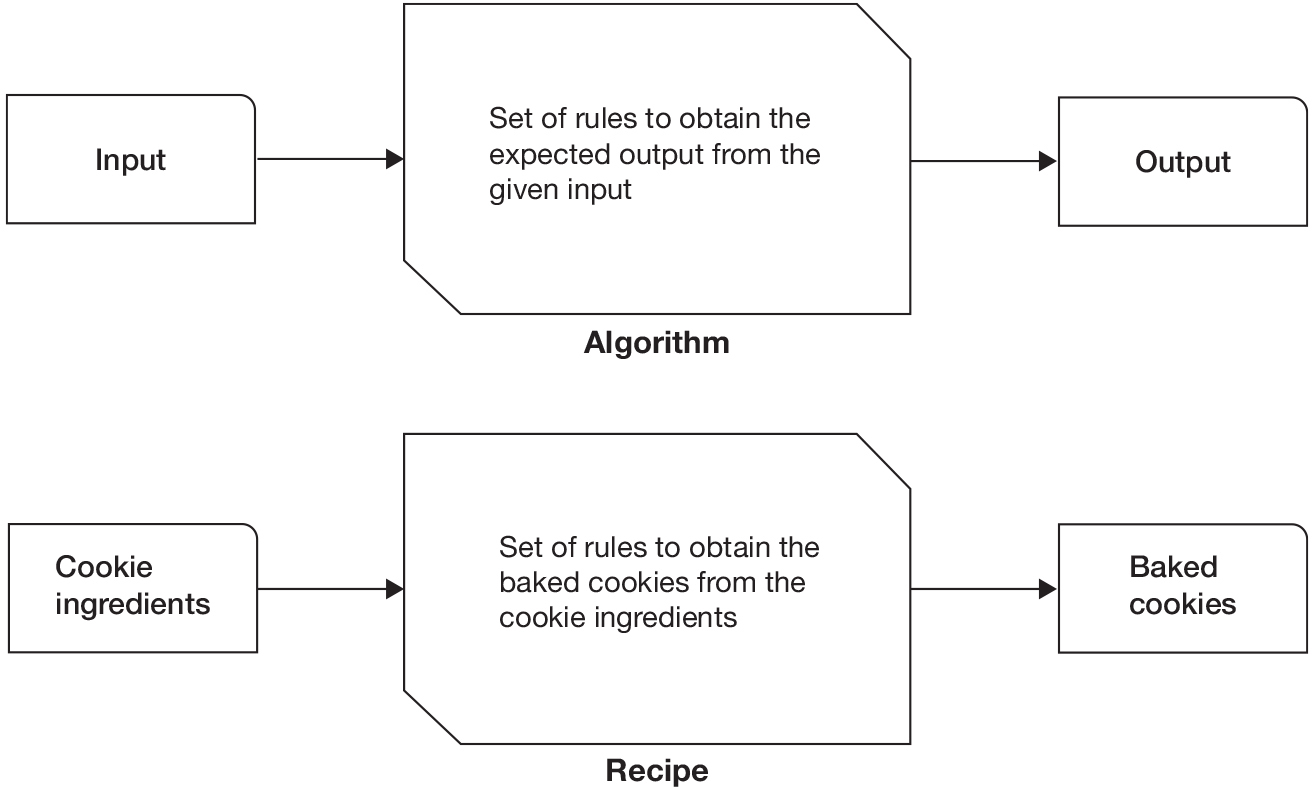
Although you may believe that algorithms belong only to the realm of advanced mathematics, in reality and at its most basic an algorithm is a set of instructions for how to do a series of steps to accomplish a specific goal. The idea behind developing an algorithm is that it will follow the same steps every time, even if the data it uses change. We all follow algorithms all the time. A recipe is an algorithm because it’s a finite list of instructions used to perform a series of tasks in a specific order. Typically, it’s the order that matters most for algorithms. Think about baking chocolate chip cookies. The recipe tells you to first cream the butter, sugars, and vanilla extract. Next you add the dry ingredients—flour, baking powder, and chocolate chips. Then you put the batter in the oven to bake. If you tried to change the order by, for example, putting the batter in the oven before adding the dry ingredients, your cookies wouldn’t turn out right. That’s true of pretty much any kind of cookies you make. Although the ingredients and their proportions might change, the basic steps—first, combine wet and dry ingredients, then bake—are virtually the same for every kind of cookie. In figure I-1 the cookie ingredients are the input, the recipe is the set of rules, and the delicious cookies are the output.
FIGURE I-1
What is an algorithm?
Where the cookie-making analogy begins to break down is that baking relies to a certain degree on tacit knowledge, which a computer does not have.13 For example, your cookie recipe might tell you to cream the wet ingredients until they are “fluffy” and bake until “slightly golden.” There are no explicit instructions for helping you to definitively determine “fluffy” or “slightly golden.” People learn how to be good bakers through experience, observation, and learning from others who transfer knowledge about, say, determining what “fluffy” means to them. This lack of specificity poses problems for computers because they cannot deal in the tacit realm. If you want your computer to do something once your data are “fluffy” you have to tell that computer specifically, numerically, what fluffy equals. Computer-programmed algorithms need to be unambiguous.
That should give you a good basic understanding of what an algorithm is. (For a deeper, more technical explanation, please consult the glossary.)
To perform, computers need algorithms or a set of instructions that follow the criteria described above. While a simple algorithm can instruct a computer to, for example, add 1 to a number, in order to perform complex tasks it needs a group of algorithms that work in concert. To continue the recipe analogy, if you wanted to prepare an entire meal, you would need more than just a recipe for baking cookies. You need one for preparing spaghetti, a third for cooking a sauce, and another for a side dish, a beverage, and so on. You might need yet another algorithm for making sure everything was ready at the same time. The point is that a computer runs on countless algorithms.
How do we tell a computer what to do?
A recipe tells the baker what to do through verbs the baker understands. Mix. Sift. Bake. Cool. To tell the computer how to follow the instructions in an algorithm, we have what’s called source code, or just code. Coding is a process of using a programing language to tell a computer how to behave. Each line of code tells the computer to do something specific. Think of each as a verb. Add. Compare. Reorder. Wait. Delete.
A document full of many lines of code is called a script. Scripts are combined to build algorithms. Below is an example of a script coded in the programming language Python. This is a very basic script called hello_name.14 On line 1, the code is instructing the computer to put on the screen the phrase “What is your name?” Line 2 tells the computer to wait for the user to input his or her name and, then, when they do enter their name, to save that name as an object. Line 3 puts the word “Hello” on the screen along with the name that the user entered.
1 print(“What is your name?”)
2 name = input()
3 print(“Hello“ + name)
python hello_name.py
What is your name?
Joe
Hello Joe
c:\Users\Joecomputer\Desktop\temp
But how does this program know what print means and why input is what the user types in and how to preserve that input in such a way that it can make it appear on the screen? It knows because this language, Python, is actually a way for humans to interact with a more fundamental language, called machine language. Machine language is binary numbers, long strings of 0s and 1s that combine in complex patterns that the computer can use. It takes millions or billions of these 1s and 0s to run computer programs. It would be impossible for humans to interact with computers, or for them to get computers to do anything useful, if we had to code with what the machine understands—0s and 1s.
To get from what you see on the screen to 0s and 1s, scripts go through a compiler. The compiler does the tedious work of turning each command into the 0s and 1s that a computer can understand. Once the code is compiled (translated into machine language) it is stored in a program that can be used over and over again. Every piece of consumer software you use, every app, every game, every website is a program that started out as someone coding within a programming language to create a script that was compiled into millions or billions of 0s and 1s so it could be read and executed by a computer.
Computers don’t do anything on their own. They need someone or something to tell them what to do. We can’t stress this enough. They have no tacit knowledge. A good illustration of this point is an old joke about a computer programmer who was unable to get out of the shower after washing their hair because the instructions on the shampoo bottle read “Wash, Rinse, Repeat” but did not say “Stop.” That’s how computers operate: if instructions aren’t explicit they won’t follow them.
Understanding the limits of what a computer can do is an important foundation to developing a digital mindset because it underlines both how a machine “thinks” and why a computer is different than a human being. Unless we include the command “Stop” at the end of a line of code, the computer will not stop, no matter how obvious it seems to you that the computer should stop.
Python is currently one of the more widely used programming languages. However, know that up to 250 programming languages are in active use today, and more than 700 have been developed.15 Other widely used programming languages include Java, C++, and Ruby. Just as human languages—English, Spanish, Mandarin, Farsi, and on and on—have different syntaxes and grammatical structures, so do computer programming languages. Also, programming languages, like our spoken languages, have evolved in a specific time and place to serve a particular set of needs.
Overall, your digital mindset journey will include understanding the basic tenets of coding, programming languages, scripts, algorithms, compiling, and machine language. This knowledge is crucial for understanding how digital applications are programmed and how computers are made to execute. Coding and programming activities are part of a complex relationship between hardware and software that undergirds digital tools.
Let’s review some of the basics we’ve covered here:
· Digital is about the interplay of data and technology that runs much of modern life, such as smartphones, apps, and streaming services, as well as the major forces that are reshaping how we work that include big data, AI, robotics, machine learning, and blockchain.
· Digital technologies can transform and handle data at exponentially higher volumes and speed.
· All digital operations require computers, software, and data to work together. Analog technologies, such as windup clocks, rely on physical signals.
· An algorithm is a set of instructions that tells a computer how to perform a certain task. Algorithms are made up of scripts, which are lines of code put together.
· Coding is a process of using a programing language to tell a computer how to behave. Each line of code tells the computer to do something specific.
Now you’re armed with what you need to get started. Congratulations! You’ve already begun embracing the 30 percent rule and building your digital mindset. With this foundation we can get into the three core areas that will set you on a path to success. Let’s start with collaboration.