
4
For this is righteous warfare, and it is God’s good service to sweep so evil a breed from off the face of the earth. … I engage them in fierce and unequal combat.
—CERVANTES, Don Quixote, VIII
Having seen how the Bush model of interrogational torture should work, in both the predictive and normative senses of “should,” we now turn to examining how the Bush model would work.1 To begin this process, we will build a game that explicitly reconstructs the implicit model behind the Bush interrogational torture program we just saw in Chapter 3. This is the Bush Interrogational Torture model, or BIT for short.2
BUILDING BIT
Take a moment and recall the game in Chapter 1 from the Law and Order SVU episode. In that Prisoners’ Dilemma game there were two players, the criminals Deborah and Carlo, who were faced with the choice of whether to keep quiet or rat each other out. Each was better off ratting out the other than staying silent (no matter what their partner-in-crime did), and so that is exactly what happened. They spilled their guts and spent more time in prison than if both had kept their mouths shut.
In an interrogational torture game between an interrogator and a detainee, the choices are somewhat different, the outcomes will be different, and the equilibria will be different, but the basic logic sketched before is the same. Consider each part of the game: players, actions, payoffs, and what they know when they make their moves.
Players
The first part is the set of players. There were two players in the Law and Order SVU game: the two suspects Deborah and Carlo. Although Detectives Stabler and Benson (and Munch and Cassidy) were in the story, their role was really limited to just setting up the Prisoners’ Dilemma game between Deborah and Carlo. The detectives weren’t actually players in the game. The only moves available (keep quiet or rat out) were those for the suspects.
How many players are there in BIT and who are they? Just as the key dynamic in the Law and Order SVU episode was the game played between the suspects, in BIT we are interested in what happens between a detainee and an interrogator. The detainees were questioned in isolation and they have to make choices on their own, not with any other detainee, so clearly the detainee is a player.
In contrast, we might think that there is more than one interrogator, since there certainly were in reality. The question, however, is whether this makes a difference for the basic interaction of interest to us. It does not. The different interrogators worked as a team, they replaced each other, and they did essentially the same thing: asked questions, subjected the detainees to EITs, and asked more questions. It is irrelevant for our purposes whether someone was a “debriefer” or an “interrogator.” From the detainee’s perspective, they were on the same side: against him. Thus, in BIT we also have two players: an Interrogator and a Detainee. To keep them clear while easing exposition in the rest of the book, I’ll assume the Interrogator is female and the Detainee is male.3
Actions
In the simplest version of an interrogational torture game, the Interrogator might have two choices: “torture” or not “torture,” where “not torture” means using alternative interrogation techniques such as deception, trickery, rapport-building, and the like. We could complicate this by, say, making each one of the EITs a different move. The interrogator might then have the moves “not torture,” “sleep deprivation,” “stress positions,” and so on. Of course, we could go further and give the interrogator multiple moves within “sleep deprivation,” such as 48 hours, 72 hours, and so forth. As you can see, things can get complicated very quickly. Different tortures will probably work differently on different detainees, for example.
Thankfully, we don’t need to get this complicated because adding that complexity doesn’t get us any further anyway. At some point, some form of torture is supposed to compel the detainee to talk. That’s the basic logic of torture. We preserve that basic logic and still keep things manageable by just giving the interrogator the choice between two possible moves: “torture” or not “torture.”
Moreover, this remains consistent with the basic structure and procedures of the Bush program discussed in Chapters 2 and 3. Although, as Chapter 2 demonstrated, the rendition process itself and the “conditioning” measures at the black sites were torture in and of themselves, not all detainees were subjected to EITs because they provided information. If a detainee refused, however, he faced the prospect of escalating EITs until he cooperated. For Abu Zubaydah this meant a gradual increase in the severity of EITs from nudity, noise, temperature manipulation, and sleep deprivation through confinement boxes and waterboarding. The detainees understood that the EITs were “not going to stop, ever, unless they cooperated” ( Thiessen 2010, p. 116).
Thus, if CIA interrogators decided that the detainee had not revealed the necessary information, then they tortured; and once torture was initiated, they continued until the detainee was deemed compliant (demonstrated by providing information). Then they stopped. At some point, in other words, the basic choice confronting the interrogator is whether or not to torture (more).
Similarly, the Detainee might have two choices, “reveal information” and “not reveal information.” Here too we might make things more complicated to reflect the reality that what information is revealed (quality) and how much (quantity) is a pretty important part of interrogational torture. True enough.
Note, though, that what counts as sufficient quality or quantity is the subjective assessment of the interrogator (or, as was apparently the case in reality, CIA headquarters on the seventh floor in Langley). The basic idea was this: If the detainee provided information of sufficient quality and quantity—however defined by the interrogator—then he was not tortured (again). If he did not, he was tortured.
So we can think of “reveal information” as “disclosing sufficient previously unknown information which is of value to the Interrogator.” “Not reveal information” has four interpretations:
1. not enough good (enough) information
2. truthful, accurate, but nonvaluable information
3. false and misleading information
4. no information whatsoever
“Not enough good (enough) information” means that the Detainee provided previously unknown and valuable information, but it is of very low quality or quantity so as to count practically as “not reveal information.” “Truthful, accurate, but nonvaluable information” means that the Detainee provides information to the Interrogator but that information is out of date or information the Interrogator already knew or information that for other reasons provides no added value to the Interrogator. “False and misleading information” means information that actually leads the Interrogator astray, diverting attention and resources away from plots, people, locations, etc., of value. This is doubly dangerous for the Interrogator: The real danger (plots and other activities) continue unabated, and human and technical resources are wasted on wild goose chases. Finally, “no information whatsoever” means that the Detainee stays silent, providing neither valuable nor false information.
In short, once again the simple binary case is sufficient to capture the basic dynamic of interrogational torture: “information” and “no information,” keeping in mind the latter’s four very different interpretations.
Outcomes and Payoffs
This would generate, just as in the Prisoners’ Dilemma, four outcomes based on the two possible choices for each of the two players:
1. “information” and “torture,”
2. “no information” and “torture,”
3. “information” and “no torture,”
4. “no information” and “no torture.”
The two players will, of course, value those four outcomes very differently. If you’re the Interrogator for example, and you prefer to use torture only as a last resort as did the CIA, then the best outcome of the four for you would be “information” and “no torture”: You got the information and didn’t have to use torture. The worst might be to use torture and still not get information. Now suppose you’re the Detainee with valuable information you’re trying to hide. “No information” and “no torture” would be the best for you, while “information” and “torture” you might consider the worst, because you both suffered torture and also gave up information.
These subjective evaluations of the outcomes are the payoffs to each player. We can represent them in multiple ways: in words, in a ranking (best, second best, etc.), or numerically, which includes algebraically, with variables, like the x and y you remember from high school math class. In the Law and Order SVU episode, the payoffs represented actual years in jail, with the assumptions that being in jail is unpleasant and more years in jail is less pleasant than fewer years in jail. That allowed us to figure out the (single) outcome, or equilibrium, of that game.
We could, however, have used any set of numbers just so long as they were true to the way Deborah and Carlo ordered their outcomes (i.e., most preferred to least preferred). Table 4.1 provides another representation of the exact same game, this time with numerical payoffs corresponding to how each of them ranked the four possible outcomes, with higher numbers more preferred to lower numbers so that four is best and one is worst.
Table 4.1 LAW AND ORDER SVU PRISONERS’ DILEMMA, ORDINAL PAYOFFS
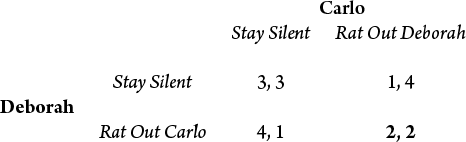
Compare this to the game in Chapter 1 and see for yourself that this version is equivalent to the one above. From Deborah’s perspective, for example, the four she gets for ratting out beats the three she gets for staying silent if Carlo stays silent. The two she gets for ratting out beats the one she gets for staying silent if Carlo rats her out. So, either way, she’s better off ratting Carlo out (making it her dominant strategy).
Since the game is exactly the same from Carlo’s perspective (this is a symmetrical game), the same logic applies to him and so the equilibrium is the same as the game with the payoffs in years (bolded once again). Assigning numerical values like this can help make the solving of the game just a bit faster than comparing words, but the process is exactly the same. Before thinking about the payoffs to the players in BIT, we must first consider a part of BIT which is different from the Law and Order SVU Prisoners’ Dilemma.
Timing and Information
In contrast to the classic prisoners’ dilemma where the players move at the same time, in ignorance of the other’s choice, BIT is a sequential move game: One player moves before the other does, and both players know this (and know the other player knows it).4
So who moves first, the Interrogator or the Detainee? The Detainee, because it is always the threat of (more) torture that is supposed to compel compliance with the Interrogator’s wishes ( Schelling 1966, pp. 70–71)). Once the Detainee knows the torture is over, he has no incentive to reveal any more information.
As we saw in previous chapters, according to those close to the Bush interrogation program, high-value detainees were “interrogated” (tortured) to make them compliant and were then “debriefed.” Note that even if this is true, it makes no difference in terms of the fundamental strategic problem facing both an interrogator and a knowledgeable detainee. Torture makes you compliant. Why does it make you compliant? You don’t want to be tortured anymore. You resisted enough that they employed “enhanced techniques” on you. You resisted those for a while until you gave in and became compliant. So it is always the threat of more torture in front of you that makes you cooperative now. This is the inescapable logic of interrogational torture whenever and wherever it is practiced. Consequently, in our game the Detainee moves first, either providing information or not revealing information, and then the Interrogator observes this move (hears, sees, evaluates this information or the lack thereof) and decides whether to torture or not.
Timing is central to our game in a way it is not for the Prisoners’ Dilemma because the Interrogator’s preferred action depends on what the Detainee has already done. If the Detainee has provided (enough) information (of sufficient quality), the Interrogator does not want to torture. If, however, the Detainee has not provided that information, then the Interrogator does want to torture him. The Detainee, of course, knows this all too well, and anticipation of the Interrogator’s move will influence his own, first move. Thus, it is the information available at the time each actor moves that makes the sequencing important.
What information did each player have, according to the Bush model? The Detainee knew that there was one other player besides himself, the Interrogator. Indeed, a central element of the EIT “dependency” idea was that the Detainee should come to think of the Interrogator as the only other relevant person for the Detainee. Second, the Detainee would know, or quickly learn, that the Interrogator had the option to torture; he would know her two possible actions. Finally, he would know her basic payoffs. For example, he would know that she preferred not to use torture to get information, but was willing to do so if necessary. As far as the Interrogator in the Bush model is concerned, in addition to knowing which move the Detainee had made, she would also, for example, know that the Detainee preferred to keep information secret and that the Detainee preferred not to be tortured.

Figure 4.1 Bush Interrogation Game with a Cooperative Detainee
As with so many other things, all this can be made a little clearer with a picture. Sequential games are best represented by something similar to the familiar decision tree. Figure 4.1 represents the BIT game with the players in boldface, their actions in italics, and their payoffs for each outcome at the end of the branches of the tree.
Starting from the left, the first choice node is the Detainee’s, who can reveal “information” (moving up the top branch) or provide “no information” (moving down the bottom branch). After each of these two moves, the Interrogator chooses either “torture” (up) or “no torture” (down). The numbers next to the tip of each branch are the payoffs to the players, with the payoff to the Detainee on the left and the payoff to the Interrogator on the right.
I have used numbers to represent how they order the four outcomes in the same way as in the Prisoners’ Dilemma above, from four (the best) to one (the worst). The numbers are arbitrary; the important point is that they prefer some outcomes more than others and we capture that with these simple payoffs. (We’ll change the payoffs a little later to make it more realistic.) With one exception, discussed in just a moment, these orderings (rankings) should be relatively uncontroversial.
Take a look at the Interrogator first. The Interrogator receives her highest payoff (4) when she gets the information she seeks and does not have to use torture. This is consistent with the fact that the CIA used torture as a last resort only on detainees that it perceived had more information but who refused to divulge it. They preferred not to use torture if at all possible and gave detainees a chance to cooperate before initiating EITs.
The Interrogator’s mission is to extract information; she receives her lowest payoffs from the two outcomes in which she does not get it, in the lower two branches of the tree. Her lowest payoff (1) occurs when she fails to use torture despite not having received any information. Her job, her mission after all, is to get the information, and torture is one of her means to do so. If she fails to employ it, she has failed at her job. If she does not receive information and so tortures, she at least has done her job and so receives a higher payoff of 2. Although she does not prefer to torture after having been provided (sufficient) information, this is less of a problem for her than not receiving the information at all, and so provides her with a higher payoff (3) than the two outcomes with no information.
The Detainee, naturally, ranks the four outcomes very differently. His highest payoff of 4 occurs when he provides no information and is not tortured. His lowest payoff (1), the worst outcome, comes when he provides information and is tortured anyway.
It is the ordering of the next two outcomes which may be controversial. Assuming no ties, there are two possibilities. In the first, he would rather give up information and not be tortured than hold the information and be tortured. Call this type of Detainee Cooperative. The payoffs in Figure 4.1 reflect this preference: “information” and “no torture” provides a payoff of 3, whereas “no information” and “torture” provides a payoff of 2.
In the second possibility, this preference is reversed. The Detainee would rather hold the information or give false information and be tortured than give up information and not be tortured. (Just reverse the Detainee’s payoffs of 2 and 3 in Figure 4.1.) Call this type of Detainee Resistant.5
As we will soon see, much depends on which type of Detainee we choose. For now we will assume that the Detainee is the Cooperative type because that is what the Bush program assumed: All detainees would eventually become compliant as a result of the EITs. Once we have worked through the model in this way, we will return to the question of Cooperative vs. Resistant Detainees.
SOLVING BIT
We now have a stripped-down, very simple model of interrogational torture representing—and faithful to—the assumptions of the Bush program. The next step is to “solve” the game—find the outcome (or outcomes) that would result from each player attempting to maximize his or her payoffs–that is, get the highest number. To do this, we need two new ideas: how to reason backward and getting rid of implausible Nash equilibria.
Backward Reasoning and Incredible Threats
In Sergio Leone’s classic Western, For a Few Dollars More, the Clint Eastwood character asks another gunman, “Do you mind tellin’ me how you got here?” The response from Colonel Mortimer is: “I just reasoned it out. I figured you’d tell Indio to do just exactly the opposite of what we agreed and he’s suspicious enough to figure out somethin’ else. Since El Paso was out of the question, well, here I am.”
Now imagine that it is late April in New Jersey and is warm. Some of my students wake up at 10:30 am (an early start for them), notice it’s a gorgeous day, and think to themselves, “Hmmm … we could go play Ultimate Frisbee on the library lawn or we could go to Schiemann’s 11:20 game theory class. He’s covering subgame perfect equilibrium today. If we play Ultimate, we’ll have a lot of fun and probably see Jordan, who is really hot. If we go to class, we won’t see Jordan or have fun playing frisbee, but we know subgame perfect equilibrium will be on the final exam and we’ll be better prepared.” … “Hmmm … Wait! Ken is a total nerd and always goes to class. We can get the notes from him. Game on!”
Just as with Colonel Mortimer, in this (unfortunately not terribly contrived) example, my students looked ahead at the downstream consequences of each choice, evaluated them, and reasoned back to make the best (if not necessarily the smartest) choice given their preferences. “Backward reasoning” doesn’t sound very smart, so the game theory jargon for this idea is backward induction. We’ll use it to solve our models.
The second idea involves noncredible threats. A noncredible threat is a threat that the threatener has no incentive to carry out if it ever comes time to actually do so. The problem for us is that you can have an outcome in a game which is a Nash equilibrium, but which relies on this sort of noncredible threat. That doesn’t sound very plausible or rational, and we want to find a way to get rid of that implausible kind of equilibrium.
In order to do this, we first need to be a little more precise about how exactly an equilibrium is defined. In Chapter 1 we defined it as a stable combination of actions or strategies by the players. And it is. But a player’s strategy is a complete set of instructions of what to do, what choice to make at every possible point where she could make a choice. In the Prisoners’ Dilemma, both players choose once and simultaneously, so each player’s instructions have just one move (e.g., “rat out”). The same is true of the Detainee in BIT; the Detainee has one move, and he moves first, so the instructions contain just one element: “information” or “no information.”
In the case of the Interrogator, things are a little different. The Interrogator has to have a contingency plan. She has to decide what she would do if the Detainee reveals information and what she will do if he does not. There are two points at which she could choose because the Detainee moves first and has two choices. The Interrogator’s instructions must be complete, with no ambiguity, a road map for whatever comes her way, even if she knows that only one choice will ever materialize. To adapt an example from a very good introductory text on game theory, think of this set of strategies, this complete plan of action, as instructions to another Interrogator. If this second Interrogator replaced the first Interrogator, she would know exactly what to do for every possible move of the Detainee and so make exactly the same choices the first Interrogator would have ( Dixit Skeath and Reiley 2009, p. 27).
Here is a sample set of such instructions, with the first element the Interrogator’s response if the Detainee provides information and the second element the Interrogator’s response if the Detainee chooses “no information”:

corresponding to “don’t torture after ‘information’ and do torture after ‘no information’.”
Another set of instructions might be

corresponding to “torture after ‘information’ and torture after ‘no information”’ too.
The set of strategies that make up an equilibrium, called a strategy profile, contains this full set of instructions for each player in the game. Writing the equilibrium for BIT will thus look a little different from the Prisoners’ Dilemma, which had just two elements, one for each player. In BIT, the Detainee’s strategy will still consist of one move, but the Interrogator’s strategy for the game, her instructions, will contain two moves, one for each possible move by the Detainee. Here is a strategy profile in BIT (not necessarily an equilibrium though):

corresponding to the following: The Detainee plays “no information” and the Interrogator plans to torture whatever move the Detainee makes, after both “information” and “no information.”
The reason why all this is important goes back to those noncredible threats. It can happen that a player’s strategy might contain a choice for a contingency that is not actually reached in a particular Nash equilibrium, but would require making a move that is not in his interest at that point if he were to have to choose there.
As an example, take a look at the {“no information”, (“torture”, “torture”)} strategy profile once again. According to this profile, the Detainee would stay silent, refusing to reveal information, and, since the Interrogator is torturing after “no information” in this profile, she tortures. Along this path of play, the Interrogator is never confronted with the choice of what to do after the Detainee plays “information” because the Detainee plays “no information.” But, the complete set of instructions requires the Interrogator to consider this possibility and have a response, and the response in this strategy, in this set of instructions, is “torture.”
Would the Interrogator really want to choose “torture” after the Detainee has chosen “information”? (Remember, we’re assuming that “information” means full, complete, good-quality information sufficient to please the Interrogator.)
No.
In the CIA program, torture was used as a last resort only if a detainee refused to talk. Once the detainee “became compliant” and talked, there was no need and no desire to torture. This is captured by the lower payoff of three if she tortures and four if she does not. Choosing “torture” is not in her interest, so threatening or promising to do so is not credible. She would not do it if she actually had to choose at that point. The second Interrogator who got those instructions would be confused, wondering what the heck is going on.
Even though this strategy combination or profile doesn’t make sense in that way, it could still be a Nash equilibrium. To see this, we need to solve for the equilibria in the game, which we are now prepared to do.
Looking for Equilibria
Go to the upper branch at the top right of Figure 4.1. The Detainee has provided information and the Interrogator must choose between “torture” and “no torture.” If she chooses “torture,” she receives a payoff of 3 and if she chooses “no torture,” she receives a payoff of 4. Since larger numbers represent better outcomes, 4 is better than 3 and she chooses “no torture.” (Yes, it really is this easy.) So the Detainee knows that if he chooses “information,” the Interrogator will choose “not torture,” and he (the Detainee) will get a payoff of 3. To keep track, write this “3” next to “information.”
Both the Detainee and the Interrogator must now consider what would happen if the Detainee chooses “no information” (that is, he chooses to stay silent or reveal nonvaluable, or false information) in the lower branch of the tree. Once again, the Interrogator can “torture,” this time receiving a payoff of 2, or “not torture” and receive a payoff of 1. Two beats 1, so she tortures. The payoff to the Detainee for this outcome is 2.6 Thus, the Detainee knows that if he does not reveal information, he will get a payoff of 2. Write this “2” next to “no information.” His choice, then, is between “information,” paying 3, and “no information,” paying 2. Three beats 2, and he chooses “information.”
So, the Detainee chooses “information” and the Interrogator chooses “no torture” for payoffs of 3 and 4, respectively. We are not quite done, however. We still need to double check that this outcome is a Nash equilibrium—a stable combination of actions in which neither player has an incentive to switch his or her choice of action given the other player’s actions. We did this for the Law and Order SVU game and confirmed that neither Deborah nor Carlo would unilaterally change his or her move—that is, switch their strategies given what his or her erstwhile partner was doing. How about here?
Consider the Interrogator first. Would she want to switch from “no torture” to “torture” after the Detainee has provided information? As we just said above, no. She gets four for “not torture” and three for “torture,” so she would not switch her strategy. In game theory lingo, the Interrogator has no incentive to deviate.
How about the Detainee? Would the Detainee want to deviate, given the Interrogator’s strategy? The Detainee knows that if he could go back in time and choose “no information,” he can expect to get tortured (because the Interrogator gets a payoff of two for torturing and one for not torturing when the Detainee fails to provide information). Getting tortured for holding on to information (a payoff of one) is worse than providing information and avoiding torture (a payoff of two). So the Detainee will not deviate either and {“information”, (“no torture”,“torture”)} is a Nash equilibrium in this game. Call this equilibrium the Valuable Information, No Torture Equilibrium. (Notice that we wrote both of the Interrogator’s moves—including the one that is not chosen in this equilibrium: “torture” after “no information.”)
Is this the only Nash equilibrium in BIT?
To find out, let’s take a look at a different strategy profile: {“no information”, (“torture”,“torture”)}, according to which the Detainee does not reveal information and the Interrogator tortures no matter what (i.e., after both information and no information). As Figure 4.1 shows, this results in payoffs of two each to the Detainee and the Interrogator.
Does either have an incentive to deviate, given what the other player is doing?
Take the Interrogator first. If she switches to “no torture,” her payoff would be one, which is less than two, so she would not deviate.
How about the Detainee? Given the Interrogator’s strategy of (“torture”,“torture”), if he switches to “information,” he gets tortured anyway and receives a payoff of one, which is less than the two he is getting, so he would not deviate either. This is, in other words, a Nash equilibrium.
But it’s weird. It depends on the Interrogator doing something manifestly against her interests, taking an action she knows she would not want to do, if she was actually faced with the move “information” by the Detainee. The Interrogator’s instructions, her strategy, tells her to play “torture” after receiving “information,” even though this makes her worse off than playing “no torture.” Why should the Detainee give any credence to the Interrogator’s strategy? It just is not credible.
Is there a way to avoid this problem?
There is. And we already found it. When we used backward induction to find the first equilibrium, we assumed that the Interrogator’s move at both of her decision points, or nodes, was optimal, the best she could do at that point. That’s why she chose “no torture” after “information” but “torture” after “no information.”
In contrast, the strategy profile constituting the second Nash equilibrium requires the Interrogator to play “torture” after “information,” even though this makes her worse off than if she played “no torture.” This can happen because “information” lies off the equilibrium path of play. We assumed that the Detainee was playing “no information,” so the Interrogator’s decision node after “information” is never reached.
The difference between the two equilibria is this: The Interrogator’s instructions for the first equilibrium are better. If she follows them, she maximizes her payoffs no matter where she is. If she is in the upper branch, after “information,” and she plays her corresponding strategy, “no torture,” she maximizes her payoff at that node. If she is at the bottom node, after “no information,” and she plays according to her instructions, she plays “torture” and again maximizes her payoffs. So she does the best that she can do in each subpart of the game. The same cannot be said for the second set of instructions, which would require her to play “torture” after “information” and receive three instead of four.
A strategy which results in a Nash equilibrium not only in the larger game, but also in every subgame, is a more compelling candidate for a rational strategy. An equilibrium which results from a strategy profile of this kind is therefore a more compelling type of equilibrium. This “refinement” of Nash equilibrium is called a subgame perfect (Nash) equilibrium, or SPE for short.
The “subgame” part comes from what we just said about the strategy profile constituting a Nash equilibrium in every part of the game in which the players could theoretically move, even ones that are not reached on the path of play.7 The “perfect” is tied to the players’ knowledge of the history of the game: who has moved and when. Together they capture the idea that the strategy profile is a Nash equilibrium for the entire possible history of the game. No player has an incentive to deviate from his or her strategy in the profile no matter what decision node is reached. If an unexpected, off-equilibrium path move were to occur, they would still do best by following the strategy. As is standard for sequential games like BIT, we will solve for SPE like the Valuable Information, No Torture Equilibrium and thus rule out Nash equilibria based on noncredible threats or promises.8
Now both the Detainee and the Interrogator know what they would do in every possible circumstance of the game. This tells them what they should do and tells us what they will do (because we assume that they are rational). In other words, we can make a prediction based on the SPE, the Valuable Information, No Torture Equilibrium, and compare it to the ideal outcome of the pragmatic model and the claims of the Bush administration. We have, in other words, a prediction from our analytical model which we can compare to the benchmark predictions of the normative, ideal, model in Chapter 3.
What is this prediction?
The Detainee reveals information and the Interrogator does not torture.
INTERPRETING BIT
Notice anything odd here?
Torture never occurs in equilibrium. The threat of torture compels the Detainee to divulge (enough quality) information to please the Interrogator, who therefore does not torture. This makes sense, in a way, since it is always the threat of future torture which elicits information now. Threats work when they don’t actually have to be carried out. After all, your threat of no ice cream unless your child eats her broccoli is intended not to deprive her of ice cream but to get her to eat broccoli. If she refuses to eat the broccoli, your threat has failed. But the BIT result does not make sense insofar as the model predicts zero torture. None at all.
It also fails to match up with what actually happened in the EIT program. Not all detainees were subjected to the enhanced torture techniques, not even all “high-value detainees.” For some, just the “dislocation” of rendition or the threat of EITs was enough. But of course some detainees didn’t provide enough information and/or good enough information and were tortured, and some were tortured a lot. So this is not the outcome predicted in Chapter 3.
So something is clearly wrong here. Recall the point I made earlier that the ordering of some of the Detainee’s payoffs might be controversial but we went ahead and assumed for this game that the Detainee was Cooperative in the way we defined it purely in terms of his preferences: The outcome “information” and “no torture” was preferred to the outcome “no information” and “torture.” What if we were to assume that the Detainee was Resistant in that those preferences were reversed so that the Resistant Detainee would rather stay silent and endure torture than avoid it at the cost of revealing information?
Although the so-called simple folklore of pain has given rise to the commonplace assumption that “everyone talks, it’s just a question of when,” Chapter 2 demonstrated that the reality is far different (Bagaric and Clarke 2007, pp. 58–59)). There are many who do not break under torture, at least not in time to provide anything valuable to their interrogators. Rumney, for example, points to court records of torture interrogations in France from the sixteenth to the mid-eighteenth centuries showing a failure to extract confessions ranged from a low of 67% to a high of 95% (Rumney 2006, p. 491). Rejali documents cases from around the world in which detainees endured horrific torture and did not break. In the resistance to the Nazis across Europe, for example, “hardcore members did not normally break” (Rejali 2007, p. 496, also Chapter 21 passim). The CIA’s own interrogation manual from the 1980s asserts that “materialization of fear is likely to come as a relief. The subject finds out that he can hold out and his resistance is strengthened.” “In fact, most people underestimate their capacity to withstand pain” (Central Intelligence Agency 1983, pp. K-2, K-8).
One of the more famous cases comes from Vietnam, that of Navy Commander and later Rear Admiral Jeremiah Denton. Shot down over Vietnam in 1965, he spent seven years and seven months in captivity. Four of those years were in solitary confinement, “including two years in a cell the size of a refrigerator.”9 Despite this and other brutalities, he managed to blink the word “torture” using Morse code during an interview the North Vietnamese hoped to use for propaganda purposes. This was the first confirmation of torture of U.S. servicemen in North Vietnamese prisons. Denton never provided the North Vietnamese with any information. The history of interrogational torture is littered with similar stories (e.g., Lea and Peters 1973, pp. 68, 75, 91, 123, 128, 130, 131, 159).
So a Resistant Detainee is possible. Would that change anything?

Figure 4.2 Bush Interrogation Game with a Resistant Detainee
As a matter of fact, this is easily checked. Figure 4.2 reproduces Figure 4.1 but with the payoffs changed to reflect the fact that the Detainee is Resistant, preferring to be tortured rather than give up information. Follow the same logic as before and identify the outcome.
What did you find?
You should have found a new SPE: {“no information”, (“no torture”,“torture”)} with payoffs of three and two to the Detainee and Interrogator, respectively. Note that the Interrogator’s strategy is the same in this version as in the first: no torture if information is provided, torture if it is not. What has changed is the Detainee’s strategy. This time, like Jeremiah Denton and many before and after him, the Detainee prefers to suffer torture (payoff of three) rather than give up information and avoid torture (a payoff of two) and thus chooses the bottom branch, after which the Interrogator tortures.
Anything odd about this result?
This time it is information which does not occur in equilibrium. We get torture, but no information. We might call this the Denton equilibrium. Whatever we call it, this outcome matches up neither with the claims of Bush program proponents nor with the pragmatic model in Chapter 3. In contrast to the predictions in there, in which torture is used infrequently but compels information, we get frequent torture—indeed, we get torture all the time—but no valuable information whatsoever. This is also implausible, and so this setup will not work either.
A QUIXOTIC MODEL OF INTERROGATIONAL TORTURE
What’s wrong?
To figure this out, begin by returning to our finding in the first version of the Bush model, namely that the Detainee always provided sufficient information (in terms of both quantity and quality) and was never tortured. This is consistent with the Bush assumptions: The high-value detainees had information, torture was so effective that it would draw that information out of them, and the interrogators would know they had given enough not to torture them. Does this sound realistic to you?
Imagine you are an interrogator. You have a file on the detainee you are about to interrogate so you know something about him, maybe even quite a bit. But not everything, or he wouldn’t be at a black site chained to the ceiling, clothed in a diaper and a hood, and subjected to deafening tones of the Red Hot Chili Peppers. And the detainee knows this.10
In particular, you don’t know two sets of things.
First, there are some things you don’t know about the information (you think) he has. You don’t know how much information of interest to you he possesses. You don’t know the quality of the information he has. You might have some idea, but you won’t know for sure. That’s why you’re interrogating him. And if he does provide you with some information, you won’t know for sure whether he has more.
Second, you don’t know how much pain he can take. Since you accept the brutal logic of torture, you assume that some techniques generate more pain than others and that more pain is worse than less pain for a given Detainee, but you also know that people differ in terms of what they can take. In other words, what you do not know is how far you’ll have to go to get this particular detainee to talk. In fact, this is what happened in the second version of the model. The detainee refused to provide any information whatsoever and was tortured all the time. The “scientific” assumptions of the Bush program assumed that this was impossible. We know, however, that this was not the case historically in general terms and not always the case in the CIA program in particular. Plenty of people have resisted far worse. As the Interrogator you know this too, and when you confront the detainee you won’t know whether the detainee is the first or second type.
Actually, there is a third possibility: that the detainee knows nothing whatsoever. This again was assumed away by the Bush administration, but we know from the history of torture that innocents get swept up by mistake in any torture program. There is, in any case, at least some chance that this could happen; the probability is not absolutely zero. So in addition to the Cooperative and Resistant Detainees, both of whom possess information, there is the possibility of an Innocent Detainee as well.
Now put yourself in the shoes of the detainee. In both versions of the BIT model, the detainee knows that if he provides information, he will not be tortured. How certain of this would you be if you had been kidnapped, hooded, cuffed, earmuffed, forcibly sodomized and tranquilized, stripped naked and put in a diaper, hung from the ceiling by manacles, doused with cold water, and subjected to white noise and cold temperatures for days on end? Why might you have doubts about an interrogator’s promise?
A couple of reasons. First, it is difficult for the interrogator to make this promise credible, since she has complete power over you. Even after you provide information, you’re still being held captive who knows where. What if the interrogator wants some revenge for 9/11? What if she’s a little sadistic? What’s to stop her now that she has the information she needs? She’s already emphasized many times to you that no one knows where you are and that you are completely dependent upon her. What is she going to do with you anyway? Remember that we are talking about detainee perceptions, not reality. It does not have to be the case that any CIA interrogators actually were sadistic—indeed, I am assuming that they were far from it—only that the detainee believes that there is a chance of this.
Second, even if this is not a problem, the detainee might have doubts that the interrogator will believe he has told her all he knows. After all, he knows both that she does not know everything and that she knows he will try to hide as much as he can. So the detainee knows that the interrogator will be skeptical—that is, will not necessarily believe him when he says he has divulged all he knows, even if he has done exactly that.
There is an additional element of uncertainty about information on the part of the interrogator. Precisely because the interrogator is trying to find out information, she may be uncertain as to the value of information which is provided to her. For example, Gestapo torturers “in many cases had no clear idea of what information they wanted and just tortured haphazard [sic]” ( Rejali 2007, p. 116). This possibility must also be taken into account.
So there is quite of bit of uncertainty here that is assumed away in the Bush program and thus in the BIT models representing that program. In game theory jargon, the BIT models are games of complete and perfect information. Information is complete insofar as both the Detainee and the Interrogator know the other players in the game (each other), all the actions each one can take, and what each player receives for each outcome (the payoffs). As alluded to above, information is perfect insofar as the players know the “history” of the game; they know what moves the players previous to them have made.
Of course, all models must simplify and make assumptions, but the assumption of complete and perfect information is too unrealistic, too idealistic, to capture what really goes on in interrogational torture. In Cervantes’ magnificent novel, the “breed”—the “them” with whom Don Quixote engaged in “fierce and unequal combat” in the epigraph to this chapter—were actually windmills and not giants. The Bush description of the interrogational torture program was an imaginary ideal, a giant, rather than the reality of a windmill.
We tilt at imaginary giants when we follow that description and model interrogational torture along the lines of BIT. And just as poor Don Quixote was unseated by the windmill, we were unseated by the outcomes of the BIT models.
Still, unlike Don Quixote, who persisted in his delusion, the BIT models help us face reality, telling us what needs to be added to the full model, to which we now turn.

The argument thus far has shown that:
1. EITs are torture and the effectiveness of interrogational torture is an open question. (Chapter 2)
2. The Bush program approximates closely the ideal model of interrogational torture and includes limits on torture; the Bush and ideal models provide benchmarks for comparison with the game theory models to come. (Chapter 3)
3. The Bush model generates strange, quixotic outcomes. (Chapter 4)
The next step in the argument is to model the Bush interrogational torture program more realistically.