
PART NINE
THIRTY-TWO
SATURDAY, SEPTEMBER 11, 1909
Angelina squirmed as Giovanna took the rags out of her hair. The night before, Giovanna had wrapped Angelina’s wet locks in rags to make perfect ringlets, which now sprung free.
“Happy birthday, my beautiful big four-year-old girl!” cried Giovanna, taking Angelina and kissing her. “Your Nonna and Nonno won’t believe how much you’ve grown in a year when they see your picture.”
“Will it hurt my eyes?” asked Angelina.
“No, not at all. And when we’re done we’ll eat pizza at Lombardi’s, just the two of us.”
“Mamma, I love you!” exclaimed Angelina, hugging her mother.
“That’s not all. Tomorrow, your cousins will come for Sunday dinner and we’ll have a party.”
Angelina practically danced all the way to the photographer’s studio on Grand Street. Her white dress bounced around her, but whenever it was in danger of touching a building or another person, she protectively held her dress close so that it wouldn’t get dirty. The ringlets were nearly gone, but her hair shone.
Once inside, a kindly man with a waxed mustache stood her on an elaborately carved oak chair. A screen painted with a landscape was the backdrop. Angelina kept fussing with her dress, frustrating the photographer, who was trying to keep her hands still.
“I think she should hold something,” he mumbled to Giovanna.
Looking around his studio, he grabbed a flag that he had gotten at a parade. The photographer liked to put American objects in the portraits, knowing they would impress the sitter’s relatives in Italy.
“Here, Angelina, I want you to hold this flag.”
It worked. Angelina, statue still, held the little white flag that said ERIN GO BRAGH. Giovanna shuffled behind the photographer’s umbrella as he covered himself with a big black cloak. A muffled voice came from beneath the black fabric.
“Angelina, don’t move anything, not even your face. Pretend you’re a doll, and look right here at the camera. You’re going to hear a pop and see smoke, but stay still.”
“Cosí bella, Angelina!” exclaimed Giovanna.
“Uno, due, tre…”
THIRTY-THREE
SUNDAY, SEPTEMBER 12, 1909
The early morning sun streamed through the stained glass, making colored patterns on the pew that Angelina used as stepping-stones for her fingers. Her mother was kneeling, so Angelina’s fingers walked behind her mother’s back to tickle Mary, who sat on the other side. Mary gave her a stern look. Rebuked, Angelina leaned against the pew and clasped her hands in prayer. Squeezing her eyes shut, she whispered, “God, please make this mass over, and bless Mamma, Papa, Mary, Frances, Clement, and everyone who is going to visit me today. It was my birthday yesterday. But I guess you know that. Grazie. Amen.”
Giovanna stirred a pot on the stove. “Angelina, you’re making me crazy. Only five minutes ago you asked what time it was.”
“Mamma, that was more than five minutes.”
“Mary, see if there is something in that room to amuse her.” Giovanna needed Mary and Frances to help with the preparation of the meal; otherwise, she would have sent one of them outside to play with the anxious Angelina.
“Can I put my dress on, Mamma?” pleaded Angelina.
“No, it’s too early. It’s at least two more hours before anyone will arrive.”
“Come on, Angelina. Take a look at this,” encouraged Mary, showing her one of her schoolbooks. It was not often that Mary let her touch her books, and Angelina jumped at the opportunity.
Giovanna peered over her stomach and down at her swollen feet. She would have to remember to sit down as much as possible. Sprinkling the table with more flour, she leaned into the dough, which was nearly up to her elbows, when there was a knock at the door.
“Frances, please.”
Frances opened the door to their neighbor Limonata and her daughter.
“Ciao, Giovanna. I hear you are already so busy. I’m taking Carmela for a walk. Do you want me to take Angelina with us?”
Giovanna looked at Limonata with surprise. It was not like Limonata to take a walk or to make such an offer. She was even wearing Sunday clothes and a hat. Maybe things were looking up for her.
When Giovanna didn’t answer right away, Limonata stammered, “We’ll go for a banana. I know you love bananas, right, Angelina?”
“Yes! Yes! Can I go, Mamma, please?”
Giovanna noticed that Carmela had not let go of her mother’s hand nor looked up from the floor.
“Carmela, are you feeling well?” Giovanna asked.
“Oh, she’s fine,” answered Limonata, before Carmela could open her mouth.
“Please, Mamma, can I go?”
Giovanna looked at Angelina’s excited face and silently chastised herself. Where was this reluctance coming from? Only minutes ago, she couldn’t get Angelina out from beneath her feet, and now her neighbor was offering to take her for a walk.
“We’ll just go for an hour,” said Limonata.
“Mamma, should I put on my dress?”
Giovanna hesitated and said, “Don’t change now. When you get back.”
“Okay, then. Let’s go,” mumbled Limonata, taking Angelina’s hand.
“Wait,” said Giovanna. “Angelina, give Mamma a kiss.” Angelina jumped up and her mother bent down. “Please, Limonata, only an hour. All our family is coming for her party, and she’ll need to change.”
Limonata led the girls to the stairs. “No problem, just a walk and a banana.”
Seeing Limonata’s smile, Giovanna felt guilty for her initial hesitation and called down the stairs after them. “Limonata, if you and Carmela would like to join us, you’re welcome for dinner.”
Limonata didn’t turn around but said, “Grazie, sì, sì.”
“We’re walking far, signora!”
“We’re going to my brother. He always has a banana.”
“You can get a banana on Mott Street.”
“But today is Sunday.”
“Oh.” Angelina seemed to take notice of the silent Carmela’s clothes for the first time. “Carmela, you have so many things on, aren’t you hot?”
Before she could answer, Limonata did. “She has a cough, she must stay warm. See, here we are already.”
A tall, skinny man with a droopy eye was waiting in front of a butcher store on Delancey Street. “Angelina, this is my brother.” Angelina didn’t see a banana and looked around his back in case he was hiding it. Noticing her looking, Limonata said, “He’s going to take you to get the banana.”
“But I have to get home for my party!”
“Oh, not far,” mumbled Limonata.
The man took Angelina’s hand, and she pulled it away, clinging to Limonata.
“No, no, Angelina, you go with my brother.”
“Aren’t you coming?”
“I have to go to the dentist to have my tooth pulled. He’ll go with you.”
“I don’t want the banana. I want to go home.”
“Come on, I’ll take you home,” said the brother.
Limonata was already halfway down the block with Carmela racing to catch up, so Angelina reluctantly took the outstretched hand of this man.
Angelina shouted to Limonata, “Can Carmela come with us?”
Limonata didn’t look back or answer, and when Carmela turned around, she yanked her daughter’s arm forward.
“Come on, kid. I’ll get you the banana and take you home on the train.”
“The train?” This sounded good to Angelina. She couldn’t walk any farther and wanted to get home soon.
“Forza,” ordered the man.
“Where’s the birthday girl?” asked Teresa, bursting through the door with her three little ones, as the older children, including Domenico, squeezed around her to get in the tenement.
“Our neighbor Limonata took her for a walk, but they’re late. I asked her to be home long before now.”
“She probably couldn’t get them out of the park,” said Teresa, setting down a package and a tray of stuffed calamari, her specialty.
Lorenzo eventually made it up the stairs. “Ciao, sorella mia!” He took a look at Giovanna and asked, “What’s the matter?”
“What’s the matter? She’s seven months pregnant and cooking in the heat,” answered Teresa.
Lorenzo squinted at Giovanna who replied, “No, nothing. I’m just upset that Angelina isn’t back yet.”
“Don’t worry. She’ll be upstairs any minute.”
Angelina looked at the tall, dark, thin man buying the tickets for the El. He didn’t look at all like Limonata, who was short and pale. Turning away from the kiosk, he shouted in a thick Sicilian accent, “Come on, kid,” over the roar of an approaching train.
The train was practically empty. After sitting down, Angelina moved a seat away from Limonata’s brother. “This train will take us to Elizabeth Street?” she asked.
“Yeah.”
Angelina stared out the window. In a few minutes they were heading over the Brooklyn Bridge.
“This isn’t the way to my house. This is the way to Coney Island.” Angelina stood up from her seat. “We’re going the wrong way!”
The only two other people on the train looked up at the little girl. The man pulled her back into her seat.
“This is another way. You don’t know this way. Sit down.” He looked at the people and smiled, relieved to hear that they were speaking English. They smiled back. When the train pulled to a stop, Angelina jumped back up.
The man took her arm and pulled her into the seat with a forced smile on his face. He said through gritted teeth, “Stay in this seat.” His voice was tough, his grip firm, and his droopy eye looked even more frightening from below.
Angelina began to cry, and when the doors to the train closed at the stop, her cry turned into a wail.
The two other passengers stared once again, and the man smiled and shrugged, trying to communicate, “What’s a father to do?” This time the passengers didn’t smile back but turned away.
“Look, stop crying. We’ll get off soon and I’ll get you the damn banana.”
“I don’t want a banana. I want to go home!”
With the passenger’s eyes upon them, the man turned to Angelina and, using a sweet tone of voice, said, “If you say another word, or cry again, you’ll never go home.”
The table was piled with meatballs, lasagna, stuffed calamari, eggplant parmigiana, olives, and artichokes. A large number four cut from paper hung from the ceiling. The adults sat around the table, silent. Giovanna stormed out and went upstairs to bang on Limonata’s door. Rocco called to her, “Giovanna, you knocked ten minutes ago. We would hear them come home!” Giovanna, wringing her hands on her apron, walked back downstairs into the apartment. Rocco looked at his wife and said, “Okay, everyone, let’s eat. Call the children. When she gets home, she’ll eat.”
Lorenzo quietly obeyed, taking a plate and filling it with food. Soon the apartment was noisy again as the children bounded up the stairs and hungrily dove on the table. Teresa helped them fix their plates while Giovanna remained in the hall watching the door.
“We’re getting off,” growled the man, grabbing Angelina’s hand. He no longer pretended to be nice—the other two passengers had left the train, and they were alone. She noticed they were leaving the train before she could see Coney Island, but after they had passed most of the houses. Angelina bit her lip. She was trying so hard not to cry; she wanted to go home.
“Where are we going?”
The man didn’t even bother to answer her anymore.
“I can’t walk so fast,” she pleaded, wiping her eyes on her shoulders so he wouldn’t see the tears.
“Are the signora and Carmela going to be here?”
“Yeah. Keep walking.”
At the base of the stairs to the El there was open space in every direction. The man pulled her down the one paved street. Every few hundred feet, a house or store faced the road. That road led to another with even fewer buildings. Two buildings faced each other—a ramshackle wooden house and a small brick office with a sign in the window. The man led her to the door of the house and knocked. A short man answered and hurried them into a small room with a black stove in the middle of the floor. Two women and four children, all smaller than Angelina, stared at her.
“What are we doing here? Who are these people?” asked Angelina, with the tears she couldn’t control streaming down her face again.
The short man ignored her and talked to Limonata’s brother. “Bravo. Any problems, Leo?”
“Idiot!” spat Leo, slapping the man’s face. “What did I tell you about names?”
Angelina became even more frightened. “I want to go home. Take me home,” she screamed, turning her plea to the woman.
The tall man named Leo grabbed her arm. “What I told you on the train is the same here. If you cry, or scream, or don’t listen, you’ll never go home again. You be quiet, forget everything you hear and see, and you’ll go home.”
“Get her in the room,” the short guy growled to one of the women, still angry and embarrassed by Leo’s rebuke.
The men and older boys were out searching the streets. Before they left, Rocco’s last words were, “Talk to no one, and if anyone goes to the police, I’ll kill you with my own hands.”
Giovanna had already tried to get into Limonata’s apartment via the fire escape, but the window was locked and so dirty she couldn’t see anything inside. Finally, she heard the sound of the super opening his door, and she flew down the steps.
“Limonata borrowed my beer pitcher. She’s not home. Can you open the door?”
“You know I don’t like to do that. Can’t you wait?”
“How am I supposed to get beer for this crowd?”
“Alright, I’ll be up in a minute.”
Giovanna paced in front of Limonata’s door until she heard the super’s heavy footsteps and keys jangling on his way up the stairs.
“I’ll wait here,” mumbled the super at the threshold to the apartment.
Giovanna was trying extremely hard to act as if nothing was wrong as she walked into Limonata’s apartment. But even in the late afternoon light she could sense that something was not right. Limonata had little in her two rooms, but now there was even less. Giovanna glanced around the kitchen. The shelves were empty, there was no cloth on the table, and the pot was missing. But it was the bedroom that confirmed her worst fears—the clothes rack was empty. She had been breathing deeply to calm herself, and her breath turned into an inhaled scream.
The super came in and looked around. “Puttana!” He kicked the table and turned to Giovanna. “You’re screaming because she took your beer pitcher! I have to tell the big man she left without paying last month’s rent!”
The woman led Angelina into a small room with a little window. Quickly, she pulled a thick piece of dark muslin over it, blocking the view of the brick office across the street.
“Why did he take me here?” Angelina openly sobbed now that she was out of sight of the men.
“I know nothing. But you listen to them and stop your crying. I’ll get you something to eat.”
“I can eat at home. Here, see, I stopped crying. He said if I didn’t cry I would go home,” asserted Angelina, pushing past the woman to the door. The woman grabbed Angelina’s arm, flung her back in the room, and quickly closed the door behind her. Angelina heard the lock click as she lunged for the doorknob.
The sound of Rocco and the men returning reached the kitchen before they did. Giovanna knew they hadn’t found Angelina and not only because their trudging footsteps told her so.
“She’s gone. Limonata’s gone, Rocco!” The door was not even fully opened when Giovanna began shouting. “Nothing is left in the apartment. I know what this means. Did they come to you again, Rocco? Did they? Did you not tell me? Did you not pay them?”
“Giovanna, stop it. People will hear!”
“What people, Rocco? My brother? Your children? You’re a fool, Rocco! A stupid, stubborn fool! You should have paid them the money!”
“Be quiet!”
“I will not be quiet! They have my daughter!” shouted Giovanna, collapsing into a chair and desperately trying to get her breath.
“Send one of the boys for Lucrezia,” instructed Teresa.
“No! No, don’t get her. Don’t get anyone. We’ll take care of this!” growled Rocco. “Listen to me. I want everyone in this room now,” he commanded with a ferocity even his children hadn’t seen before. The children in the other rooms squeezed into the kitchen. “Angelina is fine. She has gone visiting. Do you hear me? She is visiting. That is all you know. And if anyone,” he looked straight at Teresa, “says anything different to anyone outside of this room, they will have blood on their hands. Now, go home and remember—Angelina is visiting relatives!”
THIRTY-FOUR
MONDAY, SEPTEMBER 13, 1909
Hollow-eyed and silent, Giovanna and Rocco sat at the kitchen table. Neither had changed nor slept. Rocco had spent most of the night walking the streets looking for the square-headed man who had come to his cart. The children, bleary-eyed themselves, woke up slowly. Mary filled the coffeepot, and Frances lit the stove to toast the bread.
Clement slid into a chair next to his father. “Papa, what do we do now?”
“You put on your clothes and go to work. Even you, Frances. See if you can get sewing work from the signora down the street. Or ask Zia Teresa about factory jobs.”
Mary stood at attention, waiting for her assignment. When her father didn’t address her, she asked, “Papa?”
“You go to school. People will be suspicious if we take you out of school, but Frances should have been out long ago.”
Rocco had heard from Teresa that Giovanna hadn’t spoken for many months after her husband’s death; he wondered if it was going to happen again. Giovanna hadn’t said anything since last night, and she didn’t protest when Rocco ordered Frances to work. He was thinking it might not be a bad thing for Giovanna to lose her speech—but then she spoke.
“Mary, I’ll get piecework for you to do after school.”
Rocco assumed this was Giovanna’s way of saying she approved of what he was doing. He was grateful for this little bit of recognition.
Rocco got up. “Let’s go. I’ll take Mary across the street and tell the principal it is time for Frances to go to work.”
Giovanna remained seated as the family bustled around her. While her body and lips were motionless, her mind was reeling. Her husband’s solution to everything was to work. While she was grateful he at least took action, did he really believe that the money the children brought in would make a difference? She wanted him and everyone else out of the apartment so that she could leave before Teresa showed up.
Last night, Rocco described the big man who had come to his cart, and Clement said that he was the same man he saw in the Star of Italy and that his name was Tommaso. Giovanna was anxious to walk through the neighborhood. There had to be something she could find that Rocco didn’t.
The moment that everyone was gone, Giovanna removed the clothes she had been wearing since the day before, washed her face, and dressed. In the hall she heard the calls and burdened footsteps of the iceman. The doors on the second floor were opening and closing. Looping string through the buttonholes on her skirt to accommodate her belly, she was knotting it together when outside her own door the man called, “Issaman!”
“I need no ice,” answered Giovanna, opening the door a crack. But instead of a block of ice on his shoulder, the iceman held out an envelope.
“Signora, a man downstairs asked me to bring this to you since I was coming up.”
Giovanna did not move to take the envelope from the iceman’s outstretched hand.
“Who gave you this?”
“I told you, a man outside.”
“What man? Show him to me?” pleaded Giovanna, flinging open the door and running to the window.
The iceman reluctantly went to the window and looked. “I don’t see him. I made two deliveries before I came to your door. Signora, are you going to take this?” he asked once again, stretching out his hand.
“Sì, sì.” Giovanna glanced at the envelope. “What did he look like? Big chest and square head?”
“No, short, a mustache.” The man got frustrated. “I don’t know, signora. You put two hundred pounds on your shoulder, and the only thing you notice is that your back hurts.”
The frantic expression on Giovanna’s face finally caught his attention. “Signora, what’s wrong?”
His question stopped Giovanna’s mind from racing, and she tried to cover, “No, no, nothing.” Walking him to the door, she said, “I was hoping it might have been word from a woman whose child I must deliver. Thank you.” She closed the door. The sweat from Giovanna’s hand had already stained the envelope. Lifting the flap, she removed a coarse piece of brown paper.

Giovanna steadied herself against the wall at the confirmation of what she already knew. She moved in fruitless circles from the window to the table. Reading about the earthquake had given her experience at feeling powerless, but this was worse. Her child was frightened, maybe hurt, or worse, and there wasn’t anyone running to rescue her. It was like the type of nightmare where you try to move but nothing happens. Both she and Angelina were imprisoned.
When she caught her breath she took in the words of the note. Four thousand dollars! Disgraziati! What made these thieves think that they had such money? What could she possibly put in the envelope to satisfy them?
TUESDAY, SEPTEMBER 14, 1909
Angelina awoke from her second night spent on the floor. She was able to figure out that there were two women, two men, and two sets of children in the little house. One of the women, the younger one, had brought her rags and hay that she had used to cover the cold floor tile. The hay was the only thing she had to amuse herself with when she was locked back into the room before the men came home for supper. Doll-like shapes that she had braided and twisted from the straw the night before were lined up against the wall.
She could hear them eating breakfast. She didn’t understand all the words because they spoke in a thick dialect that sounded like the Sicilian neighbors on her block. Picking up and braiding more straw, she had nearly tuned them out when one of the men thundered, “What do you mean you went together to the market!”
“There was too much to carry!”
“Merda!” Angelina heard a hard slap.
“What if she screamed and someone had heard her?”
“She didn’t scream.”
“How would you know, you weren’t here! Only one of you goes shopping and the other stays here with the children. Capisci?”
Angelina’s silent tears began to flow, although this time it was not because she was frightened but because she was mad at herself. She hadn’t thought to scream. Why hadn’t she screamed? What a stupid girl she was! She wasn’t smart like the principal said! If she had screamed, someone in that office across the street with the blue shade could have heard her. She pinched herself in anger and frustration. She had lost her chance to get away.
“And don’t you let the bambini play with her! They could tell someone!”
“Who would they tell? You won’t let us out!”
Angelina heard another whack and then crying. She drew her knees to her chest and slid as far as possible into the corner.
Looking down from her window, Giovanna saw three women from the building talking outside the front door. Their building had no stoop, making it difficult to congregate, so conversations didn’t last long. She quickly grabbed her basket and headed downstairs.
“Buon giorno,” greeted Giovanna, opening the door.
“Buon giorno,” answered the women, who, because of Gio vanna’s midwife status, treated her respectfully.
Not one to stop and chat, Giovanna used her own pregnancy as an excuse. “Those stairs are getting difficult,” she complained, rubbing her belly.
“Can’t one of the children do the shopping?” the neighbor asked.
“Between work and school, they don’t have the time. I was going to ask Limonata to help me,” fished Giovanna.
“You know that she up and left without paying the rent?” exclaimed the other woman.
“I heard she was gone. Did anyone know she was going?” Giovanna asked as nonchalantly as possible.
“Who knows? I never liked her. No father to that child. She said he died, but with all those boyfriends, who could believe her!”
“Maybe she left with her boyfriend,” offered up Giovanna. “Wasn’t she seeing a man with red hair?”
“No, that was ages ago, signora. Her latest was dark with a lidded eye. He looked like a dead fish!”
“Oh, I think I did see him. He was heavy, yes?”
“No, that must have been another one. This one was tall and bony. Like a mackerel. I heard her call him Leo.”
“Well, if you see this Leo or Limonata, will you tell me? She left with my beer pitcher!”
“That puttana!” exclaimed one of the ladies. “I saw you give her food, signora, and she stole from you!”
Giovanna could feel her eyes welling up and her body quaking. “Sì, well if you hear…buon giorno,” she stammered, rushing off to her nonexistent errands.
Giovanna saw that Inzerillo took notice when she entered his Café Pasticceria. Pretending to look at the pastries, she waited until there was no one else near the counter.
“Signore, I was wondering if I could get your advice.”
“Why, of course, signora.” Inzerillo motioned someone into the back room, which was quickly emptied of four men holding cards.
Closing the door behind them, he asked, “What can I do for you, signora?”
“Signore, I need to communicate with some men who I do not know. I need these people to understand a few important things.” Giovanna paused, trying to gauge whether his expression registered any recognition of what she was saying. But he was either clueless or playing it smart.
“Go on, signora.”
“I need these men to understand three things. First, they must know that I do not believe you can ever work with the police. Second, they should know that there is no money under my mattress, but I will get what I can. And third, signore, they must understand that if anything ever happened to anyone in my family, I would hunt them down and slit their throats.”
“Signora, I assure you that I have no knowledge of what would prompt you to deliver such a message. But without putting anyone at risk, I will do my best to find these men and communicate this information.”
“One of the men might be large with a squarish head. Another, short with a mustache. And perhaps one is tall and skinny with a lidded eye.”
“Don’t worry, signora, I will find them,” assured Inzerillo.
It had taken every bit of Giovanna’s strength to say her piece without breaking down. She felt her facade crumbling, and she wanted to collapse into this man’s arms, who she knew was a murderer. With her last ounce of fortitude, she said, “Grazie, signore,” and got up quickly to make her exit.
“Signora,” Inzerillo called. Giovanna stopped but did not turn, not trusting that she could control her tears. “Signora, you did the right thing by coming to me. I will see that your message is delivered.”
WEDNESDAY, SEPTEMBER 15, 1909
Giovanna started the day by buying the paper, for while Rocco’s weapon and solace was work, Giovanna’s was information.
After scanning every headline for anything relevant, Giovanna went back to page one. PEARY GETS TO NORTH POLE. Giovanna bristled with resentment at the irony. Some man had managed to find the end of the earth, and she couldn’t find her daughter.
Picking up a pencil, she copied the note she had written to the kidnappers for the fifth time, making sure it was perfect.
In this envelope is $507. This is all the money that we have in the world. You are mistaken if you think we have more. Please take it and return our daughter and we will never speak of this. She is only a little girl, please.
She would deliver the note tonight. With Angelina’s birthday dress in her lap, she prayed that all would go well and this would be over. She had picked up the dress yesterday and hadn’t put it down since. Initially, she held it to her face, searching for a scent of her daughter—the sweet smell of her skin after her bath or the soft whisper of her breath. There was no vestige of Angelina to be found.
At supper she didn’t eat a thing and picked up the plates from the table before the others finished. Rocco and Clement rose to put on their boots.
“Why are you getting dressed?” Giovanna’s blue eyes narrowed.
“Don’t be ridiculous. You’re not going there alone.”
“We spoke of this! We can’t frighten them!”
“They’ll only see you. But Clement and I will be near in case you need us.”
“If this is what you wanted, you should have told me earlier! What makes you think they’re not watching! If they see you leave they’ll think you’re meeting the police.”
Rocco wondered where his wife had learned to think this way. “Okay, Clement and I will go to the roof and leave from another building,” he said, continuing to put on his shoes.
“If I wanted to watch the front door of a building, I would watch it from the roof.”
“What do you want?” Rocco shouted in exasperation.
“To do this as we planned. I’m in no danger. There’s no money for them without me.”
Rocco knew she spoke the truth, but he couldn’t let her leave without protection. He went into the bedroom and called Giovanna to join him. Closing the door behind her, he went to the bottom drawer of their one bureau, where his two extra shirts were stored, and from beneath the shirts drew out a pistol.
Giovanna stifled a gasp.
“After they threw the rock, I got it from Clement’s friend. It cost practically nothing.”
Staring at the gun in disbelief and confusion, she quickly became practical. “How does it work?”
“You cock it here and pull the trigger. There are three bullets.”
“I won’t need this, Rocco, but thank you.” Giovanna took the gun from his hand and floundered for somewhere to put it. Rocco lifted her blouse and tucked it into her waistband. “It won’t show; the baby will hide it.”
“You’re right,” replied Giovanna, looking down at herself. “I should go.”
“Giovanna, I love you.” The words hung in the air. Rocco had never said it before. Giovanna was taken aback. Despite the emotion of the moment, she believed he meant it.
She stroked his face as affectionately as she could manage. “Thank you, Rocco.”
They opened the door, and the children who had been leaning against it eavesdropping jumped back. All three studied Giovanna’s waistline in awe.
Giovanna took her red shawl, wrapped it around her shoulders, and said, “Do not follow me. If I am not home by ten o’clock you can come looking for me.”
Mary was crying, and Giovanna hugged her at the door. “I am perfectly safe, and we will get your sister back.”
By the time she had walked three blocks north, her body heat had warmed the metal of the gun, and the envelope had settled into position within her corset. Heading toward Washington Square, she planned her route to avoid the streets near Lucrezia’s apartment. They hadn’t seen each other since the kidnapping, and there was no way she would get past her without revealing something.
Checking the time, she saw that she still had half an hour and only a few blocks to go. She was east of the park on Broadway and Bond. She slowed down, wanting to time her arrival to a few minutes before eight, and said a prayer of thanks that the moon was nearly full. Her hope was to get a good look at the man so she could find him again and trail him.
As she approached the park, she saw Garibaldi’s back, hand to the hilt of his sword, at the ready to unsheathe his weapon. She allowed herself the fantasy of Garibaldi springing to life and slicing up the kidnapper, scaring him into bringing her to Angelina. At that moment it occurred to her that she could put Rocco’s gun to the man’s head and demand to be taken to her daughter. Adrenaline pumped through her body thinking about it, but when she played the scenario out in her head, her initial euphoria was dampened by the thought that there would surely be other gang members among the trees, or that the bagman wouldn’t even know where Angelina was hidden. The kidnapper’s rules would have to prevail.
Reaching the statue, she leaned back on the base. She didn’t see anyone waiting or suspiciously idle. She was looking down, pretending to tend to her swollen feet, when a legless beggar rolled toward her.
“Scusi, signora, you have something for me?”
“Vai, go, go.” Giovanna brushed him away with her hand.
“I believe you have something for me. An envelope.”
Giovanna was so stunned that she stared down wordlessly at the crippled man who was atop a piece of wood with wheels attached.
“Signora, in two seconds I will be gone.”
Giovanna bent toward the man and swiftly took the envelope from her blouse. The second she placed the envelope in his hands, the cripple put his knuckles to the paving stones and launched his body away.
“Wait!! I must talk to you!” Giovanna called after him fruitlessly. He sped around a group of people strolling through the park, and in seconds the beggar bagman was nowhere in sight. She walked aimlessly through the park, looking around trees and bushes, hoping against hope to see Angelina. Instead, there was emptiness. There was no sign of her daughter, no money clutched to her bosom, and no one to follow. Giovanna felt consumed by her own naïveté and terror.
THURSDAY, SEPTEMBER 16, 1909
The front door slammed, and Angelina waited anxiously for her own door to open. When it didn’t happen quickly enough, Angelina moaned through the door, “Signora, please, please, the men are gone. I’ll be good.”
“Stop your begging.” The door opened abruptly. “Okay, out.” Angelina moved around the older woman’s skirts. Halfway out the door, she grabbed her. “Get your chamber pot. No reason you can’t empty it yourself. I’m not your slave.”
“Sì, signora.” Angelina headed back into the room for the bucket that was her toilet. “Where do I empty it, signora?”
“So, the principessa has never emptied a chamber pot?”
“No, signora, we have a toilet.”
“Yes, of course, you’re a principessa. It’s only pee. Throw it out the back door.”
Angelina opened the back door and squinted; she couldn’t see. Her first glimpse of sunlight blinded her. Before her eyes could adjust, the other woman pulled her back in by the shoulder and shut the door. “What are you doing?”
“The signora told me to empty the pot.”
“Are you crazy?” The woman turned to the other. “You’ll be beaten again if she goes outside.”
“They are such big shots! But who has to feed her and take care of her? And where is this fortune? Where?”
Angelina cowered against the wall. She feared the anger would spill over to her. The woman who was yelling looked older, although they were nearly identical.
The four children said little. They would often just sit and stare or become amused by the simplest of things. During the first few days they would poke her, giggle, and run away. As dismal as the company was, it was much better than being locked alone in the room, so Angelina did everything she could to please the women. She didn’t cry. She barely made a noise, and she helped with the two littlest children.
After her outburst, the woman calmed down and went about her chores. The oldest child, a boy nearly her age, was drawing on the kitchen wall with a charred piece of wood. The first day, when she had asked the child’s name, the younger woman smacked Angelina’s face, so she knew to tug on a sleeve to get attention. Not wanting to share, the boy pointed to another piece of wood, and Angelina settled herself next to him and began writing her letters. His curiosity got the best of him, and when he asked what they were, Angelina was thrilled with the opportunity to play teacher. For the next hour she forgot her fear, hunger, and sadness.
THIRTY-FIVE
FRIDAY, SEPTEMBER 17, 1909
Giovanna had spent all day Thursday pacing the small apartment waiting for word. The second she heard a sound in the hall, she would throw open the door, only to startle a neighbor. At the call of the iceman, she ran to the window and asked if he had anything for her.
“I have a big block of ice.”
“No, I mean an envelope.”
“Signora, I am the iceman, not the postman.”
Today, Rocco had left the house at dawn, only to return minutes later. Handing the letter to Giovanna, he said, “It was in my empty cart.”

Giovanna shook and wept. Rocco tried to comfort his wife, his large hands patting her shoulders.
“What about going to that lawyer and getting the rest of the money?” asked Rocco.
“I tried, yesterday. Signore DeCegli became suspicious. He showed me in the contract where it said that the money can only be paid on the dates in the agreement.”
WEDNESDAY, SEPTEMBER 22, 1909
Padre Luongo exited Our Lady of Loreto and was surrounded by a gang of children tugging at his vestments. Mary noticed the group from afar and watched them come toward her. One little boy was shouting, “Padre, Padre, it’s my birthday!” The priest stopped, dug into his robes, and produced a gleaming nickel, which he placed in the boy’s hand. The children surrounded him and then ran off together in the opposite direction.
The priest, now alone, passed Mary. She ran a couple of feet to catch up.
“Padre, you give all children a nickel on their birthday?”
“If they ask.”
“It’s my birthday, Padre.”
“Well then, here’s a nickel for you. Happy birthday, my child.”
Mary made the sign of the cross. The priest smiled at what he thought was her piety.
“Please, God, forgive me, but I know you’ll understand,” Mary muttered.
SATURDAY, SEPTEMBER 25, 1909
Giovanna cleared the dinner table and retreated to her bedroom. She dropped to her knees before the shrine she had created of candles flanked by statues of the blessed mother and Saint Rocco. Balanced on the top of the largest candle was a prayer card depicting Saint Anthony, patron saint of the lost. From the moment Giovanna knew Angelina had been kidnapped, not an hour went by that she didn’t beseech Saint Anthony for the safe return of her daughter.
A knock at the door interrupted her prayers. She heard Rocco tell her upstairs neighbor she was resting. Giovanna remembered that this was one of the women on the stoop.
“No, no, I’m awake,” declared Giovanna, coming out of the bedroom.
She brushed past Rocco and into the hall with her neighbor. “Excuse me, signora, we just ate and the kitchen is a mess,” apologized Giovanna, closing the door to the apartment.
“See, you’re a good, proud woman, not like that puttana, Limonata. That’s why I stopped by. I saw that boyfriend of hers, Leo!”
“Did you see Limonata?” Giovanna blurted.
The neighbor’s gossipy tone and expression changed at Giovanna’s outburst. “No, signora levatrice…”
“Oh, I am sorry. I didn’t mean to startle you. It’s just that…we’re finding she took more than the beer pitcher.”
“Really! Well, he claims that he doesn’t know where she is. He acted like he didn’t even know her. He was going into an apartment, so I waited and asked someone if he was living there with a woman and a young girl. But they said he was a boarder in the building.”
“Where was this apartment?”
“Sixty-six Hester Street. But don’t bother, signora. She’s not there, and that Leo is a mean one. He scared me. The only reason I stayed to ask questions is our super offered a few dollars if we got him Limonata’s address.”
SUNDAY, SEPTEMBER 26, 1909
Giovanna waited on the east end of Hester at Mulberry Street and Rocco at the west end at Baxter. They arrived before sunrise, and with the dawn came rain.
After an hour, Rocco ran through the rain toward Giovanna, shielding his head with his coat. Reaching her, he grumbled, “We don’t even know if he has anything to do with this. I should just go and knock on his door. I’ll beat him if he doesn’t talk.”
Giovanna answered with little patience. “If he’s involved he may say nothing, and then we’ll never know where she is! If you follow him, he can lead you to her, Rocco. Just do what we planned!”
As Rocco walked back in frustration, Giovanna wiped her eyes. It was going to be extremely difficult to spot this Leo in the rain. Another hour passed. She could see Rocco pacing.
The first man to exit the building was stocky. It was the fourth man who’d left the building that matched the description. He was using a piece of cardboard as an umbrella, so Giovanna couldn’t see his eye, but he was tall, skinny, and dark. Rocco noticed him, too, and took pursuit. Giovanna swept into the building, shaking herself off in the vestibule.
At the apartment on the right, she listened at the door. It sounded like a family was eating breakfast. At the apartment on the left, she heard nothing but knocked, calling, “Limonata!” She did the same thing on the second floor, and an apartment door opened.
“Signora, can I help you?” asked a woman.
Flustered, Giovanna quickly composed herself. “Oh, yes, I’m a midwife.”
The woman glanced at her stomach, confused.
Giovanna forced a little laugh. “Sometimes even midwives have babies.”
The woman smiled.
“No, I seem to be getting forgetful with this pregnancy, and I’ve lost the address of a woman I was attending to on this block. I thought this was the house.”
“There’s no Limonata in this building, signora. It can’t be this house.”
“Oh, grazie. You know, I just saw a man exit that looked like the father. Tall, lidded eye?”
“No, that must have been Leo. He’s a boarder who lives on four.”
“Now I’m not only forgetful, I can’t see so well!”
“You’re wet. Do you need a cup of tea?” offered the woman.
“Thank you, signora. But I really must find her.”
Giovanna sat at their apartment window waiting and watching for Rocco. In the distance she saw a man running through the rain. He crossed the street in the middle and headed straight for their building. Giovanna’s heart pounded. Surely this meant news. Had Rocco found Angelina? Was Rocco dead? She paced in front of her door and opened it before the man reached her landing. Breathing deeply, she tried not to let her anxiety show. She recognized him, but from where? When his entire face lifted, she knew the dramatic mustache and hazel eyes.
“Signora! The photos have been ready but you haven’t picked them up,” exclaimed the photographer, taking a package from inside his jacket and handing it to Giovanna. “After all, they are paid for and I wanted you to have them.”
Giovanna stared at the package.
“Signora, are you going to take them?” The man was still holding out his hand.
She gingerly took the photographs wrapped in brown paper and tied with string.
“Don’t you want to see them?” asked the man with a hint of pride.
Trying to control her tears, Giovanna stammered, “I’ll open them with my daughter. She’s out with her father. Thank you. Thank you for delivering them.” The photographer was left standing outside the door.
Two hours later, Rocco arrived home. He looked away from his wife’s pained face and mumbled, “I lost him.”
THIRTY-SIX
TUESDAY, SEPTEMBER 28, 1909
There was nothing else for her to pursue, so Giovanna watched Leo’s apartment from the corner of Hester and Mulberry day and night. She had become so accustomed to not seeing him that she nearly missed him when he stepped out of the door. Leo looked up and down the street before heading west away from Giovanna.
In three short blocks he was on Lafayette and then turned left to the Canal Street Station of the underground railway. Keeping her distance, she saw him descend the stairs to the uptown platform. Hundreds of people mobbed the station, and Giovanna was reminded that the big American Hudson-Fulton parade was scheduled at one o’clock on Fifth Avenue.
Fumbling for change, she got a ticket and waited at the opposite end of the platform. She didn’t think the man had noticed her, but cursing her height and size, she pulled her gray shawl tight and high around her in an effort to be less conspicuous.
In seconds, a train thundered into the station. Giovanna stiffened. She was so focused on her pursuit of Leo that until that moment she had forgotten that the only other time she had ridden the underground railway, she vowed fearfully never to do it again. She entered the car adjacent to Leo and remained standing where she could see him through the car window. The train went all the way to Rector Street before he exited. At street level, he checked his pocket watch and headed to Trinity Church.
Entering Trinity’s cemetery, Leo sat on a bench under an oak tree. Giovanna lingered at the outskirts of the graveyard, pretending to look at the church. The sky was blue and the day was warm. The next time she took a glance, another man, this one considerably better-dressed, sat beside Leo. His hands, noticeably untouched by labor, opened his newspaper in front of a face framed by groomed sideburns. In the same motion, the man laid an envelope on the bench between himself and Leo. Leo nonchalantly picked up the envelope and walked away.
He didn’t go far. He leapt up the steps of a tall building next to the cemetery. Through the glass doors Giovanna could see a long, narrow marble corridor with ornate carvings on the ceiling and Leo waiting at the rear bank of elevators. When he stepped into an open lift, Giovanna hurried into the building. The door to Leo’s elevator closed, and Giovanna watched the numbers light as the lift ascended.
“Can I help you, ma’am?” questioned a guard, eyeing her suspiciously.
The words were foreign, but Giovanna knew he wanted to know where the Italian woman was going. A board with names and numbers faced the elevator. Giovanna picked one with an “Esq.” at the end, like Signore DeCegli’s name. She pointed to the name on the board, smiling.
The man’s eyes narrowed. “Mr. Schmidt, the attorney. That would be the nineteenth floor.”
Giovanna smiled and continued to watch the numbers. The elevator stopped on the eleventh floor. She waited anxiously for the car to come back down. When the doors opened, a number of people streamed out, and Giovanna was about to get on when she saw Leo at the back of the car. He didn’t exit the elevator, and she didn’t enter. The doors closed again. This time it went down to a floor labeled “TP.” Another elevator opened and Giovanna entered, motioning down to the elevator operator. In seconds she was down a floor in time to see Leo exit the building’s back doors onto Trinity Place.
She didn’t follow immediately because when the elevator door opened, she thought Leo might have seen her face. She followed him down Trinity Place back to the Rector Place underground station, keeping farther behind than before. As Leo entered the uptown train, she stepped in the car behind him.
Was he trying to lose her? Or was he trying to avoid being followed? If someone was watching him, then they must also be watching her, and for the first time Giovanna was as afraid of what was behind her as what was in front of her.
On the train she could see Leo’s shoulder through the car window. Her ankles were swollen, and the veins in her legs were throbbing. Mercifully, Leo didn’t get out right away. He exited at Bryant Park, walked upstairs, and switched to the Sixth Avenue El.
The parade had already started. Throngs of people clogged the sidewalks. She had never seen such a large crowd in her life—this was a hundred times the size of a feast—in Scilla or New York. When they reached the last stop at Fifty-eighth Street, she saw the tops of floats half a block long squeezing down Fifth Avenue.
Trying not to be distracted by the pageantry, Giovanna followed Leo east to Fifth Avenue. The streets were so packed with exuberant crowds that Giovanna no longer had to worry about keeping her distance, but instead was trying desperately not to lose Leo in the multitude.
“Get your souvenir programs here!” shouted a man, holding a sack like a newsboy. Leo flipped him a nickel and, rolling the program under his arm, headed downtown at Fifth Avenue, parallel with the parade.
To get through the crowd, Giovanna walked on the innermost portion of the sidewalk, but between her height and the immense size of the floats, she was able to see an old ship manned by people in costume sail down the street. On its side was painted HALF MOON. Teams of horses pulled the floats, and each horse was covered in a red blanket stitched with an H and an F.
“We’ve got the line of march. Learn about the floats!” shouted a barker who blocked Giovanna’s path.
Maneuvering around him only led her into a gang of kids on the corner holding up crates, yelling, “Get yer own grandstand here, only fifteen cents. Keeps yuh three feet off the sidewalk!”
In between the floats marched bands from every nation, and men, puffed chests adorned by sashes, walked in formation behind their flags. Sometimes the music of one band stepped on the toes of another, and the crowd reacted to the clash of cultures by sticking their fingers in their ears.
Leo checked his pocket watch, slowed, and turned to view the parade. Giovanna reacted by stopping abruptly, and someone pushed into her from behind, unleashing a string of angry words. The words were foreign, but the meaning clear. Mumbling “Excuse me” in heavily accented English, she pressed into the crowd, watching the parade with one eye and Leo with the other.
Walking more slowly, she became aware of the dampness in her shoes. The pain in her feet was such that she knew the moisture was blood.
A passing float elicited cheers and hats were raised in salute. Giovanna recognized the figure that was part of this tableau—he was the white-haired first president of America who was in Mary’s schoolbooks. He stood on a building’s balcony, and below, on what was made to resemble an old street, people waved flags.
Leo continued down Fifth Avenue, picking up his pace, and Giovanna struggled to keep up. As they neared Forty-second Street, the crowd became so dense it was nearly impossible to get through. Large columns lined the streets, and a massive grandstand faced the festivities. Leo bullied his way through the throng toward the grandstand, and Giovanna followed in his wake. When he reached it, he hovered there. Giovanna stopped at a safe distance and immediately heard complaints. She played dumb and smiled, excusing herself in Italian.
“Look! That’s probably why she pushed her way to the front. There’s an eye-talian float.”
Hearing the unmistakable “eye-talian,” Giovanna took a second look at the approaching float, which was preceded by an Italian band. A man dressed as Garibaldi stood in front of a small house and a sign that read STATEN ISLAND.
The entire section of the grandstand near where Leo stood erupted into cheers. If the standing ovation they gave the float was not proof enough that these dignitaries were Italian, their red, white, and green sashes confirmed it. Following the float, men from the Italian societies marched with crossed American and Italian flags, and the grandstand cheers grew even more thunderous. An older man with a sash across his chest, graying hair, and a pockmarked face strode past Leo. A split second later she saw the man with the sash holding the envelope that had been left at the bench in Trinity’s cemetery. Leo was already moving out of the crowd.
She hustled to catch up but was caught in a surge of Italians leaving the grandstand. Bounced from body to body, Giovanna could feel him escaping. She tried to cut under the grandstand but was stopped by a policeman who held her there until a group of dignitaries passed. She nearly tripped free when the policeman lifted his arm, but there were no straight lines of pedestrian traffic anymore; people were crisscrossing the side streets and sidewalks, and after nearly six hours of following him, she could no longer see any part of Leo.
WEDNESDAY, SEPTEMBER 29, 1909
After wrapping her bleeding and swollen feet in chamomile-soaked rags, Giovanna put on an old pair of Rocco’s boots, the only shoes that would fit. Once again, she tucked the gun into her ballooning waistband.
Giovanna bought a paper in front of 111 Broadway, the building that yesterday Leo had entered and then exited out the back. The newsstand didn’t have Italian papers, so she bought the one with the most pictures of the parade, thinking she would save it for Angelina. Near the same time as yesterday’s exchange, she sat on a bench diagonally across from the one under the oak tree where the man had sat with Leo. A leaf fluttered onto Giovanna’s shoulder, and she almost jumped out of her skin. Looking up, she realized that the trees were changing color and that she hadn’t noticed—she was spending all her time looking, but not seeing.
Like clockwork, the businessman entered the cemetery with a paper under his arm, and Giovanna snapped back to attention. He strode directly toward the same bench, but it was taken. Without skipping a step, he continued on to the next bench, which was directly opposite Giovanna.
Giovanna jerked the newspaper in front of her face in surprise and embarrassment. It hardly mattered, because within a few moments she could see that, unlike yesterday, he was not on the lookout for anything and that droopy-eyed Leo was not in sight.
Although she didn’t exactly blend in, at least there were other women in the park. Giovanna knew that it was unacceptable for unescorted ladies to eat in restaurants, which explained why so many office workers were eating lunch in the cemetery. Clusters of women sat on the grass, leaning against gravestones and chatting.
The man with the sideburns concentrated on his reading, turning the pages slowly. A steady stream of people walked through the cemetery heading to a grave that was covered in flowers. Leaning to one side, she tried to get a look at the name on the grave, squinting to make out the letters. Someone moved and she saw the inscription, ROBERT FULTON. It was impossible to escape this Fulton. If only Angelina was so easy to find.
Precisely twenty-five minutes later, the man stood up to leave. Giovanna put her paper in the netted shopping bag she’d brought along and followed him. While the man might not have noticed her, many of the office workers out for a lunchtime stroll on Broadway raised an eyebrow at her appearance. Rocco’s worn boots didn’t help. She did her best not to make eye contact with anyone as she walked in the man’s path north on Broadway to Chambers Street. He turned left, away from City Hall, and entered a storefront painted red, white, and blue. Giovanna crossed the street and took the pencil and book that Domenico had given her from her bag and recorded the words on the sign: ELECT GAYNOR MAYOR AND TAMMANY HEADQUARTERS.
Although those words meant nothing, the gaiety of the signs, the colors, and the lack of merchandise communicated to Giovanna that it had something to do with voting. She had been in the country long enough to know that Americans treated elections like a holiday, or a party, and even “the eye-talians” were welcome. At similar storefronts in the Italian district, they were always being invited inside. Giovanna fixed the stray hair that was cascading out of her pins and tugged at her skirt, pulling it lower to cover Rocco’s boots, before crossing the street and entering the storefront.
“Can I help you?” asked a young man in suspenders behind a counter.
The man from the church cemetery sat at a desk in one of the offices beyond the counter. A handmade sign with his name was tacked to the door.
“Voto,” mumbled Giovanna. Looking past the young man, she tried to memorize the name on the sign.
“You’re a woman. You can’t vote. You want your husband to vote?”
Giovanna shrugged.
“Does anybody in here speak eye-talian?” shouted the young man over his shoulder.
“No, send her to the precinct on Mulberry Street.”
“Lady, here,” said the young man, taking a flyer depicting a proud portrait of William Gaynor. “Go here. They’ll help you.” He wrote a Mulberry Street address.
Once outside, Giovanna took the little black book and wrote down “Edwin Reese,” the name outside the man’s door.
Heading to the Battery, she saw throngs of people and a brass band lined up along the bulkhead. Everyone was facing the water and waving American flags. She passed the El to get a closer view. People were looking up, and there was an air of anticipation among the crowd. She followed the pointing fingers and shouts until she saw a speck in the sky grow larger; when the wings became visible, she heard it as well. A flying machine headed toward the Scylla in the harbor. Uproarious cheers greeted the aeroplane, and the crowd thrust signs with portraits of two men, labeled WRIGHT and CURTISS, into the air.
The aeroplane circled Lady Liberty, looking like a fly the statue would soon swat with her upraised arm if it got any closer to her face. Many in the crowd stood with their jaws agape at the spectacle; little children jumped up and down, and a number of people couldn’t contain their tears of excitement. The crowd, swept up in the moment, began to sing with the band, “America, America, God shed his grace on thee, and…”
Giovanna also started to cry. “You, the American Madonna! Men build machines to fly around your head! Find her! Please, I beg of you, find her…”
THURSDAY, SEPTEMBER 30, 1909
“Pietro, you said this woman was going to behave. This crazy lady is following me. I had to move yesterday!”
“Leo, I said she wouldn’t go to the police.” Pietro Inzerillo played with the brim of his hat. He hated coming out to Brooklyn. He hated Leo. And he hated that he had to be involved in this when there was more pressing and potentially more lucrative business going on upstate.
“Tell Lupo we should kill the kid and forget it,” Leo pronounced.
“Lupo said if we keep getting money to keep her alive.”
“Since when does Lupo care about a couple hundred bucks?”
“Sometimes it takes money to make money,” answered Inzerillo cryptically.
“What are you talking about?” Leo was agitated.
“Nothing, Leo. Calm down.”
“That strega needs to just come up with the money.”
“Maybe she doesn’t have it,” commented Inzerillo, who was beginning to believe Giovanna.
“Are you kidding? Lupo said she sent a grand to Italy. And besides, everyone knows how cheap and stubborn her husband is. Those other guys had to blow up his store. They have it.”
“Well then, Leo, I’m sure you’ll get it,” commented Inzerillo, getting up.
“Make sure that crazy strega knows that if she follows me again, I’ll kill her and the kid.”
SATURDAY, OCTOBER 2, 1909
The festivities of the Hudson-Fulton celebration had made it to the Lower East Side.
“Zia, I need another pin here,” instructed Mary.
“Mary, let me finish with Frances first,” said Giovanna, wrapping the skirt around her stepdaughter’s waist. “There.”
Frances swung around, swirling the skirt. “Is this really what Italian girls wear?”
“I would wear skirts and blouses like this, but only for special holidays.”
“Zia, I need a pin!”
“Mary, patience!”
“The teacher said we had to meet in front of the school on Mott Street at noon.”
“That’s nearly an hour away. Patience.”
Giovanna had spent the entire morning making the girls costumes and replaying her conversation with Inzerillo in her head. By reprimanding her for following Leo, Inzerillo had confirmed that Leo was one of the culprits.
“If Clement was still in school, he could have played the slide trombone,” moaned Mary.
“Is Papa coming?” asked Frances.
“You heard your father say he’d be there.”
“I know it’s early, Zia, but can we go?”
Nodding her head, Giovanna watched the girls descend the stairs, trying to conceal their excitement. How strange this was, seeing her stepdaughters off to a parade. All of New York, including her own family, was celebrating as if nothing was wrong, as if Angelina wasn’t being held captive by criminals in this festooned city.
At one o’clock Giovanna headed for Mulberry Bend Park. Already the streets were jammed, and she could hear instruments being tuned in the distance. In the center of the park was a small stage decorated with flags surrounded by empty, roped-off benches.
Regiment after regiment of schoolchildren arrived until the park and benches were packed. Each child carried a little furled flag. A bugle sounded. The children fell silent. At the second blast from the bugle, all the children whipped American flags over their heads, converting the park into a waving sea of patriotism that was greeted by thunderous cheers. At a third signal, the youngsters recited the “Pledge of Allegiance” and then, accompanied by the school bands, they sang “The Star-Spangled Banner.”
With this homage to their adopted homeland complete, the performances began. The first featured a Jewish girl dressed as an Indian doing a dance to attract the attention of an Indian buck, played by an Italian boy. Giovanna was certain he was Italian by his appearance, and she knew the girl was Jewish when she stopped midperformance to shake her fist at the bandmaster and scold him in Yiddish.
After the Indians came the Dutch. As each school finished, a file of policemen escorted the children, giddy with pride, home.
Last on the program, Italian girls dressed in costumes from southern Italy mounted the platform. The crowd had thinned, and Giovanna was able to maneuver to a bench with a perfect view of Frances and Mary. The boys on trombone struck up a tune, and the dance started.
Giovanna was clapping when a woman handed her an envelope. “Signora, your husband said to give this to you. He had to leave.”
Giovanna recognized the paper at once. But Rocco would never give this letter to someone else to deliver.
“Where was my husband?” Giovanna quizzed the woman.
“Over there,” she said, pointing. “I don’t see him now.”
“What did he look like?”
“Signora, you don’t know what your own husband looks like?” chided the woman.
“It wasn’t my…” Giovanna stopped. “Yes, of course,” she said, jumping up and quickly surveying the crowd.
Every face looked familiar, but none familiar enough.
“Have you lost something, signora?” asked a man whom she had seen seated with the dignitaries.
Until that moment Giovanna didn’t realize how frantic she appeared.
“Oh, I’m trying to find my daughter.”
“Was she in the program?”
“Sì.”
“Signora, you have no need to worry. She was escorted back to her school.”
“Giovanna, is something wrong?” Rocco appeared by her side.
She slipped the envelope into her skirt pocket.
“No, no, this kind gentleman was telling me that the children were walked back to school.”
Giovanna read Rocco the letter in the bedroom.
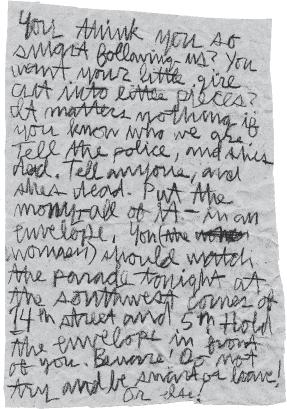
Rocco left to see what Lorenzo could contribute. He returned with $40 and with what they had earned over the last two weeks; it only totaled $159. Knowing this wouldn’t be enough to satisfy the kidnappers, Giovanna grabbed her shawl and left the apartment.
Circling the block, she looked at her neighborhood in a new way—as a thief. She tried to figure out how to reach into cash boxes or pockets but could think of nothing that wouldn’t get her seen or arrested. Desperation mounting, she was about to go to Lucrezia when she remembered Pretty Boy’s pledge to help her family whenever she needed him. It took two hours to find Nunzio’s former co-worker, but when she did, Mariano handed over $130 without question.
Standing at the designated corner, Giovanna held the envelope to her chest. It held $289.
Rocco and the children insisted on going with Giovanna, but she was able to persuade them to remain at a safe distance and not be seen. They stood on the east side of Fifth Avenue near Thirteenth Street.
“I think it’s coming,” said Mary, jumping out into the street.
“Don’t do that again, Mary!” shouted her father. “You stay in the crowd!”
Clement tried to catch sight of his stepmother on the southwest corner of Fourteenth Street. “She’s still there, Papa,” he reported.
The first of the electric floats passed. They held elaborate scenes of heroes and fantastic creatures. Marchers holding colored flames walked at the edge of the floats.
“I don’t get this,” commented Clement with one eye on a float and the other on his stepmother.
“A girl at work said it was a German parade about myths and legends,” offered Frances.
Sure enough, a band marched by, playing what Rocco called “oompah” music. It was followed by another float covered in thousands of colored lights that illuminated the smoke from the torches. The clouds of colored smoke made it nearly impossible to see Giovanna. Clement strained to see through the haze. He was not only checking on his stepmother, but he was there with strict instructions from Domenico to get a description of the person who took the envelope. Lorenzo had forbidden Domenico to go with them after Rocco had come by earlier in the day to ask for more money. It broke Lorenzo’s heart that he had already given all the money he could spare and some he could not.
A break in the floats cleared the air, and clowns came stumbling down the street. One clown clutched a “North Pole” that was captioned I GOT IT. Another clown played a stringless violin, while yet another rode a bicycle with no tires. They were flanked by a line of clowns on either side who jostled the crowd, tilting hats and honking noses. The line of clowns blocked Rocco’s view of Giovanna, and soon the clowns were in front of them, one tugging at Clement’s suspender. Ripples of laughter flowed through the crowd as various people were picked on. When the clowns passed, Rocco looked to Giovanna. It was Clement who noticed first.
“She’s not there. Zia’s gone.”
A policeman stopped them from crossing the street. They ran behind the crowd on the sidewalk heading south, assuming Giovanna had followed the flow of the parade. At Tenth Street, Clement spotted her running through the crowd on the opposite side of the street, as they were doing. At every block, they attempted to cross the street, but each time a policeman caught them and sent them back.
The parade ended at Washington Square Park, and it was here that they were finally able to catch up with Giovanna.
“It was one of the clowns. He took the envelope,” Giovanna sputtered breathlessly.
“Zia, come, we must find a place to sit,” said Frances, alarmed at her stepmother’s breathing.
Rocco and Clement escorted Giovanna to a bench. They were silent; the only sound was Giovanna’s breath slowly returning to normal.
“Every clown was dressed the same. What made you think you would find him running like that! Besides, you risk her life if you follow them!” Rocco was both angry and worried.
“It wasn’t Leo. The clown was too short. But he could have led us to her…”
They sat in silence for a long time. “Let’s go home,” Rocco said, lifting Giovanna to her feet.
THIRTY-SEVEN
MONDAY, OCTOBER 4, 1909

Giovanna knew they wouldn’t be satisfied with what she had given them, but even though she expected the threat, it didn’t make it any less terrifying. The only positive sign was that they were once again given two weeks to get the money, but that meant two more weeks that Angelina was in their filthy hands.
Her heart was palpitating, and it set the baby to kicking. Everything was outside of her control, even the movements within her own body. Panic rose in her chest, and she bolted from her chair with nowhere to go. The walls of the tenement were closing in on her, and she had an inexplicable urge to get to the roof. She needed air; she needed the freedom her daughter and unborn baby didn’t have.
Opening the door to the hallway, she nearly knocked over Lucrezia.
“Giovanna! Where have you been? I came to check on you.”
Giovanna stared into Lucrezia’s face. Every muscle in her body wanted to relax, weeping into her arms. She wanted Lucrezia to hold her head, stroke it, and tell her what to do.
“Giovanna? Is something the matter?”
Giovanna froze.
“Let’s go inside your apartment. Come on, dear.”
The movement back inside and loss of eye contact with Lucrezia helped Giovanna to compose herself.
“I’m fine, Lucrezia. Just a little dizzy.”
“Lie down. I wonder if it’s your sugar.” Lucrezia went to her bag and withdrew all sorts of instruments and elixirs. Listening to Giovanna’s heart, she looked around and asked, “Where’s Angelina?”
Caught off guard, Giovanna answered, “I sent her to her grandparents.” Seeing Lucrezia’s perplexed face, she added, “I’ve been exhausted with this pregnancy.”
“But, Giovanna, so soon after the earthquake? There’s disease.”
“No, no. It’s nearly a year. They say it’s fine.”
Giovanna could tell that Lucrezia was skeptical either of the soundness of her decision or of her truthfulness.
“Your blood pressure is way up. Giovanna, why didn’t you call me? You’re not well.”
“It’s just a bad day, Lucrezia. Really. I overdid it watching these American festivities.”
“Lie back down.”
Giovanna obeyed, and Lucrezia propped pillows beneath her head. She then went to remove Giovanna’s shoes.
“No…” protested Giovanna, but it was too late. Lucrezia had seen her raw feet.
“Did you march in the parades? What on earth have you been doing? Giovanna, really, you know better! I don’t understand this at all.”
“It’s nothing. Stop fussing.”
“I’m surprised you’re so interested in all this nonsense.”
Giovanna remained silent.
“My husband says this Hudson-Fulton celebration is a ploy to get all the new immigrants interested in voting before the elections.”
“I doubt it. It would have been cheaper to pay everyone double what they normally do for voting. They even dressed the horses.”
Lucrezia laughed, relieved at a sign of her friend’s humor. “I didn’t see it, but I read in the paper that during the naval parade, Hudson’s boat, the Half Moon, rammed into Fulton’s Clermont.”
“On purpose?”
“They say it was an accident, but if you ask me, it was the ghosts of these two men’s egos at work. And they say women are jealous!”
Giovanna laughed a real laugh, and Lucrezia continued, encouraged.
“And did you hear what happened in Brooklyn?”
“No,” answered Giovanna, not at all surprised that Lucrezia had all this information.
“They lost thirty-five of the fifty-four floats that were supposed to be in the parade.”
“That’s not possible!”
“It’s like losing the elephants at the circus! You can get up if you want. Your heart rate is normal now.”
Giovanna swung her legs over the bed. “Lucrezia, I’m fine, really.”
“Giovanna, I would hope after all our time together that if you had anything to tell me you would feel free to do so.”
“Sì, sì…” Giovanna couldn’t look Lucrezia in the face. “I’ll walk out with you. I was on my way to get things for dinner.”
When they parted, Giovanna felt far worse than she had before. Her anxiety had lessened, but it was replaced with a heavy, broken heart.
THURSDAY, OCTOBER 7, 1909
Hands over her eyes, Angelina tried to imagine the sights and sounds from the Ferris wheel. “Happy birthday to you. Happy birthday to you…” The room was pitch dark and her lids were shut tight and covered, but no matter how hard she tried, she couldn’t pretend. Something crawled up her skin. Trembling and shaking, she tried again. “Happy birthday to you. Happy birthday to you…”
SATURDAY, OCTOBER 9, 1909
“I heard something!” Teresa entered the apartment nearly breathless and handed over a baby each to Mary and Frances.
Giovanna jumped up and closed the door. “Sit, Teresa.”
“Don’t get excited…”
“Just tell,” beseeched Giovanna.
“I overheard these drunken men talking about all the new greenhorns Il Lupo had working for him. They said that they were the ones who bombed the Bank Pati where the teller was killed.”
“And?” asked Rocco.
“That’s it. That’s what I heard,” replied Teresa.
“Are you crazy? You get us all excited, and you tell us nothing!” Rocco shouted.
“Rocco! Stop! Do you think we will just happen to hear where she is? Teresa was right to come. This could be helpful,” said Giovanna.
SATURDAY, OCTOBER 16, 1909
An early light snow was falling, the first of the season. Giovanna was nearly oblivious to it, sitting at the window looking for signs or signals. Everyone was at work, including Mary, who had insisted on going with Frances.
It was two weeks to the day and she had not received instructions. No crude drawings and misspelled words. No sign of Leo or the phony cripple. Every few days she dropped into Inzerillo’s cafe to beg him to persuade the kidnappers not to harm Angelina and to let him know they were working hard to get the money. She assumed that once again word would come via Rocco because it was fairly easy to drop a piece of paper unseen into his cart, and so she hoped and half expected to see Rocco hurrying toward their building.
Instead, a moment later, her heart leapt when she saw Lieutenant Petrosino. Clutching her chest, she didn’t move her eyes off him and quickly debated whether to tell her old friend. For nearly ten seconds she was certain Petrosino was alive and his death had been staged. But when he came closer she could see that all this man and Petrosino shared was their stature and a derby. His face held none of the determination of the little lieutenant.
When Giovanna calmed down, she poured herself a glass of wine and went back to her position at the window. She remembered the first time she saw Petrosino in Saulino’s restaurant. He looked so depressed, and the lawyer DeCegli said it was because a little boy who had been kidnapped was found dead.
Maybe her dead friend was trying to tell her something, because the memory ignited a spark, and seconds later she was off her chair, wrapping herself in a thick shawl, and out the door. The kidnappers were right. It was not enough to know who they were. She needed to know their secrets.
Giovanna went to the library, and the same librarian who had helped her and Domenico find articles about Nunzio’s accident directed her to articles about kidnapping in the Italian language news papers. She left the library with a name and address in Brooklyn.
It was a dress shop. Giovanna hesitated before the door, and when she saw someone from inside looking at her suspiciously, she brushed the snow from her shawl and entered.
“Is Signora Palermo here?”
“Why? I can help you,” answered a small, stooped woman standing behind the counter.
“I wanted to speak with the signora.”
“What about?”
“I prefer to speak directly to her.”
“I would need to know why.”
Giovanna noticed the sorrow around the woman’s eyes and decided to speak frankly.
“It’s a private matter. But I believe the tragedy in the signora’s life can help me avoid a similar fate.”
The woman wordlessly retreated to a back room. The door opened, a young woman exited, and the stooped woman from behind the counter beckoned to Giovanna. “Follow me,” she instructed.
Giovanna found herself in a storeroom lined with dress racks, and she was invited to take a seat at a small desk. The woman seated herself and moved a dress form out of the way. “I am Signora Palermo.”
“Yes, I thought so. Thank you for speaking with me.”
“I am not speaking with you yet, signora.”
“No, but I hope you will. No one knows what I am going to tell you, but you will have no reason to talk to me unless you hear the truth, and even then, I can only appeal to your sympathy.”
It was obvious even to a stranger that this burst of emotional honesty was out of character for this woman, who the signora realized was pregnant. Glancing at Giovanna’s feet, the woman slid a crate beneath them. “Talk, signora.”
“My daughter has been kidnapped.”
The woman’s eyes closed momentarily, and she inhaled deeply. “Do the police know?”
“No!” Giovanna reacted like the woman had made a suggestion, and she only relaxed when Signora Palermo replied, “Thank God.”
“I do not understand why you are coming to me. My Mario is gone. We could not get him back.” Tears welled in her eyes even before she said her dead son’s name, and in seconds she was trying to stifle deep sobs. Giovanna reached for the woman’s hand. Seeing Signora Palermo’s grief triggered the emotion that Giovanna was suppressing, and the strangers ended up crying in each other’s arms.
It was a long time before Giovanna said anything. But eventually she asked, “Signora, do you know who kidnapped your son?” Seeing the fear on the woman’s face, Giovanna added, “I swear on my daughter’s head, no one will know, no one, what you tell me.”
“Why do you want to know then?”
“Because, signora, the only hope I have of finding my daughter is to know their crimes. I must make her safe return more valuable than ransom.”
Signora Palermo stared a long time at Giovanna and then began. “Even my husband does not know my suspicions, because if he did he would try to kill them himself, and I would lose a son and a husband.”
“I understand, signora. Please, I promise you. No one will know we’ve spoken, not even your husband.”
“There was a man. He kept coming and asking for money. My husband was proud and sent him away, week after week. Then a different man started coming—a large brute. I think I heard another man call him ‘The Bull’ once. This man, too, even though he was frightening, was sent away by my husband. The next time he came he was with a tall, thin man with a droopy eye. I saw the cafone look at my Mario, and I pleaded with my husband to pay, but he refused. Two days after their visit, Mario was gone.”
The signora was crying so hard she fought to catch her breath. Knowing it was the same kidnappers, and that they were truly capable of killing, paralyzed Giovanna.
“They sent us letters and asked for a lot of money. We didn’t have that much money. We were supposed to look for a man with a red handkerchief, but we didn’t go because we had only a few dollars. Instead, my husband went to the police; it was all we could do, signora! Two days later they found my Mario’s body.”
Giovanna, consumed by fear, held and rocked the woman, wiping her face with her sleeve. “Did you ever see these men again?”
“No, but another man came to the funeral. He told my husband if we spoke to the police again he would kill us.” Stopping and looking at Giovanna, she wailed, “Signora, Mario was my only son! So I decided to tell the police about the man who defiled my son’s wake. We spoke with the dead policeman, you know, the famous one, and he said only a wolf with no fear would come to my boy’s funeral.”
The trip home from Brooklyn felt like the longest Giovanna had ever taken. Time seemed to expand as it did on the boat to America. She was now certain that Il Lupo was behind Angelina’s kidnapping and that his accomplice Leo had murdered at least one kidnapped child. She revisited every word of her conversations with Inzerillo, knowing that her messages were indeed going straight to the source.
Her thoughts churned. Inzerillo had children! Yes, that was it! She would kidnap one of his children and return the child in exchange for Angelina. It took only a few stops on the El to find the flaws in this plan. Giovanna had learned that kidnapping was a crime of mind games and strategy. If she took Inzerillo’s child, for the plan to be effective, they would have to believe that she was capable of killing the child. Additionally, it would prompt all-out war, and none of her stepchildren, nieces, or nephews would be safe.
Giovanna climbed the stairs to her apartment, not knowing her next move. She was relieved to see Frances and Mary already preparing supper and said a prayer of thanks for her stepdaughters, even though at the moment they were acting awkward. Rocco was also home and making their tenement even smaller by pacing its perimeter. Needing to put her feet up, Giovanna decided to take a few minutes to lie down and think about the conversation with Signora Palermo. Teresa’s information about Il Lupo’s gang and the bombing at the bank was also ringing in her ears.
“Where’s Angelina’s dress?” called Giovanna from the bedroom. It was missing from where she kept it under her pillow.
Frances and Mary exchanged looks in the kitchen.
“What does it matter? She can’t wear it,” answered Rocco, already defensive.
“What do you mean?” Giovanna yelled, louder than she ever had in her life.
Rocco was already putting on his jacket. “They came collecting clothes for the people of the earthquake. We had nothing left to give.”
“You didn’t have to give anything! We gave plenty! How, how could you?” Giovanna wailed with pain. “If I hadn’t sent the money to Scilla, we could have moved! We would have been far away from the schifosi. Because of the earthquake they have my daughter!”
Rocco slammed the door on the way out, leaving his daughters to comfort Giovanna. Mary and Frances expected their stepmother to be upset, but they hadn’t expected her to fall completely apart. They didn’t realize her rage was fueled by fear. Giovanna now knew who the kidnappers were and what they were capable of—and she was terrified. She lay on the bed, alternately clutching and punching a pillow. It was hours before she stopped blaming herself, the terremoto, her husband, and Lieutenant Petrosino for Angelina’s abduction. Frances and Mary had given up trying to console her and had sent for Teresa.
Teresa entered the apartment alone and began ministering her magic. Had she been a Costa by blood, it could have been said that she took after Zia Antoinette. But it was under the tutelage of her own mother that Teresa had become versed in the curses, rituals, and prayers that she was to master.
To release her sister-in-law’s demons, Teresa heated glass cups. Putting water around the rims, she placed them on Giovanna’s back, and with the suction they created, she captured the bad spirits. After this cleansing, Teresa took olive oil and made the sign of the cross on Giovanna’s forehead over and over while murmuring prayers. When she stopped, she spat twice on Giovanna’s head.
“That will take the pain away,” announced Teresa. “And soon you will sleep.”
Giovanna, weak from raging, submitted to all Teresa’s ministrations without resistance. Teresa sat by her bed, occasionally patting Giovanna’s hand and commanding her to sleep while she recited prayer after prayer.
Whether it was something Teresa had done, or exhaustion, Giovanna slept through the following day.
THIRTY-EIGHT
MONDAY, OCTOBER 18, 1909
Giovanna woke with a plan. If she couldn’t kidnap Inzerillo’s child, she would hold information hostage and demand her daughter in return. Lupo was an experienced thug. He would make the best business decision.
Teresa’s evil eye remedies inspired part two of the plan. Although these schifosi were living in New York, they were still peasants from Italy. Guns were less frightening than the evil eye. Her size, presence, and the fact that she was a midwife, already made her suspect. It would be easy to play the part of a witch.
Giovanna turned the corner onto Bayard Street and entered another world. The signs were Chinese, women scarce, and the smells pungent. Heading toward her friend’s shop, she was shocked to see a small group of white men and women, dressed extremely well, being led down the sidewalk by an older Chinese man. They were laughing and taking in the sights. Steps from her they entered what she knew from her many walks in the neighborhood to be an opium den. Had she not been on a mission, she would have waited and followed them out of curiosity. It never occurred to her that she, too, looked out of place.
The proprietor of the herb shop waved her in with a genuine smile. It appeared even more crowded than normal, piled high with crates, bins, drying plants, and mysterious jars. So many smells competed for attention that they canceled each other out and instead created an air laden with possibility. Seeing her belly, the herbalist assumed she wanted something to bring on labor and went for a raspberry leaf and blue cohosh tincture. “No, no,” Giovanna said, looking for a piece of paper and a pencil. This would be a challenge. He handed her brown paper and a stub of pencil lead. She drew a hand, and then she drew bumps on the hand and pantomimed scratching.
“No, no problem,” said the proprietor and he scurried away. Giovanna had a feeling he would return with the exact opposite of what she wanted and tried to think of the way to communicate that she wanted something that would cause, not cure, a rash.
“Good, good?” He returned with aloe and arrowroot powder in his hand.
Giovanna picked up the lead and drew nettles. Whether her drawing was bad, or there weren’t nettles in China, she didn’t know, because the herbalist was stumped. Giovanna realized she was trying to be too specific. She drew a skull and crossbones and scratched at her skin.
“Yes, yes!” His euphoria at getting the clue was quickly replaced by confusion. The Italian lady always bought healing herbs. He doubted himself until he produced an oil-like tincture that after inspection produced a triumphant nod from Giovanna.
Still skeptical, the herbalist made all sorts of cautionary gestures that Giovanna greeted with reassuring smiles. On her way out, he took a look at her big belly and called her back in for what Giovanna thought would be a final warning, but instead he handed her raspberry leaf tea.
WEDNESDAY, OCTOBER 20, 1909
From her post at the window, Giovanna absentmindedly scratched her hand. Looking down she was pleased to see little red blisters. When she had returned from Chinatown she had put a small dot of the tincture on a piece of paper. She waited until the next morning to handle the paper, which looked like it was stained with fish oil. Less than a day later the poison had produced a rash. If she got such results with this small amount, surely the scoundrels’ hands would be covered.
Mary opened the door with a bang of her hip. Her arms were filled with two primers and a writing notebook sent from school so she could study in the evenings. Relieved to have the company and the diversion, Giovanna leaned on the windowsill and lifted herself out of the chair.
“Don’t get up, Zia. I can get you something.”
“No, I need to move. Why all the books?”
“My teacher sent them so I can practice my writing. They were in the foyer.”
“Let me see, Mary.” Giovanna walked to the kitchen table where Mary had left her books and opened the top one. A handmade envelope fell out.
Mary was busy removing her coat and boots, so Giovanna turned her back to her and said, “Mary, I must lie down.” The letters were frightening enough; she didn’t want Mary to be further traumatized by knowing the threat had been placed in her schoolbook.
“See, Zia, I told you not to get up! I’ll make you tea.”
“No, no. I want to sleep. Do your schoolwork.”
On the bed with her back facing the kitchen, she quietly opened the envelope.

It was when she put the letter back that she saw a dark brown lock of Angelina’s hair at the bottom of the envelope.
SUNDAY, OCTOBER 24, 1909
“Zia, I can’t find my hat!”
“Look under your coat, Mary.”
Rocco had gone for his morning coffee, and Clement was still asleep, giving Giovanna the little bit of privacy that she needed. Opening her bottom drawer, she grabbed the gun, but also a knife—a kitchen knife that she had spent the better part of Saturday sharpening. It had occurred to her that it was probably foolish to sharpen a knife that she had no intention of using, but she wanted it to gleam.
She placed the knife into a makeshift sheath and attached it to her waistband next to where she tucked the gun. “Scusa, bambino.” Giovanna wondered for a quick second what Zia Antoinette would have said about the future of a baby that had spent its last months in utero cuddled up to a knife and gun. Saying a quick prayer to Zia Antoinette to reverse its effect, she headed to the door.
Earlier that morning, she had told Lorenzo that she needed Domenico’s help moving the piano. It was nearly true—she had sold the piano, but it wouldn’t be moved until that evening. Giovanna had already taken Domenico for coffee and explained her plan. His eyes widened, and he sat straighter than Giovanna had ever seen him. She made him promise to stick to her scheme, which would not put him in touch with the kidnappers, but she thought herself insane to be involving her nephew and added this to her list of sins.
“Let’s go, girls.” Giovanna grabbed a purse and dropped in the envelope marked FOR THE BABY JESUS. With the sale of the piano it held $224.
Frances and Mary noticed that their stepmother was on edge, but that had become normal. They tried to keep pace with her as she walked north on Elizabeth Street to Our Lady of Loreto. They were early and stood aside to watch the parishioners from the nine o’clock mass exit. Mary mimicked her stepmother by scrutinizing every face. When they entered the church, Giovanna walked down three rows and nudged the girls into the pew.
“Zia, we always sit up front!” exclaimed Mary, tugging at her hand.
“I don’t want to walk that far. Sit, Mary.”
The church was cool, but Giovanna was already sweating and fanning herself with the pages of the missal.
“Are you okay, Zia?” asked Frances, looking at her. “You sure you don’t want to go home?”
“No, no. Just pray. Pray to Saint Anthony.” Frances knew what praying to Saint Anthony meant.
Little bits of the priest’s sermon on the paganism of the American holiday Halloween drifted in and out of Giovanna’s consciousness. His voice rallied when he warned parents not to let their children dress in costume on next week’s Sabbath. His admonishments interrupted Giovanna’s calculation of the number of minutes until the first collection of offerings.
Finally, four ushers, one on each side aisle and two in the center, walked from the back of the church to the altar. They waited there, hands crossed over the stick of their rattan baskets, for the priest to announce the first offering. Giovanna studied their faces. They were all good family men she recognized from the neighborhood, but with a stab to her heart she remembered Limonata’s deceit, and once again they became suspects.
The ushers began to weave the baskets in and out of the pews collecting contributions. After the last row, the ushers would walk to the vestry room off the church foyer, empty the money and envelopes, lock the door, and then walk back down to the altar for the second collection.
The ushers were now only five rows in front of her; a hymn drowned out the beating of her heart. Her face was completely flushed, and she saw Frances staring at her—it would work in her favor.
When they reached her row, Giovanna lifted her arm noticeably and dropped the envelope in the basket. Without looking, she monitored the ushers’ movements. There were three more rows behind her—slide the basket in and out, in, out, in, out. Six steps to the vestry. Open the door. Empty the baskets. She heard the coins cascade into a strong box. Now they’ll close the door. Six steps back inside the church, footsteps on marble. Start gasping.
“Zia, what’s wrong?” asked Frances, concerned.
“I’m fine. I just need air. You stay here.” She fanned herself on the way out of the church.
Domenico stood at the open door and nodded his head in the direction of the vestry, meaning the crook was inside collecting the payoff. Giovanna went outside to the alley entrance while Domenico stayed at his post. At least two minutes passed. Was there another exit? She was beginning to panic when she saw Domenico nod, indicating the man was coming. There was an alley on either side of the church. If the Blackhander came her way, she could easily pull him in. If he went in the other direction, she would have to run to reach him before he passed the alley. Domenico nodded again, this time to the left, indicating he was exiting on the side opposite Giovanna. His nod gave her the precious few seconds she needed.
A foot before the alley entrance she flung out her arm, grabbed the man’s neck from behind, and dragged him into the alley. She held him so tight he was choking. He tried to pry her arm from his neck until she drew the blade to his chin. His hands dropped, and for a moment Giovanna was unnerved when she looked into his face and realized it was the “cripple” from Washington Square.
“Be quiet. Say nothing or I’ll slit your chicken neck,” Giovanna hissed.
Everything about the man quieted except his eyes, which he desperately tried to roll backward in an attempt to see his attacker. Giovanna’s enormous belly was pressed so tightly against his back that she knew he must feel the baby kicking. He was so short that his head was pulled back onto her breasts.
“Listen, clown, I know who you are and I know who your boss is. You tell him this. You tell him that there are three sealed envelopes waiting to go to the police, the mayor, and the newspaper with details about the killing of Mario Palermo and the bombing of Bank Pati. If anything, anything, happens to my daughter, to me, or to anyone in my family, someone has been instructed to deliver these letters. The evidence will hang you all. Do you understand, cafone?”
The man tried to nod but couldn’t move his head in Giovanna’s death grip. “If you understand, stomp your foot.”
His foot stomped.
Giovanna slowly let go, and by the time he jerked around to face her she had her gun pointed at him. “Go. Take the money. And take the message.”
The man was frozen.
“Go, you phony cripple, go!” Giovanna commanded, knocking him in the head with the gun before he fled. “Va al diavolo!”
After tucking the knife and gun back into her waistband, she repinned her hair, took a few deep breaths, and exited the alley, practically falling to the steps of the church. No sooner had she got there than she realized Domenico was gone. “I knew it! I should not have trusted him!” her voice screamed in her head.
The recessional hymn sounded on the organ; the priest was the first to exit the church. “Signora! Are you alright?” He hurried to Giovanna on the steps.
“Sì, Father. It’s difficult with the baby, that’s all.”
“Zia!” Frances and Mary came running.
“Girls, you shouldn’t leave your mother.”
Giovanna defended them. “No, no, Father, I didn’t want them to miss mass.”
“God would forgive them. Children, take your mother home to bed.”
“Clement’s not here. He went with Papa to the cafe,” greeted Frances from the stove, where she was frying meatballs, as Domenico walked into the apartment.
Giovanna slumped in relief. Her wait for Domenico had been interminable.
“Zia almost fainted in church, Domenico,” announced Mary.
“Girls, go ask Zia Teresa if we can eat together at her house. I’m too exhausted to have the meal here.”
“Mary can go, Zia. I’ll finish this.”
“No. I don’t want her walking alone. Go.”
“Va bene.” Frances reluctantly grabbed Mary’s hand, and they left.
Giovanna said nothing. She waited for her nephew to speak.
“I followed him.”
“I told you not to do that.”
“You told me many things, Zia. I listened to most.”
Giovanna sighed. Zia. Only Aunt. There was no one to call her “Mamma.” Even her stepchildren called her Zia. She looked at Domenico with the loss that she felt and said, “You could have been killed.”
“Zia, that man was too scared to wipe his ass, let alone kill someone! Where did you learn to talk like that? I was frightened listening to you!”
Giovanna smiled but turned serious again. “Where did he go, Domenico?”
“I’m a failure as a detective.” Domenico’s voice cracked. “I was so close to him leading me right to her. Then I lost him. I lost him, Zia.”
“They are experienced in knowing how not to be followed. You can’t blame yourself.”
Although his aunt’s words were kind, Domenico heard the disappointment in her voice. “Zia, I only know that he went to Brooklyn. Where in Brooklyn, I don’t know, because that’s where I lost him.”
“That’s more than we knew yesterday.”
Domenico’s head was bowed dejectedly. He looked like a little boy.
“Did he see you?” asked Giovanna gently.
“No, I don’t think so. And I don’t think he knew someone was following him, which makes my losing him all the worse.”
“No, Domenico, we did good today. Angelina is safer tonight, I think.”
After a few moments of silence, Giovanna asked, “Domenico, how did the schifoso get into the vestry? Did he jimmy the lock?”
“No, it was open.”
“Open? Who was the last usher out? Describe him.”
“Thick, shiny black hair. The fish seller.”
“Molfetti?”
“I think that’s his name.”
THIRTY-NINE
WEDNESDAY, OCTOBER 27, 1909
Triumphantly, Giovanna noticed that there were no drawings of dripping knives or misshapen guns on the letter.

FRIDAY, OCTOBER 29, 1909
How do I know my daughter is alive? Ask her what she did on her birthday and give me the answer. If you give me this word, I will give you more money.
Giovanna took out the poison tincture and with an eyedropper carefully edged the paper and the envelope with little drops. Hours later when it was dry, she put on her gloves and, wrapping herself in her shawls, headed toward Saint Anthony’s church.
SATURDAY, OCTOBER 30, 1909
Molfetti’s fish store was crowded. Jostling her way to the front, Giovanna’s eyes fixed on Molfetti’s hands filleting a flounder. They looked red.
“Signora, what are you doing down here?” asked a woman next to her.
Giovanna had delivered the woman’s baby but couldn’t remember her name. It amazed her that if you went an extra few blocks in the neighborhood to buy something, people noticed.
“It’s my stepson’s birthday. I wanted to get a nice piece of fish.”
“He does have good fish,” agreed the woman, sounding privileged that this was her local fish store.
As if to explain the redness, Molfetti thrust his hands into a tub of ice water and, on closer inspection, Giovanna could see there was no rash.
“Good luck to you, signora,” said the woman upon leaving.
“Good luck?” replied Giovanna, preoccupied.
“Sì, with the baby!” nodded the woman, smiling at her stomach.
“Signore Molfetti,” greeted Giovanna at the counter.
“I’m sorry, signora, I seem to have forgotten your name,” replied Molfetti.
“Oh, you probably don’t know it,” said Giovanna cheerily. “I’ll have that piece of flounder,” she indicated, pointing.
As Molfetti wrapped the fish, she continued, “It’s just that I recognize you from church; you’re an usher, yes?”
“Yes, of course, that’s where I’ve seen you,” commented Molfetti, handing her change.
“Signore, you should make a point of locking the vestry door,” whispered Giovanna emphatically as she turned and left.
SUNDAY, OCTOBER 31, 1909
“Can I dress up tonight?” asked Mary.
Giovanna was making the morning espresso. “We’ll see.”
“Sometimes they give you a penny instead of a treat.”
“Then I suppose your father would consider it work.” The priest’s sermon came to mind. “And God will forgive us.”
Mary had wanted to be an Indian during the Hudson-Fulton celebration, and Halloween gave her a second chance. She borrowed a costume, and before setting out, Giovanna braided Mary’s hair and put rouge from Aunt Teresa in stripes on her face. At Prince Street, Mary headed west.
“Where are you going?” questioned Giovanna. “We know more people the other way.”
“But they have more money in these neighborhoods.”
Giovanna smiled at her stepdaughter.
“Stay on the street when I go in the store, Zia.”
It took Giovanna a few stops to get what Mary was up to. She heard Mary’s loud “Trick or treat!” and when someone presented her with a candy she politely shook her head and pointed inside her mouth to a phantom rotted tooth. Giovanna would see Mary’s feathers nod thanks when she was instead offered a penny.
An hour later, Mary shook her little burlap bag. “Not bad, Zia, and there’s a bunch more blocks we can go.”
“Except next time, you take the candy. You deserve it.” Giovanna bent down, hugged Mary, and got a stripe of lipstick on her shoulder. Her only thought had been how this trauma would affect Angelina, but now she was reminded that, to a lesser degree, everyone in the family would have scars.
At nine thirty, Giovanna had to convince Mary it was time to go home. They met Rocco and Clement on the stoop returning from selling sweet potatoes to the chilled trick-or-treaters.
“Papa! I got many pennies!” Mary held up her bag.
“I think you made more than we did, Mary!” answered Rocco, winking.
When they opened the door, Frances was pacing the little kitchen, holding an envelope.
“Angelina is alive.”
Giovanna tore the envelope from Frances’s hand.
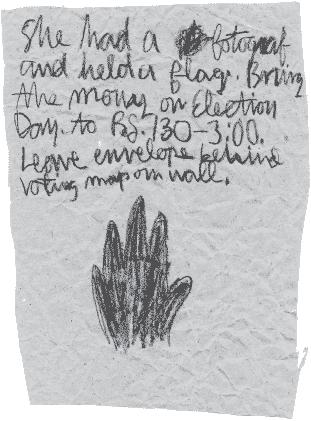
“Frances! How did you get this?” shouted Rocco.
“I was on the stoop. Someone in a mask came up to me, handed me the envelope, and said ‘Trick or treat.’ I didn’t know, I didn’t know.” Frances broke down in tears.
“Frances,” said Giovanna embracing her, “There’s nothing you could have done.”
“The children can’t be alone. Ever,” commanded Rocco.
MONDAY, NOVEMBER 1, 1909
“Lupo, you’re crazy. Why did you want to meet here?”
“Because, Pietro, I want them all to see me,” Lupo said expansively.
Lupo and Inzerillo were having dinner at Delmonico’s on Beaver Street. The restaurant was filled with local politicians making last-minute plans for the morning.
“I still don’t get it.”
“They need to think I’m more involved in the election tomorrow than I really am. The feds are all over us for counterfeiting, and we need the locals’ protection.”
“But there’s a warrant for your arrest, Lupo.”
“Pietro, who would arrest me tonight?”
“I understand that, but next week? They’ll be forced to.”
“I’ve got it worked out. They want me for fleeing bankruptcy, but instead, I’ll become the victim. I’ll go to the police and say I was blackhanded. By the time they finish the investigation, I’ll be gone.”
Inzerillo couldn’t help but laugh. “Shrewd. What about the Manzella case? There’s a warrant out for your arrest on that one, too.”
“I have a few days; I’ll deal with Manzella.”
“Well, then,” smirked Inzerillo, “a toast to your return.”
“And to All Saints Day!”
After clinking wine glasses, Lupo asked, “What’s the story with the fruit seller?”
“Every few weeks they come up with more money.”
“Good. Tell Leo not to do anything stupid. We need the cash.”
“He said the Gallucci brothers were hysterical the other day, claiming the kid’s mother was a witch and knew too much.”
“The Galluccis are greenhorns. You’ve talked to her, what do you think?”
“She’s smart. But she’s not going anywhere. She’s desperate to get that kid back.”
“Then tell Leo to keep the greenhorns in line.”
“I have. And I will.”
“They should be working the election tomorrow. Everybody we have should be working.”
“They’ll all be out. What about you?”
“I’m going to keep my eye on Leo. I want to make sure he’s not been taking advantage of my absence.”
TUESDAY, NOVEMBER 2, 1909
Giovanna got out the dropper to add black magic to her note.
Take this $155 and give me my daughter or I will tell Edwin Reese that in addition to being involved in elections you are kidnappers. Or instead, I could threaten Edwin Reese that I will tell his secret to the newspapers. You think your skin is on fire now? Return Angelina, or your skin will fall off the bone!
Much of the election hoopla had escaped Giovanna. She knew the basics: there was a party called Tammany, and their candidate was William Gaynor, and a party called Fusion, and their candidate was Otto Bannard. Earlier, there was a newspaperman named Hearst who was going to run, but didn’t. And everyone said voting didn’t matter on the Lower East Side because the Sullivans were in control.
But she did know that a man named Edwin Reese who worked in an election office had given an envelope, probably containing money, to one of the scoundrels involved in Angelina’s kidnapping. And now the Blackhanders wanted the next payment dropped at the poll.
It was pouring. An American flag hung outside in the rain at P.S. 130, as did all sorts of men with buttons covering their coats. On another corner, under umbrellas, stood three well-dressed ladies draped in sashes that read, VOTES FOR WOMEN.
Giovanna could barely walk anymore her legs were so swollen. She entered the school, shook the water from her shawl, and lumbered painfully to the gymnasium. She surveyed the setup and the faces, especially people with ribbons pinned to their chests, and headed to the precinct maps on the wall.
“Signora, can I help you?” asked a man in Italian who was accompanied by a policeman.
“My husband wants to vote, but he can’t read. I came to find out where he has to go,” answered Giovanna.
The official’s voice changed. “Let me help you, signora. Where do you live?”
“At two…at 236 Elizabeth Street.”
“That wouldn’t be here, that would be at P.S. 21.”
“Grazie, signore, but I think I’ll take a look anyway to check for my brother.” Thankfully, the man was pulled away and Giovanna had just enough time to slip the envelope behind the map.
FORTY
THURSDAY, NOVEMBER 4, 1909

FRIDAY, NOVEMBER 5, 1909
“Zia, there’s loads of people outside the Elizabeth Street police station,” announced Mary, coming through the door after work. Giovanna was confined to bed. Lucrezia wanted to put her in the hospital, but Giovanna wouldn’t allow it.
“Go to Zio Lorenzo’s house and get Domenico to go with you and find out what’s happening.”
It was nearly an hour before Domenico and Mary returned.
“It’s the Chinese, Zia. I saw Detective Fiaschetti, and he told me it was something called a tong war. Somebody got killed in August, and now the other gang killed someone in revenge.”
Giovanna, who had raised herself on her elbows, fell back onto the bed. Domenico entered her room and half closed the door. “There’s more, Zia.”
From Domenico’s expression, Giovanna could tell that it was serious. With great difficulty she once again lifted her upper body from the bed. “Go on,” she instructed.
“You’re going to think this is a joke, Zia.”
“Any joke now would be a cruel one, and you’re not cruel, Domenico.”
“Detective Fiaschetti told me that Lupo came to the police station today to make a complaint. Lupo said he was blackhanded at his store on Mulberry Street and that’s why he went out of business.”
“Lupo? Here?”
“Yes, Zia.”
“Didn’t they arrest him?”
“No. The detective said something about needing to get a complaint in order.”
“Lupo, on Elizabeth Street? And they let him go!”
“Zia, maybe he isn’t involved.”
“Maybe.”
“But imagine, Zia, he said he was blackhanded!”
“Domenico, do the police still play games in the settlement gym with boys from the neighborhood?”
“I think so.”
“I want you to go, Domenico. We need information on Lupo, but I don’t want anyone to see you go into the police station.”
“I’ll try, Zia, but I don’t think anyone other than Detective Fiaschetti would talk to me.” Secretly, Domenico was thrilled. This gave him the permission he needed to snoop around.
SUNDAY, NOVEMBER 7, 1909
It must be Sunday—they never let her out on Sunday when the men were home all day. But she couldn’t hold it in anymore. The bugs had bitten her badly, and her stomach ached, and the dark of the room was frightening. They had boarded up the window when the winter came; she couldn’t even see the blue shade across the street anymore. The only light in the room came from a little window high in the door. She tried to stifle the sobs. When she cried, they shouted and called her names. But today she couldn’t stop. The more she tried to choke down the tears, the louder she cried. Chairs scraped on the floor, and she cringed against the back wall, but even the threat of the men hurting her couldn’t stop the sobs. They had been meaner lately, ever since they got rashes and tore at their skin.
The window to her door blackened, and she could see the face of an animal.
“Stop it or il lupo will get you!” they called in rough voices. They bounced a stuffed bear up and down. “We said stop the goddamn crying or we promise il lupo will get you!”
“Stupid men,” thought Angelina. “It’s a bear, not a wolf.”
MONDAY, NOVEMBER 8, 1909
Rocco sent for Lucrezia. It was the second time in two days that he’d become frightened his wife was going to die. She still wouldn’t go to the hospital. Medically, Lucrezia couldn’t explain why Giovanna was delirious, but she supposed that if Giovanna spoke to her honestly, the reason would become evident. All Lucrezia could do was sedate Giovanna, and her secrets.
FRIDAY, NOVEMBER 12, 1909
“Leo, she’s a witch! Let’s get rid of the kid!” fumed the younger of the Gallucci brothers.
“Stop moaning,” commanded Leo, who had met them on a street corner.
“You’re not the one whose skin is blistered. I’m going to be scarred!” said the older Gallucci brother.
“You got a rash, that’s all,” dismissed Leo.
“Then how come she knows about it?”
“Because she’s probably following you, you idiots. I told you to be careful.”
“Leo,” said the younger brother, trying to play the reasonable one of the two, “we need to tell Lupo everything this crazy lady knows.”
“You want to get killed? You think Lupo would be happy knowing we were followed?”
The older Gallucci looked skeptically at Leo. “What’s going on here, Leo? Who’s Edwin Reese anyway?”
“How should I know? She’s nuts. Lupo said to not touch the kid if we keep getting money. And that’s what you’ll do.”
SUNDAY, NOVEMBER 14, 1909
“Come on, girl, see the snow.”
The woman was holding the door to the room open. Angelina’s eyes tried to adjust to the light, but she was blinded by the glare on the snow.
With the other children next to her, Angelina gazed out the door, her hands shielding her eyes. A few feet already blanketed the ground, and it was still snowing.
“America is brutta,” scoffed one of the women.
“I like the snow,” replied the other.
“But you can’t go out. You can’t move.”
“Where can we go with this kid anyway?”
“It won’t be much longer.”
Angelina always tried to listen to them but had a hard time with their accents, especially when they spoke quickly, as they were doing now. But she guessed that the conversation had something to do with her, and she tried to make herself invisible.
“Mamma, can we go out?” pleaded one of the children.
“Let them go,” said the younger woman.
“I’ll light a fire. They won’t last but a few minutes.”
She opened the door and shooed the children out, leaving Angelina behind.
“Signora, please, can I go, too?”
Ignoring Angelina, she turned to the other woman and shrugged. “She can’t run away, she’ll sink in the snow.”
“Va bene. Go, go,” she commanded, pushing Angelina out the door and closing it.
The other children giggled, trying to walk. Angelina threw herself into a drift. Her skin always felt like it was on fire. The snow stopped the itching of the bug bites and put the fire out. She was clean in the snow; it didn’t matter to her that she was frigid and shivering. Opening her mouth, she gulped in great swallows. She rubbed her hair and scalp, which also felt like it was aflame, in the icy crystals. Rolling back and forth, back and forth, she cooled and cleaned her body until a strong pair of hands gripped her waist.
A wet slap landed on Angelina’s face. “What are you, pazza? You can’t get sick. We didn’t feed you all these months for nothing.”
“Get her inside,” shouted the other woman from the door.
The women stripped off her clothes in front of the fire. It was the first time they had been removed, and her petticoat was nearly shredded. Hanging her clothes near the flames, they shooed her naked into her room and slammed the door.
MONDAY, NOVEMBER 15, 1909
A savage wind whipped at the windows of 202 Elizabeth Street. After two days of snow it was beginning to rain, but rather than melt the snow, the rain covered it in a crust of ice.
The baby was coming. Giovanna wanted to hold out as long as she could before calling Lucrezia; she was worried that the more time Lucrezia spent in the apartment the greater the risk that someone would slip and say something. Finally, she could wait no longer, and Rocco left to get the midwife.
The weather was too horrid to send the children down the block to Lorenzo’s apartment. Instead, everyone, including Rocco, huddled in the children’s tiny room and left the kitchen and bedroom to the laboring woman and midwife.
Lucrezia didn’t see the same kind of determination in Giovanna’s labor that she had with the first baby. Although that could be explained by the sedatives and two weeks in bed, she figured it had more to do with the unspoken horror that had made Giovanna construct this strange altar in the bedroom topped by Saint Anthony. Lucrezia found the story about Angelina being in Italy hard to believe. But the idea that Angelina had been taken from Giovanna was also too terrible to fathom.
Because pain makes truth harder to hide, many times in the middle of a contraction Giovanna wanted to confess to Lucrezia the inner torment that had nothing to do with pushing this baby out of her body. She longed to birth her baby and her secrets at the same time. The pain of needing Lucrezia so badly was indistinguishable from the labor. But between contractions, it didn’t matter. Lucrezia was not family. No longer could they trust anyone who was not of their flesh and blood.
It was nearly dawn when her son emerged. Her long, difficult labor had mimicked the storm raging outside the windows. Giovanna had been so certain that the baby was a boy that she was taken aback by Rocco’s surprise and excitement. After Lucrezia had cleaned the child and the birth area, the children crowded around the bed. From the moment Lucrezia put the fair boy in Giovanna’s arms she was heartened. No one was trying to replace Angelina. At the foot of her bed, the candles on her makeshift altar flickered. At least twice in the night they had gone out, and she had begged Lucrezia to relight them.
“So, children, this is Nunzio,” announced Rocco. Giovanna smiled at Rocco for remembering his promise, but she had prayed to Nunzio and the angels all night long and knew what she must do.
“No, the child will be called Anthony,” Giovanna whispered.
TUESDAY, NOVEMBER 16, 1909
“Domenico, come see our new brother,” greeted Mary when Domenico stepped in the door.
Domenico was so anxious to speak with his aunt that he hardly glanced at the infant.
“Zia, they arrested Lupo today. He’s in the city jail.”
Once again, Giovanna was left wondering what this would mean for her daughter.
“Do you know on what charges?”
“For blackhanding a shop owner named Manzella.”
WEDNESDAY, NOVEMBER 17, 1909
“Lupo had this all planned. There’s nothing to worry about, Leo,” reassured Inzerillo.
“You should of told me is all. I was real surprised,” complained Leo.
“Leo, speaking of telling each other things, Molfetti stopped by to see me and said that the fruit seller’s wife knew that he unlocked the vestry door. How did she know that, Leo?”
“How should I know?”
“You said the Gallucci brothers were nervous she knew too much. What else does this woman know, Leo?”
“I told you, she knows my name, and she knows what those idiots look like. That’s all. Hey, we’re getting the money aren’t we? Just like I told you.”
“That’s right, Leo, you’re getting the money and you need to get more. With Lupo in jail, we need cash.” Turning to leave, Inzerillo warned, “And Leo. Nothing can go wrong, Leo.”
FORTY-ONE
THURSDAY, NOVEMBER 18, 1909
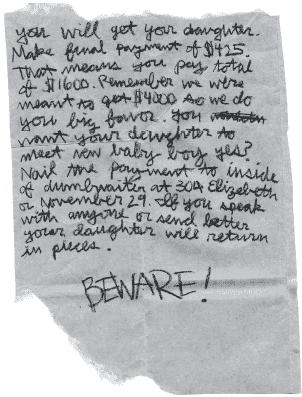
“Congratulations, signora. I hear you have a son,” greeted Inzerillo, ushering her into the back room.
How bizarre these meetings were, thought Giovanna. It was like they were two leashed dogs that, if untethered, would tear each other apart.
“Thank you, signore. His name is Anthony.” Giovanna wondered if this godless creature would understand the significance of her son’s name.
“Sit, please, signora,” directed Inzerillo.
“I heard that Lupo is in jail. I must admit, I thought he was behind my troubles, but now with him in jail it’s clear that’s not true,” fished Giovanna.
Inzerillo tried to hide his surprise and interest in what Giovanna was saying. “You’re right to assume I know Lupo, signora. And you’re also right to assume that he knows nothing of your troubles. He’s a good man.”
“In a way, I wish he was involved, signore. I get the feeling that he’s a reasonable man and would understand that we have no more money.”
“Signora, I was told that these men were going to ask for a final payment. Surely, knowing that this is the last payment will inspire you to get the money.”
“Listen, signore. We do not have this money. I will find a way to get it if you can promise that there will be no more demands and my entire family will be together and safe.”
“Signora, you forget that I am only a messenger, but I promise to use all my influence to make this so. You have acted honorably and so must these thieves.”
FRIDAY, NOVEMBER 19, 1909
For the first time in a long time, Giovanna sat down and told Rocco what was going on. She avoided the details and focused on the contents of the last letter.
“How do we know this will really be it?” Rocco asked.
“We don’t.”
Rocco looked at his wife out of the corner of his eye, realizing she was holding something back, but he was too debilitated by this process to ask questions. “But we don’t have the money. Lorenzo’s given us everything he has,” said Rocco, frustrated. “And no matter how much we work between now and then, we couldn’t earn it.”
“Maybe my parents have money left from what I sent them,” offered Giovanna.
“Even if they did, it would never get here in time.”
“I could ask Lucrezia.” Giovanna couldn’t believe she suggested it, but she meant it.
“Are you crazy? If she went to the police now, all this would be for nothing. If we ask someone outside the family, it has got to be someone who won’t be suspicious of why we need the money.”
Impressed with Rocco’s thinking, Giovanna said, “That rules out Signore DeCegli.” In her mind she was going through the possibilities. Were she to ask Mariano again, it would raise suspicions or questions.
“I’ll get the money,” resolved Rocco. “I’ll get it.”
Rocco saw in his wife’s eyes how grateful she was, but for the first time, he also thought he saw love.
SATURDAY, NOVEMBER 20, 1909
“Some of the guys at the station said you kept asking for me down here,” greeted Detective Fiaschetti, throwing a ball at Domenico.
“Detective! You came!” Domenico hadn’t spent so much time playing ball since he was a little boy.
“Why did you want me to come? There’s other guys around,” commented Fiaschetti, pointing to the handful of cops who were playing with the kids.
“Well, you’re Italian. There’s not many Italians and, besides, you knew the great Petrosino!”
“Your name is Domenico, right?”
“That’s right, detective. I was hoping you could tell me stories about Lupo.”
“Why do you want to know about him?” Fiaschetti asked suspiciously.
“He’s a famous crook. And didn’t Petrosino want to catch him, and now you have him in jail?”
Fiaschetti looked hard at Domenico. “You’re the one who wants to be the detective, right?”
“That’s me,” answered Domenico.
“Come on, sit down over here,” directed Fiaschetti. They leaned against the gym wall. “Lupo is being brought to court on Monday for blackhanding a shopkeeper named Manzella. If you’re so interested, why don’t you come?”
“I will!”
“Domenico, I have a few questions for you.”
“Okay.” Domenico put on his most innocent face.
“Some of the detectives have noticed that things aren’t so normal around your aunt’s house.”
“What do you mean, detective?”
“One of your cousins is missing, the others were taken out of school—and your aunt seems to be walking all over the city.”
“It’s nothing, detective. Angelina is in Italy with her grandparents. My aunt was having a hard time with the new baby so they sent her there. And my uncle, he thinks everyone should work,” explained Domenico dismissively.
“Good job, Domenico. You just might become a detective.”
Domenico looked down to hide his smile.
“Look, son, you tell your aunt that I’m here for her if she needs me.”
MONDAY, NOVEMBER 22, 1909
Hours before she expected him, Domenico burst through the door. “Zia! Manzella didn’t show! It was a mistrial.”
Giovanna shook her head, understanding Manzella’s fear and hoping that it was fear, not death, that had kept him from the courthouse.
“Lupo got up from the defendant’s seat the moment the judge said, ‘You’re free to go,’ with a huge smile on his face. Then Lupo is surrounded by cops, including Detective Fiaschetti, and they walk him away in handcuffs. The reporters told me he was arrested again on counterfeiting charges.”
Domenico’s tone changed. “But, Zia, this reporter started asking questions about Angelina. He said, ‘I heard your cousin is missing.’”
“How does he know?” Giovanna gasped, gripping Domenico’s arm.
Domenico let out a yelp and rubbed his arm. “When I told him it wasn’t true he said a librarian told him you were looking for articles on kidnapping.”
THURSDAY, NOVEMBER 25, 1909
“Come, Giovanna. Teresa is making an American turkey; you need to get out,” pleaded Lorenzo.
“No thank you, Lorenzo. I’ll stay here.”
“Giovanna, I wish there was a way to help you.”
“You’ve done what you can.”
Lorenzo rubbed his face as he often did when he was nervous. “Sometimes I think I should have found a way to send you back.” He paced the tiny kitchen. “We forced you to stay here with Rocco.”
“Go back? So I could have been killed in the earthquake? So I could scratch plaster from the walls to add to the flour? It’s not your fault, Lorenzo. And besides, I wouldn’t have had Angelina and Anthony.”
Lorenzo shuffled around awkwardly. Giovanna tried to ease his guilt.
“It was the money I sent to Scilla. Someone told them. But even so, they blackmail people with nothing. There is no understanding evil.”
“Are you sure you won’t come? Please?”
“No, no. Lorenzo, how many pounds is the turkey?”
“I don’t know, I think fifteen,” answered Lorenzo, puzzled.
Giovanna calculated. Turkey was expensive this year, thirty-two cents a pound. That was nearly five dollars that could have been ransom money.
“I’ll send Rocco and the children,” replied Giovanna, thinking she would at least save money on their own supper and her family would eat a little meat.
“Va bene, but I wish you would come,” said Lorenzo, kissing his sister and the top of the baby’s head good-bye.
FRIDAY, NOVEMBER 26, 1909
“Release Lupo,” ordered the lieutenant.
Fiaschetti rolled his eyes. “Why?”
“There’s not enough evidence. It was a flimsy arrest in the first place.”
“Then why did we do it?”
“Look, we know Lupo’s involved in counterfeiting, so the police chief wanted to prove he was doing something about it to impress the feds. But his friends in City Hall said to let him go.”
“He’s a wolf, but he’s slippery as an eel. We’ll never keep him more than a couple weeks,” moaned Fiaschetti.
“I don’t know,” reasoned the lieutenant, “it seems different now. The chief announced today that any cop who uncovers evidence of Lupo’s counterfeiting will be made a first-grade detective.”
Fiaschetti whistled. “Murder, extortion, that’s one thing, but when you start messing with the money, that’s serious.”
“Come on, get Lupo out of here.”
SATURDAY, NOVEMBER 27, 1909
“I got the money,” said Rocco, coming in the door.
Two weeks before, when Rocco said he would get the money, Giovanna believed him, and something in their relationship changed. He finally became her partner, and she found herself looking at him in an entirely new light. Had he failed, she would have been crushed, not only because they wouldn’t have the final ransom payment, but because she would lose the new warmth she felt for him.
“Rocco, from where? You don’t have to tell me if you can’t.”
Rocco sat down beside her. “From Dr. Bellantoni.”
Giovanna kissed Rocco with tenderness. She knew that asking another man for money was, for him, the greatest sacrifice.
SUNDAY, NOVEMBER 28, 1909
“The baby is so strong, Giovanna!” exclaimed Lucrezia, examining him. “But I’m surprised you didn’t name him Nunzio.”
“You must need to get back for Sunday dinner,” remarked Giovanna, changing the subject.
“No, I have time. I want to take a look at you, and besides, my husband is away at another conference.”
Giovanna could hear in Lucrezia’s voice that there was more to this, but she didn’t ask questions, fearing that one confidence might lead to another. She laid baby Anthony on one side of the bed, where he poked at the air with his arms and feet, and stretched out on the other for Lucrezia’s examination.
“Did you see the papers today?” commented Lucrezia, filling the awkward silence.
“No.” Giovanna wished she had so she could have more of an answer, but Lucrezia good-naturedly continued on while Giovanna said a prayer of thanks that Lucrezia had the kind heart not to be meddlesome.
“Last night at the Metropolitan, Caruso sang La Traviata with Toscanini conducting. Two Italians snuck up the fire escape and got into the balcony to hear the concert. I suppose that isn’t uncommon. But what was funny was that an Irish policeman discovered them, and instead of arresting them on the spot, he locked them in a closet so he could hear the rest of the performance!”
“I hope they heard it, too!” responded Giovanna with a forced laugh. “Did you go?”
“No. My husband left on Friday.”
“So why didn’t you go alone?”
“Ah.” Lucrezia shrugged her shoulders. For a split second Giovanna wanted to follow up the shrug and comfort her, but once again she stopped herself.
“I’ll be going. You’re doing well.”
“Thank you, Lucrezia. I’ll come visit when the weather is better.”
“You do that,” answered Lucrezia with resignation, knowing full well that she wouldn’t see her friend anytime soon.
FORTY-TWO
MONDAY, NOVEMBER 29, 1909
This is it. Here’s the final payment. I want my daughter returned immediately. If you delay, next it is your coglioni. They’ll start to itch, blister, and fall off.
Giovanna allowed Rocco to take the final payment to the arranged spot in the dumbwaiter at 304 Elizabeth Street.
TUESDAY, NOVEMBER 30, 1909
A loud rap at the door startled Giovanna. It was them. It had to be them. She flung the door open. Instead, she looked into the faces of two even more startled settlement workers.
“Buon giorno, signora. Many people in this area are getting consumption and we have come to teach your family how to avoid becoming ill…”
WEDNESDAY, DECEMBER 1, 1909
When Giovanna returned home from buying bread, there was another booklet about consumption in front of the door. She picked it up with difficulty because Anthony was in the sling at her chest. Inside, as she tossed it into a pile of papers to be burned, a note fell out.

In seconds, Giovanna was in Inzerillo’s cafe, the gun in her waistband at the ready.
“We need to talk!” ordered Giovanna, walking into the back room without stopping.
Closing the door, Inzerillo hissed, “What do you mean coming in here this way for all to see!”
Giovanna grabbed the gun and put it to Inzerillo’s head. “Is it better they see you dead?”
“Signora! Put that away.”
“Not until you sit down and listen,” she said, locking the door.
“Okay, I will listen.”
“Read this,” she ordered, thrusting the note in his hands.
Inzerillo read it. “I agree this is most unfortunate.”
“It’s more than unfortunate, you crook. It’s suicide. I know now they are playing with me, and I am done playing. Here’s your message, disgraziato.” Giovanna felt liberated by dropping all pretense with Inzerillo. “My daughter is to be delivered safe and unharmed to me immediately. If not, letters will be sent to the police and newspapers. These letters will give evidence that Lupo and his gang were involved in the Bank Pati bombing and the kidnapping and murder of Mario Palermo. They will tell how Leo took money from Edwin Reese for the elections, and, finally, they will have evidence of Lupo’s counterfeiting. If anything happens to my daughter, to me, or to anyone in my family, people unknown to you have been told to deliver the letters.”
Inzerillo remained seated and silent. The only sound was Giovanna’s labored breathing. Eventually, Inzerillo said, “That is quite a message, signora.”
“That’s only the half of it. You’ll all be braying at the moon in jail with the curse of the malocchio. Lupo thinks he can cast the evil eye? He’ll learn what a midwife can do!”
“Signora, because you are so upset, I am going to ignore the fact that you keep implicating Lupo and me in this crime. We have not touched your daughter. But because I am a man of honor, I will deliver your message and use my influence to see that your daughter is returned immediately.”
“I want word by tomorrow. If not, the letters will be sent and the curses cast.”
“How much longer do we have to keep her?” nagged the older Gallucci brother’s wife.
“There is nothing out here. We’re going crazy,” chimed in the younger woman.
“Shut up!” yelled the older of the two kidnappers.
“Shhh, someone’s at the door,” whispered his brother.
The older brother drew his gun and motioned their wives and children into the bedroom. The younger brother, gun also drawn, opened the door.
“Lupo! Pietro!” Putting his gun away, the younger brother said, “We didn’t know you were coming.”
The older brother lowered his gun but kept it in his hand, saying skeptically, “It’s dangerous for you to be here.”
“Dangerous? What’s dangerous is trusting you,” growled Lupo, barging through the door.
“Lupo, what are you talking about?” asked the younger brother in a panic.
When Lupo and Inzerillo seated themselves at the table, the brothers calmed down.
“What’s going on?” asked the older brother.
“That’s what we came here to find out,” answered Inzerillo. “It seems that the fruit seller’s wife knows more than she should.”
“We told Leo! After she grabbed me in the church, we told Leo to tell you everything she said, but Leo thought you’d be angry we were followed,” whined the younger brother.
“Grabbed you in the church…” repeated Inzerillo.
“And Lupo, she’s a witch! She gave me the rash that caused these scars. My brother too!”
Seeing Lupo’s disgusted expression, the older brother retrieved Giovanna’s notes. “Every time she sent money, she sent letters. We have them here,” he said, handing them to Lupo, who passed them to Inzerillo without looking at them.
While Inzerillo read the notes, Lupo interrogated the men, ending with, “So, what did you do for Edwin Reese?”
“We don’t know an Edwin Reese. The first time we saw his name was in the witch woman’s letter. We asked Leo, but he said she was crazy.”
“Shit for brains. Shit for brains,” muttered Lupo.
“So what do you want us to do, Lupo?” asked the younger brother. “If she knows so much, do we kill them both right away?”
“You’d have to kill the entire family. Others too.”
“Is that what you want?”
“No, you idiots, that’s not what I want. I just got out of jail. The feds are watching me. It took four hours to get here. I don’t need dead bodies and letters pointing to me.”
“Lupo, this has been going on a while,” reported Inzerillo, handing Lupo the notes from Giovanna.
Standing up to face the brothers, Lupo ordered, “The kid is going back. Don’t shave, and wait for instructions.”
Angelina, hearing the men call someone Lupo, decided that the wolf had come for her. She was too tired to be afraid, and instead, unconsciously, she scratched an L on her leg over and over till it bled. Seeing the blood-red L, she wished she knew how to spell because then, when they found her, they would know who had killed her.
“Leo, I give you a job, and it’s not enough that you fuck it up so bad. Who’s Edwin Reese, Leo?
“Lupo, I got your share right here!” sputtered Leo, trying to break free of Tommaso the Bull’s grip on him.
“Leo, you do a couple of kidnappings and you think you’re a big man. You move in on election money.”
“I told you, Lupo, I got the money for you.”
“I don’t like not knowing things, Leo.”
“Lupo, I was doing you a favor…”
“You’re trading on my name, Leo. Do you think those politicians would have anything to do with you if you weren’t working for Lupo?”
“Of course not, Lupo. Lupo, tell Tommaso to let me go and I’ll show you the money.”
Lupo nodded to Tommaso, who kept his eye on Leo as he went to his jacket.
Pulling out an envelope, he handed it to Lupo. “Here. There’s sixteen hundred dollars in ransom money. And Lupo, that family didn’t have a stack of money somewhere. I found out they’re waiting for another payment. Because of me, we got that much,” bragged Leo. “And here,” he continued, taking out another envelope from his jacket, “seven hundred dollars for getting out the vote.”
Lupo took the money from the envelopes and fanned it in front of his face. “You know, Leo, that’s lots of exposure for a little over two grand. Sloppy, very sloppy.”
“Lupo, I know things didn’t go perfect. But you gave me two idiot greenhorns!”
“I want you to return the kid. Deliver a letter right away telling them the girl will be back within the week. After you deliver her, tell the Gallucci brothers to clean the place out. No clues. Give them this,” Lupo peeled off bills totaling three hundred dollars, “and tell them to go to Chicago. I never want to see them again.”
“With pleasure,” smirked Leo.
“I’ll settle with you when the kid is returned. Now get out of here.”
When Leo left, Lupo gave orders to Tommaso. “When the kid’s returned, make sure it’s common knowledge that Leo did the job, and then make him disappear for good.”
THURSDAY, DECEMBER 2, 1909
The note was slipped under their door while they were sleeping.

FRIDAY, DECEMBER 3, 1909
“A week! Why a week?” questioned Giovanna of Inzerillo in his back room.
“You’re a formidable foe, signora. They have to be sure that they won’t be ambushed by the police or greeted with one of your curses.”
“If they are playing with me, signore, even your family will not be safe.”
“Enough with the threats, signora. I give you my word that your daughter will be returned within the week.”
“Your word.” Giovanna stopped herself from spitting.
SATURDAY, DECEMBER 4, 1909
Scratching the scab of the L, Angelina watched the blood trickle down her leg. She scratched off another scab and watched that rivulet join in with the first at her ankle. Stretching out her other leg, she scratched scabs off her thighs and held imaginary races to see which line of blood would reach the floor first.
SUNDAY, DECEMBER 5, 1909
Two days of waiting felt like two years. Baby Anthony was held so tightly that he was nearly crushed. Giovanna began to believe that perhaps Saint Anthony did send her this child, because he was the only thing keeping her from shooting Inzerillo.
When another note came, Giovanna’s disappointment was crushing, but at least it had a specific direction.

MONDAY, DECEMBER 6, 1909
The bell tinkled when she walked into Donatello’s store, minutes after it opened.
“May I help you?” asked the woman clerk.
“Yes, I need a coat for a four-year-old girl.”
“These here should all be around the right size with plenty of room for growth.”
Thinking of the red shawl she wore the first time she delivered ransom money, Giovanna’s eyes scanned the little wool coats and seized on a bright red one.
“Can I see that one, please?” she pointed. The color would make it easier to spot Angelina on the street, or to find the little imposter in her daughter’s coat.
“Yes, this is the one,” she announced to the clerk. “I’ll pay for it now, but it’s a gift for my cousin’s daughter. He’ll come get it. His name is Ricco.”
“No problem, signora. I’ll have it ready for him.”
TUESDAY, DECEMBER 7, 1909
All day long Giovanna combed the streets in case the scoundrels simply left Angelina in the neighborhood, and when the children and Rocco returned from work they joined the search.
Much later that night, they had a quiet dinner of broth and bread. There had been no money for meat since Angelina was kidnapped. Her stepchildren were skin and bones.
WEDNESDAY, DECEMBER 8, 1909
“Get the kid,” ordered the older brother to his wife. She went into Angelina’s cell and pulled her off the straw and out the door.
“Can’t you clean her up a little?” asked the older man.
“What do you care?” answered his wife.
“At least wash the blood off her arms and legs.”
With a cold cloth, the woman scrubbed Angelina’s limbs. “We’re getting rid of you today,” she said.
Angelina felt relieved. Would they throw her in the trash? In the river by the bridge? It didn’t much matter.
“Who’s taking her?” asked the woman.
“They are,” said Leo, nodding to the brothers, who both now had beards.
Angelina imagined that the droopy-eyed man might hurt her before getting rid of her and wondered if the short men would try to stop him.
“Where’s the coat?” asked Leo.
“Here,” said the younger brother, tossing him a package. “Look at that color!”
“It’s not like the Calabresi. Very flashy,” commented the younger woman.
Angelina was happy that she was going to be warm before she died. She hugged the coat around her and played with the black braid at the waist.
“Go,” said Leo. “I’ll wait for you here.”
Angelina turned to wave at the children, who silently waved back.
They walked a long time. Angelina was so weak that she kept trying to sit, but the men with beards would yank her back up. After she fell a few times, the older man picked her up impatiently. Angelina couldn’t bear to be so close to his breath, which smelled of wine and cigars.
“I can walk. Put me down,” she commanded. She had lost all fear of them. Even the lupo bear didn’t provoke her anymore.
“Then stop falling,” barked the older man.
At the station, they climbed the stairs and waited on the platform. “They could be taking me to the ocean, not the river,” thought Angelina.
Once on the train, she was warm, warm enough to not want to end up in cold water. “I should scream,” she thought, “then someone will stop them from taking me to the ocean.” But right before yelling, she saw that they were heading over the Brooklyn Bridge to the city, not away from it.
“Where are we going?”
“You’re going home,” snarled the younger brother.
“He’s lying,” thought Angelina. “Besides, my parents don’t want me.” Watching out the window, she recognized the Bowery with the train tracks hugging the sides of the street and darkening the storefronts. They passed the big hotel with the name she could never pronounce. Gazing down at her new coat, she had another thought. One Sunday dinner she had heard the grown-ups talk about people selling children. They were making her look nice because they were going to sell her, not kill her.
At the next stop, the older brother yanked again at her arm, pulling her out of the train. “Walk fast or I’ll carry you.”
Angelina tried to keep up with them as they pulled her down the Bowery. Ahead of her she saw the black marble columns of the Germania Bank Building across from the brick building that looked like it was holding an ice cream cone. This was her old neighborhood.
“Where are we going?” Angelina asked again, this time more tentatively.
“I told you. You’re going home,” muttered the younger brother.
“But my parents gave me up,” she practically whispered.
They were on Spring Street, a block from the corner of Elizabeth.
“Do you know how to get home from here?” asked the older man.
Angelina nodded but was confused.
“Go, then, go!” commanded the younger brother.
They had let go of her hand. She could run.
“Go!” they shouted at her.
Angelina ran as fast as she could, which wasn’t very fast, down Spring Street. She looked behind her, but they were gone. She could go home! But what if her parents didn’t let her in? Where would she go? She turned onto Elizabeth Street, because she figured she would at least ask her mother why she gave her away. At the sight of her building in the distance, she ran faster, grabbed the brass handle on the door, ran over the little mosaic tiles and up the slate stairs.
The sound of little feet running up the stairs reached Giovanna. She dropped the baby in the bureau drawer that was his bassinet and lunged toward the door, throwing it open.
“Mamma! Mamma!” Angelina was halfway up the stairs when she saw her. In seconds Giovanna scooped her up and buried her face in Angelina’s neck. “Mamma, you’re hurting me!” called Angelina.
“Scusa, scusa, let me see your face!” Giovanna cupped her daughter’s face in her hands and sobbed.
Angelina was confused and angry. Hitting her mother, she shouted, “Brutta Mamma! Brutta Mamma! Brutta! Brutta! Why didn’t you come and get me? Why did you give me away?”
Angelina’s confusion was only magnified when she saw her mother, who was crying, start to laugh. “You talk like a little Sicilian!”
Rocco and the girls burst through the door.
“Angelina! My Angelina!” Rocco took her from Giovanna’s arms and kissed her face many times over. The child was completely bewildered. Her father never kissed her. And then he kissed her mother.
Mary and Frances pulled at her shouting, “You’re back!”
Angelina struck out at her father and sisters too, her little fists raining down on them. “Why didn’t you get me! Brutti! Brutti!” Her cries became louder when they, too, laughed with joy.
“My baby, my baby, don’t cry. We are so happy to have you back.” Giovanna stroked her face. “If we had known where you were we would have come at once to get you.”
“You didn’t know where I was?”
“No, bambina.”
“But you sent me away with Limonata.”
“She was a bad woman.” Turning to Frances, Giovanna said, “Go to Zio Lorenzo’s house and tell them Angelina is back.”
Word had already spread that people had seen a little girl in a red coat running through the streets. Teresa and her children arrived before Frances made it down the stairs.
Angelina had a hard time understanding all the crying and the laughing. There wasn’t a moment when she wasn’t being kissed and thrown in the air. Arms were everywhere, and her head was alternately pressed into someone’s body or cupped in someone’s hand. The happier they all were, the angrier Angelina got. “If they like me so much, why didn’t they find me?” she thought.
Her mother broke away, and Angelina saw her and Zia Teresa heating water and pouring it into a big tub by the stove. Frances, who Angelina hadn’t even noticed was missing because of all the commotion, returned from the pharmacist, her arms brimming with bottles. At one point in the mayhem, her mother brought her into the bedroom and said, “Angelina, this is your baby brother, Anthony.”
“I’m glad you didn’t give him away.”
Giovanna hugged her tighter.
“Let’s get these clothes off,” ordered Teresa. Teresa cut the clothes from Angelina’s body and handed them and the red coat to her oldest daughter, Concetta. “Burn them, they’re infested.”
Angelina was dipped in the hot tub. It was the first time in three months her body was immersed in water. The heat actually made her shiver; something inside was thawing.
“My baby, my baby,” Giovanna was crying, but there was no laughter as she gently washed her daughter’s emaciated body, which was covered in open wounds, scabs, and vermin.
“I’ll start on her hair,” offered Teresa. Taking a thin-toothed comb, she separated each strand, capturing and killing lice and nits. By then all her cousins were in the apartment as well. Everyone was laughing, and her cousins, especially Domenico, kept trying to ask her questions. But her mother would shush them, “Not now, not now.”
Concetta, who had left to burn Angelina’s clothes, returned an hour later with food. Soon everyone was eating, including Angelina, who ate in the bath while her mother and Teresa continued to minister to her body. Frances had emptied and filled the tub nearly ten times, and Mary was feeding her sips of hot tea and bites of meatballs.
Hours later, when Angelina was lifted out of the water, her mother wrapped her in a towel and her father poured wine. Someone held a little glass to Angelina’s lips as everyone drank.
On the bed, Giovanna removed Angelina’s towel and kissed every square inch of her daughter’s body, using the towel to wipe the tears that fell on Angelina’s clean skin. Uncapping bottles, she dabbed lotion and salves on the cuts, bites, and wounds, muttering prayers the entire time.
“I bought you a new nightgown,” said Giovanna, pulling a soft flannel dress over Angelina’s head. She picked Angelina up off the bed and knelt with her before her makeshift altar. “I prayed every minute to Saint Anthony to bring you home, Angelina. He answered my prayers.”
Giovanna retrieved a brown paper package from under her pillow that was tied with string. “I have something to open with you. I waited for you,” she whispered, crying and gently ripping the paper to reveal a photograph with three views. “Look how beautiful you are!” exclaimed Giovanna, crying even harder. “I want you to forget everything from the day after this picture was taken until this moment,” she said, placing the photo on her makeshift altar.
Angelina’s eyelids fluttered, and her head swayed groggily. Giovanna lay down on the bed with one arm wrapped tightly around her daughter as if she would never let go. Stroking Angelina’s hair, Giovanna whispered, “Sleep, child, you’re safe. You’re home.”