
EIGHT
By 1862 the antebellum landscape of Washington City had vanished. The old town—long derided as a failed blueprint, a stillborn utopia, a national disgrace—suddenly became the key to victory for the Army of the Potomac and the Union itself. Holding and fortifying the capital became critical, as did making it a base for the federal government’s prosecution of the war against the rebel states. The transformation wasn’t hard to see: Barracks peppered the hillsides, hospitals occupied public spaces, nearby cemeteries began filling up, and camps for runaway slaves sprang up in ever larger numbers.
The textbook history of the capital’s role in the Civil War usually focuses on the life and actions of Abraham Lincoln. It makes for epic, stirring biography, but it barely describes what Washington City resembled during these dark years or what its residents saw and experienced inside the battle lines. As the war moved the center of power from the halls of Congress to the White House and the War Department, the entire District of Columbia experienced more dramatic change from 1861 to 1865 than perhaps any other urban center in the North. Accordingly, the federal government unleashed its full, formidable might to fight secessionists and subversives—even if that meant ignoring more than a few constitutional liberties—and forced Washingtonians to confront the legacy of slavery by engineering its abrupt conclusion.
Volunteer Work
Trouble began almost as soon as South Carolina seceded on Christmas Eve, 1860. It readily became apparent that other slaveholding states would follow quickly in its wake, forming a daunting bloc ready to defend its actions by force. The national government knew it would have a hard time stopping it. Worse, many residents of the new Confederate states had their eye on the District of Columbia as a great prize in the coming battle; the rebel secretary of war even planned to fly the Stars and Bars over the Capitol once they had captured it.1 Southern armies would have plenty of sympathizers too if they invaded the capital. Members of aristocratic, slaveholding families held many positions in the Buchanan administration, from high-ranking politicians and diplomats to military officers and an array of midlevel clerks.2 Nearly half the residents of the District had family ties of one kind or another to the South.3
More depressing for Unionists in the capital, the new Lincoln administration wouldn’t be taking the reins until March 1861—and as was customary for the timing of the transfer of power then—leaving the town’s defense in the hands of the doddering lame-duck president Buchanan and “Old Fuss and Feathers” general Winfield Scott, whose service to the country began in the War of 1812. Scott, however, astutely recommended that Buchanan promote US Army topographical engineer Charles Stone to the rank of colonel and to the role of inspector general of the District so he could provide an overview of what defenses the capital possessed.4 What Stone found wasn’t pretty.
While there were three hundred to four hundred Marines at their barracks and fifty-six officers and ordnance men at the Arsenal, the local militia looked suspect.5 Units such as the National Rifles swarmed with secessionists, and outgoing Secretary of War John Floyd had supplied them plentifully with arms and ammunition, including a few howitzers.6 Moreover, instead of obeying General Scott’s order to reinforce federal garrisons in the Southern states, Floyd shipped 115,000 muskets and rifles to rebel arsenals and planned to send 120 cannons from Pittsburgh to the Deep South as well.7 Luckily, Floyd’s latter order was overturned before it went into effect—after which he resigned and took up arms for the Confederacy. (Floyd later became known for helping lose the Battle of Fort Donelson, which handed an obscure Union commander named Ulysses S. Grant his first major victory.)
Despite the efforts of turncoats like Floyd, Charles Stone did his job well, and by February he had organized twenty-five militia companies and purged the National Rifles and other companies of their subversives.8 He brought together two thousand infantrymen, two hundred cavalrymen, two batteries of artillery, and a company of engineers for militia training and service.9 This complement of citizen-soldiers formed a critical defense for the capital when it lay almost completely exposed to hostile forces. It wouldn’t be strong enough to fight off a Southern army, but at least it provided a better defense against the pro-slavery mobs and other hooligans who had run riot in earlier years.
More drama came in short order, including a twelve-day threat to the capital in April, when Maryland secessionists isolated the town from the North by cutting telegraph wires and burning bridges near Baltimore. The Seventh New York and other regiments saved Washington City by arriving just in time to populate the capital with its first major complement of Union troops.10 Many more arrived in the coming months as the US military transformed the District of Columbia from a sleepy, dysfunctional village into a smart and efficient martial colony.

Source: Albert Boschke, topographical map of the District of Columbia, 1861.

Oaths of Iron
Even before the Northern troops arrived in the capital, the more overt secessionists made a quick exit, including hundreds of families of Southern slaveholders, government clerks, and army officers.11 Despite the disappearance of the more vocal rebels, a climate of fear and paranoia took hold of the capital as rumors abounded over conspiracies involving saboteurs trying to deliver the District into the hands of the Confederacy. The federal reaction was swift, imposing, and effective—some even called it dictatorship.
Lincoln began to suspend the writ of habeas corpus during 1861, and the following year he denied it to all persons detained under military order. Confederate sympathizers were labeled “Copperheads” and found their houses searched, their property confiscated, and themselves carted off to prison with no expectation of trial, legal counsel, or often any explanation of the charges against them. Secretary of State William Seward led the charge in hunting down potential rebels with a team of crack detectives to do his dirty work. (Secretary of War Edwin Stanton later took over responsibility for this branch of state security and released a number of the wrongly imprisoned.)12
By August, Congress provided an additional tool for rooting out subversives by imposing an oath to the Constitution and the Union on all government employees. Among them was the mayor himself, James Berret, a Southern Democrat. Initially declining to take the oath, Berret sat in prison for three weeks until he changed his mind . . . and relinquished his office.13 More than a hundred other officeholders refused the oath and were driven from their positions, along with more than three hundred army officers in 1861 alone.14 The following May, an even more “iron-clad oath” applied to all residents of Georgetown and Washington City trying to vote in municipal elections.15
The Fallen Capitol
Wartime paranoia reached ridiculous extremes—some even imagined Secretary of the Smithsonian Joseph Henry sending covert signals to secessionists in his castle turrets16—but Southern spies did operate in Washington City and did anything they could to mine information on troop movements, battle plans, public morale, and anything else of value to the Confederate leadership. The most famous spy in town, Rose O’Neal Greenhow, a holdover from the old Southern gentry, hadn’t left town like so many of her peers. Instead, she relayed secrets from her sources in the federal government to Confederate general P. G. T. Beauregard, which helped the South rout the North in the First Battle of Bull Run.17 She was summarily arrested and imprisoned, but even from her cell she was said to be adept at passing information to her associates outside the prison walls.
Taking the lead in the arrest and detention of potential and actual spies was the army’s provost marshal,18 who—for enemies of the state, including Rose Greenhow—favored the ominous and much-feared Old Capitol Prison, a building with a long and unexpected history.
Thomas Law and others had conceived it as the Brick Capitol, the temporary home for Congress after the British burned the town in 1814. The sturdy three-story brick structure played a valuable role in the late 1810s, temporarily housing the legislature when countless schemers tried to displace Washington City as the national capital. In the years following it became a private school and a boardinghouse for congressmen, as well as the publishing site of Anne Royall’s newspaper The Huntress, until the federal government purchased it and converted it to a prison in spring 1861.19 A block south stood a line of tumbledown wooden buildings known before the war as Carroll Row, the site of one of the capital’s first hotels and boardinghouses. Rechristened Carroll Prison, the structures took their name from civic leader and property speculator Daniel Carroll. The jail also employed runaway slaves from Virginia as an ad hoc labor force.20

Postwar view of the former Carroll Prison and Southeast DC.
Virginia Lomax, wrongly imprisoned at Old Capitol Prison for inquiring about her friends held there, later wrote a famous account of her ordeal and described her “accommodations” as follows:
The room was one mass of dirt; spiderwebs hung in festoons from the ceiling, and vermin of all kinds ran over the floor. The walls had been papered, but dampness had caused most of it to fall off, while all over that which was left were great spots of grease . . . The furniture consisted of an iron bedstead, pillows, and mattress of straw, a pair of sheets, and a brown blanket. Between the windows stood a small table, on which was a stone jug containing water, and a tin cup. A tin basin was on the floor. One wooden chair completed the inventory.21
The prison held a surprising number of women prisoners, not only Lomax and actual spies Greenhow and Belle Boyd but all manner of upper-crust matrons—“ladies of education and refinement,” according to the prison superintendent—whose sympathies lay on the wrong side of the conflict. The warden, William Wood, found it useful to detain such Southern sympathizers, since they could serve as useful sources of information about rebel spies and other activity. Wood employed a complex system of intercepting and reading prisoners’ mail, used his own spies within the prison to figure out what the inmates were doing, and allowed Colonel Lafayette Baker, like “a tiger on the loose,” to interrogate suspects in the fearsome Room 19.22
Baker took over the job of Union spymaster and intelligence director from the famous Allan Pinkerton in 1862. Using a force of two thousand men, Baker essentially ran his own secret police, investigating anyone alleged to be committing treason, fraud, counterfeiting, profiteering, or bounty jumping, along with gamblers, prostitutes, their johns, and dealers in black-market medicine and illicit liquor. For his efforts, Baker’s enemies branded him a tyrant, but few doubted the efficacy of his organization. He had a knack for offending those in power, usually by spying on them, and then getting fired; federal officials then decided they once again needed his special brand of skills and rehired him. (He most famously tracked down the conspirators in the Lincoln assassination.)23
As a result of all of this activity, the capital veered closer to a police state than perhaps any major city in American history. Democracy still flickered here and there in the sharp protests from well-protected members of the upper class and in the vigorous dissent in Congress over the conduct of the war. But the executive branch exercised almost unchecked rule in most areas of civic life.24 Not surprisingly, newspapers in the early years of the war represented only a narrow slice of acceptable politics, from the National Intelligencerand National Republican (moderate to conservative Republican views) to the Daily Chronicle (radical Republican views).25 Even the strongly Democratic-leaning and widely read Evening Star quickly came around to supporting the Lincoln administration, though it maintained its criticisms of the dismal state of urban infrastructure.
Rise of a New Force
Paradoxically, even as the federal government was expanding its power over spies, secessionists, and saboteurs, the local government was proving thoroughly inept in dealing with garden-variety criminals. The District of Columbia had fallen far behind other US cities in law enforcement. New York created a formal police department in 1844, as had Boston, Philadelphia, Chicago, Baltimore, and New Orleans in the 1850s.26 When the Metropolitan Police finally came into being in August 1861, covering Washington City and Georgetown, it bore some of the hallmarks of those other forces: The District had ten precincts, each under the control of a police sergeant; station houses administered each precinct; and a superintendent oversaw the entire department, the first being William Webb.27
It looked good on paper, and almost anything would have been an improvement on the city’s dysfunctional constables and Auxiliary Guard. But the DC force faced significant challenges, thanks to the unwillingness of Congress—once again—to fully fund or staff an organization it had created. For a start, the department had far fewer patrolmen than it needed: only 161 officers to cover 75,000 people in 1860 and 140,000 people at the wartime height of 1864.28 An early report from the police commission in 1862 didn’t gloss over the daunting challenge of having one officer for every 625 citizens, most spread out across 307 miles of roads and alleys.29 Allowing for sickness, absences, and double beats, the average officer beat stretched four miles, and covering it proved next to impossible.30The town, the report claimed, needed a minimum of 545 officers to patrol such a huge, crime-ridden place, which also contained “the very worst and most disorderly class of residents from other cities.”31
The duties of these beleaguered officers didn’t extend just to preserving the peace and tracking down lawbreakers. Instead, Congress made sure to pile on the work, directing them to fix just about everything that made the District of Columbia unpleasant. Some of these labors included cracking down on pawnbrokers, auctioneers, gamblers, drunks, vagrants, and disorderly citizens; guarding firefighters and property around burning buildings; maintaining blue laws on the Sabbath; looking after visitors new to town at docks and rail depots; protecting the public from illness and disease; and dealing with all manner of public nuisances, from “dead horses, bone factories, and garbage,” to filthy stables and hog pens, leaking privies, broken sewers, and manure and ash heaps.32
Malicious Mischief
The appearance of the police didn’t exactly inspire fear in the hearts of criminals. At first the officers didn’t even have weapons, badges, or uniforms. They were given a small oil band reading METROPOLITAN POLICE to drape around their hats, and for protection they had to create their own clubs or mallets from whatever woodpile they could find.33 They were better outfitted as the months went on, but the difficulty and brutality of the work didn’t change.
More than half a century later, veteran patrolman Lingan Anderson gave an interview to the Washington Post in which he detailed the raw, barbaric nature of early police work. One of the biggest challenges was trying to corral enraged or drunk suspects and take them back to the station house. Sometimes they used horses for the task, but other times they had to force a suspect to walk a great distance, even as he tried “to straddle your chest so he can beat your head off.” In one case, Anderson recalled having to strong-arm one brute, nearly a foot taller, a mile and a half to the station, trying to keep the man from escaping or punching him along the way. Finally, armed with a club, Anderson “belted him so hard that he had to lay down for a little while before he could get up and go on.” Anderson ended up hauling him in a wheelbarrow for the rest of the journey, during which the suspect’s mood brightened considerably: “All the way to the station the prisoner kept singing ‘Nelly Gray’ at the top of his voice, and when we finally landed him [at the station] he told us he’d had a fine evening.”34
Anderson was shot in the leg during one of the worst episodes of violence he witnessed, a ferocious barroom brawl and gunfight between pro-Southern sympathizers and abolitionists. He tangled again with the Copperheads when a group of them paraded down 4th Street, “up to devilment.” Their infernal strategy included outnumbering the cops, one hundred to one, and trying to pull them from their horses to beat them. The police responded with guns and clubs and finally rode down the rioters on horseback.35
The levels of street crime could be staggering. During Election Day skirmishes in June 1862, the force separated crowds from their knives, clubs, and guns in one part of town, halted scattered fighting between partisan zealots in another, and joined the army in stopping a fusillade of bricks and stones near City Hall in yet another.36
Despite their meager numbers, the Metropolitan Police force arrested a huge number of people: 22,000 in the first year and 24,000 in 1863, amounting to a rate three and a half times that of Brooklyn.37 Most of the offenses, however, didn’t concern violent crimes but drunk and/or disorderly conduct. Assaults, burglaries, and various kinds of fraud and thievery made up most of the rest of the offenses, along with a handful of arrests for adultery, bigamy, fast driving, vagrancy, and the catchall “malicious mischief.”38
Cops versus Cops
With so many people up to devilment, the task of keeping public order strayed well beyond the ability of the Metropolitan Police. But they weren’t the only cops in town. As soon as the war began, the army’s Provost Guard began patrolling the town at night to keep soldiers from committing crimes—including a law passed by Congress to keep liquor out of their hands—then arresting them when they did break the law.39 A few months later the Provost Guard expanded its mission to include daytime patrols and arrested citizens of the District along with army personnel.
The Metropolitan Police force arrested its own share of soldiers, nabbing 5,750 of them during its first year of operation, more than a quarter of its total arrests.40 As Lingan Anderson recalled, the soldiers “filled up on forty-rod liquor . . . and if we interfered we were their meat.”41 Not all the offenses related to possessing illegal liquor, though. Sometimes rogue soldiers raced their carriages down Pennsylvania Avenue at breakneck speed and the police tried to stop them—despite the risk of being dragged by their horses or sustaining broken ribs.42 Other times garrulous troops fought with citizens. The police interceded, only to be beaten themselves by the soldiers, who often escaped arrest or court-martial.43 The War Department increased the potential conflict by ordering the police to hunt down army deserters and anyone resisting the wartime draft. While some officers did their duty, others exploited their power and became “substitute brokers,” pocketing a handsome fee for finding someone willing to enlist in lieu of the draftee. One particular cop managed to pocket $125 for each substitute he found.44
The hostility between the Metropolitan Police and rogue soldiers peaked in September 1862, when a full-scale riot broke out downtown after some drunken troops got into a dispute with a merchant and beat him. Soon the furious soldiers vented their rage on passersby and then on area blacks. A trio of police officers tried to intervene, but a volley of bricks and stones greeted them, and the mob chased them for several blocks. The Provost Guard made a belated appearance and arrested more than twenty-five malefactors.45It was one of the most violent riots in wartime DC, made even worse because members of a military force who had sworn oaths to protect the Union had instead disgraced it.
Muddy Footprints
The lawless character of the town matched its physical appearance. Margaret Leech, in her magisterial history of wartime Washington City, described the place as “sour as a medieval plague spot,” thanks to its rank odors and lack of ventilated buildings.46 The increased presence of military wagons and foot traffic buried some streets in almost a foot of mud, and great dust clouds arose in the dry months to envelop the town in a hot, choking atmosphere.47
The lack of proper sanitation for soldiers garrisoned in the capital posed a particular challenge. The local Board of Health declared many of the barracks to be filthy and a public health hazard. (It didn’t help that some soldiers new to town bathed in the fetid waters of the city canal.) Such poor living conditions, combined with a meager diet in the early war years, kept the men “half-starved, living on crackers and cold water.” Soon enough, illnesses such as measles, whooping cough, and diarrhea claimed the good health of a number of the soldiers regardless of whether they had experienced combat.48 Adding insult to injury, the military located Camp Fry, one of its largest encampments, in the capital’s own disease central, Foggy Bottom,49 best known for its equally large encampments of infectious mosquitoes. Here they put thousands of troops in barracks, supplies in warehouses, and horses and mules in stables.

The Union Army used the forlorn grounds of the Washington Monument as a livestock corral, with slaughterhouses nearby.
A great necessity for military transport and provision, livestock also created major sanitation problems, including the excrement of thousands of draft animals matched with a lack of effective measures to deal with it. The army built slaughterhouses for its droves of cattle, butchered them freely within city limits, and pastured its herds on the grounds of the Washington Monument.50 Soon enough, the stench of feces from the live animals and of the carcasses of the dead ones left in the street overwhelmed the town.51
To the army, these concerns paled in comparison to the more critical mission of keeping the country together and subduing the rebellion. Accordingly, the war forced the city to grow and expand as a vital supply base and staging point for battle. The most visible examples of this change included not only the countless soldiers billeted here on their way to campaigns in the South, but also the hospital workers who attended to them when they came back.
Under the Blade
The waves of casualties came by land, rail, and sea. They arrived over rutted roads from Virginia in two- and four-wheeled horse-drawn ambulances. They came via the railroad depot on The Island, in boxcars and flatcars on mattresses or bare boards. They arrived at the wharves at 6th and 7th Streets on riverboats, where they lay in cabins and on decks, in saloons and on stairs.52 But few general hospitals existed to care for all the wounded, so the army had to improvise. It requisitioned schools, hotels, barns, homes, and even boats to the task of keeping soldiers alive.53
Hospital wards and operating rooms sprang up inside the old Braddock House, where George Washington once held councils of war.54 Wounded men found themselves in the Insane Asylum, the halls of Congress, and the Patent Office—where they shared space with miniature models of inventions.55 Even churches saw their pulpits, cushions, and hymnals stashed away, their pews covered with boards for operating tables, and their doors greeting ambulances of the dying instead of the carriages of the pious.56 The amenities for the wounded were as spartan as the facilities themselves. Sacks of straw or corn shucks doubled as mattresses, and, where there were no mattresses, old boxes, benches, and woodpiles had to suffice.57
Nor were there enough surgeons for all the casualties—at most, one doctor per every seventy-five58—so an injured soldier might have to wait three to five days before seeing a physician. When he did receive care, he might expect a mixture of chloroform and whiskey to disinfect his wounds, if anything at all, and the same kinds of fluids to be consumed as painkillers. In the days before germ theory, elementary hygiene suffered: Soiled bandages were reused, wax and lard were applied to suppurating wounds, and sponges were dipped in dirty water and applied to multiple patients.59Predictably, gangrene ran rampant, and when necrosis developed a surgeon could saw off a damaged limb in as few as forty seconds. Such speed barely lessened the terror of the blade, though. Some hospitals had piles of severed arms and legs outside, and after particularly bloody battles, such as Fredericksburg, a given hospital could become “a house full of amputated limbs.”60
Infectious diseases also afflicted the Army of the Potomac, both when its soldiers occupied the field and when they had gone to the District for treatment. In the early years, typhoid fever, malaria, and measles posed the major threats, and as the carnage continued diarrhea, chronic dysentery, tuberculosis, and an unsettling typhoid-malaria combination also ravaged the troops and those who tended to them.61 (Typhoid in its various forms was one of the top killers of the war, felling an estimated 81,360 in the Union army alone.62) Shockingly, soldiers had a greater chance of survival on the battlefield than in the hospital. More soldiers died from infections than bullets.63
At various times, up to fifty-six hospitals operated in the capital and held some fifty thousand soldiers64—more than the town’s entire population just a dozen years earlier. Of varying sizes, the facilities usually employed a team of doctors, stewards, chaplains, clerks, cooks, launderers, gardeners, grave diggers, and guards. But for many of the wounded, the most visible and benevolent presence belonged to the nurses.
Dix’s Legions
Our modern conception of nurses doesn’t quite fit who they were and what they did in the Civil War. The majority of nurses were men,65 but for women the term usually applied to white ladies of the middle and upper class. “Matron” was a more generic term for a woman who assisted in medical care and also cooked and did laundry. If such women were black or working-class white, they were called “cooks” or “laundresses,” even though many performed nursing duties. Some of the latter found the designation financially crippling after the war. Maria Bear Toliver, who had worked in camps for runaway slaves and risked her life in a smallpox hospital, tried for more than three decades to get a pension from the federal government—to no avail.66
Nurses handled a great number of tasks. They changed wound dressings, assisted in surgical operations, and provided medicine to patients.67 They acted as personal secretaries for injured men, writing their letters home or reading to them. They provided what we now call physical therapy or psychiatric care to soldiers suffering physical or mental trauma. They listened to the confessions of dying men, and they sang and played music to lighten the otherwise grim proceedings. They worked sixteen-hour days, sleeping in designated quarters if they were lucky or, if they weren’t, making do with luggage or supply rooms as bedchambers. Most were aging widows with sons in the military or were longtime activists for abolition or women’s rights.68
At the head of Union nursing efforts was Dorothea Dix, already nationally well known and admired for her reform efforts in jails, almshouses, and asylums.69 The supervisor for the hiring and assignment of all nurses for the army, she had a reputation for being conscientious and driven as well as rigid, brusque, and capricious. She insisted that any nurse brought into service have strong morals, dress plainly, know how to cook, and look unattractive (the last to ensure that bedridden men would avoid sexual temptation—even as they struggled to breathe).70 Other prospective nurses went through Protestant organizations like the Christian Commission, Catholic groups like the Sisters of Charity (which provided a steady supply of nuns), and most importantly the US Sanitary Commission.71
The commission united the work of charitable groups and individuals to provide food, medicine, and care to the sick, anything from “sugar, shirts, crackers, farina, drawers, and some chicken and oysters” to woolen underclothing and head rests.72 The commission also operated soldiers’ homes for rehabilitation and recovery, home lodges that offered convalescent care for soldiers just out of the hospital, sanitary fairs throughout the country to raise funds for veterans, and a nurses’ home in Washington City that provided rest and relief to medical workers overwhelmed by all the bloodshed and suffering.73 It also published regular bulletins that detailed its work and issued meticulous, pedantic recommendations for nurses: using a “noiseless step” when walking, ensuring “no door or window in the patient’s room shall rattle or creak,” being “as motionless as possible” when speaking to patients, and never speaking to an invalid from behind.74
Tales of the Armory
Armory Square Hospital, the capital’s highest-profile facility, sat on the eastern side of the Mall between the Smithsonian Castle and the city canal alongside a militia armory. It featured fifty white wooden buildings grouped into ten wards, each of which acted as its own mini-hospital.75 Unlike other local facilities, the Armory Square was well lit and ventilated, which made it one of the most modern hospitals around. The facility certainly needed to provide the best care in town, because it saw the worst casualties of the war. It lay a short distance from the railroad depot at Maryland Avenue and the wharves to the south. As such, it served as the hospital of first resort for grievously injured and dying men who needed immediate attention as soon as they returned from the battlefield. Not surprisingly, it also had the greatest number of wartime deaths of any facility in the region.76
Contemporaries realized the significance of Armory Square, and it attracted some of wartime Washington City’s most able chroniclers. One was Amanda Akin, the “Lady Nurse of Ward E,” whose diary details the mortal struggles faced by the men and her challenges in providing care to them. While she considered her hospital “the most complete and best conducted institution of its kind during the Civil War,” she had no illusions about the suffering of the soldiers, which ranged from hemorrhages and violent headaches to “neuralgic pain” and limb amputations.77
But Akin doesn’t dwell on the misery of her patients. Instead she details what she did to provide mirth and distraction. She played backgammon with them, staged impromptu classical concerts, delivered new and interesting foods such as “guava jelly,” read literature and poems aloud, and even composed goofy rhymes for her coworkers. Her purpose in entertaining the wounded was clear: “anything that will keep them from despondency, and will not add to anyone’s sufferings is welcomed with pleasure.”78
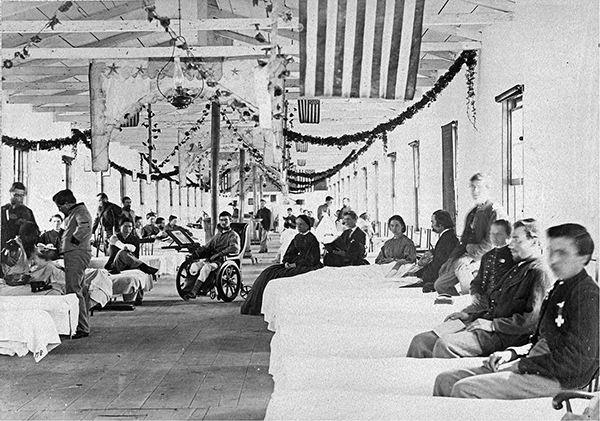
A ward at Armory Square Hospital, the most renowned of Washington City’s many wartime hospitals.
Armory Square’s most famous chronicler was Walt Whitman, who composed some of the war’s most poignant and memorable descriptions of death and suffering. Working as a nurse in several of the capital’s wards, he spent much time at Armory Square, which attracted him “because it contains by far the worst cases, most repulsive wounds, has the most suffering & most need of consolation—I go every day without fail, & often at night—sometimes stay very late—no one interferes with me, guards, doctors, nurses, nor any one—I am let to take my own course.79
The hospital tolerated Whitman, but it didn’t exactly welcome him. The controversial poet’s then-scandalous work Leaves of Grass challenged conventional notions of moral propriety and poetic form. It made him a celebrated figure in some literary quarters, but the more devout ladies at the Armory Square had their doubts, Akin among them. She called him an “odd-looking genius” who “has written some very queer books about ‘Free Love,’ etc. . . . When he stalks down the ward I feel the ‘prickings of my thumbs,’ and never speak to him. . . . With all his peculiar interest in our soldier boys he does not appeal to me.”80
But propriety had its limits, and throughout her book Akin exhibits a strange fascination with America’s bold new poet and itinerant nurse, however much she disapproves of his ways. She tellingly gives an entire chapter in her diary to an excerpt from Whitman’s work, in which he praises a hospital concert featuring convalescent soldiers and nurses: “I am not sure but I received as much pleasure under the circumstances sitting there as I have had from the best Italian compositions. . . . The sounds and scene altogether have made an indelible impression on my memory.”81
Camp Misery and Beyond
The conditions at other Washington-area hospitals were much worse: no concerts, games, guava jelly, or famous poets. Julia Wheelock, another author of a fine memoir, The Boys in White (named for the shrouded bodies of the dead), found herself at Camp Convalescent, aka “Camp Misery,” near Alexandria. She unsparingly recorded her contempt for it:
Pen would fail to describe one-half its wretchedness. Here were ten to fifteen thousand soldiers—not simply the convalescent, but the sick and dying—many of them destitute, with not even a blanket or an overcoat . . . sick with fever, pneumonia, or chronic diarrhea, eating raw pork and lying upon the cold, damp ground . . . the wonder will be, not that they died, but that any recovered.82
Only after several soldiers froze to death in winter 1862 did the camp finally close and relocate.
Camp Convalescent represented the nadir of hospitals in the capital area, but many run-of-the-mill facilities were almost as bleak. One of the most well chronicled was Georgetown’s Union Hospital, a converted hotel. Its darkened hallways and cold floors provided a sense of “universal depression” to the enlisted men confined there and to the nurses who dealt with living conditions almost as bad as those of the patients.83 A Sanitary Commission report in 1861 described “narrow, tortuous and abrupt” hallways, a lack of functional sinks and bathrooms, decaying woodwork, undrained cellars, and worst of all no morgue.84 Louisa May Alcott, who worked there briefly as a nurse before Little Women made her famous, called it the “Hurly Burly Hotel,” a place where “disorder, discomfort, bad management . . . reduced things to a condition I despair of describing.” Her patients stood “ragged, gaunt and pale, mud to the knees, with bloody bandages untouched since put on days before; many bundled up in blankets, coats being lost or useless; and all wearing that disheartened look which proclaimed defeat.”85 Hospital typhoid afflicted Alcott herself, forcing her to leave the hospital. She survived, but at the physical expense of a long and painful recovery.
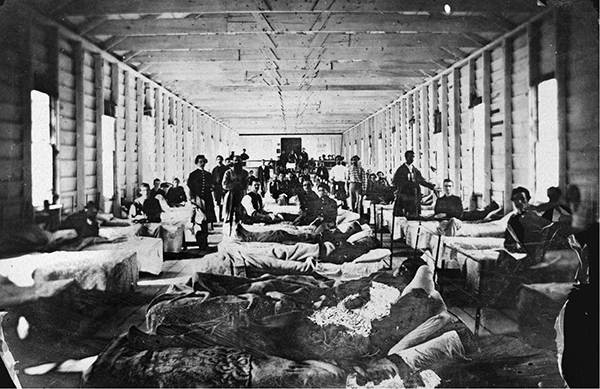
The grim confines of Camp Convalescent, also known as “Camp Misery,” represented the worst of DC’s hospitals.
Soldier of God
Another trenchant wartime diarist at Union Hospital, Alcott’s boss Hannah Ropes, a Christian activist, had a background in abolitionist politics that gave her a radical stance on injustice where she found it. Ropes hailed from Massachusetts, wife of one William Ropes, who abandoned his family and left her and their son and daughter to fend for themselves. Her son, Edward, became a homesteader in the worst possible place: Kansas during its “Bleeding Kansas” phase of internecine guerrilla warfare over slavery.86 She and her daughter followed him there, and, as she described in her book Six Months in Kansas, they soon found themselves under the threat of pro-slavery Missourians, for whom “To kill a man is not much more than to shoot a buck.” In response, she had no qualms about the reality of self-preservation: “How strange it will seem to you to hear that I have loaded pistols and a bowie-knife upon my table at night, three of Sharp’s rifles, loaded, standing in the room,” and “Now the hour for action has come . . . and may Heaven speed the RIGHT!”87
Six years later, after Edward enlisted in the Union army, Ropes entered the fray again, this time a bit farther from the front lines. She came to the capital—“the ugliest and dirtiest city I ever saw”88—with no proper experience in nursing, armed only with her knowledge of Florence Nightingale’s influential Notes on Nursing. Despite her inexperience and lack of training—typical for most nurses in the war, before the development of professional organizations and proper licensing—Dorothea Dix accepted her as a ward matron for Union Hospital. Ropes started in July 1862.89
Frightful Grandeur
Ropes had great sympathy for the soldiers in her care and great impatience for the cogs of bureaucracy that hampered that care. She gathered supplies from donations, the Sanitary Commission, and anyone with influence and recorded her observations of the men in their bleakest hour. The workers around her generally provided good care, but the head surgeon’s treatment of the soldiers disgusted her. She claimed that he cared “no more for a private than for a dog” and that he released soldiers not fully healed or recovered: “the poor men in all the hospitals barely escape with life or clothes or money.”90 She had already encountered the darkest side of human nature in Kansas, had “seen the elephant”—a popular nineteenth-century term for an intense emotional experience, often in combat—and didn’t shrink from it. Thus, she resolved to act even if doing so meant upsetting the hierarchy of the medical system.
At Union Hospital, as with others in the capital, the top surgeon, A. M. Clark, reported to US Surgeon General William Hammond and, above him, Secretary of War Edwin Stanton. Below the chief was an array of assistants, contract physicians, medical students, and wardmasters who assisted both doctors and nurses.91 Hannah Ropes’s main nemesis, though, was the hospital steward, a devious (unnamed) character who withheld food from the injured men, stole their clothes, and sold their rations.92 After he suggested to Ropes that they form a ring to purloin hospital food and supplies, she reported him to Clark, but the high-handed surgeon dismissed her complaints. She went over his head to Surgeon General Hammond, who referred her complaint back to Clark, who again dismissed it out of hand. Finally, when the steward attacked a patient with a chisel and created his own little prison for disfavored patients in the damp, rat-infested cellar, Ropes took dramatic action. She ignored the chain of command entirely and set up a meeting with the secretary of war.93
At Stanton’s office, as Ropes mentally prepared herself to be locked away for insubordination among “the rats and cockroaches,” the secretary entered: “a large man with dark beard, bald head, and legal brow” whose eyes “gleamed with the fire of a purpose.” Ropes stated the case about the problems at her hospital as succinctly as she could.
Stanton’s response: “Call the Provost Marshal.”94
The marshal charged into Union Hospital with his investigators in “a frightfully grand scene.” He released one of the steward’s victims from the cellar and arrested the steward and sent him to the Old Capitol Prison—to the “pale terror of the head surgeon” and the fearful reaction of his subordinate officers. Soon after, head surgeon Clark himself went to prison, and a medical inspector came to the hospital. He looked around and questioned Ropes about the relationship of the steward and chief surgeon. She compared the former to a whispering devil and the latter to a tyrant, “harsh and unsympathizing.” Her words kept them imprisoned a while longer.95
Ropes had engineered a shocking, unexpected outcome. Not only had she upended the protocols between surgeons and their supposed subordinates, she had struck a powerful blow against the culture of greed and corruption that had held sway for decades in Washington City. What replaced it, at least for a few years, was a new military efficiency, intolerance for bureaucratic incompetence, and frightening use of absolute power.
Within the Fray
Countless other nurses and support staff took on miscreants in the medical system where they found them, from administrators unfairly withholding food and supplies from needy patients to rogue surgeons threatening and harassing their staff.96 Even though many surgeons acted heroically and diligently to save the lives of soldiers, they had fraught relationships with the female nurses below them. Nurse diarist Georgeanna Woolsey wrote, “Hardly a surgeon of whom I can think received or treated them with even common courtesy . . . [they] determined to make their lives so unbearable that they should be forced in self-defense to leave.”97
Joining the nurses in the wartime workforce were great numbers of women who filled jobs throughout the capital. These included clerks at the US Treasury and other departments—unheard of before the war—workers at the Government Printing Office, and weapons makers at the Navy Yard and Arsenal. Their pay predictably was low, and in some professions they earned about half what their male colleagues did.98 Still, the war helped challenge antebellum notions of the role of women, and it did so in combination with social reform movements and Christian charitable work.99Hannah Ropes had ably chronicled and actively participated in both. Perhaps a bit too actively.
Because of her regular proximity with sick and infected patients, she regularly took ill with one disorder or another, complaining to her daughter, “We get lousy! and dirty. We run the gauntlet of disease from the disgusting itch to smallpox!”100 In her last journal entry, dated December 29, 1862, in her description of a dying soldier, she had a sense of something darker on the horizon:
two eyes like live coals roll, gleam, recede in terror behind their own pupils, or soften to tears before mine; two cheeks, purple with fever, a sweet mouth and beardless chin, teeth a girl might envy, and a wide fair brow, from which light brown hair, dank and curlless, falls away . . . .[The doctor] pronounces him very sick and orders an anodyne—still, no closing, hardly to wink, of these bright, restless, beautiful blue eyes.101
Typhoid finally did what the medical bureaucracy couldn’t do and conquered Hannah Ropes in January 1863.102
Rise of the Contrabands
Ropes wouldn’t have said her death was in vain. She had a keen sense of what the war was really about, and why soldiers like her son were fighting. As she wrote the month before her death, “If in the beginning our President had declared freedom for all, and armed all, the rebellion would not have lasted three months . . . the only way out of this trouble remains just where it did before, only to be gained by immediate, unreserved emancipation.”103 Instead, freedom for slaves proceeded piecemeal, by moderate gestures and accidents. One of the biggest such accidents, however, fundamentally reshaped the racial and social landscape of the District.
Slaves had been coming to the capital even before the war started. Their masters and other Southern whites fled and either abandoned their “property” or made keeping track of it difficult in the growing chaos.104 Farther south, in May 1861, three slaves escaped to the Union lines at Virginia’s Fort Monroe, one of the few federal installations still held by the national government. General Benjamin Butler decided not to send them back to their masters as required by the Fugitive Slave Act of 1850. Instead, improvising his own military law, he held them as “contraband of war,” or commandeered enemy property. After Lincoln reluctantly confirmed Butler’s decision, thousands of “contrabands” escaped their plantations in the South to take shelter behind Union lines, a number that grew to half a million by the end of the war.105
The District of Columbia, not far from the fighting in Virginia, became a major draw for escaped slaves, who arrived via the Long Bridge and within two years formed a community of ten thousand people in Washington City and three thousand more in Alexandria. They took exceptional risks in the first year of the contraband policy, when Maryland slaveholders could have them held as fugitive slaves if they had come from that state and when they could be arrested for the slimmest of reasons and confined to the municipal jail (and the whims of its racist warden).106
This situation changed on April 16, 1862, when President Lincoln signed the Compensated Emancipation Act, which freed slaves held within the District of Columbia and provided up to three hundred dollars for their owners,107 the only time such an act occurred during the war in any US city or state. This act predated Lincoln’s much more famous Emancipation Proclamation—which freed slaves only behind enemy lines and didn’t apply to slave states that remained within the Union—by nine months, and 996 slaveholders came forward to get their recompense. All they had to do was prove their ownership and take a loyalty oath, so the federal government essentially rewarded them for owning human chattel and staying in town. The total cost ran to more than two million dollars—owners typically claiming their slaves were young, sprightly, and in excellent health, while bondsmen argued the opposite—but the act was much less sweeping than it sounded. Slaveholding whites composed only 2 percent of the District’s population in 1862.108 In the end, while it did free 3,100 slaves in the District,109 compensated emancipation also provided an undeserved treat for slaveholders. Abolitionists knew as much at the time and endeavored to make sure the policy was never repeated anywhere else in the future.
Camps and Villages
The Emancipation Proclamation went into effect at the beginning of 1863 and only increased the flow of slaves across Union lines. In response, the army used them as workers in trenches, kitchens, hospitals, and even plantations.110 In Washington City, the federal government employed thousands more, hiring them as “carpenters and masons, teamsters and blacksmiths, nurses and orderlies, and laborers of every description to move supplies, chop wood, haul coal, tend animals, build roads, and dig fortifications.” For such work, the government paid them up to thirty dollars a month, the same as whites, but with an unpopular monthly tax of five dollars deducted to defray the costs of operating the sites where many of them lived.111
The Department of War tried to provide at least a minimum amount of assistance, which included clothing, food, shelter, medicine, and education for the former bondsmen, consigning them to on-site settlements known as contraband camps.112 Conditions there were often grim, though. The camps faced a lack of sanitation and supplies, a surfeit of poverty and disease, and an inability to handle the seemingly endless flood of new arrivals. In due course, the healthier men and women with contacts elsewhere in the region departed the camps, leaving behind the poorest and sickest individuals.113 One of the most prominent outposts was Camp Barker, near Washington City’s northern boundary. Built over a former brickyard and cemetery, its swampy conditions made it notorious as a plague center. In one of the camp’s deadliest outbreaks, the six hundred residents suffered through a smallpox epidemic in 1863 that killed three to five people a day, worsened by the lack of access to water and vaccines.114
Encampments closer to town didn’t fare much better. Just a few blocks from the heart of Pennsylvania Avenue, freedmen found dreadful accommodation in the disease-ridden shacks and hovels that lined the poisonous city canal, making for a shantytown between the White House and Capitol known as Murder Bay.115

The shanties of Murder Bay, where escaped slaves, or “contrabands,” took refuge amid deplorable conditions.
Such dismal living conditions shocked the residents of the capital but persisted for years afterward. As late as 1866 the superintendent of the Metropolitan Police reported to Congress that whole families packed into shanties “without light or ventilation,” barely protected from rain or snow, exposed to the “most disgustingly filthy and stagnant water.” Even if sanitary standards were ever fully enforced, “these places can be considered as nothing better than propagating grounds of crime, disease, and death; and in the case of a prevailing epidemic, the condition of these localities would be horrible to contemplate.”116 (The Bureau of Refugees, Freedmen, and Abandoned Lands—the “Freedmen’s Bureau”—had the postwar task of improving this and other substandard conditions for blacks, and we’ll see in chapter ten.)
By the summer of 1863, the military had to address the crisis. As a partial solution, it created Freedmen’s Village, a mini-town with fifty houses and two families per residence, just across the river in Virginia. It also had schools, churches, a home for the elderly and disabled, streets and parks, and a tailor and other artisan shops. It provided job training for men in such fields as blacksmithing and for women in sewing, which paid the meager wage of ten dollars per month, minus five dollars for the contraband tax.117Freedmen were charged rents of one to three dollars per month, which didn’t leave much money to spare, so many African Americans there found other sources of income, including working as military laborers, defending the siege works of the District, and working in local fields and gardens.118 Eventually the army constructed barracks to hold 250 families at much lower rental costs, and the village ultimately grew to 1,500 people.119
Life in the quasi town was marginal, but at least it improved on the awful conditions of the contraband camps. It also held great symbolic value. The village sat on the Custis-Lee estate, where Robert E. Lee lived before the war in Arlington House.120 On this former slave manor, African Americans now lived willingly and earned pay for their labors, where once they would have lived as prisoners at the behest of the Confederates’ top general.
New Authorities
The Union army also opened Freedmen’s Hospital on the site, a groundbreaking facility where African Americans could receive treatment for diseases and other ailments in the camps.121 Its most famous employee was the legendary Sojourner Truth, who before the war had been an activist for abolition and women’s rights, an agent on the Underground Railroad, a preacher, and a lecturer. Already in her mid-sixties, she helped bring about the integration of the horse-drawn street railway by riding in whites-only cars, had a private audience with President Lincoln, and lobbied Congress for establishing proper training for doctors and nurses. During her time in Washington City, she also organized the cleaning of Freedmen’s Hospital to help prevent disease at a time when few recognized, and most ignored, the need for medical sanitation at other hospitals in the District.122
Other employees of Freedmen’s Hospital may not have shared her fame, but they proved just as critical to the health of black soldiers and former slaves who needed care there. One of them, Dr. Alexander Augusta, had fought widespread racism directed at black professionals to become an army major and the surgeon in chief at Camp Barker. In 1863 his authority was transferred to the new three-hundred-bed Freedmen’s Hospital, where he and eight other doctors became part of a select fraternity: African-American physicians who worked in a District medical facility. Augusta’s second in command was Dr. Anderson Abbott, a prominent Canadian who attended levees held at the White House, became an acquaintance of the president, and fit well into local middle-class black society, despite his foreign origins. He was even present at Lincoln’s deathbed, and the first lady later gave him the president’s plaid shawl, “a most precious heirloom,” as a reminder of his time in the capital and friendship with the chief executive.123
Unlike the more reserved Abbott, hospital director Augusta cut a controversial figure in some circles because of his activism for racial equality. Like Sojourner Truth, he protested segregation on the capital’s street railway and helped force the integration of the “c’yar boxes,” as the streetcars were known, by lobbying Congress for action.124 Augusta’s actions raised his public profile just as they raised the jealousy of his white peers. In 1864, these doctors forced his removal as chief surgeon, and Abbott assumed control of Freedmen’s Hospital, continuing Augusta’s policies.
Fighting Old Demons
Charles Sumner aided Augusta’s antisegregation cause by bringing it up in the US Senate and by threatening to revoke the streetcar company’s charter if it didn’t remedy the problem.125 Other abolitionist politicians joined him in such attempts to lessen racial bias in public accommodations and helped pass laws that gave black-oriented schools a proportion of the municipal school fund and expunged some parts of the Black Code, including the hated ten o’ clock curfew.126 However, racism remained alive and well: White District residents protested any assistance shown to African Americans, and laws like the one funding black schools existed more on paper than in reality thanks to the recalcitrance of the City Council.127
The crazed mobs that had enforced the racial status quo before the war returned with a vengeance too. After such events as the Emancipation Proclamation or the enlistment of African-American troops, crowds of reprobates hurled stones and shattered glass at black churches, convalescing soldiers attacked minorities at random on the street, and interracial hostility increased throughout the capital.128 The law often gave sanction to such violence. Not only could blacks not testify against whites in many courts or even take the stand as witnesses, but they could be held as lawbreakers just for defending themselves from mob attack.129
Similar prejudice existed in the military, as black troops became more visible defenders of the Union in 1863 and after. Many in the city and the nation resisted the idea of sending African Americans to fight in the war, and even Lincoln had his doubts.130 The army didn’t enlist black troops out of magnanimity; it just needed more men, 150,000 more. Surprisingly, despite being offered less money than white soldiers and severely limited in rank and command, more than the requested number of African Americans enlisted, including many ex-slaves.131 It made for dangerous service, even when the bullets weren’t flying. Local thugs occasionally attacked camps where these soldiers were billeted, and, if Southerners captured any of them, they stood a good chance of being massacred on the spot—infamously so at Fort Pillow in 1864. Nonetheless, black troops proved themselves to be able, vigorous combatants in the field, and their courageous service in such battles as Port Hudson and Milliken’s Bend in the Deep South made their detractors less vocal if not necessarily more tolerant.
Village No More
By the end of the war, the racial landscape in Washington City had changed dramatically. No longer was the capital a backward village of plantation owners and white gentry with a minority of free blacks and slaves bound by law and custom. Instead, according to a special census in 1867, the capital boasted 106,000 people, a third of them black and none of them slaves.132
At least one general in Washington City knew the value of African Americans as soldiers, laborers, and citizens of the Union. He happily employed contraband labor against the Southern enemy.133 He ordered that black soldiers buried at the humble Freedmen’s Cemetery be reinterred in a more prominent facility.134 He developed a plan to give slaveholders’ property to freed slaves, and he understood how “the loyal inhabitants of the country, white or black, must be compelled to assist” in the war since they were “animated by the strong desire not merely for political but for personal liberty.”135 He was the city’s greatest master builder, Montgomery Meigs.
An Engineer’s Apotheosis
An officer in the US Army Corps of Engineers, Meigs cultivated an interest in just about everything: architecture, engineering, fine art, history, languages, literature, photography, and science.136 No ordinary engineer, he held thirteen patents on innovations from fire hydrants to file cases.137Most importantly, Meigs devised and constructed the huge Washington Aqueduct that utilized only gravity (not steam pumps or other devices) to bring freshwater from Great Falls, Maryland, through 18.6 miles of reservoirs, bridges, conduits, tunnels, and pipes at a cost of more than two million dollars.138 His aqueduct had a capacity of sixty-seven-million gallons, twice what New York City needed and four times what Paris required.139 In the history of Washington City, only the Capitol itself had a higher price tag140—which Meigs himself, as chief engineer, had helped reconstruct in the 1850s, the great white iron dome the most visible example of his exceptional ability.
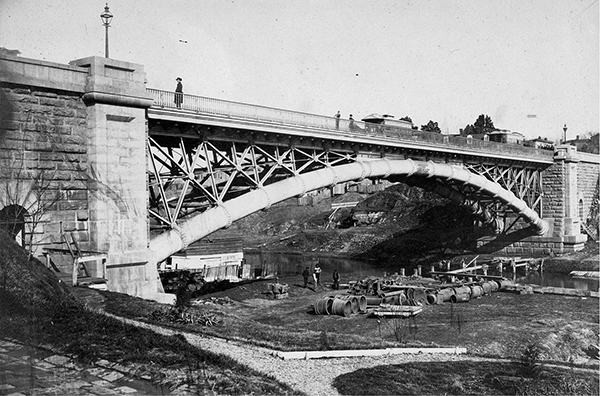
The ingenious arches of the Washington Aqueduct, which doubled as pipes carrying water into the city.
Before the war, the turncoat Secretary of War John Floyd had shipped Meigs to the distant Dry Tortugas island chain. Instead of moping about his fate, Meigs instituted an immediate campaign to strengthen the defenses of the federal post there, Fort Jefferson. By February 1, 1861, he had bolstered the fort against potential attack, and three weeks later his political allies aided his return to Washington City.141
In June, Lincoln promoted him to brigadier general and gave him the title of quartermaster general of the US Army, overseeing the administration, procurement, and supply of military troops. When he arrived, the shambling, debt-ridden condition of the quartermaster’s office didn’t help the massive organizational task, nor did the insidious fraud and corruption of federal contractors. Yet Meigs succeeded beyond expectation and helped the Union army dramatically improve its logistical planning and deployment of troops, equipment, and supplies—everything from shipping food, clothing, tents, and blankets to delivering gunboats and expediting railroad construction.142 Meigs also succeeded in the monumental feat of delivering huge numbers of horses, mules, wagons, and ambulances to the capital to aid the Union cause (while, more regrettably, tramping the town’s roads into muck). But that wasn’t the only way he altered the local landscape.
In fall 1862, Stanton named him to a commission to fortify the District of Columbia against Confederate assault.143 By the end of the war, it had become the most fortified city in the world, with sixty-eight forts and ninety-three batteries manned by twenty thousand troops along a thirty-seven-mile defensive line. Countless battles took place in the Chesapeake region, but only Jubal Early’s July 1864 raid breached this line when the rebel cavalry general attacked Fort Stevens in Washington County.144 Meigs participated in the battle, commanding a force of some fifteen hundred men in rifle pits between Fort Stevens and Fort Totten, the latter appropriately named for the general who first brought Meigs to Washington City in 1852 to fix the town’s water supply.145Union troops repulsed Early’s raid, and the capital remained secure.

During fifteen years, Montgomery Meigs built an aqueduct, engineered a new US Capitol, and helped the Union Army win the Civil War.
Ghosts of War
For all he did to provide clean water, engineer the Capitol, and help win the war, Meigs’s most lasting contribution lay not within Washington City but across the river in Arlington, Virginia. Here the great engineer made a mark on the landscape of the capital that remained long after the war ended, the hospitals and military camps closed, and the decrepit antebellum village of Washington City disappeared from view and memory.
On the huge Custis-Lee estate, in a neoclassical manor rising above the Potomac, Robert E. Lee had once held court. His wife, Mary, had luxuriated under blooms of honeysuckle and jasmine here, and old George Custis had danced and cavorted with his wealthy guests. But Meigs had very different plans for the estate.
The federal government confiscated the property shortly after the outbreak of the war and claimed outright ownership of it in 1864 after Mary Lee failed to pay her property tax in person (though she had tried to do so via courier). With battles in Virginia causing eighty thousand casualties a month, local hospitals bursting with wounded and dying men, and the dozen Union cemeteries in the capital filling up rapidly, Meigs recommended the estate become the grounds for a new national cemetery to hold the bodies of deceased soldiers.146 Edwin Stanton concurred, and by the summer of 1864 plots for the Union dead began to populate the grounds.
Meigs’s resolve only strengthened when he learned that his son had died in the Shenandoah Valley on an army scouting mission. He vowed that Lee’s estate would never again serve as a leisurely retreat or pleasure garden. Instead, with its sarcophagi, memorials, and tombstones, it would stand as a testament to sacrifice and death.147 He located one of the biggest pits near the manor house, ordering Mary Lee’s garden excavated and filled with the remains of two thousand unknown soldiers.148 Mary Lee fought for decades afterward in Congress and court for the return of her estate,**but Meigs served just as long as quartermaster general, continuing to expand and develop the property as the nation’s foremost burial ground, adding temples, arches, and an amphitheater to the landscape. As he did on the aqueduct he created, Meigs took care to have his name engraved prominently and proudly on a column near the entrance, so all the world could see who had built this grand tribute to the fallen.149
** Mary Lee achieved her aim in an 1882 Supreme Court case, after which she sold her estate back to the federal government for $150,000. The official buyer was the Secretary of War—Robert Todd Lincoln. (Robert M. Poole, “How Arlington Cemetery Came to Be,” Smithsonian (November 2009): 4, accessed at www.smithsonianmag.com/history-archaeology/The-Battle-of-Arlington.html)
Conceived as revenge, Arlington National Cemetery in many ways became the ideal gesture. This estate, which sat on some of the area’s most scenic property, never saw the Confederate general and his wife live out their twilight years in splendor. Instead, the hillsides embraced thousands of American heroes and warriors, officers and enlisted men, Supreme Court justices and presidents, explorers and reformers, black and white, North and South. And as Arlington grew, so too did the town on the flatlands below. Through terrible carnage and tumult, the capital city stood bloody but unbroken, straining to live and grow, watched over by armies of the dead.