
CHAPTER 5
Trade is inseparable from political, diplomatic, and military relations. The mingling of people and goods traveling back and forth across the Mediterranean was accompanied by a mingling of ideas, technologies, and texts— of cultures, in short. All the various players adopted the technologies, institutions, and tools of the merchants and sailors— whether banking instruments, contracts, funduqs, compasses, or portulans— modified them to fit their own needs and culture, and perfected them when necessary.
Exchanges of ideas and technologies in the Mediterranean basin were not limited to commerce and navigation. They occurred in all areas: agricultural, hydraulic, architectural, and military technologies; the knowledge and practice of medicine and pharmacology; artistic, musical, and literary tastes and expertise; scientific and philosophical scholarship. It would clearly be impossible to provide a complete list of these activities here; I can give only a brief outline and focus on a few examples.
Greco- Arab Science and Philosophy in Latin Europe
Latin and Arab geographers differed significantly in their training and learning, as we saw in chapter 1, and that contrast was even more marked in the fields of science and philosophy, which were much more developed in the Arab world than in Latin Europe.1 The cultural and intellectual mixing of Greek, Persian, and Arab elements, well under way with the Umayyads of Damascus (680– 750), continued under the Abbasids. In addition, “Greek” science was already the product of a hybrid civilization, Hellenistic and then Roman, marked by Babylonian, Egyptian, Persian, and other sciences. That was the case in the second century for Galen’s medicine and Ptolemy’s astronomy, for example.2 Caliph al- Ma‘mūn (813– 833) established the Bayt al- Hikma, or House of Wisdom, to promote the translation of Persian, Syriac, Sanskrit, and especially Greek scientific works. According to the tenth- century Baghdad author Ibn al- Nadīm, Aristotle appeared to the caliph in a dream and inspired his plan. The caliph, Ibn al- Nadīm relates, asked for and obtained Greek manuscripts from the Byzantine emperor.3 It is likely that the caliph was able to find most of the texts and translators in the caliphate itself. Translations were done— to cite only the best- known authors— of Euclid and Archimedes in geometry, Ptolemy in astronomy, Galen and Hippocrates in medicine, and of course, Plato and Aristotle. Also translated were works of Hindu mathematics and astronomy. From the eighth century on, many Arab authors studied and annotated that rich panoply of texts, adding to it their own contributions in the sciences, philosophy, and theology.
It has often been said that, as the Abbasid caliphs were transforming Baghdad into a new world capital of science, Charlemagne and his successors were laboriously learning to write their own names. In Byzantium, scholars continued to study the classics of antiquity; but in Latin Europe, from the Carolingian period to the twelfth or thirteenth century, few read Greek, and only one of Plato’s dialogues had been translated into Latin. No text by Aristotle, Euclid, Hippocrates, Galen, or Ptolemy was available in Latin translation. True, there were Latin vulgarizers dating from Late Antiquity and the early Middle Ages: Macrobius, Boethius, Isidore. But their works provided only scant remnants of Greek thought. Between the eighth and eleventh centuries, a few traces of the influence of Arab science survived in Latin Europe. Then, in the eleventh and especially the twelfth century, many Europeans began to learn Arabic, especially in Spain, to study science and philosophy and, if need be, to translate texts into Latin. In the twelfth and thirteenth centuries, these translations would have a profound impact on intellectual life in Europe. By way of example, let us consider the field of medicine.
In medicine as in so many other disciplines, Arab science rested on a Greek theoretical base, combined with significant Persian and Indian elements. Many Arab authors introduced additions to these foundations, whether from medical theory, clinical practice, or pharmacopoeia. In 987, for example, when Ibn al- Nadīm compiled his Fihrist, a sort of catalogue raisonné of works written in the Arabic language, he listed 430 medical texts, 174 of which were translated from other languages (primarily Greek). For the Middle Ages as a whole, there may have been a thousand or so Arabic texts in medicine.4
Hunayn ibn Ishāq was one of the major figures in the movement aimed at assimilating Greek medicine. Born into a Christian family from the Euphrates valley, the son of a pharmacist, Hunayn immigrated to Baghdad, where he was involved in the work of the Bayt al- Hikma. He learned Greek and did many translations, producing Syriac and Arabic versions of texts in astronomy, philosophy, mathematics, the divinatory sciences, and especially medicine. In a letter written in 856, he mentions 129 treatises by Galen that he knew, and a good share of which he and his collaborators had translated.5 Thanks to that work, the Arab world appropriated the Greek medical heritage. In 850, a contemporary of Hunayn’s, ‘Alī b. Rabban al- Tabarī, completed an encyclopedia of medical knowledge, the Firdaws al- Hikma (Paradise of Wisdom), in which Greek, Persian, and Indian traditions blended together.6 Although in al- Tabarī, as in later authors, Greek thought dominated and structured Arab medicine, Eastern contributions remained significant. The Firdaws describes in detail Indian medical practices, based on Sanskrit texts translated under the caliphate of Harūn al- Rashid (786– 809); in its chapters on pharmacopoeia, Persian terms predominate. Hence there emerged in the mid- ninth century a true theoretical and practical Arab medicine, a blending of various traditions.
Such were the foundations on which Arab physicians of the Middle Ages were working. They adapted or honed ancient hypotheses about the origins of illnesses, which generally rested on a theory positing a balance or imbalance of the four elements (earth, water, air, fire), the four corresponding humors (black bile, phlegm, blood, yellow bile), and their respective properties (hot/cold and dry/wet). When the great Greek thinkers were not in harmony— for example, when Galen’s medical theories contradicted Aristotle’s notions of physics— the Arab authors provided arguments for choosing between the two or for constructing syntheses.
Although the theoretical structure stemming from classical antiquity predominated, practices continued to evolve, and medical writers did not hesitate to correct Galen’s errors. This is particularly well demonstrated in the prolific writings of Abū Bakr Muhammad al- Razī (d. 925 or 935); 61 of his 184 known works are devoted to medicine.7 This Persian physician, a discriminating connoisseur of ancient medical texts, claims that he surpassed the ancients since, after integrating their knowledge acquired over thousands of years, he made his own discoveries and contributed to the development of science. A modern who applies himself, he says, necessarily sees farther than the ancients. His medical works reflect this conviction: he carefully lists descriptions of one illness or another and its treatment by his predecessors (Greek, Syriac, Persian, Indian, Arab), then offers his own ideas, the result of extensive clinical experience, which might confirm or on the contrary invalidate the theses of the ancients. When his experience revealed the weakness of an argument of Galen’s (on the healing process of arterial wounds, for example, or the treatment of ulcers), he clearly sets out its refutation. Al- Razī provides the most brilliant example of that critical attitude toward the ancients, but he was not alone. In about 1200, ‘Abd al- Latīf al- Baghdādī, after observing skeletons, showed that the description given by Galen of the structure of the jaw was wrong; he wrote ironically of the excessive regard that modern scholars displayed toward Greek medicine.8
In terms of medical theory, one of the most remarkable syntheses is the Canon by Ibn Sīna, Avicenna for Europeans (980– 1037), a text destined for unparalleled success, since for several centuries it was the most widely used manual in medical schools from India to Oxford.9 There is nothing to indicate that Avicenna ever practiced medicine; his knowledge, unlike that of al- Razī, came almost exclusively from books. But the strong points of the Canon are its clear organization and its effort to make medicine a true rational science. Avicenna tried to apply the principles of logic to medicine, in order to show the correspondences between an illness, its symptoms, and its treatment.
Until the eleventh century, Latin Europe stood at a remove from that medical science: it was not familiar with either the Greek or the Arabic texts. There are some scattered indications of a trade in pharmaceutical products, however. In the Carolingian Rhineland, there were medicinal formulas in the 790s that very clearly displayed knowledge of Arab remedies and a commerce in medical products from the East, such as camphor.10 But between the Arab world and Latin Europe, the gap in medical theory and practice remained great. Usāma ibn Munqidh, a twelfth- century Syrian author, describes Frankish medical practitioners with disdain and contempt, depicting them as inept, superstitious, and arrogant.11
In eleventh- century southern Italy, a push began, associated with Constantine the African, to translate Arabic medical texts into Latin. Constantine’s life, transmitted through more or less improbable legends, remains obscure.12 It seems, however, that he was originally from Ifrīqiya and that he settled in southern Italy, where he died in 1087. Constantine is reputed to have translated a dozen medical works from Arabic into Latin. As often in the Middle Ages, these were adaptations rather than exact translations. They reveal an ignorance of superior works, such as those of al- Rāzi. Compared to what had previously been available in Latin, however, they represented an important advance in medical theory. It was primarily in Salerno of the eleventh century that these translations were used in the teaching and practice of medicine.
More essential and long- lasting were the translations done in Toledo under Gerard of Cremona between 1145 and 1187. If we are to believe the list drawn up by his colleagues, Gerard translated seventy- three works, probably with the aid of his associates.13 That list, inserted into the preface to a translation of a work by Galen, shows that Gerard’s work shone not only for its quantity but also for its quality and variety. The text describes how Gerard, a native of Cremona, Italy, quickly reached the limits of the scientific knowledge available in Latin in the twelfth century. The work of his predecessors had awakened his curiosity, and he came to Toledo impelled “by the love of the Almagest” by Ptolemy, a fundamental astronomical text. When he arrived, he was astonished by the number of scientific texts available in Arabic, an abundance he contrasted to the scarcity of Latin texts. He began to learn Arabic, then undertook the translation of works chosen in advance, in order to offer a “wreath” of the most beautiful flowers of Arab wisdom. The quality of the works selected clearly stands out: in medicine, for example, he translated ten texts by Galen and one by Hippocrates, thus offering the Latin world the complete theoretical foundations of the ancient science. He added ten works by Arab medical authors, in particular, three texts by al- Rāzi and Avicenna’s Canon.
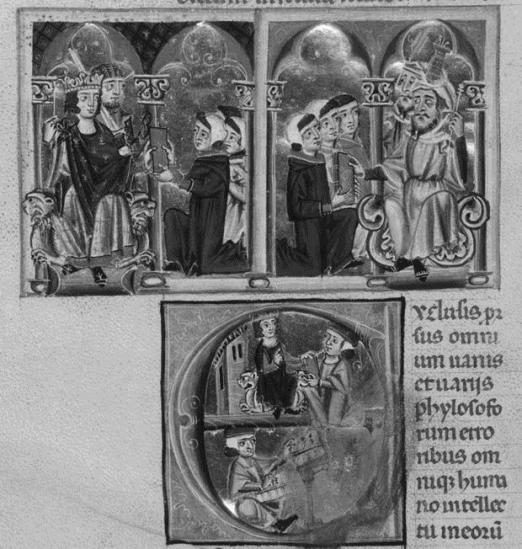
Figure 4. Manuscript of al- Razi’s Continens, 1282. The four scenes show the different phases in the translation of the work: Charles I sends an embassy to the emir of Tunis to request a copy of the work (top left); the emir gives the Arabic manuscript to the king’s emissaries (top right); the translator Faraj bin Salem at work (bottom half of lower image); Faraj bin Salem presents his Latin translation to the king (top half of lower image). Bibliothèque Nationale de France (MS Latin 6912, fol. 1). Reprinted by permission of the Bibliothèque Nationale de France.
Yet only a small number of medical texts were translated from Arabic into Latin in the Middle Ages— about forty of the thousand or so texts available. To be sure, medical texts continued to be translated in the thirteenth and fourteenth centuries, though they did not manage to compete with Galen or Avicenna. Charles I of Anjou, king of Sicily, having heard of the Kitāb al- Hāwī, al- Rāzi’s encyclopedic work, sent an embassy to the emir of Tunis, who sent back a copy of the Arabic text, which the king ordered translated in 1279 (figure 4).14 In the fourteenth century, the Montpellier school of medicine was influenced by the work of Arnald of Villanova, a practicing physician, professor, and translator of medical texts from the Arabic. He sharply criticized his contemporaries for their excessive dependence on Avicenna and attacked Averroes (Ibn Rushd). For Arnald, the two philosophers were less reliable in medicine than the true masters, Galen and al- Rāzi (whom Arnald called the “second Galen”).15
We could similarly trace the history of the different sciences in the Arabophone world and that of the translations and adaptations to which they gave rise in Europe. In astronomy, for example, the contribution of Arab science through translations, most of them done in the twelfth and thirteenth centuries, was essential to the development of that science in Europe.16 Arab astronomy, like medicine, came into being in ninth- century Baghdad; knowledge and ideas of Persian, Sanskrit, and then Arab origin were brought to bear on an essentially Ptolemaic structure. The Latin world, meanwhile, had only a few vulgarizations of Greek astronomy (Macrobius, Martianus Capella), until, at the start of the twelfth century, a certain number of astronomers (Petrus Alfonsi, Adelard of Bath, Raymond of Marseilles) promoted Arab astronomy and began a translation movement, which took on greater scope mid- century.17
Thanks to the work of Gerard and the other translators, Greco- Arab thought arrived in the major intellectual centers of Europe in the thirteenth century and completely altered learning and thinking. Aristotle— “the Philosopher,” as he was most often called— entered Europe wearing a turban: in most cases, the Latin translations of his works were from the Arabic, often accompanied by glosses or commentaries also translated from the Arabic, such as those of Maimonides and Averroes, which were still recent. They would have a profound influence on intellectual life in Latin Europe, an influence perceptible, in the first place, in the sharp reaction they produced in the newly created universities. In 1215, when the pontifical legate Robert de Courçon set forth the regulations for the University of Paris, he specified that the metaphysical and scientific works of Aristotle were not to be taught in the faculty of arts. It appears, therefore, that not everyone was fond of the new fruits offered by the translators. We must not overstate the importance of such bans, however: other works by Aristotle, especially in logic, were taught, and the prohibitions were merely local. In 1229, when the new University of Toulouse wanted to attract students, it boasted that they could study there the works of Aristotle that were banned in Paris. Further bans, in 1231, 1245, 1263, 1270, and 1277, were intended to proscribe the teaching of certain doctrines that supposedly attacked the Christian faith, including ideas from Aristotle, Averroes, and Thomas Aquinas. But the Aristotelian works banned in 1215 were by now an integral part of the university curriculum.
Various theologians sought a middle way between the unbridled enthusiasm of some people for that new philosophy and the absolute rejection of others. The chief authors of that compromise were Albertus Magnus (1193– 1280) and his student Thomas Aquinas (1225– 1274), who declared that the truths of philosophy or science could not be used to prove those of faith, but that it is possible to demonstrate that these truths do not contradict one another. In his scientific and theological works, Albertus forged an imposing synthesis of Arab, Greek, biblical, and patristic knowledge, attempting to eliminate or minimize disagreements between these different sources and to dismiss ideas considered heterodox (for example, that the world is eternal, as Aristotle and Averroes claimed, and not created). It was upon these foundations that Thomas built a monumental system of thought, which historians often compare to a Gothic cathedral, with solid foundations in Genesis and Aristotle, Augustine and Averroes, Moses and Maimonides. Yet the controversies continued, and some Parisian scholars were accused of being “Averroists,” of teaching, among other erroneous doctrines, that there were two independent truths, one based in revelation and the other in philosophy. Ibn Rushd had never formulated such a doctrine, but the accusation of “Averroism” was an easy way to cast aspersions on intellectual enemies. The canonization of Thomas Aquinas in 1323, however, marked the triumph of his synthesis of Greco- Arab philosophy and Christian theology, a synthesis that would dominate religious teaching for centuries.18
Artistic and Cultural Exchanges
Artistic contacts and influences were also numerous and far-reaching. Architecture in the Umayyad period generally followed the Persian and Byzantine traditions, but there were also innovations, especially for palaces and religious buildings. For the construction of the Dome of the Rock in Jerusalem (692), the first great monument of Islam, Caliph ‘Abd al- Malik appealed to Greek architects and mosaicists: the gold- covered dome, the mosaics, and the colored marble evoke Byzantine churches. But its octagonal form is unique, and the mosaics represent not holy figures (as in Byzantine churches) but plant motifs rendered abstractly. Its greatest novelty, however, was the use of Qur’anic inscriptions in Arabic, done in a sumptuous calligraphy, making the divine word of the Qur’an an object of decoration as well as instruction.19 That mix of Byzantine tradition and innovation can also be found in others monuments of the time, such as the great mosques of Medina (705– 709) and Damascus (706– 715) or al- Aqsa mosque in Jerusalem (about 715).
In the following centuries, the eastern Mediterranean became such a cultural melting pot that sorting out the artistic “influences” would be difficult. Different ethnic and religious groups shared a largely undifferentiated material culture: looking at a ceramic cup from the twelfth century or a piece of silver jewelry from the thirteenth, you would be hard pressed to say whether the maker or user was Jewish, Christian, or Muslim, Turkish, Arab, Armenian, or Frankish.20
In Europe, it is first in the territories captured from the Muslims, in Spain and Sicily, that one finds the use and appropriation of elements of Arab culture. The Norman kings of Sicily, for example, struck coins bearing legends in Greek, Latin, and Arabic. Roger II struck gold taris that displayed a central cross on the reverse, with a legend in Greek: IC/XC NI/KA, “Jesus Christ is victorious.” The obverse bears an inscription in Arabic, with the mint mark (for Palermo) and the king’s motto in Arabic: al- Mu‘tazz bi- llāh, “he who finds his strength and glory in God” (figure 5). In architecture, the same mix is found in the representations of kings in Palermo churches. In the Church of Martorana, for example, a mosaic shows Roger II crowned by Christ, the adaptation of a model common in the Byzantine world. And on the ceiling of the palatine chapel, the painted image of a crowned king depicts him in the guise of an Arab potentate, sitting cross- legged, a cup in his hand, flanked by servant girls who fan him. Roger also ordered a coronation mantle on which was represented, on either side of a palm tree, a lion (symbol of royal power) bringing down a camel; the Arabic inscription bordering it celebrated the king’s virtues (figure 6).21
Byzantine and Arab architecture in Europe enjoyed a clear influence and prestige. In Italy, art objects and artisans arrived from the Muslim world along the trade routes. The monk and chronicler Amato de Montecassino explains that, in the last quarter of the eleventh century, when his abbot wished to decorate the abbey with new mosaics, he brought in Greek and Arab artisans from Constantinople and Alexandria.22 It was no doubt Amalfitan merchants, patrons of the abbey, who arranged for these artisans to come. Twelfth- century Pisa enjoyed a craze for ceramics from Andalusia and the Maghreb, which were even incorporated into the façades of the city’s churches as decorative
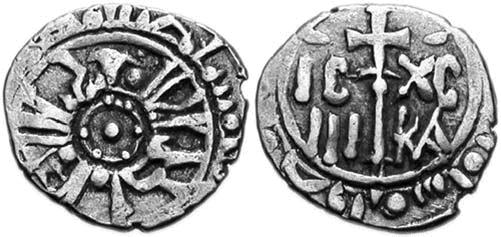
Figure 5. Golden Tari struck by Roger II, king of Sicily (1130– 1154), minted in Palermo, 1140– 1154. Left (obverse): The words “al- malik Rujar al- Mu‘tazz billāh” appear around an inner circle decorated with six pellets and containing a pellet in the center; the mint mark and date are in the outer margin. Right (reverse): “IC/XC NI/KA” (Jesus Christ is victorious) appears in two lines across a field flanking a central cross; the mint mark and date are in the outer margin.
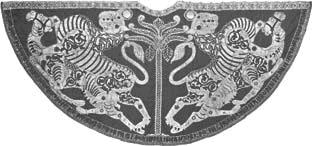
Figure 6. Coronation mantle of Roger II (Kunsthistorisches Museum, Vienna). A lion (symbol of royal power) subjugates a camel. On the fringe is the following Arabic inscription: “Here is what was created in the princely treasury, filled with luck, illustration, majesty, perfection, longanimity, superiority, welcome, prosperity, liberality, shine, pride, beauty, the achievement of desires and hopes, the pleasure of days and nights, without cease or change, with glory, devotion, preservation, protection, chance, salvation, victory and capability, in the capital of Sicily, in the year 528 H. [1133- 1134].”
elements.23 In the Romanesque churches of southern France from the eleventh and twelfth centuries, both the forms of Muslim architecture (polylobe or horseshoe arches) and its techniques (polychrome stones, ceramic) are apparent. Even the Qur’anic text on view in the mosques could become a source of inspiration: “inscriptions” in kufesque (pseudo- Kufic) characters, an approximate imitation of Arabic letters, were engraved in the stone of churches purely as decoration. Sometimes there were true Arabic inscriptions, which attest no doubt to the presence of Arab artisans from Spain. For example, the doors of the Cathedral of Puy bear the words ma shalla, “it was God’s will.”24
The Christian kings of Spain appropriated the palaces of the Muslim princes they had defeated. These ranged from the Aljafería in Saragossa, an eleventh- century palace that became one of the favorite residences of the kings of Aragon with Alfonso I’s conquest of the city in 1118, to the Alhambra of Granada, which Isabel and Ferdinand seized during the conquest of 1492. When the kings built their own palaces, they were often inspired by the Arab models around them. One of the most beautiful examples is the palace built by Pedro I of Castile (1350– 1369) inside the Alcázar of Seville. Laborers sent by Emir Muhammad V of Granada worked on it alongside local artisans. The decorations for that palace belonged to a pure Arab tradition: walls covered with azulejos, or sculpted stucco panels, coffered ceilings, and even Arabic inscriptions that proclaimed, among other things, “There is no other victor but God.” The palace of Pedro I is a jewel of so- called Mudejar art, a style also omnipresent in the religious architecture of the thirteenth and fourteenth centuries, especially in Aragon and Toledo. The Toledo church of Santiago del Arrabal (thirteenth century) seems to have sprung forth from a union between a Romanesque church and a Maghrebian mosque: the plan and the shape of the apses are Romanesque, but the material (brick) and the shape of the arches are reminiscent of Arab architecture. The nearby Church of San Román from the same period is in a similar Mudejar style, mixing Arab and European forms. Even more striking is the interior decoration: abstract frescoes in the pure Arab tradition stand side by side with portraits of saints, identified by inscriptions in both Arabic and Latin. Around the arches as well, inscriptions in the two languages alternate.
The Arab influence in literature is also clear in Italy, Christian Spain, and Provence. The cultural diversity of al- Andalus at the time of the taifas is evident in, among other things, the large quantity of poetry produced in both Arabic and Hebrew. It is a hybrid and innovative poetry, entailing two new forms: the zajal, a poem in dialectical Arabic with the inclusion of words borrowed from the vernacular proto- Spanish; and the muwashshaha, a poem in classical Arabic with a refrain in proto- Romance. These songs became very popular throughout the Arab world and remain so among Arab singers today. They also influenced the development of courtly poetry in Occitan, though the channels and degree of that influence continue to elicit spirited debates among specialists. The chronicler Ibn Hayyan enumerates, among the fabulous booty falling to the Provençal knights at the time of the taking of Barbastro in 1064, a large number of women singers, who did not fail to charm their ravishers. One of the participants in that expedition was Duke William VIII of Aquitaine; his son, William IX, was the first great troubadour. Could the zajal and muwashshahat that William heard from his father’s slaves have inspired that first great Provençal poet?25
The Arab literature of the Middle Ages was also a success with European writers and readers. Various stories from the Thousand and One Nights, from Kalīla wa Dimna, and from other texts were transmitted orally or in written translation, and then adapted by European authors. In the twelfth century, Petrus Alfonsi composed his Disciplina clericalis, an anthology of aphorisms accompanied by brief fables of Arab origin. That work enjoyed great popularity in the Middle Ages: many authors borrowed its tales, from preachers in the thirteenth century to Boccaccio and Chaucer in the fourteenth. Other Christian authors from the peninsula, writing in Latin, Castilian, Catalan, or Portuguese, took up Arabic stories, translating them or taking inspiration from them. Among the most illustrious examples were Juan Manuel’s Conde Lucanor and Juan Ruiz’s Libro de Buen Amor in the fourteenth century, Fernando de Rojas’s Celestina in the fifteenth, and Cervantes’s Don Quixote in the seventeenth century, all influenced by the Arabic narrative tradition.
One of the European sovereigns most taken with Arab culture and science was undoubtedly Alfonso X the Wise of Castile, who surrounded himself with Jewish and Muslim scholars and oversaw the production of a vast library of Eastern and Western scholarship in Castilian. Some of the sumptuous miniatures in these works strikingly depict him as the king of all three religions: he is playing chess with a Muslim subject; listening to music with Christian and Muslim musicians; or, book in hand, directing his staff of Christian, Jewish, and Muslim scholars. The king in fact ordered the translation from the Arabic of several scientific and practical works: treatises in astronomy and astrology, divination, hunting, and chess. For centuries, his Alfonsine Tables remained the standard reference for European astronomers.26 He also had literary works translated— notably, the Kalīla wa Dimna— as well as religious writings— a version of the Mi‘rāj, or Heavenly Journey of Muhammad, and the Qur’an (that translation is now lost). In some sense, Alfonso was the counterpart of the Abbasid caliph al- Ma‘mūn, who in the ninth century oversaw the translation of Greek and Persian works, which were Arabized and Islamized. The result was an enormous library that henceforth constituted the foundation of Arab culture and scholarship. Although the king of Castile’s project was less vast, his ambition was similar: to found a rich library of scientific and literary works in his own language, in his case, Castilian. Alfonso sought to Hispanize Arab culture, just as al- Ma‘mūn and his translators had Arabized Greek and Persian knowledge.
Religious Conflicts and Convergences
In the area of religion, doctrinal differences gave rise to conflicts and polemics among Jews, Christians, and Muslims. Just as, in the early centuries of Christianity, Christian doctrine had taken shape in competition and dialogue with Judaism and ancient paganism, the dogmas and practices of nascent Islam were marked by the rival forms of monotheism and by ancient philosophy and science. In Damascus and Baghdad, debates with Jewish and Christian scholars impelled the Muslims to define their orthodoxy and to defend their practices and sacred texts. A deep ambivalence toward Judaism and Christianity took root, one that was already present in the Qur’an. The holy book claimed in fact that the three great prophets (Moses, Jesus, and Muhammad) had revealed the word of God (the Torah, the Gospels, and the Qur’an) to their respective peoples. At the same time, it expressed sharp criticisms of certain Jewish and, especially, Christian practices and doctrines: the Christians worshipped a man, Jesus, as God; they compromised monotheism through the doctrine of the Trinity. Muslim scholars in Baghdad accused the Jews and Christians of having corrupted, intentionally or not, the sacred texts that their prophets had revealed to them. That “corruption” (tahrīf ) supposedly discredited the arguments of Jews and Christians and marked the decline of their religions.27
One of the polemical texts from Baghdad religious circles was destined to become well known in Europe between the twelfth and sixteenth centuries: the Risâlat al- Kindī.28 It is presented as an exchange of letters between two eminent members of the Abbasid court. A Muslim introduces Islam to a Christian friend and invites him to convert; in response, the Christian sets forth a long and meticulous refutation of Islam, accompanied by a defense of Christianity, and in turn asks his Muslim friend to convert. In reality, both letters were probably the work of a single Christian author. The Risâlat al- Kindī is both polemical and apologetic: it attacks Muslim doctrine and presents a defense of the fundamental Christian doctrines that particularly offended the Muslims. The author accuses Muhammad of being a libidinous false prophet who faked his revelations in order to impose his power on the Arabs and to satisfy his sexual desires. Muhammad himself composed the Qur’an, claims the Risâlat with the cooperation of a heretical Christian monk and two Jews. As for the Muslim rites, the Christian author finds them meaningless. Ritual ablutions? “You wash your bodies, but your hearts are impure and tainted by sin,” like the hypocrites Christ denounces in the Gospel of Matthew. For similar reasons, the author attacks the Ramadan fast, circumcision, Muslim laws relating to marriage and divorce, and the prohibition on eating pork. He then launches into a long diatribe against the pilgrimage rite to Mecca, which he compares to the idolatrous rites of India. He adds an extensive tirade against holy war, explaining that it contradicts the Qur’anic injunctions denouncing the use of force in matters of religion. Those who die in wars will not go to heaven as martyrs; the only true martyrs are those who have given their lives for God peaceably and of their own free will. This diatribe, supposedly sent from a Christian to a Muslim friend, was no doubt actually intended for Christian dhimmi readers, to dissuade them from converting to Islam. It would be a notable success in Europe: first, in the Arabic- speaking Christian circles of the Iberian Peninsula; then, once it was translated into Latin in about 1143, throughout the rest of Europe.
In the East, a multitude of apologetic and polemical texts circulated, written by Christian, Muslim, and Jewish authors. In the West, by contrast, few polemical works were in evidence before the eleventh century, at which time the fall of the caliphate led to an ideological as well as a military confrontation between the Muslims of the taifas and the Christians from the northern kingdoms. One of the best- known examples is Ibn Hazm of Cordova (994– 1064), who, probably in the 1050s, completed his Fisal, a polemical encyclopedia against Judaism, Christianity, and heterodox currents of Islam.29 Some Muslim authors in the early centuries of Islam reproached the Christians and Jews for no longer respecting the precepts of their religion and for having falsified their holy writings. Ibn Hazm was the first to study the Torah and the Gospels in detail, and he did so in order to base these accusations on a critical reading of the Bible.
By pointing out the internal contradictions of the scriptures and the passages that seem illogical or blasphemous, Ibn Hazm aspires to prove that Jews and Christians falsified the revelations they had received from God. In Genesis and in the Gospels, for example, there are sometimes two versions of the same event, with small differences in the geographical, chronological, and genealogical information. Ibn Hazm uses these discrepancies to support his view and also catalogues passages in which God is described anthropomorphically: walking, eating, becoming angry. In addition, the Torah attributes the worst sort of behavior to the leaders of the chosen people: Abraham marries his half- sister, Jacob sleeps with his sister- in- law, Lot is seduced by his daughters, Solomon is led by his many wives to practice idolatry, and so on. All that shows not only that the writings were falsified but also that the Jews or Christians who accepted them were entirely lacking in morality, critical acumen, and rationality.
Ibn Hazm’s father had been an official at the court of al- Mansūr in Cordova, and it may have appeared for a time that the son was also destined to play an important political role. But after the collapse of the caliphate, Ibn Hazm withdrew from political life and devoted himself to scholarly pursuits. He was one of the most remarkable and most prolific writers from al- Andalus, the author of poetry, chronicles, and legal, scientific, and theological treatises. His most widely read and best- known work today is no doubt his book on love, The Ring of the Dove. From his Fisal, we get the impression of a well- read man convinced that his Islamic culture and erudition placed him well above the despicable Christian (and Jewish) dhimmis, not to mention the barbarian harbīs from the northern Iberian Peninsula. But a growing insecurity can also be detected. The caliphate has fallen apart, and the Andalusian Muslim must now defend himself, militarily and ideologically, against the infidel.
It was in the context of reconquista, which changed the balance of powers between Muslims and Christians of the Iberian Peninsula, that a revival of anti- Muslim texts in the Arabic language occurred. They were written by Christian authors, some of them recent converts from Islam or Judaism. The authors of these texts attempt to defend Christianity against the objections that the Muslims raised: they assert the integrity of the Gospels in face of the accusations of tahrīf; they defend the Trinity against the charge of polytheism and seek to demonstrate its existence through arguments founded on reason; and they similarly defend the Incarnation. They also take the offensive, arguing against Muhammad and the Qur’an: they try to demonstrate that Muhammad was not a true prophet; that his law, in glorifying the pleasures of the flesh, showed itself to be irrational; and that Muslim rites, such as the pilgrimage to Mecca, were tainted by the remnants of paganism.
That apologetic and polemical tradition spread to Europe in the twelfth century by two means: the diffusion of Petrus Alfonsi’s Dialogues against the Jews in 1110; and that of the Qur’an and other Arabic texts (including the Risâlat al- Kindī), translated into Latin at the initiative of Peter, abbot of Cluny (1142– 1143). Petrus Alfonsi, a Jew who converted to Christianity, devotes a chapter of his anti- Jewish text to refuting Islam.30 He adapts in abridged form the arguments of the Risâlat al- Kindī, which he probably knew in its Arabic version. Petrus Alfonsi’s work was extremely successful, and the anti- Islamic chapter of the Dialogues was read and recopied. Humbert of Romans, master general of the Dominican order (1254– 1263), in his On the Formation of Preachers of the Crusade, advises preachers to read two books so as to know the Muslim adversary: the Qur’an and the anti- Islamic chapter of Petrus Alfonsi.
During a trip to Spain in 1142– 1143, Peter of Cluny formed the plan to have the Qur’an translated into Latin, along with other Arabic texts about Islam. He therefore hired Robert of Ketton, a translator of astronomical works, and a whole staff of scholars.31 The aim of that project was to get to know the adversary thoroughly, in order to better combat him. Peter of Cluny, thanks to the information gleaned from these translations and from Petrus Alfonsi’s Dialogues, could now fight the doctrine of Muhammad, whom he characterized as the worst of heresiarchs. He sought to produce a learned refutation of “the diabolical heresy of the Saracens,” just as the church fathers had done against Arianism and other heresies. He uses the Qur’an to show that the Muslims ought to accept the Gospel; then he appeals to the Gospels to attack Muhammad and Islamic doctrines. The anti- Muslim polemics of Peter of Cluny caused little stir in the Middle Ages, but the translations he commissioned, especially that of the Qur’an, were recopied and reread— and finally published in Basel in the sixteenth century.
The relations between Christians, Muslims, and Jews cannot be reduced to conflicts and polemics, however. The three religions have common roots, and their doctrines, rites, and venerated sites are often similar. Hence there are many accounts of shared worship, common religious festivities, sites venerated together. Not surprisingly, these convergences, marks of the rapprochement between the faithful of different religions, sometimes elicit disapproval in the sources. We know, for example, that Muslims in ninth- century Spain celebrated Christmas, New Year’s, and the summer solstice alongside the Christians only because muftis criticized that promiscuity and tried to ban it.32 No doubt few heeded the prohibitions, since the muftis were obliged to reiterate them.
Many sites, associated with biblical and Qur’anic figures, were frequented by Christians, Muslims, and Jews. Such was the case for Hebron, where pilgrims visited the graves of the patriarchs Abraham, Isaac, and Jacob. In two sanctuaries dedicated to the Virgin Mary, the joint devotion of Christians and Muslims was particularly marked: at al- Matariyya, near Cairo, Egypt; and at Saydnāyā, near Damascus. Al- Matariyya has a spring in the middle of a grove of balsams; tradition has it that, during the flight into Egypt, the holy family stayed at that place and that the Virgin washed Jesus’ diapers in the spring, conferring therapeutic properties on it. Various medieval authors (Copts, European Catholics, and Muslims) speak of it. Burchard of Strasbourg, who visited the site in about 1175, claims that Christians and Muslims came there and washed themselves in the spring. He adds that near Cairo was a date tree that had bent over to give its fruit to the Virgin, and that it too was an object of veneration for Christians and “Saracens.”33
Several writers, including Burchard of Strasbourg, describe Saydnāyā, the site of a monastery dedicated to the Virgin. Here the object of veneration was an icon that was supposedly “incarnated” and that exuded oil smelling of balm. Burchard maintains that the miraculous oil cured many Christians, Muslims, and Jews. Clearly, Burchard’s Virgin made no theological distinctions among her faithful: Saracens from the provinces in fact participated in the Christian feasts of the Nativity and of the Assumption of the Virgin and performed “their ceremonies with great devotion.”
Muslims and Christians both, at times, demonstrated open admiration for the piety of those of other faiths. Usāma ibn Munqidh praises the devotion of the Christian monks. Riccoldo da Montecroce, a Florentine Dominican, admires the zeal of the Muslims of Baghdad: their respect for the rites, the fervor of their prayers, their love and compassion for their neighbor. Usāma and Riccoldo, like many other authors, were able to praise the zeal of their religious rival even while declaring that he embraced erroneous doctrines. In addition, these manifestations of admiration often had a rhetorical aim. As Riccoldo says, “We have recounted the preceding less to praise the Saracens than to embarrass certain Christians, who refuse to do for a living law what the damned do for a dead law.”34
Other texts, though these are in the minority, show a greater openness, even an astonishing relativism. The pilgrim Burchard of Mount Sion wrote Description of the Holy Land in 1283. While describing a church dedicated to Saint John the Baptist, he explained that the Saracens venerated John as a holy prophet. They too believed that Jesus, born of the Virgin Mary, was the Word of God, but they did not recognize him as God, “and they say that Muhammad is the messenger of God and that God sent him only to them; I read it in the Qur’an, which is their book.”35 He places the emphasis on the fundamental compatibility of Christian and Muslim doctrines. Burchard begins with the idea that Muhammad was sent specifically to the Arabs (an idea indeed found in the Qur’an),36 reaching the (erroneous) conclusion that, according to the Muslims, Islam is not universal. The Saracens, he suggests, have a revealed religion proper to them and make no claim for its superiority. Burchard confirms that sentiment in another passage from his Description, where he presents the various nations of the Holy Land. The Saracens form one group among many others: Latins, Greeks, Syrians, Armenians, and so forth, neither better nor worse than the others. Actually, according to Burchard, the worst of them are the Latins.37
That relativism finds literary expression in the legend of the three rings, first set down in writing in Italian in the thirteenth century and later repeated many times— by Boccaccio in particular, and even by Gotthold Ephraim Lessing in the eighteenth century, in Nathan the Wise.38 In Boccaccio’s version, Saladin, wanting to seize the riches of a Jew named Melchizedek, sets a trap for him by asking him which of the three religions is best: if he replies “Judaism,” the sultan can declare himself insulted and seize Melchizedek’s property; if he replies that Islam is better, the sultan can force him to convert. But the Jew replies with a tale: a king had three sons, whom he loved very much. Unable to choose among the three, he had two perfect copies made of his gold ring, the symbol of his power. Having arrived at death’s door, the king called for his sons one by one and gave each a ring, declaring he had chosen that son as his heir. After his death, all three brothers, each brandishing his ring, laid claim to the paternal inheritance. And, concludes Melchizedek, we are like the three sons: Jews, Christians, and Muslims, we all claim the inheritance of our Father, God, but He alone knows which one He has chosen. At this, Saladin, filled with remorse, showered Melchizedek with presents, and the two became lifelong friends. Boccaccio has the Jewish character express that relativism. Menocchio, a sixteenth- century Friulian miller, read Boccaccio’s tale and was inspired to declare openly that the Jews, the Christians, and the Turks could all have access to eternal joy by means of their own religion if they respected its precepts. Judged a heretic by the Inquisition tribunals, Menocchio was executed for that and other assertions.39
In the thirteenth century, a missionary movement appeared in Christian Europe, spearheaded primarily by the two new mendicant orders, the Franciscans and the Dominicans. Well before that date, Baghdad, Constantinople, and Rome had competed to convert Slavic and Turkish peoples around the periphery of the Black Sea, sending missionaries to them. But it was the thirteenth- century mendicant orders that lauched missions to Islam. The founder of the Order of Friars Minor, Francis of Assisi (1182– 1226), traveled to Egypt in 1219, as the troops of the Fifth Crusade were besieging Damietta, and set out to meet Sultan al- Kāmil.40 Francis, who was seeking to lead an apostolic life, wished to follow through to the end: like the apostles, he wanted to preach the faith to the infidels and, if he could not convert them, to suffer glorious martyrdom (figure 7). But al- Kāmil apparently had no desire to make a martyr of Francis; he listened patiently and sent him back to the Crusader camp, safe and sound. After that mission, martyrdom became the goal of several thirteenth- century Franciscans. Wishing to lead a life of poverty and asceticism like the apostles and to preach following their example, the Franciscans obviously aspired to die like them as well.
The first of these martyrs (1220) were five Franciscans who went to Seville (which was still Muslim), then to Marrakech. In both cities, they entered mosques, preached, insulted Muhammad and the Muslim religion— all gestures that would theoretically merit the death penalty according to the Sharia. But the Muslim authorities responded with prison and exile. It was only after several further infractions that the Almohad sultan granted them what they were fervently seeking: death. The news of their martyrdom spread; it filled Francis with joy and induced Anthony of Padua to become a Franciscan friar.
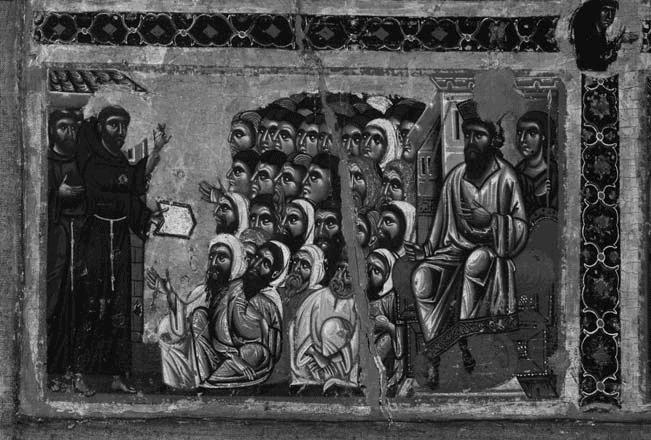 Figure 7. Bardi Dossal, ca. 1245, now in the Bardi Chapel in Santa Croce, Florence. Francis preaches to the Saracens. Reprinted by permission of akg- images, Paris.
In 1221, the Regula non bullata, the rule of the Franciscan order, encouraged missions among the infidels, specifying that superiors must not stand in the way of friars who were qualified to go, and that the friars must not fear death. Several Franciscans therefore set out in search of martyrdom: two met their deaths in Ceuta in 1227, five in Marrakech in 1232. Agnellus, bishop of Fez, also died in that city in 1246. Then ten Franciscans were martyred in the East between 1265 and 1269, and seven more in Tripoli in 1289. Other Franciscans lived more discreetly in Islamic countries, serving the Latin Christian communities (merchants, mercenaries, captives, slaves). But for many Franciscans, the Islamic countries were a stage on which the confrontation between apostles and “pagans” was being reenacted, and where the apotheosis of the former and the perdition of the latter were reproduced.
Other Franciscan missionaries endeavored to convert the Mongols. Giovanni dal Piano Carpini went to Karakorum between 1245 and 1247; Ascelin, to Tabriz (1246– 1247); and then William of Rubruck, also to Karakorum (1253– 1255).41 These friars did not seek out martyrdom but tried to use logical arguments, inspired by the apologetic and polemical textual traditions, to bring the Mongol chiefs to Christianity. William of Rubruck in particular attempted to convert various Mongol sovereigns, not by insulting their religious traditions but by engaging in debate with the followers of rival religions. He therefore participated in a debate before Möngke Khan in person, between representatives of Christianity, Islam, Buddhism, and Uyghur paganism.42 Not without pride, William describes his role in the debate. Having declared that there was only one God, he asked the Buddhist what he believed. The Buddhist replied that the gods were many: a supreme god in heaven and many lower gods. William then asked him whether one of these gods was all- powerful. The Buddhist sat in silence for a good while, until the khan’s scribes ordered him to reply. He acknowledged that no god was all- powerful: “Then all the Saracens erupted in a great burst of laughter.” William had scored one point for monotheism against Buddhism. Seen from Kharakorum, the Muslims were decidedly allies as much as rivals.
The Dominicans had their own missionary strategy, whose great promoter was Raymond of Penyafort, superior general of the order (1238– 1240), then adviser to James I, king of Aragon.43 He founded a language school so that the missionary friars could learn Arabic and Hebrew and read the sacred Muslim and Jewish texts. Embracing a textual critique of rival scriptures, they sought arguments that could both undermine the religion of their adversaries and confirm the truth of Christianity. Ramón Martí, a friar in Raymond of Penyafort’s entourage, produced a diptych for evangelizing the Muslims: the De seta Machometi, composed before 1257, and the Explanatio simboli apostolorum, written in 1257.44 The first text is devoted almost entirely to the life and deeds of Muhammad, whom Martí makes a scapegoat: it is the Prophet and his false law he attacks, not the wisdom of later Muslims. He tries to bring Arab philosophers into the Christian camp by turning their philosophical arguments against Muhammad. For example, he cites Averroes to demonstrate that a true prophet must produce miracles. Muhammad thus becomes Martí’s sole, but formidable, adversary: reason, natural law, philosophy, and even a good part of Muslim doctrine, he strives to demonstrate, are on the side of the Christians. In his Explanatio simboli apostolorum, Martí seeks to prove the truth of Christianity by presenting the main Christian doctrines and by providing explanations and justifications, while at the same time attempting to refute the Muslim objections to these doctrines. It is not known to what extent the Dominican missionaries actually used Martí’s arguments before a Muslim public. Laws promulgated under James I obliged the Jews and Muslims to listen to the sermons of the missionary friars in their synagogues and mosques. Ramón Martí, according to some of these contemporaries, traveled to Tunis and presented his Explanatio simboli apostolorum to the sultan.45
Riccoldo da Montecroce, a Florentine friar, went to Baghdad in about 1290 to learn Arabic and to attempt to convert Muslims.46 He describes his amazement at the city of Baghdad (which, however, was no longer what it had been before the Mongol sack of 1258): the sumptuousness of its houses, the beauty of its gardens, the devotion and generosity of its residents, the learning of its ulemas. Riccoldo studied the Qur’an in Arabic, and the book greatly perplexed him. For him, it was full of “lies,” such as the allegations that Jesus is not God, and that Jesus and his apostles were Muslims. What most troubled Riccoldo was that God should allow the “blasphemies” of the Qur’an. Hence he addresses a complaint directly to Jesus: irectlypMy heart stung to the quick, in unbearable pain while reading the Qur’an in Arabic, often, as you know, I have set the book down open upon your altar, in front of your image and that of your very holy mother, and have said: ‘Read, read what Muhammad says!’ And I have the impression that you do not want to read.”47 Far from punishing the “Saracens” for their “blasphemies,” God appears to favor them, granting them victory after victory over the Christians, especially during the capture of Acre by al- Ashraf Kahlīl, Mamluk sultan of Egypt.
Riccoldo returned to Italy in about 1300 and there composed his Against the Law of the Saracens, a refutation of the Qur’an. The friar was very familiar with the Qur’anic text, which he considered an out- and- out fabrication by Muhammad, whose incoherence, impiety, and irrationality Riccoldo denounces. In the Qur’an, Riccoldo declares, Muhammad teaches Christian truth without understanding it. To prove the existence of the Trinity, Riccoldo adopts the arguments of earlier polemicists, which are based on the fact that God is designated by plural nouns and pronouns. He also cites passages that, if we are to believe him, prove the existence of the Holy Spirit and of Christ, the Word of God. Observing that the Qur’an praises the Torah and the Gospels, he asks why, in that case, Muslims do not study them. If they were to do so, they would soon discover their error. But to avoid being confronted with the truth, they have banned the study of the Bible, just as they have forbidden that of philosophy. In truth, declares Riccoldo, the Saracens use four tricks to prevent their error from becoming glaringly obvious: they kill anyone who attacks the Qur’an; ban all religious disputes; put the Saracens on their guard by telling them not to believe what the non- Saracens say; and proclaim, “your law is for you, mine is for me.”48 It is nevertheless astounding in Riccoldo’s view that the Saracens prefer the Qur’an to the Gospels. Once again, it must have to do with their irrationality, for which there is only one remedy: “As a result, when certain doubts arise in the Qur’an, and certain questions to which the Saracens cannot reply, we must not only invite them but compel them to take part in the Banquet of Truth.”49 Since our rational arguments cannot persuade them, Riccoldo seems to be saying, we must force them to join the church. When dialogue fails, he recommends force. His book would become one of the most widely read anti- Islamic treatises between the fourteenth and the sixteenth centuries. Martin Luther would translate it into German. Riccoldo’s image of violent and irrational Saracen zealots, impervious to reason, and against whom only force would be effective was destined for a long career.
Humanism and the Rejection of Arab Culture
The intellectual ties between Arab and European culture weakened in the fourteenth and fifteenth centuries. The golden age of translations was past, though a few continued to appear, in medicine, for example. A new humanist movement, founded on reverence for antiquity, which developed in large part in the courts of the great princes of Italy, opposed the clerical culture of the universities. In their infatuation with the ancient world and their rejection of university culture, some humanists displayed their contempt for everything they disdainfully called “Gothic” or “medieval,” and in particular everything that was supposedly a Germanic or an Arab aggregate of the culture of antiquity.
The Florentine poet Petrarch (1304–1374), a friend of Boccaccio and passionate supporter of the Crusade, railed against the influence of Arab authors on his contemporaries’ ways of thinking. In his Letters of Old Age, Petrarch claims that the Greeks laid the foundations for medicine and that the Arabs, mediocre doctors, ought to be kept “in banishment” from it. “I hate the entire race” of the Arabs, he declares. Although he undoubtedly never read any Arabic p oetry, he considers them bad poets. He accuses European doctors of worshiping Averroes as a demigod, of preferring him even to Christ. He calls Averroes a “mad dog . . . who barks against his Lord, Christ” and infects his Christian admirers with his poison. He calls Muhammad an impostor, the inventor of absurd fables, and the object of a revolting cult at his tomb in Mecca (Muhammad’s tomb is actually in Medina).50 In the Divine Comedy, Dante places Averroes and Avicenna in the circle of the “good pagans,” next to the great teachers Plato and Aristotle. On many occasions, Boccaccio shows his sympathy and admiration for Arab figures, especially Saladin, and expresses a certain religious relativism in the fable of the three rings. There is nothing of the sort in Petrarch, who hated the Arabs and wanted to banish them.
He was not alone. In the late fifteenth century, Marineo Siculo believed that the reason Arabic was so rarely studied was that it was a barbarous language. A debate raged in the field of medicine in the fifteenth and sixteenth centuries: Should the Arabs be banished in an attempt to return to the “purity” of Greek medicine, to Galen and Hippocrates? Symphorien Champier (1471–1538), who taught medicine in Montpellier, acknowledged the value of Avicenna’s work but warned his readers against the bad influence that the “empty and barbarous philosophy” of that “impious apostate” could have on the Christian doctor. He cursed the doctors from European medical schools who allowed their university curriculum to be dominated by “Arabs, Persians, Indians, and Mahometans.” In his Three Books of the Medical Paradoxes (1535), Leonhart Fuchs affirms that the Arabs invented nothing; rather, like the Harpies, they plundered the Greeks and contaminated everything they touched.51
But other authors defended Avicenna and, more generally, the Arab authors’ contribution to science. The Canon remained a standard manual for medical education in Europe until the eighteenth century.52 Two friends, major figures of fifteenth- century humanism, Marsilio Ficino and Pico della Mirandola, express their admiration for the great Arab thinkers such as al- Farabi, Avicenna, and Averroes. Pico had read the Qur’an in Latin and tried to learn Arabic so that he could read the original. He concludes that each of the great religions contains a share of truth. In his Oration on the Dignity of Man, he cites approvingly a declaration of Muhammad’s, according to which the man who distances himself from divine law falls into bestiality.53 But at a time when the Ottomans were making major conquests in central Europe and in the Mediterranean, few humanists showed the open- mindedness of Ficino and Pico.
In certain fields, the effects on the level of knowledge were perceptible. Fifteenth- century cartographers were mad for Ptolemy, whom they considered the great ancient authority on the matter. Cartography regressed as a result, especially in the Mediterranean, where maps based on Ptolemy were much less precise than the portolan charts established on the basis of the concrete knowledge of navigators in the Mediterranean.54 The rejection of the Turk and the cult of Greco- Roman antiquity led to a refashioning of the European historical and cultural imagination. The rich common heritage of a shared Mediterranean civilization was denied. People began to think of “Islam” as a civilization foreign and hostile to Europe.