13
The structure of rational action
In this chapter, and in Chapter 18, I state some normative principles about how people should behave to realize their aims, whatever they might be, as well as possible. These principles can also have explanatory power, if we assume that social agents abide by them. In Chapter 14 and Chapter 19 I confront this assumption with empirical observations, and find it to be partly unfounded.
Rational-choice theorists want to explain behavior on the bare assumption that agents are rational. This assumption includes the hypothesis that agents form rational beliefs, including beliefs about the options available to them. There is no need, therefore, to classify the determinants of behavior as either subjective (desires) or objective (opportunities). Rational-choice theory is subjective through and through.
The structure of rational-choice explanation is laid out in Figure 13.1. An action is rational, in this scheme, if it meets three optimality requirements: the action must be optimal, given the beliefs; the beliefs must be as well supported as possible, given the evidence; and the evidence must result from an optimal investment in information gathering. In Figure 13.1 the arrows have a double interpretation, in terms of causality as well as of optimality. The action, for instance, should be caused by the desires and beliefs that make it a rational one; it is not enough to do the right thing by fluke. Similarly, a belief is not rational if it is the outcome of two oppositely biased processes that exactly cancel each other. To take an example, smokers as well as non-smokers process information about the dangers of smoking in ways that make them believe these are greater than in fact they are. At the same time, smokers are subject to a self-serving bias that makes them discount the risks. If as a result they form the same belief as an unbiased observer would hold,1 that does not prove they are rational. In one of the most influential discussions of rationality in the social sciences, Max Weber made the mistake of inferring “process rationality” from “outcome optimality” when he wrote that:
for the purposes of a typological scientific analysis it is convenient to treat all irrational, affectually determined elements of behavior as factors of deviation from a conceptually pure type of rational action. For example a panic on the stock exchange can be most conveniently analyzed by attempting to determine first what the course of action would have been had it not been influenced by irrational affects; it is then possible to introduce the irrational components as accounting for the observed deviations from this hypothetical course. Similarly, in analyzing a political or military campaign it is convenient to determine in the first place what would have been a rational course, given the ends of the participants and adequate knowledge of all the circumstances. Only in this way is it possible to assess the causal significance of irrational factors as accounting for the deviation from this type.
Although Weber was right in thinking that deviation from the rational course of action is a sufficient condition for irrationality to be at work, he erred in asserting (in the phrase I have italicized) that it was a necessary one. A similar mistake is involved in asserting that instinctive fear reactions are rational, when all that can be said is that they are adaptive. When I see a shape on the path that may be either a stick or a snake, it makes sense to run away immediately rather than gathering more information. It seems that human beings are in fact hardwired to do so. This flight behavior is not rational in the strict sense, since it is not produced by the machinery of rational decision making, yet it mimics rationality in the sense of being the very same behavior that that machinery would have produced had it been brought to bear on the situation. When the opportunity costs of gathering information (Chapter 14) are high, a rational agent will not collect much of it. Yet often the flight tendency is not caused by such calculations, but preempts them.2
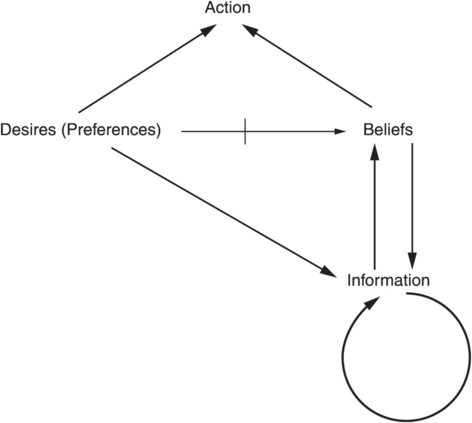 Figure 13.1
Preferences and ordinal utility
Spelled out more fully, the first optimality requirement is that the action must be the best means of satisfying the agent's desires, given his beliefs about the available options and their consequences. What is “best” is defined in terms of “betterness” or preference: the best is that than which none is better, as judged by the agent. There is no implication that the desires be selfish. The confusion of rationality and egoism is a crude error, although one that is facilitated by the practice of some rational-choice theorists. Nor do we need to require that desires be stable, not even in the minimal sense of excluding temporary preference changes. An agent who under the influence of emotion or drugs prefers A to B acts rationally in choosing A, even if she under other circumstances prefers B to A. A case in point (see Chapter 6) occurs when the weight the agent assigns to future consequences of present choice is diminished as the result of such influences.
For the analysis to get off the ground, the notion of “best” has to be well defined. Barring technicalities, two conditions ensure that this will be the case. First, preferences have to be transitive. Suppose there are three options, A, B, and C. If a person thinks A is at least as good as B and B at least as good as C, he should also think A at least as good as C. If transitivity fails, for instance if the person strictly prefers A to B, B to C, and C to A, he may not have a “best” option. Moreover another person can exploit this fact, by offering the agent a move from a less preferred to a more preferred option in return for a sum of money. Since preferences cycle, this operation can be repeated indefinitely, bringing about the person's ruin by a series of stepwise improvements.3
This situation can arise if the agent ranks the options by “counting aspects.” Suppose I choose one apple over another if it is better in at least two out of three aspects, such as price, taste, and perishability. If apple A beats apple B in price and taste, apple B beats apple C in price and perishability, and apple C beats apple A in taste and perishability, transitivity is violated. Although this possibility is relatively unimportant in individual choice, in which it merely reflects the failure of a rule of thumb, we shall see (Chapter 24) that it is more significant in collective choice.
A different problem arises when indifference fails to be transitive. I may be indifferent between A and B and between B and C, because the differences within each pair are too small to be noticeable, but prefer C to A because there is a detectable difference between them. There is an option that is “best,” namely, C, but it is still possible to make the agent worse off by making her a series of offers – exchanging C for B and B for A – that she has no reason to refuse and hence might well accept. What justifies calling an agent with intransitive preferences irrational is not so much the lack of a “best” option, but the fact that she may accept offers that make her worse off.
To ensure that the idea of “the best” is always a meaningful one we must also require that preferences be complete: for any two outcomes the agent should be able say whether he prefers the first to the second, prefers the second to the first, or is indifferent between them. If he is unable to make any of these three responses, he may not be able to determine which option is the best. I say more about incompleteness toward the end of the chapter. Here, I only want to note that unlike lack of transitivity, a lack of completeness is not any kind of failure. Suppose I want to give an ice cream to the one of two children who will enjoy it most. For me to have a preference over the two options, I would have to be able to compare their levels of preference satisfaction were they given the ice cream. Often, however, this is an impossible task. The failure to carry it out is not a failure, in the sense that I could have done better, but reflects simply a fact of life.
For many purposes, transitivity and completeness of preferences are all we need to identify the rational action. It is often convenient, however, to represent preferences by numbers, often called utility values, that are assigned to the options. To ensure this possibility we impose a further condition on preferences: continuity. If each option in a sequence A1, A2, A3, …, is preferred to B and the sequence converges to A, then A should be preferred to B; if B is preferred to each option in the sequence, B should be preferred to A. A counterexample is provided by “lexicographic preferences”: a bundle of two goods A and B in quantities (A1, B1) is preferred to another bundle (A2, B2) if and only if either A1 > A2 or (A1 = A2 and B1 > B2). In this preference ranking, the bundles (1.1, 1), (1.01, 1), (1.001, 1), …, are all preferred to (1, 2), which is preferred to (1, 1). Loosely speaking, we may say that the first component of the bundle is incomparably more important than the second, since no extra amount of good B can offset even the smallest loss of good A.4 Or, more simply, no trade-off is possible. Hence these preferences cannot be represented by indifference curves. Whereas lexicographic preferences rarely if ever apply to ordinary consumption goods, they can matter for political choices. A voter may prefer candidate A to candidate B if and only if A has a stronger pro-life attitude on abortion or if they have the same attitude on that issue and A proposes lower taxes than does B. For such voters, the “sacred value” of life may not be traded off against the secular value of money.
If the agent's preferences are complete, transitive, and continuous, we can represent them by a continuous utility function u that assigns a number u(A) to each option (A). Instead of saying that a rational agent chooses the best feasible option, we may then say that the agent maximizes utility. In this phrase, “utility” is a mere shorthand for preferences with certain properties. To see this, we may note that the only requirement for a function u to represent a preference order is that A is preferred to B if and only if u(A) > u(B). If u is always positive, v = u2 can also represent the same preference order, although v assigns larger or (for u < 1) smaller numbers than u. The absolute numbers have no significance; only their relative or ordinal magnitude has. Hence the idea of “utility-maximization” does not imply that the agent is engaged in getting as much as possible of some psychic “stuff.” It does, however, exclude the kind of value hierarchy embodied in lexicographic preferences. These cannot, in fact, be represented by a utility function.
Cardinal utility and risk attitudes
Often, agents face risky options, that is, choices that may, with known probabilities, have more than one possible outcome. Intuitively, it would seem that a rational agent would choose the option with the greatest expected utility, an idea that incorporates the utility of each outcome as well as its probability of occurrence. She would first, for each option, weigh the utility of each consequence by its probability and add up all the weighted utilities, and then choose the option with the greatest sum.
Ordinal utility does not allow us, however, to spell out this idea. Suppose there are two options, A and B. A can produce outcome O1 or O2 with probabilities 1/2 and 1/2, whereas B can produce outcome O3 or O4 with probabilities 1/2 and 1/2. Assume now a utility function u that assigns values 3, 4, 1, and 5 to O1, O2, O3, O4, respectively. The “expected ordinal utility” of A is 3.5 and that of B is 3. If instead we use the function v = u2, the numbers are 12.5 and 13. Each function represents preferences as well as the other, and yet they single out different options as “the best.” Clearly, this approach is useless.
It is possible to do better, but at some conceptual costs. The approach associated with John von Neumann and Oskar Morgenstern shows that one can assign the options utility values that have a cardinal and not merely ordinal significance. An instance of a cardinal value assignment is temperature. Whether we measure temperature in Celsius or Fahrenheit does not affect the truth value of the statement “the average temperature in Paris is higher than the average temperature in New York.” (If temperatures were measured ordinally, this statement would not make sense.) By contrast, the truth value of the statement “It is twice as hot in Paris as in New York” does depend on the choice of scale. Yet although the truth value of this particular statement about intensities is scale sensitive, others are not. The truth value of the statement “The temperature difference between New York and Paris is greater than that between Paris and Oslo,” for instance, does not depend on the choice of scale. Similarly, we can construct cardinal measures of utility that reflect – among other things, as we shall see – the intensity of preferences and not merely the ordinal ranking of options. These enable us to compare the utility gain (or loss) of going from x to (x + 1) to that of going from (x + 1) to (x + 2), that is, to talk about increasing or decreasing marginal utility – concepts that are meaningless for ordinal utility measures.
The technical details of the construction need not concern us, as the basic idea is simple and sufficient for present purposes. We begin by assuming that agents have preferences not simply over options, but over lotteries of options (including the “degenerate lotteries” that consist of getting a basic option for sure). For any given set of basic options or “prizes,” a lottery specifies, for each prize, the probability of obtaining it, the probabilities adding up to 1. Agents are assumed to have complete and transitive preferences over such lotteries. Preferences are also assumed to obey an “independence axiom”: the preference between two lotteries p and q is unaffected if they are both combined in the same way with a third lottery r. The “certainty effect” cited in Chapter 7 and further discussed in Chapter 14 violates this axiom.
Finally, preferences are assumed to exhibit a form of continuity, defined as follows. Suppose the basic options include a best element A and a worst element B. We assign them, arbitrarily, utility numbers 1 and 0. Continuity means that for any intermediate option C there is a probability p(C) that would make the agent indifferent between getting C for certain and engaging in a lottery that would give him A with probability p(C) and B with probability 1 – p(C).5 We then define the cardinal utility u(C) as equal to p(C). This number, to be sure, is arbitrary because the end-point utilities are. Suppose we assign utility numbers M and N to A and B, respectively (M > N). We then define the utility of C as the expected utility of the lottery:
The class of utility functions that arise in this way is much smaller than the class of ordinal utility functions.6 It is easy to see that if option X has greater expected utility than Y according to one function, it will also have greater expected utility according to any other. Thus we can assert, without ambiguity, that a rational agent maximizes expected utility.
Cardinal utility functions have the important property of being linear in probability. Let us introduce the notation XpY, meaning a lottery that offers probability p of getting X and 1 – p of getting Y. Using the 1 – 0 end-point scale, the utility u(X) equals the probability q at which the agent is indifferent between X and the lottery AqB. Similarly, the utility u(Y) equals the probability r at which he is indifferent between Y and the lottery ArB. XpY, therefore, offers the utility equivalent of a chance p of getting A with probability q and a chance 1 – p of getting A with probability r. The utility of XpY, therefore, is pq + r(1 – p), which is p times the utility of X plus (1 – p) times the utility of Y. For instance, the utility of the probabilistic combination of a 3/5 chance of getting X and a 2/5 chance of getting Y is 3/5q + 2/5r.
Somebody could make the following objection. Suppose a farmer has the choice between two crops: the traditional variety that is equally likely to produce a good or a mediocre harvest, depending on the weather, and a modern variety that is equally likely to produce an excellent crop or a poor one. Suppose the cardinal utilities are 3 and 2 for the old crop, 5 or 1 for the new one. Since the expected utility of the new crop is larger, that is what the farmer ought to choose. But – the objection might go – does this not disregard the fact that the farmer might be risk-averse and unwilling to accept any option that might lead to a utility level as low as 1? The objection involves double-counting, however, as risk aversion is already incorporated in the construction of the cardinal utilities. Assuming that A, B, and C take the values of 100, 0, and 60, u(C) might well be 0.75 for a risk-averse person, implying that she is indifferent between getting 60 for certain and a lottery that leaves her with a 25 percent chance of getting nothing and a 75 percent chance of getting 100. A similar argument applies to the assignment of cardinal utility values to physical amounts of the crop.
For another illustration, consider the allocation of child custody (see Figure 13.2). The horizontal axis can be understood in two ways, as involving either a physical division of custody (percentage of the time spent with the child) or a probabilistic division (the chance of being awarded full custody in a court of law). The cardinal utility of equal time sharing is AE, which is greater than the utility AC of a 50 percent chance of full custody. (Here we appeal to the fact that cardinal utility is linear in probability.) The reason is that most people in this situation display risk aversion. They are willing to accept joint custody because a 50 percent risk of not being able to see the child at all is intolerable. It is only if a parent believes that his or her chance of getting full custody is greater than q percent that litigation is preferable to joint custody. If there is a considerable amount of custody litigation it is not because parents are risk lovers, but because wishful thinking makes them exaggerate their chance of being awarded custody.
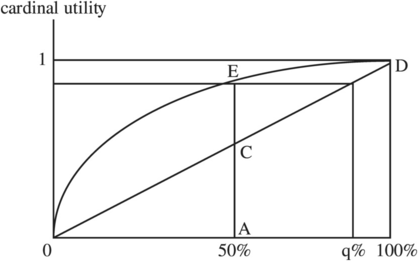 Figure 13.2
Risk aversion and decreasing marginal utility
The preceding exposition, while accurate, could be misleading. There is a tendency in part of the literature to blur the distinction between risk aversion and decreasing marginal utility. To develop this point, I need to introduce a concept that is intuitively meaningful, although it has not (so far) lent itself to measurement. This is the idea of the intrinsic utility of a good, reflecting the intensity of preferences of the agent. Introspection tells us compellingly that some goods or experiences are immensely enjoyable, others merely satisfying, still others mildly annoying, and some downright dreadful. To represent the difference between them merely in terms of ordinal preferences – “I prefer heaven to hell, just as I prefer four apples to three” – is clearly to use a very impoverished notion of welfare or utility. The fact that there is no reliable way of assigning numbers to intrinsic levels of satisfaction or dissatisfaction does not prove that the idea is meaningless, any more than our inability to quantify and compare the levels of satisfaction of different individuals shows that the idea of interpersonal comparison of welfare is meaningless.
The idea that many goods have decreasing marginal utility may be understood in this perspective. For a poor person, the first dollars have great utility, but then each successive extra dollar becomes worth less in subjective terms. Every smoker knows that the first cigarette in the morning is the best one, and that you enjoy each cigarette more if you pace yourself and do not smoke too frequently. Smoking a cigarette, in fact, has two effects: producing enjoyment in the present and reducing the enjoyment of future cigarettes.
The second effect does not, however, have to be negative. Consider again the child custody case. For a parent, one afternoon with the child every other weekend may provide more frustration than satisfaction. An afternoon every weekend is more than twice as satisfying, because the stronger emotional bonds created by more frequent encounters make each of them more satisfying. At the other end of the time spectrum, the extra satisfaction of being with the child seven days a week rather than six exceeds the extra satisfaction of six days rather than five, because full custody provides the benefits of unconstrained planning. Being with the child, in fact, has increasing marginal (intrinsic) utility, as shown in Figure 13.3.
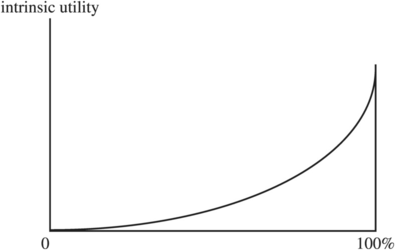 Figure 13.3
Here, the interpretation of the horizontal axis is the percentage of the time spent with the child. For the reasons just given, each extra hour is more valuable than the preceding one. This statement is perfectly compatible with the analysis underlyingFigure 13.2. The marginal utility of time spent with the child may be decreasing if utility is understood as cardinal utility, but increasing if it is understood as intrinsic utility. The fact that only the first part of this statement has a measurable interpretation does not imply that the second is meaningless.
While cardinal utility functions are always generated by two underlying psychological factors, risk attitudes and intrinsic utility, these cannot be measured separately. We cannot tell in any rigorous way whether the curve OED in Figure 13.2 is derived from risk neutrality combined with decreasing marginal intrinsic utility of time spent with the child or from risk aversion combined with increasing marginal intrinsic utility of time spent with the child. In a given case, intuition may tell us that the one or the other interpretation is more plausible. For some parents, time spent with the child may be experienced the way it is by many grandparents: it is good in small doses but soon becomes exhausting. At the same time, these parents may not worry much about the risk of not spending any time at all with the child (risk neutrality). Other parents might differ in both respects, generating the same cardinal utility function. To repeat, or re-repeat, these statements cannot (so far) be made rigorous, but they make obvious sense.7
Rational beliefs
This concludes the discussion of the first component of a rational choice: choosing the best means to realize one's desires, given one's beliefs. Clearly, this is only a necessary condition for rationality, not a sufficient one. If I want to kill my neighbor and believe the best way of killing someone is to make a puppet representing him and stick a pin through it, I act rationally (as far as this first component goes) if I make a puppet representing my neighbor and stick a pin through it. Barring special circumstances, however, that belief is hardly rational.8
Rational beliefs are those that are shaped by processing the available evidence using procedures that, in the long run and on average, are most likely to yield true beliefs. Suppose we want to form a belief about the likelihood of rain on November 29, one week from today. We can probably not do much better than look up the statistics of rainfall in earlier years and assume that the (expected) future will be like the past. But as November 29 approaches, current rainfall may make us modify our expectations. If it often rains in November and we experience day after day with unclouded skies, we might infer the existence of a high-pressure system that makes rain on November 29 somewhat less likely.
This process of belief revision is often called Bayesian learning (named after the eighteenth-century minister Bayes). Assume that we have an initial (“prior”) subjective probability distribution over different states of the world. In the example just given, the prior distribution was derived from past frequencies. In other cases, it might be a mere hunch. On the basis of my intuition, I might assign, for instance, probability 60 percent to the prime minister's (PM's) being competent and 40 percent to his being incompetent. We can then observe the actions he takes in office and their outcomes, such as the rate of growth of the economy. Suppose we can form an estimate about the likelihood of these observations given the competence of the PM. With a competent PM we have an 80 percent expectation of a good outcome, with an incompetent only 30 percent. Bayes showed how we can then update our initial probabilities concerning the PM's competence, given the observations.
Assume that there are only two possible outcomes, good or bad, and that we observe a good one. If we write p(a) for the probability that a obtains and p(a | b) for the conditional probability that a obtains given that b obtains, we have assumed that p(PM is competent) = 60 percent, p(PM is incompetent) = 40 percent, p(good outcome | PM is competent) = 80 percent, and p(good outcome | PM is incompetent) = 30 percent. We seek to determine p(PM is competent | good outcome). We use the letters a and b to denote, respectively, competence and good outcome. We then note first that
(*)
In words, the conditional probability p(a | b) equals the probability that both a and b obtain, divided by the probability of b. This follows from the more intuitive idea that p(a & b) equals p(b) multiplied by p(a | b). Dividing both sides of this equation by p(b), we get equation (*).
Using equation (*) again, but with a and b reversed, we have
or, equivalently,
Substituting the latter expression in (*), we obtain
(**)
Now, there are two ways for b (the good outcome) to occur, with a competent PM or with an incompetent PM. Drawing on the fact that the probability that one of two mutually exclusive events will occur is the sum of the probabilities for each event, we can thus write
which, by the reasoning in the paragraph following (*), is equivalent to
If we substitute this expression for p(b) into (**), we obtain Bayes's theorem:
9
Plugging in the numerical probabilities on the right-hand side of this equation tells us that p(a | b) = 80 percent, that is, that the observation of a successful outcome raises the likelihood that the PM is competent from 60 percent to 80 percent. A second and a third positive observation would raise it to 91 percent and then to 97 percent. If another person initially estimated p(a) = 0.3 rather than 0.6, three successive positive observations would raise her estimate first to 0.53, then to 0.75, and finally to 0.89. Hence it may not matter much whether the initial hunches are unreliable, since as more and more information comes in the updated beliefs become more and more trustworthy. Over time, initial differences of opinion can be swamped by new evidence.10 For future reference (Chapter 22), we also note that each new piece of information has less of an impact than the previous one.
Optimal investment in information-gathering
The third component of a rational action is the optimal investment of resources – such as time or money – in acquiring more information. As shown in Figure 13.1 there are several determinants of this optimum. First, how much information it is rational to acquire depends on the desires of the agent.11 For instance, an agent who does not care much about rewards in the distant future would not invest much in determining the expected lifetime of a durable consumption good. More obviously, it makes sense to gather more information before making an important decision such as buying a house than when choosing between two equally expensive bottles of wine. In the latter case, one should perhaps just decide by flipping a coin, if the expected cost of determining which is the better exceeds the expected benefit (based on a prior knowledge of the quality range of equally priced wines) from drinking the better wine rather than the inferior one.
Desires and prior beliefs jointly determine the expected benefits from new information. It is sometimes possible to tell with great precision how many additional lives will be saved by doing a specific test for cancer or, translated to the level of the agent, how likely it is that his or her life will be saved. The value of life depends on how the agent goes about trading off life against other desired ends. By one calculation, a premium of about $200 per year was required to induce men in risky occupations such as coal mining to accept one chance in a thousand per year of accidental death. Hence at the time this calculation was done, the value of a life was about $200,000.12 The expected costs of new information, which are determined by prior beliefs, can also sometimes be ascertained with precision. To detect intestinal cancer, it is common to perform a series of six inexpensive tests on a person's stool. The benefits of the first two tests are significant. However, for each of the last four tests the costs of detecting an additional case of cancer (not even curing it) were found to be $49,150, $469,534, $4,724,695, and $47,107,214, respectively.
The optimal search for information may also depend on the results of the search itself (this is represented by the loop in Figure 13.1). When a new medical product is being tested, there is a prior decision to provide the medication to one group and withhold it from another for a certain period. If it becomes evident early on, however, that the product is spectacularly successful, it would be unethical to withhold it from the control group. The same argument applies to a single rational agent. Suppose I am out in the woods plucking berries. I know that berries tend to grow in clusters, so I am prepared to spend some time looking before I start plucking. If I am lucky and find an abundant patch right at the beginning, I would be foolish to keep on looking.
We may view the gathering of information as a shadow action that accompanies the primary action. Before deciding what to do, we have to decide how much information to collect. Sometimes, the shadow action and the primary action may coincide, at least partially. Suppose the leaders of a country are weighing whether to go to war against another country. Germany's invasion of France in 1940 can serve as an example. To make the final decision whether to attack, information was crucial. The leaders needed to know the objective capacities of the prospective enemy, as well as “the organization, customs and habits of the enemy's army” (from the German manual Duties of the General Staff). Much of this information could be gathered by conventional means, including spying. However, to determine the morale of the enemy – their fighting spirit – there was no other option than actually fighting them.
Indeterminacy
These last examples – plucking berries and planning for war – will also help us see the limitations of rational-choice theory, or rather one of its two limitations. As an explanatory tool, the theory can fail in one of two ways. On the one hand, it may fail to yield unique predictions about what, in a given situation, people will do. On the other hand, people may fail to live up to its predictions, whether unique or not. The second failure, irrationality, is the topic of the next chapter. The first, indeterminacy, is the topic of the following remarks.
An agent may be unable to identify the best element in the feasible set, for one of two reasons. A consumer may be indifferent between two options that are equally and maximally good. In trivial cases, this happens when the options are indistinguishable, as when a consumer faces the choice between two identical cans of soup in the supermarket. In non-trivial cases, two options might differ along several dimensions so that the differences exactly offset each other. The non-trivial case is rare, perhaps non-existent. If offered a choice between two cars that differ in price, comfort, appearance, speed, and so on, I might not prefer either to the other without, for that matter, being indifferent between them. If I were, a five-cent discount on one car should induce a preference for that option. Intuition suggests that this is unlikely to happen.
In fact, the consumer's preferences may be incomplete. Suppose I have inspected five car models, A, B, C, D, and E, and rank them as shown in Figure 13.4 (arrows standing for the preference relation). My inability to compare C and D does not matter, since I am not going to buy either of them anyway. By contrast, my inability to compare A and B leaves me in a pickle. True, I might try to gather more information, but how do I know it is worth the trouble? I return to this point shortly.
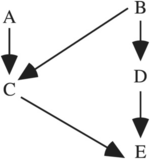 Figure 13.4
First, however, let me point to another and probably more important source of incomplete preferences. Typically, option preferences are induced by outcome preferences. I prefer one option because I prefer its outcome, that is, its expected utility, compared to that of other options. If the situation is one of uncertainty or ignorance rather than risk (Chapter 7), however, I may not be able to compare the outcomes.13 In the immortal words of Dr. Johnson, “Life is not long, and too much of it must not pass in idle deliberation how it shall be spent: deliberation, which those who begin it by prudence, and continue it with subtlety, must, after long expence of thought, conclude by chance. To prefer one future mode of life to another, upon just reasons, requires faculties which it has not pleased our Creator to give to us.”14 In the equally memorable words of Keynes, “Most, probably, of our decisions to do something positive, the full consequences of which will be drawn out over many days to come, can only be taken as a result of animal spirits – of a spontaneous urge to action rather than inaction, and not as the outcome of a weighted average of quantitative benefits multiplied by quantitative probabilities.”
A further indeterminacy arises in the difficulty of determining the optimal investment in information gathering. When I am out plucking berries in unknown territory, how long should I keep looking for a dense cluster and when should I begin plucking? Unless I find a rich patch right away, it makes sense to spend some time looking around. At the same time, I do not want to keep looking until nightfall, because then I shall certainly go home with an empty basket. Between the lower and the upper bounds on the time one should spend looking, there may be a large interval of indeterminacy. A different problem arises in the case of planning for war. If the primary decision and the shadow decision coincide, the planner is doomed to remain in a state of (at least partial) uncertainty. Rational-choice theory cannot guide us well in these situations. The theory is helpful in highly structured situations about which a great deal is known, such as testing for cancer, but less so in unknown environments.
Whereas spending less time than the lower bound and more than the upper bound would be irrational, no choice the agent makes within this interval can be characterized as irrational. One might therefore, perhaps, think about dropping the idea of rationality in favor of that of non-irrationality. This revised version of the theory would allow us to make sense of a greater range of behavior but have less predictive power. Most practitioners of the theory would, I believe, be reluctant to revise the theory along these lines. What attracts them to the theory in the first place is precisely that it holds out the promise of generating unique predictions. It does so by virtue of the elementary mathematical fact that any “well-behaved” utility function defined over a “well-behaved” opportunity set attains a maximal value for a unique member of that set. The interaction between opportunity set and indifference curves in Figure 10.1 offers a good example of the compelling simplicity of this idea, “doing as well as one can.”
Indeterminacy can also arise if the feasible set is unknown and unknowable, as is the case in the search for innovations. The “innovation-possibility frontier” that some economists stipulated to propose a rational-choice explanation of technical change is an essentially meaningless concept. More generally, creativity cannot be reduced to a rational procedure. This proposition is obvious when it comes to artistic creation (Chapter 16), but applies to other cases as well. Scholars have proposed the idea of integrative bargaining, to move from a zero-sum activity in which one party's loss is the other party's gain to one in which both parties profit. An often-cited example is that of two sisters who were bargaining over an orange and split it in half. One sister who wanted only the juice, squeezed it out, drank it, and threw out the peel. The other sister, who wanted only the peel for a cake she was baking, threw out the pulp. Clearly, both could have done better. Yet in a given case, a mutually beneficial solution of this kind may not exist. A clever arbitrator may be able to think of one – or not.
Finally, an important source of belief indeterminacy arises in strategic interaction, when each agent has to form beliefs about what others are likely to do on the basis of their beliefs, knowing that they are going through similar reasoning with regard to his. In some cases, further considered in Chapter 18, the reward structure does not allow the agents to converge to a commonly held set of beliefs.
Rational choice under uncertainty
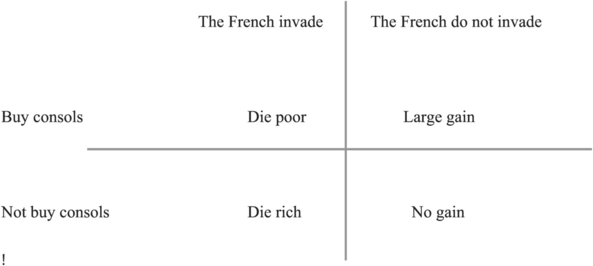
Often, agents are not able to make a rational choice in conditions of uncertainty. In some cases, though, rationality under uncertainty is well defined. Thus in England in 1797–8, the fear of an imminent French invasion bought the value of consols (government bonds) down to half their price. A smart investor, Thomas Thompson of Hull, decided that “if the French landed it mattered not whether he met his fate as a rich man or a poor one,” and invested heavily in the funds. When the invasion threat vanished and consols revived, he made a killing. The situation may perhaps be reconstructed as in Table 13.1.
Table 13.1
|
|
In the language of economists, the option of buying the consols has stochastic dominance: it can never be worse than not buying, and it can be better. Since this statement makes no appeal to probabilities, it is consistent with the investor being in a state of complete uncertainty about the invasion. In experimental treatments of fatal diseases with no known cure, it is also rational to apply the principle “Can't hurt, might help” without any knowledge about the prospects of a successful outcome. A murderer who would get the death penalty if caught might rationally decide to kill any witnesses to his act, reasoning that he might as well be hanged for a sheep as for a lamb. This decision, too, requires no probabilistic reasoning, except for the tacit assumption that a multiple murder will not trigger a more intensive search with a higher probability of capture. If that assumption is unjustified, rational-choice theory will not tell the murderer what to do. He cannot compare the expected values of committing one murder and committing several, since he only knows the ordinal probabilities (Chapter 7) of being caught if he makes the one and the other choice. Calculation of expected value requires both cardinal utilities and cardinal probabilities.
Rationality is subjective through and through
Let me conclude the discussion of rational-choice theory by emphasizing again its radically subjective nature. One might, to be sure, take the word “rational” in an objective sense, implying that a rational agent is one who makes decisions that make his life go better as judged by objective criteria such as health, longevity, or income. Used in this way, however, the idea would not have any explanatory power. As I have emphasized, consequences of a decision cannot explain it. Only the mental states that precede the decision enable us to explain the actions as optimal from the point of view of the agent rather than to characterize them as useful or beneficial from the point of view of an external observer (or of the agent at a later time).
Suppose I suffer from a severe inability to defer gratification, that is, from being unable to take account of future consequences of present behavior. And suppose scientists came up with a discounting pill, which would increase the weight of future rewards in present decisions. If I take the pill, my life will go better. My parents will be happy I took the pill. In retrospect, I will be grateful that I did. But if I have a choice to take the pill or not, I will refuse if I am rational. Any behavior that the pill would induce is already within my reach. I could stop smoking, start exercising, or start saving right now, but I do not. Since I do not want to do it, I would not want to take a pill that made me do it. Similarly, a selfish person would refuse an “altruism pill” and, even more compellingly, an altruistic person a “selfishness pill.” If I love my family and am willing to sacrifice some of my hedonic welfare for their sake, I would refuse a pill with the two-step effect of lowering theirs, just as I would refuse any option (e.g. buying an expensive meal for myself) that produced the same effect in one step.
To sharpen the argument, assume that a person consumes x today and y tomorrow, and that her one-period discount rate is 0.5 (she is indifferent between one unit of utility tomorrow and one half-unit today). Assume for simplicity that u(x) = x and u(y) = y. The discounted presented value of her consumption stream is x + 0.5y. Suppose the person learns that tomorrow she is going to suffer from pain that will reduce the utility of her consumption by a factor of 0.5. The discounted present value of consumption now is x + 0.25y. If a rational agent is offered a costless aspirin that will eliminate the pain, she would clearly take it, thus restoring the original present value. If she took a pill that induced a discounting rate of 1 (but did not take the aspirin) the outcome would be the same in the sense that in either case, she would be indifferent between the two-period stream and a period-one utility of x + 0.5y. Since the agent would take the aspirin and since its effect is the same as that of the discounting pill, why would she not take the latter? The reason is that the choice of the discount pill is constrained by the need for the pill-induced consumption to be superior to non-pill consumption as judged by prepill preferences. There is no similar constraint on the aspirin choice, because there is no difference between pre-aspirin and post-aspirin preferences. Even without the aspirin I prefer being able to be free of pain tomorrow. When that state becomes part of my repertoire, I choose to bring it about. By contrast, the utility stream induced by the discounting pill is already in my repertoire, but I choose not to bring it about.15
Choices, in other words, need to be seen through the eyes of the agent. A myopic person who loses his glasses may be prevented by his myopia from finding them. He is “trapped.”16 Similarly, a rational agent may find himself in a “belief trap” that leaves him stuck with a false belief, namely, if the believed costs of testing the belief are too high. Thus women who practice genital mutilation may be caught in a belief trap. The Bambara of Mali believe that the clitoris will kill a man if it has contact with the penis during intercourse. In Nigeria, some groups believe that if a baby's head touches the clitoris during delivery, the baby will die. In Poland it has been widely believed that anyone who drinks when using disulfiram (Antabuse) implanted under the skin will die. As a matter of fact, implanted disulfiram is pharmacologically inert. The false belief might nevertheless deter people from testing it.
The rationality of beliefs is a completely different matter from that of their truth. Whereas truth is a feature of the relation between the belief and the world, rationality is a feature of the relation between the belief and the evidence possessed by the agent. Although rationality may require the agent to invest in new information, the investment is always constrained by its expected (that is, believed) costs and benefits. If gathering more information is believed to have high opportunity costs, as in the face of a possible imminent danger, it may be rational to abstain from the investment. If it is believed to have high direct costs, as in testing the belief about the fatal effects of drinking while using implanted disulfiram, only an irrational person would make the investment. More generally, many beliefs must be taken at face value secondhand, since if we were to test them all we would never get on with our lives.
Any choice-based explanation of behavior is subjective. Not all subjective explanations assume, however, the transparency of the agents to themselves and the relentless search for optimality that are the hallmarks of rational-choice explanations. In the next chapter I shall canvass a number of explanations that depart from rational-choice theory on one or both accounts.
Bibliographical note
I discuss the relation between reason (in the sense of Chapter 4) and rationality in my inaugural lecture at the Collège de France, Raison et raisons (Paris: Fayard, 2006). For more about Weber and rationality, see my “Rationality, economy, and society,” in S. Turner (ed.), The Cambridge Companion to Weber (Cambridge University Press, 2000). A classic exposition of utility theory is found in R. D. Luce and H. Raiffa, Games and Decisions (New York: Wiley, 1957). The original work by J. von Neumann and O. Morgenstern, The Theory of Games and Economic Behavior, 2nd edn (Princeton University Press, 1947), is still worth consulting. An outstanding exposition of rational-choice theory (and its problems) is R. Hastie and R. Dawes, Rational Choice in an Uncertain World (Thousand Oaks, CA: SAGE, 2001). I discuss the child custody example at greater length in Chapter 3 of Solomonic Judgments (Cambridge University Press, 1989). An excellent elementary presentation of Bayesian theory is R. Winkler, An Introduction to Bayesian Inference and Decision (Gainesville, FL: Probabilistic Publishing, 2003). I discuss and criticize the idea of an “innovation possibility frontier” in Explaining Technical Change (Cambridge University Press, 1983), pp. 104–5. The story about Thomas Thompson is taken from J. Uglow, In These Times (London: Faber and Faber, 2014), p. 223. My argument that a rational person would not take the discounting pill has been influenced by exchanges with Gary Becker and Peter Diamond; see also O. J. Skog, “Theorizing about patience formation: the necessity of conceptual distinctions,” Economics and Philosophy 17 (2001), 207–19. I take the idea of a belief trap from G. Mackie, “Ending footbinding and infibulation: a convention account,” American Sociological Review 61 (1996), 999–1017. A useful study of the importance of intelligence in preparing for war is E. R. May, Strange Victory: Hitler's Conquest of France (New York: Hill & Wang, 2000). I owe the information about the use of implanted disulfiram in Poland to W. Osiatynski, Alcoholism: Sin or Disease? (Warsaw: Stefan Batory Foundation, 1997), and the data about its ineffectiveness to J. Johnsen and J. Mørland, “Depot preparations of disulfiram: experimental and clinical results,” Acta Psychiatrica Scandinavica 86 (1992), 27–30.
1 As a matter of fact, the second bias of the smokers does not fully compensate for the first.
2 In rats, the delay between the unthinking response and the reflective one is about 10 milliseconds.
3 An agent who discounts the future hyperbolically may also be trapped in this way. See Chapter 9 for another way of “improving oneself to death.”
4 The intuitive notion of incomparability may, therefore, be spelled out in two distinct ways: as incomplete preferences or as discontinuous preferences.
5 Identifying this probability raises the problems of anchoring cited in the introduction to Part II.
6 Any two such functions are in fact related to each other as are the Celsius and Fahrenheit temperature scales, which assign different values (corresponding to M and N in the text) to the temperatures at which water boils and freezes.
7 Hence the analogy with temperature scales is only partly valid. These scales measure only the intensity of temperature. Cardinal utility functions measure the joint result of intensity of preference and risk attitudes.
8 Belief in witchcraft may be self-fulfilling, if the cursed person believes in the efficacy of the curse and simply loses the will to live. In that case, the observed efficacy of the curse might make belief in witchcraft rational, even if (as with the theory of action at a distance) the agent cannot specify the mechanism by which it works. It could also make witchcraft punishable on the basis of its actual consequences rather than, as suggested by Donne and Hobbes (see introduction to Part II), on the basis of mens rea only.
9 If p(a) = 1, the formula yields p(a | b) = p(a), for any b. In other words, complete certainty is impermeable to new evidence. In particular, fanatics can never be persuaded that they are wrong. In Hume's example, “An English Whig, who asserts the reality of the popish plot, an Irish Catholic, who denies the massacre in 1641 and a Scotch Jacobite, who maintains the innocence of queen Mary, must be considered as men beyond the reach of argument or reason, and must be left to their prejudices.”
10 For the convergence to occur, the successive pieces of new information must be statistically independent of each other. In the textbook example of Bayesian belief formation, a person draws balls from an urn known to be equally likely to contain either 80 percent black and 20 percent white balls or 20 percent black and 80 percent white in order to determine how likely it is that the one or the other obtains. Since the draws are random and the balls are put back into the urn after each draw, the outcome of each draw is independent of the previous ones. In political situations such as the one described in the text, it may be much more difficult to verify independence. Also, convergence presupposes that the underlying situation remains the same or at least does not change too fast. If the environment changes rapidly, the process of updating beliefs resembles that of aiming at a moving target (Chapter 6).
11 Wishful thinking, in which “the wish is the father of the thought,” is clearly irrational. By contrast, there is nothing irrational about the process shown in Figure 13.1, in which the desires are, as it were, the grandfather of the beliefs.
12 There are many pitfalls in making such calculations, but the general point is impossible to deny: we all attach a finite value to our lives. If we did not, we would not engage in all the enjoyable or profitable risky activities that we do.
13 In decision making under uncertainty, I may be able to compare options if the worst outcome of one option is better than the best outcome of another. In decision making under ignorance, even this modest comparability is unavailable.
14 I might, however, “conclude by chance” and then invent the “just reasons,” for instance, by giving greater weight to the attributes on which the chosen option is clearly superior. This can have undesirable consequences. Suppose I have the choice between going to law school and going to forestry school. Being unable to make a reason-based choice, I go to law school more or less by chance and justify the decision retrospectively by giving more weight to the income dimension of the two careers. With these newly induced preferences, I might go on to make other decisions that differ from those I would have made on the basis of my pre-choice preferences.
15 With hyperbolic discounting, an agent might accept a discounting pill. Using the numerical example from Chapter 6, suppose that the effect of the pill is to lower the value of k from 1 to 0.3. At the time the smaller reward becomes available, its present value is simply 10 (no discounting). The present value of the larger reward of that time is 30/(1 + 0.3.5) = 12. Hence precommitment in the form of taking the pill will enable the agent to act in accordance with his calm and reflective judgment, thus preventing weakness of will (in the broad sense). This statement remains true even if he has to buy the pill, as long as its cost (in utility terms) is less than 2. It also remains true if precommitment has the effect of reducing the value of the delayed reward (perhaps the discounting pill has the side effect of reducing the capacity for enjoyment), as long as the loss is less than 5. These facts might be relevant if for the discounting pill we substitute psychotherapy.
16 If offered his glasses, he would put them on. I have argued that if offered the discounting pill, he would not take it. The difference is that he can already do without the discounting pill anything he could do if he took it, whereas there are many things he cannot do without his glasses that he could do if he put them on.