Obscurantism
Drawing on previous chapters and sometimes adding to them, I shall present my ideas about how social science should be done, and how it should not be done. Beginning with the latter, I shall criticize soft and hard obscurantism in the social sciences and, more briefly, soft obscurantism in the humanities. The criticism is twofold. On the one hand, obscurantism causes a massive waste, when students, scholars, and professionals spend years and careers learning, teaching, and practicing nonsense when they could have devoted their lives to work that would have been more useful to society and more fulfilling to themselves.1 On the other hand, obscurantism can do harm, by creating the intellectual premises for actions that cause suffering or economic loss. In addition to criticizing obscurantist theories on these grounds, I shall also try, more tentatively, to explain their emergence and persistence.
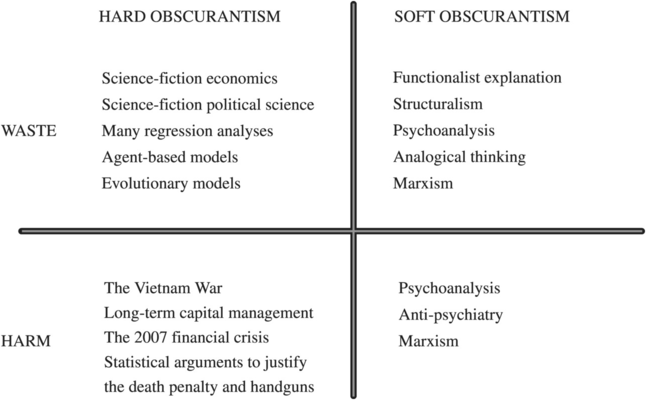
As a preview of the argument, let me fill in the cells that are created if we cross the two distinctions with each other (see Table C1). I shall discuss these theories and their effects, selectively and for the most part briefly.
Table C1
|
|
To document waste, intellectual criticism is sufficient. I feel confident in my objections to soft obscurantist theories and to some forms of hard obscurantism. Specifically, I know enough about science-fiction economics and political science – based on the assumption of ideally rational agents that have never existed and will never exist – to criticize them, which I shall do at some length. My objections to regression analyses are second-hand, and based on criticisms by more competent scholars. Although the appeal to authorities rather than argument is commonly, usually for good reasons, viewed as an academic sin, the stakes are so high that I am willing to risk my reputation.
To document harm, causal analysis is needed. I shall make some gestures in that direction, without fully substantiating my claims. Some harms are easily documented, whereas others are more uncertain. It is not clear, for instance, whether the belief in science-fiction economic theories was causally responsible for the recent financial crisis, or whether Marxism as an intellectual doctrine was causally responsible for the horrors committed in its name. I shall not try at all to justify my skepticism about agent-based models and evolutionary models, except to remark that the former seem to be getting out of hand as they are becoming increasingly opaque and that the latter have little empirical relevance.
Fighting a two-front war, as I do here, is difficult. Tocqueville wrote that the “Constituent Assembly of '89 was dispatched to fight aristocracy and despotism, and it was quite vigorous in opposing those enemies but [not] in opposing anarchy, which it was not prepared to combat … It is rare for a man and almost impossible for an assembly to have the ability to alternately make violent efforts in two opposite directions. The energy that launched it violently in one direction impeded its progress in the other.” In my case, the energy I spent over many years attacking soft obscurantism probably impeded my progress in the opposite direction. The French Revolution also illustrates another phenomenon: moderates suffer a constant risk of one group of extremists accusing them of being in league with the other, or of each group trying to engage them as an ally in the fight against the other. These, too, are experiences in which I recognize myself.
Soft obscurantism
A minor philosophical subdiscipline, bullshittology, studies the academic writings that constitute soft obscurantism. In my opinion, the study of bullshit ought to have its main location within cognitive psychology and the sociology of science, not within philosophy. Although conceptual analysis is important, the more urgent task is to document and explain the alarming rise of nonsense masquerading as scholarship.
Among the soft obscurantists some aim at truth, but do not respect the norms for arriving at truth, such as focusing on causality, acting as devil's advocate, and generating falsifiable hypotheses. Others do not aim at truth, and often scorn the very idea that there is such a thing. They would endorse the response of Humpty Dumpty to Alice when she said, “the question is whether you can make words mean so many different things.” “The question is,” he answered, “which is to be the master; that's all.” Power, not truth, determines which theories will succeed. By assumption, these non-respecters of truth cannot be reached by argument, only by ridicule. Alan Sokal achieved this most effectively by getting an obscurantist journal to publish an article he submitted on the hermeneutics of quantum gravity, chockfull of meaningless but impressive-sounding jargon. However, this kind of hoax can work only once. I did not include these extreme obscurantists in Table C1, and shall usually ignore them in what follows.2
In Chapter 9, I argued that many scholars – like many of the subjects they are studying – are driven by an almost obsessional search for order and meaning in the social universe. As Albert Hirschman once remarked, they have a seamless vision of society, with no room for accidental benefits, coincidences, and innocent mistakes. In previous chapters I have cited two examples of such overinterpretation of 'font-size: 13.5pt;font-family:"inherit",serif;color:#5D6CEB'>Chapter 9) and the explanation of elite norms by their efficacy in keeping outsiders out and upstarts down (Chapter 21). To elaborate on the last example, suppose it is true, as it may well be, that when intellectuals play around with language, violating rules of grammar or of spelling, they frustrate the efforts of would-be intellectuals who think they can gain access to the elite by following rules. From these observations one cannot infer, however, that the playful attitude of intellectuals is explained by the effect on their imitators. In earlier chapters, I have repeatedly denounced such functional explanations. In Chapter 9, I also cited possible explanations of the tendency to indulge in them. Although one cannot refute an explanation by explaining why it was proposed, once it has been refuted on intellectual grounds it is legitimate to ask why it was put forward, especially if it is an instance of a larger class. I shall return to this issue of “explanations of explanations” shortly.
Concerning the humanities, I cited (Chapter 16) textual interpretations that rely on the arbitrary impression a text makes on a reader to infer the intentions of the author. I shall add an example from a famous structuralist interpretation of Baudelaire's sonnet “Les Chats.” In the sixth line of the poem, we read that the “cats” of the title “cherchent le silence et l'horreur des ténèbres” (seek out the silence and the horror of darkness). The authors affirm that “not only does the word ‘cat’ not reappear in the poem, but even the initial fricative [“ch”] reappears only in one word [“cherchent”]. It designates, with doubling, the first action of the felines. Later in the poem, this unvoiced fricative is carefully avoided.” How do the authors know that the absence is a deliberate avoidance? What is the significance of the absence? What about all the other absences one could list? What is the significance of the “doubling” of the fricative?
One of the authors of this study was Claude Lévi-Strauss, also famous for his structural analysis of myth and his invention of the idea of “mythemes,” elementary components that can be combined in various ways to yield myths, just as phonemes can be combined to yield words. (The other author of the study was Roman Jakobson, an eminent phonologist.) After first applying this idea to the Oedipus myth, Lévi-Strauss later wrote four volumes, Mythologiques, on the myths of South American Indians. The arbitrariness of his interpretations approximates that of numerological studies that claim to retrieve “the number of the beast,” 666, from the names of world leaders who would thereby be revealed to be the Antichrist. (During World War II, Hitler and Churchill were both identified as the beast.) When I had the occasion to ask one of the later occupants of Lévi-Strauss's chair whether he had students who pursued this line of analysis, he replied, “No, only he could do that.” Science, however, requires intersubjectivity and replicability.
Psychoanalysis also lacks scientific status, in part for the same reason. An editorial in Nature from 2009, entitled “Psychology: A reality check,” assessed it in the following terms: “Anyone reading Sigmund Freud's original work might well be seduced by the beauty of his prose, the elegance of his arguments and the acuity of his intuition. But those with a grounding in science will also be shocked by the abandon with which he elaborates his theories on the basis of essentially no empirical evidence. This is one of the reasons why Freudian-style psychoanalysis has long since fallen out of fashion: its huge expense – treatments can stretch over years – is not balanced by evidence of efficacy.” Although Freud made some valuable contributions to our understanding of the human mind (see Chapter 4), much of his work and that of his followers is vulnerable to such objections. The problem is not only lack of empirical evidence, but also lack of conceptual agreement, for instance regarding defense mechanisms. One author “reviewed 12 psychoanalytic authors, who among themselves had described 27 distinct mechanisms of defense, only 7 of which were noted by 11 of the 12 writers. [Another author] reviewed 17 psychoanalytically informed authors … and identified 37 different terms for defense mechanisms. Only 5 of these 37 mechanisms … were cited by 15 of [the] 17 authors, and only 14 of his 37 terms were cited by as many as 5 out of 17 authors.”
In Chapter 9 I cited reasoning by analogy as a temptation that social scientists share with other social agents. To the many brief examples given there, I shall add the explanations offered by Marx and Tocqueville of why Christianity takes different forms in different societies. Marx inconsistently asserted both that the hoarding of gold and silver was associated with Protestantism, and that it was essentially a Catholic practice. On the one hand, “the piling-up of gold and silver gained its true stimulus with the conception of it as the material representative and general form of wealth. The cult of money has its asceticism, its self-denial, its self-sacrifice – economy and frugality, contempt for mundane, temporal and fleeting pleasures; the chase after the eternal treasure. Hence the connection between English Puritanism, or also Dutch Protestantism, and money-making.” On the other hand, the “monetary system is essentially Catholic, the credit system essentially Protestant. ‘The Scotch hate gold.’ In the form of paper the monetary existence of commodities has only a social life. It is Faith that makes blessed.” Since everything is a little bit like everything else, Marx could focus either on the fact that gold and silver, unlike credit, can be hoarded, or on the fact that credit, unlike gold and silver, depends on faith.
Tocqueville formulated a general principle “Allow the human spirit to follow its bent and it will impose a uniform rule on both political society and the divine city. It will seek, if I may put it this way, to harmonize earth with Heaven.” For instance, to the fragmentation of society after the fall of the Roman Empire there corresponded a fragmentation of religion: “If Divinity could not be divided, it could nevertheless be multiplied, and its agents could be magnified beyond all measure. For most Christians homage to angels and saints became an almost idolatrous cult.” Elsewhere, Tocqueville observed the opposite tendency in democracies: equality “distracts attention away from secondary agents and focuses it primarily on the sovereign master.” Inconsistently, he also claims that equality favors Catholicism, which is precisely the religion that multiplies secondary beings. As in the writings of Marx, these efforts to demonstrate an intrinsic connection between social structure and religious dogma are arbitrary. There are so many different ways of harmonizing heaven and earth and, in choosing a religion, so many more important reasons than the desire for harmony, that it is more plausible to think that the harmony comes after the event, to consolidate a choice that has already been made or imposed on other grounds.3 As an historian of classical antiquity writes, “the belief that the unity of the Empire required monotheism by the necessity of false windows is an old sociological superstition” (see Chapter 16 on Pascal's idea of false windows).
As these examples show, Marx and Tocqueville were susceptible to the temptation of analogies. Unlike Tocqueville, Marx also succumbed to the functionalist temptation. As I mentioned in Chapter 9, Tocqueville did give in to the temptation of agency. These are temptations to which the human mind seems to be naturally prone. The task of the social scientist should be to resist them and explain them, not surrender to them.
As a transition to the discussion of hard obscurantism, let me observe that since functionalist explanation straddles the distinction between the soft and hard varieties, the typology in Table C1 is somewhat misleading. In Chapter 3, I cited an example of “rational-choice functionalism” to which I return later. Another example can be taken from a study of marriage and migration patterns in South India. The authors find that women tend to marry and settle down in areas that are so distant from their home region that rainfall patterns in the two regions are (somewhat) uncorrelated. This produces risk diversification within the extended family, since family members living in an area hit by drought can he helped out by those who are less affected. From this interesting fact, the authors conclude to the existence of “implicit interhousehold contractual arrangements aimed at mitigating income risks and facilitating consumption smoothing.” How an implicit contract can aim at anything, is a mystery. The authors do not seek out evidence about the explicit reasons the women might give for their choices. Instead, they tell a functionalist just-so story.4
Rational choice theory: tool-box or toy-box?
The theory of rational choice, including game theory, has immense conceptual value. In my opinion, it was the greatest breakthrough in the history of the social sciences. The idea of maximization under constraints, illustrated in Figure 10.1, is a simple, unifying, and powerful tool. The idea of decreasing marginal utility or marginal productivity implies that the maximization will take the form of equalizing at the margin. Game theory overcame a difficulty previously seen as insurmountable, by replacing the infinite regress of “I think that he thinks that I think …” by the concept of an equilibrium. In doing so, it also made intelligible why suboptimal states may persist as bad equilibria. In all these cases, formal modeling made it possible to convert vague preanalytical intuitions into crystal-clear understandings. I provided many illustrations in Chapters 13 and 18.
In some situations, the theory has also considerable explanatory and predictive power. Consider first explanations, using examples from Hume's History of England. He affirmed that the reason why some early popes created very strict regulations of divorce and marriage between relatives, up to the seventh degree of affinity, was to profit from the dispensations they could grant. As I noted in Chapter 25, he argued that the tendency of barons to stay on their estates rather than at court was individually rational behavior, although undermining the interest of their body. Finally, Hume observed that Elizabeth I, knowing that every heir would be a dangerous rival, deliberately did not name her successor. These commonsensical rational-choice explanations could obviously be multiplied indefinitely.
Consider next predictions. Rational-choice theory is an indispensable and effective tool for officials in ministries of finance and central banks when they are called upon to predict short-term effects of small changes in, say, tax schedules. Because consumers respond to price incentives, one can predict pretty accurately the impact on consumption of a 5 percent increase in the tax on liquor. If people equalize at the margin, they will spend part of their income on other goods. I do not think, however, that one could predict the impact of a doubling of the price, since the amount of smuggling and bootlegging it would trigger depends on a host of largely unknowable factors. In the recurrent debate about legalizing hard drugs, opponents and proponents make claims about the malign or benign effects of reform that are largely unverifiable, in part because the effects would depend on how preferences would change if the drugs became easily available. Rational-choice theory cannot explain preferences.
Rational-choice theory turns into hard obscurantism when it ceases to be a tool-box and becomes a toy-box.5 The examples I shall consider exhibit an uncanny combination of mathematical sophistication, conceptual naivety, and empirical sloppiness. Now, since substandard work can be found in any discipline, I focus on writings by economists who are highly acclaimed by their peers, recipients of either the Nobel Prize in economics or the John Bates Clark Medal. I am not claiming that all the work done by these scholars is obscurantist, only that the publication of their obscurantist writings in leading journals or by leading publishers shows that the profession as a whole has lost its bearings. If I had more pages at my disposal, I would follow the example of David Freedman, who reproduced, as appendices to a book on statistical models, four articles published in leading journals of economic and political science so that readers could verify whether the criticisms he made of them in the body of the text were justified. (I say more later about what he did.) As it is, I shall content myself with citing from the texts; readers are invited to seek out the original publications.
In earlier parts of this book, I have mentioned several examples of hard obscurantism:
The claim that young people enter universities to reduce their rate of time discounting (Chapter 3).
The claim that charitable donations and voting in national elections can be explained by the “warm glow” they produce in the agents (Chapter 5).
The claim that social agents have well-defined and stable subjective probabilities regarding future states of the world (Chapter 6).
The claim that the unconscious can make intertemporal trade-offs between short-term benefits and long-term costs (Chapter 7).
The claim that tipping in restaurants can be explained as an efficient monitoring of the agents (the waiters) when it would be too costly for the principal (their employer) to do it himself (Chapter 21).
The claim that participants in revolutionary collective action are motivated by the private benefits they will receive as leaders of the post-revolutionary society (Chapter 23).
I shall consider the first and the last of these in more detail, add another example, and then propose a general criticism.
In the model of rational choice I set out in Chapter 13, preferences are given, not chosen. They are certainly not the result of a rational choice, since they provide the yardstick by which action, belief formation, and information gathering can be assessed as rational. Some economists have argued, however, that people rationally choose their formal preferences (Chapter 4) – altruism, time discounting, risk attitudes – to maximize their welfare. It makes obvious sense that people's lives go better (they live longer, divorce less frequently, etc.) if they do not discount the future too heavily and are neither too risk-averse nor too risk-seeking. It is at least arguable that altruism can have the same effect: earlier, I quoted Montaigne as saying that “He who does not live a little for others hardly lives at all for himself.” One might be able to characterize some formal preferences as (approximately) optimal. When an economist sees the word “optimality,” however, he easily tends to read it as “rationality.” Here, I consider an article arguing that the rate of time discounting is endogenous, optimal and, in fact, rationally chosen.
The basic assumption of this model is that “people have the option to put forth effort to increase their appreciation of the future” and that “more resources spent on imagination increase the propinquity of future pleasures and therefore their [present] value.” For instance, a “person may spend additional time with his aging parents in order to appreciate the need for providing for his own old age.” Similarly, because “schooling can communicate images of the situations and difficulties of adult life … educated people should be more productive at reducing the remoteness of future pleasures.” In fact, the authors claim that this effect of schooling may also provide the motivation to seek higher education: “more patience may be the reason why some people choose to continue their schooling.” Moreover, if individuals invest in information about the afterlife there could be a spillover effect to life on earth: “To the extent that future-oriented capital is ‘general’ – it facilitates the imagination of events at a variety of distances into the future – a higher utility after death [sic] will even encourage consumption growth before death.”
Toward the end of Chapter 6, I offered a conceptual objection to this argument: people will not invest in “future capital” unless they already care about the future. Here I shall only repeat the more elementary objection I made in Chapter 3: the neglect of the distinction between intentions and consequences. It may be true that people who spend time with their parents realize the need to provide for their old age, and that as a result they make saving decisions that make their life as a whole go better. These two causal claims provide, however, no evidence that they intentionally choose to spend time with the parents in order to learn to value the future more highly. In fact, the idea is ludicrous.
I now consider an article that aims at providing game-theoretic foundations for the transition to democracy. I shall not address all the issues discussed in the article, but only comment on the basic conceptual framework and its empirical support or lack thereof.
The authors reduce the question of class struggle to the conflict between rich and poor, thus neglecting, for instance, possible conflicts of interest between poor peasants and poor urban workers. The former have an interest in high prices on food products, the latter an interest in low prices, a phenomenon that mirrors the conflict between landowners and industrialist capitalists in nineteenth-century England. I shall not pursue this issue further, but take the two-class model as given. They also assume that all agents have identical preferences, differing only in their capital endowments. All poor agents are assumed to have the same endowments, as do all the rich. Having already swallowed the two-class assumption, why not swallow these simplifications as well? I am not equally willing, however, to accept the assumption that agents discount the future exponentially. Although mathematically convenient and seemingly justified by the hypothesis that agents are rational, the assumption has little empirical support. To adopt it without trying to justify it or defend it against criticism, which is surely well known to the authors, is a cavalier procedure.
Compared to other issues, the assumption of exponential discounting is nevertheless a minor problem. A more troublesome issue is the idea that in any given period aggregative productivity A is modeled by assuming that A is either high with probability (1-s) or low with probability s. I shall ignore the starkly dichotomous character of the assumption and focus instead on its interpretation. When the authors assert that the level of income is “stochastic,” I assume they use the term in the dictionary sense of a process involving the operation of chance, such as the onset of cancer. Although scientists may today be able to quantify the probability that a given person will develop a given kind of cancer in a given period, the person herself may not – and a hundred years ago certainly could not – have any idea about the magnitude of the risk. By contrast, the authors impute knowledge of the value of s to the agents, in order to calculate the “discounted expected net present value … of a poor agent after the revolution but before the state A is revealed.” They would presumably defend this imputation by some version of the theory of rational expectations (Chapter 6). Whatever the defense might be, the imputation is indefensible. The idea that, say, the rural poor in France in 1789 or the urban poor in 1848 attached a sharp probability to aggregate productivity being high or low is a piece of science-fiction.
For the game-theoretic model of revolution to get off the ground, each class – the rich and the poor – must be viewed as a unitary actor. The authors raise the issue of free riding, but claim that “Because a revolution generates private benefits for a poor agent, there is no collective action problem.” In a footnote they add that “Although a revolution that changes the political system might seem to have public-good-like features, the existing empirical literature substantiates the assumption that revolutionary leaders concentrate on providing private goods to potential revolutionaries (see Gordon Tullock 1971).” The reference to the article by Tullock is strange, since it does not offer or cite any empirical evidence concerning actual revolutions. Tullock merely asserts that his “impression is that [revolutionaries] generally expect to have a good position in the new state which is to be established by the revolution. Further, my impression is that the leaders of revolutions continuously encourage their followers in such views” (italics mine). To cite this armchair speculation, written thirty years earlier, as a decisive piece of “empirical literature” is to offer very weak support – in fact, no support at all. Instead, the authors should have cited primary empirical sources. The French peasants who triggered the abolition of feudalism on August 4, 1789 by burning the castles of nobles in the second half of July were not motivated by the desire to occupy leading positions, nor were the East Germans who mobilized in the streets of Leipzig in October 1989 or the Egyptians who assembled in Tahrir Square in January 2011. No doubt some revolutionaries are opportunists, but it is blindingly obvious that many take risks that cannot be justified by any self-interested calculus.
Finally, I shall cite an instance of hard obscurantism from a highly regarded textbook on game theory, where the authors discuss the scope for mixed strategies (see Chapter 18). Citing the “Kitty Genovese” case, they argue that one may try to justify the idea of mixed strategies by appealing to a causal mechanism: “mixed strategies are quite appealing in this context. The people are isolated, and each is trying to guess what others will do. Each is thinking, Perhaps I should call the police … but maybe someone else does … but what if they don't? Each breaks off this process at some point and does the last thing that he thought of in this chain, but we have no good way of predicting what that last thing is. A mixed strategy carries the flavor of this idea of a chain of guesswork being broken by a random point.” So far, so good.
The authors then go on, however, to commit a simple fallacy: from the correct premise that for every person there is a probability p that he will not act, they reach the false conclusion that there is a p such that each person will abstain from acting with the same probability p. Moreover – a second unjustified step – they assume that when all abstain from acting with probability p, their choices form an equilibrium, that is, that for each person the best response to all others calling the police with probability p is to call the police with probability p. The model has one seemingly attractive feature: it predicts a striking and counterintuitive stylized fact to which I have referred several times, that when the number of bystanders goes up, the probability that at least one of them will intervene goes down. Specifically, “increasing [the size of the group] from 2 to infinity leads to an increase in the probability that not even one person helps from 0.64 to 0.8.” Yet a correct prediction from absurd assumptions does not remove the absurdity. The alleged explanation is only a just-so story.
On the basis of these examples and others that I have cited throughout the book, I shall propose a selective catalogue of some characteristic procedures of hard obscurantism:
Citing empirical evidence in a cavalier way, in the form of anecdotes, invented stories, “impressions,” and unsubstantiated historical claims.
Adopting huge simplifications that make the empirical relevance of the results essentially nil.
Imputing to social agents mental mechanisms that they demonstrably do not have (exponential discounting, rational expectations, Bayesian updating), or mental states that they could not possibly have (well-defined subjective probabilities or complete preference orderings).
Imputing to social agents mental capacities that they demonstrably do not have, such as the ability to carry out, in real time, calculations that take up many pages in mathematical appendices and that economists spend years mastering.
Imputing to the unconscious mind capacities that belong only to the conscious mind, such as the capacity to weigh present and future costs and benefits against each other.
Imputing intentions on the basis of observed outcomes.
Imputing rationality on the basis of observed outcomes (rational-choice functionalism).
Assuming that agents choose optimal beliefs, as assessed by the consequences of having them rather than on the basis of the evidence supporting them.
Assuming that agents rationally choose their preferences.
Presenting irrational behavior as rational.
Presenting disinterested behavior as self-interested.
Adhering to the instrumental Chicago-style philosophy of explanation, which emphasizes as-if rationality and denies that the realism of assumptions is a relevant issue.
The last procedure is the most general and probably the most important one. In Chapter 11 I cited and criticized Milton Friedman's analogy-based arguments for as-if rationality, and found them wanting. In Chapter 1 and again in Chapter 11, I surveyed claims that the non-intentional mechanisms of reinforcement and selection can mimic rationality, and found them wanting too. A defender of as-if rationality has to address the fact that the models the mechanisms are supposed to simulate are extremely precise and fine-grained. The claim that market competition by and large tends to drive non-maximizing firms out of business may or may not be true, but even if true it could not support the models that fill up the pages of economic journals. Fifty thousand monkeys hitting typewriters at random over a million years might produce Scene 1 of Act I in one play by Shakespeare, but hardly the whole corpus.6
Regression analysis
In this section, I often refer to the work of the late David Freedman, sometimes characterized as “the conscience of statistics” because of his relentless criticisms of facile and mechanical uses of regression analysis. Although I do not have the scholarly competence to assess his criticism – if I possessed it, I would not need to use him as a crutch – it corresponds to much I have observed in the course of a long academic career.
In an influential article on “Statistical models and shoe leather,” Freedman states his general position as follows:
A crude four-point scale may be useful: 1. Regression usually works, although it is (like anything else) imperfect and may sometimes go wrong. 2. Regression sometimes works in the hands of skillful practitioners, but it isn't suitable for routine use. 3. Regression might work, but it hasn't yet. 4. Regression can't work. Textbooks, courtroom testimony, and newspaper interviews seem to put regression into category 1. Category 4 seems too pessimistic. My own view is bracketed by categories 2 and 3, although good examples are quite hard to find.7
Regression analysis has an almost infinite number of potential temptations, pitfalls, and fallacies. Let me cite a few: data mining (shopping around for independent variables until one gets a good fit), curve-fitting (shopping around for a functional form that yields a good fit), arbitrariness in the measurement of independent or dependent variables, sample heterogeneity, the exclusion or inclusion of “outliers,” selection biases, the use of lagged variables, the problem of distinguishing correlation from causation, and that of identifying the direction of causation.8 In addition, very importantly, to ensure the quality of the data, scholars have to engage in demanding “shoe leather” work that they may – consciously or unconsciously – resist. These problems – of which I have cited only some of the best known – are too numerous and varied to be fully covered by a textbook exposition, even at an advanced level. There are certain general lessons, such as testing for “robustness,” but the number and variety of tests to run is a matter of judgment and experience. Scholars simply have to learn by trial and error until they know what tends to work. Regression analysis is not a science, nor – as is sometimes asserted – an art, but a craft. It is guided by informal norms shared by elite scholars rather than by formal rules that can be mechanically applied. To learn the craft properly, a practitioner has to work through hundreds, perhaps thousands, of applications. The process of testing and eliminating counterhypotheses is a subtle skill that cannot be reduced to rote.
More importantly, perhaps, for all but exceptionally gifted scholars, mastering the craft is so time-consuming and demanding that it excludes the acquisition of substantive knowledge in any broad field of empirical inquiry.9 At the same time, substantive knowledge is often indispensable. Among the various problems I enumerated above, the crucial one of distinguishing causal from spurious correlations may require deep familiarity with the field in question, in order to know which among the indefinitely many possible variables one should include as controls in the regression equations. To take a simple example, a person unfamiliar with geometry might try to estimate the area of rectangles as a function of their perimeter. Drawing twenty typical rectangles and doing the regression, he finds a correlation coefficient of 0.98. In a similar example, he might try to estimate the surface area of randomly selected cylinders and cones as a function of their radius and height, and find a significant relationship. In both cases the correlations would be spurious and non-predictive. In these examples, to be sure, the correct understanding is a matter of logic, not of causality. They serve only to illustrate the point that in the absence of substantive knowledge – whether mathematical or causal – the mechanical search for correlations can produce nonsense.
I conjecture that a non-negligible part of empirical social science consists of half-understood statistical theory applied to half-assimilated empirical material. To substantiate this assertion, I refer to David Freedman's detailed analyses of six articles published in leading academic journals: four from American Political Science Review, one from the Quarterly Journal of Economics, and one from American Sociological Review. The number of mistakes and confusions that he finds – some of them so elementary that even I could understand them – is staggering. It would be tempting to dismiss his criticism by responding that “substandard work exists everywhere.” Yet, commenting on three of the articles, Freedman writes that they “may not be the best of their kind, but they are far from the worst. Indeed, one was later awarded a prize for the best article published in American Political Science Review in 1988.” If a substandard article can not only pass peer review in the leading journal of the profession but also be deemed “best of the year,” one must wonder, as I did earlier, whether the profession has lost its bearings.
Next, I refer to Freedman's comments on how to avoid data mining. From my limited experience I have concluded that even when scholars try to be honest and not rig the cards in their favor, they may unconsciously favor definitions and measurements that favor the hypothesis they want to be true.10 To keep this tendency in check, the scholar could use either replication or cross validation (“out-of-sample testing”).11 The former, according to Freedman, is “commonplace in the physical and health sciences, rare in the social sciences.” The latter takes the following form: “you put half the data in cold storage, and look at it only after deciding which models to fit. This isn't as good as real replication but it's much better than nothing. Cross-validation is standard in some fields, not in others.” As far as I can gather, this method is not standard in the applied social sciences. It is not recommended in textbooks or required by journal editors. An alternative form of self-binding – probably too utopian to be seriously considered – would be to post the hypothesis to be tested on the internet ahead of testing it.
Freedman's rigorism did not please everybody. Let me cite his hilarious caricature – which like any good caricature reveals important features of its object – of the responses that modelers made to his criticism:
The modelers’ responses
We know all that. Nothing is perfect. Linearity has to be a good first approximation. Log linearity has to be a good first approximation. The assumptions are reasonable. The assumptions don't matter. The assumptions are conservative. You can't prove the assumptions are wrong. The biases will cancel. We can model the biases. We're only doing what everybody else does. Now we use more sophisticated techniques. If we don't do it, someone else will. What would you do? The decision maker has to be better off with us than without us. We all have mental models, not using a model is still a model. The models aren't totally useless. You have to do the best you can with the data. You have to make assumptions in order to make progress. You have to give the models the benefit of the doubt. Where's the harm?
I return to the question of harm shortly. First, however, I conclude the present section by discussing two procedures that are supposed to reduce the scope for arbitrariness and subjectivity in statistical analysis: randomization and the use of “instrumental variables.”
In applied policy analysis, we seek to answer, not “What worked in the past,” but “What will work?” The former question can be addressed by regression analysis, for instance by looking, within a given country, at communities with different rates of child mortality (dependent variable) and try to identify the causes (independent variables). The latter question could be addressed by first conjecturing that child mortality can be reduced (say) by providing free mosquito nets, then choosing at random, within a given country, one set of communities that will receive the nets (the treatment group) and another that will not (the control group), and finally observing whether the treatment group has significantly lower child mortality than the control. (It is not obvious that it will have, since people may not value goods they get for free.) If it does, we can conclude not only that the provision of nets should be generalized to all communities, but also that it explains the lower mortality, since the randomization effectively excludes other causes. From the policy point of view, a limitation of this approach is that the recommendation to provide the nets cannot be generalized to other countries. From the explanatory point of view, a limitation of the approach is that it tells us nothing about how the treatment affected the outcome. The causal explanation is a black box (Chapter 2). The two limitations are related, since if we understood the causal mechanism producing the treatment effect, we would be better placed to assess its usefulness in other countries. A more general limitation is obviously that the method cannot be used to explain events in the past.
The use of instrumental variables is supposed to overcome the last limitation while also overcoming the limitations of standard regression analysis. Roughly speaking, the procedure relies on natural experiments. Consider, for example, the question whether, for a given crime, judges or juries are more likely to acquit the accused in criminal trials. In countries where both procedures are used, one might try to settle the question by simple regression analysis. It is possible, however, that judges or juries are unequally influenced by other factors, such as the age, sex, race, or physical appearance of the accused; the existence of mitigating or aggravating factors that in theory should influence only the sentencing, but may also shape the verdict; the sentence he or she would receive if found guilty; and so on. I do not think one could gather the data needed to control for such factors, and in any case there could be other factors. In France, a natural experiment from 1941 proved pretty conclusively that judges were more severe than juries. In that year, the Vichy government reduced the number of jurors from twelve to six, and supplemented them with three professional magistrates. The acquittal rate fell from 24.7 percent in 1941 to 8.4 percent in 1942. It is highly plausible that the new law was the cause of the fall.12
Using instrumental variables, recent scholarship has provided many ingenious and plausible demonstrations of causality. This research has an unfortunate bias, however, since scholars tend to be attracted by cases where a natural experiment happened to occur rather than by cases with intrinsic intellectual or social importance. One can apply to natural experiments a phrase that I used in Chapter 24 about performance targets: they are good servants, but bad masters. When no servant can be found, scholars have to use their own shoe leather.
Waste and harm
I said earlier that obscurantism is capable of causing both waste and harm. The distinction may seem specious, since waste on a large scale has opportunity costs, by preventing the prevention of harm. Be that as it may, I understand waste as the social cost of the teaching and practicing of obscurantist theories. These may be defined either as direct costs (salaries of teachers and practitioners, tuition expenses) or as opportunity costs (the contributions that teachers, practitioners, and students could have made in other activities). Here, I use the first and more tangible definition. I mostly define harm as the avoidable suffering or loss that professionals who give advice based on obscurantist theories impose on others. I shall also, in a more speculative vein, discuss whether the proponents of political theories, such as Marxism, can be said to have caused harm.
In principle, it is not impossible to quantify the social waste caused by the teaching of soft obscurantism. As a minimum, one could estimate the number of scholars whose research is based on soft obscurantist theories and multiply it by the average salary of a college professor. Some years ago, I got into trouble in Norwegian media when I made a back-of-the envelope calculation of the social costs of soft obscurantism in Norway, and proposed the number of $15 million per year (200 teachers). A similar calculation for hard obscurantists would be more difficult, since many of its practitioners also do useful work. Unlike soft obscurantists, they have skills, which may be put to good as well as bad uses. A practitioner of science-fiction economics may also design auction systems that save huge sums for society.
The question is somewhat trivial. One might also want to deplore the waste created by many forms of modern art, including the employment of curators who think they must add something to the works of art rather than taking care of them.13 Other deplorable activities include the massive advertising directed at young girls in contemporary societies to make them attach an irrational importance to physical appearance. (In their case, the effect is not only waste of money, but also harm done to those who do not live up to the standards.) No society known to me has been exempt from frivolous, fashionable, expensive, and pointless activities of this kind. To complain about them is a bit like complaining about the weather.
Harm is a much more serious issue. Doctors have always been taught primum non nocere – above all do no harm. Although it has been said that up to the mid-nineteenth century most medicine was iatrogenic – causing illness by treatment intended to alleviate it – these practices could to some extent be excused by ignorance. The excuse is incomplete, because in many cases the doctors should have known that they were ignorant. Writing in the sixteenth century, Montaigne was perfectly aware of the lack of evidence-based medicine: “even if a cure is achieved, how can the doctor be certain that the malady had not simply run its course or that it was a chance effect or produced by something else the patient had eaten, drunk or touched that day? Furthermore, if that proof were absolutely convincing, how many times was it repeated and how often was the doctor able to string together such chance encounters again, so as to establish a rule?”
Montaigne had three bêtes noires: doctors, lawyers, and scholars. Because harm done by lawyers does not usually result from their reliance on obscurantist theories, I shall ignore them here. I shall discuss, though, cases in which such reliance may have caused judges to do harm. Concerning scholars, a dictum by Montaigne inspired the present book: “It may be plausibly asserted that there is an infant-school ignorance which precedes knowledge and another doctoral ignorance which comes after it.”14
I now discuss some ways in which presumed knowledge has caused harm, beginning with the more straightforward cases.
Psychoanalysis certainly leads to a waste of time and money. The Nature editorial cited earlier observed that the “huge expense – treatments can stretch over years – is not balanced by evidence of efficacy.” Things are actually worse, however, since there is considerable evidence of psychoanalysts or psychodynamic (broadly Freudian) therapists causing harm, mostly by misattributing causation of mental illness and of deviant behaviors. Per capita, the French probably suffered the most. In the aggregate, Americans have probably been exposed to the most harm.
Several theories, inspired by psychoanalysis, blamed “cold” or absent mothers for the problems of their children. (These theories may or may not be related to Freud's documented misogyny.) Some writers claimed that schizophrenia was caused by “schizophrenogenic” mothers, others that emotional problems in adults could be traced back to the fact that their mothers worked, rather than staying at home, when they were children,15 and still others that the “refrigerator mother” was responsible for autism. For reasons of space, I limit myself to the last.
Autism is a neurodevelopmental disorder that affects one or two persons per thousand. In 1967, Bruno Bettelheim, an Austrian philosopher with no medical or psychological training, highly influenced by psychoanalysis, published The Empty Fortress: Infantile Autism and the Birth of the Self, in which he claimed that autism was caused by emotionally cold parents. In his opinion, “the precipitating factor in infantile autism is the parent's wish that his child should not exist.” Although a complete charlatan, he became a professor at the University of Chicago, was elected to the American Academy of Arts and Sciences, and had an undeserved reputation as a wise and humanitarian psychologist. In the 1970s and 1980s, his views on autism were highly influential in Western societies, causing an untold number of parents to develop acute guilt feelings because they believed they were responsible for their child's illness. The blame for this harm must be laid squarely at the door of the American psychological community. If the peers who certified him had had the most elementary notions about what counts as science, he would have suffered the fate of most quacks.
Bettelheim is totally discredited in the United States, but his views on autism remain influential in France, which is, with Argentina, the main bastion of psychoanalysis today. Although the physiological and genetic roots of the syndrome had been known for decades, it was only in 2012 that the French Haute Autorité de Santé asserted that psychoanalytic treatments of autism were “not recommended.” This decision followed upon a heated polemic around a film, Le Mur, which showed interviews with eleven French psychoanalysts, several of them close to the ultra-obscurantist schools of Jacques Lacan and Melanie Klein. The analysts came across as massively irresponsible, one of them saying that: “I don't care (ça m'est égal) if the child does nothing during the whole session while I keep dozing next to him, I am used to this [sic] in my work as a psychoanalyst.” Nevertheless, upon the request of some of the analysts a lower court censured the movie, until its decision was lifted in 2014.
For many years, French psychologists and psychiatrists with a background in psychoanalysis resisted the use of methadone in the treatment of heroine addicts. A French psychiatrist, who was himself influenced by psychoanalysis before he came to his senses, writes that “In retrospect, it is clear that psychoanalysis, combined with the weight of moralizing, prejudices, ignorance and special interests, for many years prevented the establishment of an effective treatment of drug addicts. In France, more than 10,000 lives might have been saved if there had not been, for almost twenty years, this wall of resistance.” Although the number of 10,000 may suffer from excessive precision, the analysis leaves no room for doubt about the harms caused by the French psychoanalytical community. The withdrawal symptoms of addicts were routinely interpreted and treated as existential anxiety. Reflecting on France's delay in methadone treatment, a colleague of the author said “it is because the French have not bothered to read English and study the American literature thinking, with Lacan, that they were the world leaders in Theory.”16
The theory of the “repressed memory syndrome,” another descendant of Freudianism, has also caused great harm. According to the scholar who has done the most to denounce this theory, many of the alleged memories are simply false, not repressed:
The fact that the memories of victims and witnesses can be false or inaccurate even though they believe them to be true has important implications for the legal system and for those who counsel and treat victims of crimes. Some psychotherapists use techniques that are suggestive (along the lines of, “you don't remember sexual abuse, but you have the symptoms, so let's just imagine who might have done it”). These can lead patients to false beliefs and memories, causing great damage to the patients themselves and to those who are accused. In one Illinois case, psychiatrist Bennett Braun was accused by his patient, Patricia Burgus, of using drugs and hypnosis to convince her that she possessed 300 personalities, ate meat loaf made of human flesh and was a high priestess in a satanic cult. By some estimates, thousands of people have been harmed in similar ways by well-meaning providers who apply a “cure” that ends up being worse than the disease.
The use of psychologists trained in a psychodynamic tradition as expert witnesses in court can also cause a great deal of harm. In a Norwegian case where a father was accused of sexual abuse of his daughter, on the basis of her statements, an expert psychologist testified that the sharp fence posts in the child's drawing of a house surrounded by a fence very likely had a sexual significance (Aftenposten, Oslo, October 9, 1999). She affirmed, moreover, that the number of posts in the fence very probably indicated the number of occasions on which the child had been abused. The child's father spent two weeks in jail, in a security cell, was barely acquitted of incest, but his life was ruined. Later, the daughter confessed that it was all an invention.
A further example of the possible harm done by soft obscurantism is conjectural, but I believe it would be worthwhile to explore it. I have in mind the effects of the anti-psychiatric movement of the 1970s, led or inspired by Michel Foucault, Ronald Laing, Thomas Szasz, and Franco Basaglia, among many others. Like Bettelheim, these authors were clearly obscurantists in denying the “hard” (genetic or neurological) basis of many mental illnesses. It is, I think, uncontroversial that there was some connection between this “movement” (it was not really organized) and the dismantling of large psychiatric units in several countries. Whether the movement caused the process or the two were effects of a common cause – such as “the spirit of the sixties” – remains to be determined. It seems also uncontroversial that some inmates benefited from the change, while some chronically ill patients suffered. Whether the net effect was positive or negative, also remains to be determined.
My final example of the effects of soft obscurantism is even more speculative, and probably not amenable to empirical investigation. I have in mind the theories of Karl Marx, as stated by him, not as developed by his successors. Marx was certainly not causally responsible for all the actions that the leaders of the Soviet Union and China committed in his name. Their references to the ever-flexible “Marxist” doctrines were mostly rationalizations for what they wanted to do anyway, essentially to hold on to power. The main exception I can think of arises from Marx's utter commitment to the idea that Communist society was the end of history, in both senses of that term. To the (probably unknowable) extent that Lenin, Stalin, and Mao Zedong took over this teleological conception of history, it may have made them more willing to sacrifice millions of lives for the sake of eternal Communist bliss.
The harm caused by hard obscurantism is far from easy to determine. I shall consider three cases: the impact of obscurantist social science on the conduct of the Vietnam War, the impact of obscurantist statistical analyses on decisions by the American Supreme Court, and the impact of obscurantist economic models on the recent financial crises.
The Vietnam War caused the death of 58,000 American soldiers, perhaps a million Vietnamese soldiers and civilians, and several hundred thousand civilians in Laos and Cambodia. Financial costs to the US are estimated to $700 billion. Vietnam was physically devastated. If these losses could be charged to hard obscurantism, the indictment would be devastating. The question is probably too complex to admit of a clear answer. The major mistakes in the war stemmed from false analogies, ignorance about Vietnamese nationalism, the belief that international Communism was a monolithic bloc, adherence to the intellectually flawed domino theory, wishful thinking about the South Vietnamese army, and American electoral considerations, not from hard obscurantism. Yet the obsession with quantification in decision makers and advisers may have prevented them from looking in the right place, as the proverbial drunk who looked for his lost key under the lamppost because it was the only place where there was light.
The quantification extended to facts, probabilities, and utilities. I shall cite some sample statements by Robert McNamara (Secretary of Defense), John McNaughton (his assistant), McGeorge Bundy (National Security Adviser), William Bundy (Assistant Secretary of State for the Far East) and Walt Rostow (McGeorge Bundy's successor as National Security Adviser).
“I think that without this decision [to commit troops in Vietnam] the whole program will be half-hearted. With this decision I believe that the odds are almost even [sic] that the commitment will not have to be carried out.”
(McGeorge Bundy, November 1961)
“Every quantitative measurement we have shows we're winning the war.”
(McNamara, late 1962)
“We cannot assert that a policy of sustained reprisal will succeed in changing the course of the contest in Vietnam. It may fail, and we cannot estimate the odds with any certainty – they may be somewhere between 25 percent and 75 percent. What we can say is that even if it fails, the policy will be worth it. At a minimum it will dampen down the charge that we did not do all that we could have done, and this charge will be important in many countries, including our own.”
(McGeorge Bundy, February 1965)
US aims were defined as follows. “70 percent – To avoid a humiliating US defeat (to our reputation as guarantor). 20 percent – To keep SVN [South Vietnam] and then adjacent territory from Chinese hands. 10 percent – To permit the people of SVN to enjoy a better, freer way of life.”
(McNaughton, March 1965)
If “we assume that the situation is deteriorating so that we have at present no more than a 20 percent chance of stemming the VC gains so that Hanoi would come to terms, we believe that the introduction of major additional US forces would not increase the chances of success to more than 30 percent, and would run the overwhelming risk of a truly disastrous US defeat. We believe such defeat would be far worse than defeat without such a major additional commitment.”
(William Bundy, June 1965)
McNaughton thought the “chances of victory with that number of troops [200,000 to 400,000+] would be 20 percent throughout 1966, 40 percent in 1967, and still only 60 percent by election year in 1968. How did one value-scale the desirability of various outcomes? McNaughton asked himself. ‘Is a collapse at a 75,000 level worse than an inconclusive situation at 200–400,000 level? Probably yes.’”
(July 1965)
The “Communists were losing the battle for hearts and minds at a rate that had now reached 3 percent of the population a month.”
(Rostow, November 1968)
As I argued in the Introduction to Part II, the precision of such assessments is spurious. It is hard to tell, of course, whether they were used as premises for action or were rationalizations for decisions made on other grounds. In either case, they undermined the non-quantified advice offered by those who knew the history, culture, and language of Vietnam.
Turning next to the possible harm caused by statistical analysis, consider the impact of Chicago-style economics on legislation concerning the death penalty and gun control. In one summary, “Isaac Ehrlich's analysis [in 1975] of national time-series data led him to claim that each execution saved eight lives. Solicitor General Robert Bork cited Ehrlich's work to the Supreme Court a year later, and the Court, while claiming not to have relied on the empirical evidence, ended the death penalty moratorium when it upheld various capital punishment statutes in Gregg v. Georgia and related cases.” Ehrlich's work was later discredited. The claim by John Lott – cited by John Ashcroft when he was Attorney General in the Bush administration – that the right to carry concealed handguns saves lives is also dubious and seems to be driven mainly by ideology. Commenting on Lott's work, one scholar writes that “The academic survival of a flawed study may not be of much consequence. But, unfortunately, the ill-effects of a bad policy, influenced by flawed research, may hurt generations.” In other words, we can tolerate waste, but we should not accept harm.
Regarding financial crises, I do not know of any detailed study discussing the importance of modeler hubris in the 1998 collapse of Long Term Capital Management, costing investors $4.5 billion, or in the current financial crisis. Greed, short-termism and deregulation may have been more important than unwarranted confidence in the Nobel Prize-winning models. To be sure, some fund managers told their clients that according to their models a crisis of the magnitude of what has happened since 2007 would only occur once in 100,000 years. It remains to be shown, however, that these managers actually believed in the models and used them as premises for decisions or advice. After all, being “too big to fail” they had very little to lose if the models got it wrong and much to gain if they did not (a mechanism that has been called “survival of the fattest,” rather than of the fittest). They may have been dishonest rather than incompetent, crooks rather than stupid. That being said, I find it hard to believe that excessive belief in the efficiency of markets did not play some role in generating the crisis. Since the information that is reflected in asset values is a public good, nobody has an incentive to produce it. This free-rider problem has arguably generated mechanical diversification of assets as a substitute for due diligence.
Explaining obscurantism
Several of the preceding comments on harm done by soft and hard obscurantism were conjectural – sketches of a research program rather than statements of facts. This characterization is equally apt for the present section. Both the psychological explanations I offer of the emergence of obscurantism and the sociological explanations I propose of its persistence are at best strongly suggestive, not conclusive.
In Chapter 9, I argued that scholars sometimes go wrong because of the strong tendency of all human beings to find meaning and order in the world, causing them to search for agency, objective teleology, and analogy. Before elaborating, it seems appropriate, in a chapter where I criticize other scholars, to recount some of my own failings. On three occasions in the 1970s, I fell victim to the lure of analogy, and perhaps also of teleology. In a book in Norwegian from 1971, I drew a parallel between the impossibility of predicting technical change and Gödel's incompleteness theorem. When a logician colleague at my university raised his eyebrows, I realized the foolishness of the analogy. In a book in French from 1975, I approvingly cited Jacques Lacan's analogy between Marx's concept of surplus-value (Mehrwert) and Freud's concept of surplus-pleasure (Mehr von Lust). I did not need help to quickly realize how stupid that comparison was. In a book from 1979, I claimed that the system of periodic elections without the possibility of recalling representatives “can be interpreted [as] the electorate's method of binding itself and of protecting itself against its own impulsiveness.” Needless to say, no electorate ever did anything of the kind. In that case, the flaw in my reasoning may have been due either to a misplaced analogy between individual and collective self-binding or to objective teleology. In getting rid of my confusion, I was assisted by a history professor who told me bluntly, “In politics, people never try to bind themselves, only to bind others.” An irony is that I proposed this “interpretation” in a book, Ulysses and the Sirens, which among other things was a crusade against functionalist explanations.
As I argued in Chapter 9, explanation by agency, objective teleology or analogy can produce a click in the brain that is easily confused with the click of explanation – The pleasure of finding things out, as Richard Feynman called it in a book of that title.17 The production of some kind of click may also be why people find patterns in random sequences of Heads and Tails in coin tosses. In a classic study of perceptions of randomness we read that “among the 20 possible sequences (disregarding direction and label) of six tosses of a coin, we venture that only H T T H T H appears really random. Or four tosses, there may not be any.” As I mention shortly, it has been argued that the left brain hemisphere is involved in this process of finding spurious patterns.
The tendency to search for patterns is obviously only a necessary condition for obscurantism, not a sufficient one. We all have it, and we are not all obscurantists. What, in a given person, actualizes our common potential for talking and writing nonsense? Alternatively, what prevents us from doing it all the time? According to a study I cited in Chapter 9, teleological explanation seems to be the default mode. According to neuroscientists, the study of the brain might explain both excessive pattern seeking and the fact that it is kept within limits. The left hemisphere has the function of imposing a coherent framework on all the information with which we are constantly bombarded. It is corrected by the right hemisphere, which serves as devil's advocate and dismantles the constructions of the left hemisphere when they get out of bounds. I am reluctant to pursue these speculations, fascinating as they are. In the abstract, it seems plausible that natural selection has favored both a tendency to jump to conclusions and a tendency to correct the first tendency when it gets out of hand, but this piece of armchair reasoning has no purchase on the explanation of obscurantism. Too many intermediate links in the causal chain are missing.
Hard and soft obscurantism often have in common what, citing Albert Hirschman, I called their seamless character. In some forms of soft obscurantism, Western, capitalist, male, and heterosexual domination accounts for all social phenomena, with no residual. In some forms of hard obscurantism, rational choice and self-interest account for all social phenomena, with no residual. These two statements exaggerate somewhat, but not wildly. They suggest a possible tendency of the human mind to search for grand unifying theories and to disregard stubborn facts that do not fit, a mindset not amenable to the piece-meal mechanism approach that I advocate in this book. I cannot think, however, of an evolutionary explanation for this tendency, if it exists, or even a plausible just-so story.
Turning now from the emergence of obscurantism to its persistence, we have to confront the claim that science is a form of organized skepticism that sooner or later will weed out invalid theories. In the humanities everywhere and in the social sciences outside the Anglo-American sphere of influence, soft obscurantism is a strong presence and shows no sign of abating. In that sphere of influence, hard obscurantism has achieved a seemingly impregnable status in economics and political science, and to a lesser degree in sociology. In the natural sciences, the Ptolemaic system of astronomy, phlogiston theory, phrenology, the theory of spontaneous generation, and Lamarckism, were eventually weeded out. Why are the social sciences so different?
One might put one's hope in the word “eventually.” After all, the teleological Aristotelian physics dominated Western thought for two millennia until someone thought of looking out of the window. Theories of alchemy, which also existed for millennia, counting Francis Bacon and Newton among their believers, made extensive use of analogies (“correspondences”) until swept away by Mendelev. Alfred Wallace, the co-inventor of the theory of natural selection, believed in spiritism. Perhaps the social sciences of the twenty-fifth century will be non-obscurantist. In the meantime, though, I would like to understand why obscurantism shows no sign of fading away.
Among the theories I mentioned, phlogiston theory, phrenology, the theory of spontaneous generation, and Lamarckism were refuted by the facts. The Ptolemaic system crumbled under the weight of the complex constructions needed to “save the appearances,” that is, to accommodate the facts, and by the proposal of a simpler alternative theory. Most theories in the social sciences stand in little danger of being refuted by the facts. This is obviously true for soft obscurantism, but no less for the hard variety. On central issues, competing schools of economists disagree completely, as shown by the absurd award of the Nobel Prize in economics in 2013 to one economist who had predicted the recent financial bubble and to another who denied that there was a bubble. In statistics, the battle between Bayesians and frequentists seems never-ending. The Nobel Prize in physics is awarded only to scientists who have made confirmed predictions that are not also consequences of rival theories, which is why neither Stephen Hawking nor the string theorist Edward Witten has received it. Many of the economists who have received the Alfred Nobel Memorial Prize for Economic Science work within the paradigms of rational choice theory and statistical modeling. Yet not one of them was awarded the prize for confirmed empirical predictions.18 By an ironic contrast, on the one occasion it was awarded on that basis it went to Daniel Kahneman for his work in behavioral economics, notably for the discovery of loss aversion.19
The invulnerability to empirical objections may be a necessary condition for the persistence of obscurantism, but hardly a sufficient one. I shall propose five sociological mechanisms that may add some explanatory power.
One obscurantism-sustaining mechanism is mind binding, an idea conceived on analogy with the Chinese practice of foot binding, which persisted as a bad equilibrium for centuries.20 Given that no parents would let their son marry a woman who did not have her feet bound, it was in the interests of the parents of girls to adhere to the practice. Although crippling and horribly painful, the practice was sustained by the fact that no family had an incentive to deviate unilaterally. My observation of the American academic situation strongly suggests to me that departments of economics and, increasingly, political science are caught in a bad equilibrium of this kind. The mind binding to which they subject their students is due, at least in part, to the perceived need to produce marriageable – hirable – candidates. A department that reduced the course load in game theory and data analysis while increasing the course requirements in economic or political history would have difficulties placing their students in first-tier universities.21
A second mechanism arises through pluralistic ignorance (Chapter 22). In the case of economic and statistical models, this situation would obtain if most scholars, although secretly worried about the procedures, kept quiet because of the perception that most of their colleagues were firmly convinced of their validity. There are several mechanisms that might be at work here. From my own experience I know very well how a scholar's confidence in his own judgment can be undermined by the fact that the majority thinks differently. How could all these people, who are certainly smarter than I am, be wrong? Also, even with unshakable self-confidence, a scholar might worry that speaking up might cause ostracism and career obstacles. I am more concerned, however, with self-doubt than with opportunism.
A third mechanism derives from the use of citation rankings to allocate funds to universities, departments, or individual scholars. Although many writers have commented on the perverse and pathological features of this system, they have not, to my knowledge, noted its obscurantist-sustaining effects. Once a group of obscurantist scholars in a given field has reached a critical mass, the number of within-group citations can be used to argue for funds and positions that will further cement their grip on the discipline in question.
Fourth, obscurantism is sustained by informal social norms (“don't rock the boat”) of the academic community that prevent frank criticism. In Norway, where I have criticized soft and hard obscurantism on many occasions, I am regularly accused of being arrogant (and sometimes of being ignorant) and of not recognizing “the value of value pluralism.” The fear of being the target of such accusations, together with the uncomfortable situation of charging colleagues whom one meets on a regular basis with doing substandard research, is probably an important reason why obscurantism continues to thrive.
Finally, obscurantism is sustained by the self-interest of non-obscurantist scholars. To be effective, an attack on obscurantism has to be well documented and well argued. Mere diatribes are pointless and sometimes counterproductive. Yet scholars have a greater personal interest in achieving positive results than in exposing the flaws of others, not only because of the reward system of science, but also because achieving positive results is intrinsically more satisfying. On grounds of self-interest, therefore, many scholars will hesitate to take time off from their main work and hope that someone else will do the cleaning up. The stage is set for another bad equilibrium. There are exceptions. Brian Barry, Robyn Dawes, and David Freedman performed disinterested public service by criticizing obscurantist work, line by line, equation by equation. The highly regarded economist Ariel Rubinstein has offered rare insider criticism of mainstream economics, commenting, for example, on “as-if rationality” that “it ultimately became clear to [him] that the phrase ‘as if’ is a way to avoid taking responsibility for the strong assumptions upon which economic models are founded.” In his view, “economics is a culture and not a science.”22 Yet, important as they are, these are solitary efforts.
Micro-mechanisms
I shall not say more about soft obscurantism, but attempt to sketch a more modest and more robust alternative to hard obscurantism. I shall add some detail to what I have said in earlier chapters, but the main purpose is to make a synthetic statement. After a brief comment on why one should not discard rational-choice models and statistical models altogether, I shall discuss micro- and macro-mechanisms, the importance of learning from the classical writers, and the importance of learning from history.
First, rational-choice theory and statistical analysis are indispensable tools, when kept simple. Although I cannot define simplicity, I can give a few pointers. Rational-choice theory is most likely to be useful when agents are not assumed to have well-defined beliefs about features of the world to which they have no direct access. These include macro-economic and macro-social facts, the preferences and beliefs of other agents, and the actions of people they do not know. Since most people do not know how much others donate to charity or whether others report their incomes correctly, explanations of their donations or reported incomes as a Nash equilibrium – the best response to the best responses of others – are implausible.
Regarding statistical modeling, my lack of personal competence forces me to cite the work of others. One warning against complexity states that “Where the medians and means (and basic cross-tabulations) don't persuade, the argument probably isn't worth making.” According to another, a “statistical specification with more than three explanatory variables is meaningless.” In this perspective, the numerous “large-N” cross-national regression analyses with up to a dozen independent variables are indeed meaningless. The most important thing to keep in mind, however, is the need to go beyond regressions and ask, in the words of David Freedman, “Does the model predict new phenomena? Does it predict the results of interventions? Are the predictions right?”
In Chapter 2, I argued for explanations by mechanisms rather than by laws. I shall first discuss micro-mechanisms and then macro-mechanisms.
Among the micro-mechanisms I have discussed, many have been studied, and some of them discovered, by behavioral economists. The following are especially important:
loss aversion
hyperbolic discounting
decision myopia (choice bracketing)
the sunk-cost fallacy
altruistic punishment
the hot–cold and cold–hot empathy gaps
trade-off aversion
anchoring in the elicitation of beliefs and preferences
the representativeness and availability heuristics
probability neglect
duration neglect
the certainty effect
contrast and endowment effects
motivated reasoning
emotional reactions to unfair treatment
flaws of expert judgments and of expert predictions
magical thinking
reason-based choice
spurious pattern-finding.
Taken together, these and other mechanisms to be discussed shortly constitute an alternative to rational-choice theory. They do not form a coherent body, unified by deductive links. Instead, the accumulation of mechanisms – hardly a week goes by without a new effect being published on the internet – suggests that our beliefs, preferences, emotions, and choices are shaped by a bundle of unrelated mental quirks. If this is how we are, so be it. Yet, as I mentioned in Chapter 14, the fact that we want to be rational provides a counteracting force to the quirks. Moreover, when the stakes are high enough our self-interest may provide a corrective.23 Learning over time can also weed out some anomalous behaviors, and selection weeds out those who are most prone to them. That being said, there is little doubt that many of the mechanisms are robust and hugely important in the explanation of social behavior.
The experimental setting has several artificial features that have to be kept in mind:
The use of material (monetary) rewards and punishments is unusual outside the laboratory. In everyday life, we tend to express approval or disapproval, and seek out or avoid the target person.
In some experiments designed to elicit how subjects make decisions under risk, they are told the possible outcomes and their probability. In everyday life, people have to figure out for themselves what the outcomes might be and how likely they are.
Today, scholars are prohibited from conducting experiments with high-stake emotional charges (as in the Milgram experiments). Extrapolating from behavioral effects of the mild positive affect subjects feel when given candy or when discovering that the pay phone already has a coin in it may not be justified.
Although the great care taken in many experiments to ensure subject–subject and experimenter–subject anonymity can be justified by the need to isolate intrinsic motives from socially induced ones, the infrequency of “anonymity in the wild” makes it hard to interpret the findings.
For practical reasons, an experimenter may prefer asking a subject how she would react if another subject behaved unfairly rather than observing how she does react to the same behavior.24 The answer may not, however, be valid. Anger and indignation, for instance, are more easily triggered by actual harm done by others than by hypothetical harms. In experiments designed to compare the two situations, subjects impose lower levels of punishment in the hypothetical case.
It is virtually impossible to recreate, inside the laboratory, the ongoing open-ended interactions that shape much social behavior. It is easy to model them as indefinitely iterated games, but the models suffer from the problems that I discussed earlier.
Even when subjects are unobserved, the experimental situation may cause subjects to do what they think they are “supposed to do,” either to behave in a ruthlessly competitive way or to be cooperative and altruistic. Simply labeling the situation as a “Wall Street Game” or a “Community Game” may influence behavior.
Behavioral economists are aware of these issues, and sometimes try to adduce evidence from “the wild” to show that their findings are not due to the artificial conditions of the experiments. It is important, though, to distinguish between evidence assessed by the hypothetico-deductive method (Chapter 1) and anecdotes that are merely consistent with the stipulated mechanisms. Let me give two examples.
To show the reality of the sunk-cost fallacy outside the laboratory, scholars sometimes cite the decisions to persist with the projects of the Anglo-French Concorde plane and the tunnel under the English Channel, or the pursuit to the bitter end of the wars that France and later the United States conducted in Vietnam. They rarely, however, take the further steps of (i) excluding alternative explanations and (ii) deducing and verifying additional implications. Concerning Concorde, for instance, Great Britain did want to scrap the project in 1964, when the anticipated cost of the plane had skyrocketed and the sonic boom proved so bad as to threaten its commercial viability. In the end, however, the British government decided to go ahead, because France might be awarded £200 million in compensation by the European Court if Britain cancelled unilaterally. In the words of the biographer of Roy Jenkins, Minister of Aviation at the time, this possibility “made it more expensive to cancel than to carry on.” It is, of course, possible that the French were victims of the sunk-cost fallacy.25
Let me also illustrate the issue at greater length, by citing a study on “norm theory” in which the authors assert a
correlation between the perception of abnormality of an event and the intensity of the affective reaction to it, whether the affective reaction be one of regret, horror, or outrage. This correlation can have consequences that violate other rules of justice. An example that attracted international attention a few years ago was the bombing of a synagogue in Paris, in which some people who happened to be walking their dogs near the building were killed in the blast. Condemning the incident, a government official singled out the tragedy of the “innocent passers-by.” The official's embarrassing comment, with its apparent (surely unintended) implication that the other victims were not innocent, merely reflects a general intuition: The death of a person who was not an intended target is more poignant than the death of a target.
The statement by the “government official” – it was in fact Raymond Barre, the Prime Minister at the time – is indeed consistent with the proposed explanation in terms of norm theory. It is also, however, consistent with an explanation in terms of an anti-Semitic prejudice. The evidence suggesting that Barre had an anti-Semitic bias includes his strong defense of Maurice Papon, notorious for his role in a round-up of French Jews in 1942, and a directive he signed in 1977 (later struck down by the Conseil d’État) that effectively cancelled anti-racist legislation from 1972. Moreover, Barre's actual comment was somewhat less innocuous than in the paraphrase of the authors. He referred to “the odious attack that intended to strike Jews on the way to the synagogue and that struck innocent French citizens crossing the street.” In fact, the Jews in question were French too. In my view, this phrasing supports an explanation in terms of anti-Semitism. Although Barre may not have “intended” the implications that the Jewish victims were not innocent and that they were not French, prejudice often operates at an unconscious level (see Introduction to Part II).
Some behavioral economists do try to integrate laboratory findings and field studies in a more systematic way. In one example, which I propose as a model, a team of scholars conducted an experiment of the self-serving role of fairness with a follow-up study in the field. In the experiment, subjects were assigned to either the role of plaintiff or of defendant in a tort case and asked to negotiate a settlement. They were also asked to predict the award of the judge and to assess what they considered a fair out-of-court settlement for the plaintiff, and were paid based on the accuracy of their answers. Plaintiffs predicted higher awards than defendants, and pairs of subjects were more likely to settle the more similar were their predictions and assessments. In other words, self-serving assessments of a high or low award made the subjects less willing to reach a negotiated agreement.26 Moreover, the authors established that this was a causal effect and not a mere correlation, by running a variant of the experiment in which subjects made their assessments and predictions “behind a veil of ignorance,” before they were assigned their roles. In that condition 6 percent of the pairs of subjects failed to settle, against 26 percent in the condition where the subjects knew what their interests were.
In the field study, the authors looked at negotiations between the teachers’ union and the school boards in 500 school districts in Pennsylvania. Both sides insisted that wages be fair with respect to a reference group. The salary in the districts cited by the unions was on average about 2.4 percent, or $711 higher than the salary cited by the school board, suggesting a self-serving bias. Moreover, strikes occurred 49 percent more often in districts where the reference salary cited by the union was $1,000 higher than the reference salary cited by the school board, compared with districts where the reference salaries were the same. By itself, the study could not exclude that a third variable, such as the aggressiveness of the parties or the choice of extreme reference groups to justify industrial action, accounted for the difference. The laboratory experiments strongly suggested, however, that the choice of reference groups was self-serving and that it had a direct causal impact on the strikes.
Behavioral economics is not, of course, the only source for the study of micro-mechanisms. More traditional psychological approaches have discussed self-deception (Chapter 7), the effects of emotion on beliefs, preferences, and behavior (Chapter 8), as well as cognitive dissonance, reactance, and other mechanisms that I discussed in Chapter 9. I have also cited historians, novelists, and moralists, about whom more shortly, as sources of mechanisms. The caveat about the need to distinguish evidence from anecdotes obviously applies to these sources as well. In Chapter 1, I used the example of standing ovations on Broadway to illustrate how one may go beyond observing that this behavior is consistent with dissonance-reduction to argue that it is explained by that mechanism.
Macro-mechanisms
By a macro-mechanism one might simply understand a micro-mechanism writ large, that is, triggered simultaneously in many people.27 To explain, for instance, the stability of highly hierarchical and unequal societies, we might cite the tendency of classes at the bottom of the hierarchy to be subject to adaptive preference formation. This aggregative view of macro-mechanisms is not very satisfactory, however. To see why, imagine a society in which brutal oppression causes the hatred of the subjects to dominate their fear. It does not follow, however, that they will take to arms. Not only is there little one individual can do, but also, crucially, he or she might not know how many others feel the same way and might join the fight. In what can be seen as an early statement of the idea of pluralistic ignorance, Seneca wrote that “A proposal was once made in the senate to distinguish slaves from free men by their dress; it then became apparent how great would be the impending danger if our slaves should begin to count our number.”28 There may be strength in numbers, but only if potential rebels have an idea about how many there are of them and assume that others, too, can estimate their numbers.
A more useful idea of a macro-mechanism is based on the interaction and interdependence of agents rather than on the aggregation of isolated individual reactions. Selection effects (Chapter 11), the “younger sibling” syndrome (Chapter 17), pluralistic ignorance and the “older sibling” syndrome (Chapter 22), as well as sequential unraveling and snowballing (Chapter 23), constitute macro-mechanisms in this sense. The following is an attempt to characterize them:
Social agents have preferences and beliefs.
Preferences can be defined either over outcomes (states of the world) or over actions.
Preferences over actions can be induced either by preferences over outcomes (costs and benefits) or by non-consequentialist injunctions such as social norms, quasi-moral norms, and deontological moral norms.
Preferences to do X can be conditional, and depend on the number of other agents whom the agent observes doing X (triggering either consequentialist or quasi-moral norms), or who are in a position to observe whether the agent does X (triggering social norms).
The preferences and beliefs of an individual jointly induce actions. At the same time, as noted, the preferences may themselves depend on observation-induced beliefs.
Whereas an agent cannot observe the beliefs and preferences of other agents, he may be able to observe their actions (including their statements), or inactions, and try to infer their beliefs and preferences from them.
These inferences, which may well be wrong, can then serve him as premises for further actions. When many people do so, their actions may or may not confirm the premises.
Even when the agent cannot observe individual actions, he may be able to observe the aggregate outcome of actions or the average propensity to act, and use this information as the basis for his further action.
At the same time as the agent is forming beliefs about other agents, he knows that they are forming beliefs about him, on the basis of their observations of what he does.
Because he may have preferences regarding these beliefs (he may not want to be thought badly of), his beliefs about the beliefs of others about him can shape his behavior.
Authorities can change individual preferences directly by the use of punishments and rewards. They can also do so indirectly, by providing aggregate or individualized information that trigger conditional preferences.
Taken together, these relations create networks of nested beliefs and preferences that may explain actions or decisions to abstain from action.
The classics
Throughout this work I have constantly cited, often at great length, writings by classical authors, men and two women (Jane Austen and George Eliot) who wrote about social affairs before the creation of specialized academic disciplines of social science. A priori, it makes sense to draw on their insights. There is no reason why the last century or the last decade should have a privileged status in the generation of psychological and sociological mechanisms. If we ignore the classics, we do so at our loss and our peril.
True, if social science, like the natural sciences, were based on laws, there would be little reason to read the classics, except from the perspective of the history of ideas. Alfred Whitehead said, “A science that hesitates to forget its founders is lost.” His statement is too strong – Darwin is still worth reading – but essentially correct. Once the findings of the past have been rendered into easily assimilated textbook material, there is no reason to revisit the often stumbling and confused first efforts, except, to repeat, if those efforts are what we want to understand. The social sciences, by contrast, progress by the accumulation of mechanisms. When a new mechanism is added to the toolbox, it does not replace previous ones.
I shall say a few words about some of the classics I have cited.
Seneca (the Younger), the richest man in the Roman world of his time, was the tutor of Nero and at the age of sixty-nine killed himself at Nero's order. Michel de Montaigne was mayor of Bordeaux during the French wars of religion and had close relations with Henri de Navarre (the later Henri IV), but mostly lived the life of a landed gentleman.29 Blaise Pascal had one of the greatest intellects of all time, with interests ranging from mathematics and physics to Jansenist theology. The Duc de la Rochefoucauld was a military man, deeply involved in the “Fronde,” an intrigue of French nobles around 1650. Jean de la Bruyère was a tutor of princes and princesses at the court of Louis XIV. Samuel Johnson was the most distinguished man of letters of his time, and the object of perhaps the most famous biography ever written. David Hume never had a fixed profession, but acquired considerable wealth from the sales of his History of England. Edward Gibbon was member of parliament, with independent means that allowed him to focus on his work. Adam Smith was first a professor of moral philosophy in Glasgow, then a tutor of a young nobleman, and finally commissioner of customs in Scotland. Hume, Gibbon, and Smith traveled extensively on the continent, notably in France, where they met the leading intellectuals of the day. Jeremy Bentham, too, had close relations with a circle of French politicians at the time of the Revolution; in England, he was deeply and constantly involved in various reform projects. Jane Austen lived her short life embedded in the village lives she describes, capturing the finest nuances of behavior with the attention of an entomologist. Stendhal (Henri Beyle, by his real name) was active in Napoleon's Italian, German, and Russian campaigns and later served as a diplomat. Alexis de Tocqueville was a lawyer by training, a close observer of the French revolutions of 1830 and 1848, later a member of the French National Assembly and briefly Minister of Foreign Affairs. Marcel Proust, author of the greatest novel of the twentieth century, spent much of his life frequenting salons, not only observing the goings-on in microscopic detail, but also identifying underlying psychological mechanisms.
I offer these less-than-thumbnail descriptions to make the point that by virtue of their wide-ranging experience, these writers had a deep understanding of human nature and of social life. Some traveled widely, were active in political and military affairs, and knew danger. Others lived cloistered lives, but used their powers of observation and analysis to identify mechanisms that transcend the villages or salons. Some of their insights were rediscovered by social scientists centuries or millennia later. Examples include pluralistic ignorance (Seneca, Tocqueville), the “white bear effect” (Montaigne), the endowment-contrast effects (Montaigne, Hume), the misinterpretation of one's own feelings (Austen), adaptive preferences (the French moralists, Tocqueville), focal points (Pascal), magical thinking (Proust), the free-rider problem in information-gathering (Bentham), other forms of the Prisoner's Dilemma (Hume, Marx, Tocqueville), cognitive dissonance (Montaigne, Proust). There is an obvious risk of overinterpreting such precedents. When a writer makes a remark in passing without appreciating its implications and importance, one should be careful in attributing priority.30 Attempts to find anticipations of hyperbolic time discounting in Hume and Adam Smith are strained. Yet some of the ideas I cited are stated very precisely, and the brevity of the statements is explained by the fact that their authors were not concerned with making a contribution to social science.
Other insights seem to have escaped the attention of academic scholars. What I have called the psychology of tyranny, discussed extensively by Seneca, Gibbon, and Tocqueville, has not been a topic for modern scholars, perhaps because they tend to assume that preferences are stable. Nor have psychologists expanded on Proust's observation on the transmutation of motives: “our imagination … substitutes for our primary motives alternative motives that are more acceptable.” The idea that the spontaneous action tendency of revenge might be “two eyes for an eye” (Seneca, Adam Smith) rather than one eye does not seem to have caught the attention of the behavioral economists who study punishment in the laboratory. Nor have they taken up a central idea in Seneca and the French moralists, “those whom they injure, they also hate.” The distinction between wanting to make something the case and wishing something to be the case (Seneca, Adam Smith) has been lost, as has Tocqueville's distinction between cognitive and motivational myopia. Advocates of bicameralism could usefully have pondered Gibbon's observation that passions can undermine the precautions people take against them. Now, as it is difficult to prove a negative, especially since my knowledge of the literature is limited, some or all of the claims in this paragraph may be wrong. I think I am on safe ground, however, in asserting that these ideas do not have the place in modern scholarship they deserve.
The historians
I believe the best training for any social scientist is to read widely and deeply in history, choosing works for the intrinsic quality of the argument rather than the importance or relevance of the subject matter. Here are some suggestions:31 James Fitzgerald Stephen, A History of the Criminal law of England; E. P. Thompson, The Making of the English Working Class; G. E. M. de Ste Croix, The Class Struggles in the Ancient Greek World; Joseph Levenson, Confucian China and its Modern Fate; Paul Veyne, Le pain et le cirque and a follow-up collection of essays, L'empire gréco-romain; G. Lefebvre, La grande peur; Keith Thomas, Religion and the Decline of Magic; Tocqueville's L'ancien régime et la Révolution; two books on the ancien régime by Marcel Marion, volume I of his Histoire financière de la France depuis 1715 and Machault d'Arnouville; Gordon Wood, The Radicalism of the American Revolution; Jean Egret, La pré-révolution française; Alan Taylor, The Internal Enemy; two books on very different topics by Marc Bloch, Les rois thaumaturges and Les caractères originaux de l'histoire rurale française; two outstanding books on the Vietnam War, H. R. McMaster, Dereliction of Duty and L. Gardner, Pay any Price; Paul Langford, Public Life and the Propertied Englishman 1689–1798; Martin Ostwald, From Popular Sovereignty to the Sovereignty of Law; J. R. Pole, Political Representation in England and the Origins of the American Republic; J. Uglow, In These Times: Living in Britain through Napoleon's Wars, 1793–1815; Geoffrey Parker, Imprudent King; and two caustic books by Peter Novick, That Noble Dream (on the search for objectivity by American historians) and The Holocaust in American Life. What these writers and others of their stature have in common is that they combine utter authority in factual matters with an eye both for potential generalizations and for potential counterexamples to generalizations. By virtue of their knowledge they can pick out the “telling detail” as well as the “robust anomaly,” thus providing both stimulus and reality check for would-be generalists.
The same is true for authors of good “case studies,” among which one of the greatest remains Tocqueville's Democracy in America. Although it does not fit neatly into the category, I would also include Joseph Schumpeter, Capitalism, Socialism, and Democracy. A seemingly eccentric but, I believe, compelling candidate is Arthur Young's Travels in France, covering the years 1787, 1788, and 1789. These are “character portraits” of whole societies or regimes, all of them with a comparative perspective. Marc Bloch, La société féodale, also belongs here. Alexander Zinoviev's The Yawning Heights is not exactly a character portrait of postwar Soviet Communism, but a caricature in the good sense of the word – eliminating inessentials and isolating core features by exaggerating them. It is usefully supplemented by F. Stufford, Red Plenty, and by a study of prewar Communism by S. Fitzpatrick, Everyday Stalinism. The trilogy by Richard Evans on the Third Reich did for the specific regime of Nazism what Robert Paxton did in What Is Fascism? for the more generic regime. Richard Bosworth's Mussolini and Mussolini's Italy, if read in conjunction with Evans's books, provide striking insights into the difference between a regime whose evil, while real, was largely low-grade and one that was evil to the core.
Two multi-volume books are in a class by themselves, Hume's History of England and Gibbon's Decline and Fall of the Roman Empire (already included among “the classics”). Hume of course was not mainly an historian, and took most of his factual material from secondary sources. Yet the appendices to the six volumes show the care he took to hold various accounts up against each other and to examine their intrinsic plausibility, using some of the same methods he deployed in his essay on miracles. The work is mainly important, however, as a pioneering effort in political psychology, equaled, maybe surpassed, in his time only by Gibbon, who was a professional historian. Both Hume and Gibbon were open to the variety and complexity of human motivations, as I hope will be clear from the passages I cite from them. They were also admirably, almost programmatically, free of cant. Gibbon's irony, like that of Peter Novick, is especially refreshing.
Putting it all together
Good scholars need intelligence, creativity, persistence (Sitzfleisch), and intellectual honesty. (Luck, too, is useful.) Outside mathematics and physics, a high level of intelligence is not essential, although a modicum is obviously necessary. Creativity seems to depend both on the innate capacity of the unconscious to form associations, which cause the solution to a problem to appear when you wake up in the morning, and on the accumulation of elements between which those associations might be made. That accumulation in turns depends on a wide and broad reading of the classics and of history. The classics can provide explicit mechanisms, often in lapidary form. Historians often provide implicit or potential mechanisms, in addition to showing us the varieties of human behavior and social organization. Psychology and behavioral economics can refine the mechanisms and transform them into testable hypotheses, as well as coming up with ideas that nobody has thought of. Persistence is needed for the necessary attention to detail. It is too much to ask that scholars should have “the infinite capacity for taking pains” that has been used as a definition of genius, but they should use shoe leather. Intellectual honesty may not matter much in mathematics and physics, since formal proofs and replicable experiments do not depend on the possession of that quality. Honesty (and modesty) is vital, however, in disciplines where the constraints created by deductive logic and hard facts are lacking. If someone asked me how to acquire it, I would say: read Montaigne.
Bibliographical note
I first engaged in sustained criticism of hard obscurantism in a review essay of R. Bates et al., Analytic Narratives (Princeton University Press 1998), published as “Rational-choice history: a case of excessive ambition?” American Political Science Review 94 (2000), 685–95, followed by a reply from the authors. (Later, I dropped the question mark.) More recently I discussed hard obscurantism in “Excessive ambitions,” Capitalism and Society 4(2) (2009), Article 1, and both the hard and soft varieties in “Hard and soft obscurantism in the humanities and social sciences,” Diogenes 58 (2102), 159–70. The first of these was followed by hard-hitting replies by eminent practitioners of, respectively, rational-choice modeling and data analysis, Pierre-André Chiappori and David Hendry. The founding article of bullshittology is H. Frankfurt, “On bullshit,” Raritan Quarterly Review 6 (1986), 81–100. A useful analysis of soft obscurantism is F. Buekens and M. Boudry, “The dark side of the loon: explaining the temptations of obscurantism,” Theoria 81 (2014), 126–42. The analysis of Baudelaire's poem is in R. Jakobson and C. Lévi-Strauss, “Les Chats de Charles Baudelaire,” L'Homme 2 (1962), 5–21. The list of defense mechanisms is taken from G. Vaillant, Ego Mechanisms of Defense (Washington, DC: American Psychiatric Association Press 1992). The remark on false windows in the analogy between empire and monotheism is from P. Veyne, L'empire gréco-romain (Paris: Seuil, 2005), p. 336. The study of marriage and migration patterns in South India is M. Rozensweig and O. Stark, Journal of Political Economy 97 (1989), 905–26. Kenneth Arrow's remark on social norms is in his “Political and economic evaluation of social effects and externalities,” in M. Intriligator (ed.), Frontiers of Quantitative Economics (Amsterdam: North-Holland, 1971), pp. 3–25. The study of endogenous time discounting is G. Becker and C. Mulligan, “The endogenous determination of time preference,” Quarterly Journal of Economics 112 (1997), 729–58. The study of endogenous altruism is C. Mulligan, Parental Priorities and Economic Inequality (University of Chicago Press, 1997). A study of endogenous risk attitudes is I. Palacios-Huerta and T. Santos, “A theory of markets, institutions, and endogenous preferences,” Journal of Public Economics 88 (2004), 601–27. A study of revolutionary transitions is D. Acemoglu and J. Robinson, “A theory of political transitions,” American Economic Review 91 (2001), 938–63. The article by Gordon Tullock they refer to is “The paradox of revolution,” Public Choice 11 (1971), 89–99. The mixed-strategy analysis of the “Kitty Genovese” case is in A. Dixit and S. Skeath, Games of Strategy (New York: Norton, 2004). Two outstanding books by David Freedman are Statistical Models (Cambridge University Press, 2005) and Statistical Models and Causal Inference: A Dialogue with the Social Sciences (Cambridge University Press, 2010). The former reproduces in their entirety and criticizes four articles from leading social-science journals. The latter includes his article on “Statistical models and shoe leather.” Another important contribution along the same lines is C. Achen, “Towards a New Political Methodology,” Annual Review of Political Science 5 (2002), 423–50. The assessment of the time needed to learn optimal rules by trial and error is T. Allen and C. Carroll, “Individual learning about consumption,” Macroeconomic Dynamics 5 (2001), 255–71. The cited study of data mining and out-of-sample testing is A. Inoue and L. Kilian, “In-sample or out-of-sample tests of predictability: which one should we use?” Econometric Reviews 23 (2004), 371–402. An introduction to controlled randomization is A. Banerjee and E. Duflo, Poor Economics (New York: PublicAffairs, 2012). An introduction to instrumental variables is A. Sovey and D. Green, “Instrumental variables estimation in political science: a reader's guide,” American Journal of Political Science 55 (2010), 188–200. A devastating account of the life and work of Bruno Bettelheim is R. Pollak, The Creation of Dr. B.: A Biography of Bruno Bettelheim (New York: Touchstone Books, 1997). A critical and historical discussion of attachment theory is M. Vicedo, The Nature and Nurture of Love: From Imprinting to Attachment in Cold War America (University of Chicago Press, 2013). The passage by John Bowlby is cited after this book. For Freud's misogyny, see his Gesammelte Werke (Frankfurt am Main: Fischer, 1947), vol. XII, p. 176, vol. XV, pp. 142, 144. An excellent study of the intellectual and therapeutic shortcomings of psychoanalysis is J. van Rillaer, Les illusions de la psychanalyse (Brussels: Éditions Mardaga, 1980). The study of how psychoanalysis hindered the treatment of drug addicts is J.-J. Deglon, “Comment les théories psychanalytiques ont bloqué le traitement efficace des toxicomanes et contribué à la mort de milliers d'individus,” in C. Meyer (ed.), Le livre noir de la psychanalyse (Paris: Éditions des Arènes, 2010), pp. 516–41. The negative impact of the theory on the treatment of schizophrenia and autism is discussed in V. Gueritault, “Les mères, forcément coupables,” ibid., pp. 544–72. The cited passage on the repressed memory syndrome is from E. Loftus, “Our changeable memories: legal and practical implications,” Nature Reviews Neuroscience 4 (2003), 231–4. My comments on the Vietnam War draw on H. R. MacMaster, Dereliction of Duty (New York: Harper, 1997), L. Gardner, Pay any Price: Lyndon Johnson and the Wars for Vietnam (Chicago: Elephant Paperbacks, 1997), and Kai Bird, The Color of Truth: McGeorge Bundy and William Bundy (New York: Touchstone Books, 1998). Critics of flawed arguments about the effect of handguns and the death penalty include I. Ayres and J. Donahue, “Shooting down the ‘more guns, less crime’ hypothesis,” Stanford Law Review 55 (2003), 1193–1312, and J. Donohue and J. Wolfers, “Uses and abuses of empirical evidence in the death penalty debate,” Stanford Law Review 58 (2005): 791–846. The comment on John Lott's argument for handguns is by Hashem Dezhbakhs, as cited by Ayres and Donahue, who add that it “is equally applicable to the debate over capital punishment.” On the dangers and costs of mechanical diversification of assets, see A. Bhidé, “In praise of more primitive finance,” The Economist's Voice, February 2009, pp. 1–8. The argument about the roles of the left and right hemispheres are from V. S. Ramachandran and S. Blakeslee, Phantoms in the Brain (New York: Quill, 1998). On the question why string theory has acquired great prestige without making confirmed predictions, see L. Smolin, The Trouble with Physics (Boston: Houghton Mifflin, 2007). On foot binding, see G. Mackie, “Ending footbinding and infibulation: A convention account,” American Sociological Review 61 (1996), 999–1017. Invaluable public service in debunking soft obscurantism was performed by Robyn Dawes, House of Cards: Psychology and Psychotherapy Built on Myths (New York: The Free Press, 1996), and by Brian Barry, Culture and Equality: An Egalitarian Critique of Multiculturalism (Cambridge MA: Harvard University Press, 2002). Ariel Rubinstein's insider criticism of economic theory is in Economic Fables (Cambridge: Open Book, 2012). His observation that economics is a culture rather than a science is in his “Comment on neuroeconomics,” Economics and Philosophy 24 (2008), 485–94. The remark by Joseph Stiglitz is reported in A. Bilgrami, “Truth, balance, and freedom,” in A. Bilgrami and J. Cole (eds.), Who’s Afraid of Academic Freedom? (New York: Columbia University Press, 2015), pp. 20–1. The comment on the Concorde project is in J. Campbell, Roy Jenkins (London: Jonathan Cape, 2014), p. 248. The comment on the behavior of the “French official” is from D. Kahneman and D. Miller, “Norm theory,” Psychological Review 93 (1986), 136–53. The articles on fairness and bargaining that I held up as models are summarized in L. Babcock and G. Loewenstein, “Explaining bargaining impasse: the role of self-serving biases,” Journal of Economic Perspectives 11 (1997), 109–26.
1 See a Letter to the Editor in The Economist for October 11–17, 2008: “Imagine what these young people [who were lured into the banking industry] could have done if they had chosen careers in science and medicine.”
2 Let me mention who they are, by discipline and by name. Disciplines include deconstructionism, postmodernism, subaltern theory, postcolonial theory, queer theory, gender theory. Some names are Jacques Derrida, Bruno Latour, Gayatri Spivak, Alain Badiou, Slavoj Žižek, Homi K. Bhabha, Judith Butler.
3 Both Marx and Tocqueville also proposed explanations of why there is religion at all, as distinct from their attempts to explain why there is this or that religion in different societies. Marx said that religion was “the opium of the people,” leaving it ambiguous whether this drug was invented by the dominant classes to pacify the people and prevent it from rebelling or whether the people itself created the theory of an afterlife to compensate for the miseries of this world. Tocqueville adopted the latter of these two views to explain religion in traditional societies; for democratic societies he argued (Chapter 2) that citizens need religion to compensate for the fact that they do not have a ruler. Whether correct or not, these proposals are not arbitrary in the way the analogy-based arguments are.
4 The authors of this study are not first-tier economists. Yet even the unparalleled genius of Kenneth Arrow suggested that social norms are “reactions of society to compensate for market failures.” Apart from the fact, which I have tried to document, that many social norms are harmful, even those that are beneficial cannot, without further argument, be explained by their benefits.
5 Many rational-choice models are like the steam engine invented by Hero of Alexandria in the first century AD. He considered it mainly as a toy, not as a tool that could be put to productive use. He did apparently use it, though, for opening temple doors, so unlike many of the models his engine was not completely idling.
6 Needless to say, this is only a rhetorical statement. However, an article examining whether “a consumer might be able to find a reasonably good ‘rule-of-thumb’ approximation to optimal behavior by trial-and-error methods as Friedman … proposed long ago” found that “individual learning methods can reliably identify reasonable search rules only if the consumer is able to spend absurdly large amounts of time searching for a good rule.”
7 When I have presented my objections to data analysis to various audiences, my critics have usually located themselves at point (1) of this scale.
8 In what may be the earliest sustained criticism of statistical modeling, Keynes criticized the Dutch economist Tinbergen for “fidget[ing] about until he finds a time-lag which does not fit in too badly with the theory he is testing” and also for (what is now called) curve-fitting. In addition, as I have mentioned, he criticized the assumption that agents maximize expected utility. In other words, Keynes objected to both forms of hard obscurantism that I discuss here.
9 An argument in a letter by the biologist Stuart Firestein to The Economist (November 9, 2013) may apply even more strongly to the social sciences than to his field: “Demanding that scientists be sophisticated statisticians is as silly as demanding that statisticians be competent molecular biologists or electrophysiologists. Both are professional abilities that are not likely to be mastered by the same people.”
10 The problem can also arise without any individual bias. As two scholars note, “it is not necessary for any one researcher to mine the data deliberately. It suffices that several researchers independently consider alternative predictors and only significant results are published.”
11 The same scholars note, however, that “Nothing ensures that the researcher who presents pseudo out-of-sample validation results in his paper has not experimented with other predictors without showing the results.” My conjecture is that this procedure would require conscious rather than unconscious manipulation, and hence is less likely to occur. Even if this conjecture is correct, it would not address the issue of collective data mining presented in the previous note. However, my main focus here is on the problems, not on the efficacy of remedies.
12 A reduction of the acquittal rate was also the principal motive behind the reform. Justifying it, Minister of Justice Joseph Barthélemy said that “although it does not suppress the jury, it tends to defang it.”
13 I once visited a French building with beautiful Romanesque capitals where the curator wanted to create an atmospheric effect by dimming the lights, making it impossible to see the all-important details of the sculptures.
14 Pascal, expanding on Montaigne, put it more eloquently: “Knowledge has two extremes which meet; one is the pure natural ignorance of every man at birth, the other is the extreme reached by great minds who run through the whole range of human knowledge only to find that they know nothing and come back to the same ignorance from which they set out, but it is a wise ignorance which knows itself. Those who stand half-way have put their natural ignorance behind them without attaining the other; they have some smattering of adequate knowledge and upset everything. They upset the world and get everything wrong.”
15 This claim was central to “attachment theory,” the outcome of the mutually supportive work of John Bowlby and Konrad Lorenz. Intellectually, the theory has been widely criticized as speculative. In a revealing comment, Bowlby claimed that there are “two groups with a vested interest in shooting down the theory. The Communists are one, for the obvious reason that they need women at work and thus their children must be cared for by others. The professional women are the second group. They have, in fact, neglected their families. But it's the last thing they want to admit.”
16 If the predominantly Anglo-American readers of the present work feel that their communities are immune to such obscurantism, they might reflect on Bettelheim and ask themselves who, today, have taken on his mantle.
17 The book includes a lecture on “Cargo cult science,” which is a good study of the psychological roots of obscurantism.
18 One economist received the prize for the theory of “the market for lemons,” which was later disconfirmed by behavioral economists. The theory predicts that people will not buy what might be a lemon, such as a used car, but the “winner's curse” (Chapter 14) shows that they do. The economist later embraced behavioral economics.
19 I do not think confirmed predictions should be the only criterion. Adding to the toolbox of mechanisms can be equally valuable. Among the Nobel Prize winners in economics Thomas Schelling is the outstanding example.
20 The analogy is not an instance of the first law of pseudo-science (Chapter 9), but reflects the fact that foot binding and mind binding have the same formal structure: no agent has an incentive to deviate unilaterally from the bad equilibrium.
21 Earlier, I mentioned string theory as an instance of a physical theory with no confirmed predictions. One would think that a department that contained a mix of string theorists and other particle theorists would be healthier than one in which all the particle theorists subscribed to string theory. This is, for instance, the view of Gabriele Veneziano, a co-inventor of string theory. Yet the dominance of string theory persists as a bad equilibrium. For American Ph.D. candidates to be marriageable, that is, capable of being hired as particle theorists in a research university, they must work in string theory. The prestige of the theory is probably due to its mathematical complexity and beauty. Witten was awarded the Fields Medal, the most prestigious prize in mathematics. The Nobel Prize committee for physics rightly disregards this feature of the theory.
22 Another critic, Robert Skidelsky, asserts that economics “is a form of post-Christian theology, with economists as priests of warring sects.” While accurate, this statement will not worry the profession, since, unlike Rubinstein, Skidelsky is not a card-carrying mathematical economist. When Joseph Stiglitz, who is a (Nobel Prize-winning) mathematical economist, was asked at a private dinner party how economists can make repeated falsified claims without having their careers terminated, he reportedly answered: “I agree with you, but I don’t understand why you are so puzzled. What you should be assuming is that – as is done by most economists – economics is really a religion. So why should you be puzzled by the fact that they cling to and never give up their views despite frequent falsification?” If Stiglitz really holds this view, he should be shouting it from the rooftops, not reserving it for dinner conversation.
23 Yet by using first-world research budgets to carry out high-stakes experiments in third-world societies, it has been found that people are willing to forego as much as a month's salary rather than being taken unfair advantage of.
24 For one, subjects might refrain from making unfair proposals, expecting that they would be rejected, thus making it difficult to verify whether and how often they are actually rejected. For another, eliciting responses to many actual proposals is more costly than to present the subject with a single list of hypothetical proposals. The first problem could be overcome by having subjects respond to computer-generated proposals, as long as they thought they were dealing with a real person. Given the anonymity of the experiments, this would be easy to achieve. A norm against this practice seems to be emerging in the behavioral economics community, however, because the experiments would cease to be reliable if the practice became known in the student populations from which most subjects are taken.
25 The American and French wars in Vietnam are also often cited as examples of the sunk-cost fallacy. An historian of the French war in Vietnam observes that civilian and military leaders claimed, as a “stock argument,” that “Disengagement short of victory would insult the memory of the Frenchmen who had died defending the cause.” Although similar statements were also made in the American context, my impression is that they were less frequent and/or less sincere.
26 In Chapter 12 I made a similar observation about child custody litigation.
27 In fact, the standing ovations illustrate this case.
28 Discussing a proposal to punish those who fail to show gratitude for a benefit, Seneca also wrote that “it is not advisable that it should be publicly known how many ungrateful men there are: for the number of sinners will do away with the disgrace of the sin.” Similarly, it has been argued that publishing the number of unemployed removes the stigma of unemployment and lessens the incentive to find work. (Although people may be more affected by the proportion of unemployed among their friends and neighbors than by official statistics, the latter may also matter.) Thus, if an external shock throws a large number of individuals out of work, publishing the fact that there are so many of them might reduce their incentive to get back to work, so that unemployment might persist even when economic conditions improve (hysteresis).
29 He was deeply familiar with Latin and the Roman classics, notably Seneca and Plutarch. His father ensured that as a child he would be addressed only in Latin, even by members of his family and the servants, chosen because they spoke that language.
30 In 1831, a Scottish landowner, Patrick Matthews, published a book On Naval Timber and Arboriculture in which, Darwin wrote, “he briefly but completely anticipates the theory of Nat. Selection.” The fact that this proto-theory of natural selection was relegated to an appendix in the book shows that the author did not understand the importance of his discovery.
31 They are somewhat parochial, citing works only in the two languages I master well.