

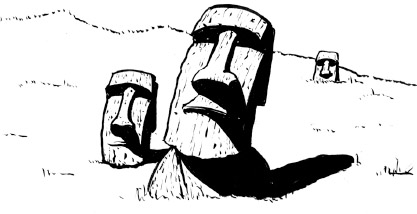
FIRST SETTLED BY Polynesian adventurers around 700 AD, the island known to its present population as Rapa Nui successfully evaded contact with Europeans until Easter Sunday, 1722, when Dutch explorer Jacob Roggeveen blundered onto its shores while trying to make his way to Australia. What he found there was both depressing and intriguing – barren and desolate, the island was host to about 2,000 malnourished people and hundreds of strange-looking stone statues that have puzzled and exercised archaeological minds ever since.
The total number of Mo’ai, as the statues are known, including those unfinished at the quarry or broken and abandoned in transport, exceeds 1,100. The overwhelming majority of these are uniform in their height and weight – about 4 metres and 14 tons respectively – but there are a few much larger ones measuring up to 12 metres and weighing over 80 tons. All were carved from the considerable deposits of volcanic tuff at the centre of the island, tuff being a relatively soft rock formed by volcanic ash. The stones were raised up to honour the ancestors of whichever family was doing the carving or paying the sculptors, who used axes and chisels made of basalt, a much harder and igneous volcanic rock. So, no mystery surrounding why they were carved nor indeed how – the main bone of contention among archaeologists concerns how they were transported to their various positions about the island.
There were, of course, various theories as to how these monolithic statues were moved from the central quarry to stand like sullen sentinels about the shoreline of this isolated and triangular island, which measures about 14 miles long by 7 miles wide. Until recently, most people believed the statues had been moved from the quarry on sledges running over wooden rollers – but not everyone was satisfied with this seemingly logical assertion. In 2000, Charles Love, an archaeologist and anthropologist from Wyoming, conducted an extensive survey of the network of roadways radiating out from that central quarry and, having cleared away the accumulated dirt and dust to get down to the original road beds, he discovered they were all U-shaped – a mirror image of the modern road with its convex camber. The results of Love’s survey punched a rather large hole in the sledge theory as rollers would have snapped through lack of central support from the countersunk road – indeed, if the intention was to use the sledge-and-roller method, then flat roads would have been laid. Love’s discovery added the final link to a chain of thought being forged elsewhere.
In 2011 two men took themselves off to Easter Island to, quite literally, road-test their theory. One was Carl Lipo, then Professor of Archaeology at the California State University, and the other was Terry Hunt, an archaeologist and anthropologist specializing in Pacific cultures. Both had been intrigued by the fact that the people of the island were united in their oral tradition that the statues had magically walked from the quarry to their site of installation; there were also several songs about ‘walking the Mo’ai’, which had a strong work-song rhythm like sea-shanties, themselves written to mark time and rhythm during rope hauling. The Rapa Nui language even includes the expression ‘neke-neke’, which means ‘walking without legs’; rather intriguingly, in the Maori language ‘neke’ denotes a snake. When an islander called Leonardo Haoa Pakomio had previously been asked by ethnologist and adventurer Thor Heyerdahl to demonstrate neke-neke, the old man stood up and, holding his arms to his side and every part of his body rigid, he rocked from side to side with his knees locked to inch forward like some kind of malevolent penguin. After resuming normal posture, Pakomio explained that this was what the expression meant – but who on earth, he asked, would want to move in such a manner?
Lipo and Hunt then turned their attention to those statues that had been broken and abandoned beside Love’s network of U-shaped roads. The vast majority of broken and discarded statues were found on sections of road with a slight gradient. Those discovered on slightly downhill sections were found lying face down, while those abandoned on uphill sections were uniformly discovered lying face up. This reinforced the Lipo–Hunt hypothesis that the statues were moved upright and were therefore at their most precarious on gradients. They also noticed striking dissimilarities between the statues in situ and those abandoned by the roadside, the latter presenting a decidedly more bulbous lower torso to such an extent that they were almost like a bowling pin in profile. It was further noted that the bases of all the abandoned statues were D-shaped – with the straight line of the D to the rear of the statue – and angled downwards towards the front. In short, they had a much lower centre of gravity than those in situ and were decidedly ‘wobbly’ on their feet, with the angle on the base inclining them to lean slightly forward when stood upright.
When their replica Mo’ai arrived in early 2012, Lipo and Hunt were ready to conduct their experiment. Dividing their eighteen-strong workforce into three teams, Lipo and Hunt tied one rope about their statue’s head and two others about its base so that two teams could twist the statue from side to side to make it ‘walk’ as the third team likewise rocked it to and fro on its base. After a few false starts and the repositioning of the ropes, they were off, successfully ‘walking’ their statue 100 metres along the concave rut in a swept section of road in forty minutes. Allowing for the proficiency of people experienced in such techniques, Lipo and Hunt reckoned that the islanders would have had no trouble in ‘walking’ one of their statues at least a kilometre a day. Once in position, the statue would have its base chipped level, its eyes completed and painted to bring it ‘alive’, and its torso slimmed to a more natural profile.
The Lipo–Hunt hypothesis drew praise from some sectors of archaeological academe and indignant howls from others – most notably those in the sledge-and-rollers lobby. It must be said that their hypothesis as to how the giant statues were moved is the only one to date that concurs with local oral tradition, and makes sense of the concave roads and the profile variance between those statues lying abandoned and those in situ. Besides, rollers made from the trunk of the palm tree, with its soft and spongy interior, would have ‘squidged’ and split under the weight, which brings us to the nature of the ecological disaster that overtook the island.
It was once thought that the islanders chopped down so many trees to make rollers for their statue obsession that they deforested their own habitat. But more diligent study of the island revealed that, when the first Polynesians stepped ashore, there would have been something like 20 million palm trees, which means that there would have been up to 20,000 trees available per statue. Not only is it unrealistic that they would have used so many trees per statue but, as mentioned previously, the spongy and pliable nature of the palm tree, which allows it to survive tropical storms, would hardly make for functional rollers on a concave road surface. With its population peaking at the 12,000 mark in the fifteenth century, the ecosystem of Easter Island was destroyed by factors other than the supposed use of palm trees for rollers: it was a concatenation of poor management of the available resources and the ravenous Polynesian rat. Factor in invading Europeans and South Americans with guns, disease and a hunger for slaves, and you have the perfect storm to reduce the population of Easter Island to 111 by 1877.
As a farming people with no use for palm trees, the Polynesian settlers opted for an aggressive slash-and-burn policy when it came to land clearance – they also munched their way through the entire population of land-and seabirds, which provided the guano so essential to the health and propagation of those trees that remained. And then there were the rats that were unwittingly brought to the island on rafts and other crafts. With their numbers unchecked by the presence of natural predators and encouraged by an abundant food source, as was the case on Easter Island, even a single pair of rats can produce a population of many millions within three years – and the rats’ preferred snack was the seeds of the palm tree. Between them, the humans and the rats wiped out all the trees to leave the island vulnerable to wind and rain erosion, and general degradation. In the times of hardship thus brought upon their own heads, the islanders then fell into civil war – or so the story goes.
THE SHUFFLE
Although they were the first to identify the specific mechanics required to make the statues ‘walk’, archaeologists Carl Lipo and Terry Hunt were not the first to realize that they might have been ‘shuffled’ along to move them into position. This was first proposed by the French anthropologist Jean-Michel Schwartz in his book The Mysteries of Easter Island (1975).
Schwartz’s suggestion inspired Pavel Pavel, a Czech engineer with an interest in how ancient cultures moved heavy weights, to make his own replica Mo’ai in 1982 and try to make it ‘walk’. In 1986, Thor Heyerdahl invited Pavel to accompany him to Easter Island and try out his ideas with real Mo’ais.
Most of their efforts involved rocking a Mo’ai from side to side using two small teams while a third team yanked rhythmically on a rope to drag the statue forward. While they did enjoy some limited success, they achieved nothing like the ease of movement later established by Lipo and Hunt with their method of twisting the base of the Mo’ai while it was rocked to and fro.
This aspect of the island’s history was first brought to European ears by the Norwegian explorer Thor Heyerdahl, best known for his 1947 Kon-Tiki expedition to the Polynesian islands. Allegedly there were two distinct groups or social classes on Easter Island – the Long-eared people thought themselves a cut above the Short-eared people, and kept them in a state of slavery from which they rebelled to slaughter their oppressors. But the Western perception of this legend is slightly skewed by the mistranslation of the designation Hanau Eepe, which, properly translated as the short and stocky people, was confused with the Rapa Nuian ‘epe’, meaning ear – so the fictitious battle was not between Long- and Short-eared peoples but between those who were short and fat and those who were tall and thin.
No one knows why, but the arrival of the first Dutch explorers in 1722 brought about an immediate cessation in statue production. Perhaps their positioning about the island’s shoreline was intended to ward off invaders and, as they had failed in this supposed duty, the statues forfeited the islanders’ respect; if the ancestors have abandoned us then why don’t we abandon them, they might have reasoned. Either way, across the next hundred years or so, with successive incursions onto the island by Dutch, Spanish and British expeditions – not to mention Peruvian slavers – all the statues fell in what the islanders call the Huri Mo’ai, or the casting down of the statues. Some islanders say this desecration was deliberate, others attribute it to ‘an angry shaking of the earth’, but, whichever it was, most of the statues have now been re-erected by the 5,000 islanders, supported by the tourist trade.