

SECOND ONLY TO the pyramids of Egypt, Stonehenge has been the subject of more conjecture than any other structure on the planet. Across the past few centuries several sub-cultures – most notably the Neo-Druids, the Wicca Movement and assorted pagans – have tried to appropriate the stone circle, claiming it to have been a temple or gathering point for their faith. There is no evidence, however, to suggest Stonehenge ever fulfilled such a function. As to why the circle provokes so much fascination, that is perhaps best summed up by the late British archaeologist Jacquetta Hawkes, wife of J. B. Priestley and the first woman ever to study her subject at Cambridge University. Seeing the site as a mirror onto which successive cultures have projected their fears or dreams, Hawkes once famously quipped that every age gets the Stonehenge it deserves. In the Middle Ages it was believed to have been built by giants labouring under the direction of Merlin; in the eighteenth and nineteenth centuries, which saw the rise of interest in the Druidic culture, it was a place of Druid worship and sacrifice; and, in the 1960s at the threshold of the computer age, it was perceived as a giant calculator.
That said, with evidence of other construction work in the immediate area dating back some 9,000 years, Stonehenge itself was not a single project but a collection of enterprises completed in four distinct phases spanning 1,500 years. There is considerable debate over the dating of these stages of construction, with some electing to divide phase 3 into multiple stages. But, to keep things simple, we are here opting for four stages with approximate dating.
Phase 1 commenced around 3000 BC with the laying out of the circular ditch and bank and the circle of fifty-six 1-metre-square pits dug into the chalk, possibly for tall wooden poles. These are today generally known as the Aubrey Holes after John Aubrey, the seventeenth-century antiquarian who first wrote of pits and depressions at Stonehenge. However, there is now significant doubt as to whether the pits so briefly mentioned by Aubrey were in fact the same ones as comprise this purpose-made circle of pits – 284 feet in diameter – which surround the later-installed stones. Phase 2 began c. 2500 BC with the importation of some eighty-odd so-called bluestones from the Preseli Mountains in south-west Wales, about 250 miles away. Weighing approximately 4 tons each, this importation of stones was itself no mean feat of logistics. With the intention of forming two concentric circles of standing monoliths, work seems to have ground to a halt leaving one of the circles incomplete. It was during this phase that a wider breach was cut in the circular bank to allow access to the inner site. Phase 3 saw the arrival of the massive standing stones and lintels brought in from quarries at Avebury in Wiltshire, about 25 miles to the north. It has been estimated that it would have taken about 500 men with log-rollers and skids to move each stone to the site, where they were arranged in a lintel-topped circle with five trilithons setting out an inner circle. Then during phase 4, c. 2300 BC, the incomplete circle of bluestones was rearranged into a horseshoe within the completed circle of its fellows before the site underwent further alterations. Stonehenge was then abandoned to its long and slow journey into decay and dilapidation.
It is important to bear the above in mind when assessing assertions as to the purpose of Stonehenge – it was a computer; it was a solar tracker; it was an astronomical observatory – because such postulations are put forward as if the monument’s construction was a single project overseen by a single culture following the dictates of a specific plan or agendum. Instead, this was a multi-stage project completed over hundreds of years, with those involved in each successive stage neither knowing nor careful of the purpose or intention of their predecessors. The initial and circular groundworks of the ditch and mound were carried out by the Windmill Hill People, an ancient culture of Salisbury Plain of whom little else is known; next came the Beaker People with the Wessex People, adding the finishing touches c. 1500 BC. Furthermore, what we see today at Stonehenge is not the pattern it presented in its original form as that is now lost for ever. Similar to the stone circle at nearby Avebury, where the larger stones for Stonehenge were sourced, many argue that what we see today at both sites is in fact a twentieth-century creation.
Neither Stonehenge nor Avebury came under the protection of the National Trust or English Heritage until the early twentieth century; before this, and most certainly in the case of Avebury, the stones were regarded either as irksome impediments to the ploughing of the land or as ‘freebie’ stones to be smashed into smaller pieces for other works. In 1934, the jam magnate Alexander Keiller used his considerable wealth to acquire the entire 950-acre site at Avebury, complete with the village, and set about what can best be described as a programme of destructive reconstruction to form what he thought the site must have looked like 5,000 years ago. Unfettered by the kind of budgetary restraints so often the bane of more formal archaeological projects, the flamboyant Keiller set about the reconstruction of his 1-mile circumference ‘Neolithic’ stone circle, with its two inner rings, in a manner that would whiten the hair of any modern archaeologist.
His labours were captured on footage shot across 1937–9 by Avebury resident Percy Lawes and transferred to video in the 1970s for posterity. The films show Keiller and his team demolishing dozens of homes and farm buildings to make way for the pattern he envisioned, with the wrong stones being set in concrete within existing pits that had to be dramatically reshaped to accept their new occupants while ‘new’ stones were installed into purpose-dug pits to complete the pattern that Keiller had in mind. It now transpires that Keiller’s vision was indeed impaired. A joint project conducted in 2017 by the universities of Leicester and Southampton, using the latest in ground-penetrating radar, has revealed that, originally, there was at the centre of the site a 30-metre square of stones laid out about the central monolith. Such deviation from the circular, according to Dr Mark Gillings, Academic Director of Archaeology at Leicester University, is unique in megalithic monuments.
As for Stonehenge, although the site is considerably smaller than that of Avebury, much the same ‘re-imaginings’ have likewise been imposed, albeit to a lesser degree. Any reader caring to conduct a quick internet search for John Constable’s 1835 depiction of the site will see the majority of the stones lying in a state of collapse and those still standing tilted to a precarious angle. It was clear that this was no artistic interpretation of the ravages of time, as borne out by early photographs of the site showing the stones in an even more advanced state of collapse. With the site attracting a broader domestic and international interest at the turn of the twentieth century, work began in 1901 to ‘tidy up’ the monument, a move unpopular in many quarters. The letters column of The Times abounded with protests at such ‘desecration’ but the restoration continued with additional phases imposed in 1919 and 1920, and again in 1958–9. The finishing touches were finally made in 1964, by which time ‘new’ lintel stones had been added and, according to Christopher Chippindale, Senior Curator at the Cambridge University Museum of Archaeology and Anthropology, virtually all the other stones moved or repositioned in some way before being set in concrete.
LOT 15
Stonehenge belonged to the Priory of Amesbury until 1536 when Henry VIII confiscated all monastic properties and granted ownership of the Amesbury estates to the Earl of Hereford, after whom the lands, along with the derelict monument, passed through the hands of several titled families, including that of the Marquis of Queensberry.
In 1824 the monument and the surrounding 30 acres of land were bought by the Antrobus family of Cheshire who built several cottages and even a café (later demolished) close to the stones. When the last of the Antrobus line was killed in the First World War, the whole parcel of land was put up for auction in September 1915.
Presented for sale as ‘Lot 15’, it was bought for £6,000 by Sir Cecil Chubb, who had been sent to the sale room by his wife, her heart set on a dining table and chair set that had been advertised. Apparently Lady Chubb was less than impressed by his acquisition, and Sir Cecil donated the land to the nation in 1918.
Thus we have a twentieth-century imagining of what the monument might have looked like thousands of years ago. At the turn of the present century, David Batchelor, Senior Archaeologist at English Heritage, acknowledged that in the 1960s a decision had been taken not to detail the renovations and restorative work in the guide books but that this error of omission would now be addressed. This aggressive restoration and repositioning of stones also calls into question the various claims of certain stones’ celestial and solar alignments as the original layout may have been different. So, that just leaves a final question – did Stonehenge ever have a roof?
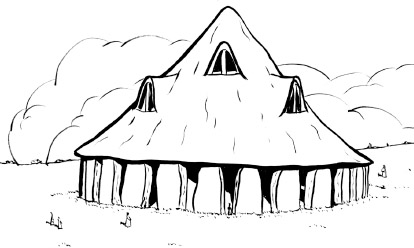
Just as changes in fashion keep the tills ringing in clothes shops, new theories are the lifeblood of academic archaeology. The most recent speculation surrounding Stonehenge proposes that it was not always just a circle of stones but spent time as an actual building. To paraphrase Sarah Ewbank, a prominent landscape architect with a long-term interest in the site, why go to all that effort to erect a simple circle of stones so you can put on your best goatskins to dance round it at the summer and winter solstices when you can put a roof on it and use the building all the year round? And she is not alone in such speculation. In the late 1990s, Dr Timothy Darvill, Professor of Archaeology at Bournemouth University and an acknowledged authority on Stonehenge, gave tentative support to the notion, but he has since distanced himself from the roof theory. Yet Dr Julian Spalding, in his time the director of some of the UK’s leading museums, favours the suggestion that the outer circle of stones at one time acted as supports for some sort of super-structure, while Dr Aubrey Burl, previously Principal Lecturer in Archaeology at Hull College and himself an acknowledged expert on Neolithic monuments, has cautiously opined that the roof theory is not without its merits and possibilities.
Supporters of the roof theory point out that the lintels of the outer circle were locked onto the top of the upright stones with double mortise-and-tenon joints, as if they were intended to absorb the kind of lateral stress that would have been exerted by vaulted timber work supporting a thatched roof. Had this not been the case then the weight of the stones themselves would have been sufficient to keep them in position, so such jointing only makes sense if super-structural additions were anticipated. It has also been suggested that the timber posts set into the aforementioned Aubrey Holes might have supported some kind of external veranda encircling the finished structure. But, for the time being at least, the roof theory is destined to languish in the realm of speculation as any such thatching and timber supports would long since have rotted away.