

IT IS SAID, and perhaps rightly so, that only the British can turn a military fiasco into an event of national pride, and none more so than with the abortive Charge of the Light Brigade of 25 October 1854 during the Crimean War, which saw the combined forces of Turkey, France and Britain pitted against the might of the Russian Empire. But why did a single brigade of British cavalry embark upon a head-on attack against a full array of Russian artillery that was itself defended by several brigades of Cossack cavalry? The British chose to remember the event as an example of the stiff upper lip of unquestioning obedience of the nineteenth-century military – ‘theirs not to reason why – theirs but to do and die’, to quote the poetic celebration of the event by Alfred, Lord Tennyson. It was in reality one blunder too far, which called into question the entire command structure of the British Army. In the main, the fiasco was occasioned by a long-standing feud between two brothers-in-law and the abject horror with which the military elite viewed the rise of the professional soldier.
During the Battle of Balaklava, the Russians overran three Turkish emplacements on the Causeway Heights. Watching from his command post, Lord Raglan, the man in overall charge of the British forces on the peninsula, thought the Russians were making ready to haul away the captured artillery so he hurriedly dictated an order to his quarter-master general, General Richard Airey, who just happened to be standing nearby. This still-extant scrap of paper read, ‘Lord Raglan wishes the cavalry to advance rapidly to the front, follow the enemy, and try to prevent the enemy carrying away the guns. Troop Horse Artillery may accompany. French cavalry is on your left. R Airey. Immediate’. The note was handed to Airey’s aide, Captain Nolan, with the verbal overrider, ‘Tell Lord Lucan that the cavalry are to attack immediately.’ So, off galloped Nolan with the highly ambiguous order. In the 1968 cinematic portrayal of the event, with Sir John Gielgud taking the part of Raglan, his character watches Nolan leaving with the observation that he distrusted Nolan as ‘he knows his job too well. It will be a sad day, Airey, when England has her armies officered by men who know too well what they are doing. It smacks of murder.’ Although claimed by the producers to be a direct quote, such attribution to Raglan cannot be found. But even if these words were a dramatic flourish in the film script, they neatly encapsulate the attitude of the aristocratic military elite to the rise of men like Nolan, who actually knew what they were about on the battlefield.
Born in Canada, Nolan was a lowly colonial who had also seen service in India in postings not held in high regard by most high-ranking officers. Much to their annoyance, he also took a professional approach to the business of soldiery and war. He cared for the wellbeing of the horses and the men, and had written much on matters of strategy and the need to unclutter the prevailing military uniforms, the dangling attachments of which presented serious problems to those forced to wear them while riding, fighting or moving through shrub or forested terrain. He also openly condemned the purchase system whereby anyone with the money could buy both rank and the command of a regiment. While those in the corridors of power saw this as a way of ensuring that control of the army remained in the hands of the upper classes, it also meant that thousands of regular soldiers died needlessly due to the ignorance of many high-ranking officers with no warfare experience and little common sense. Lord Cardigan, who had bought the colonelcy of the 11th Hussars for £40,000 before spending another fortune to make them the most ‘fashionable’ unit in the army, took personal exception to Nolan’s opinions on such matters.
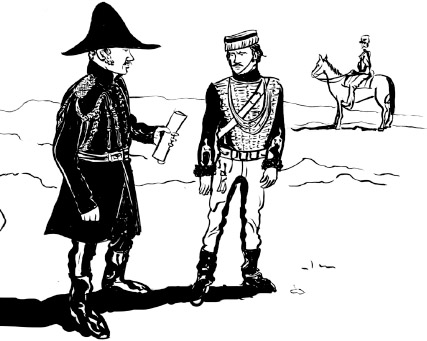
When Nolan delivered Raglan’s order to Lucan, who was in overall sub-command of the cavalry units, the Causeway Heights were obscured from his view by the local geography, causing him to complain that he could see neither enemy nor guns. Nolan was in an equally hostile mood and, careless of where he was pointing, gestured not in the direction of the Causeway Heights but straight down the North Valley to the massed Russian artillery over a mile away. ‘There, my Lord, is your enemy and there are your guns.’ And that was that. Lucan rode over to hand on the order to his detested brother-in-law, Lord Cardigan, at the head of the Light Brigade and it is fair to say that, had he and Lucan not been at such loggerheads, a dialogue would have ensued to question the sanity of such orders before demanding clarification. As it was, they just stood snarling at each other with Lucan barely able to disguise his glee at the prospect of his arch-enemy about to be flung into the jaws of hell ready to devour him at the head of the North Valley. Although he was meant to lead his Heavy Brigade in support of Cardigan, Lucan had no intention of enjoining such folly; he simply led his brigade to the mouth of the North Valley and watched the Light Brigade disappear into the cloud of their own dust.
As the Light Brigade moved off in the wrong direction, Nolan, noting the misinterpretation of the order, rode after them, calling for them to turn left, but he was almost immediately killed by shrapnel from a shell-burst to leave the Light Brigade to its fate. The Russians simply couldn’t believe their eyes; a 670-strong division of light cavalry heading straight for them; surely they would wheel away at any moment to attack elsewhere; but they just kept coming. Despite withering fire from three sides, the brigade made it to the guns with Cardigan, in the lead, jumping over the Russian artillery to find himself staring at Prince Mikhail Radziwill, an officer in the Russian army with whom Cardigan had been on friendly terms in the social circuits of London before the war. The two men exchanged a smart salute before Cardigan jumped back over the guns to ride for home, passing on his way the last of the stragglers still making for the Russian line. A fine illustration of the thinking and attitude of Cardigan and others of his ilk is provided by his later explanation that, having led the men to their objective, he considered his duty done and saw no need to tarry and ‘fight the enemy amongst private soldiers’. Having nothing better to do, he repaired to his yacht in Balaklava harbour to enjoy a champagne dinner.
Those members of the Light Brigade who managed to break through the line of Russian guns to be taken prisoner were held in awe by the Russians, who kept asking if they were all roaring drunk. When assured this was not the case, they were hailed as heroes and given all the vodka they could handle. As to the overall casualty list, this was miraculously low given the circumstances. Only 110 were killed, 161 wounded and another 60 taken prisoner, with the most cogent comment on the fiasco coming from the observing French General Bosquet who, as the Light Brigade rode to the guns, opined: ‘C’est magnifique mais ce n’est pas la guerre. C’est de la follie’ (It’s magnificent but it’s not war. It’s madness). But now it was time for the cover-up to begin.
THE VICTORIA CROSS
The debacle that was the Charge of the Light Brigade resolved the Queen to institute the Victoria Cross as the first high-level award open to all ranks. The medal should only be struck from Russian guns captured in the Crimea (still the understanding of most when it comes to the VC medal). Unfortunately, this specificity failed to make it through to Woolwich Arsenal where, keen to be rid of a couple of broken Chinese guns, they hacked off the rear ends of these and sent the chunks of metal to Hancocks of London, the jewellers commissioned to strike the medals.
The first Crimean veterans to receive their medals lined up in Hyde Park on 26 June 1857 where, against all advice, Victoria dished out the gongs from horseback. Coming to the first of the sixty-two recipients, Lt Henry James Raby, she slipped in her side-saddle when leaning down and pinned the poor chap straight through the nipple with his VC. With the same fortitude that had placed him before the Queen that day, Raby reportedly neither flinched nor uttered a sound.
Observing the folly unfold from his vantage point, Raglan was quick to realize that someone’s head was going to roll and, determined it would not be his, he and Airey dispatched another galloper to retrieve the ridiculously worded order from Lord Lucan. Sir George Paget, commander of the 4th Light Dragoons, which had the misfortune to form one quarter of the Light Brigade, observed at the time that even had they attacked the Causeway Heights, as Raglan intended, their charge would still have ended in disaster – so why, he demanded to know, had such an incoherent and stupid order been given in the first place?
Unfortunately for Raglan and Airey, Lucan had also realized the potential significance of that scrap of paper, which he had given to his civilian interpreter, John Elijah Blunt, with instruction to keep it safe. Consequently, Raglan and Airey only ever saw the return of copies of their order despite their repeated demands for the return of the original. This gambit, however, sealed Lucan’s fate. Blamed by Raglan for failing to clarify the order to Cardigan, he was returned to England in disgrace. In his absence, Nolan was blamed (with some justification) for his failure to clarify the order on delivery to Lucan. Raglan refused to be drawn on the subject while, feeling unfairly pilloried (again with some justification), Lucan demanded to be court-marshalled so he could give his account and present the original order. With Raglan such an important figure in the Establishment, his repeated requests were denied.
As The Times thundered that someone had blundered, the Establishment connived to envelop the event in the cloak of unquestioning heroism and, after Poet Laureate Alfred, Lord Tennyson published his rather mawkish ‘The Charge of the Light Brigade’ in December 1854, this was pretty much the way the British public chose to regard the folly. The use of war literature to glorify the inglorious tends to obscure the realities of the events they portray and, while weeping over music-hall recitations of Tennyson’s ditty, the great British public studiously ignored the incredible hardship and poverty endured by the Crimean veterans in their very midst. So much so that in 1890 Rudyard Kipling felt it necessary to publish ‘The Last of the Light Brigade’, highlighting the bravery of the troops in the Crimea and the poverty of the survivors, to successfully goad the collective conscience into belated action.