

ROBIN HOOD IS without doubt one of the most iconic figures of British popular culture, but the man at the heart of the legend (if, indeed, there is one and we are not looking at some composite figure or one of pure fiction) is impossible to nail down. The popular image of Robin has him as a loyal contemporary of King Richard I (reigned 1189–99), who, so keen to meet such a loyal if raffish subject, disguised himself as a merchant and rode through Sherwood as ‘bait’ to draw Robin out. But as the French-bred Richard couldn’t speak a word of English and only spent a scant five months in England throughout his entire reign, a meeting of any kind would have been unlikely. Besides, the very first mention of Robin Hood the outlaw arises in Piers Plowman, an allegorical narrative penned by William Langland in the late 1370s, and the bulk of the Robin Hood ballads, first committed to parchment in the 1450s, mention a king called ‘Edward’ but give no indication as to his regnal number.
In keeping with the general public’s deep-seated admiration for criminals of a certain type – Jessie James, Billy the Kid, Dick Turpin – people like to perceive Robin as the man who only robbed the rich in order to give the proceeds to the poor. But those original ballads in their entirety include only a single reference to an isolated incident of such charitable beneficence, which seems to stand as the lone foundation for the notion that this was Robin’s standard MO. In fact, according to those ballads, neither Robin Hood nor Little John and the rest of the so-called Merry Men were the kind of people anyone would relish meeting on a dark night. ‘Merry Men’ is a corruption of the original Merrie Mein or Meinie with the first word then meaning fitting to the purpose – be that noble or unworthy – and the second denoting an entourage.
In ‘Robin Hood and the Monk’, first published in 1450 but known to have enjoyed oral popularity before that, Robin is recognized by one of his clerical victims when he ventures into Nottingham; the hue and cry raised by that monk results in Robin being trapped and arrested by the Sheriff’s men. When they learn of this, Little John and Much the Miller’s Son waylay the quisling monk and hack him to death before also killing a child who had witnessed their actions. As for Robin himself, on many occasions he is noted in early references to have mutilated his victims and captives by cutting off their noses and/or their ears, and, on one occasion, when he waylaid a party including a conjurer-juggler, the man annoyed him so much that he nailed him to a tree by his hands and left him to die.
People were then so much more at ease with the death of their heroes and, when it came time for Robin to quit the stage, these original ballads, including ‘A Gest of Robyn Hode’, have him journey in diminished health to seek sanctuary with a prioress, who unfortunately gives him a slow poison to accelerate his death. Keeping him company to the end, Little John opens the window so that Robin can fire an arrow and, with his dying breath, he implores John to bury him wherever it falls. In the play The Downfall of Robert Earl of Huntingdon, the prioress is from Kirklees, and there is indeed a dedicated grave in the grounds of Kirklees Priory, which lies in West Yorkshire, not Nottinghamshire.
So, the original Robin Hood was a man of his medieval times, with the accounts of his adventures written for an audience of equal brutality who listened to such accounts of his bloody deeds with amused admiration. Unsuited to the more delicate tastes of later centuries, all such references to Robin were swept under the carpet to remain equally obscure today. It is, in fact, the Robin of the sixteenth and seventeenth centuries who evolved into the Robin of modern cinema.
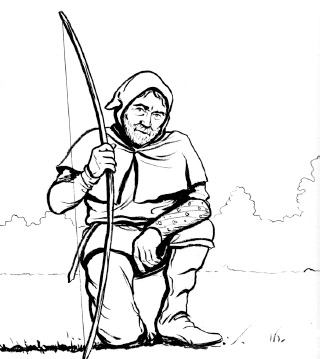
The elevation of Robin from the ranks of the peasantry or the yeomanry is first noted in Chronicles at Large (1569) by Richard Grafton, King’s Printer under Henry VIII, the same source that first refers to Edward of Woodstock as the Black Prince but neglects to explain why. Grafton presents his Robin as an impoverished Earl who, having forfeited his estates and fortune through trumped-up charges of treason, is forced to go feral and live rough as a bandit. This new and more complex Robin of Grafton’s Chronicles was further developed in the plays of Anthony Munday, who presented him as Robert, Earl of Huntingdon, who fell for the fair Maid Matilda in The Downfall of Robert Earl of Huntingdon (1598). Not only is this the first nod to any romance in the life of Robin but Matilda changes her name when she joins the outlaws to become Maid Marian in the second half of the drama. This play is thus the sole authority for the notion of a love triangle involving Robin, Marian and the evil Prince John, whose determination to wed the maid and acquire her birthright has become pivotal to so many modern depictions. So, it seems that in fact Robin was an ephemeral character, forced to morph with the changing mores. But could there have been a real man at the core of these legends?
Throughout the burgeoning tourist industry of the Victorian era, Yorkshire was apparently unconcerned by Nottingham making large the connection between Robin Hood and Sherwood Forest. Yorkshire had the Dales and the significant attraction of the spas of Harrogate to keep its tills ringing. Only in more recent times, with over 500,000 people a year visiting Nottingham to tour Sherwood, did Yorkshire start the battle to reclaim its native son. And, if there was a real person at the core of the legend, then there is much to suggest he came from that northern county.
Just five miles to the south of Whitby lies the picturesque fishing village of Robin Hood’s Bay, known as such since the early fourteenth century. In 1324 Louis I, Count of Flanders, sent the first of many letters of complaint to Edward III, protesting the acts of piracy routinely visited upon Flemish fishing vessels, which were taken by force to be deprived of their catch by the village residents. The earliest reference to anyone called Robin Hood appears in the records of the legal proceedings of the York Assizes, dated 1225, which detail the confiscation of property to the value of 32 shillings and 6 pence from a person variously referred to as Robin Hood or Hod, to recover debts owed to the estates of the church of St Peter, prior to his being banished as an outlaw.
According to David Baldwin, Fellow of the Royal Historical Society and the specialist in medieval history who predicted that Richard III lay buried under the Greyfriars car park in Leicester nearly thirty years before this proved correct, the more likely son of York at the core of the legend would have been Roger Godberd, an outlaw known to have been active in Sherwood in the late 1260s. With the Great North Way that connected London and York running straight through Sherwood Forest – which was not endless woodland but open rough country (‘forest’ in such times denoted a royal hunting ground) – this well-travelled route was a magnet for the likes of Godberd. As in the legend of Robin Hood, he led a gang of thugs who variously robbed and murdered travellers and churchmen in Sherwood, poached the king’s deer and was once captured by the Sheriff of Nottingham, only to later escape. Many of the early ballads state that Robin Hood was driven into outlawry after his support for the abortive rebellion of 1263 led against Henry III by Simon de Montfort – and Godberd is known to have been such a supporter before having to take to the hills himself. The legendary Robin is closely associated with Loxley in South Yorkshire – he is even referred to as Robin of Loxley – and Godberd is buried in Loxley, Warwickshire, which could be a further confused connection.
LINCOLN GREEN
Although it seems to make sense for forest-dwelling bandits to wear green clothing, and over the centuries there have been numerous references to ‘Robin’ wearing outfits cut from a cloth known as Lincoln Green, this is in fact a misunderstanding based on some very confusing terminology. Although the city of Lincoln did become famous for a green cloth, there is no reference to this Lincoln Green before 1510, which is a bit late for Robin to have been wearing it.
The cloth for which Lincoln was famous in Robin’s time was a bright red weave called Lincoln Greyne, sometimes Grene, a name built on the fact that ‘grenes’, or grains, of red kermine dye – later called carmine – were used to achieve this well-fixed scarlet hue, which made the cloth both expensive and desirable.
Old references to Robin wearing Lincoln Grene or Lincoln Greyne were misunderstood by later readers who, by then aware of the popularity of the early sixteenth-century Lincoln Green, presumed ‘grene’ or ‘greyne’ to be archaic forms of ‘green’.
Given Baldwin’s predictive record when it comes to medieval characters and their fates, the smart money has to be on Godberd but, with Yorkshire considering its next move, the Nottingham/Sherwood bandwagon rolls on regardless.